sarva-bhūta-stham—situated in all beings; ātmānam—the Supersoul; sarva—all; bhūtāni—entities; ca—also; ātmani—in the Self; īkṣate—does see; yoga-yukta-ātmā—one who is dovetailed in Kṛṣṇa consciousness; sarvatra—everywhere; sama-darśanaḥ—seeing equally.
TRANSLATION A true yogī observes Me in all beings, and also sees every being in Me. Indeed, the self-realized man sees Me everywhere.
PURPORT
A Kṛṣṇa conscious yogī is the perfect seer because he sees Kṛṣṇa, the Supreme, situated in everyone’s heart as Supersoul (Paramātmā).
Īśvaraḥ sarva-bhūtānāṁ hṛd-deśe ’rjuna tiṣṭhati.
The Supreme Lord is situated in everyone’s heart, O Arjuna, and is directing the wanderings of all living entities.
This is a nice Study Guide on the Bhagavad-gita As It Is. It begins with the Introduction to the Bhagavad-gita, some notes on the Original Edition, the significance of the Bhagavad-gita, a philosophical synopsis, chapter by chapter summary, Q & A, and a suguested teaching syllabus. All in all ,a very nice presentation prepared by disciples and followers of His Divine Grace A. C. Bhaktivedanta Swami Prabhupada.
We are offing it here as a free pdf download that you can view, save or print, by clicking on the following link:
Happy New Year to all are readers. Wishing you all a prosperous new year filled with happiness and love. And may your Krishna Consciousness increase with each passing day.
When I think of New Years, I am reminded of what a short time a year is in the greater scheme of eternity. In the Bhagavad-gita there is a brief description of the duration of time in the material universe.
…The duration of the material universe is limited. It is manifested in cycles of kalpas. A kalpa is a day of Brahmā, and one day of Brahmā consists of a thousand cycles of four yugas or ages: Satya, Tretā, Dvāpara, and Kali. The cycle of Satya is characterized by virtue, wisdom and religion, there being practically no ignorance and vice, and the yuga lasts 1,728,000 years. In the Tretā-yuga vice is introduced, and this yuga lasts 1,296,000 years. In the Dvāpara-yuga there is an even greater decline in virtue and religion, vice increasing, and this yuga lasts 864,000 years. And finally in Kali-yuga (the yuga we have now been experiencing over the past 5,000 years) there is an abundance of strife, ignorance, irreligion and vice, true virtue being practically nonexistent, and this yuga lasts 432,000 years. (from purport Bg 8.17)
Even if I could grasp the extent of time in the material universe, that is just a fraction of the unlimited eternal time that continues after the termination of the yuga.
…Then the process is set rolling again. These four yugas, rotating a thousand times, comprise one day of Brahmā, the creator god, and the same number comprise one night. Brahmā lives one hundred of such “years” and then dies. These “hundred years” by earth calculations total to 311 trillion and 40 million earth years. By these calculations the life of Brahmā seems fantastic and interminable, but from the viewpoint of eternity it is as brief as a lightning flash. In the causal ocean there are innumerable Brahmās rising and disappearing like bubbles in the Atlantic. Brahmā and his creation are all part of the material universe, and therefore they are in constant flux. (from purport Bg 8.17)
The above calculations Srila Prabhupada uses and I quote;
…seems fantastic and interminable, but from the viewpoint of eternity it is as brief as a lightning flash.
Earliest Recording of Srila Prabhupada in the Bhaktivedanta Archives
Its interesting to note that this lecture also became the Introduction to Bhagavad-gita As It Is
Prabhupāda:
om ajnana-timirandhasya jnananjana-salakaya caksur unmilitam yena tasmai sri-gurave namah
sri-caitanya-mano-‘bhistam sthapitum yena bhtu-tale svayam rupah kada mahyam dadati sva-padantikam
vande ‘ham sri-guroh sri-yuta-pada-kamalam sri-gurun vaisnavams’ ca sri-rupam sagrajatam saha-gana-raghunathanvitam tam sa jivam sadvaitam savadhutam parijana-sahitam krsna-caitanya-devam sri-radha-krsna-padan saha-gana-lalita-sri-visakhanvitams’ ca
he krsna karuna-sindho dina-bandho jagat-pate gopesa gopika kanta radha-kanta namo ‘stu te
Hare Krishna, Hare Krishna Krishna Krishna, Hare Hare Hare Rama, Hare Rama Rama Rama, Hare Hare
Bhagavad-gītā is known also Gītopaniṣad, the essence of Vedic knowledge, and one of the most important of the various Upaniṣads in Vedic literature. This Bhagavad-gītā, there are many commentations in English, and what is the necessity of another English commentation of the Bhagavad-gītā can be explained in the following way. One . . .
(break) One American lady, Mrs. Charlotte Leblanc, asked me to recommend an English edition of Bhagavad-gītā which she can read.
Of course, in America there are so many editions of English Bhagavad-gītā, but so far I have seen them, not only in America but also India, none of them can be said strictly as authoritative, because almost every one of them have expressed their own opinion through the commentation of the Bhagavad-gītā without touching the spirit of Bhagavad-gītā As It Is.
The spirit of Bhagavad-gītā is mentioned in the Bhagavad-gītā itself. It is just like this—if we want to take a particular medicine, then we have to follow the particular direction mentioned on the label of the medicine. We cannot take the particular medicine according to our own direction or by the direction of a friend, but we have to take the medicine under the direction given on the label of the bottle and as directed by the physician. Similarly, the Bhagavad-gītā also should be taken or accepted as it is directed by the speaker Himself.
Some years ago I put the complete Original 1972 Bhagavad-gita “As It Is” by His Divine Grace A. C. Bhaktivedanta Swami online. You can click on link prabhupada.gita to visit. I find it is a quick and easy site for reference to all your favorite chapters and slokas.
This morning I was reminded of something that I heard Srila Prabhupada say in a lecture. He was describing that Krishna Consciousness is very simple, you just need to do four things. Always think of Krishna, become His devotee, offer obeisances, and worship Him.
Engage your mind always in thinking of Me, offer obeisances and worship Me. Being completely absorbed in Me, surely you will come to Me. (Bhagavad-gita 9.34)
This verse is also repeated in the 16th Chapter:
man-manā bhava mad-bhakto mad-yājī māṁ namaskuru mām evaiṣyasi satyaṁ te pratijāne priyo ’si me
Always think of Me and become My devotee. Worship Me and offer your homage unto Me. Thus you will come to Me without fail. I promise you this because you are My very dear friend.
In this verse it is clearly indicated that Kṛṣṇa consciousness is the only means of being delivered from the clutches of this contaminated material world…Pure devotional service is the highest achievement of human society. (from purport)
This morning I was thinking about the different relationships one can have with the Lord. In “The Nectar of Devotion”, Srila Prabhupada describes the five primary kinds of devotional service-namely, neutrality, servitude, fraternity, parenthood and conjugal love.Over the course of the next five posts, I want to explore these five primary relationships.
But for today, I want to start with this nice verse from the Bhagavad-gita, where these five types of relationships are mentioned in purport.
For one who remembers Me without deviation, I am easy to obtain, O son of Pṛthā, because of his constant engagement in devotional service. (Bg 8.14)
…Bhakti-yoga is very simple and pure and easy to perform. One can begin by simply chanting Hare Kṛṣṇa. Kṛṣṇa is very merciful to those who engage in His service, and He helps in various ways that devotee who is fully surrendered to Him so he can understand Him as He is. The Lord gives such a devotee sufficient intelligence so that ultimately the devotee can attain Him in His spiritual kingdom.
…Generally, the bhakti-yogīs are engaged in five different ways: 1) śānta-bhakta, engaged in devotional service in neutrality; 2) dāsya-bhakta, engaged in devotional service as servant; 3) sākhya-bhakta, engaged as friend; 4) vātsalya-bhakta, engaged as parent; and 5) mādhurya-bhakta, engaged as conjugal lover of the Supreme Lord. (from purport)
I am sure that many of you have your favorite Bhagavad-gita slokas, and I was thinking about it this morning. I was trying to recall my top 8 slokas, (which is hard to select only 8). But I have listed them below, in no particular order.
For the list the 108 most important Bhagavad-gita slokas click on following link:1972 Bhagavad-gita
patraṁ puṣpaṁ phalaṁ toyaṁ yo me bhaktyā prayacchati tad ahaṁ bhakty-upahṛtam aśnāmi prayatātmanaḥ
If one offers Me with love and devotion a leaf, a flower, fruit or water, I will accept it.
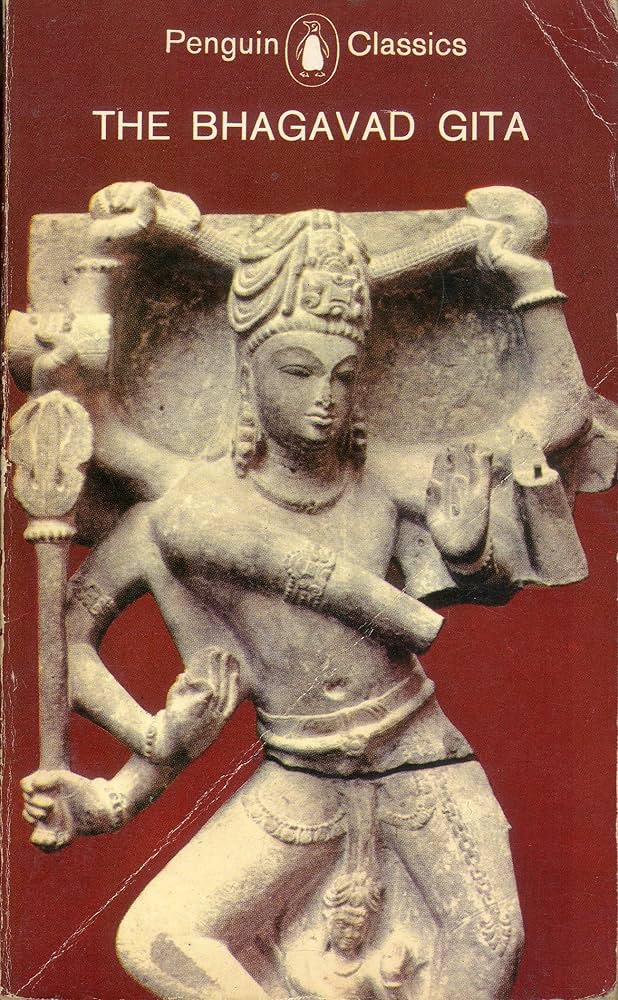
I remember back in my younger years, before I became a devotee, I decided to spend my summer off from college, hiking the Appalachian trail. I took with me some small books with me to read along the way. I was becoming interested in Eastern philosophy, and was asking myself questions like who is God, who am I, and what is my relationship with Him. I carried with me a small paperback book by Hermann Hesse entitled Siddhartha, a book by Henry David Thoreau; “Walden”, and the Penguin Classic; “The Bhagavad-gita.
From the book “Siddhartha” I became interested in meditation and the journey to self discovery. From “Walden”, I became interested is self- sufficiency, or as I later describe it as simple living and high thinking, and from the Bhagavad-gita, I discovered who God is. Really. For some reason, as soon as I began reading, I immediately accepted that Krishna was God. This book was the song of God. This was God speaking to His friend Arjuna, instructing him. And I thought how wonderful to be a friend of God, to become Gods friend.
Even though I was raised as a Christian, went to church on Sunday, was taught by nuns and priests, I never got satisfactory answers to my question, Who is God? But this book the Bhagavad-gita, This was God Himself speaking to his friend. Now I knew, there is a God, and His name was Krishna.
About a year later I meet a Hare Krishna devotee at the Chicago O’Hare airport, and I got from him the Krsna Book, then later I went back there and found a deserted copy of the Bhagavad-gita As It Is, on a neglected bench seat, by His Divine Grace A. C. Bhaktivedanta Swami. It wasn’t just the translations that the penguin classic offered, but it was the complete edition, with original Sanskrit text, Roman transliterations, English equivalents, translation and elaborate purports.
This is an old photo taken in 1907 that my wife found on Facebook. I remember as a kid, thinking that’s what yogis do. Sit on a bed of nails, or levitate off the ground while meditating.
Before Srila Prabhupada came to the West, bringing with him the Vedic Philosophy, not many people had any idea of what was Yoga or Meditation. Or that there were different types of Yoga and Meditation.
We share with you an excerpt from the small paperback book by His Divine Grace A. C. Bhaktivedanta Swmai Prabhupada entitled ” The Perfection of Yoga ”
The yogī obviously has to go through a great deal of difficulty to purify the ātmā (mind, body and soul), but it is a fact that this can be done most effectively in this age simply by the chanting of Hare Kṛṣṇa, Hare Kṛṣṇa, Kṛṣṇa Kṛṣṇa, Hare Hare/ Hare Rāma, Hare Rāma, Rāma Rāma, Hare Hare. Why is this? Because this transcendental sound vibration is non-different from Kṛṣṇa. When we chant His name with devotion, then Kṛṣṇa is with us, and when Kṛṣṇa is with us, then what is the possibility of remaining impure? Consequently, one absorbed in Kṛṣṇa consciousness, in chanting the names of Kṛṣṇa and serving Him always, receives the benefit of the highest form of yoga. The advantage is that he doesn’t have to take all the trouble of the meditational process. That is the beauty of Kṛṣṇa consciousness.
Recently a fellow Vaisnava (Kamsahanta Prabhu) passed away, or as we like to say, left his body, and we were left to settle his affairs. First there was the death certificate, and registering his death. Then there was the funeral home where arrangements were made for his cremation. Then there was the big job of distributing all his possessions. We gave his clothes to a nearby charity, food stuffs to the local church, There was tons of religious paraphernalia, dieties, pictures, books, (which were left with other devotees) and vehicles. It took weeks. And it really got me thinking… about my own mortality.
Kamshanta Prabhu was very fortunate in many ways, for in his adult life he preformed so much devotional service, distributed so many of Srila Prabhupada’s books, and collected so much laxmi to help advance this movement. He was also fortunate that his son Namacharya, was there to assist him at his hour of passing. Nam put his fathers japa beads in his hand, helped him chant in his final hours, and made arrangements to have his fathers body be cremated with his tulasi beads around his neck and his japa beads in his hand.
But this is what got me thinking…after a whole lifetime, Kamshanta Prabhu was left with only his neck and japa beads, and most importantly the holy name on his lips and in his ears. And I was reminded of the verse from the Bhagavad-gita 8.5:
“And whoever, at the time of death, quits his body, remembering Me alone, at once attains My nature, of this there is no doubt”
There has been so much misinformation lately, on the news networks, on social media, in politics, etc. about election results, relief funds for hurricane victims, eating pets in Springfield Ohio, etc., that it got me thinking about truthfulness. The English definition is simply: the quality of being honest and not containing or telling any lies. However according to the Vedic definition which goes a little deeper: Satyam, truthfulness, means that facts should be presented as they are for the benefit of others.
Satyam, truthfulness, means that facts should be presented as they are for the benefit of others. Facts should not be misrepresented. According to social conventions, it is said that one can speak the truth only when it is palatable to others. But that is not truthfulness. The truth should be spoken in a straight and forward way, so that others will understand actually what the facts are. If a man is a thief and if people are warned that he is a thief, that is truth. Although sometimes the truth is unpalatable, one should not refrain from speaking it. Truthfulness demands that the facts be presented as they are for the benefit of others. That is the definition of truth. (from purport Bhagavada-gita 10. 4-5)
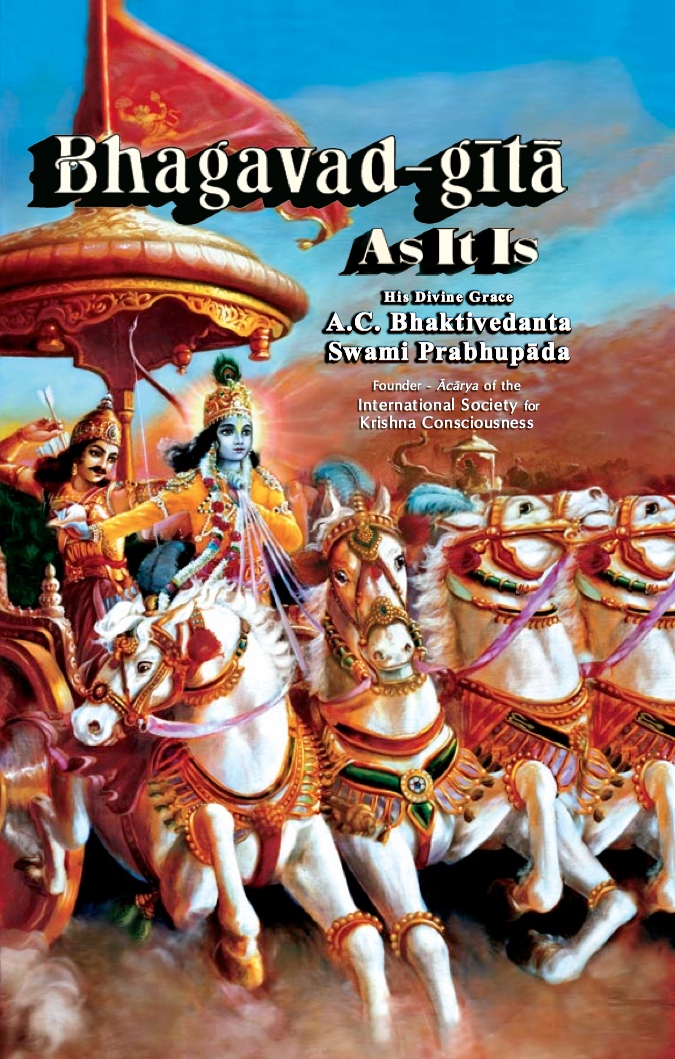
Bhagavad-gītā As It Is by His Divine Grace A. C. Bhaktivedanta Swami Prabhupada
PICTURE INDEX
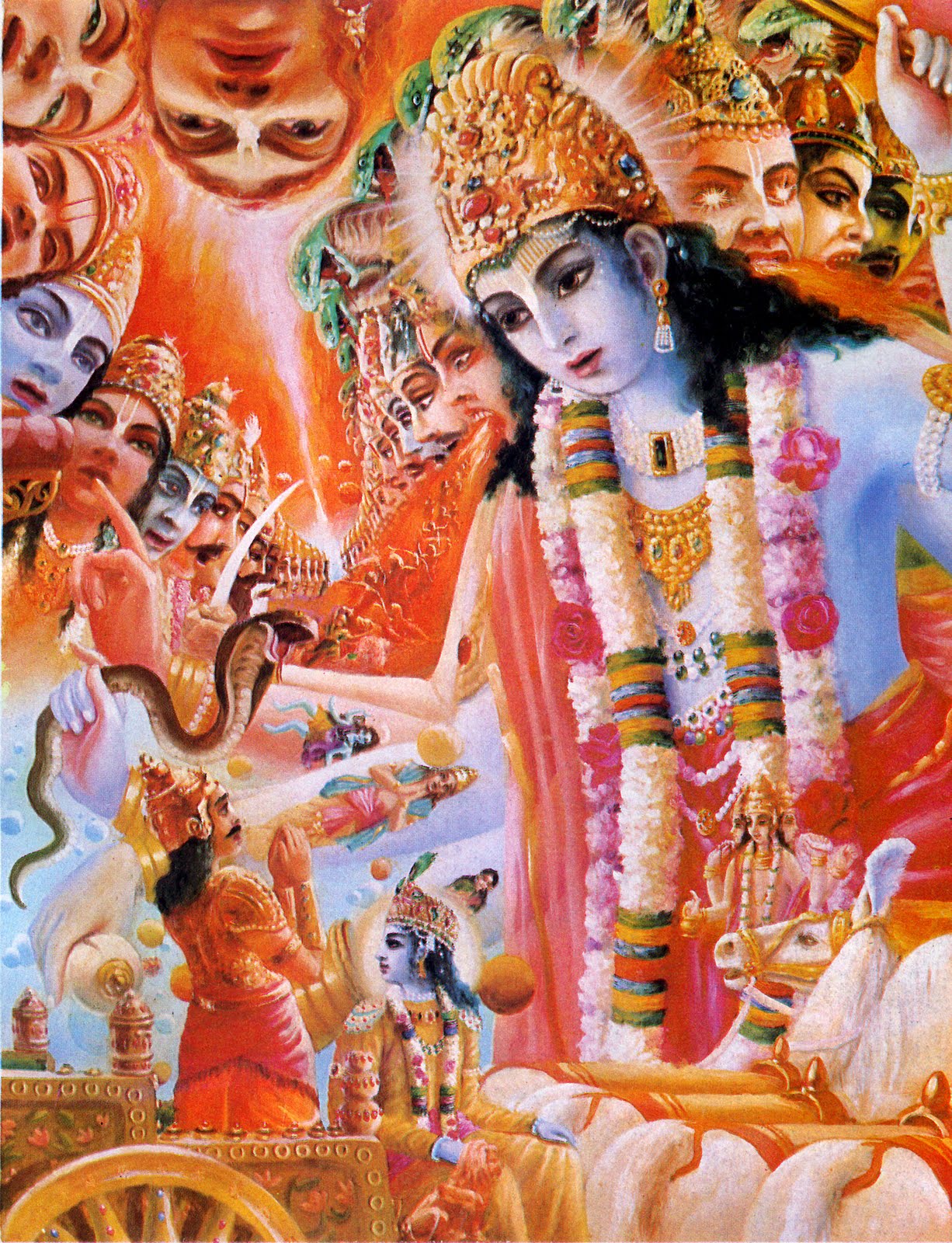
The illustrations of Bhagavad-gītā As It Is were painted by members of the International Society for Krishna Consciousness working under the personal direction of the author, their spiritual master, In the following descriptive index, the numbers in boldface type which follow each plate number refer to the chapter and verse of the Gītā that the picture illustrates.
The nice thing about mantra meditation or chanting the maha mantra:
Hare Krishna, Hare Krishna, Krishna Krishna, Hare Hare, Hare Rama, Hare Rama , Rama Rama, Hare Hare
is that one can do it anywhere, any time. In a plane, train or automobile, sitting, walking, or standing on one’s head. I find myself chanting when I am working in my shop, cutting the lawn, taking a shower, working in the garden. Chanting always makes me feel better.
“…one should learn the art of chanting the Holy name of Krishna 24 hours a day and that alone is the remedy for all problems of material existence.” (from letter to Susan Beckman August 29th 1973)
Prabhupada: The chanting is a process of purification. Just like we use soap to cleanse the body, this is material, but the chanting is spiritual cleansing. The three stages of cleansing are first
(1) To clean the mirror of the mind. In the Bhagavad Gita it is said:
“The mind is the best friend and the worst enemy, for one who has learned to control the mind it is the best of friends but for one who has failed to do so it is the worst enemy.”
Due to long term association, the mind absorbed in material things has become contaminated, or dirty, the chanting process purifies the mind.
(2) Then the next stage, when the mind is cleansed one becomes free from the symptoms of material existence. Material existence means to be always hankering and lamenting. I must have a new automobile, I must have more money, I must have good wife, I must have this I must have that. Then when I have the thing, I lament, I have lost my wife, I have lost my money, I have lost my car, simply lamenting. So the second stage is to be free from this anxiety.
(3) The third stage is “He never laments nor desires to have anything; he is equally disposed to every living entity. In that state he attains pure devotional service unto me.”
“One who is thus transcendentally situated at once realizes the Supreme Brahman and becomes fully joyful. He never laments or desires to have anything. He is equally disposed toward every living entity. In that state he attains pure devotional service unto Me.”
The following is a nice compilation of 108 quotes, taken from Srila Prabhupada’s books, lectures, letters, and conversations, on the importance of the 1972 Original Authorized Edition of the Bhagavad-gita As It Is.
This collection of quotes was compiled by Yasoda nandana Prabhu as his Vyasa-puja offering.
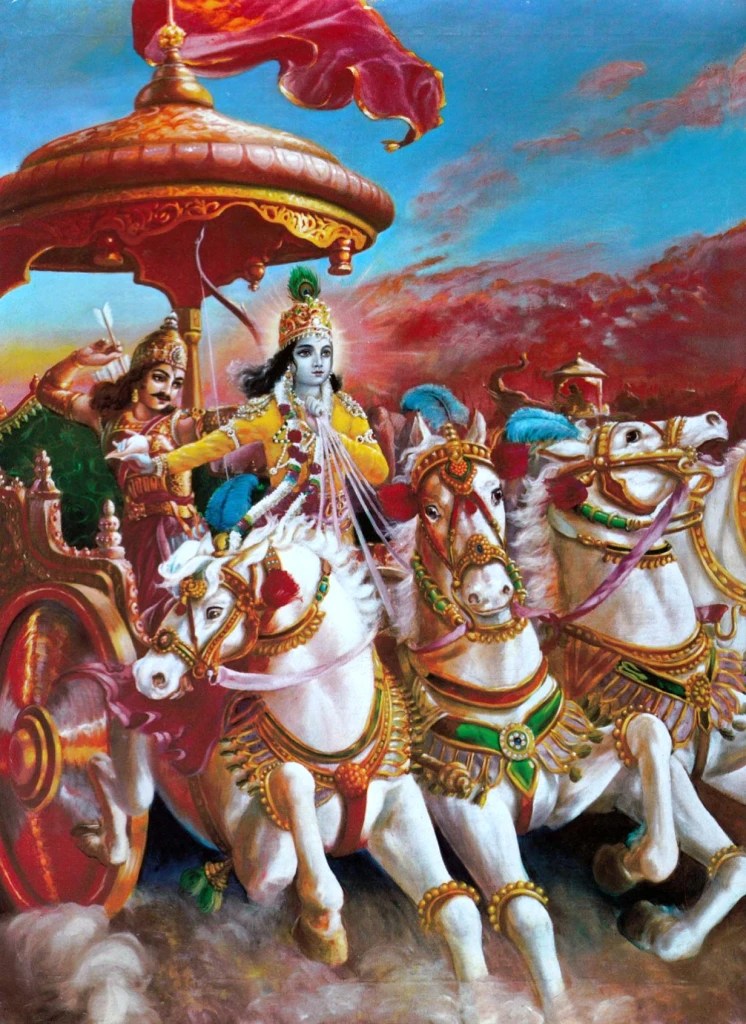
“Wherever there is Kṛṣṇa, the master of all mystics, and wherever there is Arjuna, the supreme archer, there will also certainly be opulence, victory, extraordinary power, and morality. That is my opinion.” (Bhagavad-gita 18.78)
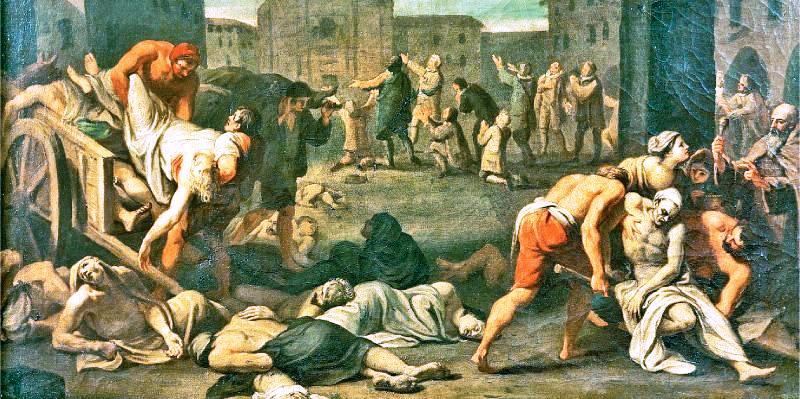
In these troubling times, in the mist of a worldwide pandemic , there is a small glimmer or hope; a vaccine. I know there is much debate over mask wearing, and taking the vaccine, due mostly to political unrest, and conspiracy theories. Even amongst devotees, there is much debate.
However,Srila Prabhupada has given us some instruction in the Bhagavad-gita, chapter 3, text 14, on how we can help protect our health.
…the devotees of the Lord, who are in Kṛṣṇa consciousness, offer food to Kṛṣṇa and then eat-a process which nourishes the body spiritually. By such action not only are past sinful reactions in the body vanquished, but the body becomes immunized to all contamination of material nature. When there is an epidemic disease, an antiseptic vaccine protects a person from the attack of such an epidemic. Similarly, food offered to Lord Viṣṇu and then taken by us makes us sufficiently resistant to material affection, and one who is accustomed to this practice is called a devotee of the Lord. Therefore, a person in Kṛṣṇa consciousness, who eats only food offered to Kṛṣṇa, can counteract all reactions of past material infections, which are impediments to the progress of self-realization. On the other hand, one who does not do so continues to increase the volume of sinful action, and this prepares the next body to resemble hogs and dogs, to suffer the resultant reactions of all sins. The material world is full of contaminations, and one who is immunized by accepting prasādam of the Lord (food offered to Viṣṇu) is saved from the attack, whereas one who does not do so becomes subjected to contamination. (from purport Bg 3.14)
So today is New Years Day 2021. Hopefully we will all see a better year ahead. But I have given this notion of “Time” some serious thought of late, what with the pandemic, blazing forest fires, flooding, hurricanes, tornadoes, political unrest, etc. As my wife has reminded me many times this last year; ‘its Kali Yuga’ the age of decline, of quarrel and hypocrisy. So today I wanted to post some about Time and the duration of the material universe.
…The duration of the material universe is limited. It is manifested in cycles of kalpas. A kalpa is a day of Brahmā, and one day of Brahmā consists of a thousand cycles of four yugas or ages: Satya, Tretā, Dvāpara, and Kali. The cycle of Satya is characterized by virtue, wisdom and religion, there being practically no ignorance and vice, and the yuga lasts 1,728,000 years. In the Tretā-yuga vice is introduced, and this yuga lasts 1,296,000 years. In the Dvāpara-yuga there is an even greater decline in virtue and religion, vice increasing, and this yuga lasts 864,000 years. And finally in Kali-yuga (the yuga we have now been experiencing over the past 5,000 years) there is an abundance of strife, ignorance, irreligion and vice, true virtue being practically nonexistent, and this yuga lasts 432,000 years. (from purport Bg 8.17)
Even if I could grasp the extent of time in the material universe, that is just a fraction of the unlimited eternal time that continues after the termination of the yuga.
…Then the process is set rolling again. These four yugas, rotating a thousand times, comprise one day of Brahmā, the creator god, and the same number comprise one night. Brahmā lives one hundred of such “years” and then dies. These “hundred years” by earth calculations total to 311 trillion and 40 million earth years. By these calculations the life of Brahmā seems fantastic and interminable, but from the viewpoint of eternity it is as brief as a lightning flash. In the causal ocean there are innumerable Brahmās rising and disappearing like bubbles in the Atlantic. Brahmā and his creation are all part of the material universe, and therefore they are in constant flux. (from purport Bg 8.17)
The above calculations Srila Prabhupada uses and I quote;“seems fantastic and interminable, but from the viewpoint of eternity it is as brief as a lightning flash. In the causal ocean there are innumerable Brahmās rising and disappearing like bubbles in the Atlantic.”Wow!
Some mornings after I do my morning meditation (japa), reading and study, I will pick out a nice sloka (verse) from the Bhagavad-gita or Srimad Bhagavatam, write it out on a note card and stick it in my pocket and throughout the course of the day refer to it in hopes of memorizing it. So today this sloka from the Bhagavad-gita will be my meditation and memorization exercise.
arjuna uvāca
paraṁ brahma paraṁ dhāma
pavitraṁ paramaṁ bhavān
puruṣaṁ śāśvataṁ divyam
ādi-devam ajaṁ vibhum
āhus tvām ṛṣayaḥ sarve
devarṣir nāradas tathā
asito devalo vyāsaḥ
svayaṁ caiva bravīṣi me
Arjuna said: You are the Supreme Brahman, the ultimate, the supreme abode and purifier, the Absolute Truth and the eternal divine person. You are the primal God, transcendental and original, and You are the unborn and all-pervading beauty. All the great sages such as Nārada, Asita, Devala, and Vyāsa proclaim this of You, and now You Yourself are declaring it to me.
In this present day, people are very much eager to have one scripture, one God, one religion, and one occupation.
Therefore,
ekam sastram devaki-putra-gitam: let there be one scripture only, one common scripture for the whole world – Bhagavad-gita.
Eko devo devaki-putra eva: let there be one God for the whole world – Sri Krishna. Eko mantras tasya namani: and one hymn, one mantra, one prayer – the chanting of His name
Hare Krishna, Hare Krishna, Krishna Krishna, Hare Hare
Hare Rama, Hare Rama, Rama Rama, Hare Hare
Karmapy ekam tasya devasya seva: and let there be one work only – the service of the Supreme Personality of Godhead.








 The Hare Krishna Movement