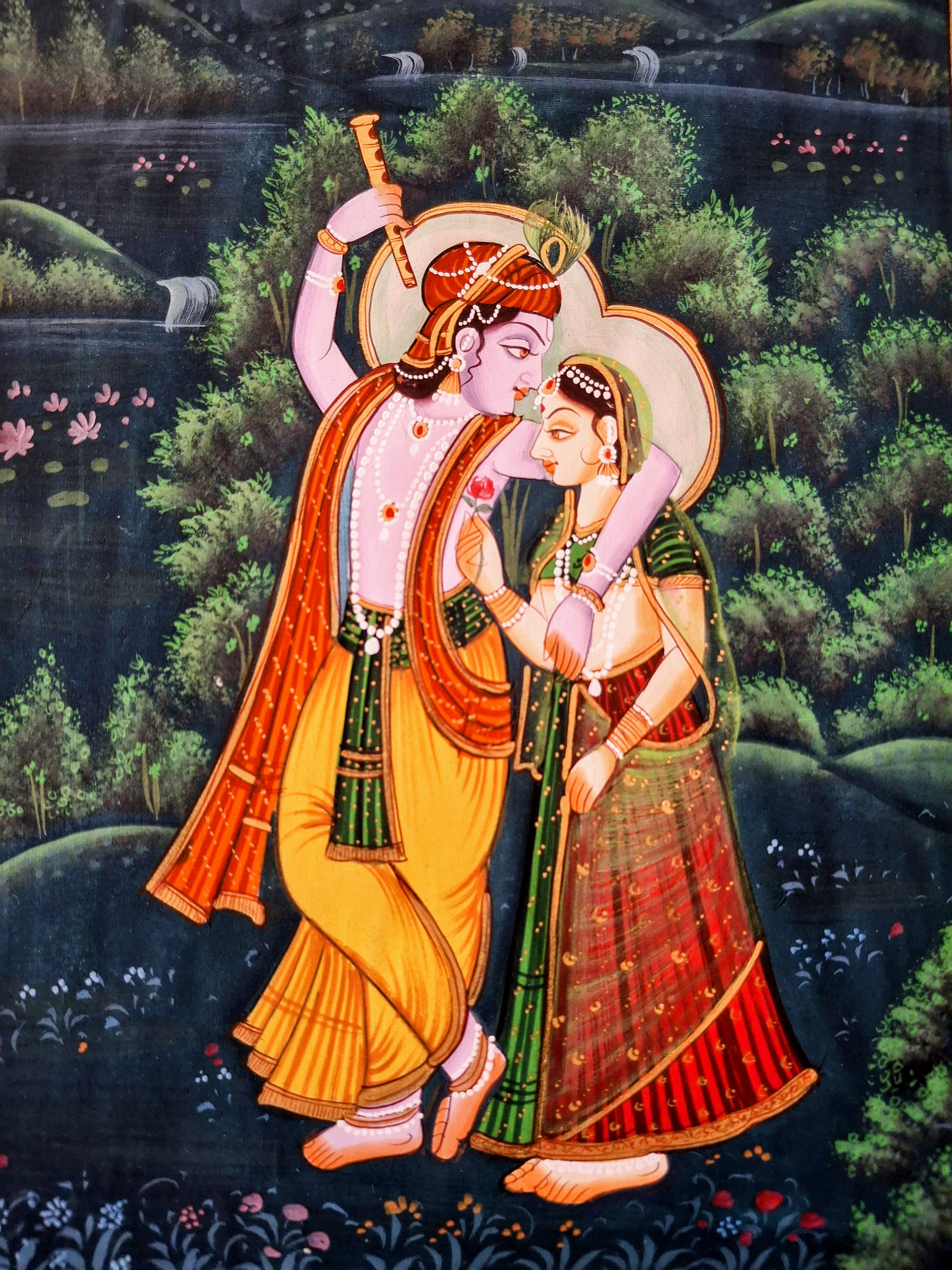
This morning there was this nagging voice that kept saying “read Adi-lila chapter 4, of the Sri Caitanya-caritamrta” I haven’t read from the Caitanya-caritamrta for a while because I was re-reading the Bhagavad-gita and Krsna Book and because it is summer, I am busy with work… But I responded to the nagging voice…and pulled Vol. 1 from the shelf. As I read I became more and more enlivened and the words jumped out at me…. Śrīmatī Rādhārāṇī, who is the attraction for the all-attractive. What is attracting the All Attractive? Srimati Radharani!
And the other thing that jumped out at me was the word hlādinī. Here is another word for your vaishnava vocabulary. So today is a two part post from the Sri Caitanya-caritamrta, describing the hladini energy, and the attractiveness of Srimati Radharani.
Lord Kṛṣṇa enchants the world, but Śrī Rādhā enchants even Him. Therefore She is the supreme goddess of all. (Adi 4.95)
Śrī Rādhā is the full power, and Lord Kṛṣṇa is the possessor of full power. The two are not different, as evidenced by the revealed scriptures. (Adi 4.96)
Śrīmatī Rādhārāṇī is as fully spiritual as Kṛṣṇa. No one should consider Her to be material. She is definitely not like the conditioned souls, who have material bodies, gross and subtle, covered by material senses. She is all-spiritual, and both Her body and mind are of the same spiritual embodiment. Because Her body is spiritual, Her senses are also spiritual. Thus Her body, mind and senses fully shine in love of Kṛṣṇa. She is the personified hlādinī-śakti (the pleasure-giving energy of the Lord’s internal potency), and therefore She is the only source of enjoyment for Śrī Kṛṣṇa.
Śrī Kṛṣṇa cannot enjoy anything that is internally different from Him. Therefore Rādhā and Śrī Kṛṣṇa are identical. The sandhinī portion of Śrī Kṛṣṇa’s internal potency has manifested the all-attractive form of Śrī Kṛṣṇa, and the same internal potency, in the hlādinī feature, has presented Śrīmatī Rādhārāṇī, who is the attraction for the all-attractive. No one can match Śrīmatī Rādhārāṇī in the transcendental pastimes of Śrī Kṛṣṇa. (from purport Adi 4.71)
…All the desires of Lord Kṛṣṇa rest in Śrīmatī Rādhārāṇī. (from purport)
The following are just a few of the many quotes from Srila Prabhupada which encourage us to approach Krishna through the mercy of Srimati Radharani, Krishna’s eternal consort. For those of us who feel that there is no hope of making spiritual progress in this lifetime, Srimati Radharani, Who is compassion personified, kindly comes to our rescue if we can humbly invoke Her divine blessings.
“I offer my respects to Radharani whose bodily complexion is like molten gold and who is the Queen of Vrndavana. You are the daughter of King Vrsabhanu, and You are very dear to Lord Krishna.” (Sri Radha Pranama)
“I emphatically say to you, O brothers, you will obtain your good fortune from the Supreme Lord Krishna only when Srimati Radharani becomes pleased with you.”(Prayer to the Lotus Feet of Krishna, September 13, 1965)
“Actually, because Krishna is the Supreme Personality of Godhead, it is very difficult to approach Him. But the devotees, taking advantage of His compassionate nature, which is represented by Radharani, always pray to Radharani for Krishna’s compassion.” (Nectar of Devotion, Chapter 22)
“There is no comparison to Radharani’s beauty and the luster of Her transcendental body. The so-called beauty of the moon has fallen on the ground in the presence of Radharani’s beauty.” (From Vrindavana by Srila Narottama das Thakura)
“The beauty of Srimati Radharani’s eyes forcibly devours the beauty of newly grown blue lotus flowers, and the beauty of Her face surpasses that of an entire forest of fully blossomed lotuses. Her bodily luster seems to place even gold into a painful situation. Thus the wonderful, unprecedented beauty of Srimati Radharani is awakening in Vrindavana.” (Caitanya-caritamrita Antya 1.169)
So we are finishing our series on the five types of relationships (rasa’s) with the Lord. Today we are exploring Devotional Service in Conjugal Love (Madhurya-rasa) as explained in chapter 44 of “The Nectar of Devotion”.
Because of the sensitive nature of this topic, we have posted the entire chapter from the the original 1970 edition of “The Nectar of Devotion”, by His Divine Grace A C Bhaktivedanta Swami Prabhupada.
A pure devotee’s attraction to Krsna in conjugal love is called devotional service in conjugal love. Although such conjugal feelings are not at all material, there is some similarity between this spiritual love and material activities. Therefore, persons who are interested only in material activities are unable to understand this spiritual conjugal love, and these devotional reciprocations appear very mysterious to them. Rupa Gosvāmī therefore describes conjugal love very briefly.
The impetuses of conjugal love are Krsna and His very dear consorts, such as Rādhārāṇī and Her immediate associates. Lord Krsnahas no rival: no one is equal to Him, and no one is greater than Him. His beauty is also without any rival, and because He excels all others in the pastimes of conjugal love, He is the original object of all conjugal love.
So we are continuing our series on the five types of relationships (rasa’s) with the Lord. Today we are exploring the Fraternal Devotional stage of Love of God (Sakhya-rasa) as explained in chapter 41 of “The Nectar of Devotion”. Also included in todays post are some select verses from the Bhagavad-gita describing Arjuna’s friendship with Krishna.
When a devotee is permanently situated in devotional service, and by different symptoms of ecstasy he has developed and matured a fraternal mellow or flavor in relationship with the Personality of Godhead, his feeling is called fraternal love of Godhead.
The impetus for such fraternal love of God is God Himself. When one is liberated and discovers his eternal relationship with the Supreme Lord, the Lord Himself becomes the impetus for increasing fraternal love. The eternal associates of the Lord in Vrindavan have described this as follows: “The Lord, Hari, whose bodily hue is like the indranīla jewel, whose smiling is as beautiful as the kunda flower, whose silk dress is as yellow as golden autumn foliage, whose chest is beautified with garlands of flowers and who is always playing upon His flute-this enemy of the Agha demon is always attracting our hearts by wandering about Vrindavan.”
There are similar statements of fraternal love expressed outside the jurisdiction of Vrindavan. When the sons of Pandu, headed by Mahārāj Yudhisthira, saw Krishna in His four handed form on the battlefield of Kuruksetra, holding His conchshell, disc, club and lotus flower, they completely forgot themselves and became merged in the ocean of nectarean happiness. This shows how the sons of Pandu-King Yudhisthira, Bhima, Arjuna, Nakula and Sahadeva-were all caught up in fraternal love for Krishna.
From the Bhagavad-gita we are reminded of Arjuna’s friendship with Krishna.
So today we are exploring the Servitude stage of Love of God (Dasya-rasa) as explained in chapter 36 of “The Nectar of Devotion”.
Each soul, according to its constitutional nature, possesses a unique loving relationship with Krishna in one of five principal categories. When devotees return to the spiritual world, they engage in direct loving devotional service to Krishna in their particular rasa.
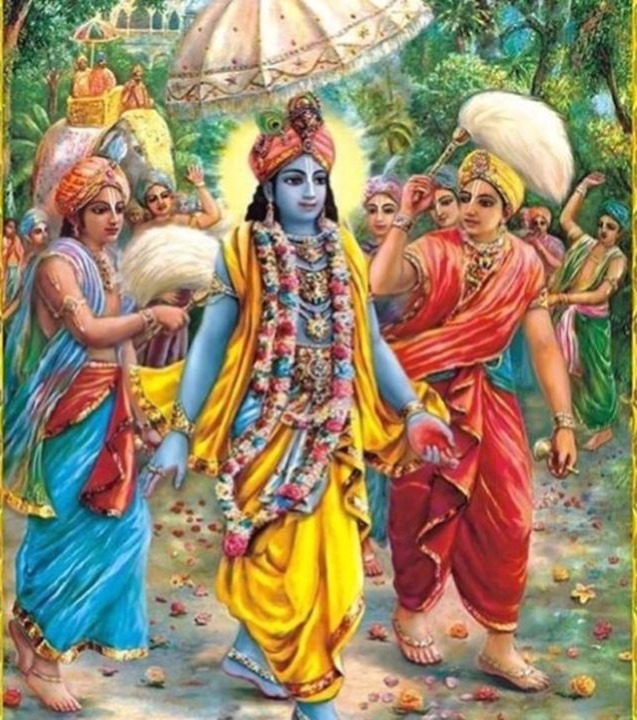
Devotees engaged in servitude are attached to Krishna in the affection of reverence. Some of the inhabitants of Gokula (Vrindavan) as exhibited on earth) are attached to Krishna on this platform of affection in reverence. The inhabitants of Vrindavan used to say, “Kṛṣṇa is always manifest before us with a complexion like a blackish cloud. He holds His wonderful flute in His lotus hands. He is dressed in yellow silks and bedecked with a peacock feather on His head. When Krishna walks near Govardhan Hill with these personal features, all the inhabitants of the heavenly planets, as well as the inhabitants of this earth, feel transcendental bliss and consider themselves the eternal servants of the Lord.”
Today we are exploring the Neutral stage of Love of God, (santa-rasa), as explained in chapter 35 of “The Nectar of Devotion”.
“When the yogi sees the eternal form of Visnu and appreciates the Lord’s beauty in awe and veneration, he is situated in the neutral stage of love of God.”
…Some great sages have attained this neutral position by practicing austerity, penance and meditation to control the senses. Such sages are generally called mystic yogīs, and in most cases they are inclined to appreciate the spiritual pleasure of the impersonal feature of the absolute truth. They are practically unaware of the transcendental pleasure derived from personal contact with the Supreme Godhead.
When some great saintly persons who had undergone penances and austerities saw the four-handed transcendental form of Visnu, they began to remark as follows: “This four-handed form of the Lord, manifested in a bluish color, is the reservoir of all pleasure and the center of our living force. Actually, when we see this eternal form of Visnu, we, along with many other paramahaṁsas, become immediately captivated by the beauty of the Lord.” This appreciation of Lord Visnu by saintly persons is an instance of situation in santa-rasa, or the neutral stage of devotional service. In the beginning, those who are aspiring for salvation try to get out of the material entanglement by performing painful austerities and penances, and ultimately they come to the impersonal status of spiritual realization. At this brahma-bhuta [SB 4.30.20] stage of liberation from the material entanglement, the symptoms, as explained in the Bhagavad-gita, are that one becomes joyous beyond any hankering or lamentation and gains a universal vision. When the devotee is situated in the santa-rasa, or neutral stage of devotional service, he appreciates the Visnu form of the Lord.
This morning I was thinking about the different relationships one can have with the Lord. In “The Nectar of Devotion”, Srila Prabhupada describes the five primary kinds of devotional service-namely, neutrality, servitude, fraternity, parenthood and conjugal love.Over the course of the next five posts, I want to explore these five primary relationships.
But for today, I want to start with this nice verse from the Bhagavad-gita, where these five types of relationships are mentioned in purport.
For one who remembers Me without deviation, I am easy to obtain, O son of Pṛthā, because of his constant engagement in devotional service. (Bg 8.14)
…Bhakti-yoga is very simple and pure and easy to perform. One can begin by simply chanting Hare Kṛṣṇa. Kṛṣṇa is very merciful to those who engage in His service, and He helps in various ways that devotee who is fully surrendered to Him so he can understand Him as He is. The Lord gives such a devotee sufficient intelligence so that ultimately the devotee can attain Him in His spiritual kingdom.
…Generally, the bhakti-yogīs are engaged in five different ways: 1) śānta-bhakta, engaged in devotional service in neutrality; 2) dāsya-bhakta, engaged in devotional service as servant; 3) sākhya-bhakta, engaged as friend; 4) vātsalya-bhakta, engaged as parent; and 5) mādhurya-bhakta, engaged as conjugal lover of the Supreme Lord. (from purport)
…”Everyone and everything is attracted to Kṛṣṇa–that is the perfect description of Kṛṣṇa’s attraction. The example of the gopīs is very instructive to persons who are trying to be absorbed in Kṛṣṇa consciousness. One can very easily associate with Kṛṣṇa simply by remembering His transcendental pastimes. Everyone has a tendency to love someone. That Kṛṣṇa should be the object of love is the central point of Kṛṣṇa consciousness. By constantly chanting the Hare Kṛṣṇa mantra and remembering the transcendental pastimes of Kṛṣṇa, one can be fully in Kṛṣṇa consciousness and thus make his life sublime and fruitful.”
Kṛṣṇa, The Supreme Personality of Godhead By His Divine Grace A. C. Bhaktivedanta Swami Prabhupada Vol. 1, Chapter 34
The Gopīs’ Feelings of Separation
The gopīs of Vṛndāvana were so attached to Kṛṣṇa that they were not satisfied simply with the rāsa dance at night. They wanted to associate with Him and enjoy His company during the daytime also. When Kṛṣṇa went to the forest with His cowherd boy friends and cows, the gopīs did not physically take part, but their hearts went with Him. And because their hearts went, they were able to enjoy His company through strong feelings of separation. To acquire this strong feeling of separation is the teaching of Lord Caitanya and His direct disciplic succession of Gosvāmīs. When we are not in physical contact with Kṛṣṇa, we can associate with Him like the gopīs, through feelings of separation. Kṛṣṇa’s transcendental form, qualities, pastimes, and entourage are all identical with Him. There are nine different kinds of devotional service. Devotional service to Kṛṣṇa in feelings of separation elevates the devotee to the highest perfectional level, to the level of the gopīs.
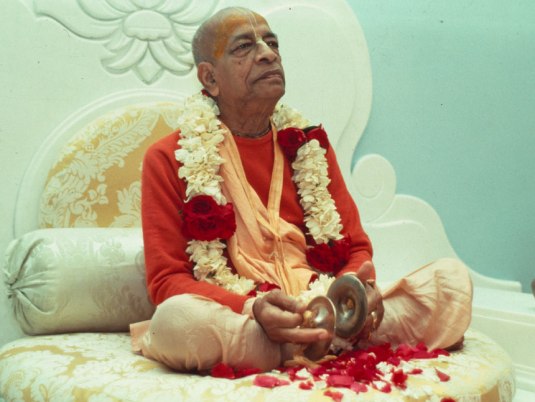
At various times people have called him a scholar, a philosopher, a cultural ambassador, a prolific author, a religious leader, a spiritual teacher, a social critic, and a holy man. In truth, he was all these things and more.
Over five hundred years ago, Lord Sri Krishna appeared as Sri Chaitanya Mahaprabhu in Navadvipa, a village in West Bengal. The purpose of His appearance was to inaugurate the Sankirtana Movement, the Yuga Dharma for this age of Kali. He declared that the chanting of His holy names would spread beyond the shores of India to every town and village in the world. He predicted that His commander-in-chief would appear to accomplish this mission.
Yes… Srila Prabhupada appeared to fulfill this prophecy.
Well the Golden Jubilee at Krishna Balarama Mandir is over, and its time for many of us to return to their respective homes. The above photo are the Prabhupada disciples, sannayasi’s, and other participants, taken on the last day of festival. Many thanks to the management and festival organizers, as well as all the Vrindavan residents who helped make this a memorable occasion.
The Sri Sri Krishna Balaram Mandir, situated in the Raman Reti area of Vrindavan, holds a special significance for the devotees of the International Society for Krishna Consciousness. This grand temple represents the fulfilled dream of Srila Prabhupada, Founder Acharya of ISKCON, who wished to construct a temple of unparalleled beauty for the worship of the transcendental brothers Krishna and Balaram in the same village where They played more than five thousand years ago. Srila Prabhupada directly oversaw all the aspects of design and construction and personally called the Lord to come and accept the worship of His devotees from around the world. He said, “Lord Balaram is the source of spiritual strength, and I have built this temple just to give strength to the devotees”.
Today, the Sri Sri Krishna Balaram Mandir is a booming spiritual center. Every day of the week pilgrims flood in the gate in great numbers from all over the world. In fact, the large green government signs posted over the highway turn off to Vrindavan only give directions to two temples: Banke Bihari and ISKCON.
The Opening of Krishna Balarama Mandir 50 years ago
Today we are celebrating The Appearance day of Lord Ramachandra (Rama Navami), at the Krishna Balarama Mamdir, for the 50th Golden Jubille Grand Opening. It was 50 years ago today, this beautiful temple was opened.
It has been a very blissful morning thus far, with ecstatic kirtan, memories given by Senior devotees who were here with Srila Prabhupada for the opening, and a Big Surprise was seeing the Ashtasakhi Gopis, who joined Radha Shyamasundar on the altar for the first time.
Padmapani Prabhu was a very dear friend, and a dear disciple of Srila Prabhupada who is well known as the web master of the pagePrabhupada Connection. He will be greatly missed.
Please join us in prayers for a very special Godbrother, Padmapani Prabhu who just left us in Canada. I never knew him personally, but loved to hear of his daring exploits in the mideast when it was quite a dangerous area! Then I knew him from the marvellous website he managed, The Prabhupada Connection. He’s on the left with Tribhuvanath in Sri Radha Rasabihari Mandir ( Deena Bandhu Das )
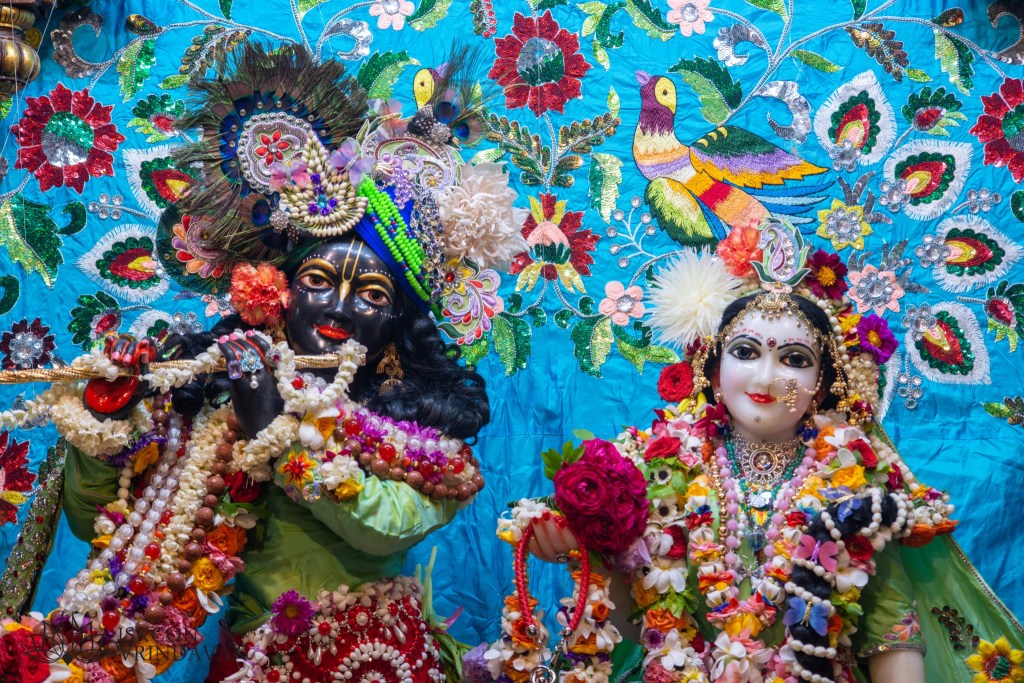
We are currently in Vrindavan, India, at the Krsna Balaram Mandir, with the most beautiful Radha Shyam. All the deities looked so gorgeous this morning, in their black outfits.
Have been doing the parikaram of the twelve forests of Vrindavan, and it has been amazing, and feel exceptional fortune, at being here, and experiencing so much devotional nectar.
I wish to share some from the Preface to the”Nectar of Devotion” By A. C. Bhaktivedanta Swami:
The basic principle of the living condition is that we have a general propensity to love someone. No one can live without loving someone else. This propensity is present in every living being. Even an animal like a tiger has this loving propensity at least in a dormant stage, and it is certainly present in the human beings. The missing point, however, is where to repose our love so that everyone can become happy. At the present moment the human society teaches one to love his country or family or his personal self, but there is no information where to repose the loving propensity so that everyone can become happy. That missing point is Krsna, and The Nectar of Devotion teaches us how to stimulate our original love for Krsna and how to be situated in that position where we can enjoy our blissful life.
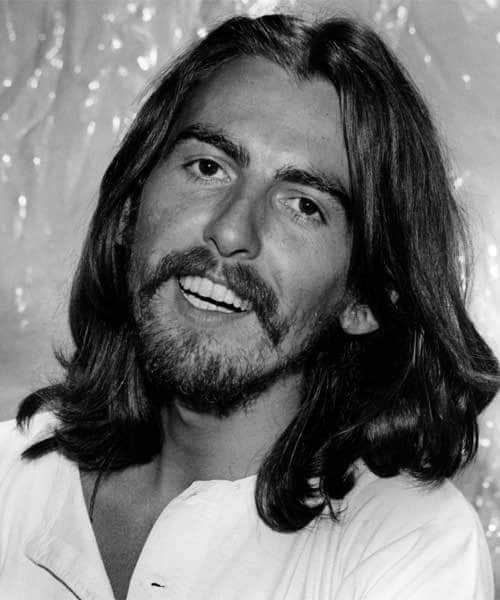
“I liked Prabhupada’s humbleness. I always liked his humility and his simplicity. The servant of the servant of the servant is really what it is, you know. None of us are God—just His servants. He just made me feel so comfortable. I always felt very relaxed with him, and I felt more like a friend. I felt that he was a good friend. Even though he was at the time seventy-nine years old, working practically all through the night, day after day, with very little sleep, he still didn’t come through to me as though he was a very highly educated intellectual being, because he had a sort of childlike simplicity. Which is great, fantastic. Even though he was the greatest Sanskrit scholar and a saint, I appreciated the fact that he never made me feel uncomfortable. In fact, he always went out of his way to make me feel comfortable. I always thought of him as sort of a lovely friend, really, and now he’s still a lovely friend.
“That was the thing about Prabhupada, you see. He didn’t just talk about loving Krishna and getting out of this place, but he was the perfect example. He talked about always chanting, and he was always chanting. I think that that in itself was perhaps the most encouraging thing for me. It was enough to make me try harder, to be just a little bit better. He was a perfect example of everything he preached.
jaya–all glories to: rādhā-mādhava–Rādhā and the Lord of sweetness; kuñja-bihārī–He who enjoys loving pastimes in the groves of Vṛndāvana; gopī-jana-vallabha–the lover of the cowherd maidens of Vraja; giri-vara-dhārī–the holder of the great hill named Govardhana;
Krsna is the lover of Radha. He displays many amorous pastimes in the groves of Vrndavana, He is the lover of the cowherd maidens of Vraja, and the holder of the great hill named Govardhana.
yaśodā-nandana–the beloved son of mother Yaśodā; vraja-jana-rañjana–the delighter of the inhabitants of Vraja; yāmuna-tīra-vana-cārī–who wanders in the forests along the banks of the river Yamunā
He is the beloved son of mother Yasoda, the delighter of the inhabitants of Vraja, and He wanders in the forests along the banks of the River Yamuna!
Srila Prabhupada said that this song is “a picture of Vrndavana. Everything is there–Srimati Radharani, Vrndavana, Govardhana, Yasoda, and all the cowherd boys.
So this is the original nature of Kṛṣṇa, original nature of Kṛṣṇa. He is Rādhā-Mādhava. He is the lover of Śrīmatī Rādhārāṇī. And kuñja-vihārī, always enjoying the company of the gopīs within the bushes of Vrndavana forest. Rādhā-mādhava kuñja-vihārī. So He’s not only lover of Rādhārāṇī, but braja-jana-vallabha. The whole residents of Vṛndāvana, they love Kṛṣṇa.(from Srila Prabhupada Lecture NY July 20, 1971)
We spent the last week at the Sri Sri Radha Madhava Temple in Mayapur. It was an incredible week! Bathing Lord Caitanya Mahaprabhu on His Appearance Day, attending aroti at Srila Prabhupada’s Samadhi, Guru-puja at temple, etc. but the take away for me was the Radha Madhava altar. To see Radha and Krishna surrounded by the beautiful Ashtasakhi’s (the 8 principle gopis) was a sight to behold. And I wanted to know more about these beautiful personality’s.
The list of Ashtasakhi include: Lalita, Vishaka, Champaklata, Chitra, Tungavidhya, Induleka, Rangadevi, and Sudevi. All of these eight prominent gopis are regarded to be an expansion of Radha, the chief consort of Krishna.
Srimati Radharani is considered the topmost devotee of Lord Krishna, His eternal consort, and the root of pure, selfless devotion, embodying the supreme devotional Bliss of seeking Krishna’s pleasure.
Well today we are in Mayapura Dham, at the Shri Shri Radha Madhava Temple, celebrating the Appearance Day of Lord Caitanya Mahaprabhu. It is a full day fast, followed by a nice Vegetarian feast at Sunset. The devotees here have been so kind and accommodating. And of course the deities are all spectacularly beautiful, and the prasadam is first class.We feel very grateful, and blessed to be here on such an auspicious occasion.
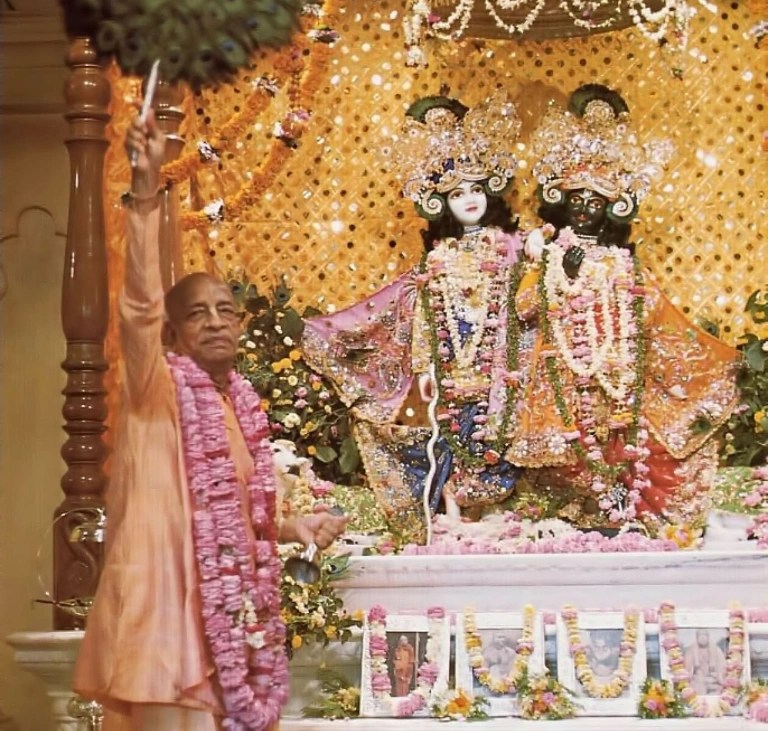
Probably because we leave for India today, and probably because we are going for the 50th Aniversity of the opening of the Sri Sri Krishna Balarama Temple in Vrindavan, but every morning I think about this Iconic picture of Srila Prabhupada offering the first Arotika to Krishna and Balarama.
We share with you some of thepastimes of the two transcendental brothers.
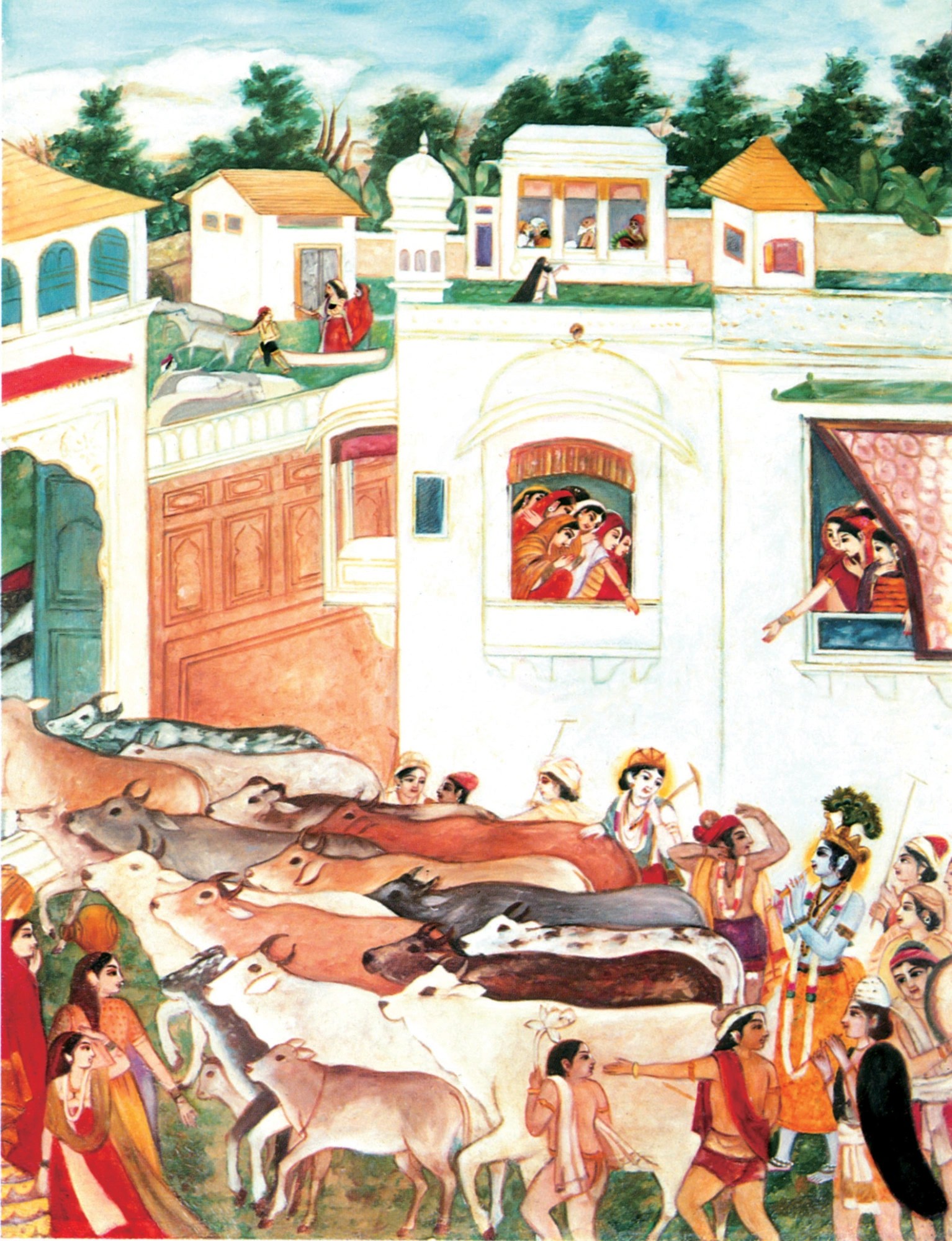
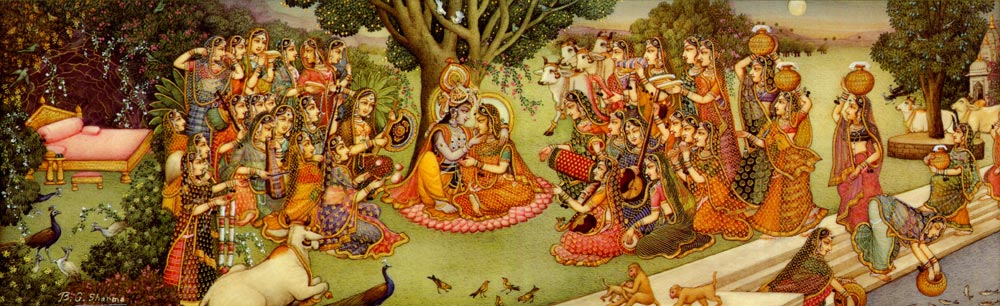
While Kṛṣṇa was engaged in tending the cows in the forest of Vṛndāvana or on Govardhana Hill, the gopīs in the village were always absorbed in thinking of Him and discussing His different pastimes. This is the perfect example of Kṛṣṇa consciousness: to somehow or other remain always engrossed in thoughts of Kṛṣṇa. The vivid example is always present in the behavior of the gopīs; therefore Lord Caitanya declared that no one can worship the Supreme Lord by any method which is better than the method of the gopīs. The gopīs were not born in very high brāhmaṇa or kṣatriya families; they were born in the families of vaiśyas, and not in big mercantile communities but in the families of cowherd men. They were not very well educated, although they heard all sorts of knowledge from the brāhmaṇas, the authorities of Vedic knowledge. The gopīs’ only purpose was to remain always absorbed in thoughts of Kṛṣṇa. (“The Gopīs Attracted by the Flute.”)
…”Your time is so valuable that you cannot get back your life, one day of your life or one moment of your life, by paying millions of dollars. (Srila Prabhupada lectureSB 1.2.19 New Vrindaban)
I have been thinking lately about about my life. I am 70 years old, or to break it down; 25,550 days, 613,200 hours, 36,792,000 minutes, 2,207,520.000 seconds. How much of my life have I wasted? When I wasn’t thinking about Krsna, when I was not engaged in devotional service. How many hours did I spend sleeping, or engaged in fruitive labor, intoxication or sense gratification? Really, I have wasted so much valuable time, and can never get that back.
“If such valuable time you simply waste, then just estimate it what is your loss, practically, from monetary point. One moment of your life cannot be returned by millions of dollars.
Therefore our Rūpa Gosvāmī also teaches, avyartha-kālatvam (CC Madhya 23.18). A Kṛṣṇa conscious person should see, “Whether my time has become wasted? Whether I am utilizing my time, the short duration of my life, properly?” All Kṛṣṇa conscious persons should be vigilant to see that the time is not wasted. Śrī Caitanya Mahāprabhu therefore advises, kīrtanīyaḥ sadā hariḥ.
tṛṇād api sunīcenataror api sahiṣṇunāamāninā mānadenakīrtanīyaḥ sadā hariḥ (CC Adi 17.31)
We have therefore introduced chanting Hare Kṛṣṇa twenty-four hours. I am glad to see all the devotees, they are carrying the beads, that this is nice practice. It must be. Chant Hare Kṛṣṇa, Hare Kṛṣṇa, for twenty-four hours: while working, even in sleeping. If you practice, in sleep also you will chant Hare Kṛṣṇa. That is possible. It is not impossible, it is fact.” (lecture SB 1.2.19 New Vrindaban)
..”So we should be very much careful in discharging the duty. The devotee should be so much careful that he’ll always see, “Whether this moment is spoiled or utilized?”Avyartha-kālatvam (CC Madhya 23.18). Avyartha-kālatvam, that “My time may not be wasted.” He should be so careful, “Whether my time is being wasted?” And time wasted, the time we engage for our bodily necessities, that is wasted. Generally, conditioned souls, they are simply wasting their time. Only the period which we are engaged in Kṛṣṇa consciousness, that is utilized. So we should be very much careful whether time is being wasted or being utilized.”… (Morning walk San Francisco, 1968)
This morning I just happened to open this small book entitled “Life comes from Life”, which has been sitting quietly on our bookshelf for many, many years. For some reason today, I opened it and began to read. It is based on morning walk conversations with Srila Prabhupada and his disciples on the origins of life, and is very interesting. We are posting the first chapter as well as a free pdf download of entire book, that you can read or save to your computer.
















 The Hare Krishna Movement