…So far Narada Muni is concerned, in His previous life He was a maidservant’s son, but by the mercy of the devotees He later on became siddha and next life He appeared as Narada with complete freedom to move anywhere by the grace of the Lord. So even though He was in his previous life a maidservant’s son there was no impediment in the achievement of His perfect spiritual life. Similarly any living entity who is conditioned can achieve the perfectional stage of life by the above mentioned processes and the vivid example is Narada Muni.
So I do not know why you have asked about my previous life. Whether I was subjected to the laws of material nature? So, even though accepting that I was subjected to the laws of material nature, does it hamper in my becoming Spiritual Master? What is your opinion? From the life of Narada Muni it is distinct that although He was a conditioned soul in His previous life, there was no impediment of His becoming the Spiritual Master. This law is applicable not only to the Spiritual Master, but to every living entity.
Letter to: Tamala Krsna Los Angeles 21 June, 1970
Paris My Dear Tamala,
Please accept my blessings. I beg to acknowledge receipt of your letter dated 18th June, 1970, sent by Special Delivery Air Mail.
Krsna philosophy is understood as it is stated in the Vedas:
Yasya deve para bhakti yatha deve tatha gurau tasya ete kathitha hi artha prakasante mahatmanah
“One who has got unflinching faith in the Supreme Lord and similar faith in his Spiritual Master to him only the imports of Vedic knowledge become revealed.”
A Spiritual Master is always liberated. In any condition of His life He should not be mistaken as ordinary human being. This position of a Spiritual Master is achieved by three processes. One is called sadhana siddha. That means one who is liberated by executing the regulative principle of devotional service. Another is krpa siddha, one who is liberated by the mercy of Krsna or His devotee. And another is nitya siddha who is never forgetful of Krsna throughout his whole life. These are the three features of the perfection of life.
I first ran across this book some twenty years ago, although it was printed in 1970, I was surprised to learn there was a handbook for devotees. I found it to be a treasure house of basic guidelines for developing our Krsna consciousness, as well as presenting the philosophy very simply. Nice little book.
Introduction This is the first annual edition of The Krsna Consciousness Handbook. The International Society for Krishna Consciousness (ISKCON) was founded in 1966 by His Divine Grace A.C. Bhaktivedanta Swami Prabhupada and is now becoming firmly established, with centers in thirty major cities around the world and world headquarters in Los Angeles,California. The goal of the Society’s members is to attain love of God by following the principles of bhakti-yoga,as ·taught by the Vedic scriptures and the disciplic succession of spiritual masters, and to spread love of God to all people through the process of sankirtana (public chanting of the holy names of God). Another important goal of the Society is to present authoritative literature on the science of God in English and other major languages.
A Summary of Srila Prabhupada’s Miraculous Accomplishments from 1965 to 1977
In reading many of the profiles of Srila Prabhupada, I’m saddened that a number of his important projects, programs and achievements are never mentioned. In the following summary I’ve tried to compile a more comprehensive list of his credits. Although this list is also incomplete, I hope it presents a fuller picture of Srila Prabhupada’s greatness.
In 1965, at seventy years of age, he ventured outside India for the first time to fulfill the order of his spiritual master. During his voyage at sea, he suffered two severe heart attacks. He reached the shores of America with virtually no money to his name.
He founded the International Society for Krsna Consciousness with a small group of disciples, after a year of struggling alone in New York City. This marked the only time in history that a Krsna devotee successfully trained non-Indians in the strict disciplines of Vaisnavism. Amazingly, this was achieved during the blossoming of America’s hedonistic counterculture movement.
He sent his followers, chanting the names of God, into the streets of cities and towns everywhere and Hare Krsna became famous in every corner of the earth.
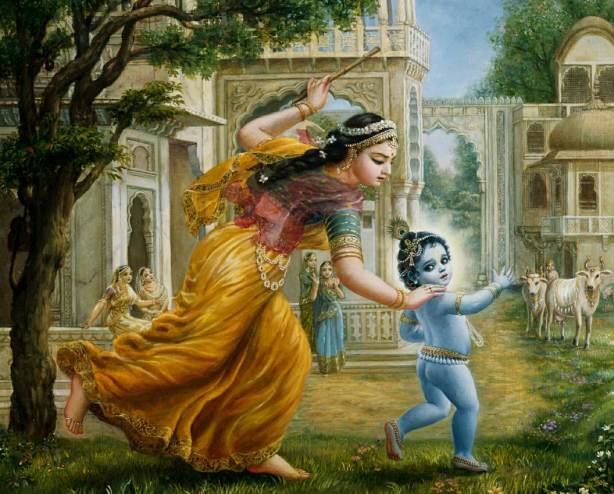
We are now in the month of Damodara (Kartika). In honor and in celebration of the month of Damodara, we will be focusing our attention on the pastimes of Krishna in Vrndavan. Especially Krishna’s childhood pastimes. The following is the first verse from the Damodarastkam prayer which is sung morning and evening, and it is customary to offer a candle or gee lamp as well to a picture of Lord Krsna and Mother Yasoda.
“To the supreme controller who possesses an eternal form of blissful knowledge, whose glistening earrings swing to and fro, who manifested Himself in Gokula, who stole the butter that the gopis kept hanging from the rafters of their storerooms and who then quickly jumped up and ran in retreat in fear of Mother Yasoda, but was ultimately caught-to that Supreme Lord, Sri Damodara, I offer my humble obeisances.“ (Sri Damodarastakam verse 1)
Our dear departed friend Padmapani Prabhu, is gone but not forgotten, as he has left us with the beautiful web page The Prabhupada Connection, but he has also, as some of the earlier devotees might remember, left us with this fine publication The Vaisnava Journal. I feel it is an important part of our history, and I wanted to be sure it available to all our readers, so we share all 5 issuses as PDF that you can view or save, by clicking on the links. Hare Krishna!
The Vaisnava Journal
by Padmapani Das
Shortly after Srila Prabhupada physically departed from this world, I joined the Middle East program. Since there were no temples in that part of the world, we simply carried on as we had always done—chanting Hare Krishna and worshiping Srila Prabhupada as our guru and the founder-acarya of ISKCON. But while visiting temples in India and Europe for short breaks, I noticed things were becoming increasingly difficult for devotees and the movement. So when the Middle East program had finished its course after five years, I humbly tried to make a positive contribution towards keeping our movement and the devotees together with Srila Prabhupada in the center. The Vaisnava Journal was created and distributed to ISKCON leaders and devotees worldwide with that objective in mind.
At the time we had Back to Godhead magazine and the ISKCON World Review, but neither of these publications addressed the topical issues of the day which were affecting the stability of Srila Prabhupada’s movement. I saw a great need for open and respectful communication in our society, and by Krishna’s grace, devotees of all persuasions and positions responded favorably. We openly discussed vital issues of concern to our movement and many spirited exchanges resulted. Unfortunately after five issues I was no longer able to support the rising publication and mailing costs on my own, so I had to stop work on the journal. However we now have a record of those discussions and our readers can research the contents online. Please click on the links below to access each issue in PDF format.
Throughout the ages, many avataras – divinely inspired teachers and incarnations of God – have appeared in the world, but none has ever distributed spiritual love as freely as the Golden Avatar, Sri Caitanya Mahaprabhu. He appeared in Bengal, India, in 1486 and lived for only 48 years, yet began a revolution in spiritual consciousness that has profoundly affected the lives of millions. He taught a practical process that anyone can perform to directly feel the ecstasy of pure love of God.
I ran across this verse and purport while reading from the the Sri Caitanya-caritamrta 1975 Edition Adi-lila Chapter 16, text 15, and it reminded me of the importance of chanting the Hare Krsna Maha-mantra.
The Lord, being satisfied, instructed him about the object of life and the process to attain it. He instructed him that the basic principle of success is to chant the holy name of the Lord [the Hare Krsna maha-mantra].
PURPORT
The Krsna consciousness movement is based upon this instruction of Lord Caitanya Mahaprabhu that one must chant the Hare Krsna maha-mantra regularly and according to the prescribed principles. We simply ask our Western students to chant at least sixteen rounds a day, but sometimes we find that they fail to chant even these sixteen rounds, and instead they bring many austere books and a worshiping method that diverts their attention in so many ways. Śrī Caitanya Mahāprabhu’s cult is based upon the chanting of the Hare Krsna mantra. Lord Caitanya first advised Tapana Misra to fix his mind in this chanting. We, the members of the Krsna consciousness movement, must strictly follow this advice of Caitanya Mahaprabhu.
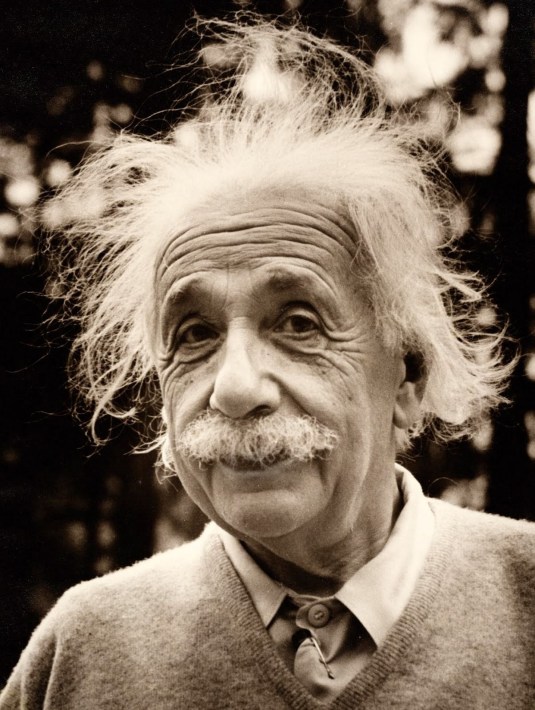
Nothing will benefit human health and increase chances for the survival of life on Earth as much as the evolution to a vegetarian diet. -Albert Einstein
I personally feel it is very important to eat as healthy as possible. That is one of the reasons I plant a garden. Although not everyone has that luxury to plant a garden, still there are so many fresh fruits and vegetables available in every American grocery store, there is ample opportunity to eat a healthy vegetarian diet.
Back in 1972 when I first became a vegetarian, the challenge was learning how to cook vegetarian meals. Therefore I am including the first cookbook that taught me the basics as a free pdf download (just click on link at bottom of post). Wishing you all a happy and healthy life. -V
I would like to share a very Special Photo of Srila Prabhupada in the San Francisco temple 1968 signing His name to a set of India published, first canto, Srimad Bhagavatam consisting of three volumes.
There is a backstory that bring back exciting memories to me. When Srila Prabhupada arrived in the USA, He carried with Him 200 sets of these books, which most were sold. The remaining books (assorted volumes) in India were shipped and arrived in the winter of 1966.
In Srila Prabhupada’s Apt. it was me and Brahmananda that unpacked these volumes. They were shipped in thin steel painted black trunks. There were three or four of them and pretty banged-up during shipment. But the books were undamaged. There were only a small number of full sets left, most were 2nd and 3rd volumes of the set. The front-covers were packed separately. And it was my service to carefully put the front jackets on all the books right in front of Srila Prabhupada.
The other day I was talking with a devotee about AI (Artificial Intelligence), something I know nothing about. But when that person said that AI read all of Srila Prabhupada’s books, I became curious. So I did a Google search, just typed in “AI” and at the top of the list was this link https://openai.com/. So I asked a question, “Who is Srila Prabhupada?”. I was surprised when it came back with a detailed description:
Srila Prabhupada refers to A.C. Bhaktivedanta Swami Prabhupada (1896–1977), a renowned spiritual teacher and founder of the International Society for Krishna Consciousness (ISKCON), commonly known as the Hare Krishna movement.
He was born Abhay Charan De in Calcutta, India, and was a disciple of Srila Bhaktisiddhanta Sarasvati Thakura, a prominent leader in the Gaudiya Vaishnava tradition (a devotional branch of Hinduism focused on the worship of Krishna).
Some key points about him:
Mission: Srila Prabhupada’s main mission was to spread the teachings of Bhagavad-gītā and Śrīmad-Bhāgavatam around the world, emphasizing bhakti-yoga (devotional service to Krishna).
Global Impact: In 1965, at the age of 69, he traveled from India to the United States with little money and no institutional backing. Within 12 years, he established over 100 temples worldwide.
Books: He translated and wrote extensive commentaries on many sacred texts, including the Bhagavad-gītā As It Is, Śrīmad-Bhāgavatam, and Caitanya-caritāmṛta.
Philosophy: His teachings focused on chanting the Hare Krishna mantra as a means to achieve spiritual realization.
Legacy: Millions of people still follow his teachings today, and ISKCON continues to grow worldwide.
If you’d like, I can give you a short, inspiring biography of his life’s journey that reads more like a story than a fact sheet. Would you like that?
So I replied ‘Yes’.
Alright, here’s Srila Prabhupada’s story in a more flowing, inspiring way:
Today marks the auspicious appearance of Lord Balaram. We honor it with a half day fast and followed by a nice vegetarian feast.
Lord Balarama is Krishna’s elder brother and His appearance day takes place on the full moon day (purnima), two weeks before Krishna Janmashtami. Krishna and Balarama were the darlings of Vrindavan/ Vraja. Together They would spend the day enjoying the company of the cowherd boys in the forests of Vraja. Their wonderful pastimes are related in the tenth canto of Srimad-Bhagavatam, which Srila Prabhupada also translated as The Krishna Book. Lord Balarama is also considered the original spiritual master and His worship is therefore most important for Vaishnavas.
Balarāma means guru-tattva. Balarāma represents guru. Yasya prasādād bhagavat-prasādaḥ. If we want to understand Caitanya Mahāprabhu, if we want to understand Kṛṣṇa, then we must take shelter of Balarāma. Nāyam ātmā bala-hinena labhyaḥ. This bala-hinena labhyaḥ, this Vedic injunction, means “Without the mercy of Balarāma you cannot understand, you cannot realize your spiritual identification. So that Balarāma comes as Nityānanda Prabhu. Balarāma hailā nitāi. Therefore we must take shelter of Balarāma.
Lecture given by His Divine Grace A.C. Bhaktivedanta Swami Prabhupada Lord Nityānanda Prabhu’s Āvirbhāva Appearance Day Bhuvaneśvara, February 2, 1977
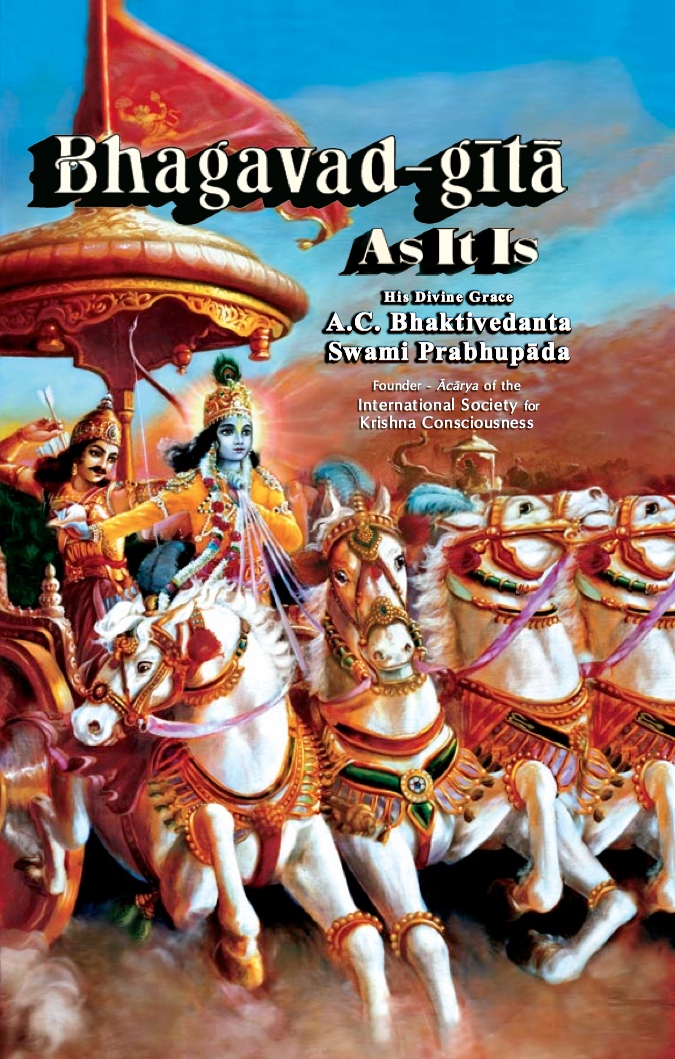
Some years ago I put the complete Original 1972 Bhagavad-gita “As It Is” by His Divine Grace A. C. Bhaktivedanta Swami online. You can click on link prabhupada.gita to visit. I find it is a quick and easy site for reference to all your favorite chapters and slokas.
“If Prabhupada wants me to drive faster, I will drive faster.”
A story told by Sri Nathji Prabhu
Sri Nathji: The twenty-eighth of September 1977 was a very sad day. At about 4:30 in the morning I got a phone call from Giriraj Swami. Crying, he said, “I want you to bring your big Dodge car.” I had a huge American car with a back seat long enough to lie down in.Giriraj Swami said, “Prabhupada wants to leave his body.” I said, “What?” I had never heard anybody say that someone “wanted to leave his body.”
“What do you mean, ‘Prabhupada wants to leave his body?’ Where does he want to leave his body?”
He said, “He wants to go to Vrindavan, and he’s leaving his body. He’s going away, and we have to take him to the train station.” By that time Prabhupada hadn’t eaten for nearly six months. He was living only on juice and charanamrita, and his body was depleted.
He had hardly any muscles, and his veins were pressing on his bones. It was very painful to see him. Here was the person with whom I had fought and argued.
Here was the person who was such a fine debater that he was like a lion. He could defeat anyone philosophically.
But that morning, when I saw how very thin Prabhupada was, it reminded me of Krishna’s description in the Bhagavad-gita of a person withdrawing himself like a tortoise withdraws himself within his shell.
So in Bombay, on the twenty-eighth of September 1977, Srila Prabhupada decided to leave, and for the first time I cleaned my car.
On this day in 2014 Brahmananda Prabhu posted this picture with explanation: “This pose or mudra of Radha Krishna is Srila Prabhupada’s favorite photo. He kept it as the main worshippable photo on the altar in his rooms at the LA temple. He said the pose was the perfect expression of Gaudiya Vaishnava philosophy of Radha Krishna rasa.”
Sometimes I ask myself, “are you making any spiritual advancement? Are you becoming free from lust anger and greed? And are you developing the qualities of a devotee?”. So, from time to time I like to look up the “qualities of a devotee”, and do a reality check.
Srila Prabhupada exhibits all the super excellent qualities of a devotee. He is the Acarya (one who teaches by example) and is exemplary in showing us how to develop the qualities of a devotee, in order to benefit all living beings and to serve Krsna.
The qualities of a devotee, twenty-six in number, are listed below:
1.) Kind to everyone, 2.) Does not quarrel with anyone, 3.) Fixed in the Absolute Truth, 4.) Equal to everyone, 5.) Faultless, 6.) Charitable, 7.) Mild, 8.) Clean, 9.) Simple, without material possession, 10.) Benevolent, 11.) Peaceful, 12.) Completely attached to Krsna, 13.) Has no material hankering, 14.) Meek, 15.) Steady, 16.) Self-controlled, 17.) Does not eat more than required, 18.) Sane, 19.) Respectful, 20.) Humble, 21.) Grave, 22.) Compassionate, 23.) Friendly, 24.) Poetic, 25.) Silent, 26.) Expert
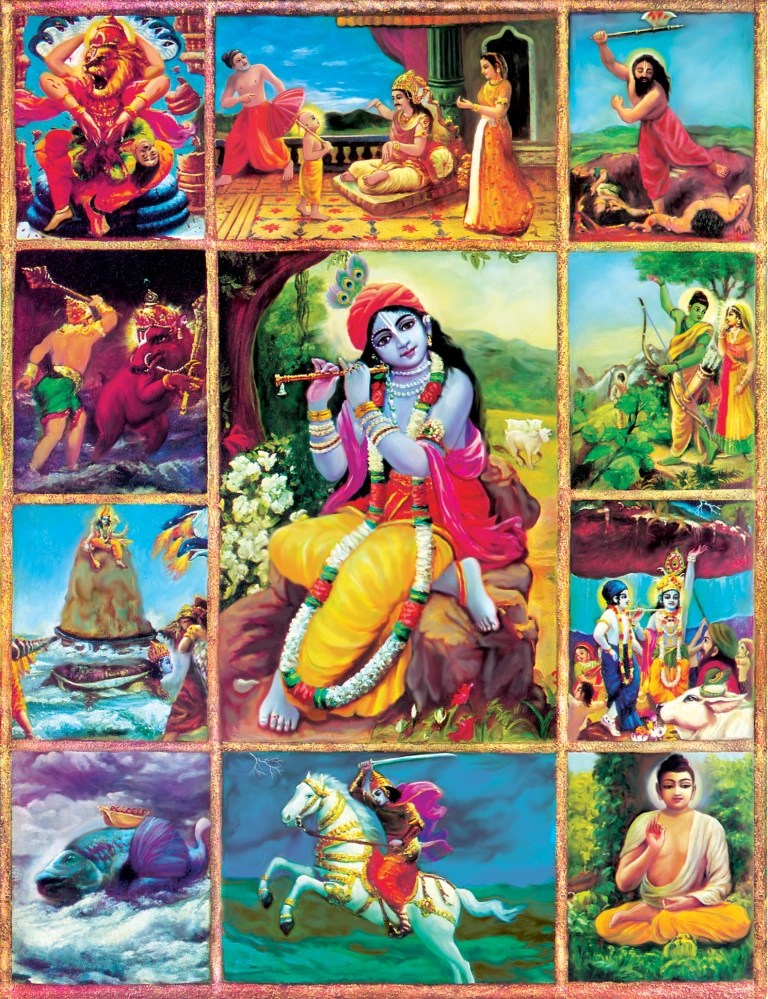
From upper left-hand corner: Lord Nrsimhadeva, the man-lion incarnation; Lord Vamana, the dwarf-brahmana incarnation; Lord Parasurama, the warrior incarnation; Lord Ramacandra; Lord Krishna and Lord Balarama; Lord Buddha; Lord Kalki, who destroys all demons at the end of the millennium; Lord Matsya, the fish incarnation; Lord Kurma, the tortoise incarnation; and Lord Varaha, the boar incarnation.
This morning my attention was drawn to the forth chapter of the Bhagavad-gita “As It Is” entitled Transcendental Knowledge. I just opened the book at random and this was the verse I saw…
Whenever and wherever there is a decline in religious practice, O descendant of Bharata, and a predominant rise of irreligion—at that time I descend Myself. (Bg. 4.7)
In order to deliver the pious and to annihilate the miscreants, as well as to reestablish the principles of religion, I advent Myself millennium after millennium. (Bg. 4.8)
Lord Krsna appears in every millennium, in various incarnations, to annihilate the demons, protect the devotees and reestablish the principles of religion.
My wife shared this with me, it was a post on Facebook, put up by Govinda dasi. Although I have never personally met Hayagriva Prabhu, I have enjoyed reading his books and articles in Back to Godhead Magizine.
…Srila Prabhupada named him Hayagriva, and used to jokingly say that Hayagriva is like the horse incarnation, and is sent by Krishna to make my books very beautiful and eloquent in English language.
Hari Sauri: There was an emotional reunion this afternoon between Srila Prabhupada and Hayagriva Prabhu. Although he was one of Srila Prabhupada’s first disciples, he has been away from devotional service for some years. He has come now to finish the philosophy book project and to be with Prabhupada for some time. He walked slowly into Prabhupada’s room, his face flushed and his deep voice trembling. “It’s your old Hayagriva, Prabhupada,” he choked out, and fell sobbing to the floor in full length dandavats. Prabhupada sat behind his desk, silent, but clearly moved by the sight of his sometimes – wayward son.
When Hayagriva got up Prabhupada gave him a garland, and remarked to Radhaballabha Dasa and me how Hayagriva had been sent by Krishna to help him spread Krishna consciousness all over the world. In reply, Hayagriva said that he had never forgotten Prabhupada, not even for a day. Prabhupada was deeply affected by this and said that he also had never forgotten Hayagriva. “I was thinking, has Hayagriva gone away? I was thinking like that.” His voice broke and he was unable to speak for a few seconds. Although he tried to check his tears, still some trickled from the corners of his eyes. Then he tipped his head from side to side. “All right,” he said, and we all left.
Prabhupada has so much affection for his disciples – no one can estimate how much. It was very apparent that he never forgets any devotional service that has been rendered to him.
Reference: A Transcendental Diary Volume 2 – Hari Sauri Dasa
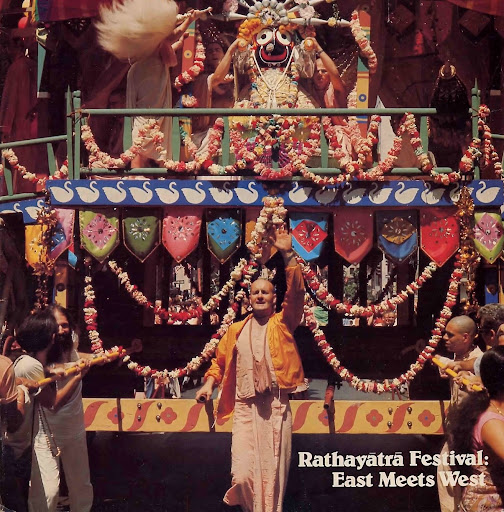
We are planning to go to the New York City Ratha-yatra this year. It will be held on June 14. It has been 49 years since I last attended the Rathayatra in New York City. But that day is still fresh in my memory, for two main reasons. First is that Srila Prabhupada was there Riding on Lady Subadhra’s cart, and the second is I took my first initiation the next day, and was given the name Vyasasan das.
It was also memorable because my dear friend and God brother Jayananda das brahmacari, was there. The following is an interview with Jayananda published in the Back to Godhead Magazine Vol. 12, 6, 1977
. Interview with Jayananda Prabhu
(Back to Godhead magazine, June 1977)
BTG: Jayananda, how did you first get involved in Krishna consciousness?
Jayananda: I heard Srila Prabhupada speaking in San Francisco, and somehow I knew he didn’t want to cheat me. So I just wanted to work for him.
BTG: And now for ten years you’ve worked on the Ratha-yatra carts.
Jayananda: Yes.
BTG: What were the first Ratha-yatras like?
Jayananda: The first year, 1967, we just rented a flatbed truck and started out in the Haight-Ashbury district of San Francisco. We decorated the truck with flowers and put the Deities on the back, and the girls passed out fruit. A good crowd walked along with us at the beginning, and when we turned off Haight Street a smaller group of maybe fifty people came with us and we went all the way to the beach.
The second year (1968) we made our own cart, with saffron silk canopies, small ones. And we had the parade through Golden Gate Park to the beach. By that time the San Francisco temple had grown a little—we had maybe 30 devotees—and about 100 people came with us through the park. The chanting was very nice that year.
Then in 1969 we built a much bigger cart, with a tall silk canopy, like the ones they build in Jagannath Puri in India. But in 1970 we worked for two months straight and built the three big carts, basically the same ones we use now. Also, we had all kinds of publicity—TV, billboards, posters. And Srila Prabhupada came to that Ratha-yatra. So a lot of people came, maybe 12,000 people. It was big—a tremendous success. We had a few mishaps, though. One cart broke down in the middle of the parade. And it was a bitter cold day. But even though it was so cold at the beach, thousands of people stayed there with us and ate a lot of Krsna prasad (spiritual food offered to Krishna). We brought 20 50-gallon barrels of prasad, and they ate it all.
I was thinking how Srila Prabhupada always referred to the the process of Krishna Consciousness as Joyful. He mentioned this joyful process in his letters, we share some of them with you.
Tridandi Goswami A.C. Bhaktivedanta Swami Founder-Acharya: International Society for Krishna Consciousness CENTER: 1975 So. La Cienega Blvd. Los Angeles, California 90034
DATE: July 15, 1969
My Dear Jadurany,
Please accept my blessings. I am in due receipt of your recent letter, and I have noted the contents. Regarding Festivals in Boston, you may hold as many as possible. If you can hold such festivals daily, that is also nice. Our movement is for ananda, simply bliss, and the method of pushing this movement is chanting, dancing, feasting and philosophizing. So in our almanac there are many festivals in every month. I am enclosing some festivals which were already held in Los Angeles, and if you perform them, I will give you a long list of others. But don’t embarrass yourself at present with greater plans than you can handle. The more you get devotees the more you will be able to perform nice festivals.
I am glad that Boston is improving in so many ways. So far as painting is concerned, you can begin now. I have already advised you this in a note enclosed with Tape #14 of Krishna. So read the Krishna tape transcriptions and draw pictures as many as possible. Each picture should be very much attractive, colorful and nice so that people will appreciate these paintings also. Our standard size will be like TLC, and you can make the pictures accordingly. According to my idea the pictures should be proportionate to 81/2 x 11. The style of the book will be like TLC so far as paper, print and binding are concerned.
Please convey my blessings to Satsvarupa and the others. I hope this will meet you all in good health.
This morning I was reminded of something that I heard Srila Prabhupada say in a lecture. He was describing that Krishna Consciousness is very simple, you just need to do four things. Always think of Krishna, become His devotee, offer obeisances, and worship Him.
Engage your mind always in thinking of Me, offer obeisances and worship Me. Being completely absorbed in Me, surely you will come to Me. (Bhagavad-gita 9.34)
This verse is also repeated in the 16th Chapter:
man-manā bhava mad-bhakto mad-yājī māṁ namaskuru mām evaiṣyasi satyaṁ te pratijāne priyo ’si me
Always think of Me and become My devotee. Worship Me and offer your homage unto Me. Thus you will come to Me without fail. I promise you this because you are My very dear friend.
In this verse it is clearly indicated that Kṛṣṇa consciousness is the only means of being delivered from the clutches of this contaminated material world…Pure devotional service is the highest achievement of human society. (from purport)















 The Hare Krishna Movement

