
Prasadam
This article includes both the Bhagavad-gita verse 3.13 and a letter written in 1968 to Nandarani dd which both help explaine the importance of Prasadam
Every Town and Village
17 Sep 2011 Leave a comment
in Letters by Srila Prabhupada, Prasadam, Vegetarianism Tags: Aniruddha, Bhagavad-gita 3.13, Letters by Srila Prabhupada, Nandarani dd, non-vegetarian, Prasadam, Srila Prabhupada, vegetarian
Prasadam
This article includes both the Bhagavad-gita verse 3.13 and a letter written in 1968 to Nandarani dd which both help explaine the importance of Prasadam
16 Sep 2011 Leave a comment
in A.C. Bhaktivedanta Swami Prabhupada, Krsna Consciousness: The Topmost Yoga System, Yoga Tags: bhagavad-gita, bhakti yoga, hatha yoga, Kali-yuga, krsna consciousness, Srila Prabhupada, the perfection of yoga, topmost yoga system, yoga

Simply to make a show of gymnastics is not perfection of yoga. Yoga means control of the senses. If you indulge your senses unrestrictedly but make a show of yoga practice, you will never be successful.
Krsna Consciousness: The Topmost Yoga System
By His Divine Grace A.C. Bhaktivedanta Swami Prabhupada
Chapter One
The Perfection of Yoga
Lord Kṛṣṇa, the Supreme Personality of Godhead, speaks about the topmost system of yoga in the Sixth Chapter of Bhagavad-gītā. There He has explained the haṭha-yoga system. Please remember that we are preaching this Kṛṣṇa consciousness movement on the authority of Bhagavad-gītā. It is nothing manufactured. The bhakti-yoga system is authorized, and if you want to know about God, then you have to adopt this bhakti-yoga system because in the Sixth Chapter of Bhagavad-gītā it is concluded that the topmost yogī is he who is always thinking of Kṛṣṇa within himself.
12 Sep 2011 Leave a comment
in Devotee's, Diksha, Iskcon Bangalore, Siksa Tags: Bangalore devotees, GBC, ISKCON Bangalore, Iskcon Times, Madhu Pandit Das, Radhapran das, Srila Prabhupada

At this critical juncture of the tussle between ISKCON Mumbai and ISKCON Bangalore, I together with the devotees here in Malaysia, pledge support for His Grace Madhu Pandit Prabhu and the devotees of ISKCON Bangalore. Knowing only too well the many similar tribulations experienced in Malaysia over the last decade, it is obvious that the same demeaning tactics magnified manifold are at work to disrepute the good work accomplished by the devotees of ISKCON Bangalore.
Pledge of Support for ISKCON Bangalore
By: Radhapran Dasa, Malaysia
It gives me much grief to see what appears to be a concerted effort by the ISKCON GBC to smear the good name of His Grace Madhu Pandit Prabhu whom I have had the fortune to know personally since 1999. His association has been a stark contrast to that of the thuggish bogus gurus whom I have had the misfortune of encountering in my early association with ISKCON.
Having understood and accepted the authentic position of Srila Prabhupada as the sole diksha guru for ISKCON through contact with other like-minded devotees and evidence related to Srila Prabhupada’s books on Guru tattva and the principal documents pertaining to the process of initiation such as the May 28th conversation, July 9th letter and the Official Will, my team of devotees initially faced an uphill task of disengaging ourselves from the deviation-ridden GBC-led setup in Malaysia. We have faced both direct harassment and indirect plots to undermine our existence since 1999.
10 Sep 2011 1 Comment
in Hansadutta das, Nam Hatta, Practicing Krishna Consciousness at Home, Srila Prabhupada His Movement & You Tags: chanting Hare Krishna, guru, hansadutta das, ISKCON GBC, Lord Caitanya, Nam Hatta, Sri Caitanya-caritmrta, Srila Prabhupada

Devotees keep asking themselves, “How will the Krishna consciousness movement spread under the present circumstances?”
They observe the lame leadership and feel personally helpless to make any change or contribution toward rectifying the situation or themselves. The answer to this debilitating state of thought is to see one’s self in the correct spiritual perspective. The devotees who helped Prabhupada spread his movement ISKCON are the same ones who can and will spread Krishna consciousness now and in the future. All that is required is that each individual devotee see himself as the servant of Prabhupada, now exactly as he was then (when Prabhupada was present)…
“The temple center is started just to present an example to the neighboring residents, how they can make a small temple in each and every home. It is not necessary that hundreds and thousands of people will live in our temple, but if we can make effective propaganda, then the neighboring residents, householders, will be inclined to be initiated and follow the modes of temple life. So you can encourage the visitors, boys and girls, as well as married couples, to understand the value of life and how they can peacefully and happily live if they follow the routine worship method in the temple and establish this in their home to be happy in all respects.” (Srila Prabhupada, letter to Tamal Krishna, June 1, 1969)
Nam Hatta: The Onus is On You
By Sriman Hansadutta Prabhu
Because of the circumstances under which most of Prabhupada’s early disciples joined the movement, a widespread misunderstanding has become a great obstacle for people in general to accept and practice Krishna consciousness in a realistic and progressive way under all circumstances. That misunderstanding is that a serious candidate for accepting and advancing in Krishna consciousness must abandon his worldly environment and responsibilities to join a temple ashram and live a communal or communistic life style under the rigid authority of an ISKCON GBC or guru. Nothing could be further from the truth, as we can plainly understand from the following descriptions of Lord Chaitanya’s preaching method and Prabhupada’s purports, which clearly support and obviously encourage the process introduced by Lord Chaitanya in His dealing with the Kurma brahmana and everyone He encountered throughout His two years of traveling and preaching in South India.
07 Sep 2011 Leave a comment
in Bhagavad-gita Tags: Arjuna, Bhagavad-gita As It Is, His Divne Grace A.C. Bhaktivedanta Swami, Macmillian 1972 edition, Srila Prabhupada, Supreme Brahman, Supreme Lord Krsna

Kṛṣṇa is the Supreme Personality of Godhead, and one should always meditate upon Him and enjoy one’s transcendental relationship with Him. He is the supreme existence…He is the supreme origin; He has no cause, for He is the cause of all causes, and everything is emanating from Him. This perfect knowledge can be had by the grace of the Supreme Lord.
Bhagavad-gita As It Is – Macmillan 1972 Edition
By His Divine Grace A.C. Bhaktivedanta Swami Prabhupada
Chapter 10 The Opulence of the Absolute
Text 12-14
arjuna uvāca
paraṁ brahma paraṁ dhāma
pavitraṁ paramaṁ bhavān
puruṣaṁ śāśvataṁ divyam
ādi-devam ajaṁ vibhum
āhus tvām ṛṣayaḥ sarve
devarṣir nāradas tathā
asito devalo vyāsaḥ
svayaṁ caiva bravīṣi me
Arjuna said: You are the Supreme Brahman, the ultimate, the supreme abode and purifier, the Absolute Truth and the eternal divine person. You are the primal God, transcendental and original, and You are the unborn and all-pervading beauty. All the great sages such as Nārada, Asita, Devala, and Vyāsa proclaim this of You, and now You Yourself are declaring it to me.
PURPORT
In these two verses the Supreme Lord gives a chance to the modern philosopher, for here it is clear that the Supreme is different from the individual soul. Arjuna, after hearing the essential four verses of Bhagavad-gītā in this chapter, became completely free from all doubts and accepted Kṛṣṇa as the Supreme Personality of Godhead. He at once boldly declares, “You are Parambrahma, the Supreme Personality of Godhead.” And previously Kṛṣṇa states that He is the originator of everything and everyone. Every demigod and every human being is dependant on Him. Men and demigods, out of ignorance, think that they are absolute and independant of the Supreme Lord Kṛṣṇa. That ignorance is removed perfectly by the discharge of devotional service. This is already explained in the previous verse by the Lord. Now by His grace, Arjuna is accepting Him as the Supreme Truth, in concordance with the Vedic injunction. It is not because Kṛṣṇa is an intimate friend of Arjuna that he is flattering Him by calling Him the Supreme Personality of Godhead, the Absolute Truth. Whatever Arjuna says in these two verses is confirmed by Vedic truth. Vedic injunctions affirm that only one who takes to devotional service to the Supreme Lord can understand Him, whereas others cannot. Each and every word of this verse spoken by Arjuna is confirmed by Vedic injunction.
07 Sep 2011 2 Comments
in Bhaktisiddhanta das, Devotee's, Diksha, Guru & Disciple, Siksa Tags: Acharya, Bhaktisiddhanta dasa, guru, initiates, ritvik, Ritvik initiation, spiritual name, Srila Prabhupada
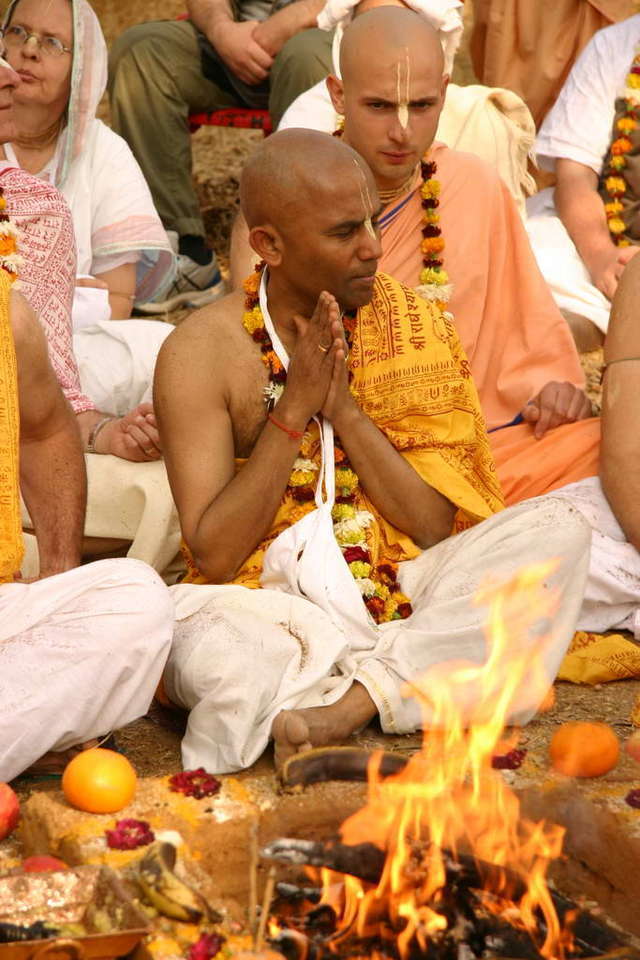
Nearly Everyone Is Ritvik
Bhaktisiddhanta Dasa – Vrndavan:
Has everyone forgotten what happened in the past? In the early ‘70’s Srila Prabhupada started his own ritvik system, surprise! At some point it became too much to chant on everyone’s beads and give the new spiritual names so what to do? He appointed some of his senior men to cover these details so he could go on with his writing and management of a world organization.
My wife and I were initiated in 1975 in Los Angeles, Srila Prabhupada had left the day before to go to San Francisco, by this time he deputed his personal secretary and Sanskrit scholar to look up the names; and then he would approve or disapprove.
During the fire sacrifice it was Hridayananda Maharaja that was standing next to the Vyasasana and handed out the beads and asked for the four regulative principles. Each time a new name was given there was a loud HARIBOL and everyone applauded.
05 Sep 2011 1 Comment
in Devotee's, Mukunda das Goswami, Srila Prabhupada Tags: A.C. Bhaktivedanta Swami Prabhupada, Hare Krishna, Indian Swami, Mukunda das, servant of God, Srila Prabhupada, The Science of Self Realization
The Science of Self Realization
Foreword By Mukunda Das
From the very start, I knew that His Divine Grace A. C. Bhaktivedanta Swami Prabhupāda was the most extraordinary person I had ever met. The first meeting occurred in the summer of 1966, in New York City. A friend had invited me to hear a lecture by “an old Indian svāmī” on lower Manhattan’s Bowery. Overwhelmed with curiosity about a svāmī lecturing on skid row, I went there and felt my way up a pitch-black staircase. A bell-like, rhythmic sound got louder and clearer as I climbed higher. Finally I reached the fourth floor and opened the door, and there he was.
About fifty feet away from where I stood, at the other end of a long, dark room, he sat on a small dais, his face and saffron robes radiant under a small light. He was elderly, perhaps sixty or so, I thought, and he sat cross-legged in an erect, stately posture. His head was shaven, and his powerful face and reddish horn-rimmed glasses gave him the look of a monk who had spent most of his life absorbed in study. His eyes were closed, and he softly chanted a simple Sanskrit prayer while playing a hand drum. The small audience joined in at intervals, in call-and-response fashion. A few played hand cymbals, which accounted for the bell-like sounds I’d heard. Fascinated, I sat down quietly at the back, tried to participate in the chanting, and waited.
03 Sep 2011 Leave a comment
in Festivals, Lectures, Srimati Radharani Tags: Krishna, Radha, Radharani, Radhastami, Srila Prabhupada, Srimati Radharani, Srimati Radharani's Apperance Day

Rādhārāṇī is hari-priyā, very dear to Kṛṣṇa. So if we approach Kṛṣṇa through Rādhārāṇī, through the mercy of Rādhārāṇī, then it becomes very easy. If Rādhārāṇī recommends that “This devotee is very nice,” then Kṛṣṇa immediately accepts, however fool I may be. Because it is recommended by Rādhārāṇī, Kṛṣṇa accepts. Therefore in Vṛndāvana you’ll find all the devotees, they’re chanting more Rādhārāṇī’s name than Kṛṣṇa’s. Wherever you’ll go, you’ll find the devotees are addressing, “Jaya Rādhe.” You’ll find still in Vṛndāvana. They are glorifying Rādhārāṇī. They’re more interested, worshiping Rādhārāṇī. Because however fallen I may be, if some way or other I can please Rādhārāṇī, then it is very easy for me to understand Kṛṣṇa.
The devotees of the Lord in Vaikuntha want to see the Lord as most beautiful, but the devotees in Vrindavana want to see Radharani as even more beautiful than Krishna
Rādhāṣṭamī:
Śrīmatī Rādhārāṇī’s Appearance Day
Lecture given by His Divine Grace A. C. Bhaktivedanta Swami Prabhupada
London, August 29, 1971
Prabhupāda: (chants maṅgalācaraṇa prayers) Today is birth, appearance day of Śrīmatī Rādhārāṇī, Rādhāṣṭamī. Fifteen days after Kṛṣṇa’s birth, Rādhārāṇī appeared. (pause) Rādhārāṇī is Kṛṣṇa’s pleasure potency. Rādhā-kṛṣṇa-praṇaya-vikṛtir hlādinī-śaktiḥ. More
31 Aug 2011 Leave a comment
in Arjuna das, Devotee's, Srila Prabhupada, Vyas-puja Tags: Arjuna das, By Your Mercy, Sampradaya sun, Srila Prabhupada, Vyasa-puja offering
By Your Mercy
By: Arjuna Das
Aug 29, 2011 — INDIA (SUN) —
An offering to Srila Prabhupada by Arjuna das.
Dear Srila Prabhupada,
Someone explained to me once that ‘ by your mercy’ , we can speak something on this day even though there may be some literary flaws. Just like a loving father appreciates the incoherent stammering of his young child as the child tries to express his affections, by your mercy, you appreciate our outpourings and heartfelt appreciations reposed at your lotus feet.
Your Divine grace is the personification of the bliss of Krsna’s mercy. You are the storehouse of compassion for the poor and suffering souls. You reveal divine knowledge, pure devotion, and ecstatic love of God, and you are the savior of the fallen souls. Therefore I pray to offer this mind, body, and very life at your lotus feet and always hope to chant the divine names of Sri Hari.”
‘By your mercy’ I am getting to understand more and more that your Divine Grace is truly the only light and love in this very dark, temporary world. You are the Supreme Personality of the servitor of Godhead.
30 Aug 2011 Leave a comment
in Guru & Disciple, Letters by Srila Prabhupada, Sriman George Harrison Tags: Dhananjaya, Jai Hari, Krishna, Rebatinandana Swami, Srila Bhaktisiddhanta Saraswati Thakur, Srila Prabhupada, Sriman George Harrison

I can understand by your activities that you are making good spiritual progress, by Krishna’s grace. That is very good news to me. It is not by accident that you are coming gradually to the right point, neither it is very common thing,
Bombay
4th January, 1973
My Dear George,
Please accept my blessings. I was informed by some of my disciples at London, namely, Dhananjaya, Jai Hari, Rebatinandana Swami and others, that you so kindly have sent your car and drive to our place filled-up with fruits and flowers to offer to Radha and Krishna on the Disappearance day of my Guru Maharaj, Srila Bhaktisiddhanta Saraswati Thakur. I am so much pleased that you have thought of Him in that way, thank you very much. Surely you will become blessed by Him more and more.
Yes, if one simply comes to that platform of spontaneous love for the spiritual master, then very quickly he will get love of God, or Krishna, and his all hankerings and lamentations of life will be finished. That is the process. Just like when two friends meet and, if the friend is also with his dog, the gentleman pats his dog first, is it not? So the friend becomes automatically pleased, his dog being patted. I have seen it in your country sometimes when I used to walk in the Regents Park early mornings. So it is like that, the spiritual master is the pet dog of Krishna, and if he is pleased so Krishna is also pleased. That is the process.
25 Aug 2011 Leave a comment
in Guru & Disciple, Iskcon Bangalore, Vyas-puja Tags: diciple, guru, ISKCON Bangalore, Madhu Pandit dasa, spiritual master, Srila Prabhupada, Vyasa Puja

A Vyasapuja offering to His Divine Grace.
By: Madhu Pandit dasa
Dear Srila Prabhupada, please accept my most respectful, humble obeisances. All glories to Your Divine Grace!
Srila Prabhupada, Your Divine Grace have displayed so many exalted qualities during the years that you physically graced this world. In the midst of the most degraded age we live in, it is the good fortune of humanity to have been blessed with your transcendental wisdom. It is our greatest fortune that our lives have been touched by your divine mercy.
On this auspicious day I humbly wish to contemplate on one of the aspects of your transcendence that has greatly impacted me from the very first day I came in touch with you. Your presentation of the purity of guru Tattva or the principle and surrender of a disciple to a Guru, who is a personal representation of such purity was most impressive. You uncompromisingly present the truth by severing the falsehood. You teach who the guru is by your personal example.
23 Aug 2011 Leave a comment
in Back to Godhead, Books by Srila Prabhupada, Brahmananda das, Radha Damodar Mandir Tags: back to Godhead, books of His Divine Grace, Brahmananda Swami, Radha-Damodara, six goswami's, Srila Prabhupada, Vrndavan
 The Books of His Divine Grace A.C. Bhaktivedanta Swami Prabhupada
Originally published in Back to Godhead No. 52
Bhaktivedanta Book Trust 1973
By Brahmananda Swami ISKCON East Africa
Part 2
The treasure of Radha-Damodara is the samadhi and bhajana(place for executing devotional service) of Srila Rupa Goswami. Of the six Goswami’s, he is the most importnt. Rupa Goswami constructed the largest temple in Vrndavana, Radha-Govindaji, and he wrote the most important book on the science of devotional service, Bhakti-rasamrta-sindhu, which was completed in the year 1552. He and his elder brother Sanatana Goswami were among the chief government administrators of their time and were highly learned in Arabic, Persian and Sanskrit. Lord Caitanya personally instructed Rupa Goswami for ten consecutive days, and Bhakti-rasamrta-sindhu codifies these teachings, with supporting evidence from scores of supplementary Vedic texts.
One great acarya (teacher) in the parampara (disciplic succession) has offered obeisances to the six Goswami’s in the following manner; “They are very expert in scrutinizingly studying all the revealed scriptures with the aim of establishing eternal religious principles for the benefit of all human beings. Thus they are honored all over the three worlds, and they are worth taking shelter of because they are absorbed in the mood of the gopis and are engaged in the transcendental loving service of Radha and Krsna.” In one of Srila Prabhupada’s rooms in the Radha Damodara temple there is a window thatoverlooks the shaded courtyard where the tow tomblike structures that honor Rupa Goswami stand. Just before this window is a bare wood asana (seat) where Srila Prabhupada sat to receive inspiration from the greatest of the Goswami’s From the other where he wrote his books, Srila Prabhupada could look out and see Jiva Goswami’s own worshipable Deities, Radha-Damodara.
22 Aug 2011 1 Comment
in Hare Krishna Maha Mantra, Krishna, Krishna Consciousness Tags: Hare Krishna Maha-mantra, Krishna, Krishna's Flute, Sri Caitanya-caritamrta, Srila Prabhupada, The Opulence and Sweetness of Lord Sri Krsna

Sri Caitanya-caritamrta – 1975 Edition
By His Divine Grace A.C. Bhaktivedanta Swami Prabhupada
The Opulence and Sweetness of Lord Sri Krsna
Madhya 21.144
“The vibration of His flute is just like a bird that creates a nest within the ears of the gopīs and always remains prominent there, not allowing any other sound to enter their ears. Indeed, the gopīs cannot hear anything else, nor are they able to concentrate on anything else, not even to give a suitable reply. Such are the effects of the vibration of Lord Kṛṣṇa’s flute.”
PURPORT
The vibration of Kṛṣṇa’s flute is always prominent in the ears of the gopīs. Naturally they cannot hear anything else. Constant remembrance of the holy sound of Kṛṣṇa’s flute keeps them enlightened and enlivened, and they do not allow any other sound to enter their ears. Since their attention is fixed on Kṛṣṇa’s flute, they cannot divert their minds to any other subject. In other words, a devotee who has heard the sound of Kṛṣṇa’s flute forgets to talk or hear of any other subject. This vibration of Kṛṣṇa’s flute is represented by the Hare Kṛṣṇa mahā-mantra. A serious devotee of the Lord who chants and hears this transcendental vibration becomes so accustomed to it that he cannot divert his attention to any subject matter not related to Kṛṣṇa’s blissful characteristics and paraphernalia.
Pasted from; PrabhupadaBooks.com
22 Aug 2011 Leave a comment
in Gaudiya Math, Lectures, Science of Self Realization, Srila Prabhupada Tags: Gaudiya Matha, Spiritual Life, Srila Prabhupada, The Science of Self Realization, Vyasa Puja

The Absolute Necessity of a Spiritual Master
From; The Science of Self Realization
By His Divine Grace A.C. Bhaktivedanta Swami Prabhupada
In February 1936, in Bombay, India, the members of a reputed religious society, the Gauḍīya Maṭha, were astonished by the powerful and eloquent words of a young member who spoke in honor of his spiritual master, Śrīla Bhaktisiddhānta Sarasvatī Gosvāmī. Three decades later, the young speaker would become the world-renowned founder and spiritual master of the Kṛṣṇa consciousness movement. Śrīla Prabhupāda’s presentation is a memorable statement on the importance of the guru in spiritual life.
sākṣād-dharitvena samasta-śāstrair
uktas tathā bhāvyata eva sadbhiḥ
kintu prabhor yaḥ priya eva tasya
vande guroḥ śrī-caraṇāravindam
“In the revealed scriptures it is declared that the spiritual master should be worshiped like the Supreme Personality of Godhead, and this injunction is obeyed by pure devotees of the Lord. The spiritual master is the most confidential servant of the Lord. Thus let us offer our respectful obeisances unto the lotus feet of our spiritual master.”
Gentlemen, on behalf of the members of the Bombay branch of the Gauḍīya Maṭha, let me welcome you all because you have so kindly joined us tonight in our congregational offerings of homage to the lotus feet of the world teacher, Ācāryadeva, who is the founder of this Gauḍīya Mission and is the president-ācārya of Śrī Śrī Viśva-vaiṣṇava Rāja-sabhā—I mean my eternal divine master, Paramahaṁsa Parivrājakācārya Śrī Śrīmad Bhaktisiddhānta Sarasvatī Gosvāmī Mahārāja.
22 Aug 2011 Leave a comment
in Festivals, Lectures, Srila Prabhupada, Vyas-puja Tags: birthday of the spiritual master, New Vrindavan 1972 Vyasa-Puja, representative of Vyasa, Srila Prabhupada

Śrī Vyāsa Pūjā Address
New Vrindaban, September 2, 1972
by His Divine Grace A.C. Bhaktivedanta Swami Prabhupada
…So this Vyāsa-pūjā means one day in a year, on the birthday of the spiritual master, because he is representative of Vyāsa, he is delivering the same knowledge which has come down by disciplic succession without any change, he is offered the respect. This is called Vyāsa-pūjā…
Prabhupāda: Ladies and gentlemen, this ceremony… Of course, those who are my students, they know what is this ceremony. Those who are visitors, for their information, I may inform you something about this ceremony. Otherwise, it may not be misunderstood. A outsider may see it that “Why a person is being worshiped like God?” There may be some doubt. So this is the etiquette. This ceremony is called Vyāsa-pūjā. Vyāsa. Vyāsa means the original author of Vedic literature. He is incarnation of Nārāyaṇa. He gave us all Vedic knowledge. He received the knowledge from Nārada. Nārada received the knowledge from Brahma. Brahmā received the knowledge from Kṛṣṇa. So in this way, by disciplic succession, we get transcendental knowledge.
20 Aug 2011 Leave a comment
in Festivals, Krishna Tags: Birth of Lord Krsna, Janmastami, Krishna Janmastami Celebration, Krsna The Supreme Personality of Godhead, Lord Krishna's birth ceremony, Srila Prabhupada, Vedic mantras

Krishna Janmastami Celebration
…In that ceremony, all the brāhmaṇas assembled began to chant different kinds of Vedic mantras to invoke all good fortune for the child. Along with this chanting of mantras and songs, bugles and kettledrums sounded outside the house. On this occasion, the joyous vibrations could be heard in all the pasturing grounds and all the houses.
When all the ecstatic cowherd men heard that Nanda Mahārāja, father of Kṛṣṇa, was celebrating the birth ceremony of his son, they became spontaneously joyful. They dressed themselves with very costly garments and ornamented their bodies with different kinds of earrings and necklaces and wore great turbans on their heads. After dressing themselves in this gorgeous way, they took various kinds of presentations and thus approached the house of Nanda Mahārāja.
As the dust on the lotus flower exhibits the exquisite beauty of the flower, all the gopīs (cowherd girls) applied the dust of kuṅkuma on their lotus-like faces. These beautiful gopīs took their different presentations and very soon reached the house of Mahārāja Nanda. Overburdened with their heavy hips and swollen breasts, the gopīs could not proceed very quickly towards the house of Nanda Mahārāja, but out of ecstatic love for Kṛṣṇa they began to proceeded as quickly as possible. Their ears were decorated with pearl rings, their necks were decorated with jewel padlocks, their lips and eyes were decorated with different kinds of lipstick and ointment, and their hands were decorated with nice golden bangles. As they were very hastily passing over the stone road, the flower garlands which were decorating their bodies fell to the ground, and it appeared that a shower of flowers was falling from the sky. From the movement of the different kinds of ornaments on their bodies, they were looking still more beautiful. In this way, they all reached the house of Nanda-Yaśodā and blessed the child: “Dear child, You live long just to protect us.” While they were blessing child Kṛṣṇa in this way, they offered a mixture of turmeric powder with oil, yogurt, milk and water. They not only sprinkled this mixture on the body of child Kṛṣṇa but on all other persons who were present there. Also on that auspicious occasion, there were different bands of expert musicians playing.
20 Aug 2011 Leave a comment
in Ajitananda das, Devotee's, Srila Prabhupada Tags: 26 qualities of a pure devotee, Ajitananda das, His Divine Grace A.C. Bhaktivedanta Swami Prabhupada, Srila Prabhupada, trancendental qualities, Vyasa Puja

Srila Prabhupada’s Trancendental Qualities
By Ajitananda dasa
His Divine Grace A.C. Bhaktivedanta Swami Prabhupada, who successfully distributed the message of Lord Krsna throughout the world, was not an ordinary conditioned soul, governed by the harsh laws of material nature. Although to the unenlightened he may have appeared to exhibit commonplace characteristics, it is evident through the careful study of his life and activities, that Srila Prabhupada perfectly displayed the twenty-six qualities of a pure devotee of Lord Krsna. We learn from Vedic literature that one who possesses these qualities is necessarily free from material bondage, and enjoys an eternal position in the intimate association of the Supreme Lord. Such a great soul is very rarely found within this material realm, and owing to his unparalleled purity and exalted status, he is worshipable by the entire world. Individually, and as a collective society of aspiring devotees, we must always strive to appreciate Srila Prabhupada’s divine qualities, teach this application to others, and perform all of our devotional activities for his satisfaction. This treatise is an imperfect but hopeful attempt to please Srila Prabhupada by illustrating, in a practical way, how he perfectly displayed the twenty-six qualities of a pure devotee of Lord Krsna.
19 Aug 2011 Leave a comment
in Chanting Hare Krishna, Sri Caitanya-Caritamrta Tags: Caitanya Caritamrta, Hare Krishna, Hare Rama, holy name, liberation, Maha Mantra, Srila Prabhupada

The holy name of Lord Krishna is an attractive feature for many saintly, liberal people. It is the annihilator of all sinful reactions and is so powerful that save for the dumb who cannot chant it, it is readily available to everyone, including the lowest type of man, the candala. The holy name of Krishna is the controller of the opulence of liberation, and it is identical with Krishna.
Simply by touching the holy name with one’s tongue, immediate effects are produced. Chanting the holy name does not depend on initiation, pious activities or the purascarya regulative principles generally observed before initiation. The holy name does not wait for all these activities. It is self-sufficient. (Caitanya-caritmrta Mad.15.110)
Hare Krishna, Hare Krishna, Krishna Krishna, Hare Hare,
Hare Rama, Hare Rama, Rama Rama, Hare Hare…
16 Aug 2011 1 Comment
in Guru & Disciple, Spiritual Life Tags: Acarya, authority of guru, disciplic succession, false gurus, guru, Spiritual Life, spiritual master, Srila Prabhupada
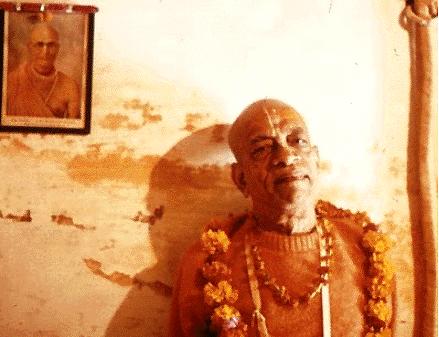
Srila Prabhupada speaks out on false Gurus
The principle of accepting a spiritual master is essential. Satisfaction of the self-realized spiritual master is the secret of advancement in spiritual life. Our Srila Prabhupada is the qualified, self-realized, spiritual master and is directly in line with the disciplic succession. And one can take shelter of him by simply reading his books and following his instructions, and make rapid advancement in spiritual life.
We should be very careful before accepting a Guru
“The sastras enjoin that before we take a guru we study him carefully to find out whether we can surrender to him. We should not accept a guru suddenly, out of fanaticism. That is very dangerous.”
(The Science of Self Realization, chapter 2, ‘Choosing a Spiritual Master’)
Ambition to be Guru is very dangerous
“Our mission is to serve (…). Not that you take the place of the guru. That is nonsense, very dangerous. Then everything will be spoiled. As soon as you become ambitious to take the place of guru-gurusu nara-matih . That is the material disease.”
(Srila Prabhupada Conversation, April 20, 1977)
“That is the difficulty. Everyone sees that “Some way or other, I become guru. Then so many persons will offer me respect. Somehow or other, create some situation. Then I become guru.” This is going on. Not bona fide guru. (…) They will drink, they will hunt after woman and have some attractive singing or dancing and become guru. What is meaning of guru, they do not know. Somehow or other become popular and become guru. This is going on.”
(Srila Prabhupada Conversation, May 2nd, 1976)
One who is disobedient to the order of the Guru cannot be a Guru
“If you become disobedient to guru, then your business is finished.”
(Srila Prabhupada’s Srimad-Bhagavatam Lecture, August 10th, 1974)
12 Aug 2011 1 Comment
in A.C. Bhaktivedanta Swami Prabhupada, Balarama, Spiritual World, Srila Prabhupada's Books Tags: Balarama, gopis, Lord Balarama Visits Vrndavana, rasa dance, Srila Prabhupada, Srimad Bhagavatam, Vrindavan forest

Lord Balarāma Visits Vṛndāvana
Lord Balarāma could, of course, understand the ecstatic feelings of the gopīs, and therefore He wanted to pacify them. He was expert in presenting an appeal, and thus, treating the gopīs very respectfully, He began to narrate the stories of Kṛṣṇa so tactfully that the gopīs became satisfied. In order to keep the gopīs in Vṛndāvana satisfied, Lord Balarāma stayed there continually for two months, namely the months of Caitra (March-April) and Vaiśākha (April-May). For those two months He kept Himself among the gopīs, and He passed every night with them in the forest of Vṛndāvana in order to satisfy their desire for conjugal love. Thus Balarāma also enjoyed the rāsa dance with the gopīs during those two months.
Lord Balarāma Visits Vṛndāvana
From; Kṛṣṇa, the Supreme Personality of Godhead
By His Divine Grace A. C. Bhaktivedanta Swami Prabhupada
Lord Balarāma became very anxious to see His father and mother, Mahārāja Nanda and Yaśodā. Therefore He started for Vṛndāvana on a chariot with great enthusiasm. The inhabitants of Vṛndāvana had been anxious to see Kṛṣṇa and Balarāma for a very long time. When Lord Balarāma returned to Vṛndāvana, all the cowherd boys and the gopīs had grown up; but still, on His arrival, they all embraced Him, and Balarāma embraced them in reciprocation. After this He came before Mahārāja Nanda and Yaśodā and offered His respectful obeisances unto them. In response, mother Yaśodā and Nanda Mahārāja offered their blessings unto Him. They addressed Him as Jagadīśvara, or the Lord of the universe who maintains everyone. The reason for this was that both Kṛṣṇa and Balarāma maintain all living entities, and yet Nanda and Yaśodā were put into such difficulties on account of Their absence. Feeling like this, they embraced Balarāma and, seating Him on their laps, began their perpetual crying, wetting Balarāma with their tears. Lord Balarāma then offered His respectful obeisances to the elderly cowherd men and accepted the obeisances of the younger cowherd men. Thus, according to their different ages and relationships, Lord Balarāma exchanged feelings of friendship with them. He shook hands with those who were His equals in age and friendship, and with loud laughing embraced each one of them.
Click on image to go to Post


click on image to visit site


click on image

click on image

click on image


click on image

click on image

click on image
 The Hare Krishna Movement