Once when Srila Prabhupada saw what was being served to the devotees, lavishly prepared multi-course lunches, he told the managers that it was too opulent. He said we should eat simply during the week with rice, dhal, chapatis and a little subji and once a week on the Sunday love feasts we could be more lavish. Today with more of us becoming Health Conscious, it is good to remember the very simple devotee diet that was recommended to us so long ago.
Standard Devotee Diet
Srila Prabhupada recommended a standard diet for the devotees, and instructed that all of the temples should follow it every day. That menu follows:
BREAKFAST:
Simple farina cereal with nuts and raisins
Milk (steaming hot), or yogurt in the summertime
Chick peas (raw, soaked overnight)
Ginger root (raw)
Oranges, apples and/or bananas
LUNCH:
Rice
Chapatis
Dal made with freshly ground ginger root and freshly ground spices
Subji made with ghee, freshly ground ginger root and freshly ground spices
BEFORE TAKING REST:
Milk (steaming hot)
Bananas
For a free download of the Hare Krishna Cookbook on pdf More
A godbrother of Srila Prabhupada’s remembers their early friendship and their meeting again after many years.
Dr. O.B.L. Kapoor: I didn’t know much about his household affairs, because we met mostly at the matha in the evening. He had a shop. He sold medicines, and he also manufactured them. Once he manufactured a tonic, and he gave it to me.
I said, “That’s nice, this gift of yours. I must accept it. But I wish you would give me the tonic which you yourself take the tonic of Krsna-prema [love of Krsna].”
He said, “I don’t have that tonic. But I have the formula.”
I said, “Oh, wonderful! If it is not a secret, tell me what the formula is.”
He said, “No, it is not a secret at all:
trnad api sunicena
taror iva sahisnuna
amanina manadena
kirtaniyah sada harih*
This is the formula, and I am going to preach it all over the world.”
*”One should chant the holy name of the Lord in a humble state of mind. One should be more tolerant than a tree, devoid of all sense of false prestige, and ready to offer all respects to others. In that way one can chant the holy name of the Lord constantly.” (Siksastaka 3)
At that time I couldn’t recognize the significance of his words, but he was going to preach it all over the world. I thought it was just a casual statement. But now I look back, and I can see that he was even then thinking and planning to preach all over the world, which he did.
…By development of Kṛṣṇa consciousness one can know that everything has its use in the service of the Lord.
…After cooking is finished and when it is offered to the Deity, then you take as much as you like, as much as you like. So that means there is God consciousness, that “This thing is being cooked for the Lord.” The cooking will go on. If you don’t think of God, you require cooking because you want to eat. The cooking is there in the program. But if you think that this cooking is done for God, then your God consciousness is there. The cooking you cannot avoid. As a householder you have to cook for yourself, you have to cook for your children, you have to cook for somebody else or for your own self. Just like I am cooking. I have no here family or children, but I am cooking for myself. So cooking you cannot stop. But if you cook with the understanding that “This foodstuff is being cooked for the Lord. The Lord may be offered first; then we shall take,” this is God consciousness. This is God consciousness. But is it very difficult thing? Anyone can accept this.” (Srila Prabhupada Lecture on Bhagavad-Gita, 04-01-66, New York)
…So on the higher platform, there is nothing material when everything is accepted in relationship with Krishna or the Supreme Spirit.
…Devotional service means transcendental activities.
Devotional service is not a matter of sentimental speculation or imaginative ecstasy. Its substance is practical activity.
The execution of devotional service is not a matter of idle meditation but practical action in the foreground of spiritual life.
“In the course of traversing the universal creation of Brahmā, some fortunate soul may receive the seed of bhakti-latā, the creeper of devotional service. This is all by the grace of guru and Kṛṣṇa.” (Caitanya-caritāmṛta, Madhya 19.151)
If by fortune one takes advantage of this opportunity to engage in devotional service, the path of liberation immediately opens.
One should accept this opportunity to return home, back to Godhead, very enthusiastically.
The Nectar of Instruction
By His Divine Grace A.C. Bhaktivedanta Swami Prabhupada
Kevin Lahart of Newsday interviews His Divine Grace A.C. Bhaktivedanta Swami Prabhupada
Mr. Lahart: I wonder if you could tell me how you came to found the Krsna consciousness movement here in the United States?
Srila Prabhupada: I was ordered by my spiritual master to do this work, so on his order I came to the U.S. I came alone, with no help or money. Somehow or other I stayed.
Mr. Lahart: How did you attract followers? You landed in New York and
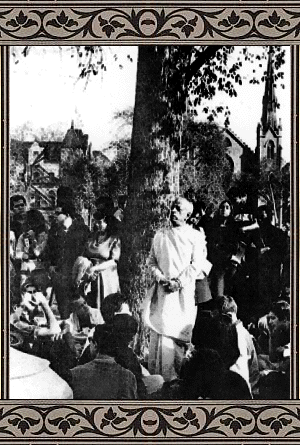
Srila Prabhupada: My attraction was this chanting of the Hare Krsna mantra. That’s all. I had no magic. Others had some sort of magic. I never showed any magic. At Tompkins Square Park I was chanting, and gradually some boys came. First a picture was published by the New York Times. Then we started a branch in San Francisco, later Montreal, Boston, then Los Angeles.
Mr. Lahart: You just chanted at Tompkins Square Park, and people came.
Srila Prabhupada: Yes, I chanted under a tree. (I think that a picture was also published in the East Village Other in a very big article.) Naturally, some boys came and joined me and began to dance. That was the beginning.
The 40th Anniversary Reunion Weekend at Toronto’s Hare Krishna Center “Sri Sri Radha Ksira-Chora Gopinatha Mandir” was held from Aug. 31-Sept. 2. It was great fun, and in addition to the many activities such as the Slideshow, Remembrances, Kirtans, Lunch Banquet and Dinners, Remembering Srila Prabhupada, Celebrating Sri Sri Radha Ksira-Chora Gopinatha, there was the amazing Historic Double Decker Bus Tour of Toronto. The Sankirtan was amplified from speakers on both bus’s, and was enjoyed by all!
On the island of Godrum in Nabadwip dham, the magnanimous Lord Nityananda has opened up the marketplace of the Holy Name, meant for the deliverance of all fallen souls. By Srila Bhaktivinode Thakur, performed by Agnideva das.
“That is the way of Krishna consciousness. Pure devotees are so absorbed in thought of Krishna that they have no other engagement; although they may seem to think or act otherwise, they are always thinking of Krishna. The smile of such a Krishna conscious person is so attractive that simply by smiling he wins so many admirers, disciples and followers.” (from purport to Srimad Bhagavatam, 3.22.21)
There is a new domain “Jayanandathakur.com” and the new and wonderful Jayananda website, http://www.jayanandathakur.com. We give many thanks to Veronica (Vera) Chatworth, for her expert service and love and devotion for Jayananda, and producing this amazing new website for displaying his recently opened memorial in Mayapur, and the memories and great photos and articles, etc. We pray that Srila Prabhupada and Lord Krishna give Their blessings to her for such sincere devotional service.
…It is obvious that as jagad-guru of the universe there is nobody who can compare to your greatness, to your humility, to your mercifulness and to your preaching potency, because you were chosen by Krsna to be His representative.
…It was a challenge for you to introduce Krsna consciousness to the West and it is a challenge for your disciples to protect your movement from any attempt made to minimize your greatness.
This offering was from 1982, by Kamadhuk-devi-dasi, and is still as pertinent today.
Dear Srila Prabhupada
Allow me to offer you my most humble oveisances in the dust of your lotus feet.
When you arrived in America in the mid-1960’s you allowed this Western world to be released from the total darkness which surrounds it. Since that time, many millions of livings entities have been released from the bondage of birth, death, disease and old age, by hearing about this Krsna consciousness process.
Today is the Apperancee Day of Our Beloved Spiritual Master, His Divine Grace A.C. Bhaktivedanta Swami Prabhupada. The Founder-Acarya of the International Society for Krishna Consciousness. We offer our profound gratitude and respectful obeisances. All Glories to Srila Prabhupada!
Vyasa-Puja Homage
Dear Srila Prabhupada
Please accept my most humble obeisances, and kindly forgive my offences. On this most blessed event; Sri Vyasa-Puja, the appearance day of my beloved spiritual master, I am filled with a sense of gratitude and wonder. I cannot even imagine where my life would be today, if you had not appeared and blessed us all with your divine benediction.
The fact that you have always resided in my heart, and have been my most constant friend and ever well-wisher, even without your physical presence, proves our eternal relationship with you. So many friends and family have come and gone, but you Srila Prabhupada, have remained in my life as the one constant I could always turn to.
You are present in your vani; your books and instructions. You are present still in your pictures and murti’s. You live in the hearts of your sincere devotees. You have touched us all so deeply; we cannot help but remember you. Srila Prabhupada, I am most unworthy to have received your mercy, and because of knowing my insignificance, it has caused me to be even more grateful and appreciative of your blessings.
“GBC must see that no one is taken away by maya. They should be instructor gurus. I am the initiator guru, and you should be instructor guru by teaching what I am teaching and doing what I am doing. This is not a title – you must actually come to this platform. This I want.
Aug.4 1975
Ran across this fine devotee cookbook on the Sampradaya Sun this morning, and thought we should share it with our readers. The recipes did in fact remind us of the early “love feasts”, and devotee diet in the early days of the Hare Krishna Movement. Very Nice!
1970’s Devotee Cookbook
BY: SUN STAFF
Aug 02, 2012 — CANADA (SUN) —
The following cookbook manuscript, which contains a wonderful collection of vintage Hare Krsna recipes, was handed to us several years ago by a devotee, who’d been carrying an old photocopy of it around for many years. While the manuscript doesn’t bear the author’s name, we’re told that it was likely compiled in the early 1970’s by Revatinanda dasa.
A bit of the text was illegible, but the manuscript is reproduced below. Obviously the cookbook was written while Srila Prabhupada was still physically present. Judging from the language and recipes, our best guess is that it’s circa 1972-73. The recipes will be pleasurably familiar to devotees who remember the wonderful prasadam pastimes in ISKCON temples during the ‘early days’.
Devotee Cookbook
“This is a very limited presentation of recipes for prasadam offerings that I have become practiced in preparing over the last few years. The ingredients and basic techniques used in the preparations are according to parampara tradition. Whether the details are as Srila Prabhupada would have exactly instructed, I do not know, but I have experienced on many occasions that He has been pleased by some of these exact preparations. Also I have experienced that devotees especially, and usually karmies (non-devotees) as well, are very much attracted by my preparations. For these reasons – to increase the attractiveness of our offerings to Sri Sri Radha and Krishna, and to increase the satisfaction of both the devotees and karmies with the prasadam they take to purify their existence – I have prepared this small cook-book. It is simply an offering of one devotee’s experience in the matter of prasadam preparation.
The bona fide guru will simply present what the supreme guru, God, says in bona fide scripture. A guru cannot change the message of the disciplic succession.
The guru’s business is to bring his disciples from darkness to light.
The guru’s business is to see that no human being suffers in this material world. No one can claim that he is not suffering. That is not possible. In this material world, there are three kinds of suffering; adhyatmika, adhibhautika, and adhidaivika. These are miseries arising from the material body and mind, from other living entities and from the forces of nature. We may suffer mental anguish, or we may suffer from other living entities-from ants or mosquitoes or flies-or we may suffer due to some superior power. There may be no rain, or there may be flood. There may be excessive heat or excessive cold. So many types of suffering are imposed by nature. Thus there are three types of miseries within the material world, and everyone is suffering from one, two, or three of them. No one can say that he is completely free from suffering.
Guru-Disciple Relationship
The Guru – Guide to the Spiritual World
from the Bhakta Handbook
On hearing the word guru, we tend to envision a caricature like image: a bizarre-looking old fellow with a long, stringy beard and flowing robes, meditating on distant, esoteric truths. Or we think of a cosmic con man cashing in on young seekers’ spiritual gullibility. But what really is a guru? What does he know that we don’t? How does he enlighten us?
In a talk given in England in 1973, Srila Prabhupada provides some enlightening answers.
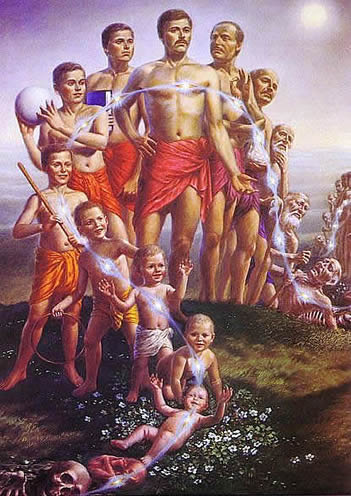
…within this body there is soul, and the body is changing every moment, but the soul is there. Just as a soul comes from the womb of his mother with a small body, and that small body changes—it becomes the body of a boy, it becomes the body of a youth, then it becomes the body of an old man, then it vanquishes… That we have to admit. We may say that the body is growing, but actually, the fact is, body is changing. It is medically admitted that we are changing our body every second. We are changing our blood corpuscles, and therefore a change of the body is taking place, and that is being manifested in a different shape only. Actually, we are changing every moment our body. So the ultimate change, when this body cannot be worked any more, just like a dress, when it is torn, when it is too old, you have to change it. Similarly, when this body becomes useless, no more, it cannot be pulled on any more, you take another body. Tathā dehāntara-prāptir. As we are, in our practical life, we are changing our body every moment, similarly, the last stage of changing this body is called death. Just as I give up this body, I have to enter into the womb of some kind of mother. These things are explained in the Vedic literatures. (Srila Prabhupada from lecture; San Francisco, April 2, 1968)
The soul is eternal, it is changing body, different bodies, and there are 8,400,000 different forms of body. According to his desire, he is entering another body.
…in the hundreds and thousands of universities all over the world there is no department of knowledge where the science of the soul is taught. Actually, we are all spirit soul. From Bhagavad-gītā we understand that we are transmigrating from one body to another, even in our present lives. All of us had at one time the body of a small baby. Where is that body? That body is gone. Presently I am an old man, but I remember that I was once a small baby. I still remember when I was about six months old; I was lying down on the lap of my elder sister, who was knitting, and I was playing. I can remember that, so it is possible for everyone to remember that he had a small body. After the baby’s body I had a boy’s body; then I had a youthful body, and now I am in this body. Where are those bodies? They are gone now. This is a different body. It is explained in Bhagavad-gītā that when I give up this body, I will have to accept another body. It is very simple to understand. I have changed so many bodies, not only from childhood to boyhood to youth, but according to medical science we are changing bodies every second, imperceptibly. This Process indicates that the soul is permanent. Although I have changed many bodies, I remember my baby body and my childhood body—I am the same person, soul. Similarly, when ultimately I change this body, I shall have to accept another. This simple formula is stated in Bhagavad-gītā. Everyone can reflect on it…(Srila Prabhupada from; Krsna Consciousness The Topmost Yoga System)
A person or an animal is not the material body; rather, the material body is the covering of the living being. Bhagavad-gītā compares the body to a dress and elaborately explains how one changes dresses one after another. The same Vedic knowledge is confirmed here. The living being, the soul, is constantly changing bodies one after another. Even in the present life, the body changes from childhood to boyhood, from boyhood to youth, and from youth to old age; similarly, when the body is too old to continue, the living being gives up this body and, by the laws of nature, automatically gets another body according to his fruitive activities, desires and ambitions. The laws of nature control this sequence, and therefore as long as the living entity is under the control of the external, material energy, the process of bodily change takes place automatically, according to one’s fruitive activities.
…”What we have heard from the Spiritual Master, that is living.”
Paramananda:
We’re always feeling your presence very strongly, Srila Prabhupada, simply by your teachings and your instructions. We’re always meditating on your instructions.
Srila Prabhupada:
Thank you. That is the real presence. Physical presence is not important.
“But always remember that I am always with you. As you are always thinking of me, I am always thinking of you also. Although physically we are not together, we are not separated spiritually. So we should be concerned only with this spiritual connection.”
Does the Guru have to be physically present?
Quotes by His Divine Grace A.C. Bhaktivedanta Swami Prabhupada
“Physical presence is immaterial. Presence of the transcendental sound received from the Spiritual Master should be the guidance of life. That will make our spiritual life successful. If you feel very strongly about my absence you may place my pictures on my sitting places and this will be source of inspiration for you.”
(SP Letter to Brahmananda and other students, 19/1/67)
“But always remember that I am always with you. As you are always thinking of me, I am always thinking of you also. Although physically we are not together, we are not separated spiritually. So we should be concerned only with this spiritual connection.”
(SP Letter to Gaurasundara, 13/11/69)
“So we should associate by vibration, and not by the physical presence. That is real association.”
(SP Lectures SB, 18/08/68)
Mother Ganges is worshiped by the water of the Ganges: a devotee takes a little water from the Ganges and offers it back to the Ganges. When the devotee takes the water, mother Ganges does not lose anything, and when the water is offered back, mother Ganges does not increase, but in this way the worshiper of the Ganges is benefited. Similarly, a devotee of the Lord offers the Lord patraṁ puṣpaṁ phalaṁ toyam—a leaf, flower, fruit or water—in great devotion, but everything, including the leaf, flower, fruit and water, belongs to the Lord, and therefore there is nothing to renounce or to accept. One must simply take advantage of the bhakti process because by following this process one does not lose anything but one gains the favor of the Supreme Person. (SB 9.9.12)
When there was a meeting of great sages at Naimiṣāraṇya, Sūta Gosvāmī was reciting Śrīmad-Bhāgavatam, and the importance of the Ganges was stated as follows: “The waters of the Ganges are always carrying the flavor of tulasī offered at the lotus feet of Śrī Kṛṣṇa, and as such the waters of the Ganges are ever flowing, spreading the glories of Lord Kṛṣṇa. Wherever the waters of the Ganges are flowing, all will be sanctified, both externally and internally.” ( Nectar of Devotion Chapter 7)
…A devotee who has attained perfect success in devotional service returns to Godhead without a doubt. For him there is no question of repeated birth and death. But if a devotee does not attain complete perfection, he is guaranteed birth in a learned and well-to-do family, and even if he is not given birth in a good family, he is blessed by being able to remember the lotus feet of the Lord. Such a benediction is greater than any number of material assets. Constant remembrance of the Lord’s name, fame and qualities automatically counteracts the reactions of all vices and extends the blessings of goodness. Constantly remembering the lotus feet of the Lord is the same as rendering active service to the Lord.
Therefore a pure devotee does not ask the Lord for material wealth, manpower, followers or beautiful women. Rather, he simply prays for unalloyed faith in the Lord’s service. This should be the prayer and life motto of all prospective students in devotional service.
The Desire of A Pure Devotee
An excerpt from “Prayers of King Kulasekhara”
An unpublished manuscript by
His Divine Grace A.C. Bhaktivedanta Swami Prabhupada
mukunda murdhna pranipatya yace bhavantam ekantam iyantam artham
avismrtis tvac-caranaravinde bhave bhave me ‘stu bhavat-prasadat
Mukunda-mala-stotra (Verse 4) King Kulasekhara
O my Lord Mukunda! I bow my head down before Your Lordship’s lotus feet and respect fully ask for the fulfillment of my only desire. Throughout my repeated births may I never forget but always remember You by Your Lordship’s mercy.
…Madhudviṣa: Śrīla Prabhupāda? Should I read the ten offenses?
Prabhupāda: Yes.
Madhudviṣa: We have them here.
Prabhupāda: Just see. Go on reading. Yes, you read.
Madhudviṣa: “The ten offenses to avoid while chanting the mahā-mantra. Number one: Blaspheming the Lord’s devotee.”
Prabhupāda: Now just try to understand. Any devotee of Lord should not be blasphemed. It doesn’t matter in any country. Just like Lord Jesus Christ, he is a great devotee. And even Muhammad, he’s also a devotee. It is not that because we are devotee and they are not devotee. Don’t think like that. Anyone who is preaching the glories of God, he is a devotee. He should not be blasphemed. You should be careful. Then?
Madhudviṣa: “Number two: Considering the Lord and other demigods on the same level or assuming there are many Gods.”…
Lecture on Initiation and the Ten Offences to be Advoided While Chanting the Maha-mantra
By His Divine Grace A. C. Bhaktivedanta Swami Prabhupāda
Seattle, October 20, 1968














 The Hare Krishna Movement