06 May 2014
by The Hare Krishna Movement
in Krishna Consciousness, Letters by Srila Prabhupada, Sankirtan, Susan Beckman
Tags: A.C. Bhaktivedanta Swami Prabhupada, chant 24 hours a day, chant Hare Krishna, holy name of Krishna, humble state of mind, ISKCON Spiritual Sky, Letters by Srila Prabhupada, Lord Caitanya, sankirtan, Srila Prabhupada, Susan Beckman, the sankirtan movement
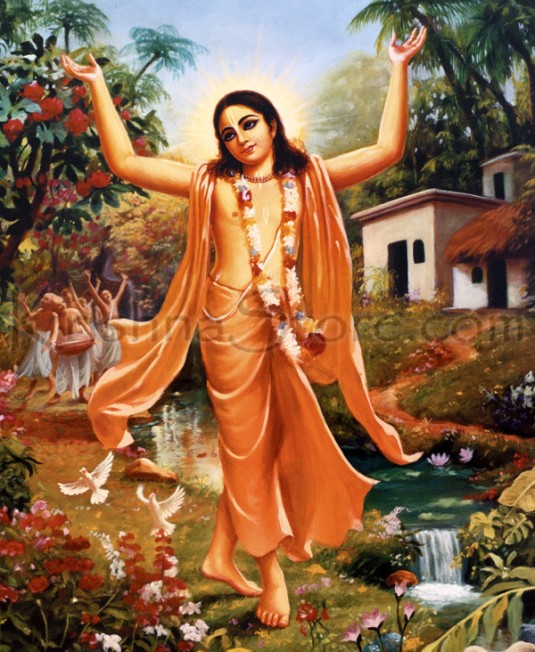
I love reading all these letter written by Srila Prabhupada to his aspiring disciples, and the following letter written to Susan Beckman is very sweet.
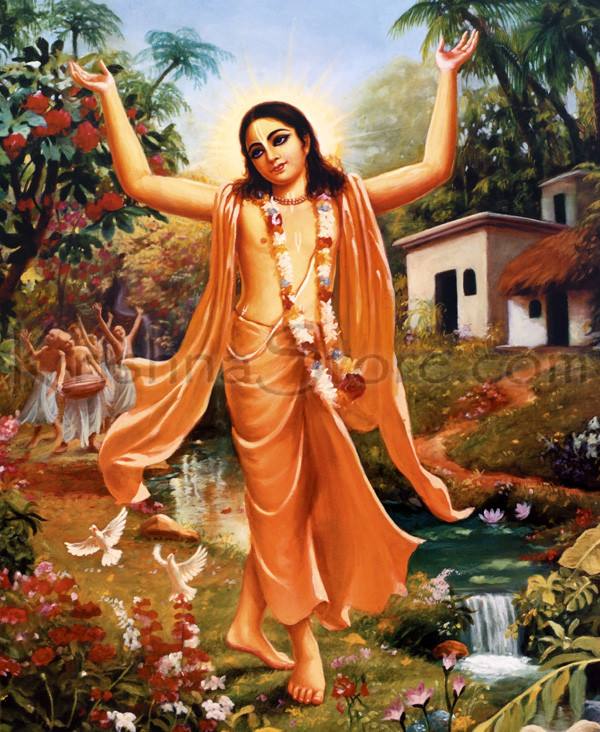
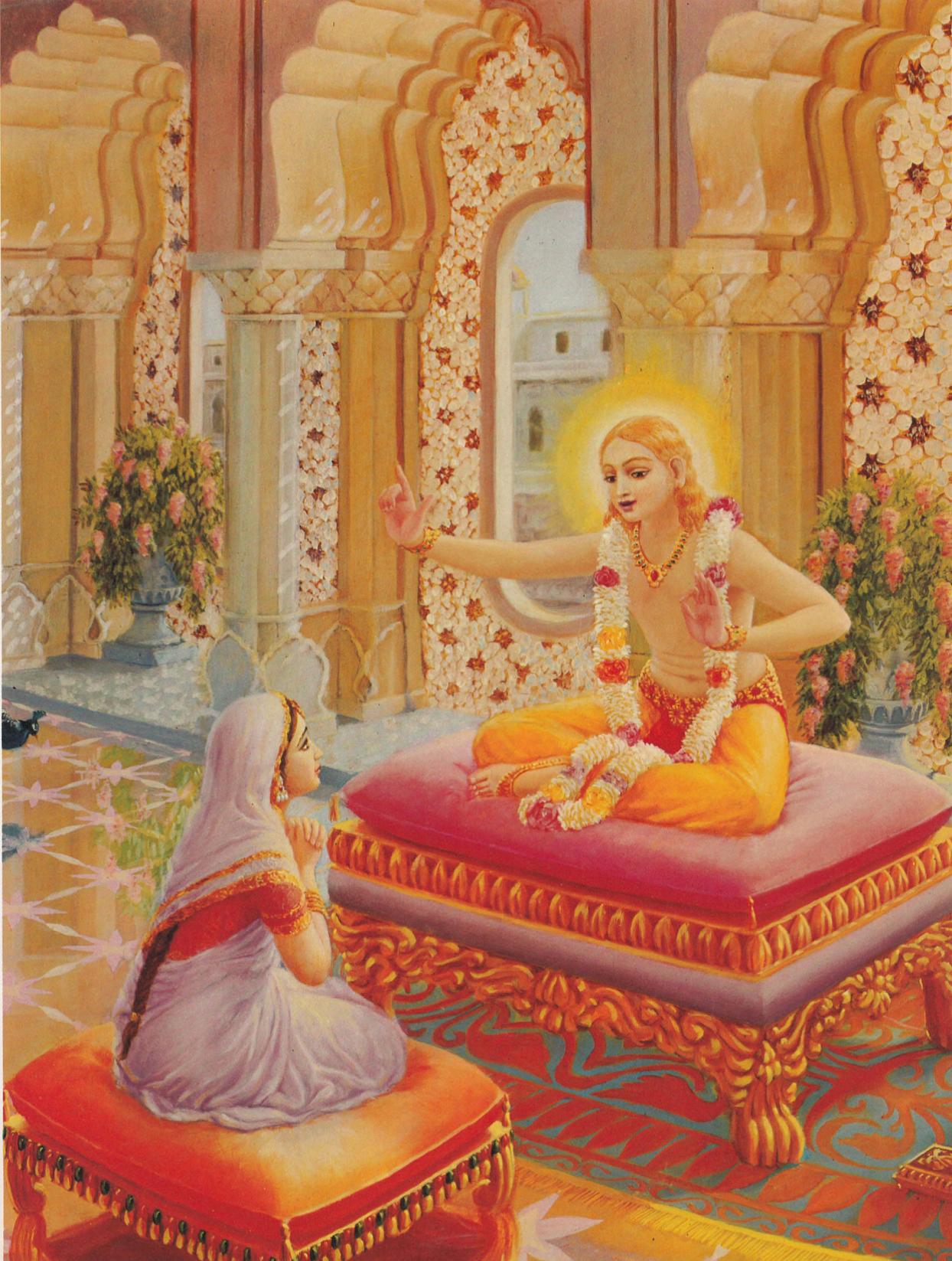
…Lord Sri Chaitanya Mahaprabhu, the incarnation of Godhead in this age has delivered the medicine for all problems of the world by his introducing the Sankirtan movement. Sankirtan means to chant that Holy names of the Lord and to give up all other engagements. The chanting is a process of purification. Just like we use soap to cleanse the body, this is material, but the chanting is spiritual cleansing.
…The conclusion is that one should learn the art of chanting the Holy name of Krishna 24 hours a day and that alone is the remedy for all problems of material existence. How is it possible to chant 24 hours a day? Lord Chaitanya gave the hint, “One can chant the holy name of God in a humble state of mind, thinking himself lower than the straw in the street, more tolerant than a tree, devoid of all kinds of sense of false prestige, and always ready to offer all respects to others. In such a humble state of mind one can chant the Holy name of God constantly.” So I cannot give you any better advice for your problem, simply chant Hare Krishna and everything will be all right. (Letter to Susan Beckman)
Full Letter More
03 May 2014
by The Hare Krishna Movement
in A.C. Bhaktivedanta Swami Prabhupada, Pure Devotee, Qualities of a Devotee, Srila Prabhupada, Twenty-Six Qualities of a Devotee
Tags: A.C. Bhaktivedanta Swami Prabhupada, peaceful, pure devotee, qualities of a devotee, Srila Prabhupada, Srila Prabhupada's Beautiful Transcendental Qualities

click on image to enlarge
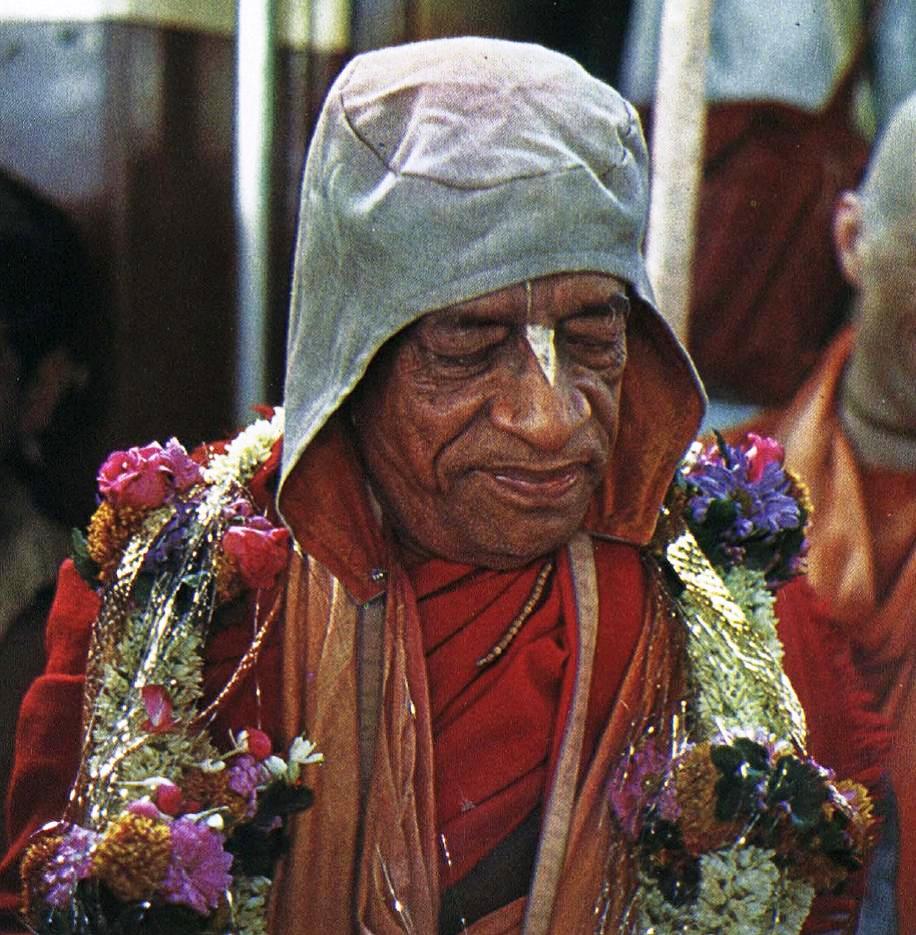
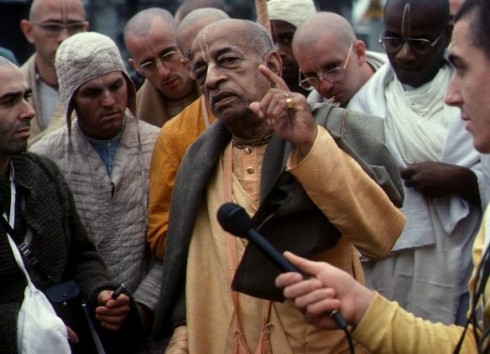
I was looking through some pictures this morning of Srila Prabhupada and my attention was drawn to this above image. He looked so peaceful, and I remembered that peacefulness is one of the transcendental qualities of the pure devotee. You can click on link at bottom of post to see the other Beautiful Transcendental Qualities of Srila Prabhupada.
Peaceful
Srila Prabhupada once described the mind of a pure devotee as being very peaceful, like a country pond filled with crystal-clear water, beautiful lotus flowers and swans gliding happily across it. This much desired state of mind is a natural quality of one who is situated in transcendence, at the lotus feet of Lord Krishna, far beyond the turbulent material world and senses. Srila Prabhupada was very peaceful due to his own pure Krishna consciousness. Shouldering the immense pressure and responsibility of a worldwide spiritual family, with its concomitant problems, Srila Prabhupada gracefully meted out love, guidance and practical instructions with full composure, never once losing touch with his peaceful Lord Krishna. (from “Srila Prabhupada’s Beautiful Transcendental Qualities” by Ajitananda das)
More
02 May 2014
by The Hare Krishna Movement
in Bhakti Caru Swami, Devotee's, Guru & Disciple, guru-tattva, Hansadutta das
Tags: Bhakti Charu Swami, Correcting ISKCON's Guru System, guru, Guru Issue, guru system, hansadutta das, inside namahatta, ISKCON's guru system, prabhupada's system for future initiations in ISKCON, spiritual master and disciple, Srila Prabhupada

My good friend and Godbrother Hansadutta Prabhu, has asked me to post this nice paper written by H.H. Bhakti Charu Swami on “Correcting ISKCON’s Guru System”, and his reply. Both the article and response have been alive in cyberspace for some time now, but the the Truth bears repeating.
Response to Bhakti Caru Swami
by Hansadutta das
[Hansadutta’s response was also posted at ISKCON Bangalore’s website]
Dear Bhakti Caru Maharaja,
Please accept my most humble obeisances, all glories to Srila Prabhupada. It’s been some years since we met and associated in person (Mayapur 2003, later in Berkeley, California temple). I think of you often with fond memories. Sometimes you asked me how “The Guru problem might be solved.” We would discuss, but nothing came of it. Now you have publicly posed the issue, so I feel I should make some comments that might shed some light on the matter. Please allow me to go thru your presentation and make some comments.
More
26 Mar 2014
by The Hare Krishna Movement
in A.C. Bhaktivedanta Swami Prabhupada, Ananta das, Ananta das Sastri, Srila Prabhupada
Tags: A.C. Bhaktiveanta Swami Prabhupada, Ananta Dasa Sastri, devotion, disciple of Srila Prabhupada, Krsna, prabhupada, prabhupadanugas, pride and illusion, Sanskrit department, Srila Prabhupada, Srila Prabhupada Stotram, Vyasasana
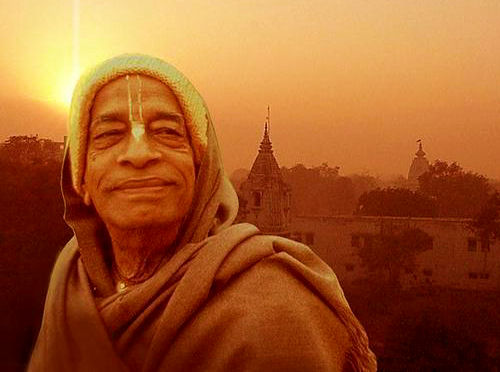
Śrīla Prabhupāda Stotram
(Composed by Ananta Dasa Sastri)
Ananta Dasa Sastri was a disciple of Srila Prabhupāda. He used to travel with Srila Prabhupāda in India and he was in the Sanskrit department assisting Srila Prabhupāda in translation work. He compiled five slokas which describe much of Srila Prabhupāda’s divine character and his divine mission also.Prabhupāda very much liked these five slokas. We used to sing them every morning before Guru Puja by his vyasasana, so some of you may remember them.
More
25 Mar 2014
by The Hare Krishna Movement
in A.C. Bhaktivedanta Swami Prabhupada, Caitanya Mahaprabhu, Chanting Hare Krishna, Devotional Service, Gauranga, Gaurangera Duti Pada, Narottama Dasa Thakura
Tags: A.C. Bhaktivedanta Swami Prabhupada, devotional service, gaura, Gauranga, gaurangera duti pada, Gaurasundara, Hare Krishna, Lord Caitanya, Narottama dasa Thakrua, self realization, Srila Prabhupada

click on image to enlarge
…Gauranga refers to Lord Caitanya, who has a fair complexion. One who has a fair complexion is called gaura, and since Lord Caitanya was very fair, just like molten gold, He was also named Gaurasundara. Narottama dasa Thakura says, gaurangera duti pada, jar dhana-sampada, se jane bhakati-rasa-sar. Anyone who has accepted the two lotus feet of Lord Caitanya can understand the true essence of devotional service. Devotional service is very difficult. It cannot be understood by any ordinary man. As it is stated in the Bhagavad-gita, out of many thousands of persons who are trying to achieve the perfection of human life, only some actually become perfect and realize the self. And out of many thousands of such self-realized persons, only one can understand Krsna. Without understanding Krsna, how can one engage himself in the service of Krsna? Therefore, the devotional service of Krsna is not an ordinary thing. But fortunately, if one follows in the footsteps of Lord Caitanya (gaurangera duti pada) by following the path shown by Lord Caitanya-the process of simply chanting Hare Krsna-he can very easily understand what devotional service is. (from purport to the song “Gaurangera Duti Pada”)
Full song with Bengali Lyrics, English translation, and purport by His Divine Grace A. C. Bhaktivedanta Swami Prabhupada
More
25 Mar 2014
by The Hare Krishna Movement
in A.C. Bhaktivedanta Swami Prabhupada, Diksha, Disciplic succession, Guru & Disciple, guru-tattva, Hencefoward, ISKCON, Iskcon Bangalore, Krishna Consciousness
Tags: A.C. Bhaktivedanta Swami Prabhupada, dikska, dikska questions, GBC, guru and disciple, Harinama diksa, harinama dikska question paper, Iskcon, ISKCON Bangalore, July 9th Letter, spiritual master, Srila Prabhupada
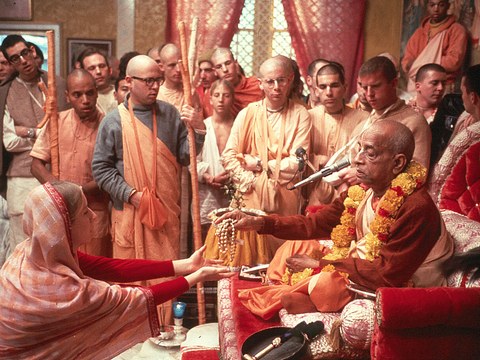

Sometime back, we published the “Harinama Diksha Reference Material and Study Guide“. Today we share with you the “Harinama Dikska Question Paper”. This was put out by the devotees at ISKCON Bangalore, and is very interesting. I won’t say anymore about it now, other than to say it is worth taking a few minutes to ‘take the test’, by answering the few basic questions.
click on following link
Harinam_Diksha_Question_Paper
More
21 Mar 2014
by The Hare Krishna Movement
in A.C. Bhaktivedanta Swami Prabhupada, Teachings of Lord Kapila, Transcendental Knowledge
Tags: A.C. Bhaktivedanta, books of His Divine Grace, Devahuti Desires Transcendental Knowledge, Kapila Muni, Lord Kapila, Srila Prabhupada, Teachings of Lord Kapila, transcendental knowledge

The following is chapter six in our series on the Teaching of Lord Kapila entitled “Devahūti Desires Transcendental Knowledge”. This chapter contains the timeless instructions on receiving spiritual knowledge. It is very difficult to get out of this entanglement and attain freedom, but if one is fortunate enough to get the association of a spiritual master like Kapila Muni or His representative, then by his grace one can be delivered from the mire of ignorance. The spiritual master is therefore worshiped as one who delivers the disciple from the mire of ignorance with the light of the torch of knowledge. We are fortunate in this age to have the books of His Divine Grace A. C. Bhaktivedanta Swami Prabhupada to guide us. Human knowledge was originally preserved through oral tradition, but today we have this knowledge preserved in the books of His Divine Grace.
Full Chapter More
06 Mar 2014
by The Hare Krishna Movement
in A.C. Bhaktivedanta Swami Prabhupada, Books by Srila Prabhupada, Krishna Consciousness, KRSNA The Supreme Personality of Godhead, Srila Prabhupada
Tags: A.C. Bhaktivedanta Swami, all attractive, beauty, fame, Krsna, Krsna Book, krsna consciousness, power, Preface to Krsna, Srila Prabhupada, Supreme Personality of Godhead, The Supreme Personality of Godhead, wealth, who is krsna, wisdom renunciation

click on image to enlarge
This morning my attention was drawn to the Krsna Book. The book was laying on my book stand unopened, but it was so attractive, that I just had to open it, and read the Preface again. Back in the early 70’s, this was the first book I received from a devotee at the Chicago O Hara Airport, and I remember when I first opened it, and began to read this Preface, I was immediately convinced that Krsna was God. Immediately! Such is the power of the words of the pure devotee; Srila Prabhupada.
In these Western countries, when someone sees the cover of a book like Kṛṣṇa, he immediately asks, “Who is Kṛṣṇa? Who is the girl with Kṛṣṇa?” etc.
The immediate answer is that Kṛṣṇa is the Supreme Personality of Godhead. How is that? Because He conforms in exact detail to descriptions of the Supreme Being, the Godhead. In other words, Kṛṣṇa is the Godhead because He is all-attractive. Outside the principle of all-attraction, there is no meaning to the word Godhead. How is it one can be all-attractive? First of all, if one is very wealthy, if he has great riches, he becomes attractive to the people in general. Similarly, if someone is very powerful, he also becomes attractive, and if someone is very famous, he also becomes attractive, and if someone is very beautiful or wise or unattached to all kinds of possessions, he also becomes attractive. So from practical experience we can observe that one is attractive due to 1) wealth, 2) power, 3) fame, 4) beauty, 5) wisdom, and 6) renunciation. One who is in possession of all six of these opulences at the same time, who possesses them to an unlimited degree, is understood to be the Supreme Personality of Godhead. (from Preface to “Kṛṣṇa, the Supreme Personality of Godhead”)
Entire Preface More
02 Mar 2014
by The Hare Krishna Movement
in A.C. Bhaktivedanta Swami Prabhupada, Chanting Hare Krishna, Maha-mantra, Mantra Meditation, Quotes by Srila Prabhupada
Tags: A.C. Bhaktivedanta Swami Prabhupada, chanting Hare Krishna, forgetfulness, Hare Krishna, Hare Krsna, holy name, Maha Mantra, quotes by Srila Prabhupada, remembering Krishna, remembering the Supreme Perosnality of Godhead, Srila Prabhupada

click on image to enlarge
” Simply our prayer should be, My dear Krishna, please remind me to always chant Your Holy Name, please do not put me into forgetfulness. You are sitting within me as Supersoul, so you can put me into forgetfulness or into remembering You. So please do not put me into forgetfulness. Please always remind me to chant, even You send me into the hell, it doesn’t matter, just so long as I can always chant Hare Krishna…” (from Srila Prabhupada’s letter to Devananda dated Nov.23,1968)
More
27 Feb 2014
by The Hare Krishna Movement
in A.C. Bhaktivedanta Swami Prabhupada, Sadhu, Spiritual Master, Srila Prabhupada, Srimad Bhagavatam, The Hare Krishna Movement
Tags: A.C. Bhaktivedanta Swami Prabhupada, devotee of the Lord, devotional service, enlighten people in devotional service, holy person, krsna consciousness, Lord Krsna, mercy of the sadhu, sadhu, SB 3.25.21, Srila Prabhupada, symptoms of a sadhu
click on image to enlarge
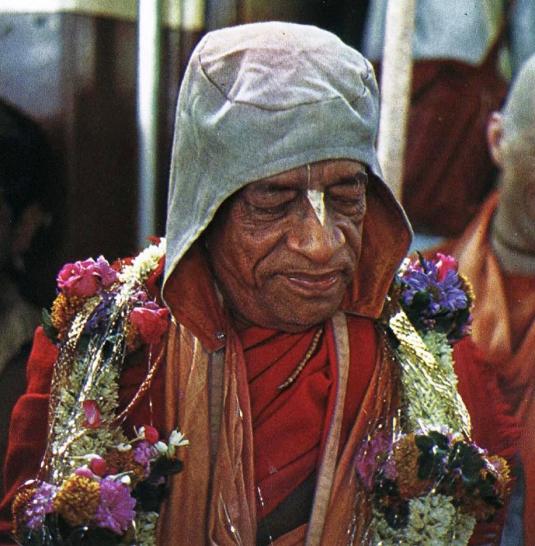
The symptoms of a sādhu are that he is tolerant, merciful and friendly to all living entities. He has no enemies, he is peaceful, he abides by the scriptures, and all his characteristics are sublime. (SB. 3,25,21)
A sādhu, as described above, is a devotee of the Lord. His concern, therefore, is to enlighten people in devotional service to the Lord. That is his mercy. He knows that without devotional service to the Lord, human life is spoiled. A devotee travels all over the country, from door to door, preaching, “Be Kṛṣṇa conscious. Be a devotee of Lord Kṛṣṇa. Don’t spoil your life in simply fulfilling your animal propensities. Human life is meant for self-realization, or Kṛṣṇa consciousness.” These are the preachings of a sādhu. He is not satisfied with his own liberation. He always thinks about others. He is the most compassionate personality towards all the fallen souls. (from purport)
Full text and purport More
16 Feb 2014
by The Hare Krishna Movement
in George Harrison, Mukunda das Goswami, Srila Prabhupada, Sriman George Harrison
Tags: A.C. Bhaktivedanta Swami Prabhupada, Allen Ginsberg, Bobby Dylan, Derek Taylor, George Harrison, Govinda, Hare Krishna, John and Yoko, John Lennon, Living in the Material World, Mukunda das, mukunda das goswami, My Sweet Lord, Norman Mailer, Radha Krishna Temple Album, Rosemary, Srila Prabhupada, The Beatles, the hare krishna mantra, Timmy Leary, Tommy Cooper, Tommy Smothers, yoko ono
click on inage to enlarge
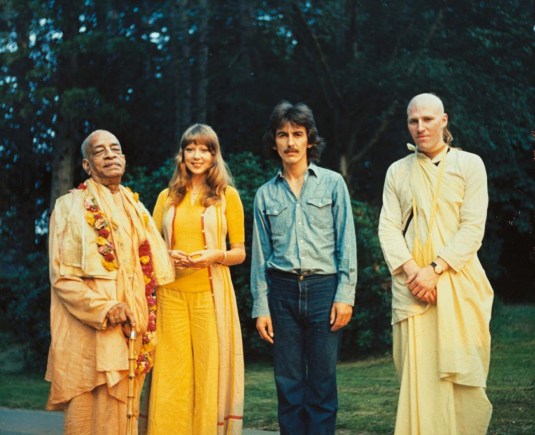
In the following conversation, taped at George’s home in England on September 4, 1982, George reveals some memorable experiences he has had chanting Hare Krishna and describes in detail his deep personal realizations about the chanting. He reveals what factors led him to produce “The Hare Krishna Mantra” record, “My Sweet Lord,” and the LPs All Things Must Pass and Living in the Material World, which were all influenced to a great extent by the Hare Krishna chanting and philosophy. He speaks lovingly and openly about his association with His Divine Grace A. C. Bhaktivedanta Swami Prabhupada, Founder-Acarya (spiritual master) of the Hare Krishna movement. In the following interview George speaks frankly about his personal philosophy regarding the Hare Krishna movement, music, yoga, reincarnation, karma, the soul, God, and Christianity. The conversation concludes with his fond remembrances of a visit to the birthplace of Lord Krishna in Vrndavana, India, home of the Hare Krishna mantra, and with George discussing some of his celebrity friends’ involvement with the mantra now heard and chanted around the world.
More
09 Feb 2014
by The Hare Krishna Movement
in A.C. Bhaktivedanta Swami Prabhupada, Krishna's flute, Spiritual World
Tags: A.C. Bhaktivedanta, damsels of vrndavana, gopis, His flute, Krishna's Flute, Lord Krsna's flute, Madhya 21.140-148, social etiquette, spiritual sky, Sri Caitanya Caritamrta, Srila Prabhupada, vibration of Krsna's flute, Vrajabhumi
click on image to enlarge
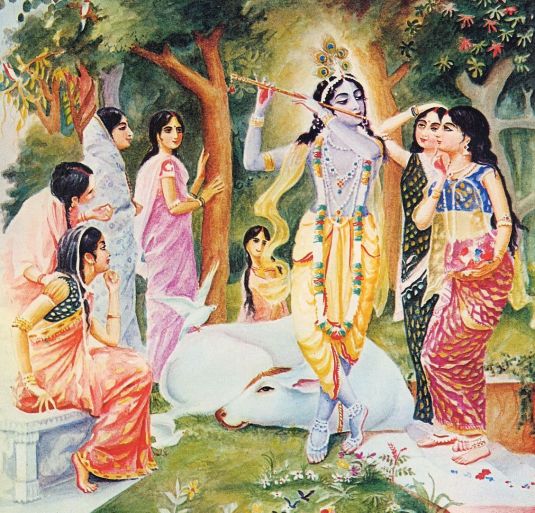
“His slight smiling and fragrant illumination are compared to camphor, which enters the sweetness of the lips. That sweetness is transformed and enters into space as vibrations from the holes of His flute.
“The sound of Kṛṣṇa’s flute spreads in four directions. Even though Kṛṣṇa vibrates His flute within this universe, its sound pierces the universal covering and goes to the spiritual sky. Thus the vibration enters the ears of all inhabitants. It especially enters Goloka Vṛndāvana-dhāma and attracts the minds of the young damsels of Vrajabhūmi, bringing them forcibly to where Kṛṣṇa is present.
“The vibration of Kṛṣṇa’s flute is very aggressive, and it breaks the vows of all chaste women. Indeed, its vibration takes them forcibly from the laps of their husbands. The vibration of His flute attracts even the goddesses of fortune in the Vaikuṇṭha planets, to say nothing of the poor damsels of Vṛndāvana.
“The vibration of His flute slackens the knots of their underwear even in front of their husbands. Thus the gopīs are forced to abandon their household duties and come before Lord Kṛṣṇa. In this way all social etiquette, shame and fear are vanquished. The vibration of His flute causes all women to dance.
“The vibration of His flute is just like a bird that creates a nest within the ears of the gopīs and always remains prominent there, not allowing any other sound to enter their ears. Indeed, the gopīs cannot hear anything else, nor are they able to concentrate on anything else, not even to give a suitable reply. Such are the effects of the vibration of Lord Kṛṣṇa’s flute.”
Sri Caitanya-caritamrta 1975 Edition
By His Divine Grace A. C. Bhaktivedanta Swami Prabhupada
Madhya-lila, Chapter 21, Text 140-148
More
03 Feb 2014
by The Hare Krishna Movement
in Remembering Srila Prabhupada, Satsvarupa das Goswami, Spiritual Life, Spiritual Master, Spiritual World, Srila Prabhupada, Srila Prabhupada Lilamrta
Tags: Citsukhananda das, Cuernavaca, happies, hatha yoga, hippies, India personified, kirtan in mexico, Laksmi-priya dasi, mexico, Mexico City, prabhupada, Spiritual world, Srila Prabhupada, yoga, yoga in mexico

click on image to enlarge
I was talking with one devotee the other day about Puerto Vallarta Mexico. We both agreed that it was a very beautiful and magical place and the devotee informed me that Srila Prabhupada had once visited there, liked it very much and said it reminded him of the birth place of Bhaktivinoda Thakur. This prompted me to do a search on Srila Prabhupada’s visit to Mexico…
More
01 Feb 2014
by The Hare Krishna Movement
in A.C. Bhaktivedanta Swami Prabhupada, Back to Godhead, Conversation with Srila Prabhupada
Tags: A.C. Bhaktivedanta Swami Prabhupada, Back to Godhead Magazine, BTG, dialogue with His Divine Grace A.C. Bhaktivedanta Swami Prabhupada, Karandhara das, science, Srila Prabhupada, Svarupa dasa, The Tiny World of Modern Science

The Tiny World of Modern Science
A dialogue with His Divine Grace A.C. Bhaktivedanta Swami Prabhupada
(Los Angeles, April 16, 1973)
Excerpted from Back to Godhead Magazine Vol. 1, No. 61, 1974
For many years, His Divine Grace A.C. Bhaktivedanta Swami Prabhupada, the spiritual master of the Krsna consciousness movement, has every day customarily taken an hour-long early morning walk with some of his disciples wherever in the world he is then preaching. Sometimes His Divine Grace says little; he simply chants Hare Krsna on his beads and walks. Sometimes, however, he holds animated discussions or even arguments, challenging disciples to defend materialistic viewpoints so that he can defeat them with Krsna consciousness. The following dialogue was recorded on an inspired morning walk at Venice Beach, Los Angeles. Walking with Srila Prabhupada were two of his disciples, Karandhara dasa and Svarupa Damodara dasa, a chemist working on his Ph.D. in Physical Organic Chemistry at the University of California.
Svarupa: Scientists are worried about energy sources, and now they are working to utilize solar energy for cooking, lighting and various other purposes. They are hoping that when they exhaust all other energy sources, they will be able to use solar energy.
Srila Prabhupada: This is not a very new theory. Everyone knows that because the roots of trees store the sun’s energy, it is possible to get fire from a tree. These scientists are tiny creatures, but they are very proud. We don’t give them credit, because they are simply stating what everyone knows. As soon as you cut a tree, you cannot get fire from it. It has to be dried in the sun. When the energy is gathered from the sun, the tree can be utilized for fire. Actually everything is being maintained by the sun’s energy, but the scientists don’t know where the sun’s energy comes from. In Bhagavad-gita Krsna says:
More
21 Jan 2014
by The Hare Krishna Movement
in A.C. Bhaktivedanta Swami Prabhupada, Devotee Books, Guru das, Roger Siegel, Srila Prabhupada, Srila Prabhupada Conversations, Srila Prabhupada vani
Tags: A.C. Bhaktivedanta Swami Prabhupada, book by gurudas, By His Example, By His Example 2nd Edition, Guru das, Gurudas, Roger Siegel, Srila Prabhupada, the wit and wisdom of his divine grace a. c. bhaktivedanta swami prabhupada

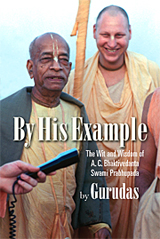
My dear friend and Godbrother, Sriman Gurudas Prabhu, has just sent me a box of his new ‘2nd Edition printing’ of the renowned classic “By His Example”, with new stories never before published. I am pleased to offer it for sale, from our web site http://www.theharekrishnamovement.com and hope it will be recieved by the vaisnava community. It is filled with wonderful stories and memories, as well as accounts of Prabhupada’s glories. In his own words…
“This book is not meant to be a biography, but rather a transcendental medium that allows both those who knew him and those who never had a chance to meet Prabhupada to experience his humor and compassion, to come into closer contact with his vani and vapu. Prabhupada once said, “Krishna consciousness means happiness.” I hope that you may derive some happiness, inspiration, encouragement, and transcendental ecstasy from this rendering.” (Gurudas)
By His Example
The Wit and Wisdom of His Divine Grace A. C. Bhaktivedanta Swami Prabhupada
by Gurudas
Excerpt from Preface; “Radha and Krishna have guided this book, a glorification of His Divine Grace A.C. Bhaktivedanta Swami Prabhupada, the kindest, wisest, most determined, noncompromising, open-minded personality I have ever come in contact with. This book is also for and in glorification of all the devotees who have embarked on the path of Krishna consciousness. My heart goes out to all devotees, you who have become tender-hearted by hearing ancient, transcendental sounds and by accepting Sri Sri Radha Krishna’s benediction and effulgence” -Gurudas
More
19 Jan 2014
by The Hare Krishna Movement
in A.C. Bhaktivedanta Swami Prabhupada, Arts and Science, KRSNA The Supreme Personality of Godhead
Tags: 64 arts and sciences, A.C. Bhaktivedanta Swami Prabhupada, Acarya, brahmacarya, crossword puzzle, disciple, education and knowledge, Krsna and Balarama, Krsna Book, pictograghic literature, sandipani muni, spiritual knowledge, spiritual master, Srila Prabhupada

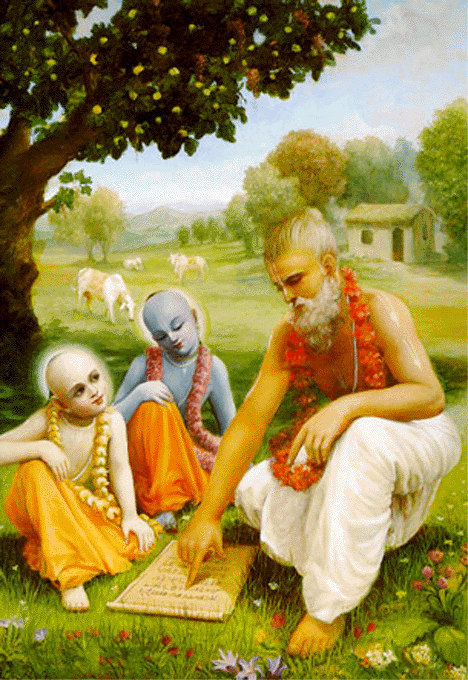
The following is an excerpt from Chapter 45 of Kṛṣṇa Book, in which Srila Prabhupada describes that after hearing only once from the teacher, Sandipani Muni, Kṛṣṇa and Balarāma learned all the arts and sciences.
…So Kṛṣṇa and Balarāma, the Supreme Personality of Godhead, are the source of all kinds of knowledge, but because They were playing like ordinary human boys, They set the example so that everyone would receive knowledge from the right source. Thus They agreed to take knowledge from a spiritual master.
After hearing only once from the teacher, Kṛṣṇa and Balarāma learned all the arts and sciences. In sixty-four days and sixty-four nights They learned all the necessary arts that are required in human society. During daytime They took lessons on a subject from the teacher, and by nightfall, after having heard from the teacher, They were expert in that department of knowledge.
More
16 Jan 2014
by The Hare Krishna Movement
in Sri Tulasi Pranama, Srimati Tulasi Devi, Tulasi
Tags: auspiciousness, devotional service to tulasi, Lord Kesava, namo namah tulasi krsna preyasi nomo mamah, o goddess, Spiritual world, Sri Tulasi devi, Srila Prabhupada, Srimati Tulasi Devi, Tulasi, tulasi is all auspicious, tulasi tree, Vrnda, vrndayai tulasi devyai, you bestow devotional service to Krsna
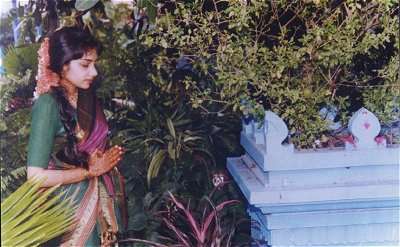
“Tulasi is auspicious in all respects. Simply by seeing, simply by touching, simply by remembering, simply by praying to, simply by bowing before, simply by hearing about, or simply by sowing this tree, there is always auspiciousness. Anyone who comes in touch with the Tulasi tree in the above mentioned ways lives eternally in the spiritual world.” (—Srila Prabhupada, The Nectar of Devotion)
Śrī Tulasī-praṇāma
(oṁ) vṛndāyai tulasī-devyai priyāyai keśavasya ca
kṛṣṇa-bhakti-prade devi satyavatyai namo namaḥ
I offer my repeated obeisances unto Vṛndā, Śrīmatī Tulasī-devī, who is very dear to Lord Keśava.
O goddess, you bestow devotional service to Kṛṣṇa and you possess the highest truth.
More
11 Jan 2014
by The Hare Krishna Movement
in A.C. Bhaktivedanta Swami Prabhupada, Raghunatha dasa Goswami, Sri Premambhoja-maranda, Srimati Radharani, Transcendental Qualities of Radha
Tags: 8.166, A.C. Bhaktivedanta Swami Prabhupada, beauty of Srimati Radharani, kacchapi-vina, Kaviraja Goswami, Lord Krsna, Madhya-lila, perfumed massage, premambhojs-maranda, Radha, Radharani, Raghunatha dasa Goswami, Sri Caitanya-caritamrta, Sri Premambhoja maranda, Srila Prabhupada, transcendental fragrances

The following is a very beautiful verse from the Sri Caitanya-caritamrta, Madhya-lila 8.166, describing the beauty and fragrance of Śrīmatī Rādhārāṇī. The purport is a summary translation of the Sri Premāmbhoja-maranda, a song composed by Raghunatha Dasa Goswami, which Kavirāja Gosvāmī quotes, and is given to us by Srila Prabhupada, as described by Śrīla Bhaktivinoda Ṭhākura. The full song follows the text and purport.
“Śrīmatī Rādhārāṇī’s transcendental body is brilliant in luster and full of all transcendental fragrances. Lord Kṛṣṇa’s affection for Her is like a perfumed massage. (Madhya 8.166)
More
06 Jan 2014
by The Hare Krishna Movement
in A.C. Bhaktivedanta Swami Prabhupada, Ganges, Pure Devotee
Tags: A.C. Bhaktivedanta Swami Prabhupada, ganges water, ganges water can sanctify, lotus feet of the Lord, pure devotee of the lord, River Ganges, sacred river ganges, spiritual benefit, Srila Prabhupada

click on image to enlarge
Here are two nice verses describing the glories of bathing in the river Ganges, and association with the pure devotee. How fortunate is this devotee who is helping the pure devotee Srila Prabhupada into the river.
O Sūta, those great sages who have completely taken shelter of the lotus feet of the Lord can at once sanctify those who come in touch with them, whereas the waters of the Ganges can sanctify only after prolonged use. (SB 1.1.15)
Dear Lord, Your personal associates, devotees, wander all over the world to purify even the holy places of pilgrimage. Is not such activity pleasing to those who are actually afraid of material existence? (SB 4.30.37)
…Pure devotees of the Lord are more powerful than the waters of the sacred river Ganges. One can derive spiritual benefit out of prolonged use of the Ganges waters. But one can be sanctified at once by the mercy of a pure devotee of the Lord.
full texts and purports More
Previous Older Entries Next Newer Entries