28 Dec 2012
by The Hare Krishna Movement
in A.C. Bhaktivedanta Swami Prabhupada
Tags: A.C. Bhaktivedanta Swami Prabhupada, Arjuna, Bg.7, bhagavad-gita, four kinds of men, Gita, Knowledge of the Absolute, Krsna, krsna consciousness, practicing yoga in full consciousness of Me, Spiritual world, yoga

click on image to enlarge
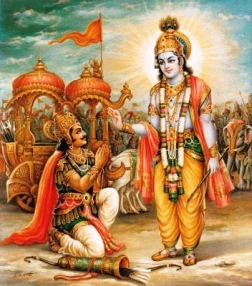
…In this Seventh Chapter of Bhagavad-gītā, the nature of Kṛṣṇa consciousness is fully described. Kṛṣṇa is full in all opulences, and how He manifests such opulences is described herein. Also, four kinds of fortunate people who become attached to Kṛṣṇa, and four kinds of unfortunate people who never take to Kṛṣṇa are described in this chapter.
Bhagavad-gītā As It Is Complete 1972 Edition
By His Divine Grace A. C. Bhaktivedanta Swami Prabhupāda
Chapter 7
Knowledge of the Absolute
More
25 Nov 2012
by The Hare Krishna Movement
in A.C. Bhaktivedanta Swami Prabhupada, Spiritual Life, Spiritual World
Tags: A.C. Bhaktivedanta Swami Prabhupada, abode, abode of the Supreme Lord, bhagavad-gita, Brahma-samhita, brahmajyoti, eternal sky, Goloka, goloka eva nivasty, Lord Sri Krsna, material conception, spiritual sky, Spiritual world, Supreme Lord, Vrndavana

…The Lord descends to this mortal world to show His pastimes in Vṛndāvana, which are full of happiness. When Lord Śrī Kṛṣṇa was in Vṛndāvana, His activities with His cowherd boy friends, with His damsel friends, with the inhabitants of Vṛndāvana and with the cows were all full of happiness. The total population of Vṛndāvana knew nothing but Kṛṣṇa. But Lord Kṛṣṇa even discouraged His father Nanda Mahārāja from worshiping the demigod Indra because He wanted to establish the fact that people need not worship any demigod. They need only worship the Supreme Lord because their ultimate goal is to return to His abode.
The abode of Lord Śrī Kṛṣṇa is described in the Bhagavad-gītā, Fifteenth Chapter, sixth verse: More
08 Nov 2012
by The Hare Krishna Movement
in A.C. Bhaktivedanta Swami Prabhupada, Devotional Service, Krishna Consciousness, Spiritual World
Tags: A.C. Bhaktivedanta Swami Prabhupada, all-beautiful face, Brahma, cintamani, cintamani-dhama, devotees, goddesses of fortune, Krishna, lotus face of the Lord, lotus feet of the Lord, Spiritual world, Srila Rupa Goswami, touchstone
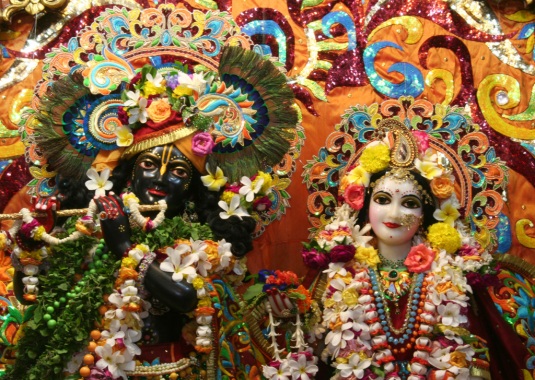
click on image to enlarge
…The essence of everything is the Supreme Lord: He is called the sāram. And those who sing and talk about Him are called the sāraṅgas, or the pure devotees. The pure devotees are always hankering after the lotus feet of the Lord. The lotus has a kind of honey which is transcendentally relished by the devotees. They are like the bees who are always after the honey. Śrīla Rūpa Gosvāmī, the great devotee ācārya of the Gauḍīya-Vaiṣṇava-sampradāya, has sung a song about this lotus honey, comparing himself to the bee: “O my Lord Kṛṣṇa, I beg to offer my prayers unto You. My mind is like the bee, and it is after some honey. Kindly, therefore, give my bee-mind a place at Your lotus feet, which are the resources for all transcendental honey. I know that even big demigods like Brahmā do not see the rays of the nails of Your lotus feet, even though they are engaged in deep meditation for years together. Still, O infallible one, my ambition is such, for You are very merciful to your surrendered devotees. O Mādhava, I know also that I have no genuine devotion for the service of Your lotus feet, but because Your Lordship is inconceivably powerful, You can do what is impossible to be done. Your lotus feet can deride even the nectar of the heavenly kingdom, and therefore I am very much attracted by them. O supreme eternal, please, therefore, let my mind be fixed at Your lotus feet so that eternally I may be able to relish the taste of Your transcendental service.”
for full verse and purport More
23 Aug 2012
by The Hare Krishna Movement
in Gajendra, Spiritual World, Srimad Bhagavatam
Tags: A.C. Bhaktivedanta Swami Prabhupada, Brahma, demigods, Gajendra, gandharvas, king of the elephants, sages, Siva, Spiritual world, Srimad Bhagavatam, Sukadeva Gosvami

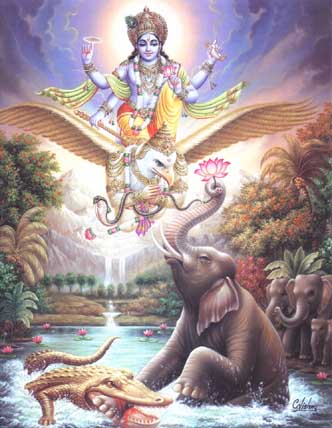
The Fourth Chapter of the Eight Canto of Srimad Bhagavatam describes the previous birth of Gajendra and the crocodile. It tells how the crocodile became a Gandharva and how Gajendra became an associate of the Supreme Personality of Godhead.
…in his birth as an elephant, when he was dangerously attacked by the crocodile, he remembered his past life in devotional service and remembered a prayer he had learned in that life. Because of this prayer, he again received the mercy of the Lord.
Śukadeva Gosvāmī ends this chapter by describing the good fortune of the elephant. Śukadeva Gosvāmī says that by hearing the narration of Gajendra’s deliverance, one can also get the opportunity to be delivered.
“One who seeks Your compassion and thus tolerates all kinds of adverse conditions due to the karma of his past deeds, who engages always in Your devotional service with his mind, words and body, and who always offers obeisances unto You, is certainly a bona fide candidate for liberation.”
A devotee who tolerates everything in this material world and patiently executes his devotional service can become mukti-pade sa dāya-bhāk, a bona fide candidate for liberation. The word dāya-bhāk refers to a hereditary right to the Lord’s mercy. A devotee must simply engage in devotional service, not caring about material situations. Then he automatically becomes a rightful candidate for promotion to Vaikuṇṭhaloka. The devotee who renders unalloyed service to the Lord gets the right to be promoted to Vaikuṇṭhaloka, just as a son inherits the property of his father.
Full Text & Purports More
23 Aug 2012
by The Hare Krishna Movement
in Quotes by Srila Prabhupada, Remembering Srila Prabhupada, Srila Prabhupada, Srimad Bhagavatam
Tags: disciples, Krishna consciousness, pure devotees, Remembering Srila Prabhupada, SB 3.22.21, smile of Krishna conscious person, Spiritual world, Srila Prabhupada, Srimad Bhagavatam, thoughts of Krsna

“That is the way of Krishna consciousness. Pure devotees are so absorbed in thought of Krishna that they have no other engagement; although they may seem to think or act otherwise, they are always thinking of Krishna. The smile of such a Krishna conscious person is so attractive that simply by smiling he wins so many admirers, disciples and followers.” (from purport to Srimad Bhagavatam, 3.22.21)
Full text and purport More
02 Aug 2012
by The Hare Krishna Movement
in Bhagavad-gita, Spiritual Life, Spiritual World
Tags: A.C. Bhaktivedanta Swami Prabhupada, abode of the Supreme Lord, Bg 15.6, brahmajoti, effulgence, Goloka Vrndavana, Krsnaloka, self-luminous, spiritual sky, Spiritual world, The Spiritual Abode, Vaikunthas

…The spiritual world, the abode of the Supreme Personality of Godhead, Kṛṣṇa-which is known as Kṛṣṇaloka, Goloka Vṛndāvana-is described here. In the spiritual sky there is no need of sunshine, moonshine, fire or electricity, because all the planets are self-luminous. We have only one planet in this universe, the sun, which is self-luminous, but all the planets in the spiritual sky are self-luminous. The shining effulgence of all those planets (called Vaikuṇṭhas) constitutes the shining sky known as the brahmajyoti. Actually, the effulgence is emanating from the planet of Kṛṣṇa, Goloka Vṛndāvana. Part of that shining effulgence is covered by the mahat-tattva, the material world. Other than this, the major portion of that shining sky is full of spiritual planets, which are called Vaikuṇṭhas, chief of which is Goloka Vṛndāvana.
The abode of Lord Śrī Kṛṣṇa is described in the Bhagavad-gītā, Fifteenth Chapter, sixth verse:
na tad bhāsayate sūryo na śaśāṅko na pāvakaḥ
yad gatvā na nivartante tad dhāma paramaṁ mama
“That abode of Mine is not illumined by the sun or moon, nor by electricity. And anyone who reaches it never comes back to this material world.” (Bg. 15.6)
This verse gives a description of that eternal sky. Of course we have a material conception of the sky, and we think of it in relationship to the sun, moon, stars and so on, but in this verse the Lord states that in the eternal sky there is no need for the sun nor for the moon nor fire of any kind because the spiritual sky is already illuminated by the brahmajyoti, the rays emanating from the Supreme Lord. We are trying with difficulty to reach other planets, but it is not difficult to understand the abode of the Supreme Lord. This abode is referred to as Goloka. In the Brahma-saṁhitā it is beautifully described: Goloka eva nivasaty akhilātma-bhūtaḥ. The Lord resides eternally in His abode Goloka, yet He can be approached from this world, and to this end the Lord comes to manifest His real form, sac-cid-ānanda-vigraha. When He manifests this form, there is no need for our imagining what He looks like. To discourage such imaginative speculation, He descends and exhibits Himself as He is, as Śyāmasundara. Unfortunately, the less intelligent deride Him because He comes as one of us and plays with us as a human being. But because of this we should not consider that the Lord is one of us. It is by His potency that He presents Himself in His real form before us and displays His pastimes, which are prototypes of those pastimes found in His abode.
More
29 Jul 2012
by The Hare Krishna Movement
in Bhagavad-gita, Opulence of the Absolute
Tags: A.C. Bhaktivedanta Swami Prabhupada, all beautiful, beautiful existence, Bg 10.41-41, bhagavad-gita, fragmental manifestations of Krsna's opulence, glorious mighty creations, material world, Spiritual world, spring bu from a spark of My splendor, yad yad vibhutimat sattvam

Bhagavad-gita As It Is 1972 Edition
By His Divine Grace A.C. Bhaktivedanta Swami Prabhupada
Chapter Ten, Text 41-42
yad yad vibhūtimat sattvaṁ
śrīmad ūrjitam eva vā
tat tad evāvagaccha tvaṁ
mama tejo ‘ṁśa-sambhavam
Know that all beautiful, glorious, and mighty creations spring from but a spark of My splendor.
Purport
Any glorious or beautiful existence should be understood to be but a fragmental manifestation of Kṛṣṇa’s opulence, whether it be in the spiritual or material world. Anything extraordinarily opulent should be considered to represent Kṛṣṇa’s opulence.
More
02 May 2012
by The Hare Krishna Movement
in Journey of Self-Discovery, Lectures, Spiritual World
Tags: A.C. Bhaktivedanta Swami Prabhupada, journey of self-discovery, journey through life, Krishna, material world, Radha Krishna, self realization, Spiritual world

“Everything in the spiritual world is substantial and original. This material world is only an imitation…. It is just like a cinematographic picture, in which we see only the shadow of the real thing.” In this lecture, delivered in October 1966 in New York City, Śrīla Prabhupāda gives an amazing glimpse into the nature of the spiritual world and some positive instructions on how to arrive there at the end of life’s perilous journey.
The Journey of Self-Discovery
By His Divine Grace A.C. Bhaktivedanta Swami Prabhupada
paras tasmāt tu bhāvo ’nyo
’vyakto ’vyaktāt sanātanaḥ
yaḥ sa sarveṣu bhūteṣu
naśyatsu na vinaśyati
“Yet there is another unmanifest nature, which is eternal and is transcendental to this manifested and unmanifested matter. It is supreme and is never annihilated. When all in this world is annihilated, that part remains as it is.” [Bhagavad-gītā 8.20]
We cannot calculate the length and breadth of even this universe, yet there are millions and millions of universes like this one within the material sky. And above this material sky there is another sky, which is called the spiritual sky. In that sky all the planets are eternal, and life is eternal, also. We cannot know these things by our material calculations, so we must take this information from the Bhagavad-gītā.
More
11 Mar 2012
by The Hare Krishna Movement
in Bhagavad-gita, Raja-Vidya, Spiritual Life
Tags: A.C. Bhaktivedanta Swami Prabhupada, Arjuna, bhagavad-gita, faith, guru, Krishna, material world, Raja-Vidya, spiritual knowledge, spiritual master, Spiritual world, surrender, the king of knowledge

As spirit souls we are part and parcel of the Supreme Spirit, but due to our desire to enjoy this material world, we have been put into material nature. Yet in whatever species of life we may be, Kṛṣṇa is the Father. Thus Bhagavad-gītā is not meant for any particular party or nation but for everyone all over the world… In this way people may realize their true spiritual nature and their relationship to the supreme spiritual whole.
“And when you have thus learned the truth, you will know that all living beings are but parts of Me—and that they are in Me, and are Mine. Even if you are considered to be the most sinful of all sinners, when you are situated in the boat of transcendental knowledge, you will be able to cross over the ocean of miseries. As a blazing fire burns firewood to ashes, O Arjuna, so does the fire of knowledge burn to ashes all the reactions to material activities.” (Bg. 4.35–37)
Raja-vidya: The King of Knowledge
By His Divine Grace A.C. Bhaktivedanta Swami Prabhupada
Chapter 7
Knowledge as Faith in Guru and surrender to Kṛṣṇa
In the Fourth Chapter of Bhagavad-gītā Śrī Kṛṣṇa concludes that of all sacrifices, the best is the acquisition of knowledge.
śreyān dravya-mayād yajñāj
jñāna-yajñaḥ parantapa
sarvaṁ karmākhilaṁ pārtha
jñāne parisamāpyate
“O chastiser of the enemy, the sacrifice of knowledge is greater than the sacrifice of material possessions. O son of Pṛthā, after all, the sacrifice of work culminates in transcendental knowledge.” (Bg. 4.33)
Knowledge is the best sacrifice because this conditional life is due to ignorance. The purpose of sacrifice, penance, yoga and philosophical discussion is to acquire knowledge. There are three stages of transcendental knowledge by which one realizes the impersonal aspect of God (Brahman realization), the localized aspect of God within the heart and within every atom (Paramātmā or Supersoul realization) and the realization of the Supreme Personality of Godhead (Bhagavān realization). But the very first step in acquiring knowledge is coming to understand that “I am not this body. I am spirit soul, and my aim of life is to get out of this material entanglement.” The point is that whatever sacrifice we make is intended to enable us to come to the point of real knowledge. The highest perfection of knowledge is given in Bhagavad-gītā as surrender to Kṛṣṇa (bahūnāṁ janmanām ante jñānavān māṁ prapadyate) (Bg. 7.19). The jñānavān, not the fool, surrenders unto Kṛṣṇa, and that is the highest stage of knowledge. Similarly, at the end of Bhagavad-gītā Śrī Kṛṣṇa advises Arjuna:
More
18 Feb 2012
by The Hare Krishna Movement
in Back to Godhead, Hayagriva das, Krishna, Spiritual World
Tags: A.C. Bhaktivedanta Swami Prabhupada, Back to Godhead Magazine, Gokula, Goloka, Goloka Vrndavana, hayagriva das, Krsna lila, Lord Krsna's pastimes, spiritual sky, Spiritual world, the Divine Forms and Pastimes

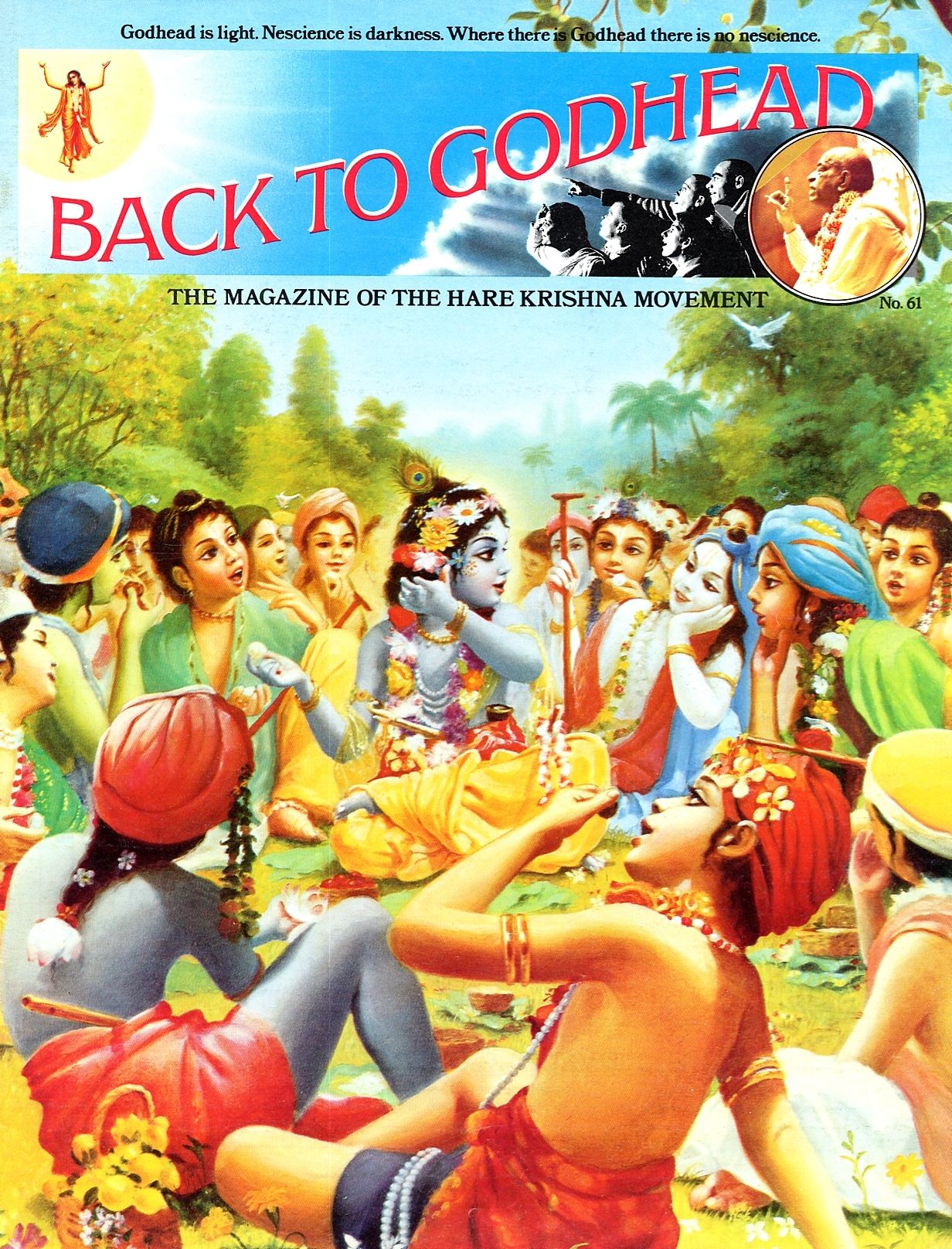
…The boys who are playing with Krsna and herding cows in Vrndavana are not ordinary living entities. They are highly developed sages who have acquired perfection by the accumulation of pious activities in past lives. For those who are under the spell of materialism, Krsna is an ordinary boy, but these cowherd boys in Vrndavana accept Him as their Master, and their Supreme Lovable Object. Consequently, all the individual boys and girls who sport in Goloka Vrndavana enjoy Krsna’s spiritual bliss. Similarly, the gopis are not ordinary cowherd girls, but are great sages who transform themselves in order to enjoy conjugal love with Krsna. Lord Caitanya spoke of them in this way: “Oh what penances did the gopis perform to eternally enjoy the beauty of the Lord Krsna? They drink His beauty with their eyes and they fill their eyes, their limbs and their hearts with celestial visions of His beauty. O, blessed are they, for they enjoy that sublime beauty which is the sweetest in the creation and which has no equal. The pure love of the gopis is like a glass that reflects this sweetness and these attributes. As the Lord sees these reflections, His sweetness increases and so does the love of the gopis. And both His sweetness and their love grow and grow as though competing with one another. And though both attain new brilliances, neither admits defeat in this wonderful competition…”
Krsna lila: The Divine Forms and Pastimes
By Sriman Hayagriva das Adhikari
From Back to Godhead Magazine 1970 Vol. 1, No. 32
Lord Krsna’s pastimes, His appearance and disappearance, are continuous and eternal throughout the universe. As far as these pastimes are concerned, there is no stoppage. It is hard for the common man to understand how Krsna’s lilas (pastimes) can be eternal. To our conception He was present on earth 5,000 years ago, and now He is gone. We compare Him to ourselves. We remain on this planet for 100 years at the most and then, like a bubble, we pop and disappear. Although this is true for ourselves, we should not compare our condition to that of the Absolute Godhead. His Body is eternal, blissful and full of knowledge, whereas ours is mortal and full of misery and ignorance. Consequently we cannot understand how Krsna’s lilas are eternal.
More
16 Jan 2012
by The Hare Krishna Movement
in Bhagavad-gita, Krishna
Tags: A.C. Bhaktivedanta Swami Prabhupada, Atlas, Atlas holding the globe, Bg 9.5, Bhagavad-gita As It Is, creation, material manifestation, Spiritual world, Visnu
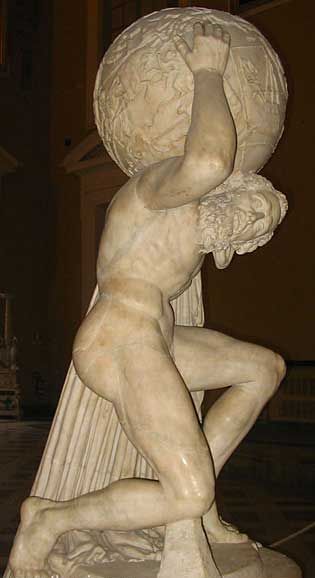
The Lord says that everything is resting on Him. This should not be misunderstood. The Lord is not directly concerned with the maintenance and sustenance of this material manifestation. Sometimes we see a picture of Atlas holding the globe on his shoulders; he seems to be very tired, holding this great earthly planet. Such an image should not be entertained in connection with Kṛṣṇa’s upholding this created universe. He says that although everything is resting on Him, still He is aloof.

Bhagavad-gita As It Is – Macmillan 1972 Edition
By His Divine Grace A.C. Bhaktivedanta Swami Prabhupada
Chapter 9, Text 5
na ca mat-sthāni bhūtāni
paśya me yogam aiśvaram
bhūta-bhṛn na ca bhūta-stho
mamātmā bhūta-bhāvanaḥ
na—never; ca—also; mat-sthāni—situated in Me; bhūtāni—all creation; paśya—just see; me—My; yogam aiśvaram—inconceivable mystic power; bhūta-bhṛt—maintainer of all living entities; na—never; ca—also; bhūta-sthaḥ—in the cosmic manifestation; mama—My; ātmā—Self; bhūta-bhāvanaḥ—is the source of all manifestations.
Translation
And yet everything that is created does not rest in Me. Behold My mystic opulence! Although I am the maintainer of all living entities, and although I am everywhere, still My Self is the very source of creation.
More
01 Dec 2011
by The Hare Krishna Movement
in Back to Godhead, Brahmananda das, Spiritual World, Vrindavan
Tags: back to Godhead, Brahmananda dasa, Krishna, Land of No Return, material world, Shangri-la, Spiritual world, Srila Prabhupada, Vrindavan
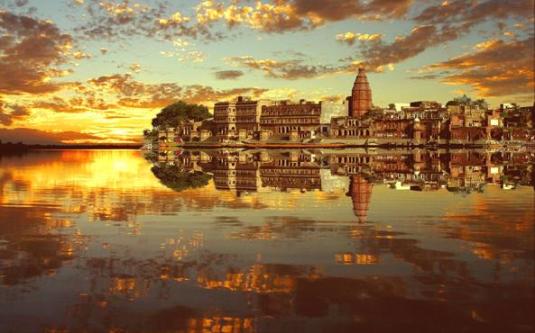
Because Vrndavana is the eternal and entirely spiritual abode of the Lord, it is nondifferent from Him. At Vrndavana, one will find unlimited wealth, strength, fame, wisdom, beauty and renunciation—all the six opulences possessed by the Supreme Personality of Godhead, Bhagavan Sri Krsna. Indeed Vrndavana is Krsna, and, to go there is to perceive God Himself.
Vrndavana—Land of No Return (Part 1)
By His Holiness Brahmananda Swami
Back to Godhead Magazine 1975 Volume 10 Number 9
From the beginning of time, man has yearned for the perfect home—a paradise, a Shangri-la, a Walden—where he could live eternally in peace and happiness. Such a place cannot be found anywhere in the material world, however, for the material world is by its very nature temporary and frustrating. To end our weary searching, we must go beyond this world of duality, beyond the boundaries of space and time, into the spiritual realm.
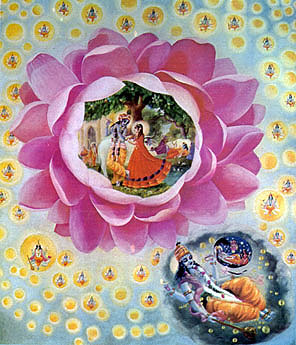
Vrndavana, India, is that sought-after eternal resting place because it is at Vrndavana that Lord Sri Krsna, the Supreme Personality of Godhead, descended to this planet five thousand years ago. The Lord’s appearance and activities are not mundane; they are completely transcendental. Just as a king may travel with all his retinue, set up camp, and conduct his affairs of state in the same style as if he were in his palace, Lord Krsna brought with Him all His transcendental associates and paraphernalia and created on earth an exact replica of the spiritual world, known as Goloka Vrndavana.
More
14 Sep 2011
by The Hare Krishna Movement
in Spiritual World, Srimati Tulasi Devi
Tags: Spiritual world, Srimad Bhagavatam, Srimati Tulasi Devi, Tulasi, tulasi garlands, tulasi leaves

Srimati Tulasi and Sri Sri Radha Vrindavan Chandra
The most important thing about the spiritual world is that there is no envy among the devotees there. This is true even among the flowers, which are all conscious of the greatness of tulasī.
Although flowering plants like the mandāra, kunda, kurabaka, utpala, campaka, arṇa, punnāga, nāgakeśara, bakula, lily and pārijāta are full of transcendental fragrance, they are still conscious of the austerities performed by tulasī, for tulasī is given special preference by the Lord, who garlands Himself with tulasī leaves.
Purport
The importance of tulasī leaves is very clearly mentioned here. Tulasī plants and their leaves are very important in devotional service. Devotees are recommended to water the tulasī tree every day and collect the leaves to worship the Lord. One time an atheistic svāmī remarked, “What is the use of watering the tulasī plant? It is better to water eggplant. By watering the eggplant one can get some fruits, but what is the use of watering the tulasī?” These foolish creatures, unacquainted with devotional service, sometimes play havoc with the education of people in general.
The most important thing about the spiritual world is that there is no envy among the devotees there. This is true even among the flowers, which are all conscious of the greatness of tulasī. In the Vaikuṇṭha world entered by the four Kumāras, even the birds and flowers are conscious of service to the Lord. (Srimad Bhagavatam)
20 Jan 2011
by The Hare Krishna Movement
in Spiritual World
Tags: abode, bhagavad-gita, goloka vrindavan, spiritual sky, Spiritual world, Syamasundara

The Spiritual World — And how to get there
Author Unknown
Krishna means the highest pleasure:
Krishna means the highest pleasure. We are all hankering after pleasure. We, the living entities, like Krishna, are full of consciousness, and we are looking for happiness. Krishna is perpetually happy, and if we associate with Krishna and cooperate with Him we will also become happy.
Krishna descends to this material world to show His pastimes in Vrndavana, which are full of happiness. When Lord Sri Krishna was in Vrndavana, His activities with His cowherd boy friends, with the gopis, with the inhabitants of Vrndavana and with the cows were all full of happiness. The total population of Vrndavana knew nothing but Krishna.
The purpose of Krishna’s pastimes in Vrindavan on this planet is so we can see such wonderful pastimes of Krishna and therefore come to understand something of what life in the spiritual world, the abode of Krishna, will be like when we go there.
More
Next Newer Entries









 The Hare Krishna Movement