18 Apr 2025
by The Hare Krishna Movement
in Uncategorized
Tags: ac-bhaktivedanta-swami-prabhupada, Buddhism, four noble truths, God, happiness, philosophy, religion, spirituality, Srila Prabhupada, Srimad Bhagavatam, suffering
Ever since I was a small child, I have been attracted to the statue of Buddha. Don’t know why, but I had a statue of Buddha in my bedroom, and it was a Christian home. I didn’t really know about Krishna then or who the Buddha was…but I was so attracted to everything Eastern. As I learned latter in life Buddha was actually an incarnation of Krsna. “From the Bhāgavatam we understand that Lord Buddha is the incarnation of Kṛṣṇa who appeared when materialism was rampant and materialists were using the pretext of the authority of the Vedas.” (from purport Bg 4.7)
The Four Noble Truths & The Eightfold Path
The Four Noble Truths
The Buddha’s first sermon after his Enlightenment centered on the Four Noble Truths, which are the foundation of Buddhism. The truths are:
The truth of suffering (dukkha)
The truth of the cause of suffering (samudaya)
The truth of the end of suffering (nirhodha)
The truth of the path that frees us from suffering (magga)
Let’s look at one truth at a time.
More
05 Feb 2025
by The Hare Krishna Movement
in Uncategorized
Tags: ac-bhaktivedanta-swami, Evolution, God, heaven or hell, philosophy, science, spirituality, Srimad Bhagavatam, the evolutionary process
Some years back I was reading from one book and the author was explaining how within each of us, we have the Keys to the gates of the Kingdom of Heaven, and we also have the Keys to the gates of Hell. It is our choice at every moment which we choose to use. Evolution can work both ways.
The Evolutionary Process
…All living entities within this material world are undergoing the cycle of birth and death according to the laws of nature. This struggle of birth and death in different species may be called the evolutionary process, but in the Western world it has been wrongly explained. Darwin’s theory of evolution from animal to man is incomplete because the theory does not present the reverse condition, namely evolution from man to animal.
Human life, which is obtained in the course of the evolutionary process, is a chance for elevation (svargāpavarga) or for degradation (tiraścām punar asya ca). If one uses this human form of life properly, he can elevate himself to the higher planetary systems, where material happiness is many thousands of times better than on this planet, or one may cultivate knowledge by which to become free from the evolutionary process and be reinstated in one’s original spiritual life. This is called apavarga, or liberation. (from purport to SB 7.13.25)
More
26 Jan 2025
by The Hare Krishna Movement
in Uncategorized
Tags: faith, God, human life, Jesus, Krishna Consciousness, philosophy, Prahlada Maharaja, Pralada, spirituality, Srila Prabhupada lecture
The Dearmost Person
Srila Prabhupada Lecture on Srimad Bhagavatam, Canto 7, Chapter 6, 1968
Today I shall speak to you of the history of a boy devotee named Prahlāda Mahārāja. He was born in a family that was stubbornly atheistic. There are two kinds of men in this world: the demons and the demigods. What is the difference between them? The main difference is that the demigods, or godly persons, are devoted to the Supreme Lord, whereas the demons are atheistic. They do not believe in God because they are materialists. These two classes of men always exist in this world. At the present moment, due to the Age of Kali (Age of Quarrel), the number of demons has increased, but the classification has existed since the beginning of creation. The incident I am narrating to you occurred very, very long ago, a few million years after the time of creation.
Prahlāda Mahārāja was the son of the most atheistic person and the most materially powerful as well. Because the society was materialistic, this boy had no opportunity to glorify the Supreme Lord. The characteristic of a great soul is that he is very eager to broadcast glorification of the Supreme Lord. Lord Jesus Christ, for example, was very eager to broadcast the glorification of God, but demoniac people misunderstood him and crucified him.
More
20 Dec 2024
by The Hare Krishna Movement
in A. C. Bhaktivedanta Swami Prabhupada, Bhagavad-gita As It Is 1972 Edition, Changing Bodies, consciousness, Soul
Tags: ac-bhaktivedanta-swami, Bhagavad-gita, consciousness, philosophy, psychology, soul, spirituality
This morning as I went out to feed the birds, I saw a dead bird on the patio who must have crashed into the window, and it just got to thinking about what is the difference between a dead body and a live body? Consciousness. So I did a little research on that word. The simple definition of the word is:
“Consciousness is the state of being aware of oneself, one’s body, and the outside world.”
OK that is the simple definition. But in the Bhagavad-gita As It Is, Srila Prabhupada gives us a more advanced understanding:
“Know that which pervades the entire body is indestructible. No one is able to destroy the imperishable soul.” (Bg. 2.17)
PURPORT
This verse more clearly explains the real nature of the soul, which is spread all over the body. Anyone can understand what is spread all over the body: it is consciousness. Everyone is conscious of the pains and pleasures of the body in part or as a whole. This spreading of consciousness is limited within one’s own body. The pains and pleasures of one body are unknown to another. Therefore, each and every body is the embodiment of an individual soul, and the symptom of the soul’s presence is perceived as individual consciousness…
…This very small spiritual spark is the basic principle of the material body, and the influence of such a spiritual spark is spread all over the body as the influence of the active principle of some medicine spreads throughout the body. This current of the spirit soul is felt all over the body as consciousness, and that is the proof of the presence of the soul. Any layman can understand that the material body minus consciousness is a dead body, and this consciousness cannot be revived in the body by any means of material administration. Therefore, consciousness is not due to any amount of material combination, but to the spirit soul. . Neither Vedic knowledge nor modern science denies the existence of the spirit soul in the body, and the science of the soul is explicitly described in the Bhagavad-gita by the Personality of Godhead Himself.
So we can conclude, that that consciousness is the presence of the soul.
08 Oct 2024
by The Hare Krishna Movement
in A. C. Bhaktivedanta Swami Prabhupada, Bhagavad-gita, Politics, truthfulness
Tags: A.C. Bhaktivedanta, Bhagavad-gita, faith, God, Krishna, Krsna, philosophy, satyam, Srila Prabhupada, truth, truthfulness, Vedas
There has been so much misinformation lately, on the news networks, on social media, in politics, etc. about election results, relief funds for hurricane victims, eating pets in Springfield Ohio, etc., that it got me thinking about truthfulness. The English definition is simply: the quality of being honest and not containing or telling any lies. However according to the Vedic definition which goes a little deeper: Satyam, truthfulness, means that facts should be presented as they are for the benefit of others.
Satyam, truthfulness, means that facts should be presented as they are for the benefit of others. Facts should not be misrepresented. According to social conventions, it is said that one can speak the truth only when it is palatable to others. But that is not truthfulness. The truth should be spoken in a straight and forward way, so that others will understand actually what the facts are. If a man is a thief and if people are warned that he is a thief, that is truth. Although sometimes the truth is unpalatable, one should not refrain from speaking it. Truthfulness demands that the facts be presented as they are for the benefit of others. That is the definition of truth. (from purport Bhagavada-gita 10. 4-5)
02 Mar 2024
by The Hare Krishna Movement
in Uncategorized
Tags: God, Krishna, philosophy, spirituality, yoga
I have always enjoyed SrilaPrabhupada’s sense of humor.
Prabhupada: ”Krsna has got accountant. [laughter] He keeps nice account of the activities of His devotees.”……
Prabhupada: So one thing is guaranteed. If you engage in Krsna consciousness, and suppose you do not become perfectly mature, some way or other you fall down… We should not fall down. Because if we have got enthusiasm and patience, we shall not fall down. But suppose we fall down. There is nothing inauspicious, because whatever you have done sincerely, that is recorded in the book, in the Krsna’s book. Krsna has got accountant. [laughter] He keeps nice account of the activities of His devotees. That’s a fact. Just like the non devotees’ accounts are kept by Yamaraja for punishment, similarly, devotees’ accounts are kept by Krsna, personally. Unless He keeps account, how He says, “I respond to the devotee to the proportionate surrender”? The real business is surrender to Krsna. If we surrender immediately, cent percent, then Krsna also gives you the result immediately, cent percent. ( The Nectar of Devotion Lecture , October 20, 1972, Vrndavana)
01 Jan 2024
by The Hare Krishna Movement
in Uncategorized
Tags: animals, food, God, philosophy, spirituality
Happy New Year! My first post of the New Year, an issue very dear to my heart, Cow Protection.
…The Srimad-Bhagavatam says the cow is an offenseless living being. It’s Krsna’s arrangement that the cow takes so little and gives so much. From her milk you can make hundreds of delicious preparations. She simply performs her service very peacefully without any bother to anyone.
Cow Protection – Practical Necessity for a Peaceful Society
(excerpted from Back to Godhead Magazine January 1976 Vol. 11, No. 1)
by Visakha-devi dasi
Speaking on the troubled condition of our modern world, the late historian Arnold Toynbee once said, “The cause of it [the world’s malady] is spiritual. We are suffering from having sold our souls to the pursuit of an objective which is both spiritually wrong and practically unobtainable. We have to reconsider our objective and change it. And until we do this, we shall not have peace, either amongst ourselves or within each of us.”
The conditions of our urbanized, technology-oriented society that prompted Dr. Toynbee’s remarks are no mystery to us. Especially in the West, and increasingly in the rest of the world, the mad quest for artificial luxuries has created a chaotic atmosphere pervaded by greed and power-seeking.
More
29 Nov 2014
by The Hare Krishna Movement
in A.C. Bhaktivedanta Swami Prabhupada, Books by Srila Prabhupada, Conversation with Srila Prabhupada, George Harrison, Photos by Gurudas, Sriman George Harrison
Tags: George Harrison, Krsna Book, Mukunda, philosophy, photo by Gurudas, Srila Prabhupada, Srila Prabhupada conversations with George Harrison, Srila Prabhupada's books
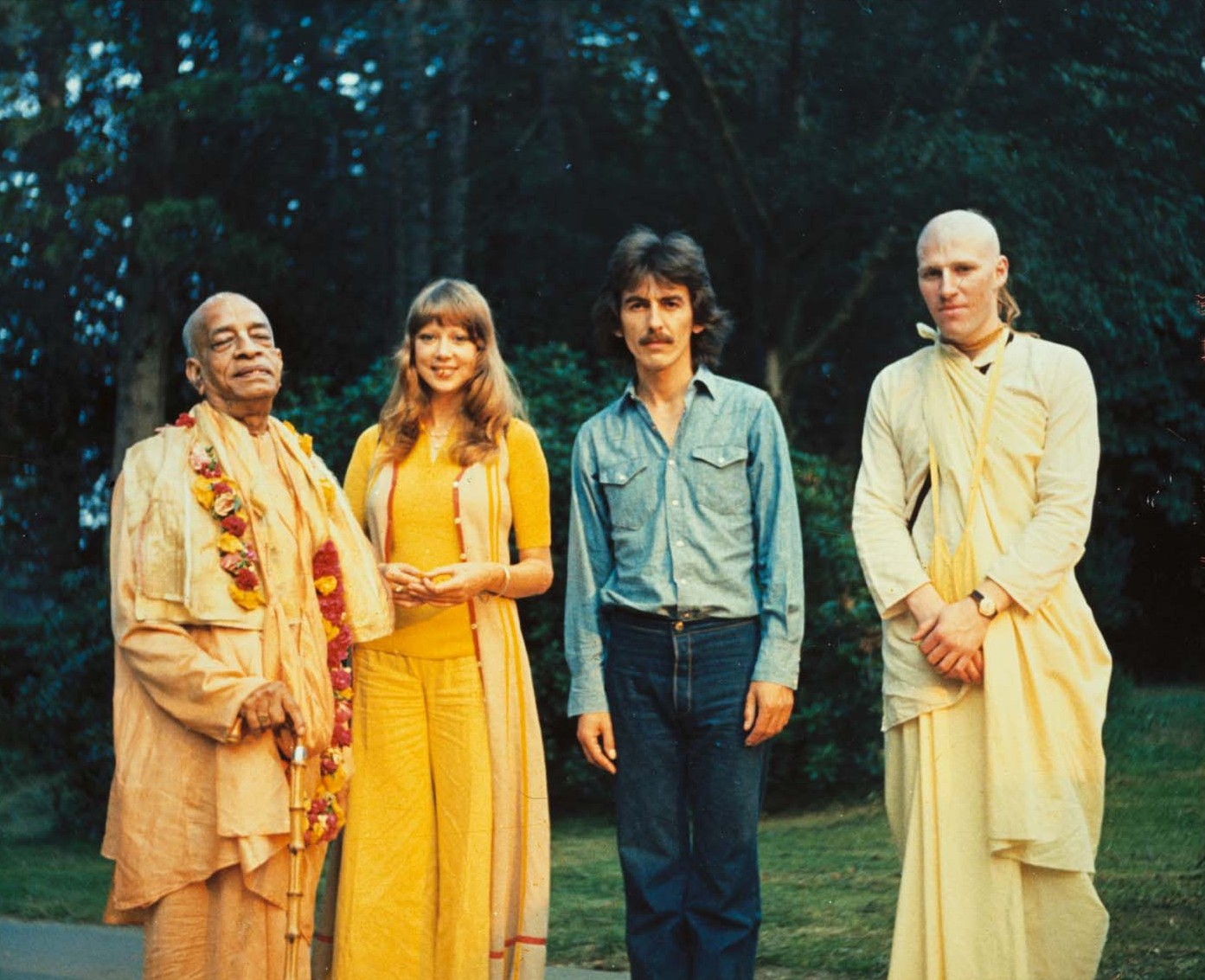
click on image to enlarge
Conversations with George Harrison
London, England – July 26, 1976
Srila Prabhupada: “Are you reading sometimes my books? Which one?”
George Harrison: “Mainly Krsna.”
Srila Prabhupada: “That is the main book.” [laughs)
George Harrison: “Mukunda gave me the new books, but there’s so much to read.”
Srila Prabhupada: “Philosophy.”
George Harrison: “I don’t know how anybody could have written it, it’s is difficult to read all that amount”
Srila Prabhupada: “Sometimes, they are surprised how one man can write so many books, but it is Krsna’ s grace. Otherwise, not possible. Human being, it is not possible.”
More
16 Sep 2014
by The Hare Krishna Movement
in A.C. Bhaktivedanta Swami Prabhupada, Caaitanya-caritamrta, Caitanya Mahaprabhu, Sri Caitanya-Caritamrta, Srimati Radharani
Tags: Adi1.5, buddhi yogam, devotee, esoteric, God, isvarah sarva-bhutanam, Krsna, magnum opus, philosophy, Radharani, scientist, servant of God, spiritual master, spiritual philosophy, spiritual science, Sri Krsna Caitanya Mahaprabhu, tesam satata-yuktanam

click on image to enlarge
Lately, I have been absorbed in reading Sri Caitanya-caritamrta. For me it is a hard book to pick up, but after I begin reading…it is a hard book to put down. Sometimes it seems so esoteric (1 intelligible only to those with special knowledge. 2 intended only for the initiated), but I cannot help but to be thrown into complete and utter awe of the masterful writing, it seems to be Srila Prabhupada’s magnum opus (1 great work of art, literture. 2 the most important work of an artist, writer, etc.). Yes, I have the Oxford Dictionary open on my desk.
The loving affairs of Śrī Rādhā and Kṛṣṇa are transcendental manifestations of the Lord’s internal pleasure-giving potency. Although Rādhā and Kṛṣṇa are one in Their identity, They separated Themselves eternally. Now these two transcendental identities have again united, in the form of Śrī Kṛṣṇa Caitanya. I bow down to Him, who has manifested Himself with the sentiment and complexion of Śrīmatī Rādhārāṇī although He is Kṛṣṇa Himself. (Śrī Caitanya-caritāmṛta, Ādi-līlā 1.5)
The following is a Lecture given on this important verse, and the complete text.
…You cannot understand God, or Kṛṣṇa, without being a faithful servant. This is the secret. And if we become faithful servant under the guidance of proper spiritual master, then we can understand what is Kṛṣṇa, what is Parabrahman, and what is loving affairs with Rādhārāṇī, what is Śrī Kṛṣṇa Caitanya Mahāprabhu. These things are revealed. It is not acquired by so-called mundane knowledge. That is not possible… So we should always remain faithful servant of Kṛṣṇa. And Kṛṣṇa is within everyone’s heart, and He will be pleased by your service, and then He will reveal Himself, what He is. Otherwise it is not possible. (from Śrī Caitanya-caritāmṛta Lecture Ādi-līlā 1.5)
Adi-lila 1.5 Lecture and Verse More
07 Feb 2012
by The Hare Krishna Movement
in Hansadutta das, Srila Prabhupada
Tags: hansadutta das, Iskcon, Krishna, philosophy, prabhupada, science of self reasization, Srila Prabhupada, Varnashrama Dharma

Prabhupada, Man of God
By Sriman Hansadutta Prabhu
His Divine Grace A.C. Bhaktivedanta Swami Prabhupada, Founder-Acharya of the International Society for Krishna Consciousness (ISKCON) is respectfully called “Srila Prabhupada”, or “spiritual master at whose feet all others bow down”. Who was he really? What did he accomplish?
Five thousand years ago, the Supreme Personality of Godhead, Lord Sri Krishna, descended to re-establish the principles of religion. At that time, Vedic culture was dying all around the world, being ruled by demonic kings. After Krishna left this world, a rapid decline in the principles of Varnashrama Dharma ensued.
Before the appearance of Srila Prabhupada, Vedic culture existed only in very small pockets in India. We must truly understand what Srila Prabhupada actually achieved in the span of about 10 years. He took THE highest spiritual culture, THE highest philosophy and THE highest science of self-realization, and successfully brought it to the West, which had no spiritual culture, no philosophy and no science of the soul. He started a worldwide revolution in religion by humbly teaching tens of thousands of fallen, sinful, lusty and degraded persons the essence of Vedic culture: pure love of God.
More
Next Newer Entries







 The Hare Krishna Movement
