08 Jan 2015
by The Hare Krishna Movement
in A.C. Bhaktivedanta Swami Prabhupada, Bhagavata Dharma Discourses, Srimad Bhagavatam
Tags: A.C. Bhaktivedanta Swami, Bhagavata Dharma Discourses, dharma means to become a devotee, dharmic life, hindu dharma, His Divine Grace A.C. Bhaktivedanta Swami Prabhupada, lectures on the Srimad Bhagavatam, liberation, New Vrindavan 1972, occupational engagements, philosophers, religious life, scientists, Vedic literature

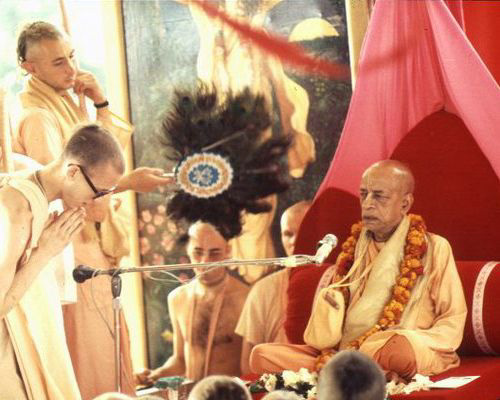
This concludes our series on the “Bhagavata Dharma Discourses” at New Vrindavan in 1972.
…So this Bhāgavata discourse is meant for giving enlightenment to the people of the world. It is not a sectarian religion; it is meant for all human beings. They should take advantage of the instruction of Śrīmad-Bhāgavatam, Bhagavad-gītā, and make their life perfect. That is our Kṛṣṇa consciousness movement.
Śrīmad-Bhāgavatam Lecture
Given by His Divine Grace A. C. Bhaktivedanta Swami Prabhupada
New Vrindaban, September 7, 1972
Canto One, Chapter 2, Text 9
Full Lecture More
04 Dec 2014
by The Hare Krishna Movement
in A.C. Bhaktivedanta Swami Prabhupada, Gopis, Vrindavan, Vrndavana
Tags: A.C. Bhaktivedanta Swami, ecstasy, gopis, great demigods like Brahma and Siva, krsna and the gopis, Lord Krsna, notorious as a teasing friend, Prabhupada books, SB3.2.14, Srimad Bhagavatam, The damsels of Vraja, transcendental love, unalloyed affection, Vrindaban, Vrndavana

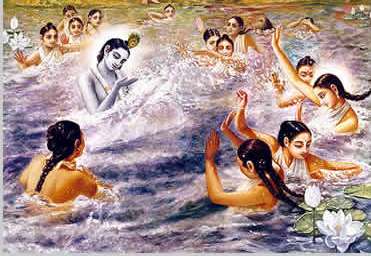
…In His boyhood at Vṛndāvana, Lord Kṛṣṇa was notorious as a teasing friend in transcendental love to all the girls His age. His love for them was so intense that there is no comparison to that ecstasy, and the damsels of Vraja were so much attached to Him that their affection excelled that of the great demigods like Brahmā and Śiva. Lord Kṛṣṇa finally admitted His defeat before the transcendental affection of the gopīs and declared that He was unable to repay them for their unalloyed affection. (from purport SB 3.2.14)
More
03 Dec 2014
by The Hare Krishna Movement
in A.C. Bhaktivedanta Swami Prabhupada, Sankirtan, Sri Siksastaka
Tags: A.C. Bhaktivedanta Swami, ceto-darpana-marjanam, darpanam, fire of conditional life, His Divine Grace A.C. Bhaktivedanta Swami Prabhupada, holy name, Lord Chaitanya Mahaprabhu, marjanam, materialistic way of life, maya, o govinda, repeated birth and death, sankirtan movement, transcendental bliss

Although I have posted the Sri Siksastaka prayers from this site in the past, the importance of these eight prayers by Lord Caitanya Mahaprabhu can not be over emphasized. Therefore we are posting them again along with a Commentary by Srila Prabhupada and a sound file by Achutananda Prabhu.
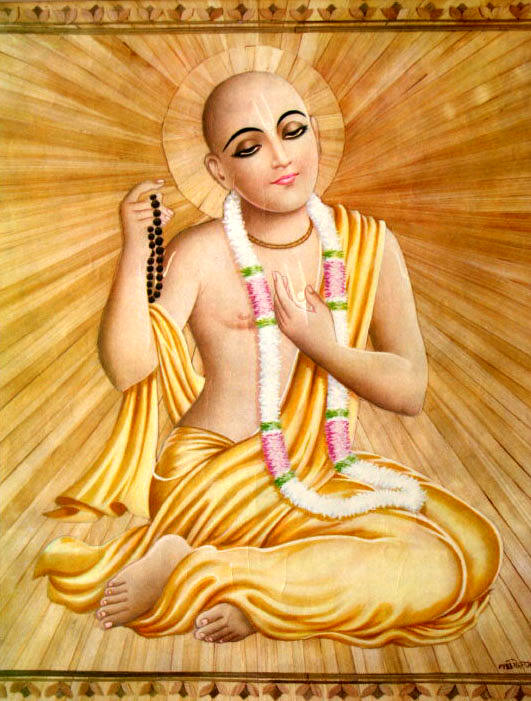
…Although Lord Caitanya was widely renowned as a scholar in His youth, He left only eight verses, called Śikṣāṣṭaka. These eight verses clearly reveal His mission and precepts. These supremely valuable prayers are translated herein.
Śrī Śrī Śikṣāṣṭaka
Eight Instructions of Lord Śrī Caitanya Mahāprabhu
More
30 Nov 2014
by The Hare Krishna Movement
in Back to Godhead, Brahmananda das, The Hare Krishna Movement
Tags: A.C. Bhaktivedanta Swami, Back to Godhead Magazine, brahmacari, Brahmananda das, Brahmananda Swami, BTG, BTG Vol.10 No. 12, How the Hare Krsna Movement came to Africa, krsna consciousness, prabhupada, preaching in Africa, The Hare Krishna Movement

How the Hare Krsna Movement Came to Africa
by His Holiness Brahmananda Swami
Excerpted from; Back to Godhead Magazine 1975 Vol. 10, No. 12
The story of how the Hare Krsna movement came to Africa starts in 1971 in the United States. I was in Tallahassee, Florida, teaching an experimental course in Krsna consciousness at the state university, when I received a letter from my spiritual master, His Divine Grace A.C. Bhaktivedanta Swami Prabhupada, instructing me to go immediately to West Pakistan for preaching work. I had very little money, and I knew the trip to Pakistan would be long and arduous. However, a disciple takes his spiritual master’s order as his very life and soul, and I was determined that nothing would stop me.
More
29 Nov 2014
by The Hare Krishna Movement
in A.C. Bhaktivedanta Swami Prabhupada, Diksha, Disciplic succession, Guru & Disciple, guru-tattva, Hansadutta das, Letters by Srila Prabhupada, Ritvik Initiation, Spiritual Master
Tags: A.C. Bhaktivedanta Swami, Ama das, Atmavidya das, Durgama das, Gobhata das, hamsadutta prabhu, Hrimati dasi, Jnanavigraha das, Kamaksi dasi, letter to hamsadutta, Nikhilananda das, Premchand das, Ram Mohan das, Ramgati das, Revantinandana Swami, Santimati dasi, Srila Prabhupada, Tirthada das, Uktal das, Vaidyanath das
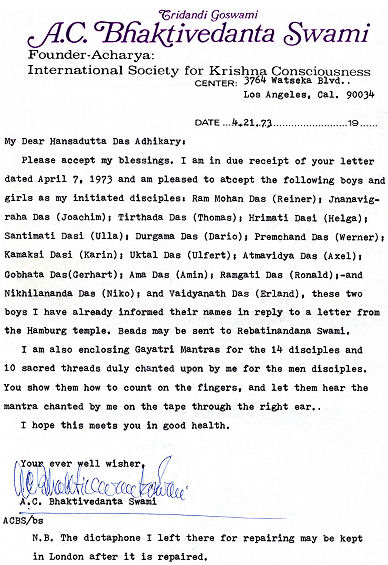
I read this letter today, by Srila Prabhupada to Hamsadutta Prabhu, written in 1973, putting in practice, the process of ritvik initiation (although we did not have a name for it then, it was simply how it was done); “…Please accept my blessings. I am in due receipt of your letter dated April 7, 1973 and am pleased to accept the following boys and girls as my initiated disciples.
I am also enclosing Gayatri Mantras for the 14 disciples and 10 sacred threads duly chanted upon by me for the men disciples. You show them how to count on the fingers, and let them hear the mantra chanted by me on the tape through the right ear.”
What I find interesting is how devotees today will decry and belittle the Ritvik Process of initiation, but this was how the initiations were performed in the early days of our movement. The majority of disciples, initiated by Srila Prabhupada when he was personally present, received initiation exactly as it was described in above letter. We almost all recieved Ritvik initiation from Srila Prabhupada. I know I did.
Anyway, food for thought.
Letter More
05 Nov 2014
by The Hare Krishna Movement
in A.C. Bhaktivedanta Swami Prabhupada, Damodara, Kartika, KRSNA The Supreme Personality of Godhead
Tags: A.C. Bhaktivedanta Swami, A.C. Bhaktivedanta Swami Prabhupada, brahmanas, gopis, handcart, hither and thither, Krishna, Krishna's childhood pastimes, Krsna, Nanda Maharaja, Supreme Personality of Godhead, Vedic hymns, Yasoda, YMother Yasoda

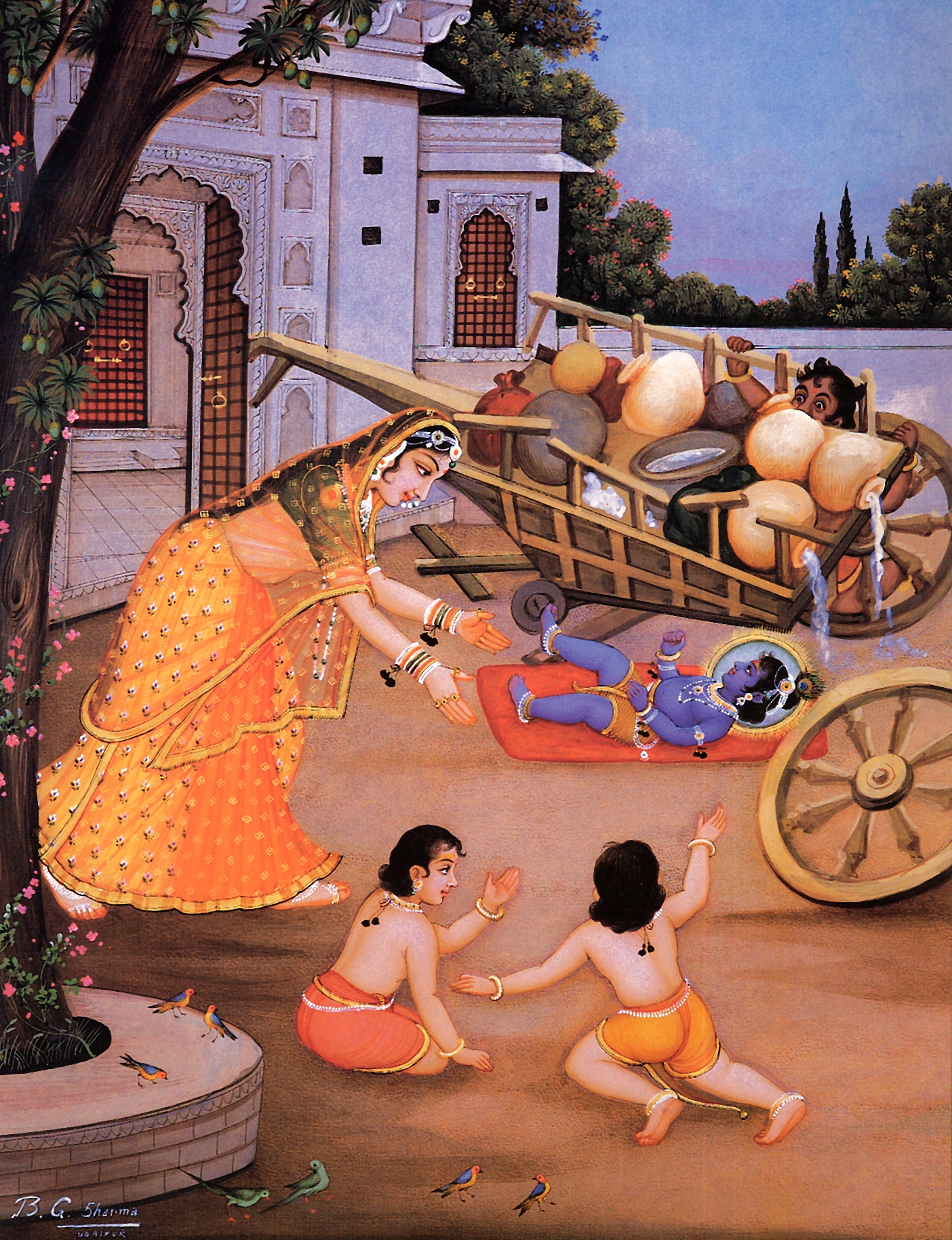
Continuining our month long attempt to stay focused on the childhood pastimes of Krsna, during this month of Damodara (Kartika), we bring you another exciting chapter from; Kṛṣṇa, the Supreme Personality of Godhead. Today we are posting the chapter entitled “The Salvation of Tṛṇāvarta”.
…Baby Kṛṣṇa had been placed underneath a hand-driven cart, and while He was kicking His legs, He accidentally touched the wheel of the cart, and it collapsed. Various kinds of utensils and brass and metal dishes had been piled up in the handcart, and they all fell down with a great noise. The wheel of the cart separated from the axle, and the spokes of the wheel were all broken and scattered hither and thither. Mother Yaśodā and all the gopīs, as well as Mahārāja Nanda and the cowherd men, were astonished as to how the cart could have collapsed by itself.
…If someone takes advantage of hearing the pastimes of the Lord, the material contamination of dust, accumulated in the heart due to long association with material nature, can be immediately cleansed. Lord Caitanya also instructed that simply by hearing the transcendental name of Lord Kṛṣṇa, one can cleanse the heart of all material contamination. There are different processes for self-realization, but this process of devotional service–of which hearing is the most important function–when adopted by any conditioned soul, will automatically cleanse him of the material contamination and enable him to realize his real constitutional position. (Kṛṣṇa, the Supreme Personality of Godhead)
Full Chapter More
31 Mar 2014
by The Hare Krishna Movement
in A.C. Bhaktivedanta Swami Prabhupada, Ecstasy, Spiritual Life, Spring, Srila Prabhupada's Books, Srimad Bhagavatam
Tags: A.C. Bhaktivedanta Swami, devotee, lotus feet of the Lord, material enjoyment, perfection in devotional service, pure devotional service, remembering Krishna, SB 1.5.19, spiritually relishable, spring break, Srila Prabhupada's books

I guess we all have our favorite verse or sloka from Srila Prabhupada’s books, and a favorite picture as well. This is probably my favorite verse from the Srimad Bhagavatam. It speaks to me, and I find that I quote this verse often when I am speaking with others about the joyous nature of Krishna consciousness.
I will be away from the computer for the next few weeks as we are taking a ‘spring break’, but I wanted our last post to be about Remembering Krishna.
My dear Vyāsa, even though a devotee of Lord Kṛṣṇa sometimes falls down somehow or other, he certainly does not undergo material existence like others [fruitive workers, etc.] because a person who has once relished the taste of the lotus feet of the Lord can do nothing but remember that ecstasy again and again. (Srimad Bhagavatam 1.5.19)
…Pure devotional service is so spiritually relishable that a devotee becomes automatically uninterested in material enjoyment. That is the sign of perfection in progressive devotional service. A pure devotee continuously remembers the lotus feet of Lord Śrī Kṛṣṇa and does not forget Him even for a moment, not even in exchange for all the opulence of the three worlds. (from purport)
Full Verse and Purport More
28 Mar 2014
by The Hare Krishna Movement
in A.C. Bhaktivedanta Swami Prabhupada, Srila Sukadeva Goswami
Tags: A.C. Bhaktivedanta Swami, Absolute Truth, Bhagavan, bhagavatam, brahman, material existence, Paramatma, SB 1.1.4, Srila Sukladeva Goswami
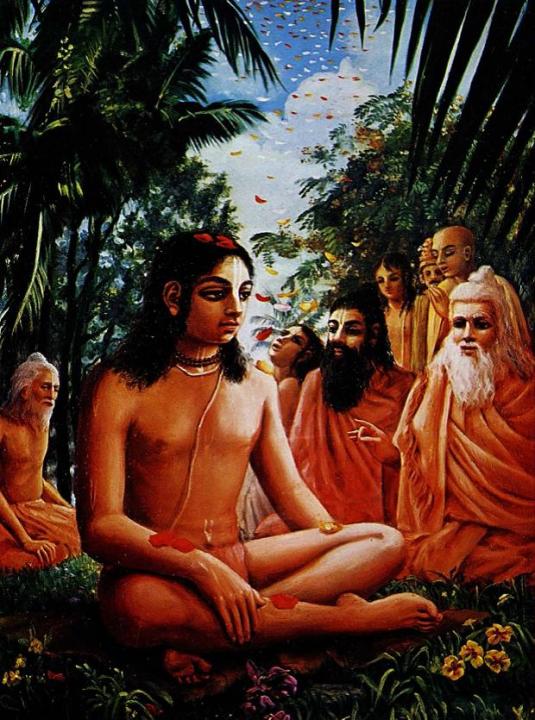
…those who are really anxious to get out of this material existence may take shelter of this Bhāgavatam because it is uttered by the liberated Śrīla Śukadeva Gosvāmī. It is the transcendental torchlight by which one can see perfectly the transcendental Absolute Truth realized as Brahman, Paramātmā and Bhagavān. (from purport to SB 1.1.4)
full text and purport More
06 Mar 2014
by The Hare Krishna Movement
in A.C. Bhaktivedanta Swami Prabhupada, Books by Srila Prabhupada, Krishna Consciousness, KRSNA The Supreme Personality of Godhead, Srila Prabhupada
Tags: A.C. Bhaktivedanta Swami, all attractive, beauty, fame, Krsna, Krsna Book, krsna consciousness, power, Preface to Krsna, Srila Prabhupada, Supreme Personality of Godhead, The Supreme Personality of Godhead, wealth, who is krsna, wisdom renunciation

click on image to enlarge
This morning my attention was drawn to the Krsna Book. The book was laying on my book stand unopened, but it was so attractive, that I just had to open it, and read the Preface again. Back in the early 70’s, this was the first book I received from a devotee at the Chicago O Hara Airport, and I remember when I first opened it, and began to read this Preface, I was immediately convinced that Krsna was God. Immediately! Such is the power of the words of the pure devotee; Srila Prabhupada.
In these Western countries, when someone sees the cover of a book like Kṛṣṇa, he immediately asks, “Who is Kṛṣṇa? Who is the girl with Kṛṣṇa?” etc.
The immediate answer is that Kṛṣṇa is the Supreme Personality of Godhead. How is that? Because He conforms in exact detail to descriptions of the Supreme Being, the Godhead. In other words, Kṛṣṇa is the Godhead because He is all-attractive. Outside the principle of all-attraction, there is no meaning to the word Godhead. How is it one can be all-attractive? First of all, if one is very wealthy, if he has great riches, he becomes attractive to the people in general. Similarly, if someone is very powerful, he also becomes attractive, and if someone is very famous, he also becomes attractive, and if someone is very beautiful or wise or unattached to all kinds of possessions, he also becomes attractive. So from practical experience we can observe that one is attractive due to 1) wealth, 2) power, 3) fame, 4) beauty, 5) wisdom, and 6) renunciation. One who is in possession of all six of these opulences at the same time, who possesses them to an unlimited degree, is understood to be the Supreme Personality of Godhead. (from Preface to “Kṛṣṇa, the Supreme Personality of Godhead”)
Entire Preface More
25 Feb 2014
by The Hare Krishna Movement
in A.C. Bhaktivedanta Swami Prabhupada, Free Downloads, Free eBooks, The Reservoir of Pleasure
Tags: A.C. Bhaktivedanta Swami, free eBooks, free pdf download, Krishna Path, Krsna The Reservoir of Pleasure, prabhupada, preaching pamphlet, The Hare Krishna Movement

Here is another free download made possiable by our friends at Krishnapath.org. I love these early publications, when preaching was the essence of our mission, and the message was so sublime.
Click on following link to view or save; More
01 Nov 2013
by The Hare Krishna Movement
in A.C. Bhaktivedanta Swami Prabhupada, Back to Godhead, Jayadvaita Swami, Remembering Srila Prabhupada, Srila Prabhupada
Tags: A.C. Bhaktivedanta Swami, Back to Godhead Magazine, BTG Vol. 13, disappearance of His Divine Grace A.C. Bhaktivedanta Swami Prabhupada, Jayadvaita Swami, ocean of mercy, Remembering Srila Prabhupada, Srila Prabhupada, Srila Prabhupada's gifts

The following is an older Back to Godhead article that that I fondly remember, which was published in 1978, shortly after Srila Prabhupada’s disappearance. We reprint it here to honor the memory of His Divine Grace Srila Prabhupada.
The Gifts of His Divine Grace
by Jayadvaita dasa [Swami]
Excerpted from Back to Godhead Magazine 1978 Vol. 13, No. 1-2
In just a dozen years, His Divine Grace A.C. Bhaktivedanta Swami Prabhupada gave the world a legacy that will last forever.
More
21 Sep 2013
by The Hare Krishna Movement
in A.C. Bhaktivedanta Swami Prabhupada, Buddha, Srimad Bhagavatam, Vegetarianism
Tags: A.C. Bhaktivedanta Swami, animal sacrifices, Anjana, buddha, Gaya, God, incarnation of the Personality of Godhead, Lord Buddha, moral discipline, nonviolence, prabhupada, Vedas

click on image to enlarge
For some reason, I have always been attracted to Buddha since my early childhood. Later in my life as I turned 18, I also became interested in vegetarianism, which peaked my interest in spiritual life as well. So it was, I began the practice of yoga and meditation. It is interesting to note that later (age 21) when I became a Hare Krishna devotee, was when my actual education in Lord Buddha began. We share with you two select verses from the Srimad Bhagavatam describing the mission of Lord Buddha.
The mission of Lord Buddha was to save people from the abominable activity of animal killing and to save the poor animals from being unnecessarily killed.
Lord Buddha, a powerful incarnation of the Personality of Godhead, appeared in the province of Gayā (Bihar) as the son of Añjana, and he preached his own conception of nonviolence and deprecated even the animal sacrifices sanctioned in the Vedas. At the time when Lord Buddha appeared, the people in general were atheistic and preferred animal flesh to anything else. On the plea of Vedic sacrifice, every place was practically turned into a slaughterhouse, and animal killing was indulged in unrestrictedly. Lord Buddha preached nonviolence, taking pity on the poor animals. He preached that he did not believe in the tenets of the Vedas and stressed the adverse psychological effects incurred by animal killing. Less intelligent men of the age of Kali, who had no faith in God, followed his principle, and for the time being they were trained in moral discipline and nonviolence, the preliminary steps for proceeding further on the path of God realization. He deluded the atheists because such atheists who followed his principles did not believe in God, but they kept their absolute faith in Lord Buddha, who himself was the incarnation of God. Thus the faithless people were made to believe in God in the form of Lord Buddha. That was the mercy of Lord Buddha: he made the faithless faithful to him.
Select verses: More
25 Aug 2013
by The Hare Krishna Movement
in A.C. Bhaktivedanta Swami Prabhupada, Letters by Srila Prabhupada, Yoga
Tags: A.C. Bhaktivedanta Swami, asana, astanga-yoga, Bg 6.47, bhakti yoga, dhayana yoga, dhyana, hatha yoga, jnana-yoga, karma yoga, Krishna consciousness, link, link-up, meaning of yoga, meditation, pranayama, raja yoga, yoga, yoga meaning, yoga systems

click on image to enlarge
When we think of Yoga, we used to think of some old bearded yogi standing on his head, or more recently of young beautiful men & women in athletic clothing posing serenely, or a class full of people stretching on yoga mats. But actually the meaning of yoga is far beyond any of the physical gymnastics we tend to associate with the word. There are many systems of yoga, namely; karma yoga, jnana yoga, dhayana yoga, hatha yoga, bhakti yoga, and so many patterns of yoga. But as we understand from the Bhagavad-gita:
…in the Bhagavad-gītā it is clearly stated that…yoga means to get into touch with the Supreme Lord. The process, however, includes several bodily features such as āsana, dhyāna, prāṇāyāma and meditation (from purport SB 1.2.28-29)
…The word yoga means “link.” Any system of yoga is an attempt to reconnect our broken relationship with the Supreme Personality of Godhead. There are different types of yoga, of which bhakti-yoga is the best. In other yoga systems, one must undergo various processes before attaining perfection, but bhakti-yoga is direct. (from purport SB 10.2.6)
…The culmination of all kinds of yoga practices lies in bhakti-yoga. All other yogas are but means to come to the point of bhakti in bhakti-yoga. Yoga actually means bhakti-yoga; all other yogas are progressions toward the destination of bhakti-yoga. From the beginning of karma-yoga to the end of bhakti-yoga is a long way to self-realization. Karma-yoga, without fruitive results, is the beginning of this path. When karma-yoga increases in knowledge and renunciation, the stage is called jñāna-yoga. When jñāna-yoga increases in meditation on the Supersoul by different physical processes, and the mind is on Him, it is called aṣṭāṅga-yoga. And, when one surpasses the aṣṭāṅga-yoga and comes to the point of the Supreme Personality of Godhead Kṛṣṇa, it is called bhakti-yoga, the culmination. Factually, bhakti-yoga is the ultimate goal, but to analyze bhakti-yoga minutely one has to understand these other yogas. The yogī who is progressive is therefore on the true path of eternal good fortune. One who sticks to a particular point and does not make further progress is called by that particular name: karma-yogī, jñāna-yogī or dhyāna-yogī, rāja-yogī, haṭha-yogī, etc. If one is fortunate enough to come to the point of bhakti-yoga, it is to be understood that he has surpassed all the other yogas. Therefore, to become Kṛṣṇa conscious is the highest stage of yoga, just as, when we speak of Himalayan, we refer to the world’s highest mountains, of which the highest peak, Mount Everest, is considered to be the culmination.
It is by great fortune that one comes to Kṛṣṇa consciousness on the path of bhakti-yoga to become well situated according to the Vedic direction. The ideal yogī concentrates his attention on Kṛṣṇa, who is called Śyāmasundara, who is as beautifully colored as a cloud, whose lotus-like face is as effulgent as the sun, whose dress is brilliant with jewels and whose body is flower garlanded. Illuminating all sides is His gorgeous luster, which is called the brahmajyoti. He incarnates in different forms such as Rāma, Nṛsiṁha, Varāha and Kṛṣṇa, the Supreme Personality of Godhead, and He descends like a human being, as the son of Mother Yaśodā, and He is known as Kṛṣṇa, Govinda and Vāsudeva. He is the perfect child, husband, friend and master, and He is full with all opulences and transcendental qualities. If one remains fully conscious of these features of the Lord, he is called the highest yogī. (Bhagavad-gita 6.47)
The very word yoga means connecting link with the supreme being. We accept Krishna as the supreme being, and nobody is equal to him or greater than him. (Letter to Sri Krishna C. Batra – Vrindaban 8 December, 1975)
Full Letter + References More
15 Jul 2013
by The Hare Krishna Movement
in A.C. Bhaktivedanta Swami Prabhupada, Chanting Hare Krishna, Lectures
Tags: A.C. Bhaktivedanta Swami, Avatara, chanting Hare Krishna, Hare, Hare Krishna, Krishna, lecture on the maha-mantra, Maha Mantra, mantra, mantra meditation, prabhupada, Prabhupada Lecture, Rama, sound incarnation, Srila Prabhupada, swami, transcendental sound

So this sound, this Hare Krsna, Hare Krsna, Krsna Krsna, Hare Hare. Hare Rama, Hare Rama, Rama Rama, Hare Hare, is the sound representation of the Supreme Lord.
Lecture on Maha-mantra
By His Divine Grace A.C. Bhaktivedanta Swami Prabhupada
Recorded September 8th, 1966, New York
Prabhupada: Now, some of you members have asked me to explain the meaning of this chanting, Hare Krishna, Hare Krsna, Krsna Krsna, Hare Hare. Hare Rama, Hare Rama, Rama Rama, Hare Hare. Now, this sound is transcendental sound, transcendental sound, incarnation, sound incarnation of the Absolute Truth. Just try to understand what is incarnation. Incarnation means… The Sanskrit word is avatara, and that is translated into English as “incarnation.” Of course, the root meaning of incarnation I cannot exactly explain to you, but the root meaning of the… (aside:) The root meaning of avatara is “which comes from the transcendental sky, the spiritual sky to the material sky.” That is called avatara. Avatarana. Avatarana. Just like… Avatarana means “coming from up to down.” That is called avatarana. And avatara is understood that when God or His bona fide representative comes from that sky to this material plane, that is called avatara.
More
02 Jul 2013
by The Hare Krishna Movement
in A.C. Bhaktivedanta Swami Prabhupada, Maharaja Pariksit, Spiritual Master, Srila Prabhupada's Books, Srimad Bhagavatam, Sukadeva Goswami
Tags: A.C. Bhaktivedanta Swami, at time of death, hear chant and remember, Maharaja Pariksit, perfection of life, segue, self realization, Srimad Bhagavatam, Sukadeva Goswami

This morning I was marveling at how beautifully Srila Prabhupada segues [def: an uninterrupted transition from one song to another. 2. go on without a pause.] from the First Canto of the Srimad Bhagavatam into the Second Canto. This Srimad Bhagavatam, is truly one of the most amazing books in existence today!
You are the spiritual master of great saints and devotees. I am therefore begging you to show the way of perfection for all persons, and especially for one who is about to die. (SB 1.19.37)
Please let me know what a man should hear, chant, remember and worship, and also what he should not do. Please explain all this to me. (SB 1.19.38)
Śrī Sūta Gosvāmī said: The King thus spoke and questioned the sage, using sweet language. Then the great and powerful personality, the son of Vyāsadeva, who knew the principles of religion, began his reply… (SB 1.19.40) [End of First Canto]
[Start of Second Canto]…Śrī Śukadeva Gosvāmī said: My dear King, your question is glorious because it is very beneficial to all kinds of people. The answer to this question is the prime subject matter for hearing, and it is approved by all transcendentalists. (SB 2.1.1)
…That very Śrīmad-Bhāgavatam I shall recite before you because you are the most sincere devotee of Lord Kṛṣṇa. One who gives full attention and respect to hearing Śrīmad-Bhāgavatam achieves unflinching faith in the Supreme Lord, the giver of salvation. (SB 2.1.10)
Unless one is perfectly anxious to inquire about the way of perfection, there is no necessity of approaching a spiritual master. A spiritual master is not a kind of decoration for a householder. Generally a fashionable materialist engages a so-called spiritual master without any profit. The pseudo spiritual master flatters the so-called disciple, and thereby both the master and his ward go to hell without a doubt. Mahārāja Parīkṣit is the right type of disciple because he puts forward questions vital to the interest of all men, particularly for the dying men. The question put forward by Mahārāja Parīkṣit is the basic principle of the complete thesis of Śrīmad-Bhāgavatam. Now let us see how intelligently the great master replies. (from purport to SB 1.19.37)
Full translation and purports More
22 Jun 2013
by The Hare Krishna Movement
in Back to Godhead, Bhaktivinoda Thakura, Brahmananda das, Gaudiya Vaisnavism
Tags: A.C. Bhaktivedanta Swami, Acaryas, age of quarrel, Back to Godhead Magazine, Bengali, Brahmananda dasa, Kali-yuga, Krsna, Lord Caitanya, sastras, scriptures, Srila Bhaktivinoda Thakur, Vedas
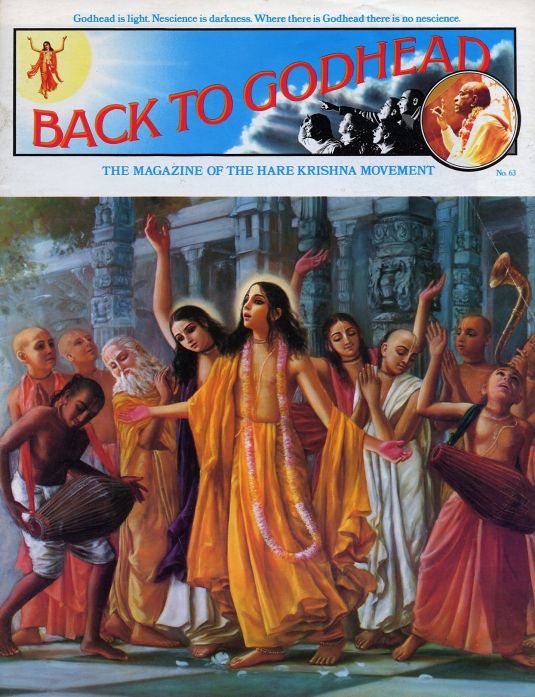
This is a very informative article which gives not only some of the History of Lord Caitanya’s Mission, but on the preaching of Srila Bhaktivinoda Thakur, Gaudiya Vaisnavism, and the Hare Krishna Movement here in the West.
How the Teachings of Lord Caitanya Came to the Western World
Excerpted from Back to Godhead Magazine
Vol.1, No. 66, 1974
Part 1
by His Holiness Brahmananda Swami
“He reasons ill who tells that Vaisnavas die When thou art living still in Sound! The Vaisnavas die to live and living try To spread a holy life around!”—verse by Srila Bhaktivinoda Thakura on the tomb of the great saint Thakura Haridasa at Puri, India
In Calcutta in 1896, the teachings of Lord Caitanya began their journey to the West. In Bengali-speaking Calcutta on August 20th of that year, Srila Bhaktivinoda Thakura published a small English treatise entitled Lord Caitanya—His Life and Precepts. Seventyone years later, in 1967, in Montreal, Canada, a graduate student came across a copy of this book while browsing through the rare-book collection of the McGill University library. The book was a wonderful find for him because he was a dedicated follower of Lord Caitanya’s, having been convinced of Lord Caitanya’s teachings by His Divine Grace A.C. Bhaktivedanta Swami Prabhupada, whom he had accepted as his spiritual master. Srila Prabhupada was born in Calcutta on September 1, 1896, only a few days after Lord Caitanya-His Life and Precepts was published. Thus by a transcendental arrangement this significant book and he who would fulfill the purpose of the book appeared together.
More
14 Jun 2013
by The Hare Krishna Movement
in A.C. Bhaktivedanta Swami Prabhupada, Dedication Slokas, Srimad Bhagavatam
Tags: A.C. Bhaktivedanta Swami, collection of slokas, dedication slokas, krsne sva-dhamopagate, original books by srila prtabhupada, slokas, srila prabhupada slokas, Srimad Bhagavatam
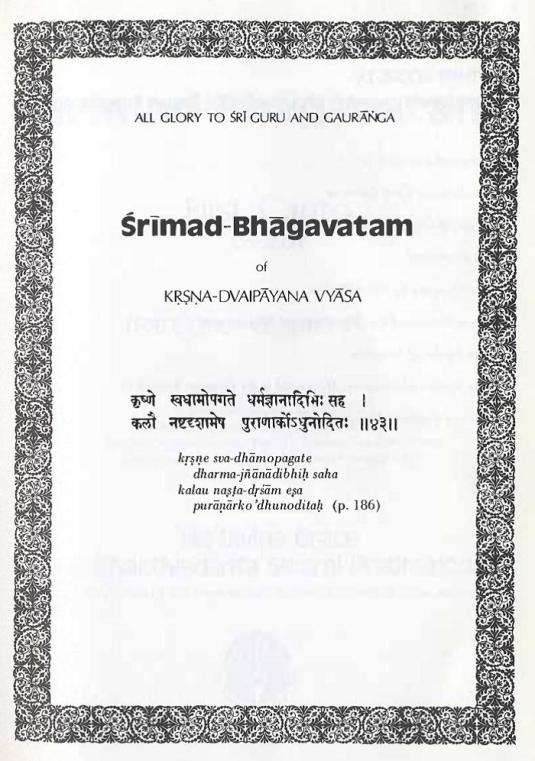
For anyone who has had the good fortune to read and study Srila Prabhupada’s epic Srimad Bhagavatam, will know that on the title page of each and every volume is a dedication sloka. I thought it would be interesting to compile a list of the dedication slokas from all of the original books. I stopped this collection of slokas with the Tenth Canto, Part Three, as this is where Srila Prabhupada left off, and where my collection of Srimad Bhagavatam’s stops. -Vyasasan das
More
23 Feb 2013
by The Hare Krishna Movement
in A.C. Bhaktivedanta Swami Prabhupada, Balarama, Festivals, guru-tattva, Nityananda
Tags: 2-2-1977, A.C. Bhaktivedanta Swami, Balarama, Caitanya Mahaprabhu, guru, guru tattva, Krishna, Krsna, lecture by Prabhupada, Lord Nityananda's Appearance Day, Nityananda, spiritual master, Srila Prabhupada, yasya prasadad bhagavat-prasadah

click on image to enlarge
…Balarāma means guru-tattva. Balarāma represents guru. Yasya prasādād bhagavat-prasādaḥ. If we want to understand Caitanya Mahāprabhu, if we want to understand Kṛṣṇa, then we must take shelter of Balarāma. Nāyam ātmā bala-hinena labhyaḥ. This bala-hinena labhyaḥ, this Vedic injunction, means “Without the mercy of Balarāma you cannot understand, you cannot realize your spiritual identification. So that Balarāma comes as Nityānanda Prabhu.”
…So if we want actually peace of mind, if we actually want to be free from this material fatiguement, then we must take the shelter of Nityānanda Prabhu. Nityānanda Prabhu is the strength, spiritual strength. And without spiritual strength you cannot approach Kṛṣṇa.
More
16 Dec 2012
by The Hare Krishna Movement
in A.C. Bhaktivedanta Swami Prabhupada, Back to Godhead, Conversation with Srila Prabhupada, The Hare Krishna Movement
Tags: A.C. Bhaktivedanta Swami, Back to Godhead Magazine, BTG Vol.1 No.49, disciple, International Society for Krishna Consciousness, Iskcon, Krishna consciousness movement, krsna consciousness, spiritual master, Srila Prabhupada, The Hare Krishna Movement, Vedic formula

The Search for the Divine
By His Divine Grace A.C. Bhaktivedanta Swami Prabhupada
Excerpted from Back to Godhead Magazine Vol. 1, No. 49
[On his way from Los Angeles to London to attend the annual Jagannatha Car Festival, His Divine Grace A.C. Bhaktivedanta Swami Prabhupada, the founder and spiritual master of the International Society for Krishna Consciousness, paused for three days at ISKCON’s East Coast Headquarters in New York City. There he delivered a short series of public lectures, initiated twenty new disciples, gave personal directions to many of his students, and granted audience to selected guests and visitors. The following is a conversation, held in Srila Prabhupada’s personal quarters on the second afternoon of his visit, between His Divine Grace and A Newsman.]
[A newsman, with two assistants and electronic equipment, has been trying to see Srila Prabhupada.]
Newsman (whispering to Syamasundara dasa, Srila Prabhupada’s secretary): Can I ask a couple of questions, and then I’ll leave?
Syamasundara: Please, ask, yes.
More
05 May 2012
by The Hare Krishna Movement
in Srimad Bhagavatam
Tags: A.C. Bhaktivedanta Swami, Absolute Truth, Bhaktivedanta purports, Krishna, Srila Prabhupada, Srimad Bhagavatam, The Supreme Personality of Godhead

…Forgetting Kṛṣṇa, we have created so many objects of questions and answers, but none of them are able to give us complete satisfaction. All things—but Kṛṣṇa—give temporary satisfaction only, so if we are to have complete satisfaction we must take to the questions and answers about Kṛṣṇa. We cannot live for a moment without being questioned or without giving answers. Because the Śrīmad-Bhāgavatam deals with questions and answers that are related to Kṛṣṇa, we can derive the highest satisfaction only by reading and hearing this transcendental literature.
Srimad Bhagavatam
By His Divine Grace A.C. Bhaktivedanta
Canto 1, Chapter 2, Text 5
munayaḥ sādhu pṛṣṭo ’haṁ
bhavadbhir loka-maṅgalam
yat kṛtaḥ kṛṣṇa-sampraśno
yenātmā suprasīdati
munayaḥ—O sages; sādhu—this is relevant; pṛṣṭaḥ—questioned; aham—myself; bhavadbhiḥ—by all of you; loka—the world; maṅgalam—welfare; yat—because; kṛtaḥ—made; kṛṣṇa—the Personality of Godhead; sampraśnaḥ—relevant question; yena—by which; ātmā—self; suprasīdati—completely pleased.
TRANSLATION
O sages, I have been justly questioned by you. Your questions are worthy because they relate to Lord Kṛṣṇa and so are of relevance to the world’s welfare. Only questions of this sort are capable of completely satisfying the self.
PURPORT
Since it has been stated hereinbefore that in the Bhāgavatam the Absolute Truth is to be known, the questions of the sages of Naimiṣāraṇya are proper and just, because they pertain to Kṛṣṇa, who is the Supreme Personality of Godhead, the Absolute Truth. In Bhagavad-gītā (15.15) the Personality of Godhead says that in all the Vedas there is nothing but the urge for searching after Him, Lord Kṛṣṇa. Thus the questions that pertain to Kṛṣṇa are the sum and substance of all the Vedic inquiries.
The whole world is full of questions and answers. The birds, beasts and men are all busy in the matter of perpetual questions and answers. In the morning the birds in the nest become busy with questions and answers, and in the evening also the same birds come back and again become busy with questions and answers. The human being, unless he is fast asleep at night, is busy with questions and answers. The businessmen in the market are busy with questions and answers, and so also the lawyers in the court and the students in the schools and colleges. The legislators in the parliament are also busy with questions and answers, and the politicians and the press representatives are all busy with questions and answers. Although they go on making such questions and answers for their whole lives, they are not at all satisfied. Satisfaction of the soul can only be obtained by questions and answers on the subject of Kṛṣṇa.
More
Previous Older Entries Next Newer Entries











 The Hare Krishna Movement