27 Jun 2014
by The Hare Krishna Movement
in A.C. Bhaktivedanta Swami Prabhupada, Krishna Nectar, Krsna Consciousness
Tags: A.C. Bhaktivedanta Swami Prabhupada, celebrated flute, cowherd boys, friends of krsna, Krishna, Krsna, remembrance of Lord Krsna, SB 3.2.27, Srimad Bhagavatam, Third Canto, transcendental flute, transcendental pleasure, Yamuna river
click on image to enlarge
This morning I was reading from the Srimad Bhagavatam Third Canto, Chapter Two. It was so enlivening, that I read out-loud, the entire chapter. The following is just three verses and purports from the chapter entitled ” Remembrance of Lord Kṛṣṇa”.
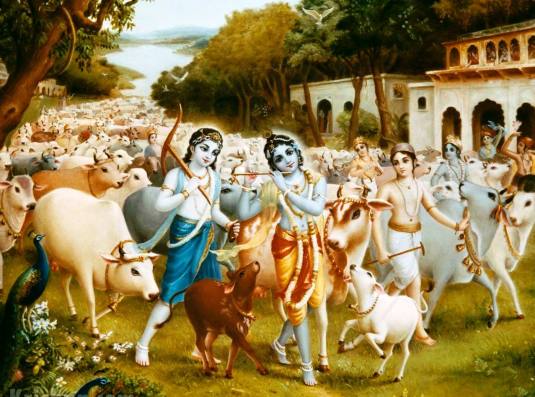
In His childhood, the Almighty Lord was surrounded by cowherd boys and calves, and thus He traveled on the shore of the Yamunā River, through gardens densely covered with trees and filled with vibrations of chirping birds. (SB 3.2.27)
…the Lord used to play His celebrated flute. The sound vibrated by His flute would give His friends such transcendental pleasure that they would forget all the talks of the brahmānanda which is so praised by the impersonalists. These cowherd boys, as will be explained by Śukadeva Gosvāmī, were living entities who had accumulated heaps of pious acts and thus were enjoying with the Lord in person and were hearing His transcendental flute. The Brahma-saṁhitā (5.30) confirms the Lord’s blowing His transcendental flute. (from purport to SB 3.2.29)
veṇuṁ kvaṇantam aravinda-dalāyatākṣaṁ
barhāvataṁsam asitāmbuda-sundarāṅgam
kandarpa-koṭi-kaminīya-viśeṣa-śobhaṁ
govindam ādi-puruṣaṁ tam ahaṁ bhajāmi
Brahmājī said, “I worship Govinda, the primeval Lord, who plays on His transcendental flute. His eyes are like lotus flowers, He is decorated with peacock plumes, and His bodily color resembles a fresh black cloud although His bodily features are more beautiful than millions of cupids.” These are the special features of the Lord.
More
25 Jun 2014
by The Hare Krishna Movement
in A.C. Bhaktivedanta Swami Prabhupada, Primeval
Tags: A.C. Bhaktivedanta Swami Prabhupada, ancient, antediluvian, Bg. 2.20, bhagavad-gita, earliest, first, having existed from the beginning, history of the world, original, prehistoric, primeval, primeval forest, primordial, primordial forms of life, primordial matter, pristine, virgin

This morning I was reading from the Bhagavad-gita As It Is 1972 Edition by His Divine Grace A. C. Bhaktivedanta Swami Prabhupada, and for the thousandth time I read the word “primeval”, as in the following verse; “For the soul there is never birth nor death. Nor, having once been, does he ever cease to be. He is unborn, eternal, ever-existing, undying and primeval. He is not slain when the body is slain” (Bg 2.20). I always figured that I understood that word ‘primeval’ and never felt the need to look it up. But this morning I paused and asked myself “what is primeval?” I really didn’t know. So that is the basis for todays post.
Definition, examples More
16 Jun 2014
by The Hare Krishna Movement
in A.C. Bhaktivedanta Swami Prabhupada, Patanjali Muni, Yoga
Tags: A.C. Bhaktivedanta Swami Prabhupada, monist, Patanjali Muni, patanjali system, Patanjali system of yoga, patanjali yoga sutras, samadhi, superself, theory of oneness, trance, transcendental pleasure, yoga, yoga practice, yoga principle, yogi

This morning my body was stiff when I woke from sleep, as I have been working rather hard lately, and I thought that I would do my morning Yoga out on the deck as the Sun was rising. Going through all the different asanas, my mind was thinking about the actual meaning of the word yoga (union with God). So after my shower I opened the Bhagavad-gita As It Is and read chapter six entitled “Sankhya-yoga”.
I guess you could say I felt some pleasure while performing my hatha-yoga asanas, as the stiffness left my body and blood circulation returned, and then from my reading I could understand that this was understandable and acceptable.
…There is an acceptance of transcendental pleasure in the Patañjali system, but the monists do not accept this transcendental pleasure out of fear of jeopardizing the theory of oneness. The duality of knowledge and knower is not accepted by the nondualist, but in this verse transcendental pleasure—realized through transcendental senses—is accepted. And this is corroborated by the Patañjali Muni, the famous exponent of the yoga system. The great sage declares in his Yoga-sūtras: puruṣārtha-śūnyānāṁ guṇānāṁ pratiprasavaḥ kaivalyaṁ svarūpa-pratiṣṭhā vā citi-śaktir iti.
This citi-śakti, or internal potency, is transcendental. Puruṣārtha means material religiosity, economic development, sense gratification and, at the end, the attempt to become one with the Supreme. This “oneness with the Supreme” is called kaivalyam by the monist. But according to Patañjali, this kaivalyam is an internal, or transcendental, potency by which the living entity becomes aware of his constitutional position. In the words of Lord Caitanya, this state of affairs is called ceto-darpaṇa-mārjanam, or clearance of the impure mirror of the mind. This “clearance” is actually liberation, or bhava-mahādāvāgni-nirvāpaṇam. The theory of nirvāṇa—also preliminary—corresponds with this principle. In the Bhāgavatam this is called svarūpeṇa vyavasthitiḥ. The Bhagavad-gītā also confirms this situation in this verse. (from purport to Bg. 6.20-23)
Maybe I just use the philosophy to justify my enjoyment of yoga-asanas, or perhaps controlling the mind, body and senses, is the preliminary path leading to liberation, freedom from all miseries.
As a lamp in a windless place does not waver, so the transcendentalist, whose mind is controlled, remains always steady in his meditation on the transcendent Self. (Bg. 6.19)

The stage of perfection is called trance, or samādhi, when one’s mind is completely restrained from material mental activities by practice of yoga. This is characterized by one’s ability to see the self by the pure mind and to relish and rejoice in the self. In that joyous state, one is situated in boundless transcendental happiness and enjoys himself through transcendental senses. Established thus, one never departs from the truth, and upon gaining this he thinks there is no greater gain. Being situated in such a position, one is never shaken, even in the midst of greatest difficulty. This indeed is actual freedom from all miseries arising from material contact.
(Bg. 6.20-23)
More
15 Jun 2014
by The Hare Krishna Movement
in A.C. Bhaktivedanta Swami Prabhupada, Bhagavad-gita, Father, Letters by Srila Prabhupada
Tags: A.C. Bhaktivedanta Swami Prabhupada, disciplic succession, eternal father, father, fathers, Fathers day, God, Krishna, Krsna, original father, spiritual master, supreme father
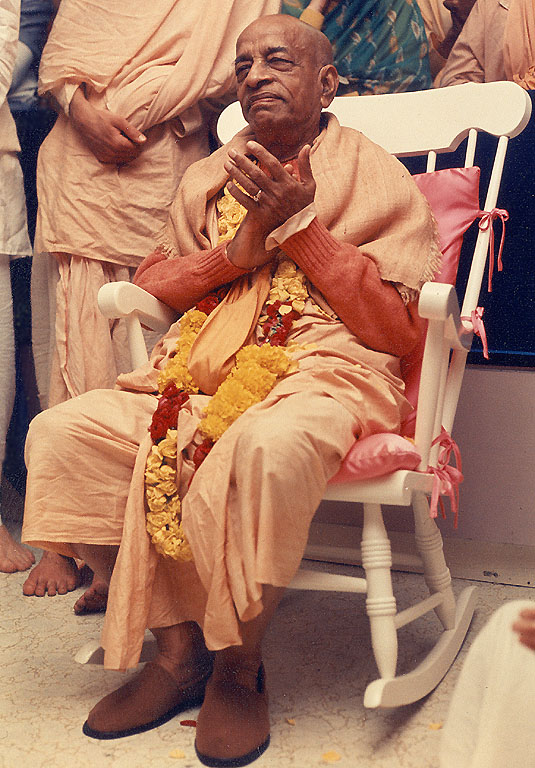
Here in the West people are celebrating Fathers day. So today we honor our our Father with some quotes on Father.
…To accept Kṛṣṇa as father means “My father is there. I have no anxiety.” (Morning Walk — April 26, 1976, Melbourne)
…I am your Spiritual Father, and Krishna is your Spiritual Husband. A girl can never forget either her father or her husband.
(Letter to Jadurani — Stinson Beach, Calif 8 July, 1967)
…The Lord is very kind to the living entities because they are His sons. Lord Kṛṣṇa declares in Bhagavad-gītā, “sarva-yoniṣu…ahaṁ bīja-pradaḥ pitā.” “I am the father of all.”
You are the father of this complete cosmic manifestation, the worshipable chief, the spiritual master. No one is equal to You, nor can anyone be one with You. Within the three worlds, You are immeasurable.
You are the Supreme Lord, to be worshiped by every living being. Thus I fall down to offer You my respects and ask Your mercy. Please tolerate the wrongs that I may have done to You and bear with me as a father with his son, or a friend with his friend, or a lover with his beloved. (Bg 11. 43-44)
More
14 Jun 2014
by The Hare Krishna Movement
in A.C. Bhaktivedanta Swami Prabhupada, Demigod, Demons, Devaki
Tags: A.C. Bhaktivedanta Swami Prabhupada, Anantadeva, Baladeva, demigods, Devaki, devaki's womb, Garbha-stuti prayers, Jarasandha, Kamsa, Lord Krsna, saktas, Sankarsana, Srimad Bhagavatam, Vaisnavas, yogamaya

click on image for full size resolution
This morning I was reading Chapter Two in the Krsna Book, the chapter entitled “Prayers by the Demigods for Lord Kṛṣṇa in the Womb” and I was reminded of this above image from the Tenth Canto of Srimad Bhagavatam, that I like very much. So I thought I would share this image with you, along with the brief chapter description. Hare Krishna!
…when the Supreme Personality of Godhead entered the womb of Devakī to kill Kaṁsa, all the demigods understood that the Lord was living within Devakī’s womb, and therefore in veneration they offered Him the Garbha-stuti prayers. (from chapter description SB 10.2)
More
13 Jun 2014
by The Hare Krishna Movement
in Back to Godhead, Cow Protection, Taru das
Tags: A.C. Bhaktivedanta Swami Prabhupada, Back to Godhead Magazine, BTG, bull as father and symbol of religion, bull protection, cow protection, devotional service, farming for Krsna, Farms, gigantic industrial enterprises, godless civilization, Kirtananda Swami, Krsna conscious farming communities, oxen, Srila Prabhupada

Farming With Krsna in Mind
Excerpted from Back to Godhead Magazine Vol. 12, No. 11 1977
I just spent the day here at New Vrindavan farm community, discussing plans for the future cow protection program, which will include an Ox barn and training for teams of young oxen, for use in plowing, wood harvesting, and pulling carts and wagons. It was all very inspiring and I am very much eger to become more deeply involved in this important aspect of our philosophy. Personally I have plans to work with some young oxen, build an ox cart, and put them to work. What is that saying…”when the father is employed the family will prosper”…so it is time to engage the bulls in some meaningful activity so the family will prosper and they will become joyful once again.
With this idea in mind, we post this older article from the Back to Godhead Magazine.
“Naturally, cow protection includes bull protection. The bull is our father and the symbol of religion. At present a few boys are working the oxen and hauling wood, plowing fields, and cutting hay. Of course, we do have tractors, but we want to develop skill working the oxen. They are our future.”
“Human prosperity flourishes by natural gifts, and not by gigantic industrial enterprises, “says His Divine Grace A.C. Bhaktivedanta Swami Prabhupada, who has founded many Krsna-conscious farming communities all over the world. “The gigantic industrial enterprises are products of a godless civilization, and they cause the destruction of the noble aims of human life…. What we need, therefore, is to be obedient to the laws of the Lord and achieve the perfection of human life by devotional service to Him. “Here’s a look at two ‘ ISKCON farms in action.
More
09 Jun 2014
by The Hare Krishna Movement
in A.C. Bhaktivedanta Swami Prabhupada, Bhagavad-gita, Devotional Service, Dharma, Spiritual Life
Tags: A.C. Bhaktivedanta Swami Prabhupada, active state, Bhagavad Gita, devotee as a conjugal lover, devotee as friend, devotee as parent, devotional service, eternal relationship with the Lord, passive state, relationship, svarupa, transcendental friendship

click on image to enlarge
I have always loved this picture since the first time I opened the Bhagavad-gita some 42 years ago. It is a beautiful image of life in the Spiritual Sky, and also, it is a nice graphic description of the 5 types of relationships one can have with the Supreme Lord. The following is a short description, from the Introduction to the Bhagavad-gita As It Is, about the eternal nature, and the 5 types of relationships on can have with the Lord.
…In this material world we find that everything is temporary. It comes into being, stays for some time, produces some by-products, dwindles and then vanishes. That is the law of the material world, whether we use as an example this body, or a piece of fruit or anything. But beyond this temporary world there is another world of which we have information. This world consists of another nature which is sanātana, eternal. Jīva is also described as sanātana, eternal, and the Lord is also described as sanātana in the Eleventh Chapter. We have an intimate relationship with the Lord, and because we are all qualitatively one—the sanātana-dhāma, or sky, the sanātana Supreme Personality and the sanātana living entities—the whole purpose of Bhagavad-gītā is to revive our sanātana occupation, or sanātana-dharma, which is the eternal occupation of the living entity. We are temporarily engaged in different activities, but all of these activities can be purified when we give up all these temporary activities and take up the activities which are prescribed by the Supreme Lord. That is called our pure life.
…That destination is called the sanātana sky, the eternal spiritual sky. (from Introduction to Bhagavad-gita As It Is)
More
08 Jun 2014
by The Hare Krishna Movement
in A.C. Bhaktivedanta Swami Prabhupada, Balarama, Krishna, Krishna Consciousness, Krishna Nectar, KRSNA The Supreme Personality of Godhead, Krsna-katha
Tags: A.C. Bhaktivedanta Swami Prabhupada, Balarama, gopis, Krishna, Krsna, Krsna and Balarama, krsna and balarama nectar, Krsna's flute, land of vrndavana, pastimes of krsna and balarama, pastimes of krsna and balarama in the forest of vrndavan, Rama, Spiritual Life, Vrndavan

When I saw this beautiful image of Krsna and Balarama, my mind immediately went to the Krsna Book. So I pulled out some of the pastimes of the two transcendental brothers to share with you today.
…Accompanied by the cowherd boys and Balarāma, Kṛṣṇa brought forward the cows and played on His flute through the forest of Vṛndāvana, which was full of flowers, vegetables, and pasturing grass. The Vṛndāvana forest was as sanctified as the clear mind of a devotee and was full of bees, flowers and fruits. There were chirping birds and clear water lakes with waters that could relieve one of all fatigues. Sweet flavored breezes blew always, refreshing the mind and body. Kṛṣṇa, with His friends and Balarāma, entered the forest and, seeing the favorable situation, enjoyed the atmosphere to the fullest extent. Kṛṣṇa saw all the trees, overloaded with fruits and fresh twigs, coming down to touch the ground as if welcoming Him by touching His lotus feet. He was very pleased by the behavior of the trees, fruits and flowers, and He began to smile realizing their desires. (Chapter 15 Killing of Dhenukasura)
…One day, when Kṛṣṇa, along with Balarāma, was maintaining the calves in the forest, They saw some cows grazing on the top of Govardhana Hill. The cows could see down into the valley where the calves were being taken care of by the boys. Suddenly, on sighting their calves, the cows began to run towards them. They leaped downhill with joined front and rear legs. The cows were so melted with affection for their calves that they did not care about the rough path from the top of Govardhana Hill down to the pasturing ground. They began to approach the calves with their milk bags full of milk, and they raised their tails upwards. When they were coming down the hill, their milk bags were pouring milk on the ground out of intense maternal affection for the calves, although they were not their own calves. These cows had their own calves, and the calves that were grazing beneath Govardhana Hill were larger; they were not expected to drink milk directly from the milk bag but were satisfied with the grass. Yet all the cows came immediately and began to lick their bodies, and the calves also began to suck milk from the milk bags. There appeared to be a great bondage of affection between the cows and calves. (Chapter 13 The Stealing of the Boys and Calves by Brahma)
…Kṛṣṇa was very pleased with the atmosphere of the forest where flowers bloomed and bees and drones hummed very jubilantly. While the birds, trees and branches were all looking very happy, Kṛṣṇa, tending the cows, accompanied by Śrī Balarāma and the cowherd boys… (Chapter 21 The Gopīs Attracted by the Flute)
More
07 Jun 2014
by The Hare Krishna Movement
in A.C. Bhaktivedanta Swami Prabhupada, Dream, Srila Prabhupada's Books, Uncategorized
Tags: A.C. Bhaktivedanta Swami Prabhupada, awakenes to discover the self, deep sleep, dreaming, dreams, human form of life, Krsna, Le Reve, original creator, Srimad Bhagavatam, Supreme Lord, The Dream, The Supreme Personality of Godhead, The Wynn, vasudevah sarvam, wynn las vegas, Wynn theater

Recently we were in Las Vegas for a wedding celebration, and after dinner we went to the show “Le Reve” at the Wynn. “Le Reve” is French for; “The Dream”. It was the most amazing theatrical performance we have seen in years. My mind was swept away by the magnificence of the production, and it was in fact, dream-like. I was transported to another dimension; phantasmagoria. A.C. Bhaktivedanta Swami uses this word in his books, to describe the dream-like nature of this material world.
I would highly recommend seeing Le Reve at the Wynn, if you are in Las Vegas, and as always…recommend reading the books by His Divne Grace A. C. Bhaktivedanta Swami Prabhupada for further advancement and enlightenment in life.
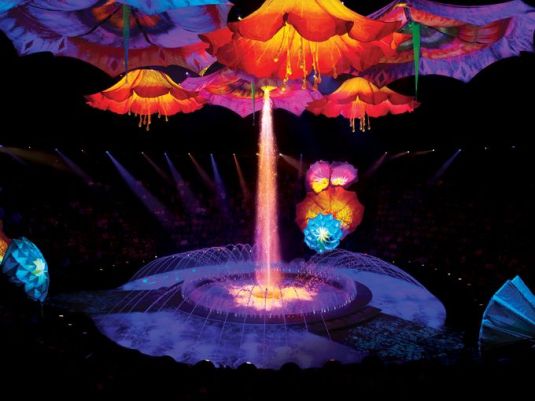
When a person is in deep sleep, he dreams and sees in himself many other objects, such as great mountains and rivers or perhaps even the entire universe, although they are far away. Sometimes when one awakens from a dream he sees that he is in a human form, lying in his bed in one place. Then he sees himself, in terms of various conditions, as belonging to a particular nationality, family and so on. All the conditions of deep sleep, dreaming and wakefulness are but energies of the Supreme Personality of Godhead. One should always remember the original creator of these conditions, the Supreme Lord, who is unaffected by them. (SB 6.16.53-54_
More
06 Jun 2014
by The Hare Krishna Movement
in A.C. Bhaktivedanta Swami Prabhupada, Bhagavad-gita, Bhagavad-gita As It Is 1972 Edition
Tags: A.C. Bhaktivedanta Swami Prabhupada, back home, back to Godhead, conditioned souls, essence of bhagavad gita, eternal relationship with the Supreme Lord, Krishna and Arjuna, Krsna, Krsnaloka planet, spiritual existence, spiritual personality, spiritual sky, Supreme Personality of Godhead
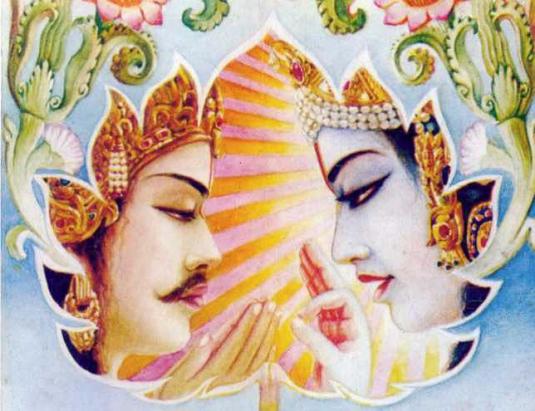
Sometimes when reading the Bhagavad-gita As It Is by His Divine Grace A. C. Bhaktivedanta Swami Prabhupada, a verse or purport will just jump out at me, as it did this morning. No matter how many times I read the Bhagavad-gita, because it is transcendental literature, it is everfresh and new. Every reading has new and deeper realizations…as was the case with this important verse and purport.
My dear Arjuna, one who is engaged in My pure devotional service, free from the contaminations of previous activities and from mental speculation, who is friendly to every living entity, certainly comes to Me. (Bg 11.55)
Anyone who wants to approach the Supreme of all the Personalities of Godhead, on the Kṛṣṇaloka planet in the spiritual sky, and be intimately connected with the Supreme Personality, Kṛṣṇa, must take this formula, as is stated by the Supreme Himself. Therefore, this verse is considered to be the essence of Bhagavad-gītā. The Bhagavad-gītā is a book directed to the conditioned souls, who are engaged in the material world with the purpose of lording it over nature and who do not know of the real, spiritual life. The Bhagavad-gītā is meant to show how one can understand his spiritual existence and his eternal relationship with the Supreme Spiritual Personality and to teach one how to go back home, back to Godhead. Now here is the verse which clearly explains the process by which one can attain success in his spiritual activity: devotional service….
More
27 May 2014
by The Hare Krishna Movement
in A.C. Bhaktivedanta Swami Prabhupada, Lectures, Wedding Ceremony
Tags: A.C. Bhaktivedanta Swami Prabhupada, devotees, Hamsaduta, Hare Krishna wedding, Himavati, Krsna consciousness movement, prabhupada, Rukmini, Satsvarupa, vedic wedding, wedding ceremony, wedding peformed by prabhupada

click on image to enlarge
Wedding Ceremony and Lecture
given by His Divine Grace A. C. Bhaktivedanta Swami Prabhupada
Boston, May 6, 1969
More
27 May 2014
by The Hare Krishna Movement
in A.C. Bhaktivedanta Swami Prabhupada, Krsna-katha, Srila Prabhupada Conversations, Srila Prabhupada vani, Vaisnava Vocabulary, Vani
Tags: A.C. Bhaktivedanta Swami Prabhupada, animal eaters, animal-killing, butcher, commit suicide, hunting, killer of animals, killer of the soul, killing animals, killing cows, Krsna conscious, Krsna-katha, pasu-ghna, pasughna, slaughterhouses

Cow Protection for the Benefit of Civilization
Here is another word for your vaisnava vocabulary; pasughna. I was reading this morning from the Introduction to the Krsna Book and this word [paśughna] just kinda jumped out at me. The meaning is: killing animals or killing oneself. I found this interesting, that killing animals was the same as killing oneself. I did a serch on Vani Quotes of this word and the following post is the results of that search.
…This book, Kṛṣṇa, which is filled with kṛṣṇa-kathā, will thus appeal equally to the liberated souls and to persons who are trying to be liberated, as well as to the gross, conditioned materialist. According to the statement of Mahārāja Parīkṣit, who heard about Kṛṣṇa from Śukadeva Gosvāmī, kṛṣṇa-kathā is equally applicable to every human being, whatever condition of life he is in. Surely everyone will appreciate it to the highest magnitude. But Mahārāja Parīkṣit also warned that persons who are simply engaged in killing animals and in killing themselves may not be very much attracted to kṛṣṇa-kathā. In other words, ordinary persons who are following the regulative moral principles of scriptures, no matter in what condition they are found, will certainly be attracted, but not persons who are killing themselves. The exact word used in Śrīmad-Bhāgavatam is paśughna, which means killing animals or killing oneself. Persons who are not self-realized and who are not interested in spiritual realization are killing themselves; they are committing suicide. Because this human form of life is especially meant for self-realization, by neglecting this important part of his activities one simply wastes his time like the animals. So he is paśughna. The other meaning of the word refers to those who are actually killing animals. This means persons who are animal-eaters (even dog-eaters), for they are all engaged in killing animals in so many ways, such as hunting and opening slaughterhouses. Such persons cannot be interested in kṛṣṇa-kathā. (Krsna Book Introduction)
More
26 May 2014
by The Hare Krishna Movement
in A.C. Bhaktivedanta Swami Prabhupada, Krishna's flute, Radha Krishna, Radha Madhava, Spiritual Life, Srimati Radharani
Tags: 1975 edition, A.C. Bhaktivedanta Swami Prabhupada, fifth note, flute, Krishna's Flute, Kuruksetra, Radha, Radharani, Sri Caitanya-caritamrta, Vrndavan, Yamuna

[This is a verse spoken by Śrīmatī Rādhārāṇī.] “My dear friend, now I have met My very old and dear friend Kṛṣṇa on this field of Kurukṣetra. I am the same Rādhārāṇī, and now We are meeting together. It is very pleasant, but still I would like to go to the bank of the Yamunā beneath the trees of the forest there. I wish to hear the vibration of His sweet flute playing the fifth note within that forest of Vṛndāvana.”
More
24 May 2014
by The Hare Krishna Movement
in A.C. Bhaktivedanta Swami Prabhupada, Srila Prabhupada, The Hare Krishna Movement
Tags: A.C. Bhaktivedanta Swami Prabhupada, every town and village, golden age, Kali-yuga, krsna consciousness, Lord Caitanya's message, Prabhupada Festival, prabhupada festival 2014, senapati, Srila Prabhupada, The Hare Krishna Movement
Prabhupada Festival 2014
Lord Caitanya Mahaprabhu predicted that His holy name would be broadcast in every town and village of the world. Acaryas of His sampradaya predicted that the spread of Krsna consciousness would usher in a ten-thousand year Golden Age within the dark age of Kali. And in Caitanya Mangala, Locana dasa Thakura foretold that a great senapati (military general) would appear to widely and powerfully preach Lord Caitanya’s message. That confidential task of spreading Krsna consciousness all over the world was entrusted to:
His Divine Grace A. C. Bhaktivedanta Swami Prabhupada
Today marks the 23rd Annual Prabhupada Festival taking place in Los Angles California. For more information click on the link;
http://www.prabhupadafestival.com/index2014.html
or visit on them on Facebook at;
https://www.facebook.com/prabhupadafestival
All Glories to Srila Prabhupada!
More
19 May 2014
by The Hare Krishna Movement
in A.C. Bhaktivedanta Swami Prabhupada, Bhagavad-gita, Study Guide for the Bhagavad-gita
Tags: 1972 Edition, A.C. Bhaktivedanta Swami Prabhupada, all paths of yoga, as it is, astanga-yoga, Bhagavad Gita, Bhagavan, bhakti yoga, brahman, empiricism, hatha yoga, jnana-yoga, karma yoga, Paramatma, raja yoga, Sankhya-yoga, the eightfold path, the yoga of devotion, yoga ladder
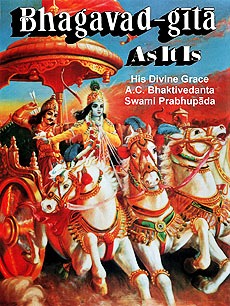
The following is a Study Guide for the Bhagavad Gita As It Is 1972 Edition which was developed by some of the disciples and followers of His Divine Grace A. C. Bhaktivedanta Swami Prabhupada. This is a definitive guide that takes the student through the Bhagavad-gita step by step and first was formulated by Srila Prabhupada.
This Study Guide begins with the full Introduction to the Bhagavad-gita As It Is, and then proceeds with chapter by chapter analysis, Q & A etc. This arrived this morning as a Word Doc and required some slight editing to upload it as a post.
Study Guide
Presented by the Disciples and Followers of His Divine Grace A. C. Bhaktivedanta Swami Prabhupada
…One cleanses himself daily by taking a bath in water, but one who takes his bath only once in the sacred Ganges water of the Bhagavad-gita cleanses away all the dirt of material life. Because Bhagavad-gita is spoken by the Supreme Personality of Godhead, one need not read any other Vedic literature. One need only attentively and regularly hear and read Bhagavad-gita. In the present age, mankind is so absorbed with mundane activities that it is not possible to read all of the Vedic literatures. But this is not necessary. This one book, Bhagavad-gita, will suffice because it is the essence of all Vedic literatures and because it is spoken by the Supreme Personality of Godhead. It is said that one who drinks the water of the Ganges certainly gets salvation, but what to speak of one who drinks the waters of Bhagavad-gita? Gita is the very nectar of the Mahabharata spoken by Visnu Himself, for Lord Krsna is the original Visnu. It is nectar emanating from the mouth of the Supreme Personality of Godhead, and the Ganges is said to be emanating from the lotus feet of the Lord.
Of course there is no difference between the mouth and the feet of the Supreme Lord, but in our position we can appreciate that the Bhagavad-gita is even more important than the Ganges.
The Bhagavad-gita is just like a cow, and Lord Krsna, who is a cowherd boy, is milking this cow. The milk is the essence of the Vedas, and Arjuna is just like a calf. The wise men, the great sages and pure devotees, are to drink the nectarean milk of Bhagavad-gita.
In this present day, man is very eager to have one scripture, one God, one religion, and one occupation. So let there be one common scripture for the whole world–Bhagavad-gita. And let there be one God only for the whole world–Sri Krsna. And one mantra only–Hare Krsna, Hare Krsna, Krsna Krsna, Hare Hare/ Hare Rama, Hare Rama, Rama Rama, Hare Hare. And let there be one work only–the service of the Supreme Personality of Godhead. (from Introduction to Bhagavad-gita As It Is)
More
15 May 2014
by The Hare Krishna Movement
in A.C. Bhaktivedanta Swami Prabhupada, Acyutanananda das, Conversation with Srila Prabhupada, Diksha, Guru & Disciple, guru-tattva
Tags: A.C. Bhaktivedanta Swami Prabhupada, Acyutananda das, guru mukha padma vakya, liberated, more than guru, prabhupada, room conversation, spiritual master, Yasomatinandana dasa

The following is a very famous room conversation that took place in 1976. It contains some very important lessons.
Acyutānanda: What prompts the soul to misuse his independence or improperly use…?
Prabhupāda: Because he has got little independence. Yathecchasi tathā, he has got this.
Acyutānanda: Why do some misuse it and some never misuse it?
Prabhupāda: That depends on him. If one is determined that “I shall only act according to the advice of my Guru Mahārāja,” then he’s perfect. One has to submit like Arjuna said, śiṣyas te ‘haṁ śādhi māṁ prapannam [Bg. 2.7]. Otherwise he’ll argue….
Devotee: Even nitya-siddha has guru.
Yaśomatīnandana: Even the liberated soul, nitya-siddha.
Prabhupāda: Liberated soul never says that “I am liberated.” As soon as he says “liberated,” he’s a rascal. A liberated soul will never say that “I am liberated.” That is liberated. Caitanya Mahāprabhu, He is God—guru more mūrkha dekhi’ karila śāsan [Cc. Ādi 7.71]. “My Guru Mahārāja saw Me a fool number one, and he has chastised Me.” He’s God. This is the example. If one remains always a servant ever-lastingly of guru, then he is liberated. And as soon as he thinks that he is liberated, he’s a rascal. That is the teaching of Caitanya Mahāprabhu. Guru more mūrkha dekhi’. Caitanya Mahāprabhu is mūrkha? Why He’s posing Himself that mūrkha? “I am fool number one.” That means that is liberation. You must be ready always to be chastised by guru. Then he’s liberated. And as soon as he thinks that “I am beyond this chastisement, I am liberated,” he’s a rascal. Why Caitanya Mahāprabhu says guru more mūrkha dekhi’ karila śāsan? This is sahajiyā-vāda. He is thinking, “Oh I have become liberated. I don’t require any direction of my guru. I’m liberated.” Then he’s rascal. Why this Gauḍīya Maṭha failed? Because they tried to become more than guru. He, before passing away, he gave all direction and never said that “This man should be the next ācārya.” But these people, just after his passing away they began to fight, who shall be ācārya. That is the failure. They never thought, “Why Guru Mahārāja gave us instruction so many things, why he did not say that this man should be ācārya?” They wanted to create artificially somebody ācārya and everything failed. They did not consider even with common sense that if Guru Mahārāja wanted to appoint somebody as ācārya, why did he not say? He said so many things, and this point he missed? The real point? And they insist upon it. They declared some unfit person to become ācārya. Then another man came, then another, ācārya, another ācārya. So better remain a foolish person perpetually to be directed by Guru Mahārāja. That is perfection. And as soon as he learns the Guru Mahārāja is dead, “Now I am so advanced that I can kill my guru and I become guru.” Then he’s finished. (from room conversation August 16, 1976)
Full Conversation More
10 May 2014
by The Hare Krishna Movement
in A.C. Bhaktivedanta Swami Prabhupada, Chanting Hare Krishna, Krishna Nectar, Krishna's flute, Krsna Consciousness, Sri Caitanya-Caritamrta
Tags: A.C. Bhaktivedanta Swami Prabhupada, chanting Hare Krishna, gopis, Krishna's Flute, Maha Mantra, Sri Caitanya-caritamrta, the Hare Krishna maha-mantra, vibration of Krsna's flute

“The vibration of His flute is just like a bird that creates a nest within the ears of the gopīs and always remains prominent there, not allowing any other sound to enter their ears. Indeed, the gopīs cannot hear anything else, nor are they able to concentrate on anything else, not even to give a suitable reply. Such are the effects of the vibration of Lord Kṛṣṇa’s flute.” (Madhya-lila 21.144)
…This vibration of Kṛṣṇa’s flute is represented by the Hare Kṛṣṇa mahā-mantra. A serious devotee of the Lord who chants and hears this transcendental vibration becomes so accustomed to it that he cannot divert his attention to any subject matter not related to Kṛṣṇa’s blissful characteristics and paraphernalia. (from purport)
Full Text and Purport More
07 May 2014
by The Hare Krishna Movement
in A.C. Bhaktivedanta Swami Prabhupada, Nectar of Instruction, Rupa Goswami
Tags: A.C. Bhaktivedanta Swami Prabhupada, Govardhana Hill, Krsna, Krsna's rasa lila pastimes, Mathura, Nectar on Instruction, Radha-kunda, Sri Krsna, Srila Rupa Goswami, Text 9, transcendental forest of Vrndavan, transcendental world, Vaikuntha
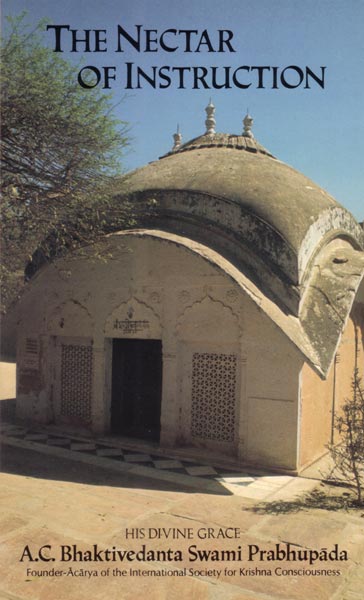
Continuing with our series on the Nectar of Instruction (Upadeśāmṛta), we are posting Text 9, the very important instructions given by Śrīla Rūpa Gosvāmī on visiting the holy places of pilgrimage.
The Nectar of Instruction
By His Divine Grace A. C. Bhaktivedanta Swami Prabhupāda
Text Nine
vaikuṇṭhāj janito varā madhu-purī tatrāpi rāsotsavād
vṛndāraṇyam udāra-pāṇi-ramaṇāt tatrāpi govardhanaḥ
rādhā-kuṇḍam ihāpi gokula-pateḥ premāmṛtāplāvanāt
kuryād asya virājato giri-taṭe sevāṁ vivekī na kaḥ
SYNONYMS
vaikuṇṭhāt—than Vaikuṇṭha, the spiritual world; janitaḥ—because of birth; varā—better; madhu-purī—the transcendental city known as Mathurā; tatra api—superior to that; rāsa-utsavāt—because of the performance of the rāsa-līlā; vṛndā-araṇyam—the forest of Vṛndāvana; udāra-pāṇi—of Lord Kṛṣṇa; ramaṇāt—because of various kinds of loving pastimes; tatra api—superior to that; govardhanaḥ—Govardhana Hill; rādhā-kuṇḍam—a place called Rādhā-kuṇḍa; iha api—superior to this; gokula-pateḥ—of Kṛṣṇa, the master of Gokula; prema-amṛta—with the nectar of divine love; āplāvanāt—because of being overflooded; kuryāt—would do; asya—of this (Rādhā-kuṇḍa); virājataḥ—situated; giri-taṭe—at the foot of Govardhana Hill; sevām—service; vivekī—who is intelligent; na—not; kaḥ—who.
TRANSLATION
The holy place known as Mathurā is spiritually superior to Vaikuṇṭha, the transcendental world, because the Lord appeared there. Superior to Mathurā-Purī is the transcendental forest of Vṛndāvana because of Kṛṣṇa’s rāsa-līlā pastimes. And superior to the forest of Vṛndāvana is Govardhana Hill, for it was raised by the divine hand of Śrī Kṛṣṇa and was the site of His various loving pastimes. And, above all, the superexcellent Śrī Rādhā-kuṇḍa stands supreme, for it is overflooded with the ambrosial nectarean prema of the Lord of Gokula, Śrī Kṛṣṇa. Where, then, is that intelligent Person who is unwilling to serve this divine Rādhā-kuṇḍa, which is situated at the foot of Govardhana Hill?
PURPORT
The spiritual world is three fourths of the total creation of the Supreme Personality of Godhead, and it is the most exalted region. The spiritual world is naturally superior to the material world; however, Mathurā and the adjoining areas, although appearing in the material world, are considered superior to the spiritual world because the Supreme Personality of Godhead Himself appeared at Mathurā. The interior forests of Vṛndāvana are considered superior to Mathurā because of the presence of the twelve forests (dvādaśa-vana), such as Tālavana, Madhuvana and Bahulāvana, which are famous for the various pastimes of the Lord. Thus the interior Vṛndāvana forest is considered superior to Mathurā, but superior to these forests is the divine Govardhana Hill because Kṛṣṇa lifted Govardhana Hill like an umbrella, raising it with His lotuslike beautiful hand to protect His associates, the denizens of Vraja, from the torrential rains sent by the angry Indra, King of the demigods. It is also at Govardhana Hill that Kṛṣṇa tends the cows with His cowherd friends, and there also He had His rendezvous with His most beloved Śrī Rādhā and engaged in loving pastimes with Her. Rādhā-kuṇḍa, at the foot of Govardhana, is superior to all because it is there that love of Kṛṣṇa overflows. Advanced devotees prefer to reside at Rādhā-kuṇḍa because this place is the site of many memories of the eternal loving affairs between Kṛṣṇa and Rādhārāṇī (rati-vilāsa).
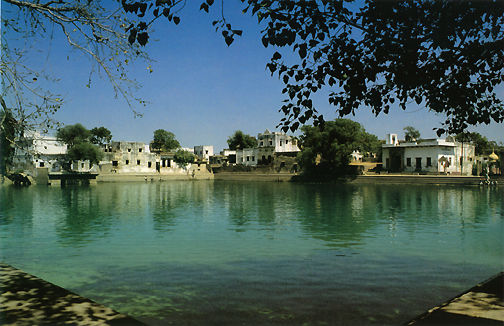
In Caitanya-caritāmṛta (Madhya-līlā) it is stated that when Śrī Caitanya Mahāprabhu first visited the area of Vrajabhūmi, He could not at first find the location of Rādhā-kuṇḍa. This means that Śrī Caitanya Mahāprabhu was actually searching for the exact location of Rādhā-kuṇḍa. Finally He found the holy spot, and there was a small pond there. He took His bath in that small pond and told His devotees that the actual Rādhā-kuṇḍa was situated there. Later the pond was excavated by Lord Caitanya’s devotees, headed first by the six Gosvāmīs, such as Rūpa and Raghunātha dāsa. Presently there is a large lake known as Rādhā-kuṇḍa there. Śrīla Rūpa Gosvāmī has given much stress to Rādhā-kuṇḍa because of Śrī Caitanya Mahāprabhu’s desire to find it. Who, then, would give up Rādhā-kuṇḍa and try to reside elsewhere? No person with transcendental intelligence would do so. The importance of Rādhā-kuṇḍa, however, cannot be realized by other Vaiṣṇava sampradāyas, nor can persons uninterested in the devotional service of Lord Caitanya Mahāprabhu understand the spiritual importance and divine nature of Rādhā-kuṇḍa. Thus Rādhā-kuṇḍa is mainly worshiped by the Gauḍīya Vaiṣṇavas, the followers of Lord Śrī Kṛṣṇa Caitanya Mahāprabhu.
06 May 2014
by The Hare Krishna Movement
in Krishna Consciousness, Letters by Srila Prabhupada, Sankirtan, Susan Beckman
Tags: A.C. Bhaktivedanta Swami Prabhupada, chant 24 hours a day, chant Hare Krishna, holy name of Krishna, humble state of mind, ISKCON Spiritual Sky, Letters by Srila Prabhupada, Lord Caitanya, sankirtan, Srila Prabhupada, Susan Beckman, the sankirtan movement
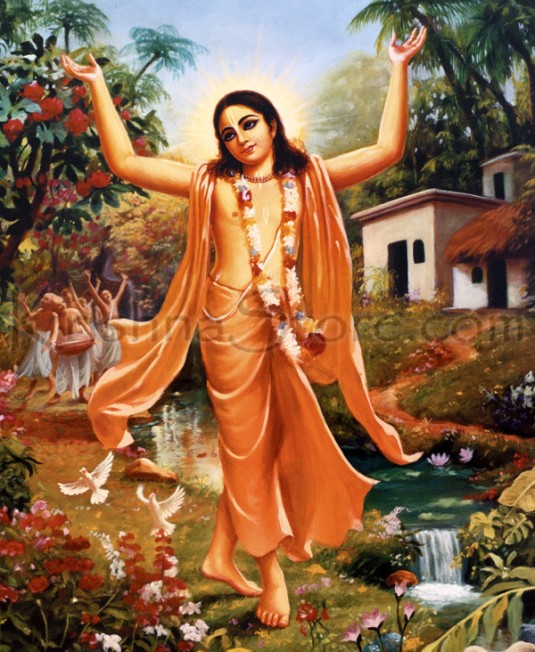
I love reading all these letter written by Srila Prabhupada to his aspiring disciples, and the following letter written to Susan Beckman is very sweet.
…Lord Sri Chaitanya Mahaprabhu, the incarnation of Godhead in this age has delivered the medicine for all problems of the world by his introducing the Sankirtan movement. Sankirtan means to chant that Holy names of the Lord and to give up all other engagements. The chanting is a process of purification. Just like we use soap to cleanse the body, this is material, but the chanting is spiritual cleansing.
…The conclusion is that one should learn the art of chanting the Holy name of Krishna 24 hours a day and that alone is the remedy for all problems of material existence. How is it possible to chant 24 hours a day? Lord Chaitanya gave the hint, “One can chant the holy name of God in a humble state of mind, thinking himself lower than the straw in the street, more tolerant than a tree, devoid of all kinds of sense of false prestige, and always ready to offer all respects to others. In such a humble state of mind one can chant the Holy name of God constantly.” So I cannot give you any better advice for your problem, simply chant Hare Krishna and everything will be all right. (Letter to Susan Beckman)
Full Letter More
03 May 2014
by The Hare Krishna Movement
in A.C. Bhaktivedanta Swami Prabhupada, Pure Devotee, Qualities of a Devotee, Srila Prabhupada, Twenty-Six Qualities of a Devotee
Tags: A.C. Bhaktivedanta Swami Prabhupada, peaceful, pure devotee, qualities of a devotee, Srila Prabhupada, Srila Prabhupada's Beautiful Transcendental Qualities

click on image to enlarge
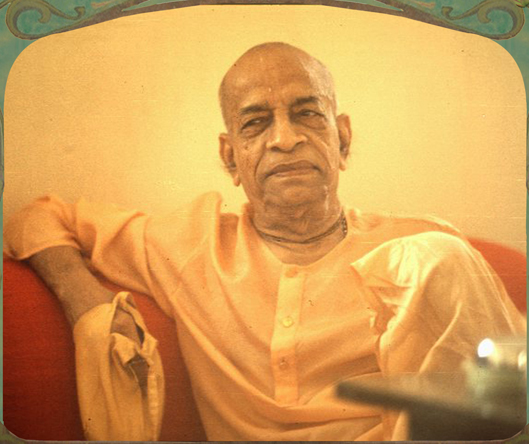
I was looking through some pictures this morning of Srila Prabhupada and my attention was drawn to this above image. He looked so peaceful, and I remembered that peacefulness is one of the transcendental qualities of the pure devotee. You can click on link at bottom of post to see the other Beautiful Transcendental Qualities of Srila Prabhupada.
Peaceful
Srila Prabhupada once described the mind of a pure devotee as being very peaceful, like a country pond filled with crystal-clear water, beautiful lotus flowers and swans gliding happily across it. This much desired state of mind is a natural quality of one who is situated in transcendence, at the lotus feet of Lord Krishna, far beyond the turbulent material world and senses. Srila Prabhupada was very peaceful due to his own pure Krishna consciousness. Shouldering the immense pressure and responsibility of a worldwide spiritual family, with its concomitant problems, Srila Prabhupada gracefully meted out love, guidance and practical instructions with full composure, never once losing touch with his peaceful Lord Krishna. (from “Srila Prabhupada’s Beautiful Transcendental Qualities” by Ajitananda das)
More
Previous Older Entries Next Newer Entries













 The Hare Krishna Movement