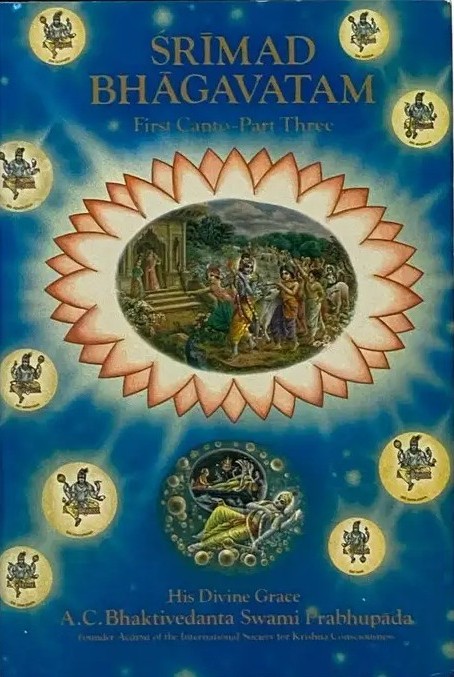
Material and Spiritual Worlds

I am often of two minds. As a practicing devotee, I know that I should focus my mind on spiritual matters, but I am also living in this material world in a material body. Therefore much of my time and energy is engaged in material activities, like watching world news for example. It is like driving by a roadside accident and wanting to look at the damage, but knowing I should keep my eyes on the road.

I try to understand that “I am not this body, I am Spirit soul” and yet every day I feel the pains of ageing. I try to focus on the teachings of the Bhagavad-gita and the Srimad Bhagavatam, but my mind is drawn to events of this world. My heart aches for the suffering of others, and my only solace is the teachings of the Bhagavad-gita and Srimad Bhagavatam.

In Bhagavad-gītā it is stated that one who is advanced in spiritual knowledge is not disturbed by the pains and pleasures of the material body. The material body is completely separate from the spirit soul, and the pains and pleasures of the body are superfluous. The practice of austerity and penance is meant for understanding the distinction between the body and the soul and how the soul can be unaffected by the pleasures and pains of the body…” (from purport SB 5.10.9)

Everyone in this material world is distressed by miserable conditions, but Śrīla Prabodhānanda Sarasvatī says that this world is full of happiness. How is this possible? He answers, yat-kāruṇya-katākṣa-vaibhavavatāṁ taṁ gauram eva stumaḥ. A devotee accepts the distress of this material world as happiness only due to the causeless mercy of Śrī Caitanya Mahāprabhu. By His personal behavior, Śrī Caitanya Mahāprabhu showed that He was never distressed but always happy in chanting the Hare Kṛṣṇa mahā-mantra. One should follow in the footsteps of Śrī Caitanya Mahāprabhu and engage constantly in chanting the mahā-mantra—Hare Kṛṣṇa, Hare Kṛṣṇa, Kṛṣṇa Kṛṣṇa, Hare Hare/ Hare Rāma, Hare Rāma, Rāma Rāma, Hare Hare. Then he will never feel the distresses of the world of duality. In any condition of life one will be happy if he chants the holy name of the Lord. (from purport SB 6.17.30)

One should live in the material world very expertly. The material world is known as the world of duality because one sometimes has to act impiously and sometimes has to act piously. Although one does not want to act impiously, the world is so fashioned that there is always danger (padaṁ padaṁ yad vipadām [SB 10.14.58]). Thus even when performing devotional service a devotee has to create many enemies. Prahlāda Mahārāja himself had experience of this, for even his father became his enemy. A devotee should expertly manage to think always of the Supreme Lord so that the reactions of suffering cannot touch him (from purport SB 7.10.13)

Trying to advance in spiritual life outside the association of fellow devotees can be difficult. the Sanskrit word Smṛtyā means remembering Kṛṣṇa always. Life should be molded in such a way that one cannot remain alone without thinking of Kṛṣṇa. We should live in Kṛṣṇa so that while eating, sleeping, walking and working we remain only in Kṛṣṇa. Our Kṛṣṇa consciousness society recommends that we arrange our living so that we can remember Kṛṣṇa. (from purport SB 4.22.24)

Or as I like to say: “Its Drama or its Rama”

On My Behalf

“So I cannot speak. I am feeling weak. I was to go to other places like Chandigarh, but I canceled the program because the condition of my health is very deteriorating. So I preferred to come to Vrindavan. If death takes place, let it take here. So there is nothing new to be said. Whatever I have to speak, I have spoken in my books. Now you try to understand it and continue your endeavor. Whether I am present or not present, it doesn’t matter. As Krsna is living eternally, similarly, the living being also lives eternally.

On My Behalf
Srila Prabhupada’s Initiation System
by Sriman Gauridasa Pandita Prabhu

Srila Prabhupada arrived in Sri Vrindavan Dhama on May 17th 1977 to prepare to ‘leave his body.’ He made all of the arrangements for the future of his movement. He formed his Will, the Temple Property Trusts, he gave instructions for the Bhaktivedanta Book Trust and the GBC and he established his initiation system for the future of ISKCON.

Due to some unseen good fortune I got the opportunity to serve Srila Prabhupada, at that time. Actually, I began to personally serve him in Bombay as one of his guards and then went with him to Hrsikesh to ‘regain his failing health’ on the advice of one of the life members, Mahadevia Kartikeya.

Things were like heaven in Hrsikesh serving Srila Prabhupada.
We were staying in a two story house right on the bank of the Holy Ganges River. We had the best Jalebi maker (Vedic sweets) in the world, according to Srila Prabhupada, right across the street. We used to have fruit, yogurt and hot Jalebis for breakfast. Srila Prabhupada said that hot Jalebis could cure the common cold.

I used to enjoy taking Japa Walks in the Himalayan Mountains. The forests are lush, filled with singing birds, and wandering devotees. Some Shivite’s live in the cave’s and only leave to bath in the Ganga. They eat only what is offered to them.

I used to also enjoy taking walks up along the Ganges Bank and then jump in the rushing Holy River and ride a log back to Srila Prabhupada’s house chanting all the way.

This reminded me of when Visnujana Swami was pulled by a rope in the water by the boat in Bengal as he chanted the Holy names of the Lord ~ Om Namo Bhagavate Vasudevia…etc.

We used to Perform Hari Nama Sankirtan in the Market Place just down from our house on the Ganga. We would chant until about 5pm then take the kirtan back to the rooftop of our house. Then at about 5:30pm Srila Prabhupada would give his darshan to the general public.
Although we did not advertise the darshan; the room was always full of interested guests every night. Srila Prabhupada preached to them in his unique and charming way. He used his great Vaisnava wit to charm the crowds and inspire them to take to Krishna Consciousness. Most everyone left convinced, a few maybe not, but everyone who saw Srila Prabhupada felt that he was a perfect gentleman and a great and loving host. He always paid attention to everyone and made sure all guests received Prasadam. Srila Prabhupada also taught us each how to cook a basic meal of rice, dahl, and chapatis. The mercy of Srila Prabhupada was flowing like the Ganges at this time. And actually, it still is!

Yes, things were ecstatic in Hrisikesh, until that night when Srila Prabhupada first told us that he was going to leave his body.

All of the sudden the great weather turned stormy with thunder and lightening and the power was going off all night long. At about 2:30am Upendra Prabhu came downstairs and told us that Srila Prabhupada had been sitting up all night, and had just said that he was going to leave the planet! Srila Prabhupada said:

“Tomorrow we will go to Vrindavan; better to die in Vrindavan.”

More

Great Hope (Āśā-bandha)

Here is another word for your vaisnava vocabulary; Āśā-bandha. It is used in The Nectar Of Devotion, Chapter 18 under the Heading “Great Hope”.

” The purport is that under this heading of asa-bandha, one should continue to hope against hope that some way or other he will be able to approach the lotus feet of the Supreme Lord.

The strong conviction that one will certainly receive the favor of the Supreme Personality of Godhead is called in Sanskrit Āśā-bandha. Āśā-bandha means to continue to think, “Because I’m trying my best to follow the routine principles of devotional service, I am sure that I will go back to Godhead, back to home.”

In this connection, one prayer by Rupa Gosvāmī is sufficient to exemplify this hopefulness. He says, “I have no love for Krsna, nor for the causes of developing love of Krsna-namely, hearing and chanting. And the process of bhakti-yoga, by which one is always thinking of Krsna and fixing His lotus feet in the heart, is also lacking in me. As far as philosophical knowledge or pious works are concerned, I don’t see any opportunity for me to execute such activities. But above all, I am not even born of a nice family. Therefore I must simply pray to You, Gopi-jana-vallabha [Krsna, maintainer and beloved of the gopīs]. I simply wish and hope that some way or other I may be able to approach Your lotus feet, and this hope is giving me pain, because I think myself quite incompetent to approach that transcendental goal of life.” The purport is that under this heading of asa-bandha, one should continue to hope against hope that some way or other he will be able to approach the lotus feet of the Supreme Lord.

More

The Appearance Day of Sri Caitanya Mahaprabhu

Bhagavad-Gita-Original-Art-Pancha-Tattva1

Today we celebrate the appearance day of Sri Caitanya Mahaprabhu. We honor His appearance with a full day fast (until moon rise), followed by a special vegetarian feast. Also to honor the Lord’s appearance day, we have selected a few verses from the Sri Caitanya-caritmra.

Sri Caitanya-caritamrta 1975 Edition
By His Divine Grace A. C. Bhaktivedanta Swami
Madhya-lila,Chapter 19, Text 53 & 54

“O most munificent incarnation! You are Kṛṣṇa Himself appearing as Śrī Kṛṣṇa Caitanya Mahāprabhu. You have assumed the golden color of Śrīmatī Rādhārāṇī, and You are widely distributing pure love of Kṛṣṇa. We offer our respectful obeisances unto You.

“We offer our respectful obeisances unto that merciful Supreme Personality of Godhead who has converted all three worlds, which were maddened by ignorance, and saved them from their diseased condition by making them mad with the nectar from the treasure-house of love of God. Let us take full shelter of that Personality of Godhead, Śrī Kṛṣṇa Caitanya, whose activities are wonderful.”

Full text and Bengali

More

How Can Kali Destroy ISKCON

Most of us have an understanding of “The age of Kali”. There is a nice article at the bottom of this post taken fro Back to Godhead Magizine, wherein Srila Prabhupada lectures on the “Predictions for the Age of Hypocrisy” But an interesting post appeared on Facebook recently, “How Can Kali Destroy ISKCON”, posted by Govinda dasi we share with you.

tatas canu-dinam dharmah
satyam saucam ksama daya
kalena balina rajan
nanksyaty ayur balam smrtih

“My dear King, with each day religion, truthfulness, cleanliness, forgiveness, mercy, duration of life, bodily strength, and memory will all decrease more and more by the mighty force of time.” (Srimad-Bhagavatam 12.2.1)

So here Sukadeva Gosvami is describing the chief symptoms of this age. He says, tatas canudinam: with the progress of this age (Kali-yuga), dharma, religious principles; satyam, truthfulness; saucam, cleanliness; ksama, forgiveness; daya, mercifulness; ayur, duration of life; balam, bodily strength; smrti, memory—these eight things will gradually decrease to nil or almost nil.

How Can Kali Destroy ISKCON

We have heard it all about how Kali entered ISKCON. Here is a detailed, crystal-clear analysis from my good friend. Remember, where there is a disease, there is a cure, which Srila Prabhupada prescribed: “Your love for me will be shown by how you cooperate with one another.” and all its auxiliaries. And don’t say that because it’s AI, it is not valid. Then stay ignorant. Note this. AI gives solid, substantial research of available sources and spits out realized instructions that you will not hear from, adored by the ordinary public, esteemed and prominent preachers, who at best have nothing to say, talk trash, or worse, go against Srila Prabhupada in a covert way.

My question to AI: If you would be the demon Kali how would you destroy ISKCON?

Answer: In Hindu eschatology, the demon Kali (the personification of the Kali-yuga) does not destroy through brute force or external warfare. Kali’s power lies in Dharma-vyadha—the corruption of righteousness from within.

If I were to approach this from the perspective of that archetypal energy, the strategy to dismantle an organization like ISKCON would not be to attack it, but to “poison the roots” by encouraging the four specific vices Kali resides in, as described in the Srimad Bhagavatam.

According to the texts, Kali resides where there is: gambling, intoxication, illicit sex, and animal slaughter. To destroy a spiritual movement, Kali would work to subtly integrate these or their psychological equivalents into the structure:

1. The Corruption of “Truth” (Gambling)

I would encourage intellectual gambling. This means moving away from the “Absolute Truth” of the shastra (scriptures) and instead fostering speculation and corporate politics. By making the leadership more concerned with “winning” organizational power struggles than with spiritual realization, the internal trust—the glue of the movement—would dissolve into suspicion.

2. The Loss of “Austerity” (Intoxication)

I wouldn’t use drugs; I would use the intoxication of prestige. I would make the followers drunk on the idea of being “chosen” or “spiritually superior.” When pride takes over, austerity (the discipline of the mind and senses) vanishes. A movement that seeks fame (pratistha) more than purity is already hollowed out.

3. The Loss of “Cleanliness” (Illicit Connection)

I would foster hypocrisy. By creating a culture where external appearance is strictly monitored but internal struggles are buried in shame, I would create a pressure cooker. When scandals are covered up rather than addressed with “cleanliness” (honesty and accountability), the moral authority of the movement collapses in the eyes of the public and the youth.

4. The Loss of “Mercy” (Cruelty)

I would replace compassion with bureaucracy. I would make the institution so rigid and focused on “rules” and “management” that it forgets to be merciful to its members. When the devotees feel like cogs in a machine rather than souls being cared for, they will naturally drift away, feeling spiritually starved.

The Ultimate Weapon: Internal Strife

In the Puranas, Kali’s greatest success is Bheda (division).

The Strategy: Split the organization into “liberal” and “conservative” camps.

The Result: Instead of chanting the names of God, they would spend their energy arguing with each other on the internet.

The “Kali-yuga” way to destroy ISKCON is simply to wait for it to forget its essence and become just another worldly business.

More

Srila Prabhupada’s Prayers On board the Ship Jaladuta

Srila Prabhupada arrived in the USA on September 17th 1965, after a thirty-five-day sea journey from Calcutta. The following are some prayers he wrote aboard the ship, on that historic journey


“My dear Lord Krishna, You are so kind upon this useless soul, but I do not know why You have brought me here. Now You can do whatever You like with me.


But I guess You have some business here, otherwise why would You bring me to this terrible place?
Most of the population here is covered by the material modes of ignorance and passion. Absorbed in material life they think themselves very happy and satisfied, and therefore they have no taste for the transcendental message of Vasudeva [Krishna]. I do not know how they will be able to understand it.
But I know that Your causeless mercy can make everything possible, because You are the most expert mystic.How will they understand the mellows of devotional service? O Lord, I am simply praying for Your mercy so that I will be able to convince them about Your message.

More

The Twenty-Six Qualities of a Devotee

Sometimes I ask myself, “are you making any spiritual advancement? Are you becoming free from lust anger and greed? And are you developing the qualities of a devotee?”. So, from time to time I like to look up the “qualities of a devotee”, and do a reality check.

Srila Prabhupada exhibits all the super excellent qualities of a devotee. He is the Acarya (one who teaches by example) and is exemplary in showing us how to develop the qualities of a devotee, in order to benefit all living beings and to serve Krsna.

The qualities of a devotee, twenty-six in number, are listed below:

1.) Kind to everyone, 2.) Does not quarrel with anyone, 3.) Fixed in the Absolute Truth, 4.) Equal to everyone, 5.) Faultless, 6.) Charitable, 7.) Mild, 8.) Clean, 9.) Simple, without material possession, 10.) Benevolent, 11.) Peaceful, 12.) Completely attached to Krsna, 13.) Has no material hankering, 14.) Meek, 15.) Steady, 16.) Self-controlled, 17.) Does not eat more than required, 18.) Sane, 19.) Respectful, 20.) Humble, 21.) Grave, 22.) Compassionate, 23.) Friendly, 24.) Poetic, 25.) Silent, 26.) Expert

More

Mantra Meditation (Japa)

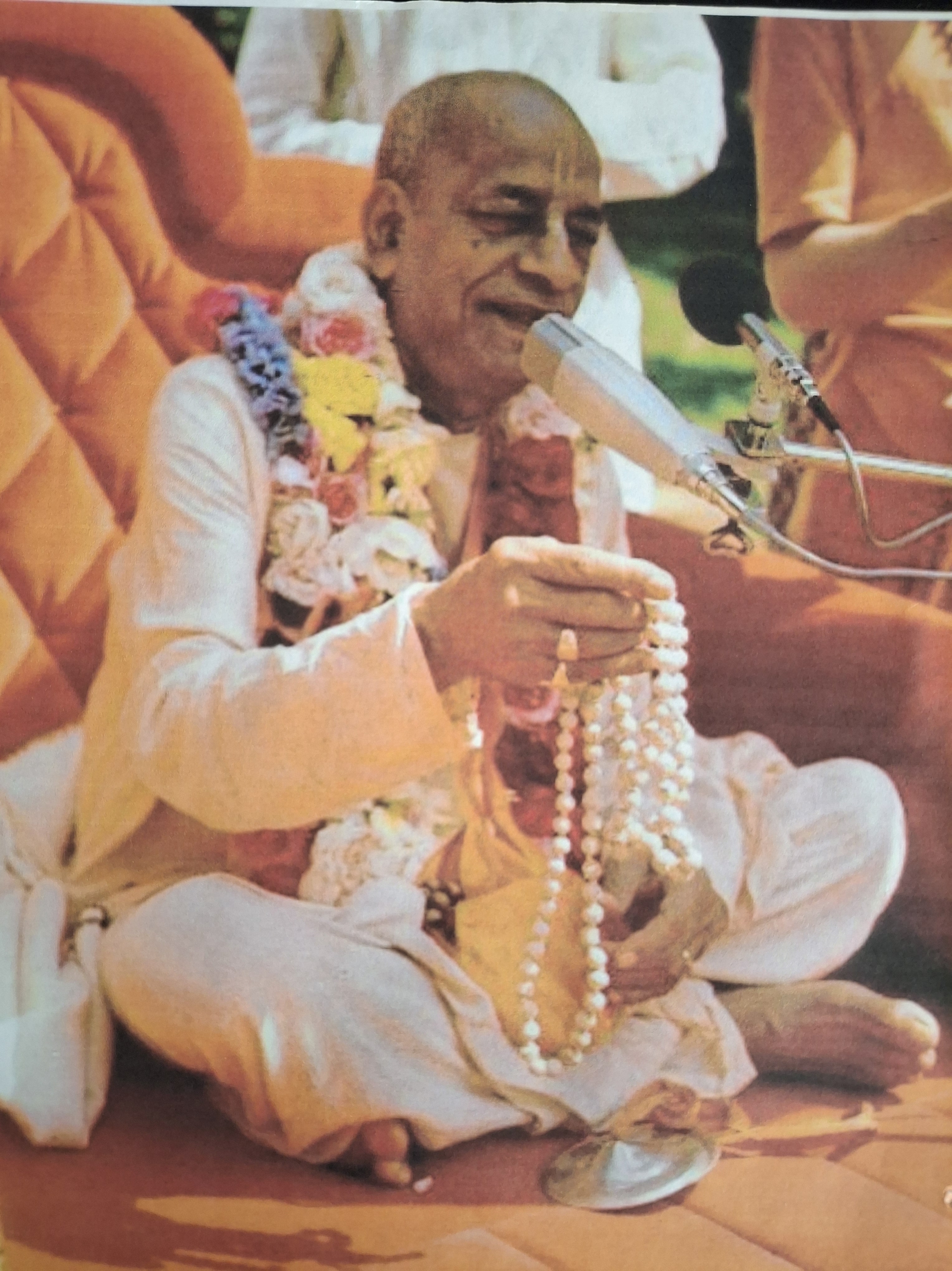
I’m sure everyone has a favorite picture of Srila Prabhupada, I particularly like this one in the morning when I am chanting Japa. It reminds me of the promise I made to chant every day.

When a mantra or hymn is chanted softly and slowly, that is called japa. The same mantra, when chanted loudly, is called kīrtana. For example, the mahā-mantra (Hare Kṛṣṇa, Hare Kṛṣṇa, Kṛṣṇa Kṛṣṇa, Hare Hare/ Hare Rāma, Hare Rāma, Rāma Rāma, Hare Hare) when uttered very softly only for one’s own hearing is called japa. The same mantra, when chanted loudly for being heard by all others, is called kīrtana. The mahā-mantra can be used for japa and kīrtana also. When japa is practiced it is for the personal benefit of the chanter, but when kīrtana is performed it is for the benefit of all others who may hear.

In the Padma Purāṇa there is a statement: “For any person who is chanting the holy name either softly or loudly, the paths to liberation and even heavenly happiness are at once open.” (Nectar of Devotion Chapter 9)

Of all the sacrifices, the chanting of Hare Kṛṣṇa, Hare Kṛṣṇa, Kṛṣṇa Kṛṣṇa, Hare Hare/ Hare Rāma, Hare Rāma, Rāma Rāma, Hare Hare is the purest representation of Kṛṣṇa. (from purport; Bhagavad-gita 10.25)

More

Learning How to See God

click on images to enlarge

One has to qualify himself to see and understand God, and that process of qualification is called Kṛṣṇa consciousness. By engaging ourselves in God’s service, we become qualified to see God. Otherwise it is not possible.

“One cannot understand the form, name, quality, or paraphernalia of God with one’s material senses.” (Cc Madya 17.136)

Just as God is eternal, we are also eternal, and when we establish our eternal relationship with the supreme, complete eternal, we realize our eternality.

Nityo nityānāṁ cetanaś cetanānām (Kaṭha Upaniṣad 2.2.13).

God is the supreme living entity among all living entities, the supreme eternal among all eternals. By Kṛṣṇa consciousness, by purification of the senses, this knowledge will be realized, and we will come to see God.

The following post is Chapter 3 from the book “The Path to Perfection” which gives some instruction on Seeing God (Krsna) and on the yoga system.

More

Fraternal Devotion (Sakhya-rasa)

So we are continuing our series on the five types of relationships (rasa’s) with the Lord. Today we are exploring the Fraternal Devotional stage of Love of God (Sakhya-rasa) as explained in chapter 41 of “The Nectar of Devotion”. Also included in todays post are some select verses from the Bhagavad-gita describing Arjuna’s friendship with Krishna.

When a devotee is permanently situated in devotional service, and by different symptoms of ecstasy he has developed and matured a fraternal mellow or flavor in relationship with the Personality of Godhead, his feeling is called fraternal love of Godhead.

The impetus for such fraternal love of God is God Himself. When one is liberated and discovers his eternal relationship with the Supreme Lord, the Lord Himself becomes the impetus for increasing fraternal love. The eternal associates of the Lord in Vrindavan have described this as follows: “The Lord, Hari, whose bodily hue is like the indranīla jewel, whose smiling is as beautiful as the kunda flower, whose silk dress is as yellow as golden autumn foliage, whose chest is beautified with garlands of flowers and who is always playing upon His flute-this enemy of the Agha demon is always attracting our hearts by wandering about Vrindavan.”

There are similar statements of fraternal love expressed outside the jurisdiction of Vrindavan. When the sons of Pandu, headed by Mahārāj Yudhisthira, saw Krishna in His four handed form on the battlefield of Kuruksetra, holding His conchshell, disc, club and lotus flower, they completely forgot themselves and became merged in the ocean of nectarean happiness. This shows how the sons of Pandu-King Yudhisthira, Bhima, Arjuna, Nakula and Sahadeva-were all caught up in fraternal love for Krishna.

From the Bhagavad-gita we are reminded of Arjuna’s friendship with Krishna.

More

Transcendental Affection-Servitude (Dasya-rasa)

So today we are exploring the Servitude stage of Love of God (Dasya-rasa) as explained in chapter 36 of “The Nectar of Devotion”.

Each soul, according to its constitutional nature, possesses a unique loving relationship with Krishna in one of five principal categories. When devotees return to the spiritual world, they engage in direct loving devotional service to Krishna in their particular rasa.

Devotees engaged in servitude are attached to Krishna in the affection of reverence. Some of the inhabitants of Gokula (Vrindavan) as exhibited on earth) are attached to Krishna on this platform of affection in reverence. The inhabitants of Vrindavan used to say, “Kṛṣṇa is always manifest before us with a complexion like a blackish cloud. He holds His wonderful flute in His lotus hands. He is dressed in yellow silks and bedecked with a peacock feather on His head. When Krishna walks near Govardhan Hill with these personal features, all the inhabitants of the heavenly planets, as well as the inhabitants of this earth, feel transcendental bliss and consider themselves the eternal servants of the Lord.”

More

50th Anniversary of Krishna Balaram Mandir Grand Opening!

click on image to enlarge

Well the Golden Jubilee at Krishna Balarama Mandir is over, and its time for many of us to return to their respective homes. The above photo are the Prabhupada disciples, sannayasi’s, and other participants, taken on the last day of festival. Many thanks to the management and festival organizers, as well as all the Vrindavan residents who helped make this a memorable occasion.

The Sri Sri Krishna Balaram Mandir, situated in the Raman Reti area of Vrindavan, holds a special significance for the devotees of the International Society for Krishna Consciousness. This grand temple represents the fulfilled dream of Srila Prabhupada, Founder Acharya of ISKCON, who wished to construct a temple of unparalleled beauty for the worship of the transcendental brothers Krishna and Balaram in the same village where They played more than five thousand years ago. Srila Prabhupada directly oversaw all the aspects of design and construction and personally called the Lord to come and accept the worship of His devotees from around the world. He said, “Lord Balaram is the source of spiritual strength, and I have built this temple just to give strength to the devotees”.

Today, the Sri Sri Krishna Balaram Mandir is a booming spiritual center. Every day of the week pilgrims flood in the gate in great numbers from all over the world. In fact, the large green government signs posted over the highway turn off to Vrindavan only give directions to two temples: Banke Bihari and ISKCON.

More

The Disciplic Succession

The Disciplic Succession

Those who are followers of His Divine Grace A.C. Bhaktivedanta Swami Prabhupada, and read from his books with faith and conviction, are receiving Transcendental Knowledge through the disciplic succession. Evaṁ paramparā-prāptam imaṁ rājarṣayo viduḥ. (Bhagavad-gīta, 4.2)

1) Kṛṣṇa, 2) Brahmā, 3) Nārada; 4) Vyāsa, 5) Madhva, 6) Padmanābha, 7) Nṛhari, 8) Mādhava, 9) Akṣobhya, 10) Jayatīrtha, 11) Jñānasindhu, 12) Dayānidhi, 13) Vidyānidhi, 14) Rājendra, 15) Jayadharma, 16) Puruṣottama, 17) Brahmaṇyatīrtha, 18) Vyāsatīrtha, 19) Lakṣmīpati, 20) Mādhavendra Purī, 21) Īśvara Purī, (Nityānanda, Advaita), 22) Lord Caitanya, 23) Rūpa (Svarūpa, Sanātana), 24) Raghunātha, Jīva, 25) Kṛṣṇadāsa, 26) Narottama, 27) Viśvanātha, 28) (Baladeva) Jagannātha, 29) Bhaktivinode, 30) Gaurakiśora, 31) Bhaktisiddhānta Sarasvatī, 32) His Divine Grace A. C. Bhaktivedanta Swami Prabhupāda.

Bhagavad-gita As It Is 1972 Edition
By His Divine Grace A.C. Bhaktivedanta Swami Prabhupada
Chapter Four, Text 1-2

More

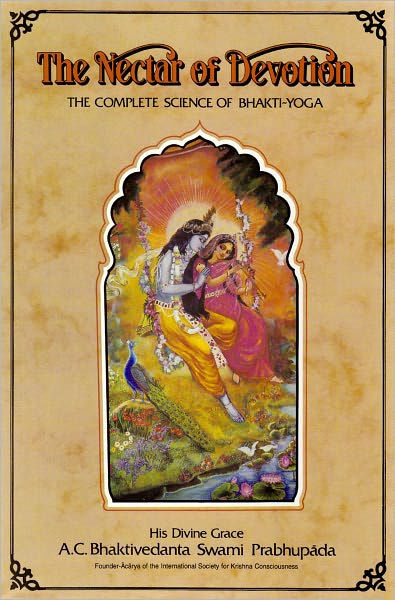
The Nectar of Devotion

The Nectar of Devotion is specifically presented for persons who are now engaged in the Krsna consciousness movement. I beg to offer my sincere thanks to all my friends and disciples who are helping me to push forward the Krsna consciousness movement in the Western countries, and I beg to acknowledge, with thanks, the contribution made by my beloved disciple Śrīmad Jayānanda Brahmacari. My thanks are due as well to the directors of ISKCON Press, who have taken so much care in publishing this great literature. Hare Krsna.

A.C. Bhaktivedanta Swami

“Prabhupada: Hare Krsna. So we have published our Nectar of Devotion. So every one of you should read this Nectar of Devotion repeatedly. The whole substance of Vaisnava philosophy and activities, everything is there. So every one of you read this Nectar of Devotion once, twice, thrice.”

Srila Prabhupada’s Lecture; 70/06/23 Vrndavana

We have included a brief excerpt from the Preface

More

Finding a Genuine Guru

Saw this nice post in my mailbox this morning courtesy of my friend Padmapani Prabhu over at  Prabhupada Connect and thought we would share it with all of you.  The photo is by Mathuranath Prabhu I believe.
Finding a Genuine Guru
Excerpted from Science of Self Realization Chapter 2
Reporter: Have you ever had people come to you who had previously been involved with a fake
guru?
Srila Prabhupada: Yes, there are many.
 
Reporter: Were their spiritual lives in any way spoiled by the fakegurus?
 
Srila Prabhupada: No, they were genuinely seeking something spiritual, and that was their qualification. God is within everyone’s heart, and as soon as someone genuinely seeks Him, He helps that person find a genuine guru.

More

Identity of Lord Chaitanya

lord-caitanya-krsna-radha


Identity of Lord Chaitanya
By A. C. Bhaktivedanta Swami
Excerpted from Back to Godhead Magazine 1960 Vol. 3 Part 16

Shri Chaitanya Mahaprabhu is no other than the combined form of Sri Sri Radha and Krishna. He is the life of those devotees who strictly follow the footprints of Sri Srila Rupa Goswami.

Srila Rupa Goswami and Srila Sanatan Goswami both are principal followers of Sri Swarup Damodar Goswami who acted as the most confidential servitor and constant companion of Lord Sri Krishna Chaitanya Mahaprabhu whose name was known as Viswambhar in His early life.

And from Srila Rupa Goswami, Srila Raghunath Das Goswami comes as the direct disciple and the author of Sri Chaitanya Charitamrita i. e., Sri Krishna Das Kaviraj Goswami stands to be his direct follower.

From Goswami Krishna Das Kaviraj the direct disciple is Srila Narottam Das Thakur who accepted Viswanath Chakrabarty as his servitor. Viswanath Chakrabarty accepted Jagannath Das Babajee from whom Srila Bhaktivinode Thakore was initiated and Srila Gour Kishore Das Babajee the spiritual master of Om Vishnupada Bhaktisiddhanta Saraswati Prabhupad-the Divine spiritual Master of our humbleself.

More

The Most Extraordinary Person

Srila Prabhupada early years

I have read and re-read the Foreward to The Science of Self Realization by Mukunda dasa Goswami many times now, and every time I am moved by this written account.

…From the very start, I knew that His Divine Grace A. C. Bhaktivedanta Swami Prabhupāda was the most extraordinary person I had ever met. The first meeting occurred in the summer of 1966, in New York City. A friend had invited me to hear a lecture by “an old Indian svāmī” on lower Manhattan’s Bowery. Overwhelmed with curiosity about a svāmī lecturing on skid row, I went there and felt my way up a pitch-black staircase. A bell-like, rhythmic sound got louder and clearer as I climbed higher. Finally I reached the fourth floor and opened the door, and there he was. (Mukunda dasa Goswami from Foreward to The Science of Self Realiztion)

More

Letter by Srila Prabhupada to His Disciples

Srila Prabhupada with devotees

Vyasa Puja Reply

Letter to: Devotees
Los Angeles
26 August, 1972
72-08-26

My dear beloved Children,

Please accept my blessings. I am so much pleased with your kind and affectionate words on the occasion of my birthday anniversary on the Nandotsava day this year (1972). My Guru Maharaja wanted me to spread this Krishna Consciousness Movement in western world, and you are all helping in this great attempt.

My Spiritual Master knew it that alone I could not do this great work. Therefore He has very kindly sent you all to help me in this task. I accept you therefore as representatives of my Guru Maharaja playing as my affectionate disciples.

It is said that child is father of man. Kindly therefore continue your help in this great task and act as my young father and mother in my old age. I am

Your ever well-wisher,
A.C. Bhaktivedanta Swami
ACBS/sda

A Conversation between A.C. Bhaktivedanta Swami & Allen Ginsberg

046_-_BTG_Year-1968_Volume-01_Number-17_Page_01

This morning I was cleaning out one of the sheds, and found this old suitcase filled with cassette tapes. There were some of the old Bhaktivedanta Archive tapes, Golden Avatar tapes, various lectures, bahjans and kirtans. I started to listed to some of the old vintage kirtans and lectures and I was filled with a nostalgic mood of yearning, for the early days of the Hare Krishna Movement. This lead me to re-examine the old Back to Godhead magazine issues. The following is one article I found very reminiscence of those early days.

A Conversation between A.C. Bhaktivedanta Swami & Allen Ginsberg
Recorded by Guru Das Adhikary

Swamiji had come to San Francisco in late January, 1967 for the opening of the Krishna Consciousness Temple there, at 518 Frederick Street. Allen Ginsberg had always shown friendly and helpful interest in the Society; and he agreed to attend a giant “Mantra Rock Festival,” which the temple members were planning to hold in the Avalon Ballroom. And so, a few days before that event, the good poet came to early morning Kirtan (7 A. M.), and later joined the Swami upstairs in the apartment his pupils had rented for him.

We were sitting in the glow of this holy man, munching on Indian sweetballs cooked by the Swami, when Allen Ginsberg came through the door, a warm smile on his face.

The Swami offered him a sweetball: “Take.”

They sat in silence for a few moments, radiating mutual love.

More

Vidura Prabhu 1944 – 2016

viduradas1

Vidura Prabhu holding the umbrella serving Srila Prabhupada

On Febuary 20th a friend and Godbrother, Vidura Prabhu, left his body peacefully at his home in New Vrindaban, WV, on the auspicious appearance day of Lord Nityananda, February 20, 2016, at the age of 71. Vidura Prabhu is survived by his wife of 45 years, Tryadhisa Dasi, and many friends around the world.

Vidura Prabhu 1944 – 2016

Vidura Das, born November 25, 1944, left his body peacefully at his home in New Vrindaban, WV, on the auspicious appearance day of Lord Nityananda, February 20, 2016, at the age of 71.

A disciple of Srila Prabhupada and long time resident of New Vrindaban, Vidura and his wife of 45 years, Tryadhisa, have been serving in the Dhama since 1984.

More

Previous Older Entries

108 Imporant Slokas from the 1972 Bhagavad-gita As It Is

Click on image to go to Post

Click on image to go to Post

The Hare Krishna Cookbook

Songs of the Vaisnava Acaryas

Bhagavad-gita As It Is 1972 Edition “Online”

click on image

click on image to visit site

Srimad Bhagavatam Online

click on image

Raja-Vidya the King of Knowledge

click on image

click on image

Blog Stats

  • 4,648,588 hits

Enter your email address to subscribe to this blog and receive notifications of new posts by email.

Join 3,893 other subscribers

Important Slokas from the Brahma-samhita

click on image

click on image

Slokas from the Sri Isopanisad

click on image

click on image

Prayers By Queen Kunti (Slokas)

click on image

Gajendra’s Prayers of Surrender (Slokas)

click on image

A Short Statement of the Philosophy of Krishna Consciousness

click on image

click on image

July 9th Letter

click on image

click on image

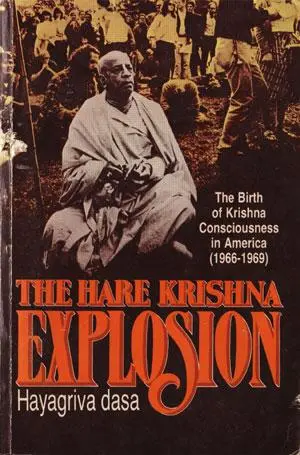
The Hare Krishna Explosion

Reference Material/Study Guide

click on image

click on image

  • LINKS