12 Feb 2013
by The Hare Krishna Movement
in A.C. Bhaktivedanta Swami Prabhupada, Srimad Bhagawatam, Vidura
Tags: A. C. Bhaktivedanta Swami Prabhuapada, Dhrtarastra, Draupadi, gandhari, krpi, Kunti, Maharaja Yudhisthira, satyaki, SB 1.13, Srimad Bhagavatam, uttara, Vidura
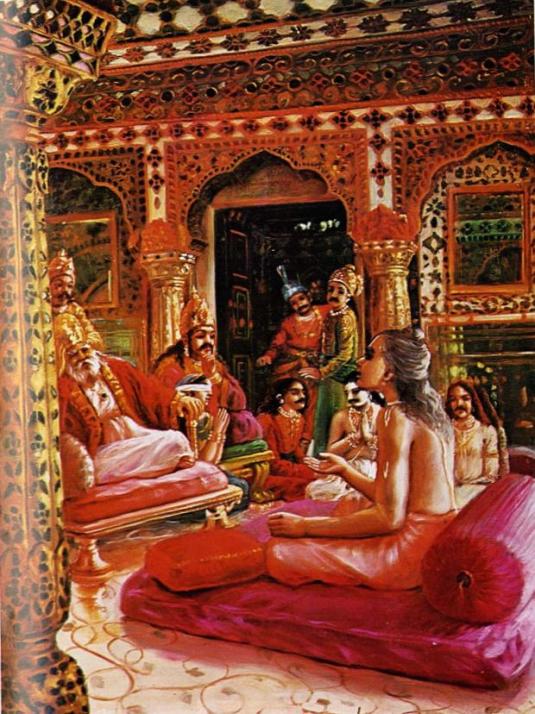
When they saw Vidura return to the palace, all the inhabitants—Mahārāja Yudhiṣṭhira, his younger brothers, Dhṛtarāṣṭra, Sātyaki, Sañjaya, Kṛpācārya, Kuntī, Gāndhārī, Draupadī, Subhadrā, Uttarā, Kṛpī, many other wives of the Kauravas, and other ladies with children—all hurried to him in great delight. It so appeared that they had regained their consciousness after a long period.
With great delight they all approached him, as if life had returned to their bodies. They exchanged obeisances and welcomed each other with embraces.
Due to anxieties and long separation, they all cried out of affection. King Yudhiṣṭhira then arranged to offer sitting accommodations and a reception.
After Vidura ate sumptuously and took sufficient rest, he was comfortably seated. Then the King began to speak to him, and all who were present there listened… (SB 1.13.3-7)
King Yudhiṣṭhira was expert in reception also, even in the case of his family members. Vidura was well received by all the family members by exchange of embraces and obeisances. After that, bathing and arrangements for a sumptuous dinner were made, and then he was given sufficient rest. After finishing his rest, he was offered a comfortable place to sit, and then the King began to talk about all happenings, both family and otherwise. That is the proper way to receive a beloved friend, or even an enemy. According to Indian moral codes, even an enemy received at home should be so well received that he will not feel any fearful situation. An enemy is always afraid of his enemy, but this should not be so when he is received at home by his enemy. This means that a person, when received at home, should be treated as a relative, so what to speak of a family member like Vidura, who was a well-wisher for all the members of the family. Thus Yudhiṣṭhira Mahārāja began to speak in the presence of all the other members.
(SB 1.13.7 purport)
full chapter More
10 Feb 2013
by The Hare Krishna Movement
in A.C. Bhaktivedanta Swami Prabhupada, Free Downloads, Free eBooks, Srimad Bhagawatam
Tags: A.C. Bhaktivedanta Swami Prabhupada, Dehli Bhagawatam, free download, original bhagavatam, Prabhupada books, scaned copy, Srila Prabhupada, Srimad Bhagwatam, Tridani Goswami A.C. Bhaktivedanta Swami
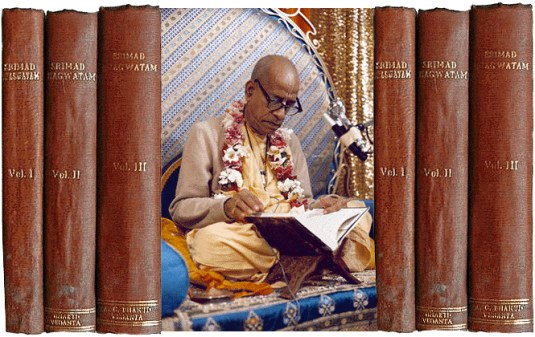
Srimad Bhagwatam
By His Divine Grace A.C Bhaktivedanta Swami Prabhupada
For a free download of these Original Srimad Bhagwatam’s please click on following links
Srimad Bhagwatam Vol. 1
Srimad Bhagwatam Vol. 2
Srimad Bhagwatam Vol.3
Thanks to our friends at Krishna Path .org for making these scanned copies available for a free PDF download
10 Feb 2013
by The Hare Krishna Movement
in A.C. Bhaktivedanta Swami Prabhupada, Caitanya Mahaprabhu, Chanting Hare Krishna, Krsna Consciousness, Sankirtan, Sri Caitanya-Caritamrta
Tags: A.C. Bhaktivedanta Swami Prabhupada, actions which will be benificial for all living entities, adi-lila 9.27-52, devotional service, Krsna consciousness movement, sankirtan movement, Sri Caitanya Mahaprabhu, Sri Caitanya-caritamrta, tree of devotional service, welfare activities for the benifit of others
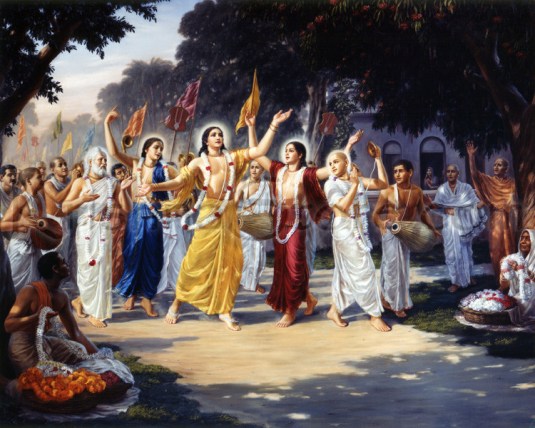
click on image to enlarge
Lord Caitanya’s Sankirtana Movement
“It is the duty of every living being to perform welfare activities for the benefit of others with his life, wealth, intelligence and words.”
“By his work, thoughts and words, an intelligent man must perform actions which will be beneficial for all living entities in this life and in the next.”
The Kṛṣṇa consciousness movement introduced by Lord Caitanya is extremely important because one who takes to it becomes eternal, being freed from birth, death and old age. People do not recognize that the real distresses in life are the four principles of birth, death, old age and disease. They are so foolish that they resign themselves to these four miseries, not knowing the transcendental remedy of the Hare Kṛṣṇa mahā-mantra. Simply by chanting the Hare Kṛṣṇa mahā-mantra, one can become free from all misery, but because they are enchanted by the illusory energy, people do not take this movement seriously. Therefore those who are actually servants of Śrī Caitanya Mahāprabhu must seriously distribute this movement all over the world to render the greatest benefit to human society.
There is a very nice section in the Śrī Caitanya-caritāmṛta wherein the author uses the figurative example of the gardener, to explain the mission of Lord Caitanya Mahāprabhu. With pleasure we are posting the entire section below… More
07 Feb 2013
by The Hare Krishna Movement
in Songs of the Vaisnava Acaryas, Vrndavana
Tags: Gopinatha, Govinda Gopinatha, jaya krsna, jaya radhe, jaya vrndavana, krsnadas kaviraja goswami, Madana-mohana, Songs of the Vaisnava Acaryas, sri govinda, The Holy Places of Vrndavana, Vrndavana

The Holy Places of Vrndavan
by Krsnadasa Kaviraja Goswami
1)
jaya rādhe, jaya kṛṣṇa, jaya vṛndāvan
śrī govinda, gopīnātha, madana-mohan
jaya rādhe jaya kṛṣṇa–all glories to Srī Srī Rādhā and Kṛṣṇa; jaya vṛndāvana–glories to the transcendental realm of Vṛndāvana; śrīgovinda gopīnātha madana-mohana–glories to the three presiding Deities of Vṛndāvana : Govinda, Gopīnātha and Madana-mohana.
All glories to Radha and Krsna and the divine forest of Vrndavana. All glories to the three presiding Deities of Vrndavana–Sri Govinda, Gopinatha, and Madana-mohana.
2)
śyama-kunḍa, rādhā-kuṇḍa, giri-govardhan
kālindi jamunā jaya, jaya mahāvan
śyāma-kuṇḍa–glories to the personal lake of śyāma; rādhā-kuṇḍa–glories to the personal lake of Rādhā; giri-govardhan–glories to Govardhana Hill; kālindī yamunā jaya–glories to the Yamunā river, known as Kālindī, the daughter of the Kalinda mountain; jaya mahāvana–glories to the great forest of Mahāvana, the place of Kṛṣṇa’s childhood pastimes.
All glories to Syama-kunda, Radha-kunda, Govardhana Hill, and the Yamuna River (Kalindi). All glories to the great forest known as Mahavana, where Krsna and Balarama displayed all of Their childhood pastimes.
More
07 Feb 2013
by The Hare Krishna Movement
in A.C. Bhaktivedanta Swami Prabhupada, Teachings of Lord Chaitanya, The Lords Omnipotency, Vaisnava Vocabulary
Tags: A.C. Bhaktivedanta Swami Prabhupada, Brahma stealing the cows and calves, Dwaraka, Krishna, Narada Muni, omnipotency, prabhava, rasa dance, svayam-rupa, Teachings of Lord Chaitanya, the Lord's Omnipotency, transcendental form, vaibhava, vaibhava-prakasa
click on image to slightly enlarge
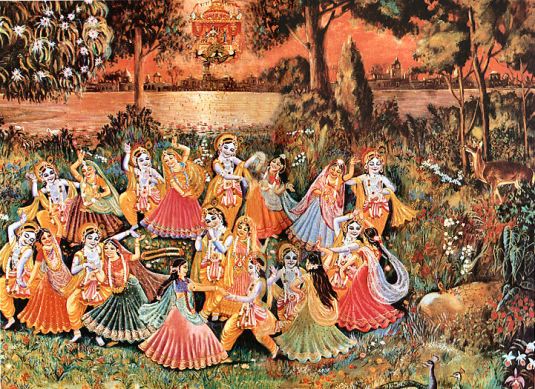
Here is a new word for your Vaisnava Vocabulary; vaibhava-prakāśa. As I was reading the Krsna Book the other day this word vaibhava-prakāśa just jumped out from the pages, and I was reminded again of the Lord’s omnipotency.
“The Lord’s omnipotency is displayed by His simultaneous presence in every place. He is present always in His eternal abode Goloka Vṛndāvana, and still He is present in everyone’s heart and even within every invisible atom.” (SB 1.9.10 purport)
“The personal form of Kṛṣṇa can be divided into two: svayam-rūpa and svayam-prakāśa. As far as His svayam-rūpa (or pastime form) is concerned, it is in that form that He remains always in Vṛndāvana with the inhabitants of Vṛndāvana. This personal form (svayam-rūpa) can be further divided into the prābhava and vaibhava forms. For instance, Kṛṣṇa expanded Himself in multiple forms during the rāsa dance in order to dance with each and every gopī who took part in forms in order to accommodate His 16,108 wives.
… As far as Kṛṣṇa is concerned, when He manifested Himself in different forms, each and every one of them was a separate individual. When Nārada Muni visited Kṛṣṇa at different palaces at Dvārakā, he was astonished at this,…He wondered how the Lord was present with His queens in each and every one of His 16,108 palaces. With each queen, Kṛṣṇa Himself was in a different form, and He was acting in different ways. In one form He was engaged in playing with His children, and in yet another form He was performing some household work. These different activities are conducted by the Lord when He is in His “emotional” forms, which are known as vaibhava-prakāśa expansions. Similarly, there are other unlimited expansions of the forms of Kṛṣṇa, but even when they are divided or expanded without limit, they are still one and the same. There is no difference between one form and another. That is the absolute nature of the Supreme Personality of Godhead.” ( Teachings of Lord Chaitanya)
More
07 Feb 2013
by The Hare Krishna Movement
in A.C. Bhaktivedanta Swami Prabhupada, Krishna, Subhadra
Tags: A.C. Bhaktivedanta Swami Prabhupada, Arjuna and Subhadra, Bahulasva, Goloka Vrndavana, grandmother subhadra, king bahulasva, King Pariksit, Krsna, omnipotency, opulence of the Supreme Personality of Godhead, Srutadeva, Subhadra, subhadra's kidnapping, vaibhava-prakasa

click on image to enlarge
…King Parīkṣit became more inquisitive to hear about Kṛṣṇa and His pastimes, and thus he inquired from Śukadeva Gosvāmī how his grandmother Subhadrā was kidnapped by his grandfather Arjuna at the instigation of Lord Kṛṣṇa. King Parīkṣit was very much eager to learn about his grandfather’s kidnapping and marriage of his grandmother.
Thus Śukadeva Gosvāmī began to narrate the story as follows: “Once upon a time, your grandfather Arjuna, the great hero, was visiting several holy places of pilgrimage, and while he was thus traveling all over he happened to come to Prabhāsakṣetra. In the Prabhāsakṣetra he heard the news that Lord Balarāma was negotiating the marriage of Subhadrā, the daughter of Arjuna’s maternal uncle, Vasudeva. Although her father, Vasudeva, and her brother, Kṛṣṇa, were not in agreement with Him, Balarāma was in favor of marrying Subhadrā to Duryodhana. Arjuna, however, desired to gain the hand of Subhadrā.”
As he thought of Subhadrā and her beauty, Arjuna became more and more captivated with the idea of marrying her, and with a plan in mind…
Full Chapter More
06 Feb 2013
by The Hare Krishna Movement
in A.C. Bhaktivedanta Swami Prabhupada, Nectar of Devotion
Tags: A.C. Bhaktivedanta Swami Prabhupada, atihasita, Balimukha, Jarati, Jatila, King of the monkeys, Krishna consciousness, Laughing Ecstasy, laughter, Nectar of Devotion, Srila Prabhupada smiling, teeth, toothless smile, vihasita smiling

Yesterday I was at the dentists office having a lose tooth removed, so naturally I was some what preoccupied with my toothless smile. But Krishna Consciousness is so nice, and Srila Prabhupada has given us so much knowledge I thought I would just do a search on the word ‘teeth’ an see if there was any reference in the books. To my surprise there was this whole section on smiling…
When the teeth are distinctly visible in a smile, that is called vihasita. One day when Kṛṣṇa was engaged in stealing butter and yogurt in the house of Jaṭilā, He assured His friends, “My dear friends, I know that this old lady is now sleeping very profoundly because she is breathing very deeply. Let us silently steal butter and yogurt without making any disturbance.” But the old lady, Jaṭilā, was not sleeping; so she could not contain her smiling, and her teeth immediately became distinctly visible. This is an instance of vihasita smiling.
Kṛṣṇa once addressed Jaratī thus: “My dear good woman, the skin of your face is now slackened, and so your face exactly resembles a monkey’s. As such, the King of the monkeys, Balīmukha, has selected you as his worthy wife.” While Kṛṣṇa was teasing Jaratī in this way, she replied that she was certainly aware of the fact that the King of the monkeys was trying to marry her, but she had already taken shelter of Kṛṣṇa, the killer of many powerful demons, and therefore she had already decided to marry Kṛṣṇa instead of the King of the monkeys. On hearing this sarcastic reply by the talkative Jaratī, all the cowherd girls present there began to laugh very loudly and clap their hands. This laughter, accompanied by the clapping of hands, is called atihasita.
…As I continued to read on, my toothless smile increased into outward laughter…
Sometimes there are indirect sarcastic remarks which also create atihasita circumstances. An example of one such remark was made by one of the cowherd girls to Kuṭilā, the daughter of Jaṭilā and sister of Abhimanyu, the so-called husband of Rādhārāṇī. Indirectly Kuṭilā was insulted by the following statement: “My dear Kuṭilā, daughter of Jaṭilā, your breasts are as long as string beans-simply dry and long. Your nose is so gorgeous that it is defying the beauty of the noses of frogs. And your eyes are more beautiful than the eyes of dogs. Your lips are defying the flaming cinders of fire, and your abdomen is as beautiful as a big drum. Therefore, my dear beautiful Kuṭilā, you are the most beautiful of all the cowherd girls of Vṛndāvana, and because of your extraordinary beauty, I think you must be beyond the attraction of the sweet blowing of Kṛṣṇa’s flute!”
Full Chapter More
05 Feb 2013
by The Hare Krishna Movement
in A.C. Bhaktivedanta Swami Prabhupada, Krishna, Nectar of Devotion, Radha Madhava, The Nectar of Devotion
Tags: A.C. Bhaktivedanta Swami Prabhupada, beautiful form, krishna exquisite beauty, Krishna's Flute, krishna's reflection, lalita-madhava, Nectar of Devotion, Rupa Gosvami, transcendental position of krsna, vibration from krishna's flute
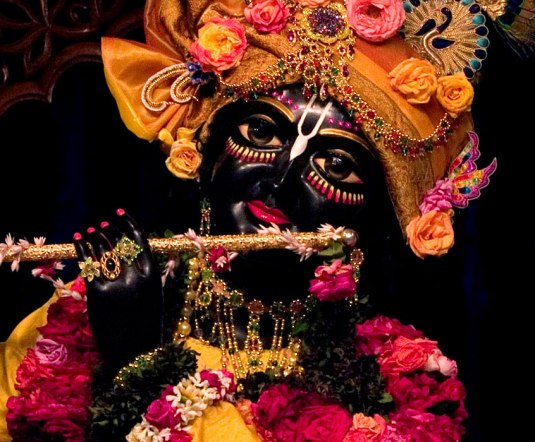
click on image to enlarge
…Regarding the attractiveness of Kṛṣṇa’s bodily beauty and the sound vibration of His flute, in the Tenth Canto, 29th Chapter, 37th verse, of Śrīmad-Bhāgavatam, the gopīs address Kṛṣṇa as follows: “Although our attitude towards You resembles loving affairs with a paramour, we cannot but wonder at how no woman can maintain her chastity upon hearing the vibration from Your flute. And not only women, but even stronghearted men are subject to falling down from their position at the sound of Your flute. In fact, we have seen that in Vṛndāvana even the cows, the deer, the birds, the trees-everyone-has been enchanted by the sweet vibration of Your flute and the fascinating beauty of Your person.”
In Rūpa Gosvāmī’s Lalita-mādhava, it is said: “One day Kṛṣṇa happened to see the shadow of His beautiful form reflected on the jeweled foreground. Upon seeing this bodily reflection, He expressed His feelings: ‘How wonderful it is that I have never seen such a beautiful form! Although it is My own form, still, like Rādhārāṇī, I am trying to embrace this form and enjoy celestial bliss.'” This statement shows how Kṛṣṇa and His shadow reflection are one and the same. There is no difference between Kṛṣṇa and His shadow reflection, nor between Kṛṣṇa and His picture. That is the transcendental position of Kṛṣṇa.
More
03 Feb 2013
by The Hare Krishna Movement
in A.C. Bhaktivedanta Swami Prabhupada, Book Distribution, Books by Srila Prabhupada, Free Downloads, Free eBooks, Manidhara das, Quotes by Srila Prabhupada, Srila Prabhupada's Books
Tags: A.C. Bhaktivedanta Swami Prtabhupada, Bhaktivedanta Archives, Book Distribution, book printing, Founder Acarya, free download, free ebook, Kindly Help Me, Manidhara das, pdf download, Srila Prabhupada, Srila Prabhupada's books

Front Cover
We are pleased to offer this new book; “Kindly Help Me”, for free pdf download.
More
02 Feb 2013
by The Hare Krishna Movement
in A.C. Bhaktivedanta Swami Prabhupada
Tags: A.C. Bhaktivedanta Swami Prabhupada, Arjuna, bhagavad-gita, guhyatamam, knowledge, Krishna, liberation, moksyase, most confidential knowledge, nonenvious, prabhupada gita, Raja-Vidya, realized knowledge, Sri Bhagavan uvaca, the most confidential knowledge, the Supreme Personality of Godhead said

…The very beginning of Bhagavad-gītā, the First Chapter, is more or less an introduction to the rest of the book; and in the Second and Third Chapters, the spiritual knowledge described is called confidential. Topics discussed in the Seventh and Eighth Chapters are specifically related to devotional service, and because they bring enlightenment in Kṛṣṇa consciousness, they are called more confidential. But the matters which are described in the Ninth Chapter deal with unalloyed, pure devotion. Therefore this is called the most confidential. One who is situated in the most confidential knowledge of Kṛṣṇa is naturally transcendental; he therefore has no material pangs, although he is in the material world. In the Bhakti-rasāmṛta-sindhu it is said that although one who has a sincere desire to render loving service to the Supreme Lord is situated in the conditional state of material existence, he is to be considered liberated. Similarly, we shall find in the Bhagavad-gītā, Tenth Chapter, that anyone who is engaged in that way is a liberated person.
Full Chapter More
02 Feb 2013
by The Hare Krishna Movement
in Songs of the Vaisnava Acaryas, Vrndavana
Tags: Krishna, Narottama das thakura, radharani's beauty Radha-Krishna, Songs of the Vaisnava Acaryas, spiritual sky, Srimati Radharani, Vrndavana, vrndavana is a transcendental beautiful place, vrndavana ramyasthana

by Narottama das Thakura
Vrndavan is a transcendental beautiful place. It is the spiritual sky, where everything is made of touchstone, which fulfills all desires. All the temples there are bedcked with costly jewels, In that far distant place is the River Yamuna, which is full of lotus flowers, In the midst of that throng of lotus flowers there is a golden boat, appearing like another big lotus flower, with eight petals, who are none but the eight chief gopis who always surround Radha and Krishna, In the surrounding petals there is a golden throne where the two transcendental lovers, namely Radha and Krishna are seated, but of all of them the governing Deity is Srimati Radharani. There is no comparison to Radharani’s beauty and the luster of Her transcendental body. The so-called beauty of the moon has fallen on the ground in the presence of Radharani’s beauty. In that assembly of Radha-Krishna and their principal associates there is a flood of laughing and joking as they address one another. Narottama das says that the eternal pastimes of Radha-Krishna from day to day are full of transcendental pleasure. Let us all remember them now and then and thus become happy even in this material world.
Bengali lyrics; More
31 Jan 2013
by The Hare Krishna Movement
in Advaita Acarya, Caitanya Mahaprabhu, Chanting Hare Krishna, Sri Caitanya-Caritamrta, Srimati Tulasi Devi
Tags: A.C. Bhaktivedanta Swami Prabhupada Sri Caitanya's descent, Advaita Acarya, appears by the desire of His devotee, Caitanya Mahaprabhu, protector of religion, srimati tulasi, tulasi buds in water from the ganges, Tulasi devi

…Whenever the Supreme Personality of Godhead descends in His human form, He sends ahead all His devotees, who act as His father, teacher and associates in many roles. Such personalities appear before the descent of the Supreme Personality of Godhead. Before the appearance of Lord Śrī Kṛṣṇa Caitanya Mahāprabhu, there appeared His devotees like Śrī Mādhavendra Purī; His spiritual master, Śrī Īśvara Purī; His mother, Śrīmatī Śacīdevī; His father, Śrī Jagannātha Miśra; and Śrī Advaita Ācārya.
Advaita Ācārya having appeared, He found the world devoid of devotional service to Śrī Kṛṣṇa because people were engrossed in material affairs.
Everyone was engaged in material enjoyment, whether sinfully or virtuously. No one was interested in the transcendental service of the Lord, which can give total relief from the repetition of birth and death.
Seeing the activities of the world, the Ācārya felt compassion and began to ponder how He could act for the people’s benefit.
[Advaita Ācārya thought:] “If Śrī Kṛṣṇa were to appear as an incarnation, He Himself could preach devotion by His personal example.
“In this Age of Kali there is no religion other than the chanting of the holy name of the Lord, but how in this age will the Lord appear as an incarnation?
“I shall worship Kṛṣṇa in a purified state of mind. I shall constantly petition Him in humbleness.
“My name, ‘Advaita,’ will be fitting if I am able to induce Kṛṣṇa to inaugurate the movement of the chanting of the holy name.”
“Śrī Kṛṣṇa, who is very affectionate toward His devotees, sells Himself to a devotee who offers Him merely a tulasī leaf and a palmful of water.”
Advaita Ācārya considered the meaning of the verse in this way: Not finding any way to repay the debt He owes to one who offers Him a tulasī leaf and water, Lord Kṛṣṇa thinks, “There is no wealth in My possession that is equal to a tulasī leaf and water.”
Thus the Lord liquidates the debt by offering Himself to the devotee. Considering this, the Ācārya began worshiping the Lord.
Thinking of the lotus feet of Śrī Kṛṣṇa, He constantly offered tulasī buds in water from the Ganges.
He appealed to Śrī Kṛṣṇa with loud calls and thus made it possible for Kṛṣṇa to appear.
Therefore the principal reason for Śrī Caitanya’s descent is this appeal by Advaita Ācārya. The Lord, the protector of religion, appears by the desire of His devotee.
More
28 Jan 2013
by The Hare Krishna Movement
in A.C. Bhaktivedanta Swami Prabhupada, Art, Free Audio Books, Free Downloads, Free eBooks, Krishna Path, Prahlada-Nrsimha das
Tags: A.C. Bhaktivedanta Swami Prabhupada, audio books, free download, free eBooks, Internet, ISKCON Press, Krishna art, Krsna Book, Krsna The Supreme Personality of Godhead, Prahlada-Nrsimha das, Transcendental Art

click on image to enlarge
I am always glad to hear from my friend Prahlada-Nrsimha Prabhu over at Krishna Path because it usually means he has another book ready to be uploaded onto the Internet. For instance today this message arrived in our mailbox:
Haribol! We are very happy to announce that KrishnaPath.org has now completed the scanning of the original 1970 ISKCON Press edition (Volume one) of KRSNA The Supreme Personality of Godhead and is available for free download! We are working hard to get you the second volume as well. By your prayers and blessings the second volume KRSNA book will be ready and available for free download soon.
More
28 Jan 2013
by The Hare Krishna Movement
in A.C. Bhaktivedanta Swami Prabhupada, Caitanya Mahaprabhu, Devotional Service, Srimad Bhagavatam
Tags: A.C. Bhaktivedanta Swami Prabhupada, causeless mercy, chanting, devotional service, hearing, Lord Sri Caitanya Mahaprabhu, mercy of sri caitanya, millennium, Prayers by Queen Kunti, praying, remembering, Srimad Bhagavad-gita, Srimad Bhagavatam, worshiping

…In the Śrīmad Bhagavad-gītā the Lord asserts that He appears in every millennium just to reestablish the way of religion. The way of religion is made by the Supreme Lord. No one can manufacture a new path of religion, as is the fashion for certain ambitious persons. The factual way of religion is to accept the Lord as the supreme authority and thus render service unto Him in spontaneous love.
The Lord, however, out of His causeless mercy, because He is more merciful to the suffering living beings than they can expect, appears before them and renovates the principles of devotional service comprised of hearing, chanting, remembering, serving, worshiping, praying, cooperating and surrendering unto Him. Adoption of all the above-mentioned items, or any one of them, can help a conditioned soul get out of the tangle of nescience and thus become liberated from all material sufferings created by the living being illusioned by the external energy. This particular type of mercy is bestowed upon the living being by the Lord in the form of Lord Śrī Caitanya Mahāprabhu. (from Purport to SB 1.8.35)
Full Text and puroprt More
26 Jan 2013
by The Hare Krishna Movement
in A.C. Bhaktivedanta Swami Prabhupada, Bhagavad-gita, Book Changes, Spiritual Master, The Hare Krishna Movement
Tags: 1972 Macmillan edition, A.C. Bhaktivedanta Swami Prabhupada, as it is, bhagavad-gita, original 1972, picture of Srila Prabhupada, prabhupada pictures
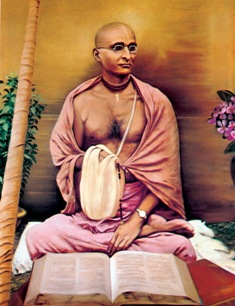
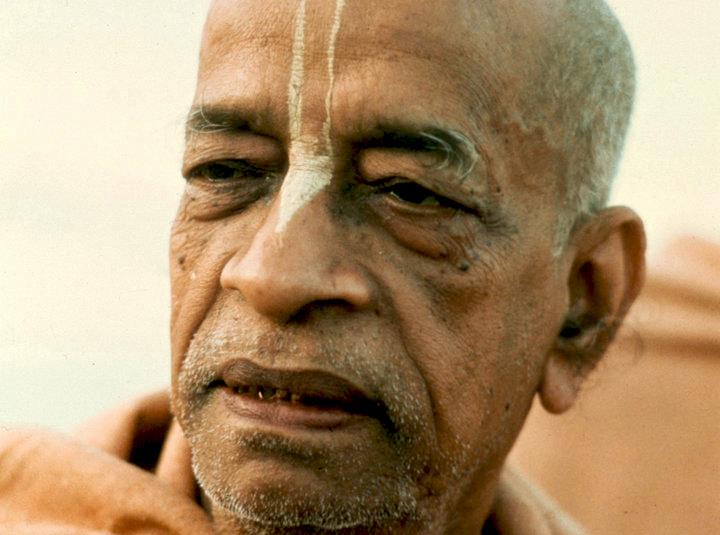
Images of the Disciplic Succession (taken from Original 1972 Edition of Bhagavad-gita As It Is)

His Divine Grace A.C. Bhaktivedanta Swami Prabhupada
the Founder-Acarya of the International Society for Krishna Consciousness
and greatest exponent of Krishna Consciousness in the western world.

Srila Bhaktisiddhanta Sarasvati Gosvami Maharaja
the spiritual master of His Divine Grace A.C. Bhaktivedanta Swami Prabhupada
and foremost scholar and devotee in the recent age.

Srila Gaura Kisora Das Babaji Maharaja
the spiritual master of Srila Bhaktisiddhanta Sarasvati Gosvami
and intimate student of Srila Thakur Bhaktivinode

Srila Thakur Bhaktivinode
the pioneer of the program to benedict
the entire world with Krishna consciousness
As taken from Original 1972 Edition of Bhagavad-gita As It Is
*Note; These images were deleted from: Second Edition, Revised and Enlarged …or rather, current edition.
25 Jan 2013
by The Hare Krishna Movement
in Sri Nandanandana das, Vegetarian Cooking, Vegetarianism
Tags: animal crulety, animal slaughter, bhakti yoga, compassion, Ferdinando Lambruschini, Isaac Bashevis Singer, karma, meateaters, Newton's third law of motion, non violence, peace, Prasadam, slaughter industry, spiritual path, universal brotherhood, vegetarian, vegetarian diet, violence to animals

…On the spiritual path, there are several reasons why a person is recommended to be vegetarian. One primary reason is that we need to see the spiritual nature within all living beings, and that includes the animals and other creatures as well. Universal brotherhood means nonviolence to both humans and animals. It consists of understanding that animals also have souls. They are alive, conscious, and feel pain. And these are the indications of the presence of consciousness, which is the symptom of the soul.
…Isaac Bashevis Singer, who won the Nobel Prize in Literature, asked, “How can we pray to God for mercy if we ourselves have no mercy? How can we speak of rights and justice if we take an innocent creature and shed its blood?” He went on to say, “I personally believe that as long as human beings will go shedding the blood of animals, there will never be any peace.”
…The Buddhist scripture (Sutta-Nipata 393) also advises: “Let him not destroy or cause to be destroyed any life at all, or sanction the acts of those who do so. Let him refrain from even hurting any creature, both those that are strong and those that tremble in the world.” It is also said in the Buddhist scripture, the Mahaparinirvana Sutra, “The eating of meat extinguishes the seed of great compassion.”
Why Be Vegetarian?
By Stephen Knapp (Sri Nandanandana dasa)
More
25 Jan 2013
by The Hare Krishna Movement
in A.C. Bhaktivedanta Swami Prabhupada, Bob Cohen, Perfect Answers Perfect Questions
Tags: A.C. Bhaktivedanta Swami Prabhupada, Bob Cohen, devotee Krsna, krsna consciousness, krsna-samprasnah, loka-mangalam, material consequences, material miseries, original consciousness, perfect devotee, prasada, pure devotee, Srila Prabhupada, Syamasundara dasa

Continuing with our series of a True account entitled Perfect Questions, Perfect Answers… A search for meaning carries Bob Cohen, a young American Peace Corps worker halfway around the world, to an ancient village in the midst of West Bengal. There, in a small bamboo hut, he finds a teacher who is able to tell him everything he ever wanted to know.
…Bob: A perfected soul, a devotee, a pure devotee…
Śrīla Prabhupāda: A perfected soul is one who engages twenty-four hours a day in Kṛṣṇa consciousness. That is perfection. That is a transcendental position. Perfection means to engage in one’s original consciousness. That is perfection.
Perfect Questions, Perfect Answers
By His Divine Grace A.C. Baktivedanta Swami Prabhupada
Chapter 6, February 29, 1972, (evening)
More
23 Jan 2013
by The Hare Krishna Movement
in A.C. Bhaktivedanta Swami Prabhupada
Tags: A.C. Bhaktivedanta Swami Prabhupada, Absolute Truth, Arjuna, atma, Bg. 8, bhagavad-gita, Bhagavan, body mind soul, brahman, devotional seervice, fruitive activities, individual soul, karma, Krishna, krsna consciousness, living enity, Paramatma, Srimad Bhagavatam, transcendental, yoga, yoga principles

Bhagavad-gītā As It Is 1972 Edition
By His Divine Grace A. C. Bhaktivedanta Swami Prabhupāda
Chapter 8
Attaining the Supreme
More
20 Jan 2013
by The Hare Krishna Movement
in A.C. Bhaktivedanta Swami Prabhupada, Devotional Service, Mayavadi, Spiritual Life, Sri Caitanya-Caritamrta
Tags: austerity, Demigod Gaṇeśa, fruitive activity, goddess durga, goddess kali, goddess of fortune, impersonal Brahman, It Is Not All One and the Same, Kṛṣṇa, Lord Ramacandra, Lord Siva, mystic yoga, speculative knowledge

click on image to enlarge
“One Can Understand Me As I Am, Only By Devotional Service”
It Is Not All One and the Same
…Lord Kṛṣṇa told the gopīs, ‘The means of attaining My favor is loving service unto Me, and fortunately you are all thus engaged. Those living beings who render service unto Me are eligible to be transferred to the spiritual world and attain eternal life with knowledge and bliss.’
The fulfillment of human life is summarized in this verse from Śrīmad-Bhāgavatam (10.82.44).
And in the Bhagavad-gita
…Lord Krsna told Arjuna, “One can understand Me as I am, as the Supreme Personality of Godhead, only by devotional service. And when one is in full consciousness of Me by such devotion, he can enter into the kingdom of God.”
Impersonalists cannot understand the Supreme Personality of Godhead; therefore it is not possible for them to enter into the spiritual kingdom of God and return home, back to Godhead. Actually one attains different results by different means. It is not that all achievements are one and the same.
More
Previous Older Entries Next Newer Entries









 The Hare Krishna Movement