11 Mar 2013
by The Hare Krishna Movement
in A.C. Bhaktivedanta Swami Prabhupada, Brahma, Krishna, KRSNA The Supreme Personality of Godhead
Tags: A.C. Bhaktivedanta Swami Prabhupada, Brahma, great swan carrier, humble obeisances, Krsna, Lord Brahma, prayers, Prayers Offered by Lord Brahma to Lord Krsna, Spiritual world, Srila Prabhupada, The Supreme Personality of Godhead, windows to the spiritual sky

Maybe it is just my mood, but I find all these stories from “Krsna, The Supreme Personality of Godhead” by Srila Prabhupada, to be transcendentally enlivening. They are like windows to the Spiritual World, and my mind just wants to hang on each and every word. So the following post is from my reading this weekend. Enjoy.
…Brahmā thus found Śrī Kṛṣṇa, the Supreme Personality of Godhead, playing the part of a small cowherd boy; he saw that little child with a lump of food in His left hand, searching out His friends, cows and calves, just as He was actually doing one year before, after their disappearance.
Immediately Brahmā descended from his great swan carrier and fell down before the Lord just like a golden stick. All the four helmets on the heads of Brahmā touched the lotus feet of Kṛṣṇa. Brahmā, being very joyful, began to shed tears, and he washed the lotus feet of Kṛṣṇa with his tears. Repeatedly he fell and rose as he recalled the wonderful activities of the Lord. After repeating obeisances for a long time, Brahmā stood up and smeared his hands over his eyes. Seeing the Lord before him, he, trembling, began to offer prayers with great respect, humility and attention. (from the end of Chapter 13, Kṛṣṇa, the Supreme Personality of Godhead)
…Brahmā said, ”My dear Lord, You are the only worshipful Supreme Lord, Personality of Godhead; therefore I am offering my humble obeisances and prayers just to please You. Your bodily features are of the color of clouds filled with water. You are glittering with a silver electric aura emanating from Your yellow garments.
“Let me offer my respectful repeated obeisances unto the son of Mahārāja Nanda who is standing before me with conchshell, earrings and peacock feather on His head. His face is beautiful; He is wearing a helmet, garlanded by forest flowers, and He stands with a morsel of food in His hand. He is decorated with cane and bugle, and He carries a buffalo horn and flute. He stands before me with small lotus feet. (beginning the 14 Chapter of Kṛṣṇa, the Supreme Personality of Godhead)
Full Chapter More
07 Feb 2013
by The Hare Krishna Movement
in A.C. Bhaktivedanta Swami Prabhupada, Krishna, Subhadra
Tags: A.C. Bhaktivedanta Swami Prabhupada, Arjuna and Subhadra, Bahulasva, Goloka Vrndavana, grandmother subhadra, king bahulasva, King Pariksit, Krsna, omnipotency, opulence of the Supreme Personality of Godhead, Srutadeva, Subhadra, subhadra's kidnapping, vaibhava-prakasa

click on image to enlarge
…King Parīkṣit became more inquisitive to hear about Kṛṣṇa and His pastimes, and thus he inquired from Śukadeva Gosvāmī how his grandmother Subhadrā was kidnapped by his grandfather Arjuna at the instigation of Lord Kṛṣṇa. King Parīkṣit was very much eager to learn about his grandfather’s kidnapping and marriage of his grandmother.
Thus Śukadeva Gosvāmī began to narrate the story as follows: “Once upon a time, your grandfather Arjuna, the great hero, was visiting several holy places of pilgrimage, and while he was thus traveling all over he happened to come to Prabhāsakṣetra. In the Prabhāsakṣetra he heard the news that Lord Balarāma was negotiating the marriage of Subhadrā, the daughter of Arjuna’s maternal uncle, Vasudeva. Although her father, Vasudeva, and her brother, Kṛṣṇa, were not in agreement with Him, Balarāma was in favor of marrying Subhadrā to Duryodhana. Arjuna, however, desired to gain the hand of Subhadrā.”
As he thought of Subhadrā and her beauty, Arjuna became more and more captivated with the idea of marrying her, and with a plan in mind…
Full Chapter More
05 Feb 2013
by The Hare Krishna Movement
in A.C. Bhaktivedanta Swami Prabhupada, Krishna, Nectar of Devotion, Radha Madhava, The Nectar of Devotion
Tags: A.C. Bhaktivedanta Swami Prabhupada, beautiful form, krishna exquisite beauty, Krishna's Flute, krishna's reflection, lalita-madhava, Nectar of Devotion, Rupa Gosvami, transcendental position of krsna, vibration from krishna's flute
click on image to enlarge
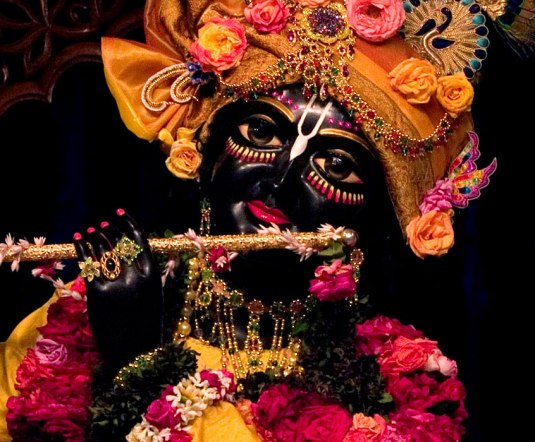
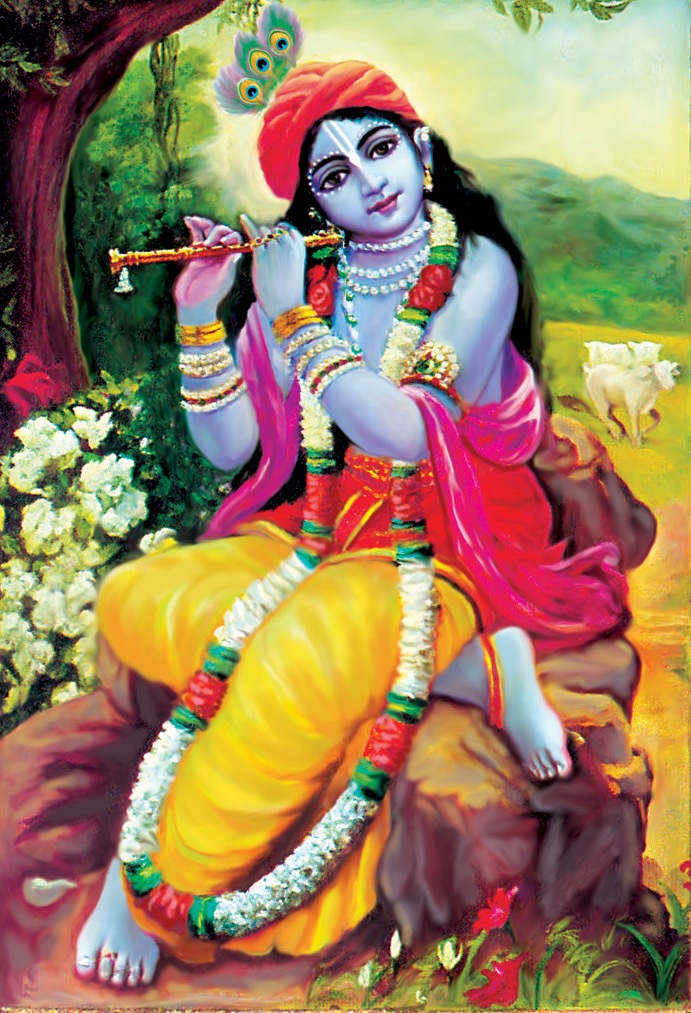
…Regarding the attractiveness of Kṛṣṇa’s bodily beauty and the sound vibration of His flute, in the Tenth Canto, 29th Chapter, 37th verse, of Śrīmad-Bhāgavatam, the gopīs address Kṛṣṇa as follows: “Although our attitude towards You resembles loving affairs with a paramour, we cannot but wonder at how no woman can maintain her chastity upon hearing the vibration from Your flute. And not only women, but even stronghearted men are subject to falling down from their position at the sound of Your flute. In fact, we have seen that in Vṛndāvana even the cows, the deer, the birds, the trees-everyone-has been enchanted by the sweet vibration of Your flute and the fascinating beauty of Your person.”
In Rūpa Gosvāmī’s Lalita-mādhava, it is said: “One day Kṛṣṇa happened to see the shadow of His beautiful form reflected on the jeweled foreground. Upon seeing this bodily reflection, He expressed His feelings: ‘How wonderful it is that I have never seen such a beautiful form! Although it is My own form, still, like Rādhārāṇī, I am trying to embrace this form and enjoy celestial bliss.'” This statement shows how Kṛṣṇa and His shadow reflection are one and the same. There is no difference between Kṛṣṇa and His shadow reflection, nor between Kṛṣṇa and His picture. That is the transcendental position of Kṛṣṇa.
More
17 Jan 2013
by The Hare Krishna Movement
in A.C. Bhaktivedanta Swami Prabhupada, Krishna, Srimad Bhagavatam
Tags: A.C. Bhaktivedanta Swami Prabhupada, Dwarka, flowers fell upon the road, garlands of flowers, Krishna, Krsna, lightning and rainbows, Lord Krsna's Entrance into Dvaraka, Lord' bodily hue, monsoon cloud, SB 1.11.27, white feathered fans, white umbrella, yellow garments

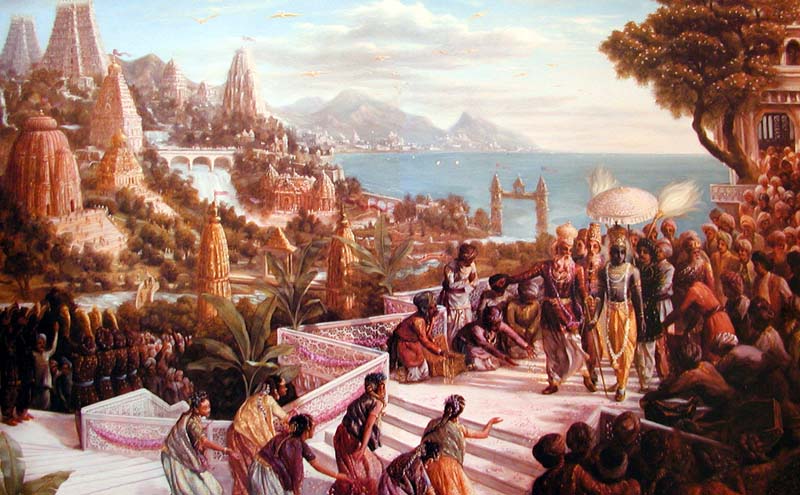
As the Lord passed along the public road of Dvārakā, His head was protected from the sunshine by a white umbrella. White feathered fans moved in semicircles, and showers of flowers fell upon the road. His yellow garments and garlands of flowers made it appear as if a dark cloud were surrounded simultaneously by sun, moon, lightning and rainbows.
…The sun, moon, rainbow and lightning do not appear in the sky simultaneously. But the situation created at the time of His passing on the roads of Dvārakā was beautiful and could not be compared to anything besides the description of natural phenomena.
full text and purport More
02 Dec 2012
by The Hare Krishna Movement
in A.C. Bhaktivedanta Swami Prabhupada, Krishna, Krishna Consciousness, KRSNA The Supreme Personality of Godhead
Tags: A.C. Bhaktivedanta Swami Prabhupada, Bhaktivedanta purports, butter-smeared footprints, divine ecstasies, Krishna, Krsna as the butter thief, Mother Yasoda, Mother Yasoda Binds Lord Krsna, SB 10.9.3-10

Even from the material point of view, A.C. Bhaktivedanta Swami’s writing is extraordinarily beautiful. But from the spiritual perspective Srila Prabhupada’s translations and purports are like ecstatic transcendental windows to the Spiritual World.
…Kṛṣṇa, at that time, was sitting on an upside-down wooden mortar for grinding spices and was distributing milk preparations such as yogurt and butter to the monkeys as He liked. Because of having stolen, He was looking all around with great anxiety, suspecting that He might be chastised by His mother. Mother Yaśodā, upon seeing Him, very cautiously approached Him from behind.(Bhaktivedanta Translation)
…Mother Yaśodā was able to trace Kṛṣṇa by following His butter-smeared footprints. She saw that Kṛṣṇa was stealing butter, and thus she smiled. (From the Bhaktivedanta Purports)
More
15 Aug 2012
by The Hare Krishna Movement
in Bhagavad-gita, Krishna, Krishna Consciousness
Tags: A.C. Bhaktivedanta Swami Prabhupada, Absolute Truth, Arjuna, Asita, Bg 10.12-14, bhagavad-gita, Devala, eternal divine person, great sages, Narada, param brahma, param dhama, primal God, supreme abode and purifier, transcendental and original, unborn and all-pervading beauty, Universal Form, Vyasa
Click on image to enlarge
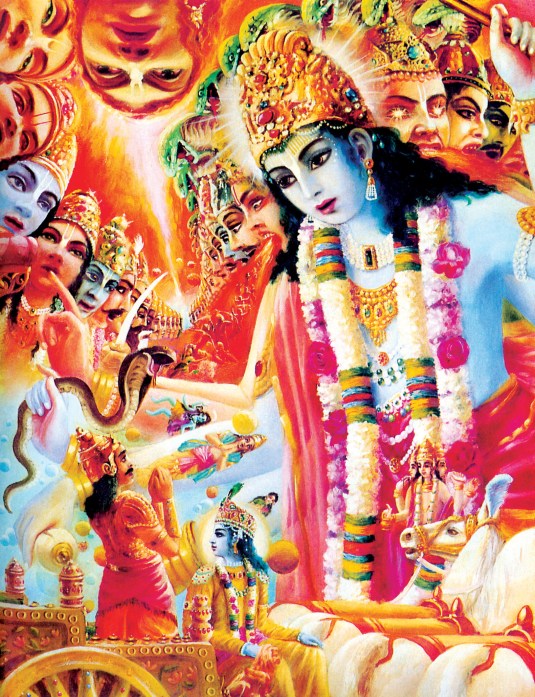
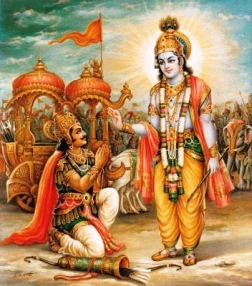
Arjuna said: You are the Supreme Brahman, the ultimate, the supreme abode and purifier, the Absolute Truth and the eternal divine person. You are the primal God, transcendental and original, and You are the unborn and all-pervading beauty. All the great sages such as Nārada, Asita, Devala, and Vyāsa proclaim this of You, and now You Yourself are declaring it to me.
O Kṛṣṇa, I totally accept as truth all that You have told me. Neither the gods nor demons, O Lord, know Thy personality.
Full verse and purport More
09 Aug 2012
by The Hare Krishna Movement
in Festivals, Janmastami, Krishna, Lectures
Tags: A.C. Bhaktivedanta Swami Prabhupada, Hare Krishna, International Society for Krishna Consciousness, Janmastami, Krishna, Krsna Kesava pahi mam, Lord Sri Krishna, Lord Sri Krsna's Appearance Day Lecture, Rama Raghava raksa mam, Srila Prabhupada lecture

Kṛṣṇa! Kṛṣṇa! Kṛṣṇa! Kṛṣṇa! Kṛṣṇa! Kṛṣṇa! Kṛṣṇa! he
Kṛṣṇa! Kṛṣṇa! Kṛṣṇa! Kṛṣṇa! Kṛṣṇa! Kṛṣṇa! Kṛṣṇa! he
Kṛṣṇa! Kṛṣṇa! Kṛṣṇa! Kṛṣṇa! Kṛṣṇa! Kṛṣṇa! rakṣa mām
Kṛṣṇa! Kṛṣṇa! Kṛṣṇa! Kṛṣṇa! Kṛṣṇa! Kṛṣṇa! pāhi mām
Rāma! Rāghava! Rāma! Rāghava! Rāma! Rāghava! rakṣa mām
Kṛṣṇa! Keśava! Kṛṣṇa! Keśava! Kṛṣṇa! Keśava! pāhi mām
Caitanya-caritāmṛta (Madhya 7.96)
Today, here in the Western half of the World, we are celebrating Janmastami: the appearance day of Lord Sri Krishna. So let us take advantage of this auspicious day and hear, chant, and remember the pastimes of the Lord. Hare Krishna!
Janmāṣṭamī
Lord Śrī Kṛṣṇa’s Appearance Day Lecture
By His Divine Grace A.C. Bhaktivedanta Swami Prabhupada
Montreal, August 16, 1968
More
05 Aug 2012
by The Hare Krishna Movement
in Festivals, Janmastami, Krishna
Tags: baby Krishna, Birth of Lord Krsna, Hare Krishna centers, Iskcon, Krishna, Krishna Janmastami, Krishna's appearance, Krishna's birth, Mother Yasoda, Rohini, Sri Krishna Janmastami

click on image to enlarge
Sri Krishna Janmastami is quickly approaching, and will be celebrated on August 9th, this year. For those of you who want to follow, it is recommended that you fast until Midnight. We would also encourage you to visit the nearest Hare Krishna Center and partake in the festivities.
Kṛṣṇa, the Supreme Personality of Godhead
By His Divine Grace A. C. Bhaktivedanta Swami Prabhupāda
Chapter Three
The Birth of Lord Kṛṣṇa
As stated in the Bhagavad-gītā, the Lord says that His appearance, birth, and activities, are all transcendental, and one who understands them factually becomes immediately eligible to be transferred to the spiritual world. The Lord’s appearance or birth is not like that of an ordinary man who is forced to accept a material body according to his past deeds. The Lord’s appearance is explained in the Second Chapter: He appears out of His own sweet pleasure. When the time was mature for the appearance of the Lord, the constellations became very auspicious. The astrological influence of the star known as Rohiṇī was also predominant because this star is considered to be very auspicious. Rohiṇī is under the direct supervision of Brahmā. According to the astrological conclusion, besides the proper situation of the stars, there are auspicious and inauspicious moments due to the different situations of the different planetary systems. At the time of Kṛṣṇa’s birth, the planetary systems were automatically adjusted so that everything became auspicious.
More
05 Aug 2012
by The Hare Krishna Movement
in Krishna, Opulence of the Absolute, Sri Caitanya-Caritamrta, Srimati Radharani
Tags: A.C. Bhaktivedanta Swami Prabhupada, Aprakrta-madana, cupid, Krishna, Krsna, Mad. 8.139, Madana, Madana-mohana, Manmatha-madana, Nectar of Devotion, sac-cid-ananda-vigraha, Sri Caitanya-caritamrta
click on image to enlarge
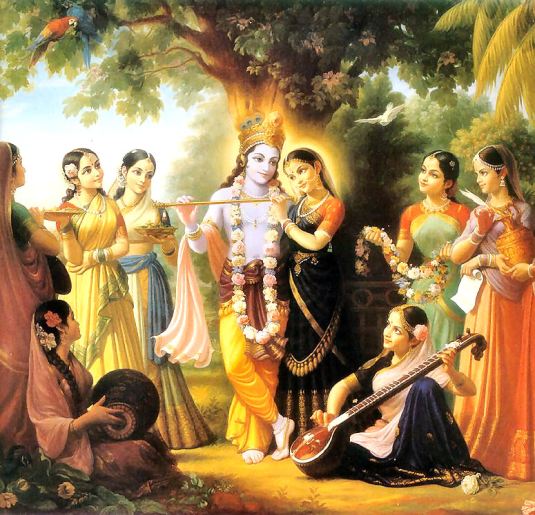
“The very name Kṛṣṇa means that He attracts even Cupid. He is therefore attractive to everyone-male and female, moving and inert living entities. Indeed, Kṛṣṇa is known as the all-attractive one.
“Śrīla Rūpa Gosvāmī has stated that devotional service attracts even Kṛṣṇa. Kṛṣṇa attracts everyone, but devotional service attracts Kṛṣṇa. The symbol of devotional service in the highest degree is Rādhārāṇī. Kṛṣṇa is called Madana-mohana, which means that He is so attractive that He can defeat the attraction of thousands of Cupids. But Rādhārāṇī is still more attractive, for She can even attract Kṛṣṇa. Therefore devotees call Her Madana-mohana-mohinī, the attractor of the attractor of Cupid. To perform devotional service means to follow in the footsteps of Rādhārāṇī…” (Nectar of Devotion Lecture, Nov. 11, 1972, Vrindavan)
…The name Madana refers to Cupid, but Kṛṣṇa is the spiritual Madana. His body is not material like the body of Cupid in this material universe. Kṛṣṇa’s body is all-spiritual-sac-cid-ānanda-vigraha. Therefore He is called Aprākṛta-madana. He is also known as Manmatha-madana, which means that He is attractive even to Cupid.
More
09 Jun 2012
by The Hare Krishna Movement
in Krishna, Srimad Bhagavatam
Tags: A.C, austerity, Bhaktivedanta Swami Prabhupada, goal of life, knowledge, Krishna, Personality of Godgead, revealed scriptures, sacrifices, SB 1.2.28-29, Sri Krsna, Srila Prabhupada, Srimad Bhagavatam, ultimate goal of life, Vasudeva, vasudeva-para veda, yoga
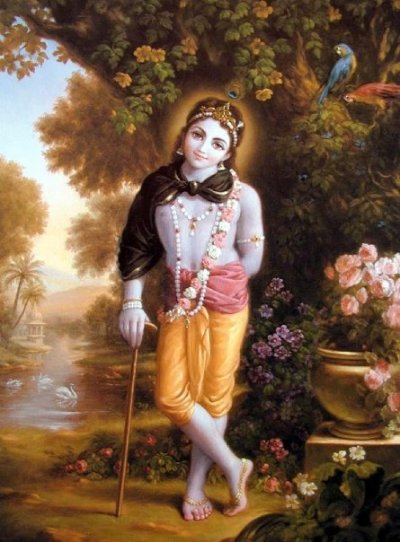
That Śrī Kṛṣṇa, the Personality of Godhead, is the only object of worship is confirmed in these two ślokas.
Srimad-Bhagavatam
By His Divine Grace A.C. Bhaktivedanta Swami Prabhupada
Canto 1, Chapter Two, Text 28-29
TEXTS 28-29
vāsudeva-parā vedā
vāsudeva-parā makhāḥ
vāsudeva-parā yogā
vāsudeva-parāḥ kriyāḥ
vāsudeva-paraṁ jñānaṁ
vāsudeva-paraṁ tapaḥ
vāsudeva-paro dharmo
vāsudeva-parā gatiḥ
vāsudeva—the Personality of Godhead; parāḥ—the ultimate goal; vedāḥ—revealed scriptures; vāsudeva—the Personality of Godhead; parāḥ—for worshiping; makhāḥ—sacrifices; vāsudeva—the Personality of Godhead; parāḥ—the means of attaining; yogāḥ—mystic paraphernalia; vāsudeva—the Personality of Godhead; parāḥ—under His control; kriyāḥ—fruitive activities; vāsudeva—the Personality of Godhead; param—the supreme; jñānam—knowledge; vāsudeva—the Personality of Godhead; param—best; tapaḥ—austerity; vāsudeva—the Personality of Godhead; paraḥ—superior quality; dharmaḥ—religion; vāsudeva—the Personality of Godhead; parāḥ—ultimate; gatiḥ—goal of life.
In the revealed scriptures, the ultimate object of knowledge is Śrī Kṛṣṇa, the Personality of Godhead. The purpose of performing sacrifice is to please Him. Yoga is for realizing Him. All fruitive activities are ultimately rewarded by Him only. He is supreme knowledge, and all severe austerities are performed to know Him. Religion [dharma] is rendering loving service unto Him. He is the supreme goal of life.
Purport
That Śrī Kṛṣṇa, the Personality of Godhead, is the only object of worship is confirmed in these two ślokas. In the Vedic literature there is the same objective: establishing one’s relationship and ultimately reviving our lost loving service unto Him. That is the sum and substance of the Vedas. In the Bhagavad-gītā the same theory is confirmed by the Lord in His own words: the ultimate purpose of the Vedas is to know Him only. All the revealed scriptures are prepared by the Lord through His incarnation in the body of Śrīla Vyāsadeva just to remind the fallen souls, conditioned by material nature, of Śrī Kṛṣṇa, the Personality of Godhead. No demigod can award freedom from material bondage. That is the verdict of all the Vedic literatures. Impersonalists who have no information of the Personality of Godhead minimize the omnipotency of the Supreme Lord and put Him on equal footing with all other living beings, and for this act such impersonalists get freedom from material bondage only with great difficulty. They can surrender unto Him only after many, many births in the culture of transcendental knowledge.
More
13 Apr 2012
by The Hare Krishna Movement
in Krishna, Krishna Consciousness, The Hare Krishna Movement, The Reservoir of Pleasure
Tags: A.C. Bhaktivedanta Swami Prabhupada, bhagavad-gita, devotional service, His Divine Grace, Krishna consciousness, Krsna The Reservoir of Pleasure, pure consciousness, real life, real pleasure, Sri Krsna

Kṛṣṇa, the Reservoir of Pleasure
by His Divine Grace A. C. Bhaktivedanta Swami Prabhupāda
Kṛṣṇa—this sound is transcendental. Kṛṣṇa means the highest pleasure. All of us, every living being, seeks pleasure. But we do not know how to seek pleasure perfectly. With a materialistic concept of life, we are frustrated at every step in satisfying our pleasure because we have no information regarding the real level on which to have real pleasure. For the last few weeks we have been learning that we are not this body; we are consciousness. Not exactly consciousness, for consciousness is actually the symptom of our real identity: we are pure soul, now merged within this material body. Modern material science lays no stress on this; therefore the scientists are sometimes misled in their understanding of spirit soul. But spirit soul is a fact, which anyone can understand by the presence of consciousness. Any child can understand that consciousness is the symptom of the spirit soul.
Now the whole process we are trying to learn from the Bhagavad-gītā (The Song of God) is how to bring ourselves to this level of consciousness. And if we act from the level of consciousness, then we may not be pushed again into the level of this bodily conception; and, if we can continue on that level, if we can continue to act in pure consciousness, then, at the end of this body we shall be free from material contamination, our spiritual life will be revived, and the ultimate result will be that in our next life, after leaving this body, we shall have our full, eternal spiritual life. Spirit, as we have already discussed, is described as eternal.
More
08 Apr 2012
by The Hare Krishna Movement
in Krishna, Lord Jesus Christ, Science of Self Realization
Tags: Easter Sunday, guru, Jesus, Jesus Christ, spiritual master, Srila Prabhupada, The Science of Self Realization
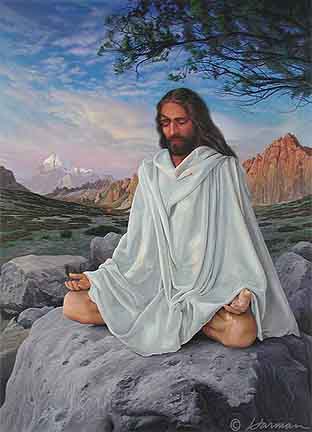
Today here in the West most of the World is celebrating Easter Sunday, therefore we are posting some of Srila Prabhupada’s instructions on Jesus Christ
…Jesus Christ was such a great personality—the son of God, the representative of God. He had no fault. Still, he was crucified. He wanted to deliver God consciousness, but in return they crucified him—they were so thankless. They could not appreciate his preaching. But we appreciate him and give him all honor as the representative of God.
Of course, the message that Christ preached was just according to his particular time, place, and country, and just suited for a particular group of people. But certainly he is the representative of God. Therefore we adore Lord Jesus Christ and offer our obeisances to him.
Once, in Melbourne, a group of Christian ministers came to visit me. They asked, “What is your idea of Jesus Christ?” I told them, “He is our guru. He is preaching God consciousness, so he is our spiritual master.” The ministers very much appreciated that.
Actually, anyone who is preaching God’s glories must be accepted as a guru. Jesus Christ is one such great personality. We should not think of him as an ordinary human being. The scriptures say that anyone who considers the spiritual master to be an ordinary man has a hellish mentality. If Jesus Christ were an ordinary man, then he could not have delivered God consciousness…
The Science of Self Realization
By His Divine Grace A.C. Bhaktivedanta Swami Prabhupada
Chapter 4,
Understanding Krsna and Christ
The Śrīmad-Bhāgavatam states that any bona fide preacher of God consciousness must have the qualities of titikṣā (tolerance) and karuṇā (compassion). In the character of Lord Jesus Christ we find both these qualities. He was so tolerant that even while he was being crucified, he didn’t condemn anyone. And he was so compassionate that he prayed to God to forgive the very persons who were trying to kill him. (Of course, they could not actually kill him. But they were thinking that he could be killed, so they were committing a great offense.) As Christ was being crucified he prayed, “Father, forgive them. They know not what they are doing.”
More
17 Mar 2012
by The Hare Krishna Movement
in Krishna, Teachings of Queen Kunti
Tags: A.C. Bhaktivedanta Swami Prabhupada, garland of lotus flowers, lotus feet, lotus flower, Personality of Godhead, SB 1.8.22, spiritual body, Srimad Bhagavatam, symbolic marks, Teachings of Queen Kunti, The Vision of Lotuses

Teachings of Queen Kuntī
By His Divine Grace A. C. Bhaktivedanta Swami Prabhupāda
Chapter Five
The Vision of Lotuses
namaḥ paṅkaja-nābhāya
namaḥ paṅkaja-māline
namaḥ paṅkaja-netrāya
namas te paṅkajāṅghraye
My respectful obeisances are unto You, O Lord, whose abdomen is marked with a depression like a lotus flower, who are always decorated with garlands of lotus flowers, whose glance is as cool as the lotus, and whose feet are engraved with lotuses. Śrīmad-Bhāgavatam 1.8.22
Here are some of the specific symbolical marks on the spiritual body of the Personality of Godhead which distinguishes His body from the bodies of all others. They are all special features of the body of the Lord. The Lord may appear as one of us, but He is always distinct by His specific bodily features.
More
18 Feb 2012
by The Hare Krishna Movement
in Back to Godhead, Hayagriva das, Krishna, Spiritual World
Tags: A.C. Bhaktivedanta Swami Prabhupada, Back to Godhead Magazine, Gokula, Goloka, Goloka Vrndavana, hayagriva das, Krsna lila, Lord Krsna's pastimes, spiritual sky, Spiritual world, the Divine Forms and Pastimes

…The boys who are playing with Krsna and herding cows in Vrndavana are not ordinary living entities. They are highly developed sages who have acquired perfection by the accumulation of pious activities in past lives. For those who are under the spell of materialism, Krsna is an ordinary boy, but these cowherd boys in Vrndavana accept Him as their Master, and their Supreme Lovable Object. Consequently, all the individual boys and girls who sport in Goloka Vrndavana enjoy Krsna’s spiritual bliss. Similarly, the gopis are not ordinary cowherd girls, but are great sages who transform themselves in order to enjoy conjugal love with Krsna. Lord Caitanya spoke of them in this way: “Oh what penances did the gopis perform to eternally enjoy the beauty of the Lord Krsna? They drink His beauty with their eyes and they fill their eyes, their limbs and their hearts with celestial visions of His beauty. O, blessed are they, for they enjoy that sublime beauty which is the sweetest in the creation and which has no equal. The pure love of the gopis is like a glass that reflects this sweetness and these attributes. As the Lord sees these reflections, His sweetness increases and so does the love of the gopis. And both His sweetness and their love grow and grow as though competing with one another. And though both attain new brilliances, neither admits defeat in this wonderful competition…”
Krsna lila: The Divine Forms and Pastimes
By Sriman Hayagriva das Adhikari
From Back to Godhead Magazine 1970 Vol. 1, No. 32
Lord Krsna’s pastimes, His appearance and disappearance, are continuous and eternal throughout the universe. As far as these pastimes are concerned, there is no stoppage. It is hard for the common man to understand how Krsna’s lilas (pastimes) can be eternal. To our conception He was present on earth 5,000 years ago, and now He is gone. We compare Him to ourselves. We remain on this planet for 100 years at the most and then, like a bubble, we pop and disappear. Although this is true for ourselves, we should not compare our condition to that of the Absolute Godhead. His Body is eternal, blissful and full of knowledge, whereas ours is mortal and full of misery and ignorance. Consequently we cannot understand how Krsna’s lilas are eternal.
More
02 Feb 2012
by The Hare Krishna Movement
in Krishna, Teachings of Queen Kunti
Tags: A.C. Bhaktivedanta Swami Prabhupada, asuras, Krsna, Nrsimha, Putana, Rama, residents of Vrndavana, Srila Prabhupada, Srimad Bhagavatam, Teachings of Queen Kunti, Varaha

…Krishna is accepted as the Supreme Personality of Godhead by such authoritative personalities as Vyāsa, Devala, Asita, Nārada, Madhva, Śaṅkara, Rāmānuja, Śrī Caitanya Mahāprabhu, Jīva Gosvāmī, Viśvanātha Cakravartī, Bhaktisiddhānta Sarasvatī, and all other authorities of the line. He Himself has declared as much in many places of the authentic literatures. And yet there is a class of men with demoniac mentality who are always reluctant to accept the Lord as the Supreme Absolute Truth. This is partially due to their poor fund of knowledge and partially due to their stubborn obstinacy, which results from various misdeeds in the past and present. Such persons could not recognize Lord Śrī Kṛṣṇa even when He was present before them.
Teachings of Queen Kunti
By His Divine Grace A.C. Bhaktivedanta Swami Prabhupada
Chapter 2, Beyond the Senses
māyā-javanikācchannam
ajñādhokṣajam avyayam
na lakṣyase mūḍha-dṛśā
nato nāṭya-dharo yathā
Being beyond the range of limited sense perception, You are the eternally irreproachable factor covered by the curtain of deluding energy. You are invisible to the foolish observer, exactly as an actor dressed as a player is not recognized. —Śrīmad-Bhāgavatam 1.8.19
In the Bhagavad-gītā Lord Śrī Kṛṣṇa affirms that less intelligent persons mistake Him to be an ordinary man like us, and thus they deride Him. The same is confirmed herein by Queen Kuntī.
The less intelligent persons are those who rebel against the authority of the Lord. Such persons are known as asuras. The asuras cannot recognize the Lord’s authority. When the Lord Himself appears among us, as Rāma, Nṛsiṁha, Varāha, or in His original form as Kṛṣṇa, He performs many wonderful acts which are humanly impossible. As we shall find in the Tenth Canto of this great literature, Lord Śrī Kṛṣṇa exhibited His humanly impossible activities even from the days of His lying on the lap of His mother. He killed the Pūtanā witch, although she smeared her breast with poison just to kill the Lord. The Lord sucked her breast like a natural baby, and He sucked out her very life also. Similarly, He lifted the Govardhana Hill, just as a boy picks up a frog’s umbrella, and stood several days continuously just to give protection to the residents of Vṛndāvana.
More
30 Jan 2012
by The Hare Krishna Movement
in Krishna, Nectar of Devotion
Tags: Krishna, Krsna's exquisite beauty, Krsna's Transcendental qualities, Srila Prabhupada, Srimad Bhagavatam
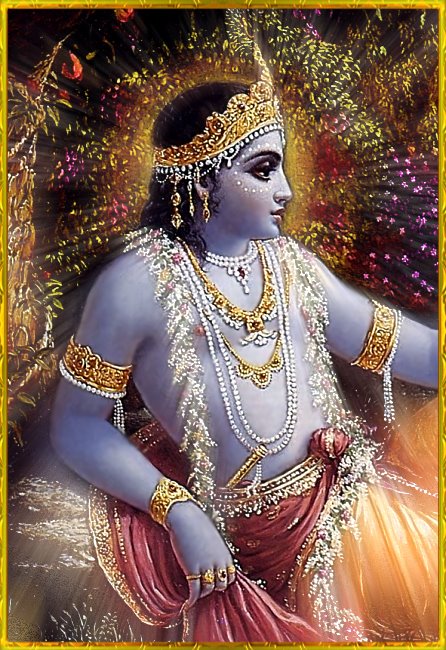
The Nectar of Devotion 1970 Edition
By His Divine Grace A.C. Bhaktivedanta Swami Prabhupada
Chapter 22 Qualities of Krsna Further Explained
Krsna’s Exquisite Beauty
In the Third Canto 2nd Chapter, 12th verse, of Śrīmad-Bhāgavatam, Uddhava tells Vidura, “My dear sir, Kṛṣṇa’s form was most wonderful when He appeared on this planet and exhibited the potency of His internal energy. His wonderfully attractive form was present during His pastimes on this planet, and by His internal potency He exhibited His opulences, which are striking to everyone. His personal beauty was so great that there was no necessity for His wearing ornaments on His body. In fact, instead of the ornaments’ beautifying Kṛṣṇa, Kṛṣṇa’s beauty enhanced the ornaments.”
Regarding the attractiveness of Kṛṣṇa’s bodily beauty and the sound vibration of His flute, in the Tenth Canto, 29th Chapter, 37th verse, of Śrīmad-Bhāgavatam, the gopīs address Kṛṣṇa as follows: “Although our attitude towards You resembles loving affairs with a paramour, we cannot but wonder at how no woman can maintain her chastity upon hearing the vibration from Your flute. And not only women, but even stronghearted men are subject to falling down from their position at the sound of Your flute. In fact, we have seen that in Vṛndāvana even the cows, the deer, the birds, the trees-everyone-has been enchanted by the sweet vibration of Your flute and the fascinating beauty of Your person.”
More
17 Jan 2012
by The Hare Krishna Movement
in Krishna, Krishna Consciousness, Spiritual World, Srimad Bhagavatam
Tags: A.C. Bhaktivedanta Swami Prabhupada, brahmanas, chariots, conchshells, elephants, Krishna, Krsna enters Dwaraka, Lord Krishna, lotus flowers, Srimad Bhagavatam, The Supreme Personality of Godhead, unbroken seeds, Vedic hymns
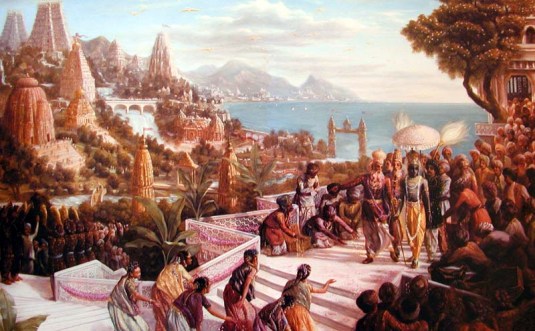
Srimad Bhagavatam
By His Divine Grace A.C. Bhaktivedanta Swami Prabhupada
Canto 1, Chapter 11
Lord Kṛṣṇa’s Entrance into Dvārakā
While entering the city of Dvaraka, Lord Krishna acknowledged all the inhabitants’ by casting His transcendental glance over them. The city was filled with the opulences of all seasons. There were hermitages, orchards, flower gardens, parks and reservoirs of water filled with lotus flowers. The highways, subways, lanes, markets and public meeting places were all thoroughly cleansed and then moistened with scented water, And to welcome the Lord, the residents of Dvaraka strew flowers, fruits and unbroken seeds everywhere. The residents hastened toward the Lord on chariots, upon which rode brahmanas bearing flowers, In front of the chariots were elephants, which are emblems of good fortune. Conchshells and bugles were sounded, and Vedic hymns were chanted. Thus, the residents offered their respects, which were saturated with affection, In return, Lord Krishna, the Personality of Godhead, approached them and offered due honor and respect to each and every one of the friends, relatives, citizens and others who came to receive and welcome Him. As the Lord passed along the public road of Dvaraka, His head was protected from sunshine by a white umbrella. White feathered fans moved in semicircles, and showers of flowers fell upon the road. His yellow garments and garlands of flowers made it appear as if a dark cloud were surrounded simultaneously by the sun, the moon, lighting and rainbows.
Lord Kṛṣṇa’s attraction is so powerful that once being attracted by Him one cannot tolerate separation from Him. Why is this so? Because we are all eternally related with Him as the sun rays are eternally related with the sun disc. The sun rays are molecular parts of the solar radiation. Thus the sun rays and the sun cannot be separated. The separation by the cloud is temporary and artificial, and as soon as the cloud is cleared, the sun rays again display their natural effulgence in the presence of the sun. Similarly, the living entities, who are molecular parts of the whole spirit, are separated from the Lord by the artificial covering of māyā, illusory energy. This illusory energy, or the curtain of māyā, has to be removed, and when it is so done, the living entity can see the Lord face to face, and all his miseries are at once removed. Every one of us wants to remove the miseries of life, but we do not know how to do it. The solution is given here, and it rests on us to assimilate it or not. (Srimad Bhagavatam 1.11.10 Purport)
Painting by-Ramadasa Abhirama dasa
16 Jan 2012
by The Hare Krishna Movement
in Bhagavad-gita, Krishna
Tags: A.C. Bhaktivedanta Swami Prabhupada, Atlas, Atlas holding the globe, Bg 9.5, Bhagavad-gita As It Is, creation, material manifestation, Spiritual world, Visnu
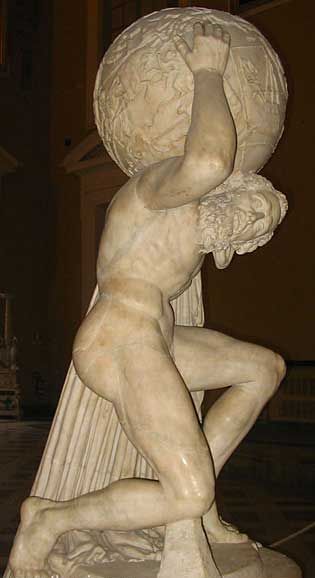
The Lord says that everything is resting on Him. This should not be misunderstood. The Lord is not directly concerned with the maintenance and sustenance of this material manifestation. Sometimes we see a picture of Atlas holding the globe on his shoulders; he seems to be very tired, holding this great earthly planet. Such an image should not be entertained in connection with Kṛṣṇa’s upholding this created universe. He says that although everything is resting on Him, still He is aloof.

Bhagavad-gita As It Is – Macmillan 1972 Edition
By His Divine Grace A.C. Bhaktivedanta Swami Prabhupada
Chapter 9, Text 5
na ca mat-sthāni bhūtāni
paśya me yogam aiśvaram
bhūta-bhṛn na ca bhūta-stho
mamātmā bhūta-bhāvanaḥ
na—never; ca—also; mat-sthāni—situated in Me; bhūtāni—all creation; paśya—just see; me—My; yogam aiśvaram—inconceivable mystic power; bhūta-bhṛt—maintainer of all living entities; na—never; ca—also; bhūta-sthaḥ—in the cosmic manifestation; mama—My; ātmā—Self; bhūta-bhāvanaḥ—is the source of all manifestations.
Translation
And yet everything that is created does not rest in Me. Behold My mystic opulence! Although I am the maintainer of all living entities, and although I am everywhere, still My Self is the very source of creation.
More
12 Jan 2012
by The Hare Krishna Movement
in Krishna, Teachings of Queen Kunti
Tags: A.C. Bhaktivedanta Swami Prabhupada, Krsna, kunty uvaca, Srimad Bhagavatam, Srimati Kuntidevi, Teachings of Queen Kunti, The Original Person
Teachings of Queen Kunti
By His Divine Grace A.C. Bhaktivedanta Swami Prabhupada
Chapter 1, The Original Person
kunty uvāca
namasye puruṣaṁ tvādyam
īśvaraṁ prakṛteḥ param
alakṣyaṁ sarva-bhūtānām
antar bahir avasthitam
Śrīmatī Kuntī said: O Kṛṣṇa, I offer my obeisances unto You because You are the original personality and are unaffected by the qualities of the material world. You are existing both within and without everything, yet You are invisible to all. —Śrīmad-Bhāgavatam 1.8.18
Śrīmatī Kuntīdevī was quite aware that Kṛṣṇa is the original Personality of Godhead, although He was playing the part of her nephew. Such an enlightened lady could not commit a mistake by offering obeisances unto her nephew. Therefore, she addressed Him as the original puruṣa beyond the material cosmos. Although all living entities are also transcendental, they are neither original nor infallible. The living entities are apt to fall down under the clutches of material nature, but the Lord is never like that. In the Vedas, therefore, He is described as the chief among all living entities (nityo nityānāṁ cetanaś cetanānām). Then again He is addressed as īśvara, or the controller. The living entities or the demigods like Candra and Sūrya are also to some extent īśvara, but none of them is the supreme īśvara, or the ultimate controller. Kṛṣṇa is the parameśvara, or the Supersoul. He is both within and without. Although He was present before Śrīmatī Kuntī as her nephew, He was also within her and everyone else. In the Bhagavad-gītā (15.15) the Lord says, “I am situated in everyone’s heart, and only due to Me one remembers, forgets, and is cognizant, etc. Through all the Vedas I am to be known because I am the compiler of the Vedas, and I am the teacher of the Vedānta.” Queen Kuntī affirms that the Lord, although both within and without all living beings, is still invisible. The Lord is, so to speak, a puzzle for the common man. Queen Kuntī experienced personally that Lord Kṛṣṇa was present before her, yet He entered within the womb of Uttarā to save her embryo from the attack of Aśvatthāmā’s brahmāstra. Kuntī herself was puzzled about whether Śrī Kṛṣṇa is all-pervasive or localized. In fact, He is both, but He reserves the right of not being exposed to persons who are not surrendered souls. This checking curtain is called the māyā energy of the Supreme Lord, and it controls the limited vision of the rebellious soul. It is explained as follows.
11 Jan 2012
by The Hare Krishna Movement
in Books by Srila Prabhupada, Krishna, Raja-Vidya
Tags: A.C. Bhaktivedanta Swami Prabhupada, Banyan tree, jivas, Krsna, material energy, Narada Muni and cobbler, prakrti, Raja-Vidya, spiritual energy, the king of knowledge

Banyan Tree by Herb Kawainui Kane
Click to enlarge
It is not very difficult to see God everywhere in the creation, for He is everywhere present…those who are conversant with the science of Kṛṣṇa can see Him in every atom of the creation.
…You can see that there is this banyan tree, and you can see that so many fruits are falling daily, and in each fruit there are so many seeds, and in every seed there is a banyan tree like this one. If, within a small seed there can be a big tree like this, is it difficult to accept that the Lord is in every atom of creation…
So this is called faith. It is not a question of blindly believing. There is reason behind the belief. If Kṛṣṇa can put a large tree within so many little seeds, is it so astounding that He is keeping all the planetary systems floating in space through His energy?
Raja-Vidya: The King of Knowledge
By His Divine Grace A.C. Bhaktivedanta Swami Prabhupada
Chapter 3
Knowledge of Kṛṣṇa’s Energies
It may be noted at this point that the Ninth Chapter of Bhagavad-gītā is especially meant for those who have already accepted Śrī Kṛṣṇa as the Supreme Personality of Godhead. In other words, it is meant for His devotees. If one does not accept Śrī Kṛṣṇa as the Supreme, this Ninth Chapter will appear as something different from what it actually is. As stated in the beginning, the subject matter of the Ninth Chapter is the most confidential material in the entire Bhagavad-gītā. If one doesn’t accept Kṛṣṇa as the Supreme, he will think the chapter to be a mere exaggeration. This is especially the case with the verses dealing with Kṛṣṇa’s relationship with His creation.
More
Previous Older Entries Next Newer Entries












 The Hare Krishna Movement