06 Dec 2011
by The Hare Krishna Movement
in Bhagavad-gita, High Thinking, Krishna Consciousness
Tags: Arjuna, Bg. 18.65, bhagavad-gita, Brahma-samhita, His Divine Grace A.C. Bhaktivedanta Swami Prabhupada, Krishna, Krsna meditation, Macmillan 1972 Edition

“…one should concentrate his mind upon Kṛṣṇa-the very form with two hands carrying a flute, the bluish boy with a beautiful face and peacock feathers in His hair. There are descriptions of Kṛṣṇa found in the Brahma-saṁhitā and other literatures. One should fix his mind on this original form of Godhead, Kṛṣṇa. He should not even divert his attention to other forms of the Lord. The Lord has multi-forms, as Viṣṇu, Nārāyaṇa, Rāma, Varāha, etc., but a devotee should concentrate his mind on the form that was present before Arjuna. Concentration of the mind on the form of Kṛṣṇa constitutes the most confidential part of knowledge, and this is disclosed to Arjuna because Arjuna is the most dear friend of Kṛṣṇa’s.”
Bhagavad-gita As It Is – Macmillan 1972 Edition
By His Divine Grace A.C. Bhaktivedanta Swami Prabhupada
Chapter 18, Text 65
man-manā bhava mad-bhakto
mad-yājī māṁ namaskuru
mām evaiṣyasi satyaṁ te
pratijāne priyo ‘si me
man-manāḥ—thinking of Me; bhava—just become; mat-bhaktaḥ—My devotee; mat-yājī—My worshiper; mām—unto Me; namaskuru—offer your obeisances; mām—unto Me; eva—certainly; eṣyasi—come; satyam—truly; te—to you; pratijāne—I promise; prijaḥ—dear; asi—you are; me—My.
Always think of Me and become My devotee. Worship Me and offer your homage unto Me. Thus you will come to Me without fail. I promise you this because you are My very dear friend.
More
04 Dec 2011
by The Hare Krishna Movement
in Bhagavad-gita, Book Changes, Book Distribution
Tags: Arjuna, as it is, Battlefield of Kuruksetra, bhagavad-gita, devotee of Sri Krishna, dharma-ksetra, gita-mahatmya, Glorification of the Gita, His Divine Grace A.C. Bhaktivedanta Swami Prabhupada, Krishna, Kuruksetra, place of pilgrimage

The Advent of Bhagavad-gita
Today is the anniversary commemorating the day when Sri Krishna spoke Bhagavad-gita to Arjuna, at the place known as Kurukṣetra.
Traditionally devotees go to Kurukṣetra (dharma-kṣetra, a place where religious rituals are performed) ) and recite Bhagavad Gita from early morning until the next morning, perform arati to Bhagavad Gita and to Krishna and Arjuna upon the chariot, offer lamps, and discuss the significance of the Bhagavad-gita.
Devotees who cannot get to Kurukṣetra, can honor the blessed event by reading or reciting the Bhagavad-gita, and discussing the subject matter of Bhagavad Gita in the association of devotees.
Distribution of Bhagavad-gita’s on this day is also a very auspicious activity to perform.
Bhagavad-gita As It Is – Macmillan 1972 Edition
By His Divine Grace A.C. Bhaktivedanta Swami Prabhupada
dhṛtarāṣṭra uvāca
dharma-kṣetre kuru-kṣetre
samavetā yuyutsavaḥ
māmakāḥ pāṇḍavāś caiva
kim akurvata sañjaya
dhṛtarāṣṭraḥ—King Dhṛtarāṣṭra; uvāca—said; dharma-kṣetre—in the place of pilgrimage; kuru-kṣetre—in the place named Kurukṣetra; samavetāḥ—assembled; yuyatsavaḥ—desiring to fight; māmakāḥ—my party (sons); pāṇḍavāḥ—the sons of Pāṇḍu; ca—and; eva-certainly; kim—what; akurvata—did they do; sañjaya—O Sañjaya.
Translation
Dhṛtarāṣṭra said: O Sañjaya, after assembling in the place of pilgrimage at Kurukṣetra, what did my sons and the sons of Pāṇḍu do, being desirous to fight?
Purport
Bhagavad-gītā is the widely read theistic science summarized in the Gītā-māhātmya (Glorification of the Gītā). There it says that one should read Bhagavad-gītā very scrutinizingly with the help of a person who is a devotee of Śrī Kṛṣṇa and try to understand it without personally motivated interpretations. The example of clear understanding is there in the Bhagavad-gītā itself, in the way the teaching is understood by Arjuna, who heard the Gītā directly from the Lord. If someone is fortunate enough to understand Bhagavad-gītā in that line of disciplic succession, without motivated interpretation, then he surpasses all studies of Vedic wisdom, and all scriptures of the world. One will find in the Bhagavad-gītā all that is contained in other scriptures, but the reader will also find things which are not to be found elsewhere. That is the specific standard of the Gītā. It is the perfect theistic science because it is directly spoken by the Supreme Personality of Godhead, Lord Śrī Kṛṣṇa.
More
04 Dec 2011
by The Hare Krishna Movement
in Bhagavad-gita, Srila Prabhupada
Tags: Advent of Bhagavad-gita, Arjuna, battle of Kurksetra, bhagavad-gita, essays and articles, His Divine Grace A.C. Bhaktivedanta Awami Prabhupada, Krishna, origin of Bhagavad-gita
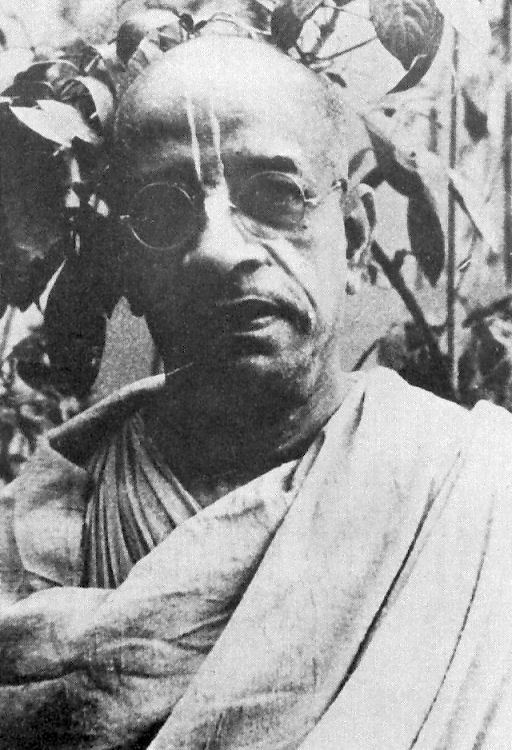
In honor of the Advent of Srimad Bhagavad-gita we are reprinting an Essay on the Bhagavad-gita written by Srila Prabhupada and published on the advent of Bhagavad-gita in 1948
Interpretations of Bhagavad-gita
Originally published c. 1948, on the auspicious observance of the advent of Srimad Bhagavad-gita.]
By His Divine Grace A.C. Bhaktivedanta Swami
It has become a luxurious fashion of the day, along with the progress of material civilization, that everyone can make his interpretation of the great Indian philosophy called the Bhagavad-gītā. This concise form of Vedic knowledge, known as the Gītopaniṣad, is acknowledged by all sections of transcendental scholars, in India especially, as the cream of all Upaniṣads and that of Vedānta-sūtras also. Scholars and ācāryas like Śrīpāda Śaṅkarācārya and some of his followers also could not leave out this very important book of knowledge, although such scholars of the Māyāvāda school did not acknowledge the bona fides of the Purāṇas. But the interpretation of Śrī Śaṅkarācārya differs from the interpretations of the Vaiṣṇava ācāryas headed by Śrī Ramanujācārya and Madhvācārya. There are innumerable interpretations of the Bhagavad-gītā in the market, and it is certainly a puzzling business to select which of the various interpretations shall be accepted as bona fide and which of them shall be rejected as mala fide.
In order to make a distinction between these two classes of bona fide and mala fide interpretations, we have to make an impartial study of the book, and such unbiased study only will make us able to discern the bona fide from the mala fide.
In this connection, we may first of all try to find out the origin of the Bhagavad-gītā. It is wrong to understand that The Bhagavad-gītā was first spoken in the battlefield of Kurukṣetra as it is a part of the great history of India, namely, the Mahābhārata. We can understand from the talks of Śrī Kṛṣṇa and Arjuna, as it is stated in the Bhagavad-gītā, that long, long before the battle of Kurukṣetra, this philosophy was once spoken by Śrī Kṛṣṇa to Vivasvān (the Sun), and from Vivasvān the knowledge was transferred to Manu, and from Manu it was transferred to King Ikṣvāku. And, in that way of disciplic succession, the knowledge has come down to generations after generations, but in course of time, such disciplic succession broke, and therefore, Śrī Kṛṣṇa again repeated the same yoga or transcendental knowledge to Arjuna. In the beginning of the 4th Chapter of Bhagavad-gītā, this fact is stated as follows:
More
01 Dec 2011
by The Hare Krishna Movement
in Bhagavad-gita, Maya
Tags: 29, Bg 5, bhagavad-gita, external energy of Krsna, His Divine Grace A.C. Bhaktivedanta Swami Prabhupada, illusion, Krishna, maya, perfection of life, perfeection of yoga

The sense of a separated existence from Kṛṣṇa is called māyā (mā-not, yā-this).
People in general, especially in this age of Kali, are enamored by the external energy of Kṛṣṇa, and they wrongly think that by advancement of material comforts every man will be happy. They have no knowledge that the material or external nature is very strong, for everyone is strongly bound by the stringent laws of material nature. A living entity is happily the part and parcel of the Lord, and thus his natural function is to render immediate service to the Lord. By the spell of illusion one tries to be happy by serving his personal sense gratification in different forms which will never make him happy. Instead of satisfying his own personal material senses, he has to satisfy the senses of the Lord. That is the highest perfection of life. The Lord wants this, and He demands it. One has to understand this central point of Bhagavad-gītā. Our Kṛṣṇa consciousness movement is teaching the whole world this central point, and because we are not polluting the theme of Bhagavad-gītā As It Is, anyone seriously interested in deriving benefit by studying the Bhagavad-gītā must take help from the Kṛṣṇa consciousness movement for practical understanding of Bhagavad-gītā under the direct guidance of the Lord. We hope, therefore, that people will derive the greatest benefit by studying Bhagavad-gītā As It Is as we have presented it here, and if even one man becomes a pure devotee of the Lord we shall consider our attempt a success.
The Kṛṣṇa consciousness movement is essential in human society, for it offers the highest perfection of life. How this is so is explained fully in the Bhagavad-gītā. Unfortunately, mundane wranglers have taken advantage of Bhagavad-gītā to push forward their demonic propensities and mislead people regarding right understanding of the simple principles of life. Everyone should know how God or Kṛṣṇa is great, and everyone should know the factual position of the living entities. Everyone should know that a living entity is eternally a servant and that unless one serves Kṛṣṇa one has to serve illusion in different varieties of the three modes of material nature, and thus perpetually one has to wander within the cycle of birth and death; even the so-called liberated Māyāvādī speculator has to undergo this process. This knowledge constitutes a great science, and each and every living being has to hear it for his own interest. (From the preface to the Bhagavad-gita As It Is)
More
25 Nov 2011
by The Hare Krishna Movement
in Bhagavad-gita
Tags: bhagavad-gita, birth and death, Black Friday, consumerism, economic development, His Divine Grace A.C. Bhaktivedanta Swami Prabhupada, material comforts, materialism, problems of material existence

Consumerism is a kind of Material Fever
The problems of material existence-birth, old age, disease and death-cannot be counteracted by accumulation of wealth and economic development. In many parts of the world there are states which are replete with all facilities of life, which are full of wealth, and economically developed, yet the problems of material existence are still present.
If economic development and material comforts could drive away one’s lamentations for family, social, national or international inebrieties, then Arjuna would not have said that even an unrivalled kingdom on earth or supremacy like that of the demigods in the heavenly planets would not be able to drive away his lamentations. He sought, therefore, refuge in Kṛṣṇa consciousness, and that is the right path for peace and harmony.
Bhagavad-gita As It Is – Macmillan 1972 Edition
By His Divine Grace A.C. Bhaktivedanta Swami Prabhupada
Chapter 2, Text 8
na hi prapaśyāmi mamāpanudyād
yac chokam ucchoṣaṇam indriyāṇām
avāpya bhūmāv asapatnam ṛddhaṁ
rājyaṁ surāṇām api cādhipatyam
na—do not; hi—certainly; prapaśyāmi—I see; mama—my; apanudyāt—they can drive away; yat—that; śokam—lamentation; ucchoṣaṇam—drying up; indriyāṇām—of the senses; avāpya—achieving; bhūmau—on the earth; asapatnam—without rival; ṛddham—prosperous; rājyam—kingdom; surāṇām—of the demigods; api—even; ca—also; ādhipatyam—supremacy.
Translation
I can find no means to drive away this grief which is drying up my senses. I will not be able to destroy it even if I win an unrivalled kingdom on the earth with sovereignty like that of the demigods in heaven.
Purport
Although Arjuna was putting forward so many arguments based on knowledge of the principles of religion and moral codes, it appears that he was unable to solve his real problem without the help of the spiritual master, Lord Śrī Kṛṣṇa. He could understand that his so-called knowledge was useless in driving away his problems, which were drying up his whole existence; and it was impossible for him to solve such perplexities without the help of a spiritual master like Lord Kṛṣṇa. Academic knowledge, scholarship, high position, etc., are all useless in solving the problems of life; help can only be given by a spiritual master like Kṛṣṇa. Therefore, the conclusion is that a spiritual master who is one hundred percent Kṛṣṇa conscious is the bona fide spiritual master, for he can solve the problems of life. Lord Caitanya said that one who is master in the science of Kṛṣṇa consciousness, regardless of his social position, is the real spiritual master.
More
22 Nov 2011
by The Hare Krishna Movement
in Bhagavad-gita, Krsna is the Source of All Incarnations
Tags: Bg 4.7, bhagavad-gita, buddha, Kalki, Krishna, Kurma, Matsya, Nrismhadeva, Parasurama, Plate 16, prabhupada, Rama, Varaha
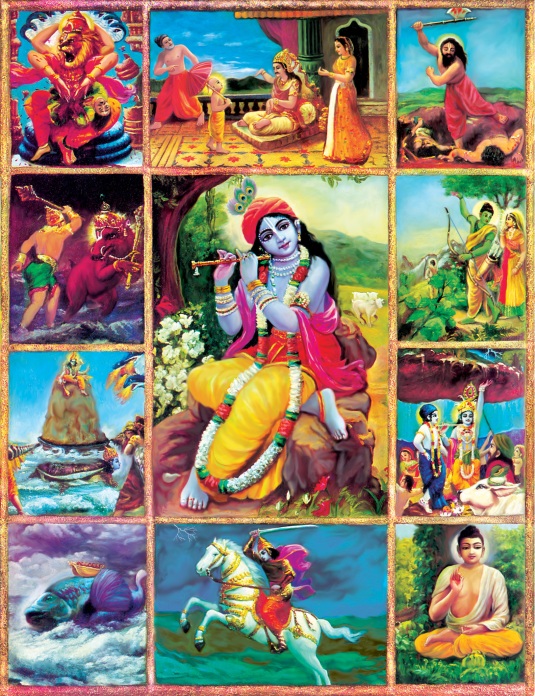
The principles of the Bhagavad-gītā were spoken to Arjuna, and, for that matter, to other highly elevated persons, because he was highly advanced compared to ordinary persons in other parts of the world. Two plus two equals four is a mathematical principle that is true both in the beginner’s arithmetic class and in the advanced class as well. Still, there are higher and lower mathematics. In all incarnations of the Lord, therefore, the same principles are taught, but they appear to be higher and lower in varied circumstances.
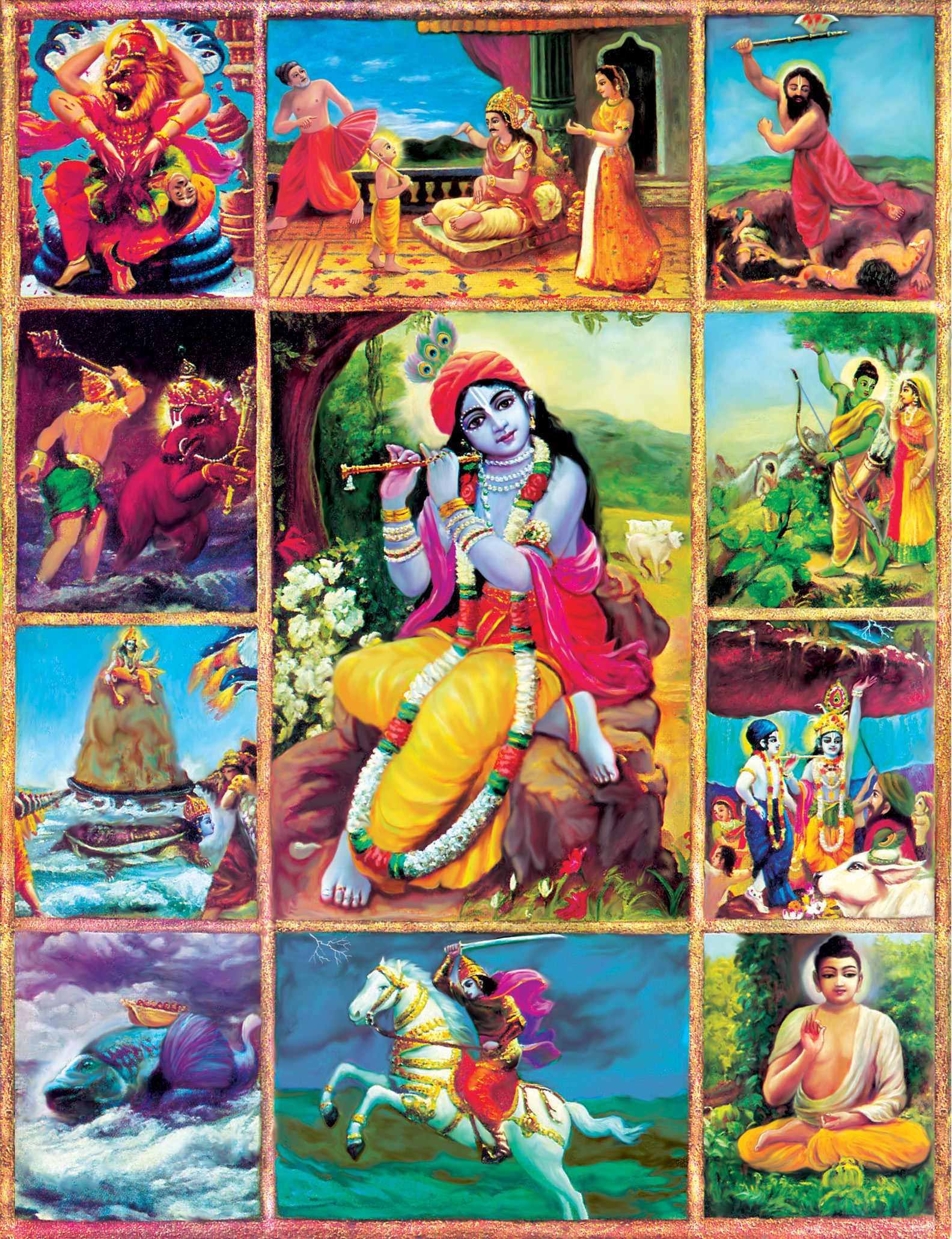
In the center Square, Krishna is shown in His original two-handed form, holding a flute. Surrounding Him are ten of His eternal incarnations, pictured in the order in which they appeared in the material world, beginning clockwise from the lower left-hand corner.
a) Matsya, the fish incarnation, is saving the Vedas.
b) Kurma, the tortoise incarnation, is holding the hill on His back.
c) Varaha, the boar incarnation, is fighting with the demon Hiranyaksa.
d) Nrismhadeva, the lion incarnation, is killing the demon Hiranyakasipu.
e) Vamanadeva, the dwarf incarnation, is begging some land from King Bali.
f) Parasurama, is killing the demoniac ksatriyas.
g) Lord Ramacandra, is going off into exile with His Wife Sita, and brother, Laksmana.
h) Krishna, is lifting Govardhana Hill and beside His is His brother, Balarama.
i) Lord Buddha.
j) Lord Kalki is riding on His horse, killing all the demons and thus liberating them.
Bhagavad-gita As It Is – Macmillan 1972 Edition
By His Divine Grace A.C. Bhaktivedanta Swami Prabhupada
Chapter 4, Text 7
yadā yadā hi dharmasya
glānir bhavati bhārata
abhyutthānam adharmasya
tadātmānaṁ sṛjāmy aham
yadā—whenever; yadā—wherever; hi—certainly; dharmasya—of religion; glāniḥ—discrepancies; bhavati—manifested, becomes; bhārata—O descendant of Bharata; abhyutthānam—predominance; adharmasya—of irreligion; tadā—at that time; ātmānam—self; sṛjāmi—manifest; aham—I.
TRANSLATION
Whenever and wherever there is a decline in religious practice, O descendant of Bharata, and a predominant rise of irreligion-at that time I descend Myself.
More
02 Nov 2011
by The Hare Krishna Movement
in Bhagavad-gita, Krishna Consciousness
Tags: Bhagavad-gita As It Is, His Divine Grace A.C. Bhaktivedanta Swami Prabhupada, Krsnaloka, man-mana bhava-bhakto, primal form of Krsna, Supreme Personality of Godhead

There are some who are demonic; they also think of Kṛṣṇa, but enviously, just like King Kaṁsa, Kṛṣṇa’s uncle. He was also thinking of Kṛṣṇa always, but he thought of Kṛṣṇa as his enemy. He was always in anxiety, wondering when Kṛṣṇa would come to kill him. That kind of thinking will not help us. One should be thinking of Kṛṣṇa in devotional love.
One should therefore engage his mind in the eternal form, the primal form of Kṛṣṇa; with conviction in his heart that Kṛṣṇa is the Supreme Personality of Godhead and that His body is not material, but is eternal, blissful knowledge. This will help one transfer into the Kṛṣṇaloka.
Bhagavad-gita As It Is – Macmillan 1972 Edition
By His Divine Grace A.C. Bhaktivedanta Swami Prabhupada
Chapter 9, Text 34
man-manā bhava mad-bhakto
mad-yājī māṁ namaskuru
mām evaiṣyasi yuktvaivam
ātmānaṁ mat-parāyaṇaḥ
mat-manāḥ—always thinking of Me; bhava—become; mat—My; bhaktaḥ—devotee; mat—My; yājī—worshiper; mām—unto Me; namaskuru—offer obeisances; mām—unto Me; eva—completely; eṣyasi—come; yuktvā evam—being absorbed; ātmānam—your soul; mat-parāyaṇaḥ—devoted to Me.
Engage your mind always in thinking of Me, offer obeisances and worship Me. Being completely absorbed in Me, surely you will come to Me.
Purport
In this verse it is clearly indicated that Kṛṣṇa consciousness is the only means of being delivered from the clutches of this contaminated material world. Sometimes unscrupulous commentators distort the meaning of what is clearly stated here: that all devotional service should be offered to the Supreme Personality of Godhead, Kṛṣṇa. Unfortunately, unscrupulous commentators divert the mind of the reader to that which is not at all feasible. Such commentators do not know that there is no difference between Kṛṣṇa’s mind and Kṛṣṇa. Kṛṣṇa is not an ordinary human being; He is Absolute Truth. His body, mind and He Himself are one and absolute. It is stated in the Kūrma Purāṇa. As it is quoted by Bhaktisiddhānta Sarasvatī Gosvāmī in his Anubhāṣya comments on Caitanya-caritāmrta, Fifth Chapter, Ādi-līlā, verses 41-48, “deha-dehi-vibhedo ‘yaṁ neśvare vidyate kvacit,” which means that there is no difference in Kṛṣṇa, the Supreme Lord, between Himself and His body. But, because they do not know this science of Kṛṣṇa, the commentators hide Kṛṣṇa and divide His personality from His mind or from His body. Although this is sheer ignorance of the science of Kṛṣṇa, some men make profit out of misleading the people.
More
13 Oct 2011
by The Hare Krishna Movement
in Back to Godhead, Bhagavad-gita, Books by Srila Prabhupada, Brahmananda das
Tags: Bhagavad-gita As It Is, Brahmananda Swami, His Divine Grace A.C. Bhaktivedanta Swami Prabhupada, Macmillan Company, original manuscript

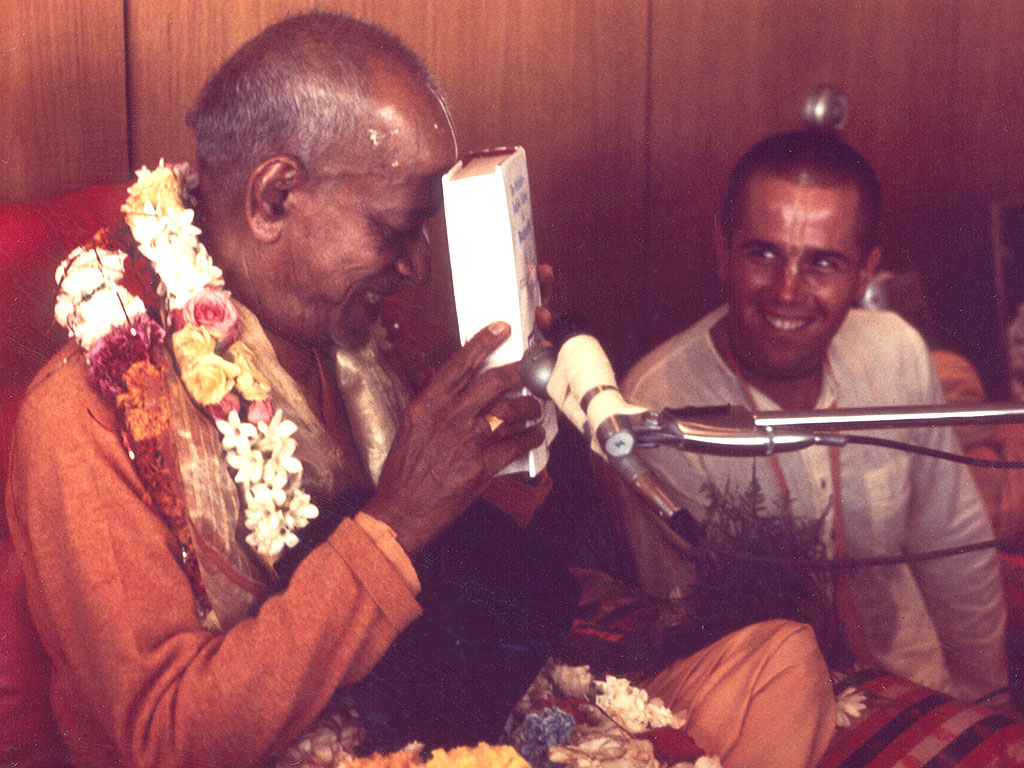
Srila Prabhupada receiving Macmillan Bhagavad-gita As It Is
The Books of His Divine Grace A.C. Bhaktivedanta Swami Prabhupada
Originally published in Back to Godhead No. 52
Bhaktivedanta Book Trust 1973
By Brahmananda Swami ISKCON East Africa
Part 5
Bhagavad-gita As It Is stands as a challenge to all the mental speculators who depart from the Gita’s central teaching of devotional service to the Personality of Godhead, Lord Sri Krsna. Even Mahatma Gandhi stands accused, since his ingenious metaphorical interpretation is simply designed to support his mundane political movement of nonviolence. In India Srila Prabhupada personally requested Gandhi to preach the Gita for what it teaches, Krsna consciousness, just as Srila Bhaktisiddhanta Sarasvati Gosvami Maharaja had personally requested the most famous Indian poet of his time, Rabindranath Tagore.
In the Gita’s Ninth Chapter Lord Krsna categorically advises Arjuna to surrender to Him and to love and worship Him only. He specifically uses the Sanskrit word mam, meaning “unto Me.” Yet one commentator, a renowned Indian philosopher and political leader, begins his commentary on this crucial verse, “It is not to Krsna that we have to surrender…” It is very clear that Krsna and Arjuna are standing on the Battlefield of Kuruksetra and that Krsna is telling Arjuna to surrender unto Him. But this scholar wants to turn the reader away from Krsna by insidiously implying that Krsna actually means to surrender to the eternal unmanifested essence within Himself. But Krsna didn’t say this. Significantly, Srila Prabhupada entitles his comments “purports,” not interpretations. In his purports he gives the actual significance of the verses. Srila Prabhupada informs all deluded scholars that because Krsna is absolute, there is no qualitative difference between His within and His without as there is with conditioned living entities like ourselves.
More
07 Sep 2011
by The Hare Krishna Movement
in Bhagavad-gita
Tags: Arjuna, Bhagavad-gita As It Is, His Divne Grace A.C. Bhaktivedanta Swami, Macmillian 1972 edition, Srila Prabhupada, Supreme Brahman, Supreme Lord Krsna

Kṛṣṇa is the Supreme Personality of Godhead, and one should always meditate upon Him and enjoy one’s transcendental relationship with Him. He is the supreme existence…He is the supreme origin; He has no cause, for He is the cause of all causes, and everything is emanating from Him. This perfect knowledge can be had by the grace of the Supreme Lord.
Bhagavad-gita As It Is – Macmillan 1972 Edition
By His Divine Grace A.C. Bhaktivedanta Swami Prabhupada
Chapter 10 The Opulence of the Absolute
Text 12-14
arjuna uvāca
paraṁ brahma paraṁ dhāma
pavitraṁ paramaṁ bhavān
puruṣaṁ śāśvataṁ divyam
ādi-devam ajaṁ vibhum
āhus tvām ṛṣayaḥ sarve
devarṣir nāradas tathā
asito devalo vyāsaḥ
svayaṁ caiva bravīṣi me
Arjuna said: You are the Supreme Brahman, the ultimate, the supreme abode and purifier, the Absolute Truth and the eternal divine person. You are the primal God, transcendental and original, and You are the unborn and all-pervading beauty. All the great sages such as Nārada, Asita, Devala, and Vyāsa proclaim this of You, and now You Yourself are declaring it to me.
PURPORT
In these two verses the Supreme Lord gives a chance to the modern philosopher, for here it is clear that the Supreme is different from the individual soul. Arjuna, after hearing the essential four verses of Bhagavad-gītā in this chapter, became completely free from all doubts and accepted Kṛṣṇa as the Supreme Personality of Godhead. He at once boldly declares, “You are Parambrahma, the Supreme Personality of Godhead.” And previously Kṛṣṇa states that He is the originator of everything and everyone. Every demigod and every human being is dependant on Him. Men and demigods, out of ignorance, think that they are absolute and independant of the Supreme Lord Kṛṣṇa. That ignorance is removed perfectly by the discharge of devotional service. This is already explained in the previous verse by the Lord. Now by His grace, Arjuna is accepting Him as the Supreme Truth, in concordance with the Vedic injunction. It is not because Kṛṣṇa is an intimate friend of Arjuna that he is flattering Him by calling Him the Supreme Personality of Godhead, the Absolute Truth. Whatever Arjuna says in these two verses is confirmed by Vedic truth. Vedic injunctions affirm that only one who takes to devotional service to the Supreme Lord can understand Him, whereas others cannot. Each and every word of this verse spoken by Arjuna is confirmed by Vedic injunction.
More
30 Aug 2011
by The Hare Krishna Movement
in Bhagavad-gita, Book Changes
Tags: Bhagavad-gita As It Is, His Divine Grace A.C. Bhaktivedanta Swami Prabhupada, Krsna, Krsna consciousness movement, Macmillan 1972 Edition

If personally I have any credit in this matter, it is only that I have tried to present Bhagavad-gītā as it is, without adulteration. Before my presentation of Bhagavad-gītā As It Is, almost all the English editions of Bhagavad-gītā were introduced to fulfill someone’s personal ambition. But our attempt, in presenting Bhagavad-gītā As It Is, is to present the mission of the Supreme Personality of Godhead, Kṛṣṇa.
Bhagavad-gita As It Is – Macmillan 1972 Edition
By His Divine Grace A. C. Bhaktivedanta Swami Prabhupada
Preface
Originally I wrote Bhagavad-gītā As It Is in the form in which it is presented now. When this book was first published, the original manuscript was, unfortunately, cut short to less than 400 pages, without illustrations and without explanations for most of the original verses of the Śrīmad Bhagavad-gītā. In all of my other books-Śrīmad Bhāgavatam, Śrī Īśopaniṣad, etc.-the system is that I give the original verse, its English transliteration, word-for-word Sanskrit-English equivalents, translations and purports. This makes the book very authentic and scholarly and makes the meaning self-evident. I was not very happy, therefore, when I had to minimize my original manuscript. But later on, when the demand for Bhagavad-gītā As It Is considerably increased, I was requested by many scholars and devotees to present the book in its original form, and Messrs. Macmillan and Co. agreed to publish the complete edition. Thus the present attempt is to offer the original manuscript of this great book of knowledge with full paramparā explanation in order to establish the Kṛṣṇa consciousness movement more soundly and progressively.
More
16 Aug 2011
by The Hare Krishna Movement
in Bhagavad-gita, The Hare Krishna Movement, Vegetarian Cooking, Vegetarianism
Tags: bhagavad-gita, spiritual food, The Hare Krishna Movement, vegetarian cookbook, vegetarian cooking, vegetarian recipes, vegetarianism

Spiritual Food
The Hare Krishna’s are famous for their delicious vegetarian food. Get a cookbook from The Hare Krishna Movement today, and begin your journey into the joys of cooking foods in the mode of goodness.
Bhagavad-gita As It Is
Macmillan 1972 Edition
By His Divine Grace A.C. Bhaktivedanta Swami Prabhupada
Chapter 17 The Divisions of Faith
Text 8-10
Foods in the mode of goodness increase the duration of life, purify one’s existence and give strength, health, happiness and satisfaction. Such nourishing foods are sweet, juicy, fattening and palatable. Foods that are too bitter, too sour, salty, pungent, dry and hot, are liked by people in the modes of passion. Such foods cause pain, distress, and disease. Food cooked more than three hours before being eaten, which is tasteless, stale, putrid, decomposed and unclean, is food liked by people in the mode of ignorance.
PURPORT
Thc purpose of food is to increase the duration of life, purify the mind and aid bodily strength. This is its only purpose. In the past, great authorities selected those foods that best aid health and increase life’s duration, such as milk products, sugar, rice, wheat, fruits and vegetables. These foods are very dear to those in the mode of goodness. Some other foods, such as baked corn and molasses, while not very palatable in themselves, can be made pleasant when mixed with milk or other foods. They are then in the mode of goodness. All these foods are pure by nature. They are quite distinct from untouchable things like meat and liquor. Fatty foods, as mentioned in the eighth verse, have no connection with animal fat obtained by slaughter. Animal fat is available in the form of milk, which is the most wonderful of all foods. Milk, butter, cheese and similar products give animal fat in a form which rules out any need for the killing of innocent creatures. It is only through brute mentality that this killing goes on. The civilized method of obtaining needed fat is by milk. Slaughter is the way of subhumans. Protein is amply available through split peas, dhall, whole wheat, etc.
Foods in the mode of passion, which are bitter, too salty, or too hot or overly mixed with red pepper, cause misery by producing mucous in the stomach, leading to disease. Foods in the mode of ignorance or darkness are essentially those that are not fresh. Any food cooked more than three hours before it is eaten (except prasādam, food offered to the Lord) is considered to be in the mode of darkness. Because they are decomposing, such foods give a bad odor, which often attracts people in this mode but repulses those in the mode of goodness.
Remnants of food may be eaten only when they are part of a meal that was first offered to the Supreme Lord or first eaten by saintly persons, especially the spiritual master. Otherwise the remnants of food are considered to be in the mode of darkness, and they increase infection or disease. Such foodstuffs, although very palatable to persons in the mode of darkness, are neither liked nor even touched by those in the mode of goodness. The best food is the remnant of what is offered to the Supreme Personality of Godhead. In Bhagavad-gītā the Supreme Lord says that He accepts preparations of vegetables, flour and milk when offered with devotion. Patraṁ puṣpaṁ phalaṁ toyam. Of course, devotion and love are the chief things which the Supreme Personality of Godhead accepts. But it is also mentioned that the prasādam should be prepared in a particular way. Any food prepared by the injunction of the scripture offered to the Supreme Personality of Godhead can be taken even if prepared long, long ago, because such food is transcendental. Therefore to make food antiseptic, eatable and palatable for all persons, one should offer food to the Supreme Personality of Godhead.
31 Jul 2011
by The Hare Krishna Movement
in Bhagavad-gita, Guru & Disciple, Kali Yuga
Tags: bhagavad-gita, disciplic succession, Iksvaku, Kali-yuga, krsna consciousness, Manu, spiritual knowledge, Srila Prabhupada, Supreme Personality of Godhead, Vivasvan

Bhagavad-gita As It Is – Macmillan 1972 Edition; Transcendental Knowledge
By His Divine Grace A. C. Bhaktivedanta Swami Prabhupada
Chapter 4, Text 1
śrī-bhagavān uvāca
imaṁ vivasvate yogaṁ
proktavān aham avyayam
vivasvān manave prāha
manur ikṣvākave ‘bravīt
SYNONYMS
śrī bhagavān uvāca—the Supreme Personality of Godhead said; imam—this; vivasvate—unto the sun-god; yogam—the science of one’s relationship to the Supreme; proktavān—instructed; aham—I; avyayam—imperishable; vivasvān—Vivasvān (the sun-god’s name); manave—unto the father of mankind (of the name Vaivasvata); prāha—told; manuḥ—the father of mankind; ikṣvākave—unto King Ikṣvāku; abravīt—said.
TRANSLATION
The Blessed Lord said: I instructed this imperishable science of yoga to the sun-god, Vivasvān, and Vivasvān instructed it to Manu, the father of mankind, and Manu in turn instructed it to Ikṣvāku.
PURPORT
Herein we find the history of the Bhagavad-gītā traced from a remote time when it was delivered to the royal order, the kings of all planets. This science is especially meant for the protection of the inhabitants and therefore the royal order should understand it in order to be able to rule the citizens and protect them from the material bondage to lust. Human life is meant for cultivation of spiritual knowledge, in eternal relationship with the Supreme Personality of Godhead, and the executive heads of all states and all planets are obliged to impart this lesson to the citizens by education, culture and devotion. In other words, the executive heads of all states are intended to spread the science of Kṛṣṇa consciousness so that the people may take advantage of this great science and pursue a successful path, utilizing the opportunity of the human form of life.
More
07 Jul 2011
by The Hare Krishna Movement
in Bhagavad-gita, Temples
Tags: A.C. Bhaktivedanta Swami Prabhupada, as it is, Bg 10.41, bhagavad-gita, Krsna's opulence, opulence, spark of My splendor, Sree Padmanabha Swamy temple, Temple, Thiruvananthapuram, treasure
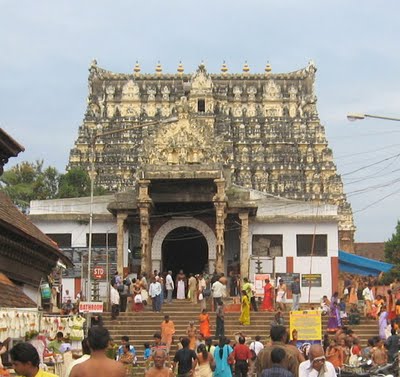
The Opulence of the Absolute
Know that all beautiful, glorious, and mighty creations spring from but a spark of My splendor.
PURPORT
Any glorious or beautiful existence should be understood to be but a fragmental manifestation of Kṛṣṇa’s opulence, whether it be in the spiritual or material world. Anything extraordinarily opulent should be considered to represent Kṛṣṇa’s opulence.(Bhagavad-gita As It Is 10.41)
Temple of boom in Thiruvananthapuram: Rs 1 lakh crore and counting
Ananthakrishnan G, TNN Jul 4, 2011, 01.27am IST
THIRUVANANTHAPURAM: Call it the mother of all treasure hunts. The stock-taking by a panel of experts at the Sree Padmanabha Swamy temple has catapulted the shrine located in Thiruvananthapuram to the country’s richest, with reports claiming that the value of recoveries may have touched close to Rs 1 lakh crore, more than Kerala public debt of Rs 70,969 crore.
With one more “secret” vault yet to be opened, the figure in all likelihood will go up further. But sources said the figures could only be speculation as it wasn’t possible to determine the antique value of the precious gems and jewellery. “These are antique pieces and it’s not possible to determine their prices,” said historian and former director of Indian Council of Historical Research M G S Narayanan. In other words, the worth of the treasure could be intimidatingly higher.
More
21 Jun 2011
by The Hare Krishna Movement
in Bhagavad-gita, Krishna Consciousness, Spiritual World
Tags: brahmajyoti, devotee, fruitive worker, impersonalist, Krishna, meditation, mystic yogi, pure devotees, spiritual effulgence, Srila Prabhupada, supersoul, transcendental world

In picture; At the top Krishna is dancing with His purest devotees as a lover. On the lotus petals the Lord is reciprocating with His devotees as a son, as a friend and as a master. Below left, a devotee in the material world is associating with Krishna personally by painting His transcendental form. Next, an impersonalist, by his meditation, is merging with the brahmajyoti, the spiritual effulgence emanating from the Lord’s body. On the right a mystic yogi is walking on the water. On the far right a fruitive worker is receiving the fruits of his labor. (Picture and description taken from the Original 1972 Bhagavad-gita As It Is)
Bhagavad-gītā As It Is
By: His Divine Grace A. C. Bhaktivedanta Swami Prabhupada
Chapter 4 Transcendental Knowledge
TEXT 11
ye yathā māṁ prapadyante
tāṁs tathaiva bhajāmy aham
mama vartmānuvartante
manuṣyāḥ pārtha sarvaśaḥ
ye—all of them; yathā—as; mām—unto Me; prapadyante—surrender; tān—unto them; tathā—so; eva—certainly; bhajāmi—do I reward; aham—I; mama—My; vartma—path; anuvartante—do follow; manuṣyāḥ—all men; pārtha—O son of Pṛthā; sarvaśaḥ—in all respects.
TRANSLATION
All of them—as they surrender unto Me—I reward accordingly. Everyone follows My path in all respects, O son of Pṛthā.
PURPORT
Eveyone is searching for Kṛṣṇa in the different aspects of His manifestations. Kṛṣṇa, the Supreme Personality of Godhead, is partially realized in His impersonal brahmajyoti effulgence and as the all-pervading Supersoul dwelling within everything, including the particles of atoms. But Kṛṣṇa is only fully realized by His pure devotees. Consequently, Kṛṣṇa is the object of everyone’s realization, and thus anyone and everyone is satisfied according to one’s desire to have Him. In the transcendental world also, Kṛṣṇa reciprocates with His pure devotees in the transcendental attitude, just as the devotee wants Him. One devotee may want Kṛṣṇa as supreme master, another as his personal friend, another as his son, and still another as his lover. Kṛṣṇa rewards all the devotees equally, according to their different intensities of love for Him. In the material world, the same reciprocations of feelings are there, and they are equally exchanged by the Lord with the different types of worshipers. The pure devotees both here and in the transcendental abode associate with Him in person and are able to render personal service to the Lord and thus derive transcendental bliss in His loving service. As for those who are impersonalists and who want to commit spiritual suicide by annihilating the individual existence of the living entity, Kṛṣṇa helps also by absorbing them into His effulgence. Such impersonalists do not agree to accept the eternal, blissful Personality of Godhead; consequently they cannot relish the bliss of transcendental personal service to the Lord, having extinguished their individuality. Some of them, who are not situated even in the impersonal existence, return to this material field to exhibit their dormant desires for activities. They are not admitted in the spiritual planets, but they are again given a chance to act on the material planets. For those who are fruitive workers, the Lord awards the desired results of their prescribed duties, as the yajñeśvara; and those who are yogīs seeking mystic powers are awarded such powers. In other words, everyone is dependant for success upon His mercy alone, and all kinds of spiritual processes are but different degrees of success on the same path. Unless, therefore, one comes to the highest perfection of Kṛṣṇa consciousness, all attempts remain imperfect, as is stated in the Śrīmad Bhāgavatam:
akāmaḥ sarva-kāmo vā mokṣa-kāma udāradhīḥ
tīvreṇa bhakti-yogena yajeta puruṣaṁ param
“Whether one is without desire [the condition of the devotees], or is desirous of all fruitive results, or is after liberation, one should with all efforts try to worship the Supreme Personality of Godhead for complete perfection, culminating in Kṛṣṇa consciousness.” (Bhāg. 2.3.10)
25 May 2011
by The Hare Krishna Movement
in Bhagavad-gita
Tags: Arjuna, as it is, Battlefield of Kuruksetra, bhagavad-gita, Bhismadeva, Draupadi, Dronacarya, His Divine Grace A.C. Bhaktivedanta Swami Prabhupada, Krishna, Kurus, Pandavas

Bhagavad-gita As It Is
By His Divine Grace A.C. Bhaktivedanta Swami Prabhupada
Observing the Armies on the Battlefield of Kurukṣetra
Duryodhana clearly felt that the victory of the Kurus depended on the presence of Bhīṣmadeva. He was confident of the full support of Bhīṣmadeva and Droṇācārya in the battle because he well knew that they did not even speak a word when Arjuna’s wife Draupadī, in her helpless condition, had appealed to them for justice while she was being forced to strip naked in the presence of all the great generals in the assembly.
…it is already concluded that all of them would die in the Battle of Kurukṣetra for joining the party of the sinful Duryodhana. Duryodhana was, of course, confident of his victory on account of the above-mentioned combined strength of his friends.
TEXT 1
TRANSLATION
Dhṛtarāṣṭra said: O Sañjaya, after assembling in the place of pilgrimage at Kurukṣetra, what did my sons and the sons of Pāṇḍu do, being desirous to fight?
PURPORT
Bhagavad-gītā is the widely read theistic science summarized in the Gītā-māhātmya (Glorification of the Gītā). There it says that one should read Bhagavad-gītā very scrutinizingly with the help of a person who is a devotee of Śrī Kṛṣṇa and try to understand it without personally motivated interpretations. The example of clear understanding is there in the Bhagavad-gītā itself, in the way the teaching is understood by Arjuna, who heard the Gītā directly from the Lord. If someone is fortunate enough to understand Bhagavad-gītā in that line of disciplic succession, without motivated interpretation, then he surpasses all studies of Vedic wisdom, and all scriptures of the world. One will find in the Bhagavad-gītā all that is contained in other scriptures, but the reader will also find things which are not to be found elsewhere. That is the specific standard of the Gītā. It is the perfect theistic science because it is directly spoken by the Supreme Personality of Godhead, Lord Śrī Kṛṣṇa.
The topics discussed by Dhṛtarāṣṭra and Sañjaya, as described in the Mahābhārata, form the basic principle for this great philosophy. It is understood that this philosophy evolved on the Battlefield of Kurukṣetra, which is a sacred place of pilgrimage from the immemorial time of the Vedic age. It was spoken by the Lord when He was present personally on this planet for the guidance of mankind.
The word dharma-kṣetra (a place where religious rituals are performed) is significant because, on the Battlefield of Kurukṣetra, the Supreme Personality of Godhead was present on the side of Arjuna. Dhṛtarāṣṭra, the father of the Kurus, was highly doubtful about the possibility of his sons’ ultimate victory. In his doubt, he inquired from his secretary Sañjaya, “What did my sons and the sons of Pāṇḍu do?” He was confident that both his sons and the sons of his younger brother Pāṇḍu were assembled in that Field of Kurukṣetra for a determined engagement of the war. Still, his inquiry is significant. He did not want a compromise between the cousins and brothers, and he wanted to be sure of the fate of his sons on the battlefield. Because the battle was arranged to be fought at Kurukṣetra, which is mentioned elsewhere in the Vedas as a place of worship—even for the denizens of heaven—Dhṛtarāṣṭra became very fearful about the influence of the holy place on the outcome of the battle. He knew very well that this would influence Arjuna and the sons of Pāṇḍu favorably, because by nature they were all virtuous. Sañjaya was a student of Vyāsa, and therefore, by the mercy of Vyāsa, Sañjaya was able to envision the Battlefield of Kurukṣetra even while he was in the room of Dhṛtarāṣṭra. And so, Dhṛtarāṣṭra asked him about the situation on the battlefield.
Both the Pāṇḍavas and the sons of Dhṛtarāṣṭra belong to the same family, but Dhṛtarāṣṭra’s mind is disclosed herein. He deliberately claimed only his sons as Kurus, and he separated the sons of Pāṇḍu from the family heritage. One can thus understand the specific position of Dhṛtarāṣṭra in his relationship with his nephews, the sons of Pāṇḍu. As in the paddy field the unnecessary plants are taken out, so it is expected from the very beginning of these topics that in the religious field of Kurukṣetra where the father of religion, Śrī Kṛṣṇa, was present, the unwanted plants like Dhṛtarāṣṭra’s son Duryodhana and others would be wiped out and the thoroughly religious persons, headed by Yudhiṣṭhira, would be established by the Lord. This is the significance of the words dharma-kṣetre and kuru-kṣetre, apart from their historical and Vedic importance.
TEXT 14
TRANSLATION
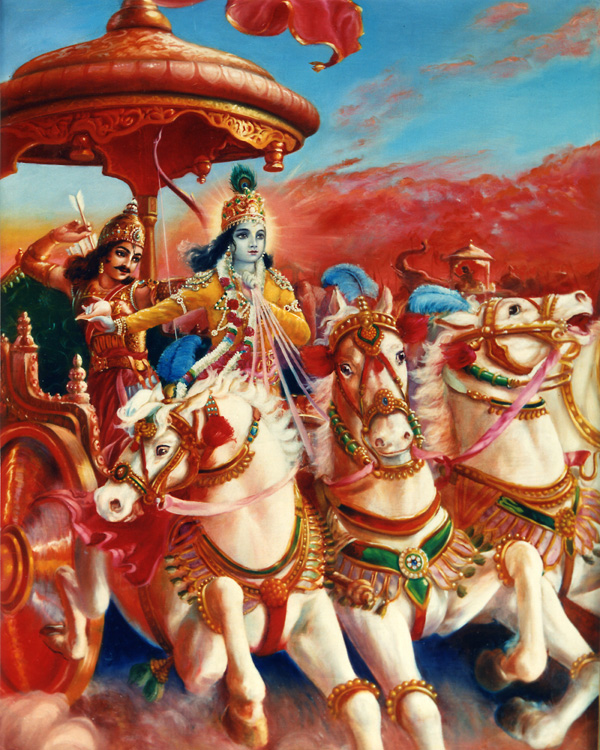
On the other side, both Lord Kṛṣṇa and Arjuna, stationed on a great chariot drawn by white horses, sounded their transcendental conchshells.
PURPORT
In contrast with the conchshell blown by Bhīṣmadeva, the conchshells in the hands of Kṛṣṇa and Arjuna are described as transcendental. The sounding of the transcendental conchshells indicated that there was no hope of victory for the other side because Kṛṣṇa was on the side of the Pāṇḍavas. Jayas tu pāṇḍu-putrāṇāṁ yeṣāṁ pakṣe janārdanaḥ. Victory is always with persons like the sons of Pāṇḍu because Lord Kṛṣṇa is associated with them. And whenever and wherever the Lord is present, the goddess of fortune is also there because the goddess of fortune never lives alone without her husband. Therefore, victory and fortune were awaiting Arjuna, as indicated by the transcendental sound produced by the conchshell of Viṣṇu, or Lord Kṛṣṇa. Besides that, the chariot on which both the friends were seated was donated by Agni (the fire-god) to Arjuna, and this indicated that this chariot was capable of conquering all sides, wherever it was drawn over the three worlds.
20 May 2011
by The Hare Krishna Movement
in A.C. Bhaktivedanta Swami Prabhupada, Bhagavad-gita, Divine and Demoniac Natures
Tags: A.C. Bhaktivedanta Swami Prabhupada, as it is, Bg chapter 16, bhagavad-gita, Demoniac, Divine, nature, qualities
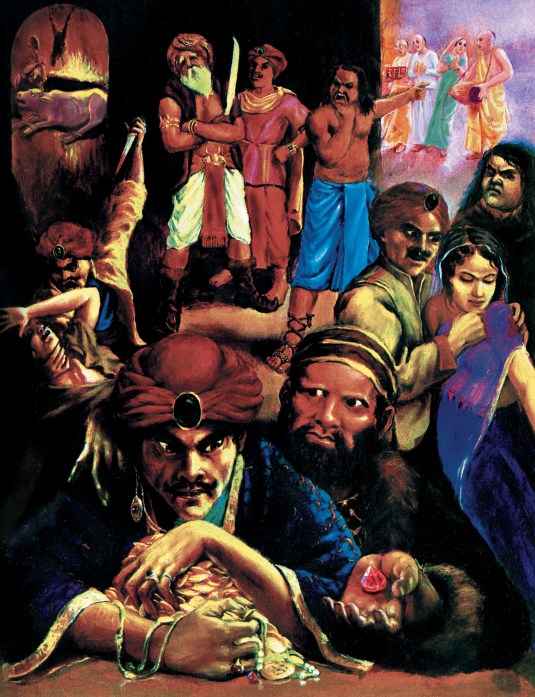
The Divine and Demoniac Natures
We are in the middle of a pandemic that is killing thousands of people worldwide.
Here in America we have a president that instead of acting in a sympathetic, compassionate way towards the sufferings of others, is instead criticizing and blaming others. This is not a good quality for a leader who should be taking responsibility for the safety and welfare of his citizens. All his self glorification, and his attack on others, in this time of turmoil, I find very disturbing and reminiscent of the description given in the 16th chapter of the Bhagavad-gita entitled “The Divine and Demon Natures”
Arrogance, pride, anger, conceit, harshness and ignorance—these qualities belong to those of demonic nature… (Bg. 4.16)
Those who are demoniac do not know what is to be done and what is not to be done. Neither cleanliness nor proper behavior nor truth is found in them. (Bg. 7.16)
The demoniac person thinks: “So much wealth do I have today, and I will gain more according to my schemes. So much is mine now, and it will increase in the future, more and more. He is my enemy, and I have killed him; and my other enemy will also be killed. I am the lord of everything, I am the enjoyer, I am perfect, powerful and happy. I am the richest man, surrounded by aristocratic relatives. There is none so powerful and happy as I am. I shall perform sacrifices, I shall give some charity, and thus I shall rejoice.” In this way, such persons are deluded by ignorance. (Bg. 13-15.16)
Full Chapter Texts and Purports More
13 May 2011
by The Hare Krishna Movement
in Bhagavad-gita, Devotee's, Free Downloads, Krishna Kirtan das
Tags: as it is, Bhagavad-gita in Portuguese, Krishna Kirtan das, original 1972, prabhupadanugas, Srila Prabhupada
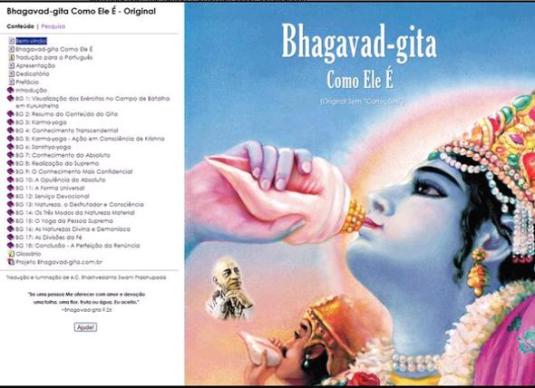
Bhagavad-gita As It Is (Original) in Portuguese!
By: Krishna Kirtan das
www.bhagavad-gita.com.br
The Bhagavad-gita.com.br project is born with the purpose of disclosing the famous and unique “Bhagavad-gita As It Is” (“Bhagavad-gita Como Ele É “) of A.C. Bhaktivedanta Swami Prabhupada to the population of the Portuguese language.
There is not enough words of gratitude to thank Sriman Visvavandya Prabhu for this magnificent, accurate, and genuine translation of the original Bhagavad-gita As It Is from 1972. Only due to his dedication and sincerity we can now read and admire the Bhagavad-gita as it really is, and as never before available in Portuguese. This is a translation of the original version of Bhagavad-gita As It Is (1972) from the original English version, without any change, addition, or extrapolation.
This Portuguese version of the Bhagavad-gita As It Is (1972) of A.C. Bhaktivedanta Swami Prabhupada is an unprecedented and unique event, and deserves your complete attention and observation. When you start reading this translated Portuguese version of the Bhagavad-gita As It Is you will immediately realize and start to experience the incredible clarity, purity, and accuracy of the words chosen by Srila Prabhupada, and will start seeing the full clarity and precision of his commentaries and of his translation from original Sanskrit verses, in their full form and unadulterated beauty.
The original Bhagavad-gita As It Is (1972) is now recognized and highly desired for the sincere study of the Bhagavad-gita. Srila Prabhupada himself lectured by reading directly from this version of the Gita, and he was also pleased with his own work. A large segment of the Vaishnava community in the world today is beginning more and more to recognize the immense value to humanity that is the original version of Bhagavad-gita As It Is from 1972.
Bhagavad-gita Como Ele É – Online
www.bhagavad-gita.com.br
With your help, this project can be expanded and improved.
Ideas such as integration with Facebook, interactive commentary, audio/video of the verses, lectures, online courses, and visual mapping technology for the study of topics, are just some of the ideas and concepts that the project has for the future.
(Find us on Facebook also at www.facebook.com/gita.1972)
If you like the project and the idea and want to contribute, please feel free. Your help is very welcome.
Only with the grace of Guru and Krishna, and with the blessings of the Vaishnavas, that everything is possible!
Om Tat Sat.
A servant and friend,
Krishna Kirtan
Pasted from
14 Mar 2011
by The Hare Krishna Movement
in Arsha Prayoga, Bhagavad-gita, Book Changes, Locanananda das
Tags: 1972 MacMillian, 1972 printing, Arsha Prayoga, BBT, bhagavad-gita, book changes, Hare Krishna, Krsna consciousness movement, Locanananda das, Maha Mantra, original edition, revised and enlarged edition, Srila Prabhupada

EDITORIAL
BY LOCANANANDA DAS – 11-01-04
While planning to print the unabridged version of the Bhagavad-gita, Srila Prabhupada often referred to it as the revised and enlarged edition. When the BBT published its unauthorized adulterated Gita years later, they would henceforward refer to the 1972 printing as the original edition while calling theirs the revised and enlarged edition. This appears to be a subtle act of deception meant to validate the irreverent practice of changing Srila Prabhupada’s Books.
The remainder of this article will focus mainly on the Bhagavad-gita As It Is, which contains the essence of Vaishnava philosophy. Srila Prabhupada said that the Krishna consciousness movement is genuine, historically authorized, natural and transcendental due to its being based on the Bhagavad-gita As It Is. It was his conviction that the entire human society could embrace one God, Krishna, and live harmoniously by practicing one religion, devotional service to God, by chanting one mantra, the Hare Krishna Maha Mantra, and by following one scripture, the Bhagavad-gita As It Is. Because the Bhagavad-gita is so vitally important to the spreading of Krishna consciousness, the adverse effect of changing its original wording without the approval of the Acharya can hardly be estimated.
More
29 Dec 2010
by The Hare Krishna Movement
in Bhagavad-gita
Tags: as it is, bhagavad-gita, devotional service, krsna consciousness, prabhupada

TEXT 40
nehābhikrama-nāśo ‘sti
pratyavāyo na vidyate
sv-alpam apy asya dharmasya
trāyate mahato bhayāt
SYNONYMS
na—there is not; iha—in this world; abhikrama—endeavoring; nāśaḥ—loss; asti—there is; pratyavāyaḥ—diminution; na—never; vidyate—there is; svalpam—little; api—although; asya—of this; dharmasya—of this occupation; trāyate—releases; mahataḥ—of very great; bhayāt—from danger.
TRANSLATION
In this endeavor there is no loss or diminution, and a little advancement on this path can protect one from the most dangerous type of fear.
PURPORT
Activity in Kṛṣṇa consciousness, or acting for the benefit of Kṛṣṇa without expectation of sense gratification, is the highest transcendental quality of work. Even a small beginning of such activity finds no impediment, nor can that small beginning be lost at any stage. Any work begun on the material plane has to be completed, otherwise the whole attempt becomes a failure. But any work begun in Kṛṣṇa consciousness has a permanent effect, even though not finished. The performer of such work is therefore not at a loss even if his work in Kṛṣṇa consciousness is incomplete. One percent done in Kṛṣṇa consciousness bears permanent results, so that the next beginning is from the point of two percent; whereas, in material activity, without a hundred percent success, there is no profit. Ajāmila performed his duty in some percentage of Kṛṣṇa consciousness, but the result he enjoyed at the end was a hundred percent, by the grace of the Lord. There is a nice verse in this connection in Śrīmad-Bhāgavatam:
tyaktvā sva-dharmaṁ caraṇāmbujaṁ harer
bhajan na pakko ‘tha patet tato yadi
yatra kva vābhadram abhūd amuṣya kiṁ
ko vārtha āpto ‘bhajatāṁ sva-dharmataḥ
“If someone gives up self-gratificatory pursuits and works in Kṛṣṇa consciousness and then falls down on account of not completing his work, what loss is there on his part? And, what can one gain if one performs his material activities perfectly?” (Bhāg. 1.5.17) Or, as the Christians say, “What profiteth a man if he gain the whole world yet suffers the loss of his eternal soul?”
Material activities and their results end with the body. But work in Kṛṣṇa consciousness carries the person again to Kṛṣṇa consciousness, even after the loss of the body. At least one is sure to have a chance in the next life of being born again as a human being, either in the family of a great cultured brāhmaṇa or in a rich aristocratic family that will give one a further chance for elevation. That is the unique quality of work done in Kṛṣṇa consciousness.
Next Newer Entries










 The Hare Krishna Movement