30 Oct 2013
by The Hare Krishna Movement
in A.C. Bhaktivedanta Swami Prabhupada, Childhood Pastimes of Krsna, Krsna Consciousness, Spiritual World, Srimad Bhagavatam, Vrndavana
Tags: A.C. Bhaktivedanta Swami Prabhupada, asura, Bakasura, BBT, Bhaktivedanta purports, cowheard boys, fruit vendor, go carana, Gokula, Krishna and Balarama, Krsna, Mother Yasoda, Nanda, Nanda Maharaja, pastimes of krsna, SB 10.11, Srimad Bhagavatam, Vatsasura, yamala arjunas, Yasoda

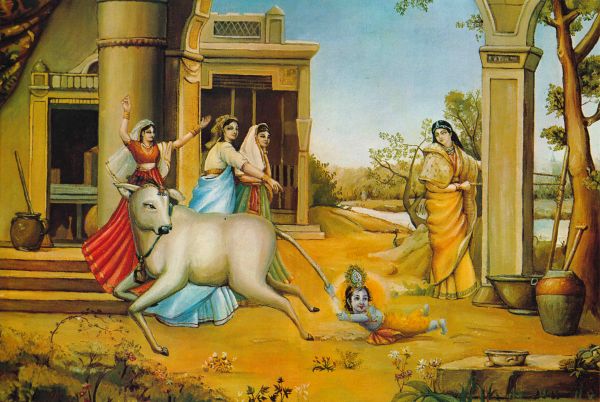
Today is Rama Ekadasi (fast from grains and beans), so on this auspicious day, in the auspicious month of Damodara, we wanted to do a special post. The following is the entire 11th chapter of the Tenth Canto of Srimad Bhagavatam entitled “The Childhood Pastimes of Kṛṣṇa”.
The following two verses are just an example of the nectar one will find in the following chapter…
…The gopīs would say, “If You dance, my dear Kṛṣṇa, then I shall give You half a sweetmeat.” By saying these words or by clapping their hands, all the gopīs encouraged Kṛṣṇa in different ways. At such times, although He was the supremely powerful Personality of Godhead, He would smile and dance according to their desire, as if He were a wooden doll in their hands. Sometimes He would sing very loudly, at their bidding. In this way, Kṛṣṇa came completely under the control of the gopīs.(Text 7)
…To pure devotees throughout the world who could understand His activities, the Supreme Personality of Godhead, Kṛṣṇa, exhibited how much He can be subdued by His devotees, His servants. In this way He increased the pleasure of the Vrajavāsīs by His childhood activities. (Text 9)
Srimad Bhagavatam
By His Divine Grace A. C. Bhaktivedanta Swami Prabhupada
Canto 10, Chapter 11
More
28 Oct 2013
by The Hare Krishna Movement
in A.C. Bhaktivedanta Swami Prabhupada, Bhagavad-gita, Krishna Consciousness, Krsna Consciousness
Tags: 1972 Edition, A.C. Bhaktivedanta Swami Prabhupada, Arjuna, Bhagavad-gita As It Is, bhava, devotee, essintial part of knowledge, friend of krsna, Krishna, krsna consciousness, man manah, official meditator, the most confidential part of knowledge
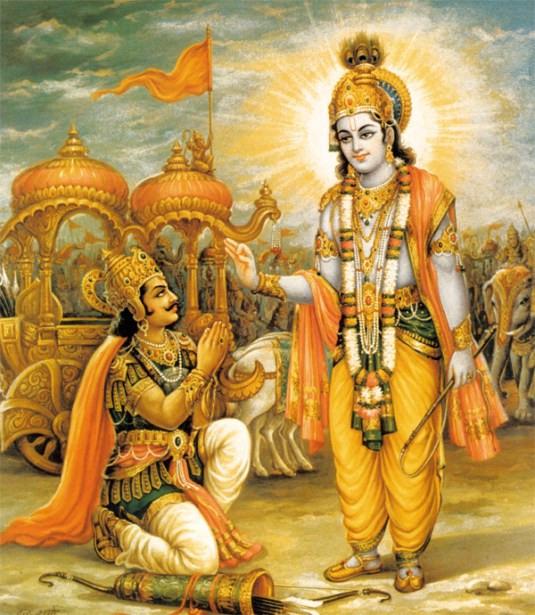
Because you are My very dear friend, I am speaking to you the most confidential part of knowledge. Hear this from Me, for it is for your benefit.
Always think of Me and become My devotee. Worship Me and offer your homage unto Me. Thus you will come to Me without fail. I promise you this because you are My very dear friend.
…”Just always think of Me.”…This is the most important instruction in all Vedic literature. What Kṛṣṇa is saying in this connection is the most essential part of knowledge, and it should be carried out not only by Arjuna but by all living entities.
…The most confidential part of knowledge is that one should become a pure devotee of Kṛṣṇa and always think of Him and act for Him. One should not become an official meditator. Life should be so molded that one will always have the chance to think of Kṛṣṇa. One should always act in such a way that all his daily activities are in connection with Kṛṣṇa. He should arrange his life in such a way that throughout the twenty-four hours he cannot but think of Kṛṣṇa. And the Lord’s promise is that anyone who is in such pure Kṛṣṇa consciousness will certainly return to the abode of Kṛṣṇa, where he will be engaged in the association of Kṛṣṇa face to face. This most confidential part of knowledge is spoken to Arjuna because he is the dear friend of Kṛṣṇa. Everyone who follows the path of Arjuna can become a dear friend to Kṛṣṇa and obtain the same perfection as Arjuna.
More
26 Oct 2013
by The Hare Krishna Movement
in A.C. Bhaktivedanta Swami Prabhupada, Damodara, KRSNA The Supreme Personality of Godhead
Tags: A.C. Bhaktivedanta Swami Prabhupada, Bhaktivedanta purport, Dhara, Drona, gopis, Krishna, krishna pastimes, Krsna, Krsna Book, Lord Balarama, Lord Damodara, Lord Krishna, month of Kartika, Mother Yasoda, Nanda Maharaja, residents of Vrndavana, SB 10.8, transcendental pleasure, Vision of the Universal Form
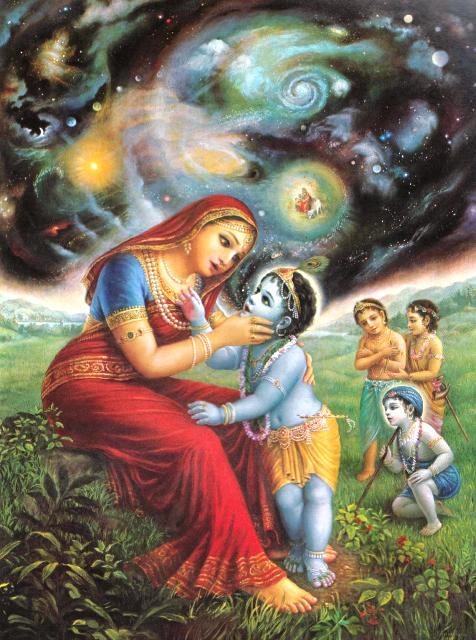
…continuing with our attempt to post Krsna’s childhood pastimes, throughout the duration of the “Month of Damodara”
…Another day, when Kṛṣṇa and Balarāma were playing with Their friends, all the boys joined Balarāma and told mother Yaśodā that Kṛṣṇa had eaten clay. On hearing this, mother Yaśodā caught hold of Kṛṣṇa’s hand and said, “My dear Kṛṣṇa, why have You eaten earth in a solitary place? Just see, all Your friends including Balarāma are complaining about You.” Being afraid of His mother, Kṛṣṇa replied, “My dear mother, all these boys, including My elder brother Balarāma, are speaking lies against Me. I have never eaten clay. My elder brother Balarāma, while playing with Me today, became angry, and therefore He has joined with the other boys to complain against Me. They have all combined together to complain so you will be angry and chastise Me. If you think they are truthful, then you can look within My mouth to see whether I have taken clay or not.” His mother replied, “All right, if You have actually not taken any clay, then just open Your mouth. I shall see.”
More
24 Oct 2013
by The Hare Krishna Movement
in A.C. Bhaktivedanta Swami Prabhupada, Damodara, KRSNA The Supreme Personality of Godhead, Srimad Bhagavatam
Tags: A.C. Bhaktivedanta Swami Ppabhupada, Balarama, butter, cows, Dear Yasoda, Krishna, Krsna Book, Krsna's childhood pastimes, milk, naughty childish activities of Krsna and Balarama in Vrndavan, naughty Krsna, Rohini, steal butter, Yasoda, yogurt

…All the gopī friends of Yaśodā and Rohiṇī enjoyed the naughty childish activities of Kṛṣṇa and Balarāma in Vṛndāvana. In order to enjoy further transcendental bliss, they all assembled and went to mother Yaśodā to lodge complaints against the restless boys. When Kṛṣṇa was sitting before mother Yaśodā, all the elderly gopīs began to lodge complaints against Him so that Kṛṣṇa could hear. They said, “Dear Yaśodā, why don’t you restrict your naughty Kṛṣṇa? He comes to our houses along with Balarāma every morning and evening, and before the milking of the cows They let loose the calves, and the calves drink all the milk of the cows. So when we go to milk the cows, we find no milk, and we have to return with empty pots. If we warn Kṛṣṇa and Balarāma about doing this, They simply smile charmingly. (Krsna Book Chapter 8)
…continuing with our attempt to post Krsna’s childhood pastimes, throughout the duration of the “Month of Damodara”
More
24 Oct 2013
by The Hare Krishna Movement
in A.C. Bhaktivedanta Swami Prabhupada, Japa, Nectar of Devotion, Practicing Krishna Consciousness at Home
Tags: A.C. Bhaktivedanta Swami Prabhupada, chanting Hare Krishna, holy name, japa, japa bag, japa beads, kirtan, Maha Mantra, mantra meditation
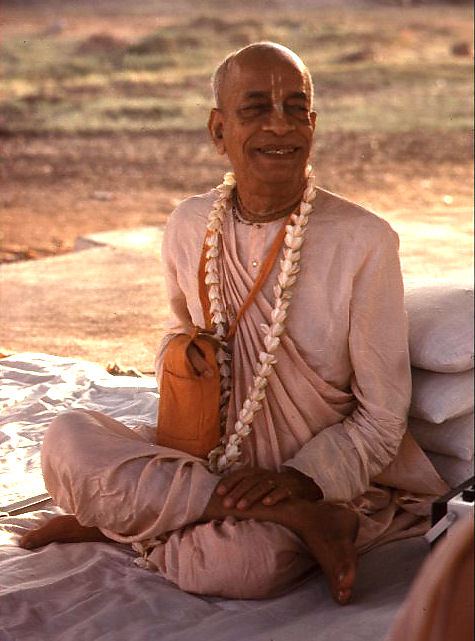
This is such a beautiful picture of Srila Prabhupada with his japa bag, that we thought we would do a short post on ‘japa’.
When a mantra or hymn is chanted softly and slowly, that is called japa. The same mantra, when chanted loudly, is called kīrtana. For example, the mahā-mantra (Hare Kṛṣṇa, Hare Kṛṣṇa, Kṛṣṇa Kṛṣṇa, Hare Hare/ Hare Rāma, Hare Rāma, Rāma Rāma, Hare Hare) when uttered very softly only for one’s own hearing is called japa. The same mantra, when chanted loudly for being heard by all others, is called kīrtana. The mahā-mantra can be used for japa and kīrtana also. When japa is practiced it is for the personal benefit of the chanter, but when kīrtana is performed it is for the benefit of all others who may hear.
In the Padma Purāṇa there is a statement: “For any person who is chanting the holy name either softly or loudly, the paths to liberation and even heavenly happiness are at once open.” (Nectar of Devotion Chapter 9)
Of all the sacrifices, the chanting of Hare Kṛṣṇa, Hare Kṛṣṇa, Kṛṣṇa Kṛṣṇa, Hare Hare/ Hare Rāma, Hare Rāma, Rāma Rāma, Hare Hare is the purest representation of Kṛṣṇa. (from purport; Bhagavad-gita 10.25)
More
23 Oct 2013
by The Hare Krishna Movement
in A.C. Bhaktivedanta Swami Prabhupada, Damodara, Krishna Consciousness, KRSNA The Supreme Personality of Godhead, Srimad Bhagavatam
Tags: A.C. Bhaktivedanta Swami Prabhupada, Balarama, clay and saffron, Damodara, gopis, Krishna, Krsna, Krsna The Supreme Personality of Godhead, Lord Damodara, naughty babies, Rohini, sandalwood pulp, Yasoda

Within the house of Nanda Mahārāja, the cowherd ladies would enjoy seeing the pastimes of the babies Rāma and Kṛṣṇa. The babies would catch the ends of the calves’ tails, and the calves would drag Them here and there. When the ladies saw these pastimes, they certainly stopped their household activities and laughed and enjoyed the incidents. (SB 10.8.24)
These childhood pastimes of Krsna are so sublime and pleasing to the consciousness. We will continue to post Krsna’s childhood pastimes throughout the duration of the “Month of Damodara”.
…both Balarāma and Kṛṣṇa began to crawl on Their hands and knees. When They were crawling like that, They pleased Their mothers. The bells tied to Their waist and ankles sounded fascinating, and They would move around very pleasingly. Sometimes, just like ordinary children, They would be frightened by others and would immediately hurry to Their mothers for protection. Sometimes They would fall into the clay and mud of Vṛndāvana and would approach Their mothers smeared with clay and saffron. They were actually smeared with saffron and sandalwood pulp by Their mothers, but due to crawling over muddy clay, They would simultaneously smear Their bodies with clay. As soon as They would come crawling to Their mothers, Yaśodā and Rohiṇī would take Them on their laps and, covering the lower portion of their saris, allow Them to suck their breasts. When the babies were sucking their breasts, the mothers would see small teeth coming in. Thus their joy would be intensified to see their children grow. Sometimes the naughty babies would crawl up to the cowshed, catch the tail of a calf and stand up. The calves, being disturbed, would immediately begin running here and there, and the children would be dragged over clay and cow dung. To see this fun, Yaśodā and Rohiṇī would call all their neighboring friends, the gopīs. Upon seeing these childhood pastimes of Lord Kṛṣṇa, the gopīs would be merged in transcendental bliss. In their enjoyment they would laugh very loudly. (excerpted from Krsna Book Chapter 8)
Also from the Srimad Bhagavatam More
22 Oct 2013
by The Hare Krishna Movement
in A.C. Bhaktivedanta Swami Prabhupada, Damodara, Kartika, Srila Prabhupada's Books, Srimad Bhagavatam
Tags: A.C. Bhaktivedanta Swami Prabhupada, austerities, bagavata, bhakta, black ointment around His eyes, Damodara, Krsna, Mother Yasoda, Mother Yasoda Binds Lord Krsna, mystics, Paramatma, penances, SB 10.9, Srila Prabhupada, Srimad Bhagavatam, yogis
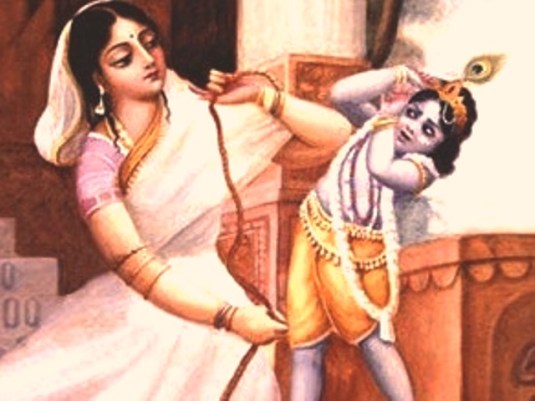
In celebration of the month of Damodara (Kartika) we are focusing our attention on the pastimes of Krishna in Vrndavan. Especially Krishna’s childhood pastimes. So with this in mind we are posting the entire 9th chapter from the Tenth Canto of Srila Prabhupada’s Srimad Bhagavatam entitled Mother Yaśodā Binds Lord Kṛṣṇa.
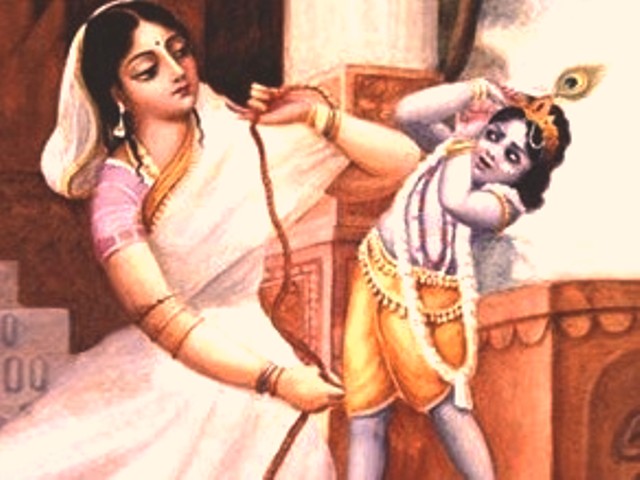
When caught by mother Yaśodā, Kṛṣṇa became more and more afraid and admitted to being an offender. As she looked upon Him, she saw that He was crying, His tears mixing with the black ointment around His eyes, and as He rubbed His eyes with His hands, He smeared the ointment all over His face. Mother Yaśodā, catching her beautiful son by the hand, mildly began to chastise Him. (SB 10.9.11)
Yogīs, mystics, want to catch Kṛṣṇa as Paramātmā, and with great austerities and penances they try to approach Him, yet they cannot. Here we see, however, that Kṛṣṇa is going to be caught by Yaśodā and is running away in fear. This illustrates the difference between the bhakta and the yogī. Yogīs cannot reach Kṛṣṇa, but for pure devotees like mother Yaśodā, Kṛṣṇa is already caught. (from purport to SB 10.9.9)
Srimad-Bhagavatam
By His Divine Grace A.C. Bhaktivedanta Swami Prabhupada
Tenth Canto, Chapter 9
More
17 Oct 2013
by The Hare Krishna Movement
in A.C. Bhaktivedanta Swami Prabhupada, Akrura, Gallery, Krishna Consciousness, Krsna Consciousness, KRSNA The Supreme Personality of Godhead
Tags: A.C. Bhaktivedanta Swami Prabhupada, Akrura, Krishna Balarama, Krsna, Krsna and Balarama, Krsna enters Mathura, Krsna The Supreme Personality of Godhead, Mathura, Vrndavana

Please click on image to enlarge
This mornings post is actually about the picture. I love this image and just wanted to put it on our page. And the words from Srila Prabhupada’s Kṛṣṇa Book, are like the music to the song.
…Akrūra said, ”My dear Lord, all wonderful things that are happening within this world, either in the sky or in the water or on the land, are factually appearing in Your universal form. So when I have seen You, what wonderful things have I not seen?“ This statement confirms the Vedic version that one who knows Kṛṣṇa knows everything, and one who has seen Kṛṣṇa has seen everything, regardless of how wonderful a thing may be. ”My dear Lord,“ Akrūra continued, ”there cannot be anything more wonderful than Your transcendental form. When I have seen Your transcendental form, what is there left to see?“
When passing from Vṛndāvana to Mathurā, all passersby along the way who saw Kṛṣṇa and Balarāma could not help but look at Them again and again. In the meantime, the other inhabitants of Vṛndāvana, headed by Nanda and Upananda, had already reached Mathurā by going through forests and rivers, and they were awaiting the arrival of Kṛṣṇa and Balarāma.
More
16 Oct 2013
by The Hare Krishna Movement
in A.C. Bhaktivedanta Swami Prabhupada, Guru & Disciple, guru-tattva, Teachings of Lord Kapila
Tags: A.C. Bhaktivedanta Swami Prabhupada, Approaching a Bona Fide Guru, bona fide guru, books of His Divine Grace, books of Srila Prabhupada, dvaipayana-sakhas tv evam, guru and disciple, guru tattva, oral tradition, Son of Devahuti, spiritual knowledge, spiritual master, tad viddhi pranipatena, Teachings of Lord Kapila
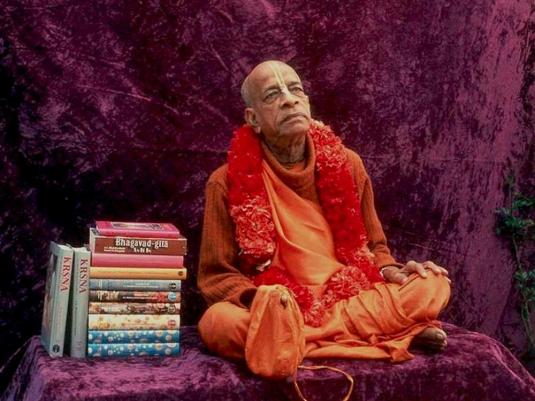
The following is chapter four in our series on the Teaching of Lord Kapila entitled “Approaching a Bona Fide Guru”. This is a nice chapter for anyone who is serious about receiving spiritual knowledge, and interested to know the process. We are fortunate in this age to have the books of His Divine Grace A. C. Bhaktivedanta Swami Prabhupada to guide us. Human knowledge was originally preserved through oral tradition, but today we have this knowledge preserved in the books of His Divine Grace.
Any person who seriously desires to achieve real happiness must seek out a bona fide spiritual master… (Śrīmad-Bhāgavatam 11.3.21)
…A bona fide guru does not impart some self-styled, concocted knowledge; his knowledge is standard and received from the paramparā system. He is also firmly fixed in the service of the Supreme Personality of Godhead (brahma-niṣṭham). These are his two qualifications: he must have heard the Vedic knowledge through the disciplic succession, and he must be established in service to the Supreme Lord.
Teachings of Lord Kapila, the Son of Devahūti
By His Divine Grace A. C. Bhaktivedanta Swami Prabhupāda
Chapter Four
Approaching a Bona Fide Guru
More
15 Oct 2013
by The Hare Krishna Movement
in A.C. Bhaktivedanta Swami Prabhupada, Bhagavad-gita As It Is 1972 Edition, Book Changes, Books by Srila Prabhupada
Tags: Arjuna, as it is, bhagavad-gita, Bhagavad-gita As It Is, book changes, complete 1972 edition, Krishna, original Bhagavad-gita, Prabhupada books, prabhupadagita, Srila Prabhupada's books

click on image to visit site
More
14 Oct 2013
by The Hare Krishna Movement
in A.C. Bhaktivedanta Swami Prabhupada, Caaitanya-caritamrta, Caitanya Mahaprabhu, Ramananda Raya, Sri Caitanya-Caritamrta
Tags: 1975 edition, A.C. Bhaktivedanta Swami Prabhupada, Govinda-mohini, Krsna, maha-bhagavata, pleasure potency, Radha-Krsna, Ramananda Raya, Sri Caitanya Mahaprabhu, Sri Caitanya-caritamrta, Sri Krishna, Srila Prabhupada, Srimati Radharani, Talks between Sri Caitanya Mahaprabhu and Ramananda Raya
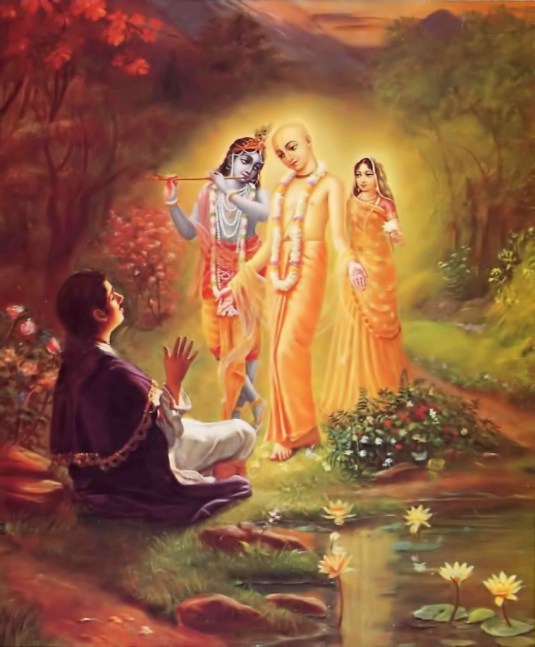
click on image to enlarge
Not only is this one of my most favorite pictures from the Śrī Caitanya-caritāmṛta, but this is one of the most nectarean chapters as well. This is a continuation from our previous post Drops of Nectar, and includes texts 279-289 from chapter eight of the Madhya-lila entitled “Talks Between Śrī Caitanya Mahāprabhu and Rāmānanda Rāya”.
Lord Śrī Kṛṣṇa is the reservoir of all pleasure, and Śrīmatī Rādhārāṇī is the personification of ecstatic love of Godhead. These two forms has combined as one in Śrī Caitanya Mahāprabhu. This being the case, Lord Śrī Caitanya Mahāprabhu revealed His real form to Rāmānanda Rāya.
More
12 Oct 2013
by The Hare Krishna Movement
in A.C. Bhaktivedanta Swami Prabhupada, Caaitanya-caritamrta, Caitanya Mahaprabhu, Krishna Nectar
Tags: A.C. Bhaktivedanta Swami Prabhupada Caitanya Mahaprabhu, advanced devotee, devotional service, ecstatic love of krsna, Godhead, maha-bhagavata, Ramananda Raya, spiritual platform, Sri Caitanya Caritamrta, Supreme Lord

Śrī Caitanya Mahāprabhu continued, ” ‘A person advanced in devotional service sees within everything the soul of souls, the Supreme Personality of Godhead, Śrī Kṛṣṇa. Consequently he always sees the form of the Supreme Personality of Godhead as the cause of all causes and understands that all things are situated in Him.’
” ‘The plants, creepers and trees were full of fruits and flowers due to ecstatic love of Kṛṣṇa. Indeed, being so full, they were bowing down. They were inspired by such deep love for Kṛṣṇa that they were constantly pouring showers of honey. In this way the gopīs saw all the forest of Vṛndāvana.’ “
Lord Caitanya Mahāprabhu continued, “My dear Rāya, you are an advanced devotee and are always filled with ecstatic love for Rādhā and Kṛṣṇa. Therefore whatever you see-anywhere and everywhere-simply awakens your Kṛṣṇa consciousness.”
Full Text and Purports More
11 Oct 2013
by The Hare Krishna Movement
in A.C. Bhaktivedanta Swami Prabhupada, Bhaktisiddhanta Sarasvati Thakura, Guru & Disciple, guru-tattva, Spiritual Master, Vyas-puja
Tags: A.C. Bhaktivedanta Swami Prabhupada, Abhay Charan das, appearance day homage, disciple, guru, guru disciple, His Divine Grace A.C. Bhaktivedanta Swami Prabhupada, spiritual master, Srila Prabhupada, Vyasa Puja
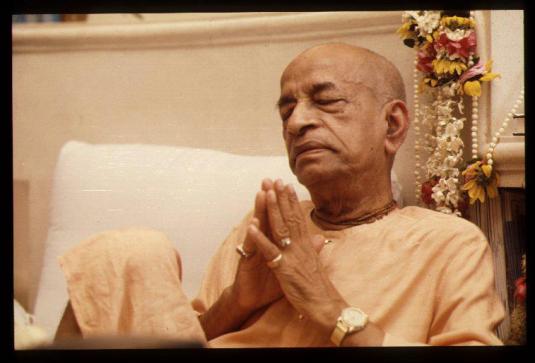
Personally, I have no hope for any direct service for the coming crores of births of the sojourn of my life, but I am confident that some day or other I shall be delivered from this mire of delusion in which I am at present so deeply sunk. Therefore let me with all my earnestness pray at the lotus feet of my divine master to allow me to suffer the lot for which I am destined due to my past misdoings, but to let me have this power of recollection: that I am nothing but a tiny servant of the Almighty Absolute Godhead, realized through the unflinching mercy of my divine master. Let me therefore bow down at his lotus feet with all the humility at my command. -Abhay Charan Das 1936
The following speech was delivered in 1936 Bombay by the pure devotee who three decades later will become the world-renowned spiritual master of The Hare Krishna Movement. Abhay Charan das who latter becomes His Divine Grace A.C. Bhaktivedanta Swami Prabhupada glorifies his own spiritual master Śrīla Bhaktisiddhānta Sarasvatī Goswami Maharaja with this Appearance day (Vyasa-puja) homage. Thus we learn the time-honored meaning of spiritual master, disciple and their relationship.
With All the Humility at My Command
His Divine Grace A. C. Bhaktivedanta Swami Prabhupada
More
10 Oct 2013
by The Hare Krishna Movement
in A.C. Bhaktivedanta Swami Prabhupada
Tags: A.C. Bhaktivedanta Swami Prabhupada, Arjuna, as it is, Bhagavad-gita As It Is, Brahma, Candra, demigods, faith, goodness, ignorance, Indra, Krishna, krsna consciousness, passion, sattva, Siva, Spiritual Life, Srila Prabhupada, sun-god, The Divisions of Faith, Visnu

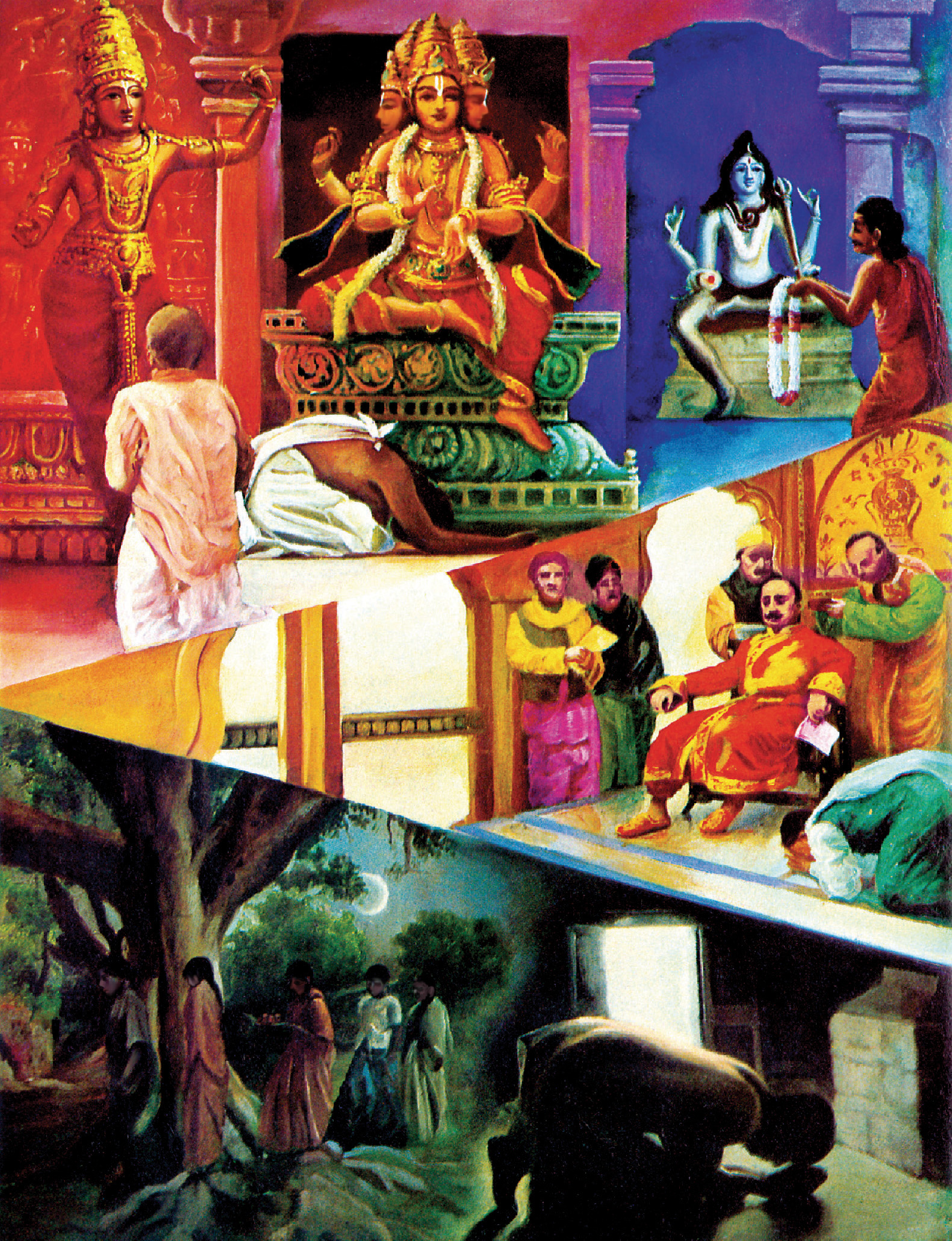
click on image to enlarge
Bhagavad-gītā As It Is 1972 Edition
by His Divine Grace A. C. Bhaktivedanta Swami Prabhupāda
Chapter Seventeen
The Divisions of Faith
More
10 Oct 2013
by The Hare Krishna Movement
in A.C. Bhaktivedanta Swami Prabhupada, Nectar of Instruction, Rupa Goswami, Upadesamrta
Tags: A. C. Bhaktivedanta Swami Prbhupada, avoid offenses, consciousness, instructions on spiritual life, Krsna consciousness movement, Nectar of Instruction, pure devotee, Rupa Goswami, Srila Prabhupada, Srila Rupa Gosvami, Upadesamrta, Vaisnavas

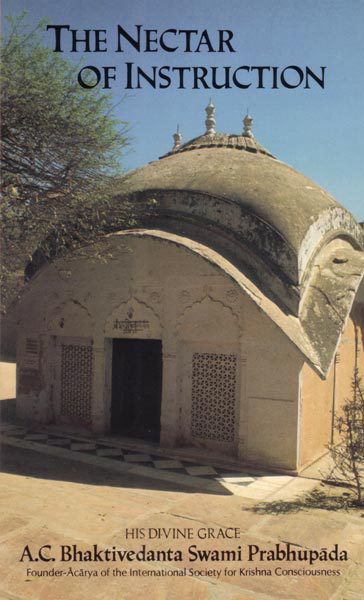
Continuing with our series on the Nectar of Iststuction (Upadeśāmṛta), we are posting Text 6, the very important instructions given by Śrīla Rūpa Gosvāmī on the position of a person situated in Krsna consciousness. Srila Prabhupada explains in the purport that a person engaged in devotional service must be free from material motives. In this Kṛṣṇa consciousness movement, one’s consciousness is what needs to be changed. How we should view the pure devotee, and also the warning is there how to avoid offenses at the feet of the Vaiṣṇavas. Very important instructions.
The Nectar of Instruction
By His Divine Grace A. C. Bhaktivedanta Swami Prabhupāda
Text Six More
09 Oct 2013
by The Hare Krishna Movement
in A.C. Bhaktivedanta Swami Prabhupada, nitya siddha, Spiritual Master
Tags: A.C. Bhaktivedanta Swami Prabhupada, eternal associates, kripa siddha, letter to Mukunda das, nitya baddha, nitya siddha, nitya-siddhas, oil in water, oil on water, Padma Purana, sadhan siddha, Satyabhama, vain quotes
In my reading I came across the word siddha and nitya siddha. By now I should know what this word means, but still…I wanted some clarification. So I went to Vani Quotes and did a search. One of the best definitions I could find came from the following letter to Mukunda dasa:
Letter to Mukunda
by His Divine Grace A. C. Bhaktivedanta Swami Prabupada
New Vrindaban 10 June, 1969
…Your next question, whether the Spiritual Master was formerly a conditioned soul, actually a bona fide Spiritual Master is never a conditioned soul. There are three kinds of liberated persons. They are called 1) sadhan siddha, 2) kripa siddha, and 3) nitya siddha. Sadhan siddha means one who has attained perfection by executing the regulative principles of devotional service. Kripa siddha means one who has attained perfection by the special mercy of Krishna and the Spiritual Master, and nitya siddha means one who was never contaminated. The symptoms of nitya siddha is that from the beginning of his life he is attached to Krishna, and he is never tired of rendering service to Krishna. So we have to know what is what by these symptoms. But when one is actually on the siddha platform there is no such distinction as to who is sadhan, kripa, or nitya siddha. When one is siddha, there is no distinction what is what. Just like when the river water glides down to the Atlantic Ocean nobody can distinguish which portion was the Hudson River or some other river. Neither is there any necessity to make any such distinction. Actually, every living entity is eternally uncontaminated, although he may be in the material touch. This is the version of the Vedas. Asanga ayam purusha—the living entity is uncontaminated. Just like when there is a drop of oil in water you can immediately distinguish the oil from the water, and the water never mixes with the oil. Similarly, a living entity, although in material contact, is always distinct from the matter.
This was an amazing answer. For more on the meaning of nitya siddha More
08 Oct 2013
by The Hare Krishna Movement
in A.C. Bhaktivedanta Swami Prabhupada, Back to Godhead, Bhagavad-gita
Tags: A.C. Bhaktivedanta Swami Prabhupada, Arjuna, as it is, bhagavad-gita, Bhaktivedanta purports, Krishna, Lord Krsna, mental agonies, Puranas, Srila Prabhupada, Srimad Bhagavatam, Upanisads, Vedanta-sutras, Vedic literatures, Vedic wisdom

1973 Back to Godhead cover
This morning I was reading from the Srimad Bhagavatam Canto 1, Chapter 15, Text 27, wherein Srila Prabhupada was describing the glories and importance of the the Bhagavad-gita As It Is. The following is some excerpts from this amazing purport, followed by full text and purport. I found this one purport to be a very nice synopsis of the entire Bhagavad-gita As It Is.
…The Lord left behind Him the instructions of the Bhagavad-gītā not for the benefit of Arjuna alone, but also for all time and in all lands. The Bhagavad-gītā, being spoken by the Supreme Personality of Godhead, is the essence of all Vedic wisdom. It is nicely presented by the Lord Himself for all who have very little time to go through the vast Vedic literatures like the Upaniṣads, Purāṇas and Vedānta-sūtras.
…the Bhagavad-gītā can be consulted in all critical times, not only for solace from all kinds of mental agonies, but also for the way out of great entanglements which may embarrass one in some critical hour.
…The merciful Lord left behind Him the great teachings of the Bhagavad-gītā so that one can take the instructions of the Lord even when He is not visible to material eyesight.
…There is no difference between the sound representation of the Lord and the Lord Himself. One can derive the same benefit from the Bhagavad-gītā as Arjuna did in the personal presence of the Lord.
…The Bhagavad-gītā begins with the problems of life by discriminating the soul from the elements of matter and proves by all reason and argument that the soul is indestructible in all circumstances and that the outer covering of matter, the body and the mind, change for another term of material existence which is full of miseries. The Bhagavad-gītā is therefore meant for terminating all different types of miseries, and Arjuna took shelter of this great knowledge, which had been imparted to him during the Kurukṣetra battle. (from Purport to SB 1.15.27)
Full verse and purport More
06 Oct 2013
by The Hare Krishna Movement
in A.C. Bhaktivedanta Swami Prabhupada, Bhagavad-gita, Dasya (Friendship), Srimad Bhagavatam
Tags: A.C. Bhaktivedanta Swami Prabhupada, Arjuna, awe and reverence, conjugal love, dasya, friendship, God is great, Krishna, neutral stage, parental affection, sakhya, santa-rasa, servitude, srngara, vatsalya

There are five basic relationships a devotee might have with the Lord; namely in the neutral stage (sānta-rasa), which is the stage of awe and reverence. Knowing that God is Great. Then there are four transcendental mellows (rasas); servitude (dāsya), friendship (sakhya), parental affection (vātsalya) and conjugal love (śṛṅgāra).
Kṛṣṇa and Arjuna are related in friendship.
Arjuna was in a relationship with the Lord as friend. Of course there is a gulf of difference between this friendship and the friendship found in the material world. This is transcendental friendship which cannot be had by everyone. Of course everyone has a particular relationship with the Lord, and that relationship is evoked by the perfection of devotional service. But in the present status of our life, we have not only forgotten the Supreme Lord, but we have forgotten our eternal relationship with the Lord. Every living being, out of many, many billions and trillions of living beings, has a particular relationship with the Lord eternally. That is called svarūpa. By the process of devotional service, one can revive that svarūpa, and that stage is called svarūpa-siddhi-perfection of one’s constitutional position. So Arjuna was a devotee, and he was in touch with the Supreme Lord in friendship. (from Introduction to Bhagavad-gita As It Is)
The following verse is one of my most favorite from the Bhagavad-gita As It Is.
I have in the past addressed You as “O Kṛṣṇa,” “O Yādava,” “O my friend,” without knowing Your glories. Please forgive whatever I may have done in madness or in love. I have dishonored You many times while relaxing or while lying on the same bed or eating together, sometimes alone and sometimes in front of many friends. Please excuse me for all my offenses.
I find this verse to be a beautiful expression of what is Bhakti Yoga. It is a personal loving exchange with the Lord. There are two ways to approach the Lord. One can approach the Lord with awe and reverence (sānta-rasa), or with a more personal approach; love and affection.
Kṛṣṇa’s devotees relate to Kṛṣṇa in various relationships.. Kṛṣṇa and Arjuna are related in friendship. As the father tolerates, or the husband or master tolerates, so Kṛṣṇa tolerates. Very Beautiful!
Bhagavad-gita As It Is Texts 40-45 More
04 Oct 2013
by The Hare Krishna Movement
in A.C. Bhaktivedanta Swami Prabhupada, Krsna Consciousness, Sri Caitanya-Caritamrta, The Reservoir of Pleasure
Tags: A.C. Bhaktivedanta Swami Prabhupada, Adi-lila 4.19, devotee, devotional service, natural affection, personal friend, pet son, Sri Caitanya-caritamrta, worship the lord with affection

“In whatever transcendental mellow My devotee worships Me, I reciprocate with him. That is My natural behavior. (Sri Caitanya-caritamrta Adi-lila 4.19)
…The Lord, by His inherent nature, reveals Himself before His devotees according to their inherent devotional service. The Vṛndāvana pastimes demonstrated that although generally people worship God with reverence, the Lord is more pleased when a devotee thinks of Him as his pet son, personal friend or most dear fiance and renders service unto Him with such natural affection. The Lord becomes a subordinate object of love in such transcendental relationships. (from purport)
Full verse and purport More
02 Oct 2013
by The Hare Krishna Movement
in A.C. Bhaktivedanta Swami Prabhupada, Arsha Prayoga, Book Changes, Book Distribution, Books by Srila Prabhupada, Quotes by Srila Prabhupada
Tags: A.C. Bhaktivedanta Swami Prabhupada, book changes, Book Distribution, do not change my books, grammatical discrepancy, instruction of the Supreme Personality of Godhead, not to change the ideas, quotes by Srila Prabhupada, Srila Prabhupada's books
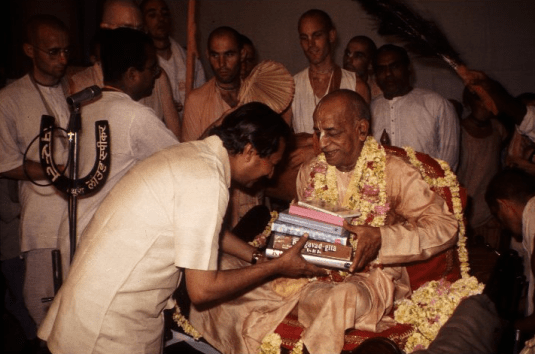
This is an older compilation of quotes and excerpts that first appeared on BookChanges.com back in 2009. I do not think one can overemphasize the importance of the Book Change issue.
For instance the way Arjuna accepted the Bhagavad-gita from Krsna was: “O Krishna, I totally accept as truth all that you have told me… ” [Bhagavad-gita 10.14]
This is the way of receiving transcendental knowledge.
Just this morning on Sampradaya Sun there was an article with this quote:
“Service means you must take order from the master. That is service. Otherwise it is mental concoction. Actually, the servant requests, “How can I serve you?” So when the master orders, “You serve me like this,” then you do that, that is service. And if you manufacture your service, that is not service. That is your sense gratification. Yasya prasādād bhagavat-prasādaḥ. You have to see how he is pleased. Now if he wants a glass of water and if you bring a nice glass of milk, you can say milk is better than water, you take it. That is not service. He wants water, you give him water. Don’t manufacture better thing.” (Lecture, Bhagavad-gita 15.15, August 5, 1976, New Mayapur, France)
So in the interest of preserving the words of our spiritual master we present this compilation of quotes. Some highlight editing has been done by me. -Vyasasan das
Srila Prabhupada on Editing His Books
Excerpted quotes by His Divine Grace A. C. Bhaktivedanta Swami Prabhupada
The Principle is No Change
“One should accept the instructions of the Supreme Personality of Godhead by bowing down at the lotus feet of the Lord. This means that anything spoken by the Personality of Godhead should be taken as it is, with great care and attention and with great respect. It is not our business to amend the words of the Supreme Personality of Godhead or make additions or alterations, as it has become a custom for many so-called scholars and swamis who comment on the words of Bhagavad-gita. Here the practical example of how to accept the instruction of the Supreme Personality of Godhead is shown by Prthu Maharaja. This is the way to receive knowledge through the parampara system.” (Purport SB 4.20.17)
More
Previous Older Entries Next Newer Entries










 The Hare Krishna Movement