Happy New Year everyone, hopefully This will be a good year.
Ya know, every year I make New Years’ resolutions, to be a better person, or to wake up early every day, stop eating so much white sugar and white flour, practice yoga, exercise, walk, chant my 16 rounds, etc. Typically my resolutions don’t even make it past the first week in January. But this year I am going to try something a little different. Keeping it simple. I am going to try to love God [Krishna] more.
I am reminded of the George Harrison song “My Sweet Lord”
My Sweet Lord
…I really want to see you Really want to be with you Really want to see you, Lord But it takes so long, my Lord
My sweet Lord My Lord My Lord
I really want to know you Really want to go with you Really want to show you, Lord But it won’t take long, my Lord (Hare Krishna)
full song below
But I am also reminded of the words of Srila Prabhupada in the KRSNA Book;
...Since Kṛṣṇa is all-attractive, one should know that all his desires should be focused on Kṛṣṇa… if we concentrate our loving propensities upon Kṛṣṇa only, then immediately universal love, unity and tranquillity will be automatically realized. When one waters the root of a tree, he automatically waters the branches, twigs, leaves and flowers; when one supplies food to the stomach through the mouth, he satisfies all the various parts of the body.
The art of focusing one’s attention on the Supreme and giving one’s love to Him is called Kṛṣṇa consciousness. (from Preface)
And from the Introduction of the KRSNA Book;
The supreme abode of the Personality of Godhead, Krsna, is also described in the Brahma-samhita as the abode of cintamani. That abode of Lord Krsna known as Goloka Vrindavan is full of palaces made of touchstone. There the trees are called desire trees, and the cows are called surabhi. The Lord is served there by hundreds and thousands of goddesses of fortune. His name is Govinda, the Primeval Lord, and He is the cause of all causes. There the Lord plays His flute, His eyes are like lotus petals, and the color of His body is like that of a beautiful cloud. On His head is a peacock feather. He is so attractive that He excels thousands of Cupids.
Krishna is so attractive, that it shouldn’t be hard to love Him more. Maybe this is a New Year Resolution I can actually keep.
The Nectar of Devotion is specifically presented for persons who are now engaged in the Krsna consciousness movement. I beg to offer my sincere thanks to all my friends and disciples who are helping me to push forward the Krsna consciousness movement in the Western countries, and I beg to acknowledge, with thanks, the contribution made by my beloved disciple Śrīmad Jayānanda Brahmacari. My thanks are due as well to the directors of ISKCON Press, who have taken so much care in publishing this great literature. Hare Krsna.
A.C. Bhaktivedanta Swami
“Prabhupada: Hare Krsna. So we have published our Nectar of Devotion. So every one of you should read this Nectar of Devotion repeatedly. The whole substance of Vaisnava philosophy and activities, everything is there. So every one of you read this Nectar of Devotion once, twice, thrice.”
Recently I have been cleaning out the warehouse, organizing things, moving boxes, and I realized that I still have many box’s of small books. What to do with so many small books??? My book distribution days are for the most part over. I mean I can still drop off books in the mail, but pounding the streets with a book bag days are over. So I decided to open the treasure chest of Srila Prabhupada’s mercy and offer any of our readers Free Books!
Anyone can write to me at: theharekrishnamovement@gmail.com and request free books. I no longer have any Bhagavad-gita’s left but I do have so many of the others. You can request specific books or just a random assortment, and I will mail them out to you.
Book distributors can write and a larger package can be arranged.
I request anyone who does not already have Srila Prabhupada’s books to feel free to write, or anyone wanting to add to their collection. Maybe you just want to give them to your friends or family, this is, after all, the season of gift giving. Hare Krishna!
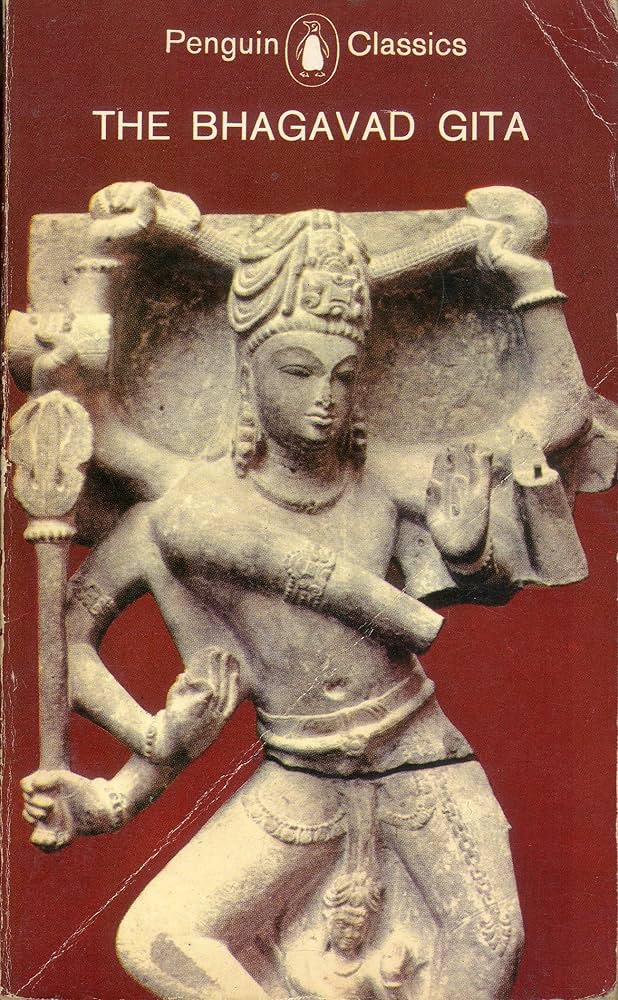
I remember back in my younger years, before I became a devotee, I decided to spend my summer off from college, hiking the Appalachian trail. I took with me some small books with me to read along the way. I was becoming interested in Eastern philosophy, and was asking myself questions like who is God, who am I, and what is my relationship with Him. I carried with me a small paperback book by Hermann Hesse entitled Siddhartha, a book by Henry David Thoreau; “Walden”, and the Penguin Classic; “The Bhagavad-gita.
From the book “Siddhartha” I became interested in meditation and the journey to self discovery. From “Walden”, I became interested is self- sufficiency, or as I later describe it as simple living and high thinking, and from the Bhagavad-gita, I discovered who God is. Really. For some reason, as soon as I began reading, I immediately accepted that Krishna was God. This book was the song of God. This was God speaking to His friend Arjuna, instructing him. And I thought how wonderful to be a friend of God, to become Gods friend.
Even though I was raised as a Christian, went to church on Sunday, was taught by nuns and priests, I never got satisfactory answers to my question, Who is God? But this book the Bhagavad-gita, This was God Himself speaking to his friend. Now I knew, there is a God, and His name was Krishna.
About a year later I meet a Hare Krishna devotee at the Chicago O’Hare airport, and I got from him the Krsna Book, then later I went back there and found a deserted copy of the Bhagavad-gita As It Is, on a neglected bench seat, by His Divine Grace A. C. Bhaktivedanta Swami. It wasn’t just the translations that the penguin classic offered, but it was the complete edition, with original Sanskrit text, Roman transliterations, English equivalents, translation and elaborate purports.
I have been reading the Krsna Book lately, and just yesterday we were reading chapter 14 “Prayers Offered by Lord Brahma to Lord Krsna”, and I was reminded this was the last chapter Srila Prabhupada was working on in the Srimad Bhagavatam series before his passing. So I had another look at the Tenth Canto, part 3, and thought it a good idea to share it with all our readers.
This is the final Śrīmad-Bhāgavatam volume translated by His Divine Grace A. C. Bhaktivedanta Swami Prabhupada, Founder-Acarya of the International Society for Krishna Consciousness, before his untimely departure. We share it with you as a free PDF download. You can click on the above link to view the complete volume or save it to your computer.
Foward
This is the final Śrīmad-Bhāgavatam volume translated by His Divine Grace A. C. Bhaktivedanta Swami Prabhupada, founder-acarya of the International Society for Krishna Consciousness. It is smaller than the earlier volumes because it ends where the renowned author stopped translating just before his departure from this mortal world on November 14, 1977, at the Krsna-Balarama Mandira in Vrndavana, India.
This morning as I went out to feed the birds, I saw a dead bird on the patio who must have crashed into the window, and it just got to thinking about what is the difference between a dead body and a live body? Consciousness. So I did a little research on that word. The simple definition of the word is:
“Consciousness is the state of being aware of oneself, one’s body, and the outside world.”
OK that is the simple definition. But in the Bhagavad-gita As It Is, Srila Prabhupada gives us a more advanced understanding:
“Know that which pervades the entire body is indestructible. No one is able to destroy the imperishable soul.” (Bg. 2.17)
PURPORT
This verse more clearly explains the real nature of the soul, which is spread all over the body. Anyone can understand what is spread all over the body: it is consciousness. Everyone is conscious of the pains and pleasures of the body in part or as a whole. This spreading of consciousness is limited within one’s own body. The pains and pleasures of one body are unknown to another. Therefore, each and every body is the embodiment of an individual soul, and the symptom of the soul’s presence is perceived as individual consciousness…
…This very small spiritual spark is the basic principle of the material body, and the influence of such a spiritual spark is spread all over the body as the influence of the active principle of some medicine spreads throughout the body. This current of the spirit soul is felt all over the body as consciousness, and that is the proof of the presence of the soul. Any layman can understand that the material body minus consciousness is a dead body, and this consciousness cannot be revived in the body by any means of material administration. Therefore, consciousness is not due to any amount of material combination, but to the spirit soul. . Neither Vedic knowledge nor modern science denies the existence of the spirit soul in the body, and the science of the soul is explicitly described in the Bhagavad-gita by the Personality of Godhead Himself.
So we can conclude, that that consciousness is the presence of the soul.
This is an old photo taken in 1907 that my wife found on Facebook. I remember as a kid, thinking that’s what yogis do. Sit on a bed of nails, or levitate off the ground while meditating.
Before Srila Prabhupada came to the West, bringing with him the Vedic Philosophy, not many people had any idea of what was Yoga or Meditation. Or that there were different types of Yoga and Meditation.
We share with you an excerpt from the small paperback book by His Divine Grace A. C. Bhaktivedanta Swmai Prabhupada entitled ” The Perfection of Yoga ”
The yogī obviously has to go through a great deal of difficulty to purify the ātmā (mind, body and soul), but it is a fact that this can be done most effectively in this age simply by the chanting of Hare Kṛṣṇa, Hare Kṛṣṇa, Kṛṣṇa Kṛṣṇa, Hare Hare/ Hare Rāma, Hare Rāma, Rāma Rāma, Hare Hare. Why is this? Because this transcendental sound vibration is non-different from Kṛṣṇa. When we chant His name with devotion, then Kṛṣṇa is with us, and when Kṛṣṇa is with us, then what is the possibility of remaining impure? Consequently, one absorbed in Kṛṣṇa consciousness, in chanting the names of Kṛṣṇa and serving Him always, receives the benefit of the highest form of yoga. The advantage is that he doesn’t have to take all the trouble of the meditational process. That is the beauty of Kṛṣṇa consciousness.
We often say “Chant and be Happy”, but there are offences to be considered. If we want to feel the full ecastscy derived from chanting the Holy names, we need to avoid them.
There are offenses to be considered while chanting the Hare Krishna mantra. Therefore simply by chanting Hare Krsna one does not become ecstatic. ( Cc. Adi-lila 8.24) 1) To blaspheme the devotees who have dedicated their lives for propagating the holy name of the Lord. 2) To consider the names of demigods like Lord Shiva or Lord Brahma to be equal to or independent of the name of the Lord Vishnu. 3) To disobey the orders of the spiritual master. 4) To blaspheme the vedic scriptures or scriptures in pursuance to the vedic version. 5) To consider the glories of chanting Hare Krishna to be an imagination. 6) To give some interpretations to the holy name of the Lord. 7) To commit sinful activities on the strength of the holy name. 8) To consider the chanting of Hare Krishna as one of the auspicious ritualistic activities which are offered in the Vedas as frutive activities (Karma kanda). 9) To instruct a faithless person about the glories of the holy name
10) To not have complete faith in the chanting of the holy name and to maintain material attachments, even after understanding so many instructions on this matter. It is also an offense to be inattentive while chanting.
Every devotee who claims to be Vaishnava must guard against these offenses in order to quickly achieve the desired successKRISHNA PREMA!!!
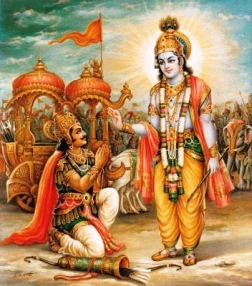
Yesterday was Gita Jayanti, or the Advent of Srimad Bhagavad-gita,which is an annual celebration to commemorate the day when Lord Krishna spoke the Bhagavad-gita to Arjuna on the first day of the battle of Kurukshetra. Recital of the Bhagavad Gita is performed throughout the day in most ISKCON centers throughout the world.
In honor of this day, Gita Jayntia, we present the Complete 1972 Edition of the Bhagavad-gita As It Is, by His Divine Grace A.C. Bhaktivedanta Swami in a link to our other page Prabhupadagita Where you can read the entire book online a chapter at a time with the original illustrations.
“To chant the holy name always, one should be humbler than the grass in the street and devoid of all desire for personal honor, but one should offer others all respectful obeisances.
“A devotee engaged in chanting the holy name of the Lord should practice forbearance like that of a tree. Even if rebuked or chastised, he should not say anything to others to retaliate.
“For even if one cuts a tree, it never protests, and even if it is drying up and dying it does not ask anyone for water.
PURPORT
This practice of forbearance (tṛṇād api sunicena) is very difficult, but when one actually engages in chanting the Hare Krishna mantra, the quality of forbearance automatically develops. A person advanced in spiritual consciousness through the chanting of the Hare Krishna mantra need not practice to develop it separately, for a devotee develops all good qualities simply by chanting the Hare Krishna mantra regularly.
“Thus a Vaisnava should not ask anything from anyone else. If someone gives him something without being asked, he should accept it, but if nothing comes, a Vaisnava should be satisfied to eat whatever vegetables and fruits are easily available.
“One should strictly follow the principle of always chanting the holy name, and one should be satisfied with whatever he gets easily. Such devotional behavior solidly maintains one’s devotional service.
“One who thinks himself lower than the grass, who is more tolerant than a tree, and who does not expect personal honor yet is always prepared to give all respect to others can very easily always chant the holy name of the Lord.”
PURPORT
The grass is specifically mentioned in this verse because everyone tramples upon it yet the grass never protests. This example indicates that a spiritual master or leader should not be proud of his position; being always humbler than an ordinary common man, he should go on preaching the cult of Caitanya Mahaprabhu by chanting the Hare Krishna mantra.
Recently a fellow Vaisnava (Kamsahanta Prabhu) passed away, or as we like to say, left his body, and we were left to settle his affairs. First there was the death certificate, and registering his death. Then there was the funeral home where arrangements were made for his cremation. Then there was the big job of distributing all his possessions. We gave his clothes to a nearby charity, food stuffs to the local church, There was tons of religious paraphernalia, dieties, pictures, books, (which were left with other devotees) and vehicles. It took weeks. And it really got me thinking… about my own mortality.
Kamshanta Prabhu was very fortunate in many ways, for in his adult life he preformed so much devotional service, distributed so many of Srila Prabhupada’s books, and collected so much laxmi to help advance this movement. He was also fortunate that his son Namacharya, was there to assist him at his hour of passing. Nam put his fathers japa beads in his hand, helped him chant in his final hours, and made arrangements to have his fathers body be cremated with his tulasi beads around his neck and his japa beads in his hand.
But this is what got me thinking…after a whole lifetime, Kamshanta Prabhu was left with only his neck and japa beads, and most importantly the holy name on his lips and in his ears. And I was reminded of the verse from the Bhagavad-gita 8.5:
“And whoever, at the time of death, quits his body, remembering Me alone, at once attains My nature, of this there is no doubt”
“The Holy Name is so powerful, that even by chanting with offense, gradually one becomes pure. Therefore we should not give up chanting under any circumstances.” -Srila Prabhupada
His Divine Grace A. C. Bhaktivedanta Swami Prabhupada’s Disappearance Day homage
by Vyasasan das
Dear Srila Prabhupada
Please accept my fallen obeisance’s, and my love, on this auspicious day of your disappearance. With your arrival on the shores of America, you brought with you the shinning lamp of knowledge; the wisdom on India and the Supreme Absolute Truth. You appeared on the shores of America the way the sun appears on the Eastern Horizon. Slowly revealing itself at first, then dominating the sky with its blazing effulgence. Illuminating the entire world with its golden light. Where there is light there is no darkness. And wherever your words are being sung and repeated, there is a glimmer of hope for the materially conditioned souls.
Your words and instructions are the very life and soul of a genuine disciple. It is said that the best process of understanding Krishna is to hear about Him, either from Krishna Himself as given in statements from the Bhagavad-Gita As It Is, or from the self realized pure devotee. One does not even need to change his worldly position; he simply has to hear the message of Krishna.
It is from you only, Srila Prabhupada, that I know anything at all about Krishna or the spiritual world. By your grace only, the knowledge is revealed, and you become revealed to your disciples and listeners. Anyone who submissively hears from you, either by reading your books, or hearing your lectures, can attain the highest perfectional platform. Just as there is the sun and the sunshine, so, there is Krishna and Krishna’s pure representative. When we feel the sunshine, we know the sun is there, and when we hear from you, we know that Krishna is there.
Today we celebrate Govardhana-puja, when Krishna exhibited His transcendental pastime of lifting Govardhana Hill to protect the inhabitants of Vrndavan. In honor of this auspicious day, we are posting the entire chapter from the KRSNA Book entitled “Devastating Rainfall in Vrndavana”. Enjoy!
…Lord Kṛṣṇa picked up Govardhana Hill with one hand, exactly as a child picks up a mushroom from the ground. Thus He exhibited His transcendental pastime of lifting Govardhana Hill. Lord Kṛṣṇa then began to address His devotees, “My dear brothers, My dear father, My dear inhabitants of Vṛndāvana, you can now safely enter under the umbrella of Govardhana Hill, which I have just lifted. Do not be afraid of the hill and think that it will fall from My hand. You have been too much afflicted from the heavy rain and strong wind; therefore I have lifted this hill, which will protect you exactly like a huge umbrella. I think this is a proper arrangement to relieve you from your immediate distress. Be happy along with your animals underneath this great umbrella.” Being assured by Lord Kṛṣṇa, all the inhabitants of Vṛndāvana entered beneath the great hill and appeared to be safe along with their property and animals. …The inhabitants of Vṛndāvana and their animals remained there for one week without being disturbed by hunger, thirst or any other discomforts. They were simply astonished to see how Kṛṣṇa was holding up the mountain with the little finger of His left hand.
… After this incident, the Supreme Personality of Godhead, surrounded by His dear friends and animals, returned to His home. As usual, the gopīs began to chant the glorious pastimes of Lord Kṛṣṇa with great feeling, for they were chanting from the heart. (Kṛṣṇa, the Supreme Personality of Godhead Chapter 25)
(Mantra Rock Dance poster, Avalon Ballroom, San Francisco, 1967)
The Prabhupada Revolution
by Padmapani Das
For many of us who came of age in the Sixties and Seventies, the counterculture and its promise of an alternative society based on love and peace was an important part of our lives. Art, music, poetry, philosophy, ecology and human rights were just a few of the buzzwords floating around the collective psyche of the Sixties generation. Revolution was in the air. “The establishment” was doomed and soon to be replaced with a kinder, gentler society. Peace would reign supreme and all peoples of the world would unite and be free from the chains of oppression. Or so we thought.
There has been so much misinformation lately, on the news networks, on social media, in politics, etc. about election results, relief funds for hurricane victims, eating pets in Springfield Ohio, etc., that it got me thinking about truthfulness. The English definition is simply: the quality of being honest and not containing or telling any lies. However according to the Vedic definition which goes a little deeper: Satyam, truthfulness, means that facts should be presented as they are for the benefit of others.
Satyam, truthfulness, means that facts should be presented as they are for the benefit of others. Facts should not be misrepresented. According to social conventions, it is said that one can speak the truth only when it is palatable to others. But that is not truthfulness. The truth should be spoken in a straight and forward way, so that others will understand actually what the facts are. If a man is a thief and if people are warned that he is a thief, that is truth. Although sometimes the truth is unpalatable, one should not refrain from speaking it. Truthfulness demands that the facts be presented as they are for the benefit of others. That is the definition of truth. (from purport Bhagavada-gita 10. 4-5)
“The government is people’s men. So if you are, we are ourselves fools and rascals, the government will also be a set of fools and rascals. And if you are intelligent, the government will be intelligent, because now it is democracy. You select some man. So don’t blame government. You are government. If you are fools the government are fools. If you are intelligent the government is intelligent. It is up to you to change; then everything will be all right.” Srila Prabhupada (Conversation with News Reporters — 25 March 1976, Delhi)
…The so called democratic government means some of the sudras, rascals without any knowledge of the highest aim of life. By hook and crook they get some votes and get the responsible chair in government. Naturally they can whimsically enact any law which is against the interest of the people in general. (Letter to: Madhudvisa Kenya 15 September, 1971)
For some time now I have been meaning to look up the word Sociopath. Srila Prabhupada has wrriten a very nice essay, which was published in our Back To Godhead Magazine, entitled, “Who Is Crazy” (which is at bottom of post). Today we see leaders and public figures who seem to fit the category of ‘Crazy’, or ‘Sociopathtic’. So I wanted to look into the description of the Sociopth, to get a better understanding.
Profile of the Sociopath
Pathological Lying Has no problem lying coolly and easily and it is almost impossible for them to be truthful on a consistent basis. Can create, and get caught up in, a complex belief about their own powers and abilities. Extremely convincing and even able to pass lie detector tests.
Manipulative and Conning They never recognize the rights of others and see their self-serving behaviors as permissible. They appear to be charming, yet are covertly hostile and domineering, seeing their victim as merely an instrument to be used. They may dominate and humiliate their victims.
Here is a new word for your vaisnava vocabulary; laulyam which can be defined as desire and great eagerness, or as greed
“My dear Lord, O lotus-eyed one, when will that day come when on the bank of the Yamuna, I shall become just like a madman, and continue to chant Your holy name while incessant tears flow from my eyes?”
One should feelingly pray and become eager to render his particular type of service to the Lord. This is the teaching of all great devotees, especially Lord Caitanya.
In other words, one should learn how to cry for the Lord. One should learn this small technique, and he should be very eager and actually cry to become engaged in some particular type of service. This is called laulyam, and such tears are the price for the highest perfection. If one develops this laulyam, or excessive eagerness for meeting and serving the Lord in a particular way, that is the price to enter into the kingdom of God. Otherwise, there is no material calculation for the value of the ticket by which one can enter the kingdom of God. The only price for such entrance is this laulyam lālasāmayī, or desire and great eagerness.
“Prabhupada: Hare Krsna. So we have published our Nectar of Devotion. So every one of you should read this Nectar of Devotion repeatedly. The whole substance of Vaisnava philosophy and activities, everything is there. So every one of you read this Nectar of Devotion once, twice, thrice.”
The Appearance Day of Our Beloved Spiritual Master
His Divine Grace A. C. Bhaktivedanta Swami Prabhupada
Founder-Acarya of the International Society for Krishna Consciousness
Dear Srila Prabhupada
Please accept my humble obeisances, and kindly forgive my offences. I am truly grateful to you for all that you have given me. Every day when I go into our temple room, and I light a candle or stick of incense, sit down and chant japa or sing bhajans, whether I am cooking an offering or preparing the Lord’s plate, picking a flower to offer or washing and drying the Lord’s plate, reading from one of your many books, or simply thinking about Lord Krishna or Caitanya Mahaprabhu, I feel a deep sense of gratitude, and appreciation.










 The Hare Krishna Movement