“O Lord of Madhu, as the Ganges forever flows to the sea without hindrance, let my attraction be constantly drawn unto You without being diverted to anyone else.” (Srimad-Bhagavatam, 1.8.42 -Prayer by Queen Kunti)
By His Divine Grace A.C. Bhaktivedanta Swami Prabhupada
In the previous verses of Srimad-Bhagavatam Queen Kunti prayed that the Lord kindly cut off her attraction for her kinsmen, the Pandava and Vrsni families. However, giving up one’s attraction for material things is not sufficient. The Mayavadi philosophers say, brahma satyam jagan-mithya: “This world is false, and Brahman [spirit] is truth.” We admit this, but qualify it. As living entities, we want enjoyment. Enjoyment means variety. It is not possible to enjoy anything without variety. Why has God created so many colors and so many forms? In order to create enjoyment out of variety. Indeed, variety is the mother of enjoyment. Mayavadi philosophers wish to negate this variety, and therefore they are called impersonalists.
The human form of life is meant for reestablishing our relationship with God. This material world means forgetfulness of our relationship with God. There is no Krsna consciousness in this material world, for as soon as there is Krsna consciousness, as soon as there is action on the basis of Krsna, there is nothing material. Everything is spiritual.
If one remains always a servant everlastingly of guru, then he is liberated. And as soon as he thinks that he is liberated, he’s a rascal. That is the teaching of Chaitanya Mahaprabhu…. You must be ready always to be chastised by guru. Then he’s liberated. And as soon as he thinks that “I am beyond this chastisement, I am liberated,” he’s a rascal…. Why this Gaudiya Math failed? Because they tried to become more than guru. He [Srila Bhaktisiddhanta Saraswati Thakura], before passing away, he gave them all direction and never said that “This man should be the next acharya .” But these people, just after his passing away, they began to fight, who shall be acharya . That is the failure. They never thought, “Why Guru Maharaja gave us instruction so many things, why he did not say that this man should be acharya? ” They wanted to create artificially somebody acharya, and everything failed. They did not consider even with common sense that if Guru Maharaja wanted to appoint somebody as acharya, why did he not say? He said so many things, and this point he missed? The real point? And they insist upon it. They declared some unfit person to become acharya . Then another man came, then another, acharya, another acharya . So better remain a foolish person perpetually to be directed by Guru Maharaja. That is perfection. –Srila Prabhupada, August 16, 1976, Bombay ( Conversations with Srila Prabhupada, Vol. 26, p. 59-60)
Guru Parampara
By Sriman Hansadutta Prabhu
These are some last minute thoughts in continuing the first edition of Srila Prabhupada, His Movement and You.
During Tamal’s conversation at Topanga Canyon, Tamal Krishna Goswami admitted that “you cannot show me anywhere where Srila Prabhupada appointed gurus. He only appointed rittviks…. This appointment is a myth….”
Certainly Prabhupada made gurus! But seeing their immaturity, he qualified them as rittvik representatives of the Acharya. One certainly must have a guru, but to understand the calibre of one’s guru, the standard for judgment of measure is there in the person of the Acharya, Srila Prabhupada. Otherwise, why did Prabhupada say, “Ramanuja Acharya is there, Madhva Acharya is there, and their commentaries are there. You follow the Acharya; don’t follow any rascal”
“Bombay Pandal Lecture”
By Srila Prabhupada
Bombay, April 6, 1971:
Ladies and gentlemen, we are very much thankful to you for your kindly participating in this great movement, Hare Krishna.
This Hare Krishna Movement is especially meant for this age because for self-realization, although there are many methods recommended in Vedic scriptures, in this age the greatest common factor for self-realization is simply chanting this Hare Krishna mantra.
Actually, our miserable condition of life is due to our forgetfulness. As I said yesterday, day before yesterday, this material existence is a condemned position of the living entities, exactly like a criminal is placed in the prisonhouse. Now, the whole Vedic literature is meant for getting us liberated from this condition of life. So far Bhagavad-gita is concerned, the same aim is there because at the ultimate instruction, Lord Krishna says, sarva-dharman parityajya mam ekam saranam vraja [Bg. 18.66].
In the Bhagavad-gītā also the Lord says: “Give up all your occupations and just become surrendered unto Me. I give you assurance that I shall give you protection from all sinful reactions.” One may think that because he is surrendering unto the Supreme Personality of Godhead, he will not be able to perform all of his other obligations. But the Lord says repeatedly, “Don’t hesitate. Don’t consider that because you are giving up all other engagements there will be some flaw in your life. Don’t think like that. I will give you all protection.” That is the assurance of Lord Kṛṣṇa in the Bhagavad-gītā.
The Nectar of Devotion – 1970 Edition
By His Divine Grace A.C. Bhaktivedanta Swami Prabhupada
Chapter 5
Purity of Devotional Service
All of the previous instructions imparted by Śrīla Rūpa Gosvāmī in his broad statements can be summarized thus: as long as one is materially inclined or desirous of merging into the spiritual effulgence, one cannot enter into the realm of pure devotional service. Next, Rūpa Gosvāmī states that devotional service is transcendental to all material considerations and that it is not limited to any particular country, class, society or circumstance. As stated in Śrīmad-Bhāgavatam, devotional service is transcendental and has no cause. Devotional service is executed without any hope for gain, and it cannot be checked by any material circumstances. It is open for all, without any distinction, and it is the constitutional occupation of the living entities.
…the root meaning of the word dharma is “that which sustains one’s existence.” A living being’s sustenance of existence is to coordinate his activities with his eternal relation with the Supreme Lord Kṛṣṇa
Srimad Bhagavatam
By His Divine Grace A. C. Bhaktivedanta Swami Prabhupada
Canto 1, Chapter 2, Text 6
sa vai puṁsāṁ paro dharmo
yato bhaktir adhokṣaje
ahaituky apratihatā
yayātmā suprasīdati
The supreme occupation [dharma] for all humanity is that by which men can attain to loving devotional service unto the transcendent Lord. Such devotional service must be unmotivated and uninterrupted to completely satisfy the self.
Purport
In this statement, Śrī Sūta Gosvāmī answers the first question of the sages of Naimiṣāraṇya. The sages asked him to summarize the whole range of revealed scriptures and present the most essential part so that fallen people or the people in general might easily take it up. The Vedas prescribe two different types of occupation for the human being. One is called the pravṛtti-mārga, or the path of sense enjoyment, and the other is called the nivṛtti-mārga, or the path of renunciation. The path of enjoyment is inferior, and the path of sacrifice for the supreme cause is superior. The material existence of the living being is a diseased condition of actual life. Actual life is spiritual existence, or brahma-bhūta [SB 4.30.20] existence, where life is eternal, blissful and full of knowledge. Material existence is temporary, illusory and full of miseries. There is no happiness at all. There is just the futile attempt to get rid of the miseries, and temporary cessation of misery is falsely called happiness. Therefore, the path of progressive material enjoyment, which is temporary, miserable and illusory, is inferior. But devotional service to the Supreme Lord, which leads one to eternal, blissful and all-cognizant life, is called the superior quality of occupation. This is sometimes polluted when mixed with the inferior quality. For example, adoption of devotional service for material gain is certainly an obstruction to the progressive path of renunciation. Renunciation or abnegation for ultimate good is certainly a better occupation than enjoyment in the diseased condition of life. Such enjoyment only aggravates the symptoms of disease and increases its duration. Therefore devotional service to the Lord must be pure in quality, i.e., without the least desire for material enjoyment. One should, therefore, accept the superior quality of occupation in the form of the devotional service of the Lord without any tinge of unnecessary desire, fruitive action and philosophical speculation. This alone can lead one to perpetual solace in His service.
Srila Prabhupada taught the principles of yukta vairagya: not to reject something of this world as material, but suitably engage everything in the service of the Supreme Lord Sri Krishna for the upliftment of humanity. These principles of yukta vairagya that he taught underlie the Krishna Lila Park project, where modern technology, commerce and management practices converge for the execution of this mega endeavour in the service of God and mankind.
Sri-Sri-Gurv-astaka
(Eight prayers Glorifying the Spiritual Master)
By Srila Visvanatha Cakravarti Thakura
Srila Visvanatha Cakravarti Thakura, who appeared in the latter half of the 17th century, is a great spiritual master in the Krsna Consciousness chain of gurus and disciples. He says that one should loudly chant the following eight prayers, with great care and attention, during the brahma-muhurta, the auspicious time an hour and a half before sunrise when devotional practices are especially potent. Anyone who thus chants these eight beautiful prayers glorigying the spiritual master will certainly get a chance to render direct service to Krsna, the Lord of Vrndavan, after the demise of his body. (from 1974 edition of “Songs of the Vaisnava Acaryas)
For complete sanskrit text, translation and purport by His Divine Grace A. C. Bhaktivedanta Swami Prabhupada…
The topmost maidservant of Sri Sri Radha-Krsna is Sri Rupa Manjari who appeared as the head of the Gaudiya Vaisnava sampradaya, Srila Rupa Goswami (1489-1588). Sri Rupa appeared in East Bengal, the son of a pious brahmana named Kumaradeva along with his brothers, Sanatana and Anupama. The three brothers later moved to Ramakeli where they were solicited by the powerful Nawab Hussein Shah to join his government. Due to their association with the Muslim king, Rupa and Sanatana became known by the Muslim names Dabir Khas and Sakir Mallik.
When Sri Caitanya Mahaprabhu came to Ramakeli, the three brothers petitioned the Lord to alleviate their suffering condition and grant them His mercy. Mahaprabhu pacified them and told them that Krsna would deliver them very soon.
His Divine Grace A.C. Bhaktivedanta Swami Prabhupada Founder Acarya of the International Society for Krishna Consciousness
There is a popular ideology that claims that Srila Prabhupad should still be considered the diksa guru in ISKCON. It is commendable that devotees who espouse this ideology want to see Krishna’s pure devotee unlimitedly and perpetually glorified. That goal can be accomplished by following the system of “officiating acharyas” that he factually authorized. An “officiating acharya” simply teaches by example how to follow in the footsteps of the great preceptor and founder acharya of ISKCON and then engages everyone in the service of expanding the sankirtan movement.
The War is Over
Editorial (VNN)
By Sriman Locanananda Prabhu
When Srila Prabhupad was asked how initiations would be performed after he was no longer physically present, his response was clear and powerful. He had been contemplating this question for ten years, and his main concern was to guarantee the continuity and future growth of his movement. His reply was “I shall recommend some of you to act as officiating acharya.” This was the term he wanted to introduce to describe the role of his disciples who would initiate new devotees as members of ISKCON after he had concluded his manifest pastimes.
The title “acharya” indicates that one is a guru, or spiritual master, and the qualifying term “officiating” means that the initiation is to be performed on behalf of the founder acharya and his institution. By naming eleven of his foremost disciples who had demonstrated great leadership ability and dedication to his movement as “officiating acharyas”, Srila Prabhupad was laying the groundwork to perpetuate Caitanya Mahaprabhu’s sankirtana movement throughout the world. His plan would be successful as long as his followers kept his teachings intact and protected his movement from any influence that might tend to push Srila Prabhupad into the background. The Krishna Consciousness Movement would ultimately establish His Divine Grace as the greatest vaisnava acharya coming in the line of Caitanya Mahaprabhu, the most merciful incarnation of Krishna.
VRINDAVANI – One who first manifested in Vrindavan.
VRINDA – The goddess of all plant and trees ( even if one Tulasi plant is present in a forest it can be called Vrindavana.)
VISHVAPUJITA – One whom the whole universe worships.
PUSHPASARA – The topmost of all flowers, without whom Krishna does not like to look upon other flowers.
NANDINI – Seeing whom gives unlimited bliss to the devotees.
KRISHNA-JIVANI – The life of Sri Krishna.
VISHVA-PAVANI – One who purifies the three worlds.
TULASI – One who has no comparison.
Anyone while worshiping Tulasi-devi chants these eight names will get the same results as one who performs the Ashvamedha sacrifice. And one who on the full-moon day of Kartika (Tulasi-devi’s appearance day) worships Her with this Mantra will break free from the bonds of this miserable world of birth and death, and very quickly attains Goloka Vrndavan. On the full moon-day of Kartik Lord Sri Krishna Himself worships Srimati Tulasi-devi with this Mantra.
One who remembers this Mantra will very quickly attain devotion to Lord Krishna’s Transcendental Lotus Feet.
By Gaura Gopala Dasa
Nov 08, 2011 — AUSTRALIA (SUN)
When we all went to meet Srila Prabhupada in April 1972 at Melbourne Airport, the first thing I noticed was he had a distinct golden aurora around him that stood out from all others; his wonderful skin glowed and caught the attention of everyone in the Airport lounge, he was so happy to see his disciples.
I handed him a big red rose, he took the rose off me and with a big smile, taped me on the head with his cane. I had tears in my eyes; it was such a special moment to see my Spiritual Master. Later many devotees gathered around me asking what it felt like to be tapped on the head by Prabhupada with his cane.
Those days were very remarkable. So kind and merciful is Srila Prabhupada, who gives even the most degraded a chance to become Krishna Conscious. Most of us were just teenager boys and girls back then, sincere seekers of truth.
At the end of all events, one of the visitor remarked, “A great work has been accomplished.” But we would consider, the work has just begun.
Krishna Balaram temple inauguration, Sunnyvale, CA
By Nanda Kishore Dasa
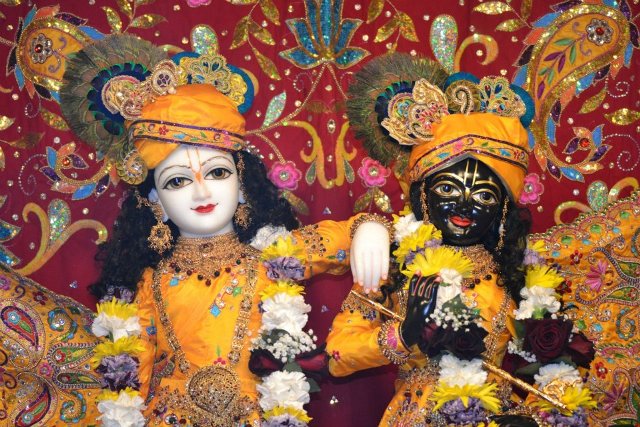
By the mercy of Srila Prabhupada, and with the blessings and good wishes of all Vaishnavas, we were able to inaugurate our newest branch of Srila Prabhupada’s temple here at the heart of Silicon Valley, in Sunnyvale city, California, on the 29th October 2011, with the installation of the Deities of Sri Sri Krishna Balarama, Sri Sri Gaura Nitai and Srila Prabhupada. This also happened to be the Disappearance day of our most beloved spiritual master, His Divine Grace A C. Bhaktivedanta Swami Srila Prabhupada. It was a fitting tribute to Srila Prabhupada on his disappearance day.
We are following in the footsteps of Lord Caitanya Mahaprabhu in order to understand Krsna consciousness. Krsna, the Supreme Personality of Godhead, is said in Sri Isopanisad to be very far away from us yet at the same time to be very near. Isvara, the supreme controller, is situated in everyone’s heart, not only in the hearts of human beings, but also within the beasts, birds, aquatics, and even within the atoms themselves. We simply have not realized Him. Actually anyone, however, can find Krsna within his heart.
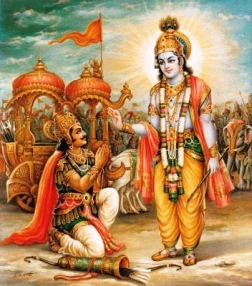
The process of finding Krsna is called yoga. There are many types of yoga. In the Western countries people are generally familiar with the process of hatha-yoga. This is an approved method and is described in the Sixth Chapter of Bhagavad-gita. At the present moment, however, people are short-lived, they are not very fortunate, and they are always disturbed by many external affairs, and therefore it is not possible to properly execute this hatha-yoga. Even five thousand years ago when Krsna advised His friend Arjuna to accept the hatha-yoga process, Arjuna said, “Krsna, this practice is impossible.” He further said that to control the mind is as difficult as to control the wind. The mind flickers from one engagement to another and changes so swiftly that it is very difficult to control it in this age. Therefore Arjuna said that for him this process of hatha-yoga was not possible.
A pure devotee always engages in the service of the Lord, taking shelter of His lotus feet, and therefore he has a direct connection with the saffron mercy-particles that are strewn over the lotus feet of the Lord. Although when a pure devotee speaks the articulation of his voice may resemble the sound of this material sky, the voice is spiritually very powerful because it touches the particles of saffron dust on the lotus feet of the Lord. As soon as a sleeping living entity hears the powerful voice emanating from the mouth of a pure devotee, he immediately remembers his eternal relationship with the Lord, although up until that moment he had forgotten everything.
Srimad Bhagavatam
By His Divine Grace A.C. Bhaktivedanta Swami Prabhupada
Canto 4, Chapter 20, Text 25
sa uttamaśloka mahan-mukha-cyuto
bhavat-padāmbhoja-sudhā kaṇānilaḥ
smṛtiṁ punar vismṛta-tattva-vartmanāṁ
kuyogināṁ no vitaraty alaṁ varaiḥ
saḥ—that; uttama-śloka—O Lord, who are praised by selected verses; mahat—of great devotees; mukha-cyutaḥ—delivered from the mouths; bhavat—Your; pada-ambhoja—from the lotus feet; sudhā—of nectar; kaṇa—particles; anilaḥ—soothing breeze; smṛtim—remembrance; punaḥ—again; vismṛta—forgotten; tattva—to the truth; vartmanām—of persons whose path; ku-yoginām—of persons not in the line of devotional service; naḥ—of us; vitarati—restores; alam—unnecessary; varaiḥ—other benedictions.
My dear Lord, You are glorified by the selected verses uttered by great personalities. Such glorification of Your lotus feet is just like saffron particles. When the transcendental vibration from the mouths of great devotees carries the aroma of the saffron dust of Your lotus feet, the forgetful living entity gradually remembers his eternal relationship with You. Devotees thus gradually come to the right conclusion about the value of life. My dear Lord, I therefore do not need any other benediction but the opportunity to hear from the mouth of Your pure devotee.
It is explained in the previous verse that one has to hear glorification of the Lord from the mouth of a pure devotee. This is further explained here. The transcendental vibration from the mouth of a pure devotee is so powerful that it can revive the living entity’s memory of his eternal relationship with the Supreme Personality of Godhead. In our material existence, under the influence of illusory māyā, we have almost forgotten our eternal relationship with the Lord, exactly like a man sleeping very deeply who forgets his duties. In the Vedas it is said that every one of us is sleeping under the influence of māyā. We must get up from this slumber and engage in the right service, for thus we can properly utilize the facility of this human form of life. As expressed in a song by Ṭhākura Bhaktivinoda, Lord Caitanya says, jīva jāga, jīva jāga. The Lord asks every sleeping living entity to get up and engage in devotional service so that his mission in this human form of life may be fulfilled. This awakening voice comes through the mouth of a pure devotee.
Sri Caitanya-caritamrta – 1975 Edition
By His Divine Grace A.C. Bhaktivedanta Swami Prabhupada
Adi-lila 9.48
The Tree of Devotional Service
yei yāhāṅ tāhāṅ dāna kare prema-phala
phalāsvāde matta loka ha-ila sakala
yei—anyone; yāhāṅ—wherever; tāhāṅ—anywhere; dāna—charity; kare—gives in; prema-phala—the fruit of love of Godhead; phala—fruit; āsvāde—by tasting; matta—intoxicated; loka—people; ha-ila—become; sakala—all.
The fruit of love of God is so relishable that wherever a devotee distributes it, those who taste the fruit, anywhere in the world, immediately become intoxicated.
Here the wonderful fruit of love of Godhead distributed by Lord Caitanya Mahāprabhu is described. We have practical experience that anyone who accepts this fruit and sincerely tastes it immediately becomes mad after it and gives up all his bad habits, being intoxicated by Caitanya Mahāprabhu’s gift, the Hare Kṛṣṇa mahā-mantra. The statements of Śrī Caitanya-caritāmṛta are so practical that anyone can test them. As far as we are concerned, we are most confident of the success of the distribution of the great fruit of love of Godhead through the medium of chanting the mahā-mantra-Hare Kṛṣṇa, Hare Kṛṣṇa, Kṛṣṇa Kṛṣṇa, Hare Hare Hare Rāma, Hare Rāma, Rāma Rāma, Hare Hare.
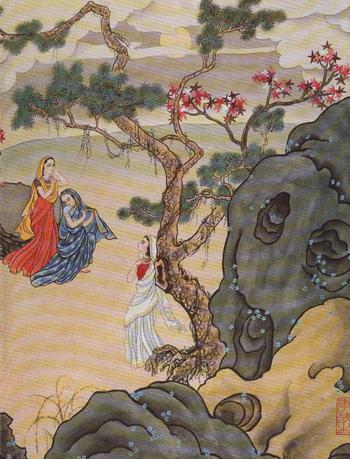
Light of the Bhagavata, Srila Prabhupada’s evocative prose and Madame Li’s graceful paintings in the classical Gongbi style combine to provide a fresh and revealing insight into the vital and enduring truths of the world’s oldest spiritual tradition.
Light of the Bhagavata
By His Divine Grace A.C. Bhaktivedanta Swami Prabhupada
Illustration by Madame Li Sheng
Illustration 42
At night in autumn the atmosphere is pleasant because it is neither very hot nor very cold. The mild wind blowing through the gardens of fruits and flowers in Vṛndāvana appeared very much pleasing to all—all but the gopīs, who were always overtaken by heartfelt sorrow in the absence of Kṛṣṇa.
Lessons from the picture
There are two kinds of transcendental feelings for those engaged in the worship of the Lord. One is called sambhoga, and the other is called viraha. According to authorities in the disciplic line, viraha worship is more palatable than sambhoga worship. Sambhoga takes place in direct touch, whereas viraha takes place without such direct contact. Lord Caitanya Mahāprabhu taught us to accept viraha worship. In the present state of affairs we cannot make any direct touch with the Personality of Godhead. But if we practice the viraha mode of worship we can transcendentally realize the presence of the Lord more lovingly than in His presence.
“O Lord, although You are able to give all kinds of benedictions, I do not pray to You for liberation, nor eternal life in Vaikuntha, nor any other boon. My only prayer is that Your childhood pastimes may constantly appear in my mind. O Lord, I do not even want to know Your feature of Paramatma. I simply wish that Your childhood pastimes may ever be enacted in my heart.” (Sri Damodarastakam, verse 4)
KRSNA, The Supreme Personality of Godhead – 1970 Edition
By His Divine Grace A.C. Bhaktivedanta Swami Prabhupada
Vol 1, Chapter 26
Wonderful Kṛṣṇa
Without understanding the intricacies of Kṛṣṇa, the Supreme Personality of Godhead, and without knowing His uncommon spiritual opulences, the innocent cowherd boys and men of Vṛndāvana began to discuss the wonderful activities of Kṛṣṇa which surpass the activities of all men.
One of them said, “My dear friends, considering His wonderful activities, how is it possible that such an uncommon boy would come and live with us in Vṛndāvana? It is really not possible. Just imagine! He is now only seven years old! How was it possible for Him to lift Govardhana Hill in one hand and hold it up just like the king of elephants holds a lotus flower? To lift a lotus flower is a most insignificant thing for an elephant, and similarly Kṛṣṇa lifted Govardhana Hill without exertion. When He was simply a small baby and could not even see properly, He killed a great demon, Pūtanā. While sucking her breast, He also sucked out her life-air. Kṛṣṇa killed the Pūtanā demon exactly as eternal time kills a living creature in due course. When He was only three months old, He was sleeping underneath a hand-driven cart. Being hungry for His mother’s breast, He began to cry and throw His legs upwards. And from the kicking of His small feet the cart immediately broke apart and fell to pieces. When He was only one year old, He was carried away by the Tṛṇāvarta demon disguised as a whirlwind, and although He was taken very high in the sky, He simply hung on the neck of the demon and forced him to fall from the sky and immediately die. Once His mother, being disturbed by His stealing butter, tied Him to a wooden mortar, and the child pushed it towards a pair of trees known as yamala arjuna and caused them to fall. Once, when He was engaged in tending the calves in the forest along with His elder brother, Balarāma, a demon named Bakāsura appeared, and Kṛṣṇa at once bifurcated the demon’s beaks. When the demon known as Vatsāsura entered among the calves tended by Kṛṣṇa with a desire to kill Him, He immediately detected the demon, killed him, and threw him into a tree. When Kṛṣṇa, along with His brother, Balarāma, entered the Tālavana forest, the demon known as Dhenukāsura, in the shape of an ass, attacked Them and was immediately killed by Balarāma, who caught his hind legs and threw him in a palm tree. Although the Dhenukāsura demon was assisted by his cohorts, also in the shape of asses, all were killed, and the Tālavana forest was then open for the use of the animals and inhabitants of Vṛndāvana. When Pralambāsura entered amongst His cowherd boy friends, He caused his death by Balarāma. Thereafter, Kṛṣṇa saved His friends and cows from the severe forest fire, and He chastised the Kāliya serpent in the lake of Yamunā and forced him to leave the vicinity of the Yamunā River; He thereby made the water of the Yamunā poisonless.”
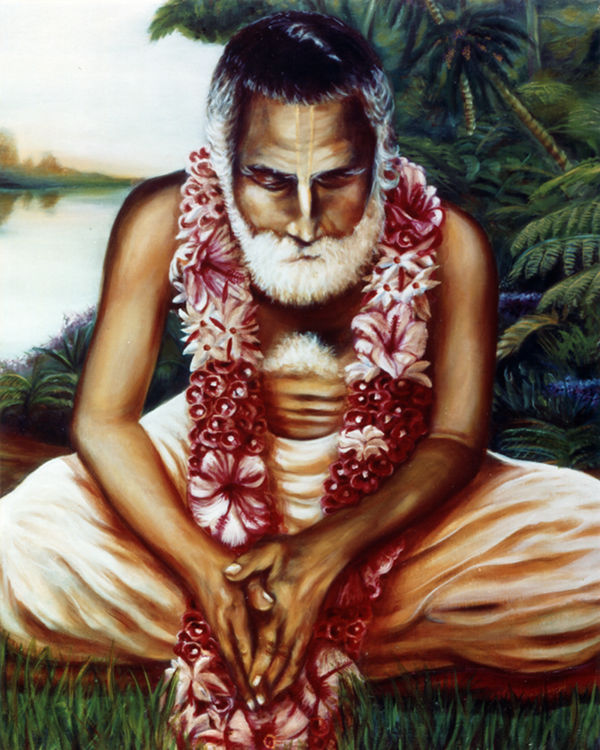
Today is the disappearance day of Gaura-kisora dasa Babaji,who was the spiritual master of Srila Bhktisiddhanta Goswami, intimate student of Srila Bhaktivinoda Thakur, and is an acharya in our line of disciplic succession, so we honor today him with this short sketch.
namo gaura-kisoraya sakshad-vairagya-murtaye
vipralambha-rasambhode padambujaya te namah
I offer my respectful obeisances unto Gaura-kisora dasa Babaji Maharaja [the spiritual master of Srila Bhaktisiddhanta Sarasvati], who is renunciation personified. He is always merged in a feeling of separation and intense love of Krishna.
In 1897 Gaura-kisora dasa Babaji came to Mayapur Navadwipa Dhama from Sri Vrndavana Dhama, where he was given the exalted title “Bhajananandi”. Seeing the transcendental behavior of Gaurakisora dasa Babaji, Srila Bhaktivinoda Thakur used him as an example of nirapeksa (indifference), the symptom of an advanced renunciate.
Gaura-kisora dasa Babaji lived a life of humility and poverty, true attributes of a Vaisnava. He never accepted material goods from anyone, wearing discarded loincloths from corpses left on the bank of the Ganges. He begged for rice, soaking it in river water, and adding only salt and chilies. Accepting no favors, he remained fully detached from all possessions.
I think we all remember very clearly where we were and what we were doing the day Srila Prabhupada first entered our lives. Many of the older devotees remember where they were when President John F. Kennedy was shot, or where they were when “The Beatles” appeared on the Ed Sullivan show. But our remembrance of Srila Prabhupada will outlive any mundane event in our lives, as our relationship with our Srila Prabhupada is an eternal relationship.
I meet my spiritual master in an unlikely place, in the Chicago O’Hare airport. I was walking through the airport just wandering aimlessly, when I was approached by a sankirtan devotee. He said “hey, you into George Harrison?” I replied “sure I just saw him in concert last night”. So he said, ”take this book and give it a read, its really far-out!” To make a long story short I took the book, the Krishna Book, and found a place to sit down and read. I couldn’t even make out some of the words it was like a foreign language. I couldn’t even pronounce some of the words like Srila Vyasadeva or Srimati Radharani. I didn’t have a clue what the book was about. But I fell in love with the picture on the cover instantly, and when I turned the book over in my hands I saw the most beautiful sight in this material world, a picture of my spiritual master Srila Prabhupada.
Sri Sri Krishna Balarama descend at Sunnyvale, California
By: Iskcontimes
The India Heritage Foundation center at Sunnyvale, California, observed the gorgeous installation ceremony of Sri Sri Krishna Balarama on Saturday, 29thNovember, 2011. The ceremony was marked with the abhishekam of Sri Krishna Balarama, Sri Sri Gaura Nitai and Srila Prabhupada deities. Hundreds of devotees assembled to witness this rare event. Amongst the devotees present were Sri Yashodanandan Dasa, senior Iskcon devotee, along with Sri Chanchalapathi Dasa and Sri Sridham Krishna Dasa from Srila Prabhupada’s Iskcon Bangalore.