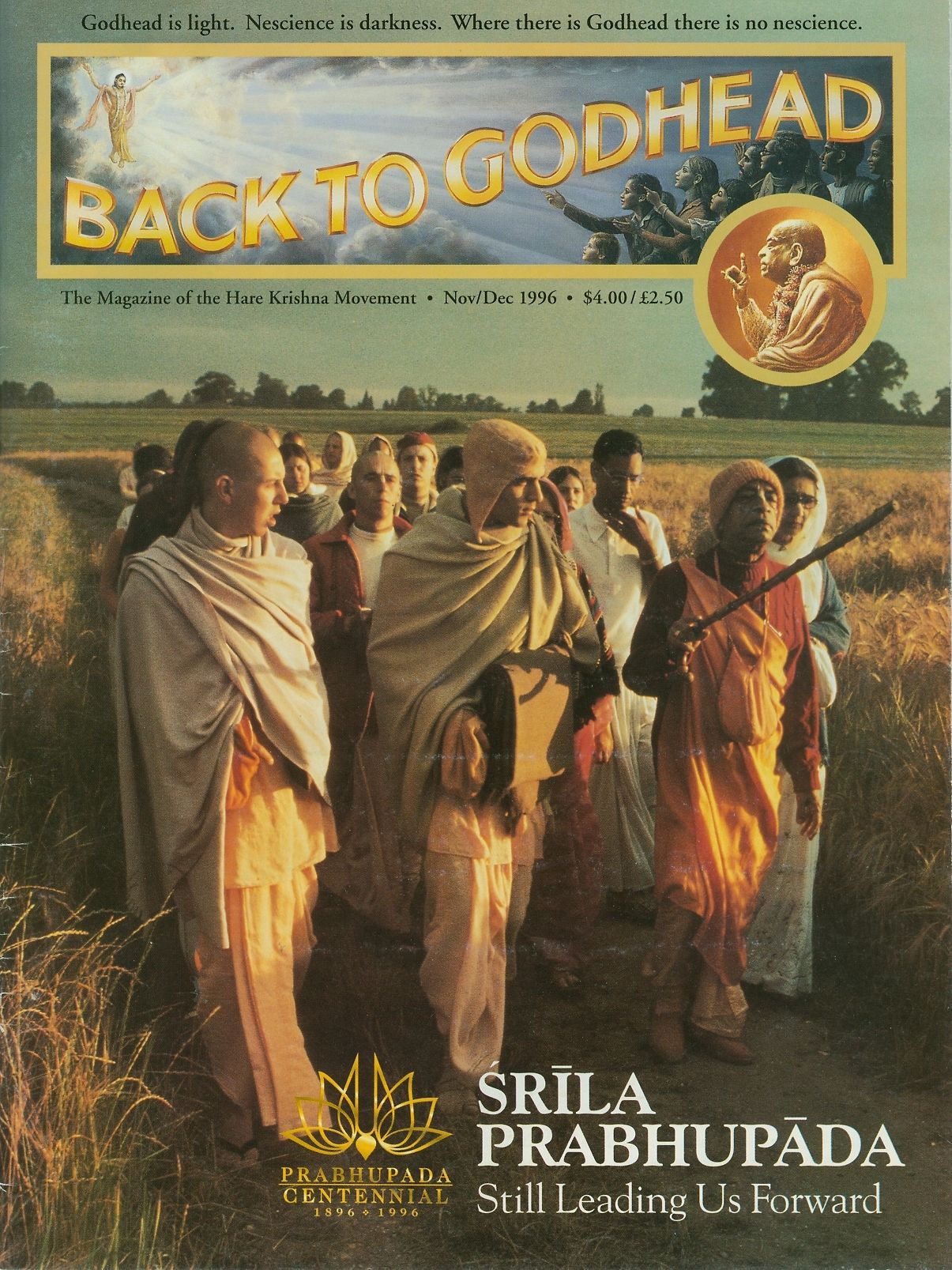
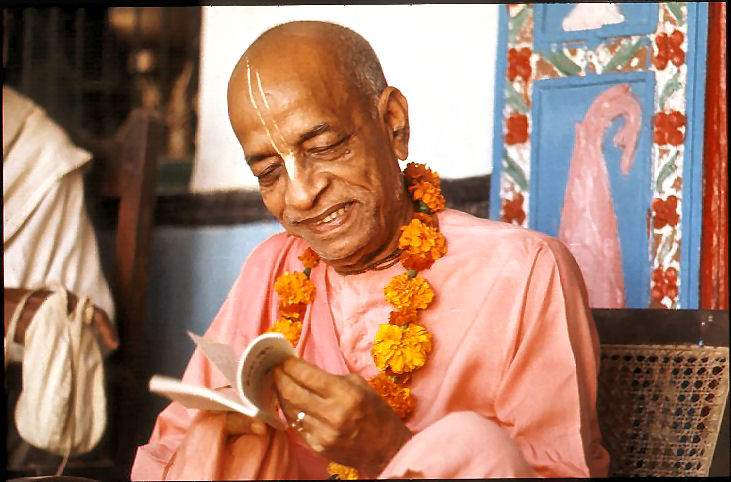
His Divine Grace A. C. Bhaktivedanta Swami Prabhupāda’s mission can be summed up in his own words:
“To preach the message of Lord Caitanya all over the world.”
Śrīla Prabhupāda saw himself as an instrument to fulfill Śrī Caitanya Mahāprabhu’s prophecy that the holy name of Kṛṣṇa would be chanted in every town and village.
He taught:
Chanting the Hare Kṛṣṇa mahā-mantra as the primary spiritual practice for this age
Bhakti-yoga (devotional service) as the natural function of the soul
Love of God (prema) as life’s ultimate goal
He often said:
“I have not manufactured anything. I am simply repeating what Kṛṣṇa has spoken.”
He established ISKCON as a vehicle, not the goal:
Śrīla Prabhupāda founded the International Society for Krishna Consciousness (ISKCON) in 1966 as a practical tool to carry out Lord Caitanya’s mission.
His intent was that ISKCON:
Remain a preaching movement, not an institutionalized religion
Train devotees in strict sādhana and character
Cooperate to distribute books, prasādam, and the holy name
He warned repeatedly that bureaucracy and power struggles could derail the mission.
I just love this song, and have been singing it every morning for the last month. Actually, I have only been singing the first two verses followed by the Hare Krishna mantra, but this song sets the mood.
All glories to Radha and Krsna and the divine forest of Vrndavana. All glories to the three presiding Deities of Vrndavana–Sri Govinda, Gopinatha, and Madana-mohana.
All glories to Syama-kunda, Radha-kunda, Govardhana Hill, and the Yamuna River (Kalindi). All glories to the great forest known as Mahavana, where Krsna and Balarama displayed all of Their childhood pastimes.
Earliest Recording of Srila Prabhupada in the Bhaktivedanta Archives
Its interesting to note that this lecture also became the Introduction to Bhagavad-gita As It Is
Prabhupāda:
om ajnana-timirandhasya jnananjana-salakaya caksur unmilitam yena tasmai sri-gurave namah
sri-caitanya-mano-‘bhistam sthapitum yena bhtu-tale svayam rupah kada mahyam dadati sva-padantikam
vande ‘ham sri-guroh sri-yuta-pada-kamalam sri-gurun vaisnavams’ ca sri-rupam sagrajatam saha-gana-raghunathanvitam tam sa jivam sadvaitam savadhutam parijana-sahitam krsna-caitanya-devam sri-radha-krsna-padan saha-gana-lalita-sri-visakhanvitams’ ca
he krsna karuna-sindho dina-bandho jagat-pate gopesa gopika kanta radha-kanta namo ‘stu te
Hare Krishna, Hare Krishna Krishna Krishna, Hare Hare Hare Rama, Hare Rama Rama Rama, Hare Hare
Bhagavad-gītā is known also Gītopaniṣad, the essence of Vedic knowledge, and one of the most important of the various Upaniṣads in Vedic literature. This Bhagavad-gītā, there are many commentations in English, and what is the necessity of another English commentation of the Bhagavad-gītā can be explained in the following way. One . . .
(break) One American lady, Mrs. Charlotte Leblanc, asked me to recommend an English edition of Bhagavad-gītā which she can read.
Of course, in America there are so many editions of English Bhagavad-gītā, but so far I have seen them, not only in America but also India, none of them can be said strictly as authoritative, because almost every one of them have expressed their own opinion through the commentation of the Bhagavad-gītā without touching the spirit of Bhagavad-gītā As It Is.
The spirit of Bhagavad-gītā is mentioned in the Bhagavad-gītā itself. It is just like this—if we want to take a particular medicine, then we have to follow the particular direction mentioned on the label of the medicine. We cannot take the particular medicine according to our own direction or by the direction of a friend, but we have to take the medicine under the direction given on the label of the bottle and as directed by the physician. Similarly, the Bhagavad-gītā also should be taken or accepted as it is directed by the speaker Himself.
…”I have read one book, Lord Jesus Christ, when he was a young boy he was very much shocked when he saw that animal-killing is going on in the synagogue. Therefore he differentiated from the Jews and he started his own religion, Christian religion. Is it not a fact? Am I right? Why… He was also a Jew. Why he deviated? Why he deviated from the Jews? Because when he saw in his young age that animals are being killed in the synagogue, he differed, “No, no, this is horrible. This should be stopped.” Therefore, his first commandment is “Thou shall not kill.” (Exodus 20:13) Am I wrong or right? Eh? That was his first impression, that people should stop killing. So who is Christian? Everyone is violating this first commandment, what to speak of other commandments. Everyone. So it is very difficult to find a real Christian. But if you violate the commandments of Christ, then what kind of Christian you are? This is our question. Who will answer this?” (Lecture by His Grace Srila Prabhupada, Srimad Bhagavatam 1.16.21 Hawaii January 17 1974)
When we were in Butler PA, this summer for thefor the 60th aniversary of Srila Prabhupada’s arrival in the USA, We visited the home of Sally Agarwal, where Srila Prabhupada first stayed as their guest when he arrived in America. We heard many sweet stories of his stay in Butler, and how Sally’s daughter referred to Srila Prabhupada as Swami Jesus.
…I am obliged to your good daughter for awarding me a good degree as SWAMIJESUS which is actually a great honour for me. Some time the Lord speaks through innocent child and I take this honour as sent by Lord Jesus through an innocent child free from all formalities of the current society. Lord Jesus preached the message of God and I have taken up the same mission, and it would be a good luck for me if I can follow the foot prints of Lord Jesus who preached the message of God in spite of all persecution. Lord Jesus is a living example how one has to suffer in this material world simply for the matter of preaching the message of God… (letter to Sally Agarwal)
click to listen the the Krishna Consciousness Happening Album
Hare Krishna, Hare Krishna, Krishna Krishna, Hare Hare/ Hare Rama, Hare Rama, Rama Rama, Hare Hare
“This Transcendental Sound Vibration is called Bhakti yoga, or the Yoga of Ecstacy. It is easy and can be practiced by anyone. Simply sit down, RELAX, and LISTEN! Listen carefully and gradually you will begin to feel like singing too. SING! As you sing, you will feel like dancing. Dance! Do the ‘Dance of Ecstacy.’ Anyone can. There is no question of learning it. You already know it! Simply raise your arms over your head and dance. RELAX, SING, DANCE. A new life of bliss and Cosmic Consciousness await you on the other side of the mirror of the mind. This life is lived in love and can most easily be reached by SINGING and DANCING. This is Bhaktiyoga, the yoga for a New Age. Try it!” (Happening Album, back cover liner notes)
“Before meeting Prabhupada and all of you, I had bought that album Prabhupada did in New York, and John and I listened to it. I remember we sang it for days, John and I, with ukulele banjos, sailing through the Greek islands chanting Hare Krishna. Like six hours we sang, because we couldn’t stop once we got going. As soon as we stopped, it was like the lights went out. It went on to the point where our jaws were aching, singing the mantra over and over and over and over and over. We felt exalted; it was a very happy time for us.” (George Harrison, Chant and Be Happy)
“It brings a state of ecstasy.” (Allen Ginsberg, New York Times)
In the following conversation, taped at George’s home in England on September 4, 1982, George reveals some memorable experiences he has had chanting Hare Krishna and describes in detail his deep personal realizations about the chanting. He reveals what factors led him to produce “The Hare Krishna Mantra” record, “My Sweet Lord,” and the LPs All Things Must Pass and Living in the Material World, which were all influenced to a great extent by the Hare Krishna chanting and philosophy. He speaks lovingly and openly about his association with His Divine Grace A. C. Bhaktivedanta Swami Prabhupada, Founder-Acarya (spiritual master) of the Hare Krishna movement. In the following interview George speaks frankly about his personal philosophy regarding the Hare Krishna movement, music, yoga, reincarnation, karma, the soul, God, and Christianity. The conversation concludes with his fond remembrances of a visit to the birthplace of Lord Krishna in Vrndavana, India, home of the Hare Krishna mantra, and with George discussing some of his celebrity friends’ involvement with the mantra now heard and chanted around the world.
I remember back many years ago, when I was a new devotee traveling with the RDTSP, we attended a Rainbow Festival in Oregon. There were many hippy type personalities, and aspiring spiritualists, and I meet this one man, who looked like Jesus, with long hair and sandals, with a sign around his neck that said, “I Am God”.
So I said to him, “If you are God, then show me your Universal Form”. It was stunned silence. He could not reply. I guess maybe he wasn’t God after all. Or I didn’t have the divine vision to see. But either way, he wasn’t still wearing the sign at the end of the day.
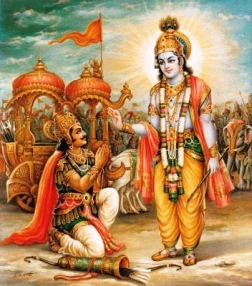
O greatest of all personalities, O supreme form, though I see here before me Your actual position, I yet wish to see how You have entered into this cosmic manifestation. I want to see that form of Yours. (Bg. 11. 3)
If You think that I am able to behold Your cosmic form, O my Lord, O master of all mystic power, then kindly show me that universal self. (Bg 11 .4)
The Blessed Lord said: My dear Arjuna, O son of Pṛthā, behold now My opulences, hundreds of thousands of varied divine forms, multicolored like the sea. (Bg 11. 5)
But you cannot see Me with your present eyes. Therefore I give to you divine eyes by which you can behold My mystic opulence. (Bg. 11. 8)
Arjuna saw in that universal form unlimited mouths and unlimited eyes. It was all wondrous. The form was decorated with divine, dazzling ornaments and arrayed in many garbs. He was garlanded gloriously, and there were many scents smeared over His body. All was magnificent, all-expanding, unlimited. This was seen by Arjuna. (Bg 11. 10-11
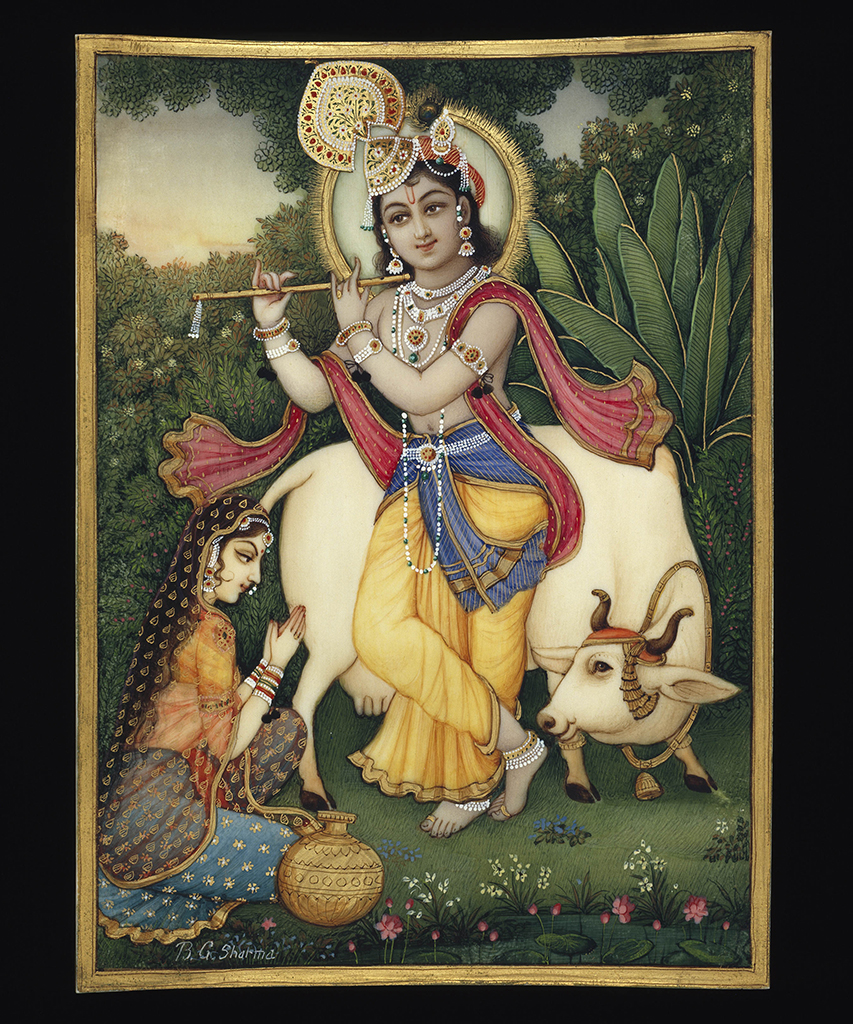
One of my favorite Krishna Painters is B. G. Sharma. Although he passed away in November 2007 at the age of 83, the B. G. Sharma Art Gallery in Udaipur, Rajasthan, remains open to the public and displays a vast collection of his original miniature and religious paintings.
Krishna and Cows
Krishna and cows have always been together. In His original form in the spiritual world, Krishna is a cowherd boy in the agricultural community of Goloka (“cow planet”) Vrindavan, where He keeps unlimited, transcendental surabhi cows.
When He descends to earth, Krishna brings a replica of Vrindavan with Him, and He spends His childhood tending cows and calves while playing in the pasturing grounds with His friends. His example shows the importance of cows to human society, the practical benefits of caring for them, and the advantages of an agrarian economy based on cooperation between man and cows.
Krishna established the original economic system, varnashrama-dharma, for the spiritual and material progress of all living beings. Protected cows are a major component of this system; bulls and oxen till the fields, and cows give milk. Cows are considered one of the mothers of humankind because cow’s milk—when properly prepared—is perfectly suited to maintaining human life. Milk can be made into a wide variety of preparations, such as yogurt and butter, which are also essential ingredients for use in the ceremonial worship of Krishna in His transcendental Deity form.
In His famous book of instructions for humankind, the Bhagavad-gita, Krishna mentions cow protection as one of the prime duties of any civilized society. The Bible also tells us that cow-killing is as punishable as killing a human being.
Kṛṣṇa had many thousands of cows, and they were divided into groups according to their colors. They were also differently named according to color. When He would prepare to return from the pasturing ground, He would gather all the cows. As Vaiṣṇavas count 108 beads, which represent the 108 individual gopīs, so Kṛṣṇa would also count on 108 beads to count the different groups of cows. (Krishna book CH 35)
The cows taken care of by Kṛṣṇa had different names, and Kṛṣṇa would call them with love. After hearing Kṛṣṇa calling, the cows would immediately respond by mooing, and the boys would enjoy this exchange to their hearts’ content. They would all imitate the sound vibrations made by the different kinds of birds, especially the cakoras, peacocks, cuckoos and bhāradvājas. (Krishna book, CH 15)
Arsha Prayoga – Part One April 26, 2010 by Locanananda Prabhu
…For those who saw the Hare Krishna movement spread from city to city and from country to country, it was clear that the original version of Srila Prabhupada’s books was full of spiritual potency and did not require to be changed in any way for his words to act upon the hearts of the conditioned souls…
The question as to whether the writings of the acarya may or may not be revised by his disciples after his disappearance is answered by the rule of “arsa prayoga”. This principle states that one should not see mistakes in what the spiritual master has written or think that his writings may be changed to make them more effective or politically correct. To preserve his teachings in their originally published form is the way by which the acarya is honored, and to do otherwise is to dishonor him. That is the rule of “arsa prayoga”, a principle that devoted followers of a bona fide spiritual master must adhere to without deviation.
The rationale for changing Srila Prabhupada’s books was based on a series of false arguments, many of which were defeated by Srila Prabhupada himself as this article will show. To justify their actions, the BBT editors created the illusion that Srila Prabhupada’s books were defective and in need of extensive editing even though they knew His Divine Grace had never authorized anyone to revise his books after his disappearance. Subsequent to his departure, they conveniently overlooked the principle of “arsa prayoga” and proceeded to do exactly what vaisnava tradition strictly prohibits.
…So far Narada Muni is concerned, in His previous life He was a maidservant’s son, but by the mercy of the devotees He later on became siddha and next life He appeared as Narada with complete freedom to move anywhere by the grace of the Lord. So even though He was in his previous life a maidservant’s son there was no impediment in the achievement of His perfect spiritual life. Similarly any living entity who is conditioned can achieve the perfectional stage of life by the above mentioned processes and the vivid example is Narada Muni.
So I do not know why you have asked about my previous life. Whether I was subjected to the laws of material nature? So, even though accepting that I was subjected to the laws of material nature, does it hamper in my becoming Spiritual Master? What is your opinion? From the life of Narada Muni it is distinct that although He was a conditioned soul in His previous life, there was no impediment of His becoming the Spiritual Master. This law is applicable not only to the Spiritual Master, but to every living entity.
Letter to: Tamala Krsna Los Angeles 21 June, 1970
Paris My Dear Tamala,
Please accept my blessings. I beg to acknowledge receipt of your letter dated 18th June, 1970, sent by Special Delivery Air Mail.
Krsna philosophy is understood as it is stated in the Vedas:
Yasya deve para bhakti yatha deve tatha gurau tasya ete kathitha hi artha prakasante mahatmanah
“One who has got unflinching faith in the Supreme Lord and similar faith in his Spiritual Master to him only the imports of Vedic knowledge become revealed.”
A Spiritual Master is always liberated. In any condition of His life He should not be mistaken as ordinary human being. This position of a Spiritual Master is achieved by three processes. One is called sadhana siddha. That means one who is liberated by executing the regulative principle of devotional service. Another is krpa siddha, one who is liberated by the mercy of Krsna or His devotee. And another is nitya siddha who is never forgetful of Krsna throughout his whole life. These are the three features of the perfection of life.
I first ran across this book some twenty years ago, although it was printed in 1970, I was surprised to learn there was a handbook for devotees. I found it to be a treasure house of basic guidelines for developing our Krsna consciousness, as well as presenting the philosophy very simply. Nice little book.
Introduction This is the first annual edition of The Krsna Consciousness Handbook. The International Society for Krishna Consciousness (ISKCON) was founded in 1966 by His Divine Grace A.C. Bhaktivedanta Swami Prabhupada and is now becoming firmly established, with centers in thirty major cities around the world and world headquarters in Los Angeles,California. The goal of the Society’s members is to attain love of God by following the principles of bhakti-yoga,as ·taught by the Vedic scriptures and the disciplic succession of spiritual masters, and to spread love of God to all people through the process of sankirtana (public chanting of the holy names of God). Another important goal of the Society is to present authoritative literature on the science of God in English and other major languages.
Here is another word for your vaisnava vocabulary; Acaryopasanam.
In Bhagavad-gita, Thirteenth Chapter, it is clearly stated that one should execute devotional service and advance on the path of spiritual knowledge by accepting the acarya.Ācāryopāsanam: one should worship an acarya, a spiritual master who knows things as they are. The spiritual master must be in the disciplic succession from Krsna. (from purport SB 3.29.17)
We can understand from Srila Prabhupada, that there are huge gaps in the disciplic succession, but we need to follow the prominent Acarya.
“So these gaps do not hamper from understanding the parampara system. We have to pick up the Prominent Acarya, and follow from him.” (letter to Dayananda April12,1968)
The Kṛṣṇa consciousness movement is conducted under the supervision of Śrīla Rūpa Gosvāmī. The Gauḍīya Vaiṣṇavas, or Bengali Vaiṣṇavas, are mostly followers of Śrī Caitanya Mahāprabhu, of whom the six Gosvāmīs of Vṛndāvana are direct disciples. Therefore Śrīla Narottama dāsa Ṭhākura has sung:
rūpa-raghunātha-pade ha-ibe ākuti kabe hāma bujhaba se yugala-pīriti
“When I am eager to understand the literature given by the Gosvāmīs, then I shall be able to understand the transcendental loving affairs of Rādhā and Kṛṣṇa.” Śrī Caitanya Mahāprabhu appeared in order to bestow upon human society the benediction of the science of Kṛṣṇa. The most exalted of all the activities of Lord Kṛṣṇa are His pastimes of conjugal love with the gopīs. Śrī Caitanya Mahāprabhu appeared in the mood of Śrīmatī Rādhārāṇī, the best of the gopīs. Therefore, to understand the mission of Lord Śrī Caitanya Mahāprabhu and follow in His footsteps, one must very seriously follow in the footsteps of the six Gosvāmīs—Śrī Rūpa, Sanātana, Bhaṭṭa Raghunātha, Śrī Jīva, Gopāla Bhaṭṭa and Dāsa Raghunātha.
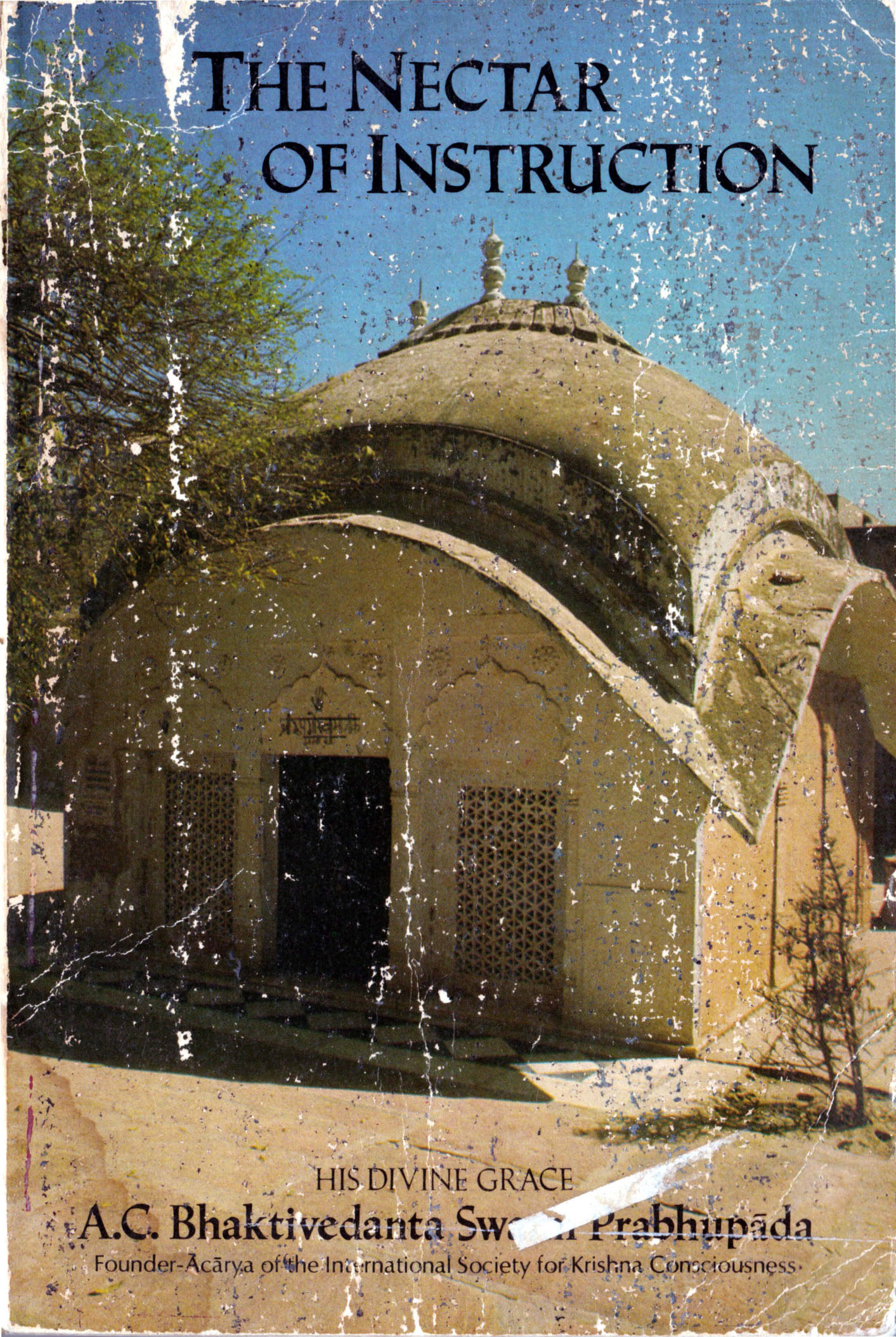
Śrī Rūpa Gosvāmī was the leader of all the Gosvāmīs, and to guide our activities he gave us this Upadeśāmṛta (The Nectar of Instruction) to follow. As Śrī Caitanya Mahāprabhu left behind Him the eight verses known as Śikṣāṣṭaka, Rūpa Gosvāmī gave us Upadeśāmṛta so that we may become pure Vaiṣṇavas.
In all spiritual affairs, one’s first duty is to control his mind and senses. Unless one controls his mind and senses, one cannot make any advancement in spiritual life. Everyone within this material world is engrossed in the modes of passion and ignorance. One must promote himself to the platform of goodness, sattva-guṇa, by following the instructions of Rūpa Gosvāmī, and then everything concerning how to make further progress will be revealed.
Advancement in Kṛṣṇa consciousness depends on the attitude of the follower. A follower of the Kṛṣṇa consciousness movement should become a perfect gosvāmī. Vaiṣṇavas are generally known as gosvāmīs. In Vṛndāvana, this is the title by which the director of each temple is known. One who wants to become a perfect devotee of Kṛṣṇa must become a gosvāmī. Go means “the senses,” and svāmī means “the master.” Unless one controls his senses and mind, one cannot become a gosvāmī. To achieve the highest success in life by becoming a gosvāmī and then a pure devotee of the Lord, one must follow the instructions known as Upadeśāmṛta, which have been given by Śrīla Rūpa Gosvāmī. Śrīla Rūpa Gosvāmī has given many other books, such as Bhakti-rasāmṛta-sindhu, Vidagdha-mādhava and Lalita-mādhava, but Upadeśāmṛta constitutes the first instructions for neophyte devotees. One should follow these instructions very strictly. Then it will be easier to make one’s life successful. Hare Kṛṣṇa.
A.C. Bhaktivedanta Swami September 20, 1975 Viśvarūpa-mahotsava Kṛṣṇa-Balarāma Mandira Ramaṇa-reti Vṛndāvana, India
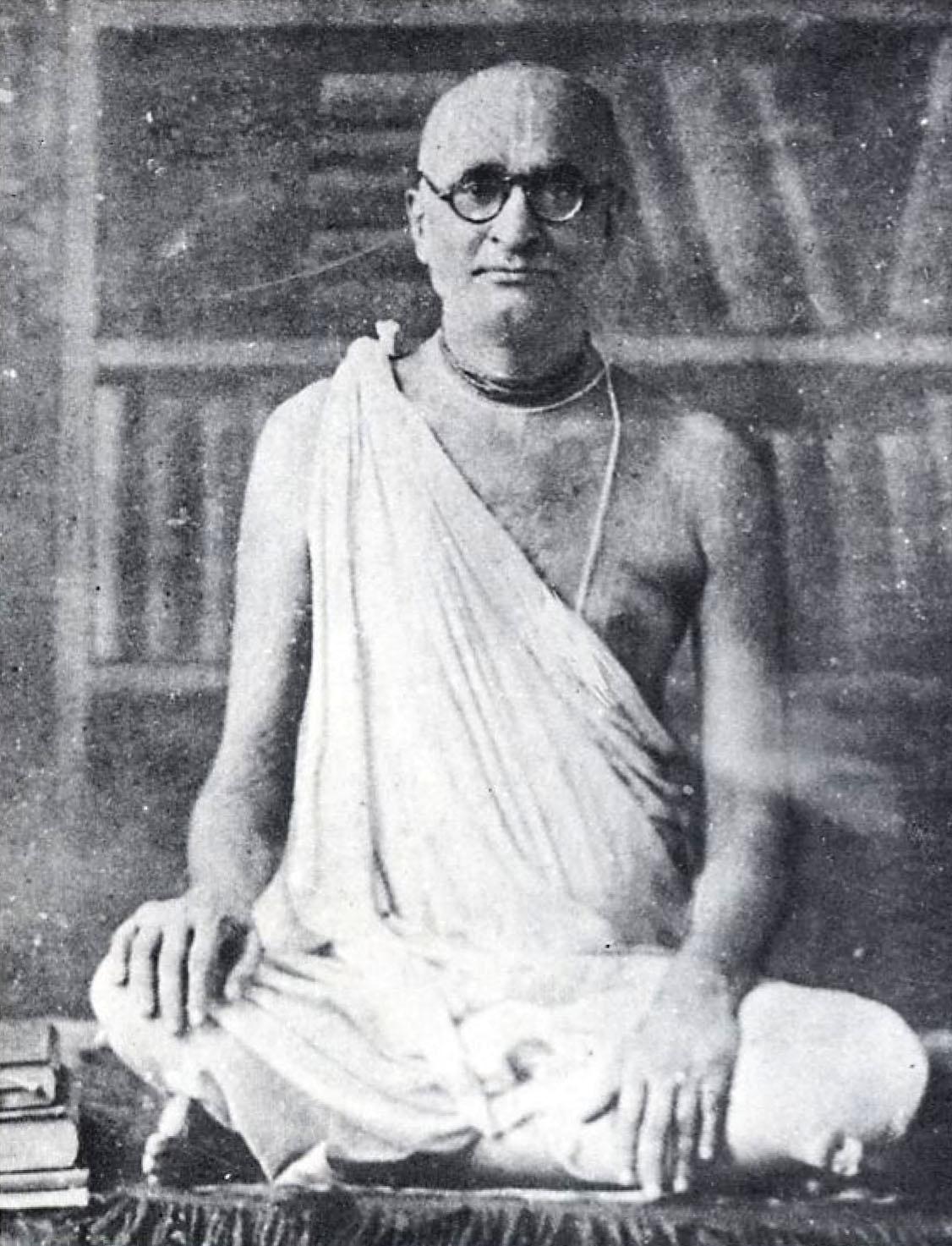
His Divine Grace Śrīla Bhaktisiddhānta Sarasvatī Gosvāmī Prabhupāda’s Disappearance Day, Lecture By His Divine Grace A. C. Bhaktivedanta Swami Prabhupāda Los Angeles, December 13, 1973
Prabhupāda:
nama oṁ viṣṇu-pādāyakṛṣṇa-preṣṭhāya bhūtaleśrīmate bhaktisiddhāntasarasvatīti nāmine
Bhaktisiddhānta Sarasvatī Ṭhākura passed away from this material world on 31st December, 1936. So almost forty years past. So there are two phases, prakaṭa and aprakaṭa, appearance and disappearance. So we have nothing to lament on account of disappearance because Kṛṣṇa and Kṛṣṇa’s devotee… Not only devotees, even the nondevotees, nobody disappears. Nobody disappears because every living entity… As Kṛṣṇa is eternal… It is confirmed in the Vedic literature, nityo nityānāṁ cetanaścetanānām. The description of the Supreme Lord is that He is also nitya, eternal, and the living entities are also eternal. But He is the chief eternal. Nityo nityānāṁ cetanaś cetanānām. So qualitatively, there is no difference between Kṛṣṇa and the living entities. And quantitatively, there is difference. What is the difference between nitya, the singular number nitya, and the plural number nitya? The plural number nitya is subordinate, eternal servants of the singular number nitya. Just like if you want to serve somebody, so the master is also exactly like you. He has got two hands, two legs, or the same sentiments. He also eats. Everything is same there. But the difference is the master and the servant. That’s all. Otherwise, equal in every respect.
The following are just a few of the many quotes from Srila Prabhupada which encourage us to approach Krishna through the mercy of Srimati Radharani, Krishna’s eternal consort. For those of us who feel that there is no hope of making spiritual progress in this lifetime, Srimati Radharani, Who is compassion personified, kindly comes to our rescue if we can humbly invoke Her divine blessings.
“I offer my respects to Radharani whose bodily complexion is like molten gold and who is the Queen of Vrndavana. You are the daughter of King Vrsabhanu, and You are very dear to Lord Krishna.” (Sri Radha Pranama)
“I emphatically say to you, O brothers, you will obtain your good fortune from the Supreme Lord Krishna only when Srimati Radharani becomes pleased with you.”(Prayer to the Lotus Feet of Krishna, September 13, 1965)
“Actually, because Krishna is the Supreme Personality of Godhead, it is very difficult to approach Him. But the devotees, taking advantage of His compassionate nature, which is represented by Radharani, always pray to Radharani for Krishna’s compassion.” (Nectar of Devotion, Chapter 22)
“There is no comparison to Radharani’s beauty and the luster of Her transcendental body. The so-called beauty of the moon has fallen on the ground in the presence of Radharani’s beauty.” (From Vrindavana by Srila Narottama das Thakura)
“The beauty of Srimati Radharani’s eyes forcibly devours the beauty of newly grown blue lotus flowers, and the beauty of Her face surpasses that of an entire forest of fully blossomed lotuses. Her bodily luster seems to place even gold into a painful situation. Thus the wonderful, unprecedented beauty of Srimati Radharani is awakening in Vrindavana.” (Caitanya-caritamrita Antya 1.169)
Śrī Caitanya Mahaprabhu is none other than the combined form of Sri Radha and Krsna.
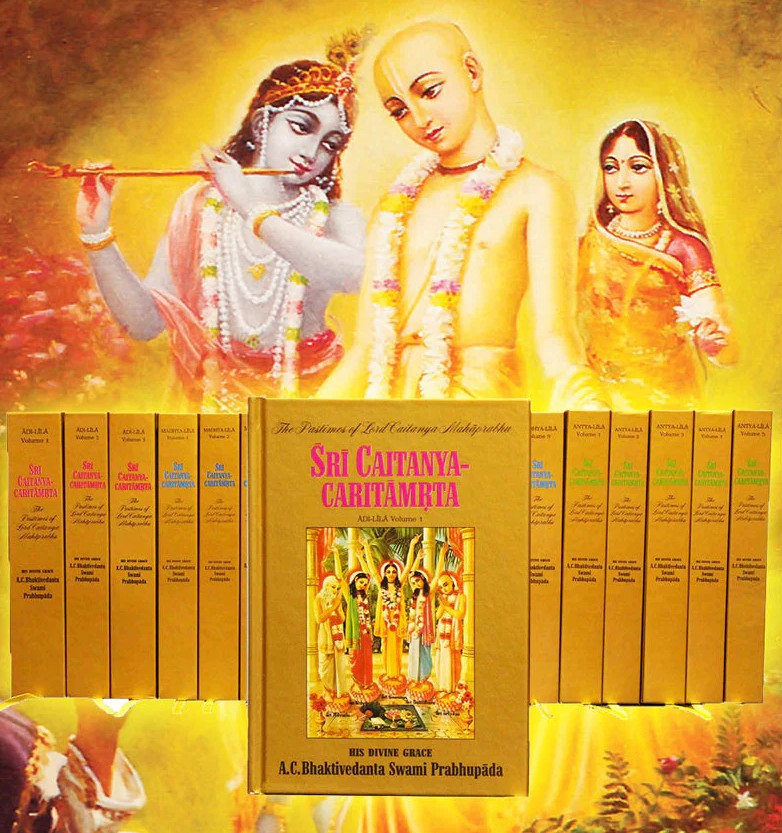
This morning I happened to open the Sri Caitanya-caritamrta Vol.1, and just began reading from the Preface. Every time I read from Srila Prabhupada’s books, something important is revealed, or something important is remembered.This morning I was reminded of the six guidelines for the process of surrender.
A pure devotee is a soul who is forever surrendered to the Lord, just as a child is surrendered to his parents or an animal to its master. In the surrendering process, one should: (1) accept things favorable for discharging devotional service, (2) reject things unfavorable, (3) believe firmly in the Lord’s protection, (4) feel exclusively dependent on the mercy of the Lord, (5) have no interest separate from the interest of the Lord, and (6) always feel oneself meek and humble.










 The Hare Krishna Movement