25 Aug 2011
by The Hare Krishna Movement
in Krishna, Spiritual World, Srimad Bhagavatam
Tags: bhakti-vedantas, His Divine Grace A.C. Bhaktivedanta Swami Prabhupada, Kali, Krsna, Sri Narada, Srimad Bhagavatam, transcendental pastimes, Vyasadeva

Srimad Bhagavatam
By His Divine Grace A.C. Bhaktivedanta Swami Prabhupada
Canto 1, Chapter 5, Text 26
The Lord descends on this material world out of His causeless mercy and displays His various transcendental pastimes as a human being so that human beings attracted towards Him become able to go back to Godhead.
O Vyāsadeva, in that association and by the mercy of those great Vedāntists, I could hear them describe the attractive activities of Lord Kṛṣṇa And thus listening attentively, my taste for hearing of the Personality of Godhead increased at every step.
Lord Śrī Kṛṣṇa, the Absolute Personality of Godhead, is attractive not only in His personal features, but also in His transcendental activities. It is so because the Absolute is absolute by His name, fame, form, pastimes, entourage, paraphernalia, etc. The Lord descends on this material world out of His causeless mercy and displays His various transcendental pastimes as a human being so that human beings attracted towards Him become able to go back to Godhead. Men are naturally apt to hear histories and narrations of various personalities performing mundane activities, without knowing that by such association one simply wastes valuable time and also becomes addicted to the three qualities of mundane nature. Instead of wasting time, one can get spiritual success by turning his attention to the transcendental pastimes of the Lord. By hearing the narration of the pastimes of the Lord, one contacts directly the Personality of Godhead, and, as explained before, by hearing about the Personality of Godhead, from within, all accumulated sins of the mundane creature are cleared. Thus being cleared of all sins, the hearer gradually becomes liberated from mundane association and becomes attracted to the features of the Lord. Nārada Muni has just explained this by his personal experience. The whole idea is that simply by hearing about the Lord’s pastimes one can become one of the associates of the Lord. Nārada Muni has eternal life, unlimited knowledge and unfathomed bliss, and he can travel all over the material and spiritual worlds without restriction. One can attain to the highest perfection of life simply by attentive hearing of the transcendental pastimes of the Lord from the right sources, as Śrī Nārada heard them from the pure devotees (bhakti-vedāntas) in his previous life. This process of hearing in the association of the devotees is especially recommended in this age of quarrel (Kali).
12 Aug 2011
by The Hare Krishna Movement
in A.C. Bhaktivedanta Swami Prabhupada, Balarama, Spiritual World, Srila Prabhupada's Books
Tags: Balarama, gopis, Lord Balarama Visits Vrndavana, rasa dance, Srila Prabhupada, Srimad Bhagavatam, Vrindavan forest

Lord Balarāma Visits Vṛndāvana
Lord Balarāma could, of course, understand the ecstatic feelings of the gopīs, and therefore He wanted to pacify them. He was expert in presenting an appeal, and thus, treating the gopīs very respectfully, He began to narrate the stories of Kṛṣṇa so tactfully that the gopīs became satisfied. In order to keep the gopīs in Vṛndāvana satisfied, Lord Balarāma stayed there continually for two months, namely the months of Caitra (March-April) and Vaiśākha (April-May). For those two months He kept Himself among the gopīs, and He passed every night with them in the forest of Vṛndāvana in order to satisfy their desire for conjugal love. Thus Balarāma also enjoyed the rāsa dance with the gopīs during those two months.
Lord Balarāma Visits Vṛndāvana
From; Kṛṣṇa, the Supreme Personality of Godhead
By His Divine Grace A. C. Bhaktivedanta Swami Prabhupada
Lord Balarāma became very anxious to see His father and mother, Mahārāja Nanda and Yaśodā. Therefore He started for Vṛndāvana on a chariot with great enthusiasm. The inhabitants of Vṛndāvana had been anxious to see Kṛṣṇa and Balarāma for a very long time. When Lord Balarāma returned to Vṛndāvana, all the cowherd boys and the gopīs had grown up; but still, on His arrival, they all embraced Him, and Balarāma embraced them in reciprocation. After this He came before Mahārāja Nanda and Yaśodā and offered His respectful obeisances unto them. In response, mother Yaśodā and Nanda Mahārāja offered their blessings unto Him. They addressed Him as Jagadīśvara, or the Lord of the universe who maintains everyone. The reason for this was that both Kṛṣṇa and Balarāma maintain all living entities, and yet Nanda and Yaśodā were put into such difficulties on account of Their absence. Feeling like this, they embraced Balarāma and, seating Him on their laps, began their perpetual crying, wetting Balarāma with their tears. Lord Balarāma then offered His respectful obeisances to the elderly cowherd men and accepted the obeisances of the younger cowherd men. Thus, according to their different ages and relationships, Lord Balarāma exchanged feelings of friendship with them. He shook hands with those who were His equals in age and friendship, and with loud laughing embraced each one of them.
More
05 Aug 2011
by The Hare Krishna Movement
in Srila Prabhupada, Srimad Bhagavatam
Tags: Book Bhagavata, Devotee Bhagavata, devotional service, Divinity and Divine Service, Srila Prabhupada, Srimad Bhagavatam, transcendental knowledge
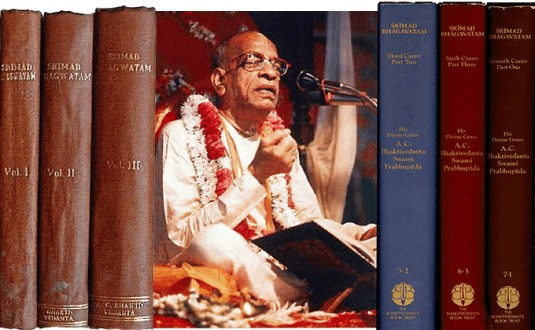
The message of the Book Bhagavata is received from the devotee Bhagavata, Srila Prabhupada, and under His guidance the devotee is able to progress in devotional service. By such sincere association the disciple is able to receive transcendental knowledge very easily.
Srimad Bhagavatam
By His Divine Grace A. C. Bhaktivedanta Swami Prabhupada
Chapter 3 Divinity and Divine Service
naṣṭa-prāyeṣv abhadreṣu
nityaṁ bhāgavata-sevayā
bhagavaty uttama-śloke
bhaktir bhavati naiṣṭhikī
By regular attendance in classes on the Bhāgavatam and by rendering of service to the pure devotee, all that is troublesome to the heart is almost completely destroyed, and loving service unto the Personality of Godhead, who is praised with transcendental songs, is established as an irrevocable fact.
Here is the remedy for eliminating all inauspicious things within the heart which are considered to be obstacles in the path of self-realization. The remedy is the association of the Bhāgavatas. There are two types of Bhāgavatas, namely the book Bhāgavata and the devotee Bhāgavata. Both the Bhāgavatas are competent remedies, and both of them or either of them can be good enough to eliminate the obstacles. A devotee Bhāgavata is as good as the book Bhāgavata because the devotee Bhāgavata leads his life in terms of the book Bhāgavata and the book Bhāgavata is full of information about the Personality of Godhead and His pure devotees, who are also Bhāgavatas. Bhāgavata book and person are identical.
The devotee Bhāgavata is a direct representative of Bhagavān, the Personality of Godhead. So by pleasing the devotee Bhāgavata one can receive the benefit of the book Bhāgavata. Human reason fails to understand how by serving the devotee Bhāgavata or the book Bhāgavata one gets gradual promotion on the path of devotion. But actually these are facts explained by Śrīla Nāradadeva, who happened to be a maidservant’s son in his previous life. The maidservant was engaged in the menial service of the sages, and thus he also came into contact with them. And simply by associating with them and accepting the remnants of foodstuff left by the sages, the son of the maidservant got the chance to become the great devotee and personality Śrīla Nāradadeva. These are the miraculous effects of the association of Bhāgavatas. And to understand these effects practically, it should be noted that by such sincere association of the Bhāgavatas one is sure to receive transcendental knowledge very easily, with the result that he becomes fixed in the devotional service of the Lord. The more progress is made in devotional service under the guidance of the Bhāgavatas, the more one becomes fixed in the transcendental loving service of the Lord. The messages of the book Bhāgavata, therefore, have to be received from the devotee Bhāgavata, and the combination of these two Bhāgavatas will help the neophyte devotee to make progress on and on.
02 Aug 2011
by The Hare Krishna Movement
in Books by Srila Prabhupada, The Hare Krishna Movement
Tags: Bhagavata Purana, Kali, Lord Krsna, Srila Prabhupada, Srimad Bhagavatam

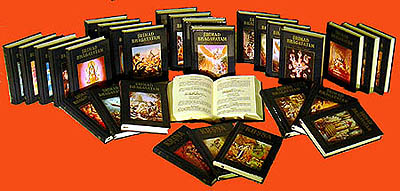
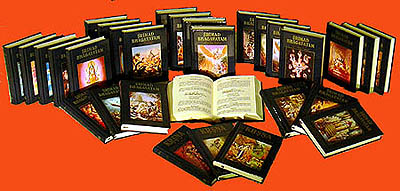
Srimad Bhagavatam Compact 30 Vol 1977 Edition
Cantos 1-9, plus the Original Krsna Book in 3 Volumes comprising the 10th Canto
This 12,000 page, 30 vol. set, comes in High Quality Hard Bound 5×7 size. with over 600 beautiful full color plates.
For a limited time selling at the reduced Wholesale rate of $149.95
No home library is complete without a set.
Get one today at http://www.theharekrishnamovement.com
And Śrīmad-Bhāgavatam is the summum bonum of life, Lord Śrī Kṛṣṇa personified. We must therefore accept Śrīmad-Bhāgavatam as the direct representation of Lord Kṛṣṇa. One who can see Śrīmad-Bhāgavatam can see also Lord Śrī Kṛṣṇa in person. They are identical.
Srimad Bhagavatam
Canto 1, Chapter 3, Text 43
By His Divine Grace A. C. Bhaktivedanta Swami Prabhupada
kṛṣṇe sva-dhāmopagate
dharma-jñānādibhiḥ saha
kalau naṣṭa-dṛśām eṣa
purāṇārko ‘dhunoditaḥ
SYNONYMS
kṛṣṇe—in Kṛṣṇa’s; sva-dhāma—own abode; upagate—having returned; dharma—religion; jñāna—knowledge; ādibhiḥ—combined together; saha—along with; kalau—in the Kali-yuga; naṣṭa-dṛśām—of persons who have lost their sight; eṣaḥ—all these; purāṇa-arkaḥ—the Purāṇa which is brilliant like the sun; adhunā—just now; uditaḥ—has arisen.
This Bhāgavata Purāṇa is as brilliant as the sun, and it has arisen just after the departure of Lord Kṛṣṇa to His own abode, accompanied by religion, knowledge, etc. Persons who have lost their vision due to the dense darkness of ignorance in the age of Kali shall get light from this Purāṇa.
More
01 Aug 2011
by The Hare Krishna Movement
in Krsna is the Source of All Incarnations, Vamanadeva
Tags: dwarf-brahman, fifteenth incarnation, Krsna Is The Source of All Incarnations, Maharaja Bali, SB 1.3.19, SB 8.18, Srila Prabhupada, Srimad Bhagavatam, Vamana, Vamanadeva

Lord Vāmanadeva, the Dwarf Incarnation
Srimad Bhagavatam: Canto 8: “Withdrawal of the Cosmic Creations”
Chapter 18, Text 1-32, Translations & Purports
By His Divine Grace A. C. Bhaktivedanta Swami Prabhupada
Chapter Eighteen
Lord Vāmanadeva, the Dwarf Incarnation
TEXT 1
Śukadeva Gosvāmī said: After Lord Brahmā had thus spoken, glorifying the Supreme Lord’s activities and prowess, the Supreme Personality of Godhead, who is never subject to death like an ordinary living being, appeared from the womb of Aditi. His four hands were decorated with a conchshell, club, lotus and disc, He was dressed in yellow garments, and His eyes appeared like the petals of a blooming lotus.
PURPORT
The word amṛta-bhūḥ is significant in this verse. The Lord sometimes appears like an ordinary child taking birth, but this does not mean that He is subject to birth, death or old age. One must be very intelligent to understand the appearance and activities of the Supreme Lord in His incarnations. This is confirmed in Bhagavad-gītā (4.9): janma karma ca me divyam evaṁ yo vetti tattvataḥ. One should try to understand that the Lord’s appearance and disappearance and His activities are all divyam, or transcendental. The Lord has nothing to do with material activities. One who understands the appearance, disappearance and activities of the Lord is immediately liberated. After giving up his body, he never again has to accept a material body, but is transferred to the spiritual world (tyaktvā dehaṁ punar janma naiti mām eti so ’rjuna [Bg. 4.9]).
TEXT 2
The body of the Supreme Personality of Godhead, blackish in complexion, was free from all inebrieties. His lotus face, decorated with earrings resembling sharks, appeared very beautiful, and on His bosom was the mark of Śrīvatsa. He wore bangles on His wrists, armlets on His arms, a helmet on His head, a belt on His waist, a sacred thread across His chest, and ankle bells decorating His lotus feet.
TEXT 3
An uncommonly beautiful garland of flowers decorated His bosom, and because the flowers were extremely fragrant, a large group of bees, making their natural humming sounds, invaded them for honey. When the Lord appeared, wearing the Kaustubha gem on His neck, His effulgence vanquished the darkness in the home of the Prajāpati Kaśyapa.
More
09 Jul 2011
by The Hare Krishna Movement
in Ananda devi dasi, Diksha, Guru & Disciple, Quotes by Srila Prabhupada, Siksa
Tags: Ananda devi dasi, association with the spiritual master, guru, instructions of the spiritual master, spiritual master, Srila Prabhupada, Srimad Bhagavatam, vani, vaphu
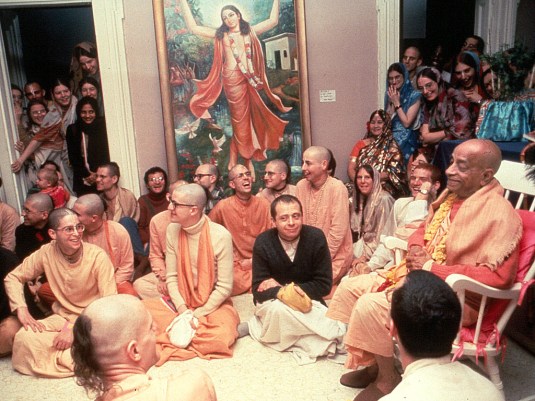
Srila Prabhupada is our Spiritual Master, the Bona Fide Uttama-Adhikari, the current link to the Disciplic succession, the all merciful, all compassionate Diksa Guru, impartially distributing Sri Caitanya’s mercy. And Initiating the general population into the cult of Devotional Service to Lord Krsna.
Our relationship with Srila Prabhupada is a spiritual relationship, it is not based on whether or not we were physically present simultaneously. Spiritual inspiration comes from within the heart, wherein the Supreme Personality of Godhead, in His Paramatma feature, is always sitting with all His devotees and associates. The Spiritual Master is the external manifestation of the Supersoul and is simultaneously manifest within the heart of the sincere disciple seated with the Supersoul and accompanying the disciple everywhere.
The disciple and spiritual master are never separated because the spiritual master always keeps company with the disciple as long as the disciple follows strictly the instructions of the spiritual master.
“In the absence of physical presentation of the Spiritual Master, the vaniseva is more important. My Spiritual Master Saraswati Goswami, may appear to be physically not present but still I try to serve His Instruction, I never feel separated from Him” (Srila Prabhupada Lecture, August 22, 1970)
More
24 Jun 2011
by The Hare Krishna Movement
in Devotional Service, Nectar of Devotion
Tags: A.C. Bhaktivedanta Swami, Bhakti-rasamrta-sindhu, characteristics of pure devotional service, Krsna, Nectar of Devotion, Srila Rupa Goswami, Srimad Bhagavatam
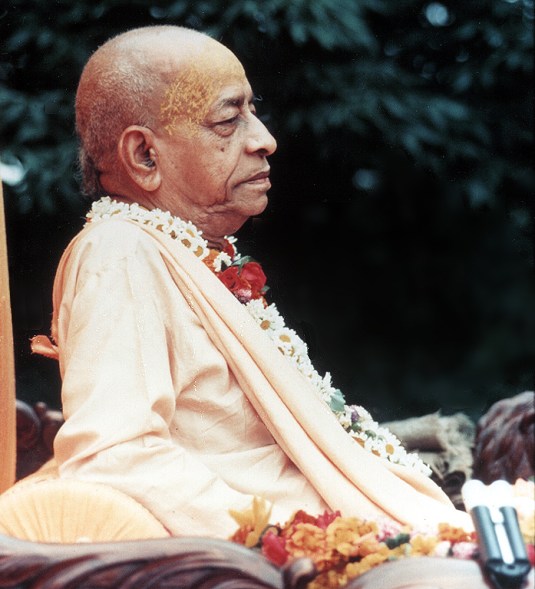
Nectar of Devotion
By: His Divine Grace A. C. Bhaktivedanta Swami Prabhupada
Chapter One
Characteristics of Pure Devotional Service
In Śrīmad-Bhāgavatam, Third Canto, Twenty-ninth Chapter, verses 12 and 13, Śrīla Kapiladeva, while instructing His mother, has given the following characteristics of pure devotional service: “My dear mother, those who are My pure devotees, and who have no desire for material benefit or philosophical speculation, have their minds so much engaged in My service that they are never interested in asking Me for anything—except to be engaged in that service. They do not even beg to live in My abode with Me.”
There are five kinds of liberation, namely to become one with the Lord, to live with the Supreme Lord on the same planet, to have the same features as the Lord, to enjoy the same opulences as the Lord and to live as a companion of the Lord. A devotee, what to speak of rejecting material sense gratification, does not even want any of the five kinds of liberation. He is satisfied simply by discharging loving service to the Lord. That is the characteristic of pure devotion.
In the above statement by Kapiladeva from Śrīmad-Bhāgavatam, the actual position of a pure devotee is described, and the primary characteristics of devotional service are also defined. Further characteristics of devotional service are described by Rūpa Gosvāmī with evidences from different scriptures. He states that there are six characteristics of pure devotional service, which are as follows:
(1) Pure devotional service brings immediate relief from all kinds of material distress.
(2) Pure devotional service is the beginning of all auspiciousness.
(3) Pure devotional service automatically puts one in transcendental pleasure.
(4) Pure devotional service is rarely achieved.
(5) Those in pure devotional service deride even the conception of liberation.
(6) Pure devotional service is the only means to attract Kṛṣṇa.
Kṛṣṇa is all-attractive, but pure devotional service attracts even Him. This means that pure devotional service is even transcendentally stronger than Kṛṣṇa Himself, because it is Kṛṣṇa’s internal potency.
More
17 Jun 2011
by The Hare Krishna Movement
in Krsna is the Source of All Incarnations
Tags: bhagavad-gita, birth, death, Garbhodakasayi, His Divine Grace A.C. Bhaktivedanta Swami Prabhupada, innumerable universes, Karanodakasayi, Krsna Is The Source of All Incarnations, Ksirodakasayi Visnu, old age disease, Personality of Godhead, Srimad Bhagavatam

Śrīmad-Bhāgavatam: Canto 1: “Creation”
By: His Divine Grace A. C. Bhaktivedanta Swami Prabhupada
Chapter 3
Kṛṣṇa Is the Source of All Incarnations
Therefore, the conclusion is that the puruṣa-avatāra is manifested in three features — first the Kāraṇodakaśāyī who creates aggregate material ingredients in the mahat-tattva, second the Garbhodakaśāyī who enters in each and every universe, and third the Kṣīrodakaśāyī Viṣṇu who is the Paramātmā of every material object, organic or inorganic. One who knows these plenary features of the Personality of Godhead knows Godhead properly, and thus the knower becomes freed from the material conditions of birth, death, old age and disease, as it is confirmed in Bhagavad-gītā.
Chapter 3
TEXT 2
yasyāmbhasi śayānasya
yoga-nidrāṁ vitanvataḥ
nābhi-hradāmbujād āsīd
brahmā viśva-sṛjāṁ patiḥ
SYNONYMS
yasya—whose; ambhasi—in the water; śayānasya—lying down; yoga-nidrām—sleeping in meditation; vitanvataḥ—ministering; nābhi—navel; hrada—out of the lake; ambujāt—from the lotus; āsīt—was manifested; brahmā—the grandfather of the living beings; viśva—the universe; sṛjām—the engineers; patiḥ—master.
TRANSLATION
A part of the puruṣa lies down within the water of the universe, from the navel lake of His body sprouts a lotus stem, and from the lotus flower atop this stem, Brahmā, the master of all engineers in the universe, becomes manifest.
PURPORT
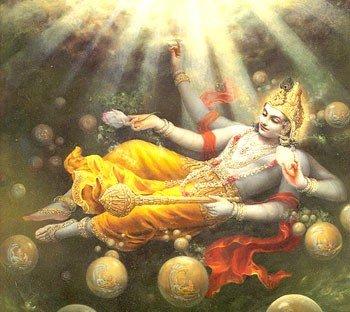
The first puruṣa is the Kāraṇodakaśāyī Viṣṇu. From His skin holes innumerable universes have sprung up. In each and every universe, the puruṣa enters as the Garbhodakaśāyī Viṣṇu. He is lying within the half of the universe which is full with the water of His body. And from the navel of Garbhodakaśāyī Viṣṇu has sprung the stem of the lotus flower, the birthplace of Brahmā, who is the father of all living beings and the master of all the demigod engineers engaged in the perfect design and working of the universal order. Within the stem of the lotus there are fourteen divisions of planetary systems, and the earthly planets are situated in the middle. Upwards there are other, better planetary systems, and the topmost system is called Brahmaloka or Satyaloka. Downwards from the earthly planetary system there are seven lower planetary systems inhabited by the asuras and similar other materialistic living beings.
From Garbhodakaśāyī Viṣṇu there is expansion of the Kṣīrodakaśāyī Viṣṇu, who is the collective Paramātmā of all living beings. He is called Hari, and from Him all incarnations within the universe are expanded.
Therefore, the conclusion is that the puruṣa-avatāra is manifested in three features — first the Kāraṇodakaśāyī who creates aggregate material ingredients in the mahat-tattva, second the Garbhodakaśāyī who enters in each and every universe, and third the Kṣīrodakaśāyī Viṣṇu who is the Paramātmā of every material object, organic or inorganic. One who knows these plenary features of the Personality of Godhead knows Godhead properly, and thus the knower becomes freed from the material conditions of birth, death, old age and disease, as it is confirmed in Bhagavad-gītā, In this śloka the subject matter of Mahā-Viṣṇu is summarized. The Mahā-Viṣṇu lies down in some part of the spiritual sky by His own free will. Thus He lies on the ocean of kāraṇa, from where He glances over His material nature, and the mahat-tattva is at once created. Thus electrified by the power of the Lord, the material nature at once creates innumerable universes, just as in due course a tree decorates itself with innumerable grown fruits. The seed of the tree is sown by the cultivator, and the tree or creeper in due course becomes manifested with so many fruits. Nothing can take place without a cause. The Kāraṇa Ocean is therefore called the Causal Ocean. Kāraṇa means “causal.” We should not foolishly accept the atheistic theory of creation. The description of the atheists is given in the Bhagavad-gītā. The atheist does not believe in the creator, but he cannot give a good theory to explain the creation. Material nature has no power to create without the power of the puruṣa, just as a prakṛti, or woman, cannot produce a child without the connection of a puruṣa, or man. The puruṣa impregnates, and the prakṛti delivers. We should not expect milk from the fleshy bags on the neck of a goat, although they look like breastly nipples. Similarly, we should not expect any creative power from the material ingredients; we must believe in the power of the puruṣa, who impregnates prakṛti, or nature. Because the Lord wished to lie down in meditation, the material energy created innumerable universes at once, in each of them the Lord lay down, and thus all the planets and the different paraphernalia were created at once by the will of the Lord. The Lord has unlimited potencies, and thus He can act as He likes by perfect planning, although personally He has nothing to do. No one is greater than or equal to Him. That is the verdict of the Vedas.
More
12 Jun 2011
by The Hare Krishna Movement
in Guru & Disciple, Spiritual Life, Srimad Bhagavatam
Tags: back to Godhead, bona fide spiritual master, Lord Krsna, Maharaja Pariksit, Personality of Godhead, Sri Suta Gowvami, Srimad Bhagavatam, Sukadeva Goswami, Vyasadeva

Srimad-Bhagavatam
By His Divine Grace A. C. Bhaktivedanta Swami Prabhupada
Canto 1:”Creation”
SB 1.19: The Appearance of Sukadeva Gosvami
The great sage Śukadeva Gosvāmī was certainly inspired by Lord Kṛṣṇa to appear voluntarily before Mahārāja Parīkṣit, the great devotee of the Lord, just to give him the teachings of Śrīmad-Bhāgavatam. One can achieve the nucleus of the devotional service of the Lord by the mercy of the spiritual master and the Personality of Godhead. The spiritual master is the manifested representative of the Lord to help one achieve ultimate success. One who is not authorized by the Lord cannot become a spiritual master. Śrīla Śukadeva Gosvāmī is an authorized spiritual master, and thus he was inspired by the Lord to appear before Mahārāja Parīkṣit and instruct him in the teachings of Śrīmad-Bhāgavatam.
Simply by such questioning and hearing, one can achieve the highest perfectional stage of life.
Text 37
You are the spiritual master of great saints and devotees. I am therefore begging you to show the way of perfection for all persons, and especially for one who is about to die.
Purport
Unless one is perfectly anxious to inquire about the way of perfection, there is no necessity of approaching a spiritual master. A spiritual master is not a kind of decoration for a householder. Generally a fashionable materialist engages a so-called spiritual master without any profit. The pseudo- spiritual master flatters the so-called disciple, and thereby both the master and his ward go to hell without a doubt. Mahārāja Parīkṣit is the right type of disciple because he puts forward questions vital to the interest of all men, particularly for the dying men. The question put forward by Mahārāja Parīkṣit is the basic principle of the complete thesis of Śrīmad-Bhāgavatam. Now let us see how intelligently the great master replies.
Text 38
Please let me know what a man should hear, chant, remember and worship, and also what he should not do. Please explain all this to me.
Text 40
Śrī Sūta Gosvāmī said: The King thus spoke and questioned the sage, using sweet language. Then the great and powerful personality, the son of Vyāsadeva, who knew the principles of religion, began his reply.
More
03 Jun 2011
by The Hare Krishna Movement
in Devotional Service, Krishna
Tags: gopis The Supreme Personality of Godhead, Krishna, Krishna's Mercy, krishnasmercy.org, Lord Kapila, pride of your devotee, Shyamasundara, Srila Prabhupada, Srimad Bhagavatam
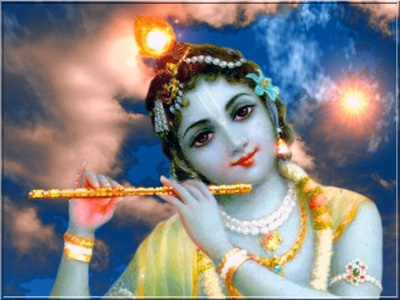
Krishna Smiles
By Krishna’s Mercy
“When a devotee with all his heart and soul serves Krishna, dresses Him in nice garments and gives Him a flower, Krishna smiles. If you can get Krishna to smile upon you just once, your life’s goal is fulfilled.” (Srila Prabhupada, Teachings of Lord Kapila, Ch 7)
Shyamasundara, the original and ever existing form of the Personality of Godhead, has an inexhaustible reservoir of sweetness just ready to flow onto whoever is sincere enough to look at His wonderful face and body. The jivas, the conditioned living entities that are technically part of the marginal energy emanating from the Supreme Spirit, have exercised their freedom by turning their faces away from God. As nothing can be separated from the origin of everything, the material nature and all its miserable components are certainly non-different from the Supreme Lord, but since they are not part of His personal, internal energy, their association cannot bring anywhere near the level of satisfaction to the heart so desperately looking for eternal pleasure that one simple and sincere glance at the smiling face of the Personality of Godhead can. From the wonderful prescriptions provided by the sweetheart of a devotee and saint, His Divine Grace A.C. Bhaktivedanta Swami Prabhupada, we find an easy way to bring to our vision that enchanting smile, an image which subsequently paints a mental picture that won’t go away anytime soon. Indeed, Krishna’s smile is so beautiful that it will kill the pride of even the staunchest of atheists.
“Dear Krishna, You are the killer of all the fears of the inhabitants of Vrindavana. You are the supremely powerful hero, and we know that You can kill the unnecessary pride of Your devotee as well as the pride of women like us simply by Your beautiful smile.” (Songs of the gopis, Krishna, The Supreme Personality of Godhead, Vol 1, Ch 31)
More
01 Jun 2011
by The Hare Krishna Movement
in Kali Yuga
Tags: animal-killing, demoniac persons, hypocrisy, Kali-yuga, Kalki Avatar, Killer of kali-yuga demons, Krsna consciousness movement, laws of God, laws of nature, prabhupadanugas, quarrel, Srila Prabhupada, Srimad Bhagavatam

Kali Yuga; The Age of Quarrel and Hypocrisy
By A.C. Bhaktivedanta Swami Prabhupada
The age of Kali is the most condemned age due to its quarrelsome features. Kali-yuga is so saturated with vicious habits that there is a great fight at the slightest misunderstanding. Those who are engaged in the pure devotional service of the Lord, who are without any desire for self-aggrandizement and who are freed from the effects of fruitive actions and dry philosophical speculations are capable of getting out of the ocean of birth and death.
The leaders of the people are very much anxious to live in peace and friendship, but they have no information of the simple method of hearing the glories of the Lord. On the contrary, such leaders are opposed to the propagation of the glories of the Lord. In other words, the foolish leaders want to completely deny the existence of the Lord. In the name of secular state, such leaders are enacting various plans every year. But by the insurmountable intricacies of the material nature of the Lord, all these plans for progress are being constantly frustrated. They have no eyes to see that their attempts at peace and friendship are failing. But here is the hint to get over the hurdle. If we want actual peace, we must open the road to understanding of the Supreme Lord Krsna and glorify Him for His virtuous activities as they are depicted in the pages of Srimad-Bhagavatam. ( SB 1.1.16 P Questions by the Sages )
More
12 May 2011
by The Hare Krishna Movement
in Devotional Service, Srimad Bhagavatam
Tags: devotional service, fearfulness, illusion, loving Krsna, Srila Prabhupada, Srimad Bhagavatam, submissive hearing, Supreme Personality of Godhead, transcending worldly miseries, Vedic literature
Srimad Bhagavatam
By His Divine Grace A.C. Bhaktivedanta Swami Prabhupada
Canto 1, Chapter 7, Text 7
The conclusion is that simply by hearing the Vedic literature Śrīmad-Bhāgavatam, one can have direct connection with the Supreme Personality of Godhead Śrī Kṛṣṇa, and thereby one can attain the highest perfection of life by transcending worldly miseries, illusion and fearfulness. These are practical tests for one who has actually given a submissive hearing to the readings of the Śrīmad-Bhāgavatam.
TEXT 7
yasyāṁ vai śrūyamāṇāyāṁ
kṛṣṇe parama-pūruṣe
bhaktir utpadyate puṁsaḥ
śoka-moha-bhayāpahā
SYNONYMS
yasyām—this Vedic literature; vai—certainly; śrūyamāṇāyām—simply by giving aural reception; kṛṣṇe—unto Lord Kṛṣṇa; parama—supreme; pūruṣe—unto the Personality of Godhead; bhaktiḥ—feelings of devotional service; utpadyate—sprout up; puṁsaḥ—of the living being; śoka—lamentation; moha—illusion; bhaya—fearfulness; apahā—that which extinguishes.
TRANSLATION
Simply by giving aural reception to this Vedic literature, the feeling for loving devotional service to Lord Kṛṣṇa, the Supreme Personality of Godhead, sprouts up at once to extinguish the fire of lamentation, illusion and fearfulness.
PURPORT
There are various senses, of which the ear is the most effective. This sense works even when a man is deep asleep. One can protect himself from the hands of an enemy while awake, but while asleep one is protected by the ear only. The importance of hearing is mentioned here in connection with attaining the highest perfection of life, namely, getting free from three material pangs. Everyone is full of lamentation at every moment, he is after the mirage of illusory things, and he is always afraid of his supposed enemy. These are the primary symptoms of material disease. And it is definitely suggested herein that simply by hearing the message of Śrīmad-Bhāgavatam one gets attachment for the Supreme Personality of Godhead Śrī Kṛṣṇa, and as soon as this is effected the symptoms of the material diseases disappear. Śrīla Vyāsadeva saw the all-perfect Personality of Godhead, and in this statement the all-perfect Personality of Godhead Śrī Kṛṣṇa is clearly confirmed.
More
10 May 2011
by The Hare Krishna Movement
in Books by Srila Prabhupada, Srimad Bhagavatam
Tags: His Divine Grace A.C. Bhaktivedanta Swami Prabhupada, original pre-1978, Set, Srila Prabhupada wholesale, Srimad Bhagavatam
 Srimad Bhagavatam Compact 30 Vol 1977 Edition
Cantos 1-9, plus the Original Krsna Book in 3 Volumes comprising the 10th Canto
Srimad Bhagavatam , an “Epic Philosophical and Literary Classic”, holds a prominent position in India’s voluminous written wisdom. The timeless wisdom of India is expressed in the Vedas, ancient Sanskrit texts that touch upon all fields of human knowledge. Originally preserved through oral tradition, the Vedas were first put into writing by Srila Vyasadeva, the “literary incarnation of God.” After compiling the Vedas, Srila Vyasadeva was inspired by his spiritual master to present their profound essence in the form of Srimad-Bhagavatam. Known as “the ripened fruit of the tree of Vedic Literature, Srimad-Bhagavatam is the most complete and authoritative exposition of Vedic Knowledge.
This 12,000 page, 30 vol. set, comes in High Quality Hard Bound 5×7 size. with over 600 beautiful full color plates.
For a limited time selling at the reduced Wholesale rate of $149.95
No home library is complete without a set.
Get one today!
Go to http://www.theharekrishnamovement.com To buy a set online!
06 May 2011
by The Hare Krishna Movement
in Buddha, Krsna is the Source of All Incarnations
Tags: ahimsa, animal sacrifice, buddha, Gaya, Kali-yuga, Lord Buddha, nonviolence, Srila Prabhupada, Srimad Bhagavatam, Vedas, vedic sacrifice
Krsna Is the Source of All Incarnations
Srimad Bhagavatam; Canto 1, Chapter 3, Text 24
By His Divine Grace A.C. Bhaktivedanta Swami Prabhupada
Lord Buddha
TEXT 24
tataḥ kalau sampravṛtte
sammohāya sura-dviṣām
buddho nāmnāñjana-sutaḥ
kīkaṭeṣu bhaviṣyati
SYNONYMS
tataḥ—thereafter; kalau—the age of Kali; sampravṛtte—having ensued; sammohāya—for the purpose of deluding; sura—the theists; dviṣām—those who are envious; buddhaḥ—Lord Buddha; nāmnā—of the name; añjana-sutaḥ—the son of Añjana; kīkaṭeṣu—in the province of Gayā (Bihar);bhaviṣyati—will take place.
TRANSLATION
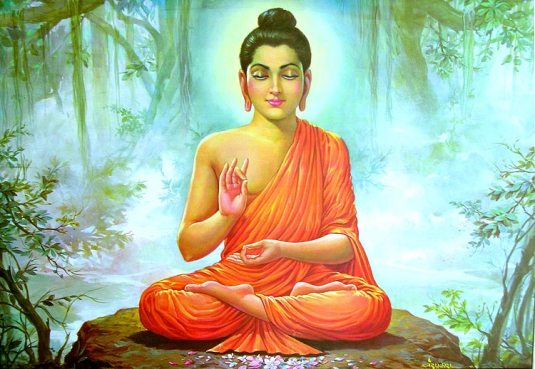
Then, in the beginning of Kali-yuga, the Lord will appear as Lord Buddha, the son of Añjana, in the province of Gayā, just for the purpose of deluding those who are envious of the faithful theist.
PURPORT
Lord Buddha, a powerful incarnation of the Personality of Godhead, appeared in the province of Gayā (Bihar) as the son of Añjana, and he preached his own conception of nonviolence and deprecated even the animal sacrifices sanctioned in the Vedas. At the time when Lord Buddha appeared, the people in general were atheistic and preferred animal flesh to anything else. On the plea of Vedic sacrifice, every place was practically turned into a slaughterhouse, and animal killing was indulged in unrestrictedly.
Lord Buddha preached nonviolence, taking pity on the poor animals. He preached that he did not believe in the tenets of the Vedas and stressed the adverse psychological effects incurred by animal killing. Less intelligent men of the age of Kali, who had no faith in God, followed his principle, and for the time being they were trained in moral discipline and nonviolence, the preliminary steps for proceeding further on the path of God realization. He deluded the atheists because such atheists who followed his principles did not believe in God, but they kept their absolute faith in Lord Buddha, who himself was the incarnation of God. Thus the faithless people were made to believe in God in the form of Lord Buddha. That was the mercy of Lord Buddha: he made the faithless faithful to him.
More
29 Apr 2011
by The Hare Krishna Movement
in Dhira Govinda das, Diksha, Dusyanta das, Rama das, Siksa, Spiritual Master, Srila Prabhupada, The Prominent Link
Tags: current link, devotees, Dhira Govinda das, disciples, Dusyanta das, GBC, Hare Krishna Movement, Iskcon, link, prominent link, Rama das, SAC, Sampradaya Acarya, spiritual master and disciple, Srila Prabhupada, Srimad Bhagavatam
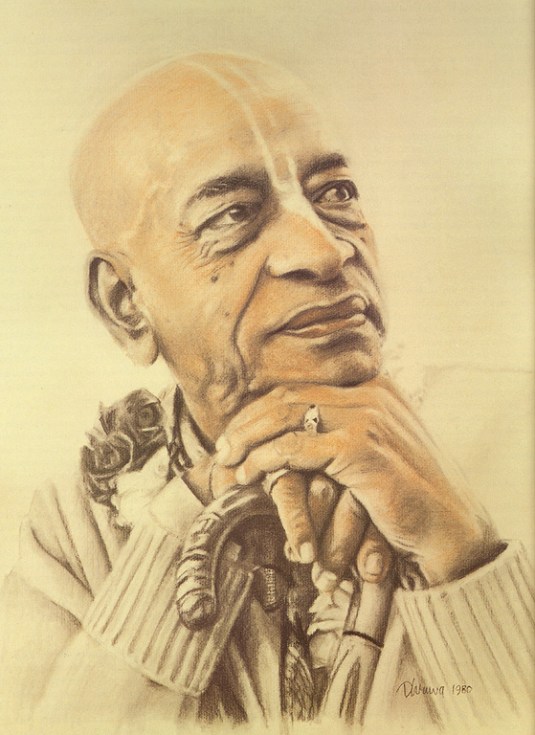
Recently there was a nice article on the Sampradaya Sun posted by Sriman Dhira Govinda Prabhu on the Current and Direct Link, for continuance of the disciplic succession in ISKCON, and two nice spin off articles. Enclosed are two of the recent articles submitted by readers.
Current Link
BY: DUSYANTA DAS
Apr 27, 2011 — UK (SUN) — In Srimad Bhagavatam 2.9.7 is where the quote is found concerning the word “link”. In the purport, Srila Prabhupada identifies this phenomena thus: “…in order to receive the real message of Srimad Bhagavatam one should approach the current link, or Spiritual master, in the chain of disciplic succession.”
The definition of “current” is explained clearly from the Collins English dictionary thus:
“most recent, commonly known, practiced or accepted, widespread, circulating and valid at present”. Which all seems to fit very easily into the idea that Srila Prabhupada is the Spiritual Master, the current link that is illustrated here in the purport of SB 2.9.7.
The application of this phenomena, the “current link” is hinging on the word in the sentence “approach”. Which is either a verb or noun. The verb “approach” is defined as “to come near, to go to someone with a request or offer, to set about doing something.” The noun “approach” is defined as “a way or road to a place, a method of doing something.”
If we follow the premise that Srila Prabhupada uses the term “immediate acarya” as synonymous with the term “current link”, then we come up with the definitions lending the validity to a direct relationship with Him without intermediaries and regardless of physical presence. Immediate definition as “without intervening medium, closest or most direct in effect of relationship.”
The point in approaching a spiritual master or current link in disciplic succession is to take initiation from him.
More
23 Apr 2011
by The Hare Krishna Movement
in Chanting Hare Krishna, The Hare Krishna Movement
Tags: chanting Hare Krishna, Hare Krishna, Maha Mantra, prabhupada, spiritual sound, Srimad Bhagavatam, The Hare Krishna Movement, transcendental vibration

What is the meaning of Hare Krishna?
It is the short form of the maha-mantra, the great spiritual sound of final liberation:
Hare Krishna Hare Krishna Krishna Krishna Hare Hare
Hare Rama Hare Rama Rama Rama Hare Hare
“By vibrating this transcendental sound, the meaning of everything, both material and spiritual, is revealed. This Hare Krishna is nondifferent from the Personality of Godhead.” (from Bhaktivedanta Prabhupada Commentary, Srimad Bhagavatam 4.24.40)
What is the deeper meaning of the Hare Krishna mantra?
Caitanya Mahaprabhu teaches us that we should only beg God for His service life after life. This is the actual meaning of the Hare Krsna maha-mantra. When we are chanting Hare Krsna, Hare Krsna, Krsna Krsna, Hare Hare. Hare Rama, Hare Rama, Rama, Rama, Hare Hare, we are actually addressing God and His energy, Hara. Hara is Krsna’s internal potency, Srimati Radharani or Laksmi. Jaya radhe! This is daivi prakrti, and the devotees take shelter of the daivi prakrti, Srimati Radharani. Thus the Vaisnavas worship Radha-Krsna, Laksmi-Narayana and Sita-Rama. In the beginning of the Hare Krsna maha-mantra we first address the internal energy of Krsna, Hare. Thus we say, “O Radharani! O Hare! O energy of the Lord!” When we address someone in this way, he usually says, “Yes, what do you want?” The answer is, “Please engage me in Your service.” This should be our prayer. We should not say, “O energy of the Lord, O Krsna, please give me money. Please give me a beautiful wife. Please give me many followers. Please give me some prestigious position. Please give me the presidency.” These are all material hankerings, which should be avoided. Lord Buddha advocated that we give up all material desires. It is not possible to become desireless, but it is possible to give up material desires. It is the nature of the living entity to desire; it is not possible to be desireless. If one is desireless, he is dead. Desirelessness means purifying one’s desire, and desire is purified when we only desire the service of Krsna. (from “Teachings of Lord Kapila”)
Why is the Hare Krishna mantra so special?
Lord Krsna says in Bhagavad-gita (7.8), pranavah sarva-vedesu: ‘In all the Vedic mantras, I am represented by pranava, or omkara.’ Thus chanting of the Vedic mantras beginning with omkara is directly chanting of Krsna’s name. There is no difference. Whether one chants omkara or addresses the Lord as ‘Krsna’, the meaning is the same, but Sri Caitanya Mahaprabhu has recommended that in this age one chant the Hare Krsna mantra (harer nama eva kevalam). Although there is no difference between Hare Krsna and the Vedic mantras beginning with omkara, Sri Caitanya Mahaprabhu, the leader of the spiritual movement for this age, has recommended that one chant Hare Krsna, Hare Krsna, Krsna Krsna, Hare Hare. Hare Rama, Hare Rama, Rama Rama, Hare Hare. (from Bhaktivedanta Prabhupada Commentary, Srimad Bhagavatam 6.5.26)
Pasted from; http://www.harekrsna.de/artikel/faq.htm
19 Apr 2011
by The Hare Krishna Movement
in Krsna is the Source of All Incarnations
Tags: Bhagavan, incarnation, Krishna, Krsna, loka, material creation, material universe, Paurusam, Purusa, Srila Prabhupada, Srimad Bhagavatam, Universal Form
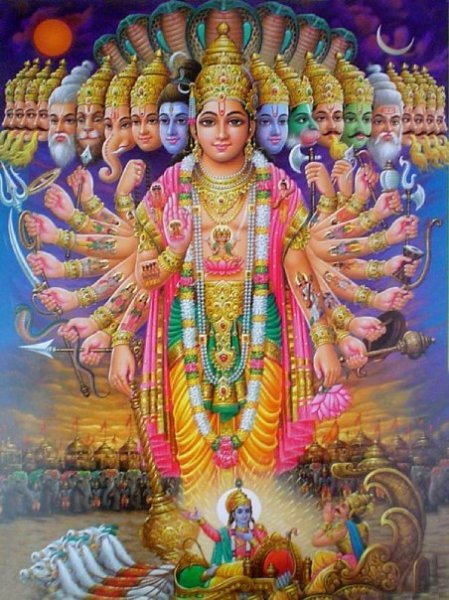
Krsna Is the Source of All Incarnations
Srimad Bhagavatam Canto 1, Chapter 3, Text 1
By His Divine Grace A.C. Bhaktivedanta Swami Prabhupada
TEXT 1
sūta uvāca
jagṛhe pauruṣaṁ rūpaṁ
bhagavān mahad-ādibhiḥ
sambhūtaṁ ṣoḍaśa-kalam
ādau loka-sisṛkṣayā
SYNONYMS
sūtaḥ uvāca—Sūta said; jagṛhe—accepted; pauruṣam—plenary portion as the puruṣa incarnation; rūpam—form; bhagavān—the Personality of Godhead; mahat-ādibhiḥ—with the ingredients of the material world; sambhūtam—thus there was the creation of; ṣoḍaśa-kalam—sixteen primary principles; ādau—in the beginning; loka—the universes; sisṛkṣayā—on the intention of creating.
TRANSLATION
Sūta said: In the beginning of the creation, the Lord first expanded Himself in the universal form of the puruṣa incarnation and manifested all the ingredients for the material creation. And thus at first there was the creation of the sixteen principles of material action. This was for the purpose of creating the material universe.
PURPORT
The Bhagavad-gītā states that the Personality of Godhead Śrī Kṛṣṇa maintains these material universes by extending His plenary expansions. So this puruṣa form is the confirmation of the same principle. The original Personality of Godhead Vāsudeva, or Lord Kṛṣṇa, who is famous as the son of King Vasudeva or King Nanda, is full with all opulences, all potencies, all fame, all beauty, all knowledge and all renunciation. Part of His opulences are manifested as impersonal Brahman, and part of His opulences are manifested as Paramātmā. This puruṣa feature of the same Personality of Godhead Śrī Kṛṣṇa is the original Paramātmā manifestation of the Lord. There are three puruṣa features in the material creation, and this form, who is known as the Kāraṇodakaśāyī Viṣṇu, is the first of the three. The others are known as the Garbhodakaśāyī Viṣṇu and the Kṣīrodakaśāyī Viṣṇu, which we shall know one after another. The innumerable universes are generated from the skin holes of this Kāraṇodakaśāyī Viṣṇu, and in each one of the universes the Lord enters as Garbhodakaśāyī Viṣṇu.
In the Bhagavad-gītā it is also mentioned that the material world is created at certain intervals and then again destroyed. This creation and destruction is done by the supreme will because of the conditioned souls, or the nitya-baddha living beings. The nitya-baddha, or the eternally conditioned souls, have the sense of individuality or ahaṅkāra, which dictates them sense enjoyment, which they are unable to have constitutionally. The Lord is the only enjoyer, and all others are enjoyed. The living beings are predominated enjoyers. But the eternally conditioned souls, forgetful of this constitutional position, have strong aspirations to enjoy. The chance to enjoy matter is given to the conditioned souls in the material world, and side by side they are given the chance to understand their real constitutional position. Those fortunate living entities who catch the truth and surrender unto the lotus feet of Vāsudeva after many, many births in the material world join the eternally liberated souls and thus are allowed to enter into the kingdom of Godhead. After this, such fortunate living entities need not come again within the occasional material creation. But those who cannot catch the constitutional truth are again merged into the mahat-tattva at the time of the annihilation of the material creation. When the creation is again set up, this mahat-tattva is again let loose. This mahat-tattva contains all the ingredients of the material manifestations, including the conditioned souls. Primarily this mahat-tattva is divided into sixteen parts, namely the five gross material elements and the eleven working instruments or senses. It is like the cloud in the clear sky. In the spiritual sky, the effulgence of Brahman is spread all around, and the whole system is dazzling in spiritual light. The mahat-tattva is assembled in some corner of the vast, unlimited spiritual sky, and the part which is thus covered by the mahat-tattva is called the material sky. This part of the spiritual sky, called the mahat-tattva, is only an insignificant portion of the whole spiritual sky, and within this mahat-tattva there are innumerable universes. All these universes are collectively produced by the Kāraṇodakaśāyī Viṣṇu, called also the Mahā-Viṣṇu, who simply throws His glance to impregnate the material sky.
14 Apr 2011
by The Hare Krishna Movement
in Diksha, Disciplic succession, Guru & Disciple, Siksa
Tags: dakshina, Founder Acarya, Iskcon, July 9th Letter, mission of the guru, Narasimha das, officiating acaryas, prabhupada, priests recommended by the spiritual master, ritvik, ritviks, Srila Prabhupada, Srimad Bhagavatam, VNN
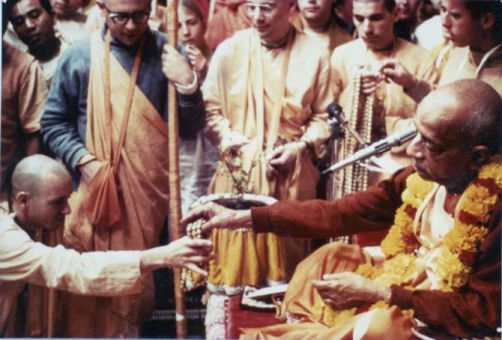
Ritvik Defined — By Narasimha Das
November 13, 1998 VNN2498
Srila Prabhupada never created any special status for “officiating acaryas.” Their function as ritivks is to assure that Srila Prabhupada requirements are met before a student is formally accepted for initiation in ISKCON. Like all senior initiated disciples, they are meant to be teachers by their practical example. They have accepted an added responsibility, an added burden on behalf of Srila Prabhupada. Their burden is to assure that Srila Prabhupada’s standards for initiation are preserved in ISKCON. (Srila Prabhupada’s July 9th directive sent to every leader in ISKCON mentions three times that all devotees are Srila Prabhupada’s disciples and that the deputed ritviks offer initiation on behalf of Srila Prabhupada. This same instruction was repeated by Srila Prabhupada several times additionally after July 9th in letters, documents, and instructions.) Ritviks are the priests authorized by the spiritual master or his institution to accept students on behalf of ISKCON and Srila Prabhupada. Srila Prabhupada made this perfectly clear. This understanding of the procedure Prabhupada prescribed is consistent with references to ritviks mentioned in Srila Prabhupada’s books.
EDITORIAL, Nov 13 (VNN) — Currently the term “ritvik” is used to refer to 1.) devotees of a particular camp, 2.) the ideas and convictions of “ritvik” devotees, and 3.) the “officiating acarya” who initiates on behalf of the spiritual master. I will try to offer guidelines for understanding the word “ritvik” according to Srila Prabhupada and the current usage among devotees.
More
13 Apr 2011
by The Hare Krishna Movement
in Srimad Bhagavatam
Tags: 4.28.48, Founder Acarya, International Socity for Krishna Consciousness, Religion means abiding by the orders of God, rogues, so-called Kings, Srimad Bhagavatam
Srimad Bhagavatam
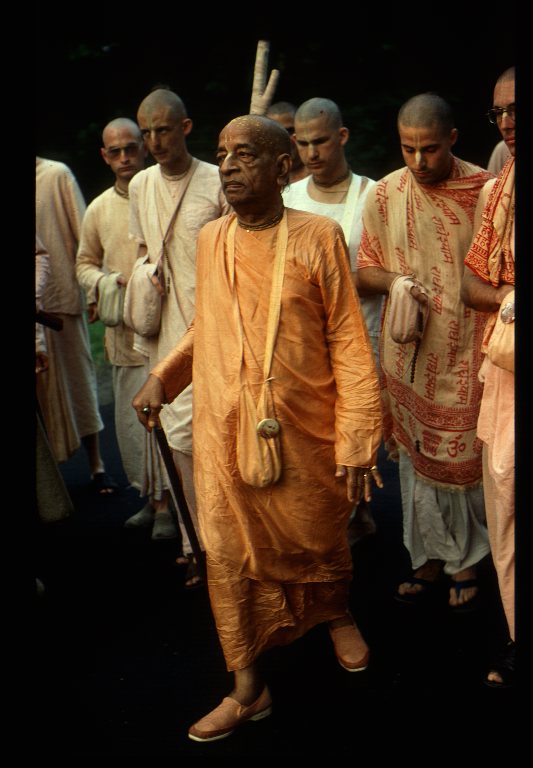
By His Divine Grace A.C. Bhaktivedanta Swami Prabhupada
Forth Canto, Chapter 28, Text 48
uttiṣṭhottiṣṭha rājarṣe
imām udadhi-mekhalām
dasyubhyaḥ kṣatra-bandhubhyo
bibhyatīṁ pātum arhasi
SYNONYMS
uttiṣṭha—please get up; uttiṣṭha—please get up; rāja-ṛṣe—O saintly king; imām—this earth; udadhi—by the ocean; mekhalām—surrounded; dasyubhyaḥ—from the rogues; kṣatra-bandhubhyaḥ—from the unclean kings; bibhyatīm—very much afraid; pātum—to protect; arhasi—you ought.
TRANSLATION
O best of kings, please get up! Get up! Just see this world surrounded by water and infested with rogues and so-called kings. This world is very much afraid, and it is your duty to protect her.
PURPORT
Whenever an ācārya comes, following the superior orders of the Supreme Personality of Godhead or His representative, he establishes the principles of religion, as enunciated in Bhagavad-gītā. Religion means abiding by the orders of the Supreme Personality of Godhead. Religious principles begin from the time one surrenders to the Supreme Personality of Godhead. It is the ācārya’s duty to spread a bona fide religious system and induce everyone to bow down before the Supreme Lord. One executes the religious principles by rendering devotional service, specifically the nine items like hearing, chanting and remembering. Unfortunately, when the ācārya disappears, rogues and nondevotees take advantage and immediately begin to introduce unauthorized principles in the name of so-called svāmīs, yogīs, philanthropists, welfare workers and so on. Actually, human life is meant for executing the orders of the Supreme Lord, and this is stated in Bhagavad-gītā (9.34):
man-manā bhava mad-bhakto
mad-yājī māṁ namaskuru
mām evaiṣyasi yuktvaivam
ātmānaṁ mat-parāyaṇaḥ
“Engage your mind always in thinking of Me and become My devotee. Offer obeisances and worship Me. Being completely absorbed in Me, surely you will come to Me.”
The main business of human society is to think of the Supreme Personality of Godhead at all times, to become His devotees, to worship the Supreme Lord and to bow down before Him. The ācārya, the authorized representative of the Supreme Lord, establishes these principles, but when he disappears, things once again become disordered. The perfect disciples of the ācārya try to relieve the situation by sincerely following the instructions of the spiritual master. At the present moment practically the entire world is afraid of rogues and nondevotees; therefore this Kṛṣṇa consciousness movement is started to save the world from irreligious principles. Everyone should cooperate with this movement in order to bring about actual peace and happiness in the world.
19 Mar 2011
by The Hare Krishna Movement
in Caitanya Mahaprabhu
Tags: apostle of love of God, Bhagavata-dharma, Caitanya, Chaitanya philosophy, father of congregational chanting, Gaura Purnima, holy name, life force, Lord Sri Chitanya Mahaprabhu, prema-dharma, Rupa Goswami, Siksastaka, six Gosvamis of Vrindavan, Sridhama Mayapura, Srila Prabhupada, Srimad Bhagavatam
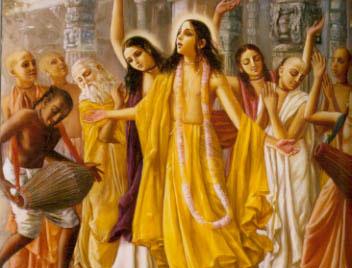
A short sketch of the life and teachings of Lord Caitanya,
The Preacher of Śrīmad-Bhāgavatam
By His Divine Grace A.C. Bhaktivedanta Swami Prabhupada
Lord Śrī Caitanya Mahāprabhu, the great apostle of love of God and the father of the congregational chanting of the holy name of the Lord, advented Himself at Śrīdhāma Māyāpura, a quarter in the city of Navadvīpa in Bengal, on the Phālgunī Pūrṇimā evening in the year 1407 Śakābda (corresponding to February 1486 by the Christian calendar).
More
Previous Older Entries Next Newer Entries









 The Hare Krishna Movement