[*Note; Les Misérables (“The Miserable Ones”); translated variously from the French as The Miserable Ones, The Wretched, The Poor Ones, The Wretched Poor, or The Victims]
Often while reading Srila Prabhupada’s books, he talks about getting free from the miseries of life, or the threefold miseries. For instance in this purport it is described:
…One who is Kṛṣṇa conscious is a perfect yogī; he is aware of everyone’s happiness and distress by dint of his own personal experience. The cause of the distress of a living entity is forgetfulness of his relationship with God. And the cause of happiness is knowing Kṛṣṇa to be the supreme enjoyer of all the activities of the human being. Kṛṣṇa is the proprietor of all lands and planets. The perfect yogī is the sincerest friend of all living entities. He knows that the living being who is conditioned by the modes of material nature is subjected to the threefold material miseries due to forgetfulness of his relationship with Kṛṣṇa. Because one in Kṛṣṇa consciousness is happy, he tries to distribute the knowledge of Kṛṣṇa everywhere. Since the perfect yogī tries to broadcast the importance of becoming Kṛṣṇa conscious, he is the best philanthropist in the world, and he is the dearest servitor of the Lord.
I thought we could do a short post on just what are the threefold miseries, and how can one become free from them.
The threefold miseries are:
(1) Those miseries which arise from the mind and body
(2) Those miseries inflicted by other living beings
(3) Those miseries arising from natural catastrophes over which one has no control.
When we think of Yoga, we used to think of some old bearded yogi standing on his head, or more recently of young beautiful men & women in athletic clothing posing serenely, or a class full of people stretching on yoga mats. But actually the meaning of yoga is far beyond any of the physical gymnastics we tend to associate with the word. There are many systems of yoga, namely; karma yoga, jnana yoga, dhayana yoga, hatha yoga, bhakti yoga, and so many patterns of yoga. But as we understand from the Bhagavad-gita:
…in the Bhagavad-gītā it is clearly stated that…yoga means to get into touch with the Supreme Lord. The process, however, includes several bodily features such as āsana, dhyāna, prāṇāyāma and meditation(from purport SB 1.2.28-29)
…The word yoga means “link.” Any system of yoga is an attempt to reconnect our broken relationship with the Supreme Personality of Godhead. There are different types of yoga, of which bhakti-yoga is the best. In other yoga systems, one must undergo various processes before attaining perfection, but bhakti-yoga is direct. (from purport SB 10.2.6)
…The culmination of all kinds of yoga practices lies in bhakti-yoga. All other yogas are but means to come to the point of bhakti in bhakti-yoga. Yoga actually means bhakti-yoga; all other yogas are progressions toward the destination of bhakti-yoga. From the beginning of karma-yoga to the end of bhakti-yoga is a long way to self-realization. Karma-yoga, without fruitive results, is the beginning of this path. When karma-yoga increases in knowledge and renunciation, the stage is called jñāna-yoga. When jñāna-yoga increases in meditation on the Supersoul by different physical processes, and the mind is on Him, it is called aṣṭāṅga-yoga. And, when one surpasses the aṣṭāṅga-yoga and comes to the point of the Supreme Personality of Godhead Kṛṣṇa, it is called bhakti-yoga, the culmination. Factually, bhakti-yoga is the ultimate goal, but to analyze bhakti-yoga minutely one has to understand these other yogas. The yogī who is progressive is therefore on the true path of eternal good fortune. One who sticks to a particular point and does not make further progress is called by that particular name: karma-yogī, jñāna-yogī or dhyāna-yogī, rāja-yogī, haṭha-yogī, etc. If one is fortunate enough to come to the point of bhakti-yoga, it is to be understood that he has surpassed all the other yogas. Therefore, to become Kṛṣṇa conscious is the highest stage of yoga, just as, when we speak of Himalayan, we refer to the world’s highest mountains, of which the highest peak, Mount Everest, is considered to be the culmination.
It is by great fortune that one comes to Kṛṣṇa consciousness on the path of bhakti-yoga to become well situated according to the Vedic direction. The ideal yogī concentrates his attention on Kṛṣṇa, who is called Śyāmasundara, who is as beautifully colored as a cloud, whose lotus-like face is as effulgent as the sun, whose dress is brilliant with jewels and whose body is flower garlanded. Illuminating all sides is His gorgeous luster, which is called the brahmajyoti. He incarnates in different forms such as Rāma, Nṛsiṁha, Varāha and Kṛṣṇa, the Supreme Personality of Godhead, and He descends like a human being, as the son of Mother Yaśodā, and He is known as Kṛṣṇa, Govinda and Vāsudeva. He is the perfect child, husband, friend and master, and He is full with all opulences and transcendental qualities. If one remains fully conscious of these features of the Lord, he is called the highest yogī. (Bhagavad-gita 6.47)
The very word yoga means connecting link with the supreme being. We accept Krishna as the supreme being, and nobody is equal to him or greater than him. (Letter to Sri Krishna C. Batra – Vrindaban 8 December, 1975)
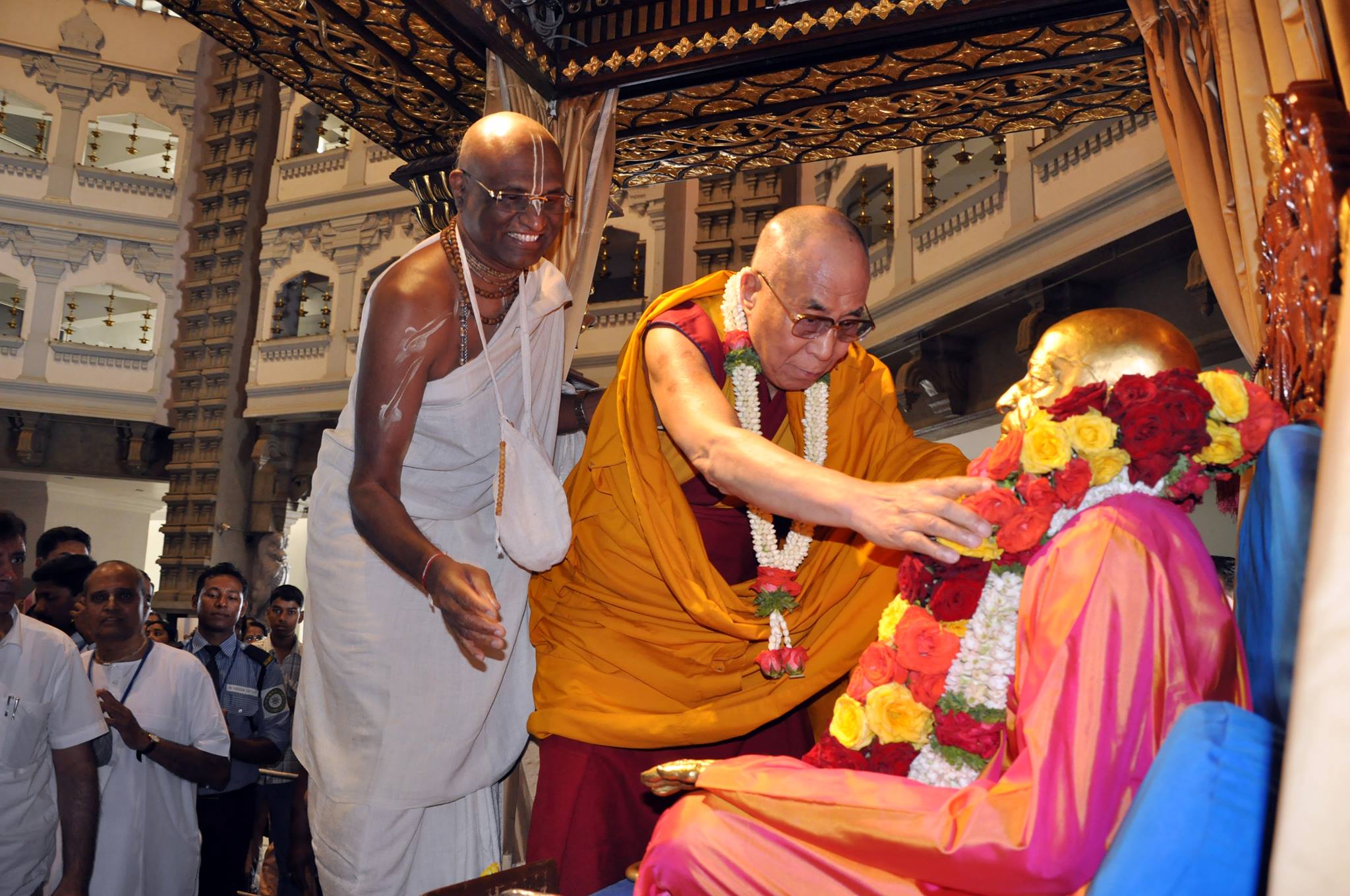
Even though this is old news, still we are posting this because the image of His Holiness the Dalai Lama of Tibet placing a flower garland around the neck of Srila Prabhupada, at the ISKCON Bagalore center, is so beautiful. The Dalai Lama is a generous and compassionate human being, an inspiration to all spiritual seekers, and is a world ambassador for peace.
Bangalore, June 05, 2013. His Holiness the Dalai Lama – the spiritual leader of Tibet paid a visit to the Radha Krishna Chandra temple at the International Society for Krishna Consciousness (ISKCON) Bangalore, Rajajinagar as part of a cultural exchange inititiative. His Holiness the Dalai Lama, while at the temple, said he was impressed by the peace and tranquillity that encompasses the holy place and added that the mission of this non-sectarian movement in promoting the well being of society by teaching the science of Krishna Consciousness is admirable.
His Holiness Dalai Lama was welcomed by the Temple President Shri Madhu Pandit Dasa. After a brief visit to the main shrine of Shri Radha Krishna Chandra, His Holiness interacted with Shri Madhu Pandit Dasa on the need for spirituality, compassion and the role of spirituality in moulding the behavior and thoughts of youth. The discussion also dwelt on the importance of promoting world peace and compassion.
Today (July 30th) marks the auspicious anniversary of Srila Prabhupada’s incorporation of ISKCON New York, in 1966. We thank Sampradaya Sun for posting this very nice homage in honor of the occasion.
Incorporation of ISKCON New York
July 29, 2013 — CANADA (SUN)
Bhaktivedanta Book Trust
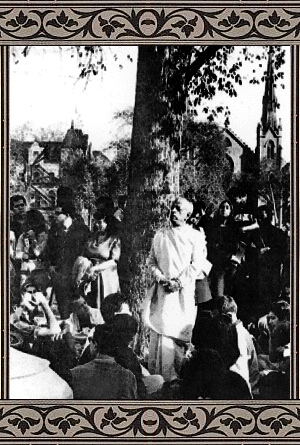
In 1966, Srila Prabhupada began chanting the Hare Krsna maha-mantra under a tree in New York’s Tompkins Square Park, thereby inaugurating the western advance of Lord Caitanya Mahaprabhu’s glorious Sankirtana movement. On July 13th, 1966 Srila Prabhupada incorporated ISKCON New York, and in Autumn of 1966 he established the ISKCON Press, which clearly demonstrated his emphasis on the importance of publishing and distributing his authorized books. Since that time, many millions of his books have been distributed throughout the world, translated into many different languages.
“We shall call our society I.S.K.C.O.N.”, Srila Prabhupada said with great pleasure when he first coined the acronym for the International Society of Krishna Consciousness. ‘Krishna Consciousness’ was Srila Prabhupada’s rendering of a phrase from Srila Rupa Goswami’s Padyavali:
krsna-bhakti-rasa-bhavita
“To be absorbed in the mellow taste of executing devotional service to Krsna’.”
“He had initiated the legal work of incorporation that spring, while still living on the Bowery, but even before its legal beginning, he had been talking about his “International Society for Krishna Consciousness”, and so it had appeared in letters to India and in “The Village Voice” (newspaper). A friend had suggested a title that would sound more familiar to Westerners “International society for God Consciousness”. But ‘God’ was a vague term, whereas ‘Krishna’ was exact and scientific; ‘God Consciousness’ was spiritually weaker, less personal. And if Westerners didn’t know or understand that Krishna was God, then the ‘International Society for Krishna Consciousness’ would tell them, by spreading His glories ‘in every town and village’. (“Your Ever Well-wisher”, page 45-47)
Srila Prabhupada once said that Krishna Consciousness is “So simple you can miss it”. Sometimes we become overwhelmed with so many books, so much instruction, rules and regulations etc.etc. but actually Krishna Consciousness is very simple, and anyone can begin this blissful process by simply thinking of Krishna. As we can see from the following verse and purport from the Bhagavad-gita:
Always think of Me and become My devotee. Worship Me and offer your homage unto Me. Thus you will come to Me without fail. I promise you this because you are My very dear friend.
…Life should be so molded that one will always have the chance to think of Kṛṣṇa. One should always act in such a way that all his daily activities are in connection with Kṛṣṇa. He should arrange his life in such a way that throughout the twenty-four hours he cannot but think of Kṛṣṇa. And the Lord’s promise is that anyone who is in such pure Kṛṣṇa consciousness will certainly return to the abode of Kṛṣṇa, where he will be engaged in the association of Kṛṣṇa face to face. This most confidential part of knowledge is spoken to Arjuna because he is the dear friend of Kṛṣṇa. Everyone who follows the path of Arjuna can become a dear friend to Kṛṣṇa and obtain the same perfection as Arjuna.
…one should concentrate his mind upon Kṛṣṇa—the very form with two hands carrying a flute, the bluish boy with a beautiful face and peacock feathers in His hair.
….One should be attracted by the beautiful vision of Kṛṣṇa. His name is Kṛṣṇa because He is all-attractive. One who becomes attracted by the beautiful, all-powerful, omnipotent vision of Kṛṣṇa is fortunate.
…So our Kṛṣṇa consciousness movement is so nice.. We present, “Here is God.” Here is God. Take His name. Take His address also. It is so perfect. They are searching after God. We are giving the name, address, activity, everything, quality, all. Nāma-rūpa-līlā-parikara-vaiśiṣṭhyam, everything. Nāma means name. Here is Kṛṣṇa, “He is engaged in enjoyment with Rādhārāṇī and playing on His flute.”Veṇuṁ kvaṇantam aravinda-dalāyatākṣaṁ bar… [Bs. 5.30]. We are not imagining. Not that this artist imagines, the poet imagines. No. We don’t do that rascaldom. We don’t do that. We take information from the Vedas. Kṛṣṇa, when He was present personally, He played on His flute. The gopīs saw and the cowherds boys saw five thousand years ago. And the ācāryas took information. Even if you don’t believe in the history, then come to śāstra. The śāstra says veṇuṁ kvaṇantam aravinda-dalāyatākṣam: [Bs. 5.30] “Kṛṣṇa, the Supreme Personality of Godhead, is always engaged in playing on His flute.” This is Vedic statement. Veṇuṁ kvaṇantam aravinda-dalāyatākṣam: [Bs. 5.30] “His eyes are just like lotus petals.”Veṇuṁ kvaṇantam aravinda-dalāyatākṣaṁ barhāvataṁsam asitāmbuda-sundarāṅgam: [Bs. 5.30] “He has got a peacock feather on His head.” These are the description in the Vedas. “He has got a peacock feather on His head.”Barhāvataṁsam asitāmbuda: “His color is blackish.” What kind of blackish? Asitāmbuda: “Just like new cloud.”Asitāmbuda-sundarāṅgam: “But don’t think because He is blackish, He is not beautiful. He is most beautiful.” How much beautiful? Kandarpa-koṭi-kamanīya-viśeṣa-śobham: [Bs. 5.30] “He is so beautiful that if you gather millions of Cupids, still He is more beautiful.” These descriptions are there.
So Kṛṣṇa consciousness movement is very nice. You will be able to understand what is God, and you will be able to understand what is your relationship with God. And you will be able to understand how you can go back to home, back to Godhead.
…The essence of spiritual knowledge is found in the pastimes of Śrī Caitanya Mahāprabhu, which are identical with the pastimes of Lord Kṛṣṇa. This is the essence of knowledge. If knowledge does not include the understanding of Śrī Caitanya Mahāprabhu and Kṛṣṇa, it is simply superfluous. By Śrī Caitanya Mahāprabhu’s grace, the nectar of Lord Śrī Kṛṣṇa’s pastimes is flowing in different directions in hundreds and thousands of rivers. One should not think that the pastimes of Śrī Caitanya Mahāprabhu are different from Kṛṣṇa’s pastimes. It is said: śrī-kṛṣṇa-caitanya, rādhā-kṛṣṇa nahe anya. Lord Caitanya Mahāprabhu is a combination of Rādhā-Kṛṣṇa, and without understanding His pastimes, one cannot understand Rādhā and Kṛṣṇa. Śrīla Narottama dāsa Ṭhākura therefore sings: rūpa-raghunātha-pade haibe ākuti kabe hāma bujhaba se yugala pirīti. “When shall I become very eager to study the books left by the six Gosvāmīs? Then I shall be able to understand the conjugal pastimes of Rādhā and Kṛṣṇa.” (Purport Madha-lila 25.271)
Here are some nice quotes stressing the importance of reading Srila Prabhupada’s books.
One has to associate with liberated persons not directly, physically, but by understanding, through philosophy and logic, the problems of life.
(SB 3.31.48)
What we have heard from the spiritual master, that is living.
(Lecture Excerpt – Los Angeles, January 13, 1969)
In my books the philosophy of Krishna Consciousness is explained fully so if there is anything which you do not understand, then you simply have to read again and again. By reading daily the knowledge will be revealed to you and by this process your spiritual life will develop.…You may please me the most by reading my books and following the instructions therein and by becoming fully Krishna Conscious in this life time.
(Letter to: Bahurupa Bombay 74-11-22)
I have instructed everything in my books.
(Letter to: Dina Dayala Mayapur 76-02-25)
…Our Kṛṣṇa consciousness movement is genuine, historically authorized, natural and transcendental due to its being based on Bhagavad-gītā As It Is. It is gradually becoming the most popular movement in the entire world, especially amongst the younger generation. It is becoming more and more interesting to the older generation also. Older gentlemen are becoming interested, so much so that the fathers and grandfathers of my disciples are encouraging us by becoming life members of our great society, the International Society for Krishna Consciousness.
…The Kṛṣṇa consciousness movement is essential in human society, for it offers the highest perfection of life. How this is so is explained fully in the Bhagavad-gītā. This knowledge constitutes a great science, and each and every living being has to hear it for his own interest. (from Preface to the Bhagavad-gita As It Is)
Yesterday I was at the dentists office having a lose tooth removed, so naturally I was some what preoccupied with my toothless smile. But Krishna Consciousness is so nice, and Srila Prabhupada has given us so much knowledge I thought I would just do a search on the word ‘teeth’ an see if there was any reference in the books. To my surprise there was this whole section on smiling…
When the teeth are distinctly visible in a smile, that is called vihasita. One day when Kṛṣṇa was engaged in stealing butter and yogurt in the house of Jaṭilā, He assured His friends, “My dear friends, I know that this old lady is now sleeping very profoundly because she is breathing very deeply. Let us silently steal butter and yogurt without making any disturbance.” But the old lady, Jaṭilā, was not sleeping; so she could not contain her smiling, and her teeth immediately became distinctly visible. This is an instance of vihasita smiling.
Kṛṣṇa once addressed Jaratī thus: “My dear good woman, the skin of your face is now slackened, and so your face exactly resembles a monkey’s. As such, the King of the monkeys, Balīmukha, has selected you as his worthy wife.” While Kṛṣṇa was teasing Jaratī in this way, she replied that she was certainly aware of the fact that the King of the monkeys was trying to marry her, but she had already taken shelter of Kṛṣṇa, the killer of many powerful demons, and therefore she had already decided to marry Kṛṣṇa instead of the King of the monkeys. On hearing this sarcastic reply by the talkative Jaratī, all the cowherd girls present there began to laugh very loudly and clap their hands. This laughter, accompanied by the clapping of hands, is called atihasita.
…As I continued to read on, my toothless smile increased into outward laughter…
Sometimes there are indirect sarcastic remarks which also create atihasita circumstances. An example of one such remark was made by one of the cowherd girls to Kuṭilā, the daughter of Jaṭilā and sister of Abhimanyu, the so-called husband of Rādhārāṇī. Indirectly Kuṭilā was insulted by the following statement: “My dear Kuṭilā, daughter of Jaṭilā, your breasts are as long as string beans-simply dry and long. Your nose is so gorgeous that it is defying the beauty of the noses of frogs. And your eyes are more beautiful than the eyes of dogs. Your lips are defying the flaming cinders of fire, and your abdomen is as beautiful as a big drum. Therefore, my dear beautiful Kuṭilā, you are the most beautiful of all the cowherd girls of Vṛndāvana, and because of your extraordinary beauty, I think you must be beyond the attraction of the sweet blowing of Kṛṣṇa’s flute!”
On Chanting Hare Krishna is a small booklet originally published by ISKCON in 1966 in New York City and was distributed widely at peace marches and other similar gatherings in the 60′s. I have always maintained that Krishna Consciousness is very simple and sublime, and this small pamphlet is an example of that. In the early days of our movement people joined after reading one small book or pamphlet, hearing Hari nama sankirtan, tasting prasadam, or just meeting one of the enthusiastic devotees. Please click on following link for a free PDF Download: On_Chanting_the_Hare_Krsna_Mantra-Original_booklet
Times change and our Movement has changed…but the purity is still present in this original publication.
The following letter arrived in our mail box and because it is a very good question we have attempted to answer it here.
Dear Hare Krishna Movement
I understand that the Hare Krishna mantra should be received through a proper disciplic succession for it to be “active”
My question is, how can this be achieved? Is it sufficient to read about the mantra in books by His Divine Grace A.C. Bhaktivedanta Swami Prabhupada? Or is there a need to in person receive the mantra from a authentic disciple? If so, where can information be found on who such disciples are and how to contact them?
Thanks and best regards
Our Reply is as follows:
Dear _____
Thank you for your very important question. If you would take a moment and view the following YouTube… or listen to it while you read the purport given by Srila Prabhupada. By the end of it I assure you, that you will have received the Hare Krishna Mantra through the proper disciplic succession from the proper person who is a pure devotee of Krishna, the representative of Krishna. and is the direct link to the parampara (disciplic succession).
The Hare Krishna Maha Mantra
Purport to the Hare Krishna Maha Mantra
By His Divine Grace A.C. Bhaktivedanta Swami Prabhupada,
Founder and Acharya of the Krishna Consciousness Movement
New York, New York, USA 1966
As explained on the cover of the record album, this transcendental vibration– by chanting of Hare Krishna, Hare Krishna, Krishna Krishna, Hare/ Hare Rama, Hare Rama, Rama, Hare Hare – is the sublime method for reviving our Krishna consciousness. As living spiritual souls we are all originally Krsna conscious entities, but due to our association with matter since time immemorial, our consciousness is now polluted by material atmosphere. In this polluted concept of life, we are all trying to exploit the resources of material nature, but actually we are becoming more and more entangled in our complexities.
click on above image to buy Srila Prabhupada’s original books
A Short Statement of the Philosophy of the Hare Krishna Movement
The Hare Krishna Movement is a worldwide community of devotees practicing bhakti-yoga, the eternal science of loving service to God. The movement was founded in the western world in 1966 by His Divine Grace A.C. Bhaktivedanta Swami Prabhupada, a pure devotee of God representing an unbroken chain of spiritual masters originating with Lord Krsna Himself.
Although the Movement has changed in many ways since the physical departure of Srila Prabhupada, still the principles, and practice has remained the same. And Srila Prabhupada is still the Spiritual Master for the Hare Krishna Movement.
“As long as the Spiritual master is physically present , the disciple should serve the physical body of the Spiritual master, and when the spiritual master is no longer physically existing, the disciple should serve the instructions of the spiritual master.” (Srimad Bhagavatam Purport 4.28.47)
The following eight principles are the basis of the Krsna consciousness movement. More
“When I was alone in your New York, I was thinking, who will listen to me in this horrible, sinful place? All right, I shall stay little longer, at least I can distribute a few of my books, that is something. But Krishna was all along preparing something I could not see, and He brought you to me one by one, sincere American boys and girls, to be trained-up for doing the work of Lord Caitanya Mahaprabhu. Now I can see that it is a miracle. Otherwise, your city of New York, one single old man, with only a few books to sell for barely getting eatables, how he can survive, what to speak of introducing God-consciousness movement for saving the humankind? That is Krishna’s miracle. Now I can see it.” (Letter to: Sudama — Bombay 23 December, 1972)
…While churning the butter, mother Yaśodā was singing about the childhood activities of Kṛṣṇa. It was formerly a custom that if one wanted to remember something constantly, he would transform it into poetry or have this done by a professional poet. It appears that mother Yaśodā did not want to forget Kṛṣṇa’s activities at any time. Therefore she poeticized all of Kṛṣṇa’s childhood activities, such as the killing of Pūtanā, Aghāsura, Śakaṭāsura and Tṛṇāvarta, and while churning the butter, she sang about these activities in poetical form. This should be the practice of persons eager to remain Kṛṣṇa conscious twenty-four hours a day. This incident shows how Kṛṣṇa conscious mother Yaśodā was. To stay in Kṛṣṇa consciousness, we should follow such persons. (SB 10.9.1-2)
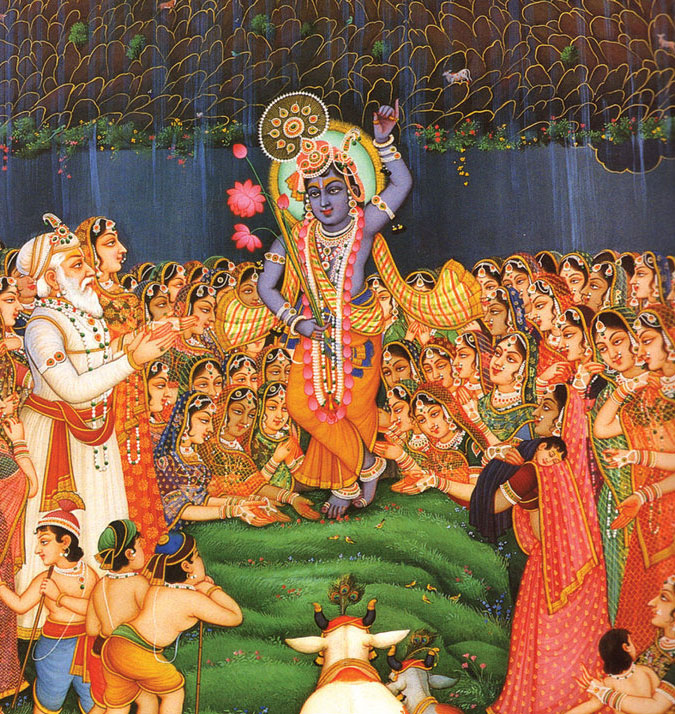
On this very auspicious day, Govardhana-puja, we are reminded of Krsna’s lifting of Govardhana Hill, as told by His Divine Grace A.C. Bhaktivedanta Swami Prabhupada in chapter 25 of the Krsna Book.
…Kṛṣṇa has declared in the Bhagavad-gītā that the worshipers of the demigods are not very intelligent. He has also declared that one has to give up all kinds of worship and simply concentrate on Kṛṣṇa consciousness. Kṛṣṇa’s invoking the anger of Indra and later on chastising him is a clear indication to His devotee that those who are engaged in Kṛṣṇa consciousness have no need to worship any demigod, even if it is found that the demigod has become angry. Kṛṣṇa gives His devotees all protection, and they should completely depend on His mercy.
Kṛṣṇa, the Supreme Personality of Godhead
By His Divine Grace A. C. Bhaktivedanta Swami Prabhupāda
Chapter 25
Devastating Rainfall in Vṛndāvana
When Indra understood that the sacrifice offered by the cowherd men in Vṛndāvana was stopped by Kṛṣṇa, he became angry, and he vented his anger upon the inhabitants of Vṛndāvana, who were headed by Nanda Mahārāja, although Indra knew perfectly well that Kṛṣṇa was personally protecting them. As the director of different kinds of clouds, Indra called for the Sāṁvartaka. This cloud is invited when there is a need to devastate the whole cosmic manifestation. The Sāṁvartaka was ordered by Indra to go over Vṛndāvana and inundate the whole area with an extensive flood. Demonically, Indra thought himself to be the all-powerful supreme personality. When demons become very powerful, they defy the supreme controller, Personality of Godhead. Indra, though not a demon, was puffed up by his material position, and he wanted to challenge the supreme controller. He thought himself, at least for the time being, as powerful as Kṛṣṇa. Indra said, “Just see the impudence of the inhabitants of Vṛndāvana! They are simply inhabitants of the forest, but being infatuated with their friend Kṛṣṇa, who is nothing but an ordinary human being, they have dared to defy the demigods.”
…The Lord ordered all the citizens of Navadvīpa to chant the Hare Kṛṣṇa mantra, and in each and every home they began performing saṅkīrtana regularly.
[All the devotees sang this popular song along with the Hare Kṛṣṇa mahā-mantra.] “Haraye namaḥ, kṛṣṇa yādavāya namaḥ gopāla govinda rāma śrī-madhusūdana.”
When the saṅkīrtana movement thus started, no one in Navadvīpa could hear any sound other than the words “Hari! Hari!” and the beating of the mrdaṅga and clashing of hand bells.
…This Fifth Chapter is a practical explanation of Kṛṣṇa consciousness, generally known as karma-yoga. The question of mental speculation as to how karma-yoga can give liberation is answered herewith. To work in Kṛṣṇa consciousness is to work with the complete knowledge of the Lord as the predominator. Such work is not different from transcendental knowledge. Direct Kṛṣṇa consciousness is bhakti-yoga, and jñāna-yoga is a path leading to bhakti-yoga. Kṛṣṇa consciousness means to work in full knowledge of one’s relationship with the Supreme Absolute, and the perfection of this consciousness is full knowledge of Kṛṣṇa, or the Supreme Personality of Godhead. A pure soul is the eternal servant of God as His fragmental part and parcel. He comes into contact with māyā (illusion) due to the desire to lord it over māyā, and that is the cause of his many sufferings. As long as he is in contact with matter, he has to execute work in terms of material necessities. Kṛṣṇa consciousness, however, brings one into spiritual life even while one is within the jurisdiction of matter, for it is an arousing of spiritual existence by practice in the material world. The more one is advanced, the more he is freed from the clutches of matter. The Lord is not partial toward anyone. Everything depends on one’s practical performance of duties in an effort to control the senses and conquer the influence of desire and anger. And, attaining Kṛṣṇa consciousness by controlling the above-mentioned passions, one remains factually in the transcendental stage, or brahman-nirvāṇa. The eightfold yoga mysticism is automatically practiced in Kṛṣṇa consciousness because the ultimate purpose is served. There is gradual process of elevation in the practice of yama, niyama, āsana, pratyāhāra, dhyāna, dhāraṇā, prāṇāyāma, and samādhi. But these only preface perfection by devotional service, which alone can award peace to the human being. It is the highest perfection of life.
Kevin Lahart of Newsday interviews His Divine Grace A.C. Bhaktivedanta Swami Prabhupada
Mr. Lahart: I wonder if you could tell me how you came to found the Krsna consciousness movement here in the United States?
Srila Prabhupada: I was ordered by my spiritual master to do this work, so on his order I came to the U.S. I came alone, with no help or money. Somehow or other I stayed.
Mr. Lahart: How did you attract followers? You landed in New York and
Srila Prabhupada: My attraction was this chanting of the Hare Krsna mantra. That’s all. I had no magic. Others had some sort of magic. I never showed any magic. At Tompkins Square Park I was chanting, and gradually some boys came. First a picture was published by the New York Times. Then we started a branch in San Francisco, later Montreal, Boston, then Los Angeles.
Mr. Lahart: You just chanted at Tompkins Square Park, and people came.
Srila Prabhupada: Yes, I chanted under a tree. (I think that a picture was also published in the East Village Other in a very big article.) Naturally, some boys came and joined me and began to dance. That was the beginning.
“That is the way of Krishna consciousness. Pure devotees are so absorbed in thought of Krishna that they have no other engagement; although they may seem to think or act otherwise, they are always thinking of Krishna. The smile of such a Krishna conscious person is so attractive that simply by smiling he wins so many admirers, disciples and followers.” (from purport to Srimad Bhagavatam, 3.22.21)












 The Hare Krishna Movement