Sri Damodarastakam as explained by Visnujana Swami / Verse Seven

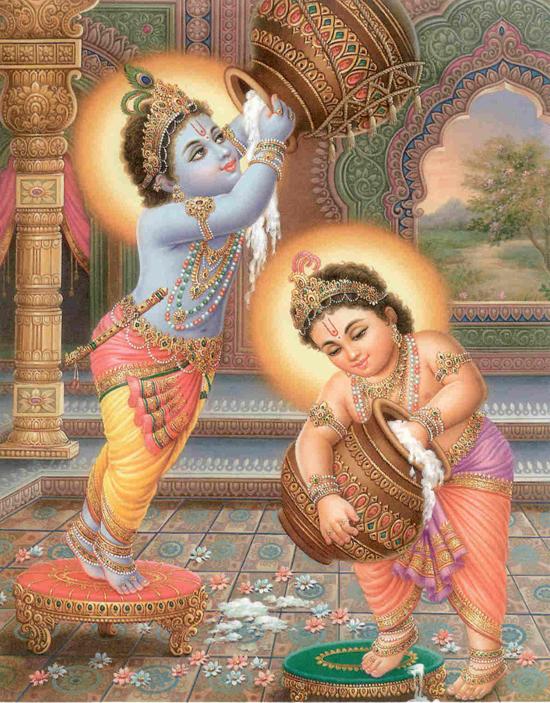
You then freed the sons of Kuvera, Manigriva, and Nalakuvera, who were cursed to stand as trees, and You gave them the chance to become Your devotees.

kuverātmajau baddha-mūrtyaiva yadvat
tvayā mocitau bhakti-bhājau kṛtau ca
tathā prema-bhaktiḿ svakāḿ me prayaccha
na mokṣe graho me ‘sti dāmodareha

kuvera-ātmajau–the two sons of Kuvera (named Nalakūvara and Maṇigrīva); baddha-mūrtyā-eva–by He whose divine form was bound with ropes to the grinding mortar; yat-vat–since they were like that (cursed by Nārada to take birth as twin arjuna trees); tvayā–by You; mocitau–they who were liberated; bhakti-bhājau–the recipients of devotional service; kṛtau–You made them; ca–also; tathā–then; premabhaktim–loving devotion; svakām–Your own; me–unto me; prayaccha– please give; na mokṣe–not for liberation; grahaḥ–enthusiasm; me–my; asti–is; dāmodara–O Lord Dāmodara!; iha–this.

7) O Lord Damodara, in Your form as a baby, Mother Yasoda bound You to a grinding stone with a rope for tying cows, You then freed the sons of Kuvera, Manigriva, and Nalakuvera, who were cursed to stand as trees, and You gave them the chance to become Your devotees. Please bless me in this same way, I have no desire for liberation into Your effulgence.

Purport
This verse reveals deep truths about prema-visesa, pure ecstatic love for Krishna. Beginning with kuveratmajau, the two sons of Kuvera are introduced. They were able to obtain the direct vision of the Lord. But isn’t prema-bhakti the only means for seeing the Lord face to face? And having once seen the Lord, doesn’t the agony of separation set in upon losing that vision? This is the feature of prema-bhakti that brings the Lord under the sway of the pure devotee’s love.

How did the two reprobates get such mercy? The answer is that by the quality of Sri Krishna’s love, bhakta-vatsala, the impossible becomes possible. To honor the word of His pure devotee Narada Muni, who gave the benediction that they would see the Lord face to face, the Lord actually delivers these two brothers. Did they ever do anything to deserve this? No. It is simply causeless mercy!
More

Sri Damodarastakam as explained by Visnujana Swami / Verse Five

O Lord, the cheeks of Your blackish lotus face, which is encircled by locks of curling hair, have become reddened like bimba fruit due to Mother Yasoda’s kisses


idaḿ te mukhāmbhojam atyanta-nīlair
vṛtaḿ kuntalaiḥ snigdha-raktaiś ca gopyā
muhuś cumbitaḿ bimba-raktādharaḿ me
manasy āvirāstām alaḿ lakṣa-lābhaiḥ

idam–this; te–Your; mukha-ambhojam–lotus-like face; avyakta-nīlaiḥ–by very dark blue; vṛtam–surrounded; kuntalaiḥ–by curling locks of hair; snigdha–soft and glossy; raktaiḥ–by reddish-tinted; ca–also; gopyā–by the gopī (Srī Yaśodā); muhuḥ–again and again; cumbitam–kissed; bimbarakta-adharam–with lips red as the bimba fruit; me–my; manasi–in the heart; āvirāstām–may it be manifest; alam–useless (there is no need for me); lakṣa-lābhaiḥ–by millions of attainments of other boons.

5) O Lord, the cheeks of Your blackish lotus face, which is encircled by locks of curling hair, have become reddened like bimba fruit due to Mother Yasoda’s kisses. What more can I describe than this? Millions of opulences are of no use to me, but may this vision constantly remain in my mind.

Purport

The poet demonstrates in this verse that longing for the association of the Lord in the heart is the best means to achieve Him. The longing to see the beautiful lotus face of the Lord, which is supremely enchanting, is stated first (idam te mukhambhojam). The indescribably sweet face of Sri Krishna resembles a lotus flower in full bloom. Simply by seeing His face, which is the treasure house of supreme bliss, all anxiety and distress disappear.

More

Sri Damodarastakam as explained by Visnujana Swami / Verse Four

My only prayer is that Your childhood pastimes may constantly appear in my mind

varaḿ deva mokṣaḿ na mokṣāvadhiḿ vā
na canyaḿ vṛṇe ‘haḿ vareṣād apīha
idaḿ te vapur nātha gopāla-bālaḿ
sadā me manasy āvirāstāḿ kim anyaiḥ

varam–boons; deva–O Lord!; mokṣam–liberation; na–not; mokṣāavadhim–the highest pinnacle of liberation (the realm of Srī Vaikuṇṭhaloka); vā–or; na–not; ca-anyam–or anything else; vṛṇe aham–I pray for; vara-īśāt–from You Who can bestow any boon; api–also; iha–here in Vṛndāvana; idam–this; te–Your; vapuḥ–divine bodily form; nātha–O Lord!; gopāla-bālam–a young cowherd boy; sadā–always; me manasi–in my heart; āvirāstām–may it be manifest; kim anyaiḥ–what is the use of other things (mokṣā, and so forth.)

4) O Lord, although You are able to give all kinds of benedictions, I do not pray to You for liberation, nor eternal life in Vaikuntha, nor any other boon. My only prayer is that Your childhood pastimes may constantly appear in my mind. O Lord, I do not even want to know Your feature of Paramatma. I simply wish that Your childhood pastimes may ever be enacted in my heart.

Purport
Both verses four and five describe the poet’s innermost desires, beginning with, varam, boons. No benedictions of any kind are requested even here in Vrindavan (lila) from He who can bestow any boon (varesad). Satyavrata Muni does not seek liberation (moksa na), nor does he desire the highest conception of liberation (moksa-avadhim), which is eternal life in Vaikuntha. Neither is he interested in any other benediction (na ca anyam), referring to the nine processes of devotional service, beginning with sravanam kirtanam, and the benefits they bestow. If others desire these, or even if Krishna wants to bestow these upon him, he has no attraction for them.

The three benedictions referred to – moksa (liberation), moksavadhim (eternal life in Vaikuntha), and anyam (any other boon) – reflect an ascending order of superiority. Eternal life in Vaikuntha is clearly superior to impersonal liberation. The position of other boons, such as the nine processes of devotional service, are described in Srimad Bhagavatam.

“O Lord, we pray that You let us be born in any hellish condition of life, just as long as our hearts and minds are always engaged in the service of Your lotus feet, our words are made beautiful [by speaking of Your activities] just as Tulasi leaves are beautified when offered unto Your lotus feet, and as long as our ears are always filled with the chanting of Your transcendental qualities.” Srimad Bhagavatam 3.15.49.

By these words spoken by the four Kumaras, we can understand that the nine processes of devotion can be perfected even in hell. So in any condition of life, one can experience the perfection that is available in the eternal abode, Vaikuntha, through bhakti-yoga.

More

Sri Damodarastakam as explained by Visnujana Swami / Verse Two

Mother Yasoda bound His belly with ropes, He shivered in fright and His pearl necklace shook.


rudantaḿ muhur netra-yugmaḿ mṛjantam
karāmbhoja-yugmena sātańka-netram
muhuḥ śvāsa-kampa-trirekhāńka-kaṇṭha-
sthita-graivaḿ dāmodaraḿ bhakti-baddham

rudantam–crying; muhuḥ–again and again; netra-yugmam–His two eyes; mṛjantam–rubbing; kara-ambhoja-yugmena–with His two lotus-like hands; sa-ātańka-netram–with very fearful eyes; muhuḥ–again and again; śvāsa–quick breathing and sighing; kampa–trembling; tri-rekhaańka-kaṇṭha–neck marked with three lines (just like a conchshell); sthita–situated; graiva–pearl necklaces and other neck-ornaments; dāma-udaram–unto He with a rope around His belly; bhakti-baddham– who is bound by devotion.

2) Upon seeing His mothers whipping stick, He cried and rubbed His eyes again and again with His two lotus hands. His eyes were fearful and His breathing quick, and as Mother Yasoda bound His belly with ropes, He shivered in fright and His pearl necklace shook. To this Supreme Lord, Sri Damodara, who is bound with His devotee’s love, I offer my humble obeisances.

Purport
The second verse continues describing the lila-visesa. He is crying (rudantam) because He sees the stick in Mother Yasoda’s hand. Perceiving that she may strike Him, He appears fearful, hoping her natural empathy may save Him from punishment. Due to fear, tears are forming in His eyes, so He rubs his eyes with his lotus-like hands in the normal manner of children to wipe away the tears that are beginning to flow.

Then (satanka-netram) His fearful eyes reveal how much He is dreading punishment. It also indicates His glancing here and there in great fear, trying to avoid being punished. The confidential pastime is revealed in this way. Therefore, due to his continual sobbing He is trembling, (muhuh svasa-kampa) and thus, (sthita-graiva) the pearl necklaces and earrings that adorn Him are also shaking.

More

Next Newer Entries

108 Imporant Slokas from the 1972 Bhagavad-gita As It Is

Click on image to go to Post

Click on image to go to Post

The Hare Krishna Cookbook

Songs of the Vaisnava Acaryas

Bhagavad-gita As It Is 1972 Edition “Online”

click on image

click on image to visit site

Srimad Bhagavatam Online

click on image

Raja-Vidya the King of Knowledge

click on image

click on image

Blog Stats

  • 4,903,628 hits

Enter your email address to subscribe to this blog and receive notifications of new posts by email.

Join 3,888 other subscribers

Important Slokas from the Brahma-samhita

click on image

click on image

Slokas from the Sri Isopanisad

click on image

click on image

Prayers By Queen Kunti (Slokas)

click on image

Gajendra’s Prayers of Surrender (Slokas)

click on image

A Short Statement of the Philosophy of Krishna Consciousness

click on image

click on image

July 9th Letter

click on image

click on image

The Hare Krishna Explosion

Reference Material/Study Guide

click on image

click on image

  • LINKS