25 Dec 2011
by The Hare Krishna Movement
in Bhagavad-gita, Devotional Service, Krishna Consciousness, Lord Jesus Christ
Tags: Arjuna, bhagavad-gita, devotee is friendly to every living entity, devotional service, God consciousness, Jesus Christ, Lord Jesus Christ, Srila Prabhupada
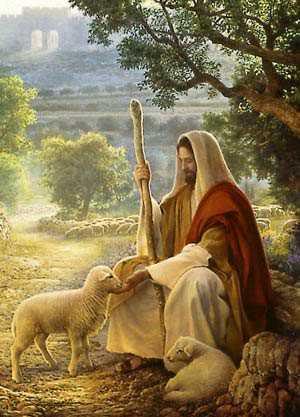
A devotee of Kṛṣṇa is friendly to everyone. Therefore it is said here that he has no enemy. How is this? A devotee situated in Kṛṣṇa consciousness knows that only devotional service to Kṛṣṇa (God) can relieve a person from all the problems of life. He has personal experience of this, and therefore he wants to introduce this system, Kṛṣṇa consciousness, or God Consciousness, into human society. There are many examples in history of devotees of the Lord risking their lives for the spreading of God consciousness. The favorite example is Lord Jesus Christ
He was crucified by the nondevotees, but He sacrificed His life for spreading God consciousness. Of course, it would be superficial to understand that He was killed. Similarly, in India also there are many examples, such as Ṭhākur Haridāsa. Why such risk? Because they wanted to spread Kṛṣṇa consciousness, and it is difficult. A Kṛṣṇa conscious person knows that if a man is suffering, it is due to his forgetfulness of his eternal relationship with Kṛṣṇa (God). Therefore, the highest benefit one can render to human society is relieving one’s neighbor from all material problems. In such a way, a pure devotee is engaged in the service of the Lord. Now, we can imagine how merciful Kṛṣṇa is to those engaged in His service, risking everything for Him. Therefore it is certain that such persons must reach the supreme planet after leaving the body.
Bhagavad-gita As It Is – Macmillan 1972 Edition
By His Divine Grace A.C. Bhaktivedanta Swami Prabhupada
Chapter 11 The Universial Form Text 55
mat-karma-kṛn mat-paramo
mad-bhaktaḥ saṅga-varjitaḥ
nirvairaḥ sarva-bhūteṣu
yaḥ sa mām eti pāṇḍava
mat-karma-kṛt—engaged in doing My work; mat-paramaḥ—concerning Me, the Supreme; mat-bhaktaḥ—engaged in My devotional service; saṅga-varjitaḥ—freed from the contamination of previous activities and mental speculation; nirvairaḥ—without an enemy; sarva-bhūteṣu—to every living entity; yaḥ—one who; saḥ—he; mām—unto Me; eti—comes; pāṇḍava—O son of Pāṇḍu.
Translation
My dear Arjuna, one who is engaged in My pure devotional service, free from the contaminations of previous activities and from mental speculation, who is friendly to every living entity, certainly comes to Me.
More
13 Dec 2011
by The Hare Krishna Movement
in Books by Srila Prabhupada, Raja-Vidya
Tags: Arjuna, bhagavad-gita, books by Srila Prabhupada, His Divine Grace A.C. Bhaktivedanta Swami Prabhupada, Raja-Vidya, Sri Bhagavan uvaca, Sri Krsna, the king of knowledge

Raja-vidya: The King of Knowledge
In the first verse of this Ninth Chapter, by the word guhyatamam, Śrī Kṛṣṇa intimates that He is imparting the most confidential knowledge to Arjuna. Why is He proclaiming this to Arjuna? It is because Arjuna is anasūyu—non-envious. In the material world if someone is greater than us, we are envious. We are not only envious of one another, but of God. Also when Kṛṣṇa says, “I am the proprietor,” we disbelieve it. But this is not the case with Arjuna, who listens to Kṛṣṇa without envy. Arjuna does not cavil with Kṛṣṇa but agrees with whatever He says. This is his special qualification, and this is the way of understanding Bhagavad-gītā. It is not possible to understand what God is by our own mental speculations; we have to hear, and we have to accept.
Raja – Vidya: The King of Knowledge
By His Divine Grace A.C. Bhaktivedanta Swami Prabhupada
Chapter One
śrī bhagavān uvāca
idaṁ tu te guhyatamaṁ
pravakṣyāmy anasūyave
jñānaṁ vijñāna-sahitaṁ
yaj jñātvā mokṣyase ’śubhāt
“The Supreme Lord said: My dear Arjuna, because you are never envious of Me, I shall impart to you this most secret wisdom, knowing which you shall be relieved of the miseries of material existence.” (Bg. 9.1)
The opening words of the Ninth Chapter of Bhagavad-gītā indicate that the Supreme Godhead is speaking. Here Śrī Kṛṣṇa is referred to as Bhagavān. Bhaga means opulences, and vān means one who possesses. We have some conception of God, but in the Vedic literature there are definite descriptions and definitions of what is meant by God, and what is meant is described in one word—Bhagavān. Bhagavān possesses all opulences, the totality of knowledge, wealth, power, beauty, fame and renunciation. When we find someone who possesses these opulences in full, we are to know that he is God. There are many rich, wise, famous, beautiful and powerful men, but no one man can claim to possess all of these opulences. Only Kṛṣṇa claims to possess them in totality.
More
06 Dec 2011
by The Hare Krishna Movement
in Bhagavad-gita, High Thinking, Krishna Consciousness
Tags: Arjuna, Bg. 18.65, bhagavad-gita, Brahma-samhita, His Divine Grace A.C. Bhaktivedanta Swami Prabhupada, Krishna, Krsna meditation, Macmillan 1972 Edition

“…one should concentrate his mind upon Kṛṣṇa-the very form with two hands carrying a flute, the bluish boy with a beautiful face and peacock feathers in His hair. There are descriptions of Kṛṣṇa found in the Brahma-saṁhitā and other literatures. One should fix his mind on this original form of Godhead, Kṛṣṇa. He should not even divert his attention to other forms of the Lord. The Lord has multi-forms, as Viṣṇu, Nārāyaṇa, Rāma, Varāha, etc., but a devotee should concentrate his mind on the form that was present before Arjuna. Concentration of the mind on the form of Kṛṣṇa constitutes the most confidential part of knowledge, and this is disclosed to Arjuna because Arjuna is the most dear friend of Kṛṣṇa’s.”
Bhagavad-gita As It Is – Macmillan 1972 Edition
By His Divine Grace A.C. Bhaktivedanta Swami Prabhupada
Chapter 18, Text 65
man-manā bhava mad-bhakto
mad-yājī māṁ namaskuru
mām evaiṣyasi satyaṁ te
pratijāne priyo ‘si me
man-manāḥ—thinking of Me; bhava—just become; mat-bhaktaḥ—My devotee; mat-yājī—My worshiper; mām—unto Me; namaskuru—offer your obeisances; mām—unto Me; eva—certainly; eṣyasi—come; satyam—truly; te—to you; pratijāne—I promise; prijaḥ—dear; asi—you are; me—My.
Always think of Me and become My devotee. Worship Me and offer your homage unto Me. Thus you will come to Me without fail. I promise you this because you are My very dear friend.
More
04 Dec 2011
by The Hare Krishna Movement
in Bhagavad-gita, Book Changes, Book Distribution
Tags: Arjuna, as it is, Battlefield of Kuruksetra, bhagavad-gita, devotee of Sri Krishna, dharma-ksetra, gita-mahatmya, Glorification of the Gita, His Divine Grace A.C. Bhaktivedanta Swami Prabhupada, Krishna, Kuruksetra, place of pilgrimage

The Advent of Bhagavad-gita
Today is the anniversary commemorating the day when Sri Krishna spoke Bhagavad-gita to Arjuna, at the place known as Kurukṣetra.
Traditionally devotees go to Kurukṣetra (dharma-kṣetra, a place where religious rituals are performed) ) and recite Bhagavad Gita from early morning until the next morning, perform arati to Bhagavad Gita and to Krishna and Arjuna upon the chariot, offer lamps, and discuss the significance of the Bhagavad-gita.
Devotees who cannot get to Kurukṣetra, can honor the blessed event by reading or reciting the Bhagavad-gita, and discussing the subject matter of Bhagavad Gita in the association of devotees.
Distribution of Bhagavad-gita’s on this day is also a very auspicious activity to perform.
Bhagavad-gita As It Is – Macmillan 1972 Edition
By His Divine Grace A.C. Bhaktivedanta Swami Prabhupada
dhṛtarāṣṭra uvāca
dharma-kṣetre kuru-kṣetre
samavetā yuyutsavaḥ
māmakāḥ pāṇḍavāś caiva
kim akurvata sañjaya
dhṛtarāṣṭraḥ—King Dhṛtarāṣṭra; uvāca—said; dharma-kṣetre—in the place of pilgrimage; kuru-kṣetre—in the place named Kurukṣetra; samavetāḥ—assembled; yuyatsavaḥ—desiring to fight; māmakāḥ—my party (sons); pāṇḍavāḥ—the sons of Pāṇḍu; ca—and; eva-certainly; kim—what; akurvata—did they do; sañjaya—O Sañjaya.
Translation
Dhṛtarāṣṭra said: O Sañjaya, after assembling in the place of pilgrimage at Kurukṣetra, what did my sons and the sons of Pāṇḍu do, being desirous to fight?
Purport
Bhagavad-gītā is the widely read theistic science summarized in the Gītā-māhātmya (Glorification of the Gītā). There it says that one should read Bhagavad-gītā very scrutinizingly with the help of a person who is a devotee of Śrī Kṛṣṇa and try to understand it without personally motivated interpretations. The example of clear understanding is there in the Bhagavad-gītā itself, in the way the teaching is understood by Arjuna, who heard the Gītā directly from the Lord. If someone is fortunate enough to understand Bhagavad-gītā in that line of disciplic succession, without motivated interpretation, then he surpasses all studies of Vedic wisdom, and all scriptures of the world. One will find in the Bhagavad-gītā all that is contained in other scriptures, but the reader will also find things which are not to be found elsewhere. That is the specific standard of the Gītā. It is the perfect theistic science because it is directly spoken by the Supreme Personality of Godhead, Lord Śrī Kṛṣṇa.
More
04 Dec 2011
by The Hare Krishna Movement
in Bhagavad-gita, Srila Prabhupada
Tags: Advent of Bhagavad-gita, Arjuna, battle of Kurksetra, bhagavad-gita, essays and articles, His Divine Grace A.C. Bhaktivedanta Awami Prabhupada, Krishna, origin of Bhagavad-gita
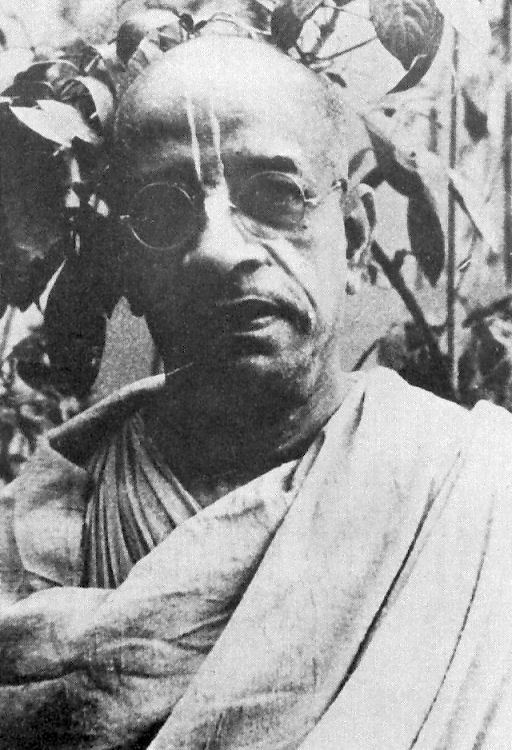
In honor of the Advent of Srimad Bhagavad-gita we are reprinting an Essay on the Bhagavad-gita written by Srila Prabhupada and published on the advent of Bhagavad-gita in 1948
Interpretations of Bhagavad-gita
Originally published c. 1948, on the auspicious observance of the advent of Srimad Bhagavad-gita.]
By His Divine Grace A.C. Bhaktivedanta Swami
It has become a luxurious fashion of the day, along with the progress of material civilization, that everyone can make his interpretation of the great Indian philosophy called the Bhagavad-gītā. This concise form of Vedic knowledge, known as the Gītopaniṣad, is acknowledged by all sections of transcendental scholars, in India especially, as the cream of all Upaniṣads and that of Vedānta-sūtras also. Scholars and ācāryas like Śrīpāda Śaṅkarācārya and some of his followers also could not leave out this very important book of knowledge, although such scholars of the Māyāvāda school did not acknowledge the bona fides of the Purāṇas. But the interpretation of Śrī Śaṅkarācārya differs from the interpretations of the Vaiṣṇava ācāryas headed by Śrī Ramanujācārya and Madhvācārya. There are innumerable interpretations of the Bhagavad-gītā in the market, and it is certainly a puzzling business to select which of the various interpretations shall be accepted as bona fide and which of them shall be rejected as mala fide.
In order to make a distinction between these two classes of bona fide and mala fide interpretations, we have to make an impartial study of the book, and such unbiased study only will make us able to discern the bona fide from the mala fide.
In this connection, we may first of all try to find out the origin of the Bhagavad-gītā. It is wrong to understand that The Bhagavad-gītā was first spoken in the battlefield of Kurukṣetra as it is a part of the great history of India, namely, the Mahābhārata. We can understand from the talks of Śrī Kṛṣṇa and Arjuna, as it is stated in the Bhagavad-gītā, that long, long before the battle of Kurukṣetra, this philosophy was once spoken by Śrī Kṛṣṇa to Vivasvān (the Sun), and from Vivasvān the knowledge was transferred to Manu, and from Manu it was transferred to King Ikṣvāku. And, in that way of disciplic succession, the knowledge has come down to generations after generations, but in course of time, such disciplic succession broke, and therefore, Śrī Kṛṣṇa again repeated the same yoga or transcendental knowledge to Arjuna. In the beginning of the 4th Chapter of Bhagavad-gītā, this fact is stated as follows:
More
01 Dec 2011
by The Hare Krishna Movement
in Bhagavad-gita, Maya
Tags: 29, Bg 5, bhagavad-gita, external energy of Krsna, His Divine Grace A.C. Bhaktivedanta Swami Prabhupada, illusion, Krishna, maya, perfection of life, perfeection of yoga

The sense of a separated existence from Kṛṣṇa is called māyā (mā-not, yā-this).
People in general, especially in this age of Kali, are enamored by the external energy of Kṛṣṇa, and they wrongly think that by advancement of material comforts every man will be happy. They have no knowledge that the material or external nature is very strong, for everyone is strongly bound by the stringent laws of material nature. A living entity is happily the part and parcel of the Lord, and thus his natural function is to render immediate service to the Lord. By the spell of illusion one tries to be happy by serving his personal sense gratification in different forms which will never make him happy. Instead of satisfying his own personal material senses, he has to satisfy the senses of the Lord. That is the highest perfection of life. The Lord wants this, and He demands it. One has to understand this central point of Bhagavad-gītā. Our Kṛṣṇa consciousness movement is teaching the whole world this central point, and because we are not polluting the theme of Bhagavad-gītā As It Is, anyone seriously interested in deriving benefit by studying the Bhagavad-gītā must take help from the Kṛṣṇa consciousness movement for practical understanding of Bhagavad-gītā under the direct guidance of the Lord. We hope, therefore, that people will derive the greatest benefit by studying Bhagavad-gītā As It Is as we have presented it here, and if even one man becomes a pure devotee of the Lord we shall consider our attempt a success.
The Kṛṣṇa consciousness movement is essential in human society, for it offers the highest perfection of life. How this is so is explained fully in the Bhagavad-gītā. Unfortunately, mundane wranglers have taken advantage of Bhagavad-gītā to push forward their demonic propensities and mislead people regarding right understanding of the simple principles of life. Everyone should know how God or Kṛṣṇa is great, and everyone should know the factual position of the living entities. Everyone should know that a living entity is eternally a servant and that unless one serves Kṛṣṇa one has to serve illusion in different varieties of the three modes of material nature, and thus perpetually one has to wander within the cycle of birth and death; even the so-called liberated Māyāvādī speculator has to undergo this process. This knowledge constitutes a great science, and each and every living being has to hear it for his own interest. (From the preface to the Bhagavad-gita As It Is)
More
25 Nov 2011
by The Hare Krishna Movement
in Bhagavad-gita
Tags: bhagavad-gita, birth and death, Black Friday, consumerism, economic development, His Divine Grace A.C. Bhaktivedanta Swami Prabhupada, material comforts, materialism, problems of material existence

Consumerism is a kind of Material Fever
The problems of material existence-birth, old age, disease and death-cannot be counteracted by accumulation of wealth and economic development. In many parts of the world there are states which are replete with all facilities of life, which are full of wealth, and economically developed, yet the problems of material existence are still present.
If economic development and material comforts could drive away one’s lamentations for family, social, national or international inebrieties, then Arjuna would not have said that even an unrivalled kingdom on earth or supremacy like that of the demigods in the heavenly planets would not be able to drive away his lamentations. He sought, therefore, refuge in Kṛṣṇa consciousness, and that is the right path for peace and harmony.
Bhagavad-gita As It Is – Macmillan 1972 Edition
By His Divine Grace A.C. Bhaktivedanta Swami Prabhupada
Chapter 2, Text 8
na hi prapaśyāmi mamāpanudyād
yac chokam ucchoṣaṇam indriyāṇām
avāpya bhūmāv asapatnam ṛddhaṁ
rājyaṁ surāṇām api cādhipatyam
na—do not; hi—certainly; prapaśyāmi—I see; mama—my; apanudyāt—they can drive away; yat—that; śokam—lamentation; ucchoṣaṇam—drying up; indriyāṇām—of the senses; avāpya—achieving; bhūmau—on the earth; asapatnam—without rival; ṛddham—prosperous; rājyam—kingdom; surāṇām—of the demigods; api—even; ca—also; ādhipatyam—supremacy.
Translation
I can find no means to drive away this grief which is drying up my senses. I will not be able to destroy it even if I win an unrivalled kingdom on the earth with sovereignty like that of the demigods in heaven.
Purport
Although Arjuna was putting forward so many arguments based on knowledge of the principles of religion and moral codes, it appears that he was unable to solve his real problem without the help of the spiritual master, Lord Śrī Kṛṣṇa. He could understand that his so-called knowledge was useless in driving away his problems, which were drying up his whole existence; and it was impossible for him to solve such perplexities without the help of a spiritual master like Lord Kṛṣṇa. Academic knowledge, scholarship, high position, etc., are all useless in solving the problems of life; help can only be given by a spiritual master like Kṛṣṇa. Therefore, the conclusion is that a spiritual master who is one hundred percent Kṛṣṇa conscious is the bona fide spiritual master, for he can solve the problems of life. Lord Caitanya said that one who is master in the science of Kṛṣṇa consciousness, regardless of his social position, is the real spiritual master.
More
22 Nov 2011
by The Hare Krishna Movement
in Bhagavad-gita, Krsna is the Source of All Incarnations
Tags: Bg 4.7, bhagavad-gita, buddha, Kalki, Krishna, Kurma, Matsya, Nrismhadeva, Parasurama, Plate 16, prabhupada, Rama, Varaha
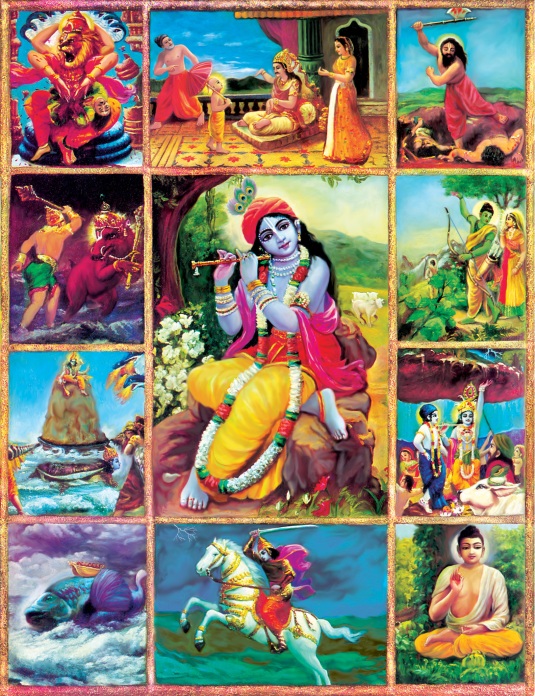
The principles of the Bhagavad-gītā were spoken to Arjuna, and, for that matter, to other highly elevated persons, because he was highly advanced compared to ordinary persons in other parts of the world. Two plus two equals four is a mathematical principle that is true both in the beginner’s arithmetic class and in the advanced class as well. Still, there are higher and lower mathematics. In all incarnations of the Lord, therefore, the same principles are taught, but they appear to be higher and lower in varied circumstances.
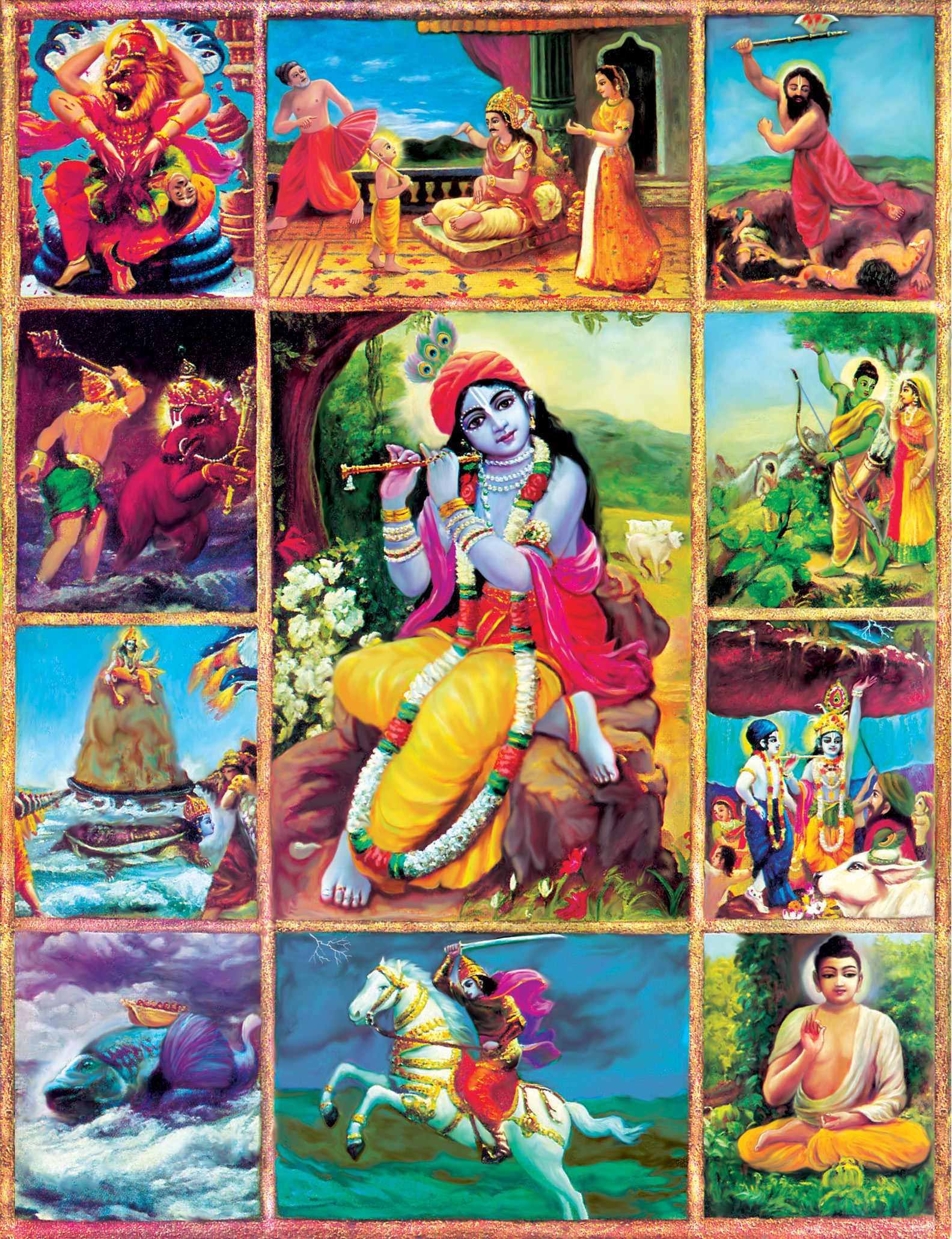
In the center Square, Krishna is shown in His original two-handed form, holding a flute. Surrounding Him are ten of His eternal incarnations, pictured in the order in which they appeared in the material world, beginning clockwise from the lower left-hand corner.
a) Matsya, the fish incarnation, is saving the Vedas.
b) Kurma, the tortoise incarnation, is holding the hill on His back.
c) Varaha, the boar incarnation, is fighting with the demon Hiranyaksa.
d) Nrismhadeva, the lion incarnation, is killing the demon Hiranyakasipu.
e) Vamanadeva, the dwarf incarnation, is begging some land from King Bali.
f) Parasurama, is killing the demoniac ksatriyas.
g) Lord Ramacandra, is going off into exile with His Wife Sita, and brother, Laksmana.
h) Krishna, is lifting Govardhana Hill and beside His is His brother, Balarama.
i) Lord Buddha.
j) Lord Kalki is riding on His horse, killing all the demons and thus liberating them.
Bhagavad-gita As It Is – Macmillan 1972 Edition
By His Divine Grace A.C. Bhaktivedanta Swami Prabhupada
Chapter 4, Text 7
yadā yadā hi dharmasya
glānir bhavati bhārata
abhyutthānam adharmasya
tadātmānaṁ sṛjāmy aham
yadā—whenever; yadā—wherever; hi—certainly; dharmasya—of religion; glāniḥ—discrepancies; bhavati—manifested, becomes; bhārata—O descendant of Bharata; abhyutthānam—predominance; adharmasya—of irreligion; tadā—at that time; ātmānam—self; sṛjāmi—manifest; aham—I.
TRANSLATION
Whenever and wherever there is a decline in religious practice, O descendant of Bharata, and a predominant rise of irreligion-at that time I descend Myself.
More
16 Nov 2011
by The Hare Krishna Movement
in Nectar of Devotion
Tags: A.C. Bhaktivedanta Swami Prabhupada, bhagavad-gita, Nectar of Devotion, occupational duties, Purity of Devotional Service, Supreme Personality of Godhead, surrender

In the Bhagavad-gītā also the Lord says: “Give up all your occupations and just become surrendered unto Me. I give you assurance that I shall give you protection from all sinful reactions.” One may think that because he is surrendering unto the Supreme Personality of Godhead, he will not be able to perform all of his other obligations. But the Lord says repeatedly, “Don’t hesitate. Don’t consider that because you are giving up all other engagements there will be some flaw in your life. Don’t think like that. I will give you all protection.” That is the assurance of Lord Kṛṣṇa in the Bhagavad-gītā.
The Nectar of Devotion – 1970 Edition
By His Divine Grace A.C. Bhaktivedanta Swami Prabhupada
Chapter 5
Purity of Devotional Service
All of the previous instructions imparted by Śrīla Rūpa Gosvāmī in his broad statements can be summarized thus: as long as one is materially inclined or desirous of merging into the spiritual effulgence, one cannot enter into the realm of pure devotional service. Next, Rūpa Gosvāmī states that devotional service is transcendental to all material considerations and that it is not limited to any particular country, class, society or circumstance. As stated in Śrīmad-Bhāgavatam, devotional service is transcendental and has no cause. Devotional service is executed without any hope for gain, and it cannot be checked by any material circumstances. It is open for all, without any distinction, and it is the constitutional occupation of the living entities.
More
08 Nov 2011
by The Hare Krishna Movement
in A.C. Bhaktivedanta Swami Prabhupada, Back to Godhead, Krishna Consciousness
Tags: A.C. Bhaktivedanta Swami Prabhupada, Back to Godhead Magazine, bhagavad-gita, Freedom in Krsna, krsna consciousness, yoga, yogi

Freedom in Krsna
By His Divine Grace A.C. Bhaktivedanta Swami Prabhupada
Re-printed from Back to Godhead Magazine 1973, Vol. 1, No. 48
vande rupa-sanatanau raghuyugau sri-jiva-gopalakau.
We are following in the footsteps of Lord Caitanya Mahaprabhu in order to understand Krsna consciousness. Krsna, the Supreme Personality of Godhead, is said in Sri Isopanisad to be very far away from us yet at the same time to be very near. Isvara, the supreme controller, is situated in everyone’s heart, not only in the hearts of human beings, but also within the beasts, birds, aquatics, and even within the atoms themselves. We simply have not realized Him. Actually anyone, however, can find Krsna within his heart.
The process of finding Krsna is called yoga. There are many types of yoga. In the Western countries people are generally familiar with the process of hatha-yoga. This is an approved method and is described in the Sixth Chapter of Bhagavad-gita. At the present moment, however, people are short-lived, they are not very fortunate, and they are always disturbed by many external affairs, and therefore it is not possible to properly execute this hatha-yoga. Even five thousand years ago when Krsna advised His friend Arjuna to accept the hatha-yoga process, Arjuna said, “Krsna, this practice is impossible.” He further said that to control the mind is as difficult as to control the wind. The mind flickers from one engagement to another and changes so swiftly that it is very difficult to control it in this age. Therefore Arjuna said that for him this process of hatha-yoga was not possible.
More
24 Oct 2011
by The Hare Krishna Movement
in Back to Godhead, Books by Srila Prabhupada, Brahmananda das
Tags: back to Godhead, bhagavad-gita, Caitanya Caritamrta, His Divine Grace A.C. Bhaktivedanta Swami Prabhupada, ISKCON Press, Macmillan's Gita, Nectar of Devotion, Sri Isopanisad, Teachings of Lord Caitanya

The Books of His Divine Grace A.C. Bhaktivedanta Swami Prabhupada
Srila Prabhupada teaches the most difficult and sublime science—the science of how to serve God—in such a way that anyone can understand it. The concepts are presented over and over again, for repetition is a time-tested learning technique in transcendental study. Thus in whichever of Srila Prabhupada’s books one reads first, one will find the entire science of Krsna consciousness presented, yet each succeeding book reveals something more, and with each rereading one will find new light. Srila Prabhupada’s books are the most wonderful vehicle because they swiftly transport the reader to a timeless and ever- green world where everyone is joyfully awakened to the Absolute Truth of Krsna, the Supreme Personality of Godhead.
The Books of His Divine Grace A.C. Bhaktivedanta Swami Prabhupada
Originally published in Back to Godhead No. 52
Bhaktivedanta Book Trust 1973
By Brahmananda Swami ISKCON East Africa
Part 6
The next book, Teachings of Lord Caitanya, was then dictated. It is a summary study of the historic Caitanya-caritamrta. Instead of the exhaustive format of verse to verse translation and purport, Srila Prabhupada presented this book in a shortened but more essential manner. “My books are for my students,” he told us, and so he wanted to write as many as possible. If Bhagavad-gita could be considered the undergraduate study of spiritual life and Srimad-Bhagavatam the master’s study, then Caitanya-caritamrta is the doctorate course. It recounts Lord Caitanya’s teachings to the only five disciples He personally taught. In Teachings of Lord Caitanya, the incomplete philosophy of impersonalism is fully analyzed and forcefully defeated by Lord Caitanya in His discussions with the two biggest impersonalists of His time, Prakasananda Sarasvati and Sarvabhauma Bhattacarya. Also, the quintessence of all detailed knowledge of Krsna and how He acts both in the spiritual and material worlds is disclosed to Ramananda Raya.
More
30 Sep 2011
by The Hare Krishna Movement
in Krishna Consciousness, Srila Prabhupada Conversations
Tags: bhagavad-gita, bhakti, conversation with Srila Prabhupada, Krishna consciousness, perfection of yoga, remembering Krishna

Remembering Krishna. This is Krishna Consciousness
Bhagavad-gītā 2.1-10 and Talk
by His Divine Grace A. C. Bhaktivedanta Swami Prabhupāda
Los Angeles, November 25, 1968
…It is stated in the Bhagavad-gītā, that we have to try to remember Kṛṣṇa. He’s so beautiful, His instructions are so nice. If we simply remember Kṛṣṇa… That was the perfection approved by Lord Caitanya.
I think I have narrated the story. When Lord Caitanya was traveling in South India in a big temple, Raṅganātha temple, He went to see the Deity, and He saw one brāhmaṇa was reading Bhagavad-gītā. And people were joking him, “Oh, Mr. brāhmaṇa, how you are reading Bhagavad-gītā?” Because they were the neighbors, they knew that this brāhmaṇa was illiterate and he was studying Bhagavad-gītā. So they were joking. But the brāhmaṇa did not about care them. He was taking the book and in his own way he was reading. Caitanya Mahāprabhu saw this incident, He came to the brāhmaṇa. So He asked the brāhmaṇa, “My dear brāhmaṇa, what you are reading?” So he could understand “This persons is not joking with me; He is serious.” So he explained, “My dear sir, I am reading Bhagavad-gītā. Unfortunately, I am illiterate. I do not know even the alphabets.” “Why you are reading Bhagavad-gītā?” So he said that, “My spiritual master knows that I am illiterate, but still, he has asked me to read Bhagavad-gītā. What can I do? Therefore I have taken this book. I am seeing simply. I do not know how to read.” “Oh, that’s all right. You cannot read. But I see that you are crying. How you are crying if you are not reading?” “Yes, I am crying. Of course, there is cause.” “What is that?” “As soon as I take this Bhagavad-gītā, I remember Kṛṣṇa. Kṛṣṇa is sitting as driver and Arjuna is hearing. I have heard the story. I know something of the instruction but cannot read. So as soon as I take this book, this picture comes before me and I simply think, ‘Oh, how Kṛṣṇa is nice that He has become a charioteer of His devotee. He is so great. Still, He has accepted a menial service of His devotee.’ This gives me so much pleasure that I cry.” Caitanya Mahāprabhu embraced him, “Your Bhagavad-gītā reading is perfect. You have taken the essence.” So this is the thing. If you simply remember Kṛṣṇa is teaching Arjuna and Arjuna is hearing, if you simply remember the picture, that is sufficient. Even if you think that you cannot read. Because after all we have to become Kṛṣṇa conscious. We haven’t got to become a learned man to argue with another learned man. If it is possible we can do that, but that does not make any difference if I cannot argue with others or if I cannot teach very nicely Bhagavad-gītā to others. Simply if I remember this picture, that is perfection. Because we have to become Kṛṣṇa conscious. We have to simply think of Kṛṣṇa. You think in any way. That is your perfection. Smartavyaḥ satataṁ viṣṇuḥ. This is the injunction. You have to think of Viṣṇu always. This is samādhi; this is meditation; this is yoga siddhi, perfection of yoga.
More
28 Sep 2011
by The Hare Krishna Movement
in Book Changes, Letters by Srila Prabhupada, Srila Prabhupada's Books
Tags: bhagavad-gita, book changes, Letters by Srila Prabhupada, Miss Nedungadi, original books, Srimad Bhagavatam
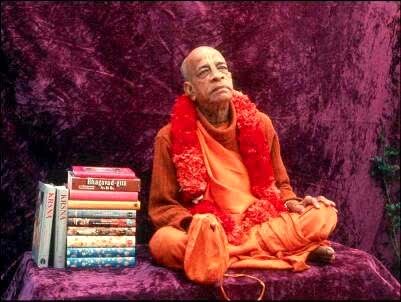
Bombay, Calicut–2, Kerala State,
Friday, 19 March, 1975:
My dear Miss Nedungadi, please accept my greetings. I am in due receipt of your letter dated March 6th, 1975 and have noted the contents.
Thank you so much for your kind appreciations. I am so much grateful that you have enjoyed studying my books. Many young intelligent persons such as yourself are studying these books in the colleges and universities all over the world.
Actually anyone who tries to understand these books will become a great realized devotee of Lord Krishna gradually. The original potency of the sastra remains in these books because I have not added or opinionated anything of my own. I have simply presented the scriptures such as Bhagavad-gita and Srimad-Bhagavatam as they are. Therefore just see the effect they have on the world.
At present, we have about 100 centers worldwide and about 10,000 fully dedicated students in those centers. You are welcome to visit or stay in any of our centers for your spiritual advancement. We have a nice center in Madras: 50, Aspiran Gardens, 2nd St., Kilpauk, Madras–600010. You can get all the books there.
I will be in Bombay at the end of April and beginning of May. So, if you can come then, I shall see you there. In the meantime please correspond with or visit one of our temples.
I hope this meets you in good health.
Your ever well-wisher,
A. C. Bhaktivedanta Svami
ACBS/ps
21 Sep 2011
by The Hare Krishna Movement
in Back to Godhead, Books by Srila Prabhupada, Brahmananda das
Tags: back to Godhead, bhagavad-gita, Books of His Divine Grace A.C. Bhaktivedanta Swami Prabhupada, Brahmananda Swami, Srimad Bhagavatam
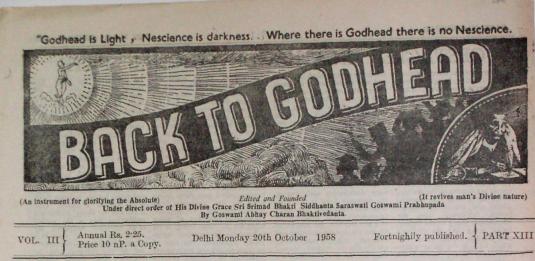
The Books of His Divine Grace A.C. Bhaktivedanta Swami Prabhupada
Originally published in Back to Godhead No. 52
Bhaktivedanta Book Trust 1973
By Brahmananda Swami ISKCON East Africa
Part 3
Back to Godhead contained timely articles, essays, book reviews and selections from full-length works in progress such as the Sri Isopanisad. It should be noted that this paper was entirely the effort of Srila Prabhupada. He wrote all the material, edited it, typed it for the printer and checked the galley proofs. Then he sold the copies. Each fortnight he would take batches of Back to Godhead into Delhi. To save a few cents bus fare he sometimes had to walk for miles, and often he would sit in tea parlors until late at night, himself not even taking a glass of water there, preaching and distributing his paper and collecting one cent per copy.
At this time Srila Prabhupada also wrote outlines of his dream. It was a worldwide association of God conscious devotees who actively preached the eternal religion of love of God in all fields of society at large and who used all the modern means at their disposal. The League of Devotees, the forerunner of the now worldwide ISKCON, the International Society for Krishna Consciousness, was thus formally registered. From international sankirtana parties, to gosalas (cow protection reserves), to authorized teaching of Sanskrit, to a printing press solely for flooding the marketplace with Krsna conscious literature, ISKCON is today the reality of that dream.
More
16 Sep 2011
by The Hare Krishna Movement
in A.C. Bhaktivedanta Swami Prabhupada, Krsna Consciousness: The Topmost Yoga System, Yoga
Tags: bhagavad-gita, bhakti yoga, hatha yoga, Kali-yuga, krsna consciousness, Srila Prabhupada, the perfection of yoga, topmost yoga system, yoga
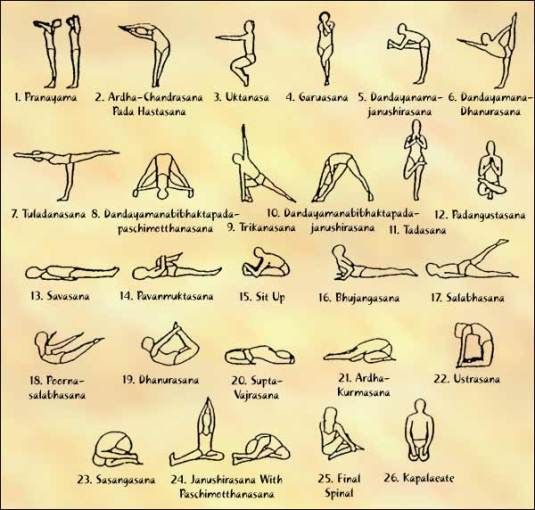
Simply to make a show of gymnastics is not perfection of yoga. Yoga means control of the senses. If you indulge your senses unrestrictedly but make a show of yoga practice, you will never be successful.
Krsna Consciousness: The Topmost Yoga System
By His Divine Grace A.C. Bhaktivedanta Swami Prabhupada
Chapter One
The Perfection of Yoga
Lord Kṛṣṇa, the Supreme Personality of Godhead, speaks about the topmost system of yoga in the Sixth Chapter of Bhagavad-gītā. There He has explained the haṭha-yoga system. Please remember that we are preaching this Kṛṣṇa consciousness movement on the authority of Bhagavad-gītā. It is nothing manufactured. The bhakti-yoga system is authorized, and if you want to know about God, then you have to adopt this bhakti-yoga system because in the Sixth Chapter of Bhagavad-gītā it is concluded that the topmost yogī is he who is always thinking of Kṛṣṇa within himself.
More
16 Aug 2011
by The Hare Krishna Movement
in Bhagavad-gita, The Hare Krishna Movement, Vegetarian Cooking, Vegetarianism
Tags: bhagavad-gita, spiritual food, The Hare Krishna Movement, vegetarian cookbook, vegetarian cooking, vegetarian recipes, vegetarianism

Spiritual Food
The Hare Krishna’s are famous for their delicious vegetarian food. Get a cookbook from The Hare Krishna Movement today, and begin your journey into the joys of cooking foods in the mode of goodness.
Bhagavad-gita As It Is
Macmillan 1972 Edition
By His Divine Grace A.C. Bhaktivedanta Swami Prabhupada
Chapter 17 The Divisions of Faith
Text 8-10
Foods in the mode of goodness increase the duration of life, purify one’s existence and give strength, health, happiness and satisfaction. Such nourishing foods are sweet, juicy, fattening and palatable. Foods that are too bitter, too sour, salty, pungent, dry and hot, are liked by people in the modes of passion. Such foods cause pain, distress, and disease. Food cooked more than three hours before being eaten, which is tasteless, stale, putrid, decomposed and unclean, is food liked by people in the mode of ignorance.
PURPORT
Thc purpose of food is to increase the duration of life, purify the mind and aid bodily strength. This is its only purpose. In the past, great authorities selected those foods that best aid health and increase life’s duration, such as milk products, sugar, rice, wheat, fruits and vegetables. These foods are very dear to those in the mode of goodness. Some other foods, such as baked corn and molasses, while not very palatable in themselves, can be made pleasant when mixed with milk or other foods. They are then in the mode of goodness. All these foods are pure by nature. They are quite distinct from untouchable things like meat and liquor. Fatty foods, as mentioned in the eighth verse, have no connection with animal fat obtained by slaughter. Animal fat is available in the form of milk, which is the most wonderful of all foods. Milk, butter, cheese and similar products give animal fat in a form which rules out any need for the killing of innocent creatures. It is only through brute mentality that this killing goes on. The civilized method of obtaining needed fat is by milk. Slaughter is the way of subhumans. Protein is amply available through split peas, dhall, whole wheat, etc.
Foods in the mode of passion, which are bitter, too salty, or too hot or overly mixed with red pepper, cause misery by producing mucous in the stomach, leading to disease. Foods in the mode of ignorance or darkness are essentially those that are not fresh. Any food cooked more than three hours before it is eaten (except prasādam, food offered to the Lord) is considered to be in the mode of darkness. Because they are decomposing, such foods give a bad odor, which often attracts people in this mode but repulses those in the mode of goodness.
Remnants of food may be eaten only when they are part of a meal that was first offered to the Supreme Lord or first eaten by saintly persons, especially the spiritual master. Otherwise the remnants of food are considered to be in the mode of darkness, and they increase infection or disease. Such foodstuffs, although very palatable to persons in the mode of darkness, are neither liked nor even touched by those in the mode of goodness. The best food is the remnant of what is offered to the Supreme Personality of Godhead. In Bhagavad-gītā the Supreme Lord says that He accepts preparations of vegetables, flour and milk when offered with devotion. Patraṁ puṣpaṁ phalaṁ toyam. Of course, devotion and love are the chief things which the Supreme Personality of Godhead accepts. But it is also mentioned that the prasādam should be prepared in a particular way. Any food prepared by the injunction of the scripture offered to the Supreme Personality of Godhead can be taken even if prepared long, long ago, because such food is transcendental. Therefore to make food antiseptic, eatable and palatable for all persons, one should offer food to the Supreme Personality of Godhead.
31 Jul 2011
by The Hare Krishna Movement
in Bhagavad-gita, Guru & Disciple, Kali Yuga
Tags: bhagavad-gita, disciplic succession, Iksvaku, Kali-yuga, krsna consciousness, Manu, spiritual knowledge, Srila Prabhupada, Supreme Personality of Godhead, Vivasvan

Bhagavad-gita As It Is – Macmillan 1972 Edition; Transcendental Knowledge
By His Divine Grace A. C. Bhaktivedanta Swami Prabhupada
Chapter 4, Text 1
śrī-bhagavān uvāca
imaṁ vivasvate yogaṁ
proktavān aham avyayam
vivasvān manave prāha
manur ikṣvākave ‘bravīt
SYNONYMS
śrī bhagavān uvāca—the Supreme Personality of Godhead said; imam—this; vivasvate—unto the sun-god; yogam—the science of one’s relationship to the Supreme; proktavān—instructed; aham—I; avyayam—imperishable; vivasvān—Vivasvān (the sun-god’s name); manave—unto the father of mankind (of the name Vaivasvata); prāha—told; manuḥ—the father of mankind; ikṣvākave—unto King Ikṣvāku; abravīt—said.
TRANSLATION
The Blessed Lord said: I instructed this imperishable science of yoga to the sun-god, Vivasvān, and Vivasvān instructed it to Manu, the father of mankind, and Manu in turn instructed it to Ikṣvāku.
PURPORT
Herein we find the history of the Bhagavad-gītā traced from a remote time when it was delivered to the royal order, the kings of all planets. This science is especially meant for the protection of the inhabitants and therefore the royal order should understand it in order to be able to rule the citizens and protect them from the material bondage to lust. Human life is meant for cultivation of spiritual knowledge, in eternal relationship with the Supreme Personality of Godhead, and the executive heads of all states and all planets are obliged to impart this lesson to the citizens by education, culture and devotion. In other words, the executive heads of all states are intended to spread the science of Kṛṣṇa consciousness so that the people may take advantage of this great science and pursue a successful path, utilizing the opportunity of the human form of life.
More
07 Jul 2011
by The Hare Krishna Movement
in Bhagavad-gita, Temples
Tags: A.C. Bhaktivedanta Swami Prabhupada, as it is, Bg 10.41, bhagavad-gita, Krsna's opulence, opulence, spark of My splendor, Sree Padmanabha Swamy temple, Temple, Thiruvananthapuram, treasure
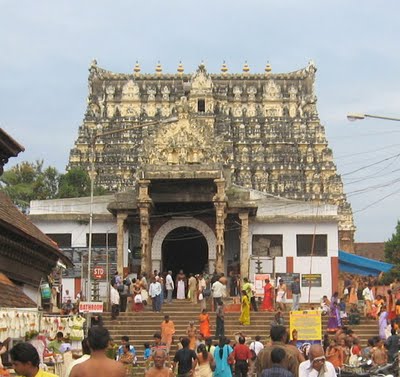
The Opulence of the Absolute
Know that all beautiful, glorious, and mighty creations spring from but a spark of My splendor.
PURPORT
Any glorious or beautiful existence should be understood to be but a fragmental manifestation of Kṛṣṇa’s opulence, whether it be in the spiritual or material world. Anything extraordinarily opulent should be considered to represent Kṛṣṇa’s opulence.(Bhagavad-gita As It Is 10.41)
Temple of boom in Thiruvananthapuram: Rs 1 lakh crore and counting
Ananthakrishnan G, TNN Jul 4, 2011, 01.27am IST
THIRUVANANTHAPURAM: Call it the mother of all treasure hunts. The stock-taking by a panel of experts at the Sree Padmanabha Swamy temple has catapulted the shrine located in Thiruvananthapuram to the country’s richest, with reports claiming that the value of recoveries may have touched close to Rs 1 lakh crore, more than Kerala public debt of Rs 70,969 crore.
With one more “secret” vault yet to be opened, the figure in all likelihood will go up further. But sources said the figures could only be speculation as it wasn’t possible to determine the antique value of the precious gems and jewellery. “These are antique pieces and it’s not possible to determine their prices,” said historian and former director of Indian Council of Historical Research M G S Narayanan. In other words, the worth of the treasure could be intimidatingly higher.
More
23 Jun 2011
by The Hare Krishna Movement
in Chanting Hare Krishna, Lectures, Srimati Radharani
Tags: bhagavad-gita, Caitanya Mahaprabhu, chanting Hare Krishna, hara, Hare, Hare Krishna Mantra, man-mana bhava mad=bhakto, O Radha-Krishna, Radha, Radharani, Radhastami, Srila Prabhupada, taking shelter of Krishna
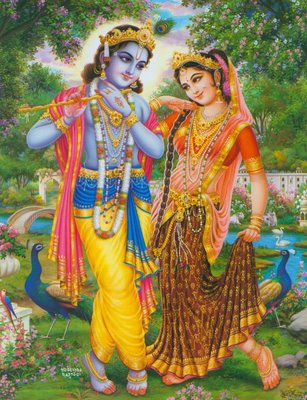
Lectures on Bhagavad-gita As It Is, (Bhagavad-gita 4.10)
Calcutta, September 23, 1974
By His Divine Grace A. C. Bhaktivedanta Swami Prabhupada
By taking shelter of Krishna, one has to become absorbed in thinking of Krishna. That is not very difficult. Man-mana bhava mad-bhakto mad-yaji mam namaskuru [ Bhagavad-gita 18.65]. It is not at all difficult. You simply chant Hare Krishna mantra. You’ll be man-maya. This is so nice thing. Therefore Chaitanya Mahaprabhu has recommended,
harer nama harer nama harer namaiva kevalam
kalau nasty eva nasty eva nasty eva gatir anyatha [ Chaitanya-charitamrita Adi-lila 17.21]
So our request is… Everyone who is present here… Today is Radhastami. So pray to Radharani. And She is hare, hara. This hare, this word, is Radharani. Hara, Radharani. Radha or Hara: the same thing. So Hare Krishna. So we are praying to Radharani, “My Mother, Radharani, and Krishna.” Hare Krishna. “O Krishna, O the Lord.” Hare Krishna, Hare Krishna, the same thing, repetition. “O Radharani, O Krishna.” “O Radha-Krishna.” “Radhe-Krishna” or “Hare Krishna,” the same thing. Hare Krishna, Hare Krishna, Krishna Krishna, Hare Hare. Again addressing, “O Krishna, O Krishna, O Radharani.” Hare Rama. The same thing, again. Hare Rama. Rama is also Krishna. Rama is Rama, Rama is Balarama. They are all Krishna. Hare Rama, Hare Rama, Rama Rama, Hare Hare.
So this repetition of addressing Radha and Krishna or Hare Krishna is to pray, “My dear Lord, … and the energy, the spiritual energy of the Lord, kindly engage me in Your service.” That’s all. “I am now embarrassed with this material service. Please engage me in Your service.”
This is good sense. We are servants here. We are engaged in so many services. But it is not giving us comfort. Na trapa nopashanti. The service which we are rendering to others, they are not satisfied, I am not satisfied. This is material service. But if you give service to Krishna… Svalpam apy asya dharmasya trayate mahato bhayat. A little service can save you from the greatest danger. This is the formula.
More
17 Jun 2011
by The Hare Krishna Movement
in Krsna is the Source of All Incarnations
Tags: bhagavad-gita, birth, death, Garbhodakasayi, His Divine Grace A.C. Bhaktivedanta Swami Prabhupada, innumerable universes, Karanodakasayi, Krsna Is The Source of All Incarnations, Ksirodakasayi Visnu, old age disease, Personality of Godhead, Srimad Bhagavatam

Śrīmad-Bhāgavatam: Canto 1: “Creation”
By: His Divine Grace A. C. Bhaktivedanta Swami Prabhupada
Chapter 3
Kṛṣṇa Is the Source of All Incarnations
Therefore, the conclusion is that the puruṣa-avatāra is manifested in three features — first the Kāraṇodakaśāyī who creates aggregate material ingredients in the mahat-tattva, second the Garbhodakaśāyī who enters in each and every universe, and third the Kṣīrodakaśāyī Viṣṇu who is the Paramātmā of every material object, organic or inorganic. One who knows these plenary features of the Personality of Godhead knows Godhead properly, and thus the knower becomes freed from the material conditions of birth, death, old age and disease, as it is confirmed in Bhagavad-gītā.
Chapter 3
TEXT 2
yasyāmbhasi śayānasya
yoga-nidrāṁ vitanvataḥ
nābhi-hradāmbujād āsīd
brahmā viśva-sṛjāṁ patiḥ
SYNONYMS
yasya—whose; ambhasi—in the water; śayānasya—lying down; yoga-nidrām—sleeping in meditation; vitanvataḥ—ministering; nābhi—navel; hrada—out of the lake; ambujāt—from the lotus; āsīt—was manifested; brahmā—the grandfather of the living beings; viśva—the universe; sṛjām—the engineers; patiḥ—master.
TRANSLATION
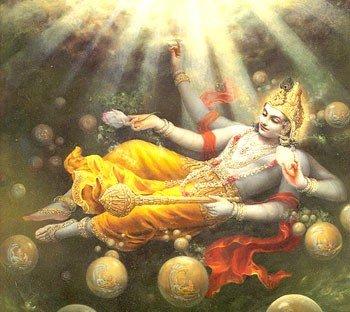
A part of the puruṣa lies down within the water of the universe, from the navel lake of His body sprouts a lotus stem, and from the lotus flower atop this stem, Brahmā, the master of all engineers in the universe, becomes manifest.
PURPORT
The first puruṣa is the Kāraṇodakaśāyī Viṣṇu. From His skin holes innumerable universes have sprung up. In each and every universe, the puruṣa enters as the Garbhodakaśāyī Viṣṇu. He is lying within the half of the universe which is full with the water of His body. And from the navel of Garbhodakaśāyī Viṣṇu has sprung the stem of the lotus flower, the birthplace of Brahmā, who is the father of all living beings and the master of all the demigod engineers engaged in the perfect design and working of the universal order. Within the stem of the lotus there are fourteen divisions of planetary systems, and the earthly planets are situated in the middle. Upwards there are other, better planetary systems, and the topmost system is called Brahmaloka or Satyaloka. Downwards from the earthly planetary system there are seven lower planetary systems inhabited by the asuras and similar other materialistic living beings.
From Garbhodakaśāyī Viṣṇu there is expansion of the Kṣīrodakaśāyī Viṣṇu, who is the collective Paramātmā of all living beings. He is called Hari, and from Him all incarnations within the universe are expanded.
Therefore, the conclusion is that the puruṣa-avatāra is manifested in three features — first the Kāraṇodakaśāyī who creates aggregate material ingredients in the mahat-tattva, second the Garbhodakaśāyī who enters in each and every universe, and third the Kṣīrodakaśāyī Viṣṇu who is the Paramātmā of every material object, organic or inorganic. One who knows these plenary features of the Personality of Godhead knows Godhead properly, and thus the knower becomes freed from the material conditions of birth, death, old age and disease, as it is confirmed in Bhagavad-gītā, In this śloka the subject matter of Mahā-Viṣṇu is summarized. The Mahā-Viṣṇu lies down in some part of the spiritual sky by His own free will. Thus He lies on the ocean of kāraṇa, from where He glances over His material nature, and the mahat-tattva is at once created. Thus electrified by the power of the Lord, the material nature at once creates innumerable universes, just as in due course a tree decorates itself with innumerable grown fruits. The seed of the tree is sown by the cultivator, and the tree or creeper in due course becomes manifested with so many fruits. Nothing can take place without a cause. The Kāraṇa Ocean is therefore called the Causal Ocean. Kāraṇa means “causal.” We should not foolishly accept the atheistic theory of creation. The description of the atheists is given in the Bhagavad-gītā. The atheist does not believe in the creator, but he cannot give a good theory to explain the creation. Material nature has no power to create without the power of the puruṣa, just as a prakṛti, or woman, cannot produce a child without the connection of a puruṣa, or man. The puruṣa impregnates, and the prakṛti delivers. We should not expect milk from the fleshy bags on the neck of a goat, although they look like breastly nipples. Similarly, we should not expect any creative power from the material ingredients; we must believe in the power of the puruṣa, who impregnates prakṛti, or nature. Because the Lord wished to lie down in meditation, the material energy created innumerable universes at once, in each of them the Lord lay down, and thus all the planets and the different paraphernalia were created at once by the will of the Lord. The Lord has unlimited potencies, and thus He can act as He likes by perfect planning, although personally He has nothing to do. No one is greater than or equal to Him. That is the verdict of the Vedas.
More
Previous Older Entries Next Newer Entries











 The Hare Krishna Movement