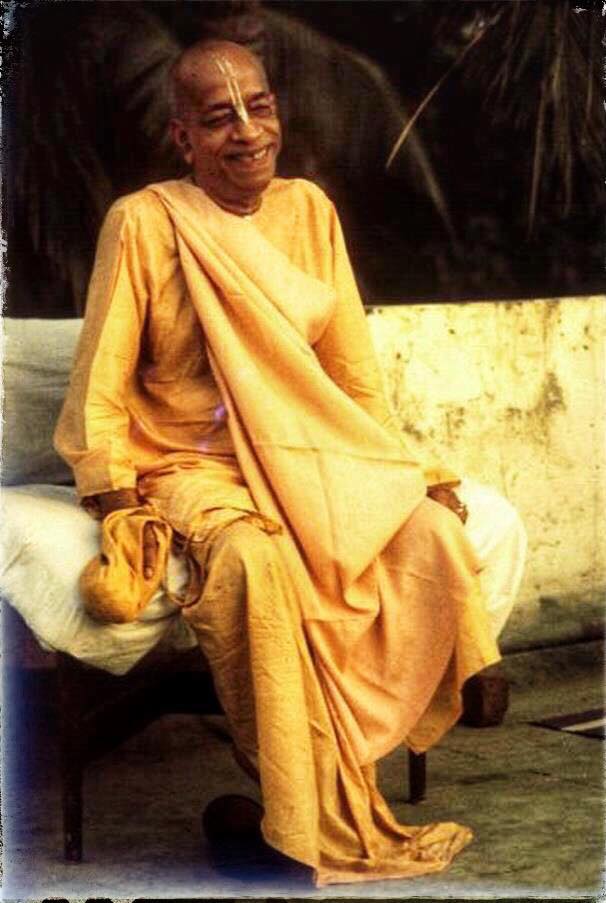
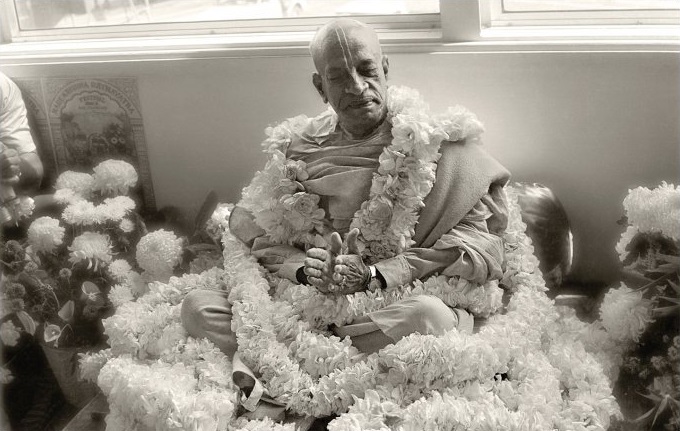
Today we honor the disappearance day of His Divine Grace A.C. Bhaktivedanta Swami Prabhupada, with a half day fast and remembrance of his many glorious pastimes and achievements. We have included a very nice brief life sketch you can view or download.
At various times people have called him a scholar, a philosopher, a cultural ambassador, a prolific author, a religious leader, a spiritual teacher, a social critic, and a holy man. In truth, he was all these things and more.
Over five hundred years ago, Lord Sri Krishna appeared as Sri Chaitanya Mahaprabhu in Navadvipa, a village in West Bengal. The purpose of His appearance was to inaugurate the Sankirtana Movement, the Yuga Dharma for this age of Kali. He declared that the chanting of His holy names would spread beyond the shores of India to every town and village in the world. He predicted that His commander-in-chief would appear to accomplish this mission.
Yes… Srila Prabhupada appeared to fulfill this prophecy.
” Upon seeing His mothers whipping stick, He cried and rubbed His eyes again and again with His two lotus hands. His eyes were fearful and His breathing quick, and as Mother Yasoda bound His belly with ropes, He shivered in fright and His pearl necklace shook. To this Supreme Lord, Sri Damodara, who is bound with His devotee’s love, I offer my humble obeisances.” (Damodarastakam)
We are now in the month of Damodara (Kartika). In honor and in celebration of the month of Damodara, we will be focusing our attention on the pastimes of Krishna in Vrndavan. Especially Krishna’s childhood pastimes. The following song is sung morning and evening and it is customary to offer a candle or gee lamp as well to a picture of Lord Krsna and Mother Yasoda.
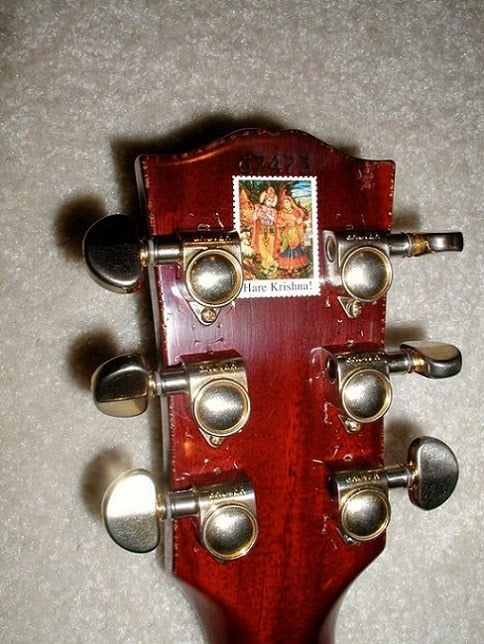
Eric Clapton’s Guitar with Hare Krishna Stamp.George Harrison placed a Hare Krishna sticker on the headstock of Eric Clapton’s famous guitar—the red Gibson ES-335 that he played throughout his career until auctioning it for charity to benefit his Crossroads Centre in Antigua, a residential-care facility dedicated to the treatment of drug and alcohol dependency and addiction.“
‘I think this is the star of the show,’ Clapton said prior to the 2004 Crossroads Guitar Auction at Christie’s, where it sold for $847,500. Even though the guitar was 40 years old when Clapton sold it, it was in remarkably good shape. Even the Hare Krishna stamp that George Harrison affixed to the back of the headstock was still in good shape. ‘It’s worked really hard,’ Clapton said. ‘It was on a lot of albums, went everywhere, and was played regularly over the years, but it never got old or worn down or lost anything. It’s amazing that it’s survived in this condition. I’d still play it today.”
Gibson produced a reissue of the guitar—an exact replica numbering 250—complete with the Hare Krishna stamp.
Today we celebrate the Appearance of Srila Bhaktivinoda Thakur with a half day fast, and one of my favorite songs written by Thakur Bhaktivinoda.
The dust of the lotus feet of pure devotees, enthusiastic devotional service, and service to the pure devotees of the highest order are the roots of the creeper of devotion.
…When I hear the sound of the mrdanga in my heart I always desire to join in kirtana; and when I hear the bonafide songs describing Lord Caitanya’s pastimes, my heart dances in ecstasy.
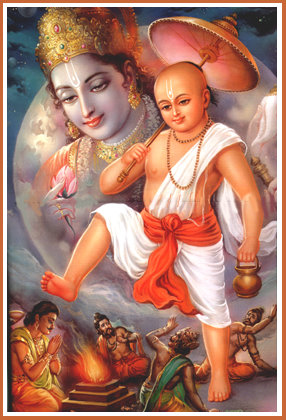
Today is Parsva Ekadasi (fast from grains and beans) and also a fast till noon for appearance of Lord Vamanadeva. His appearance is tomorrow but the fast is today.
With His appearance day in mind, as we are fasting today, we offer in Honor of Lord Vamanadeva, a select verse from the Srimad Bhagavatam, and a chapter summary. Hare Krishna!
Srimad-Bhagavatam By His Divine Grace A. C. Bhaktivedanta Swami Prabhupada Canto One, Chapter 19, Text 19
pañcadaśam—the fifteenth in the line; vāmanakam—the dwarf brāhmaṇa; kṛtvā—by assumption of; agāt—went; adhvaram—arena of sacrifice; baleḥ—of King Bali; pada-trayam—three steps only; yācamānaḥ—begging; pratyāditsuḥ—willing at heart to return; tri-piṣṭapam—the kingdom of the three planetary systems.
TRANSLATION
In the fifteenth incarnation, the Lord assumed the form of a dwarf-brāhmaṇa [Vāmana] and visited the arena of sacrifice arranged by Mahārāja Bali. Although at heart He was willing to regain the kingdom of the three planetary systems, He simply asked for a donation of three steps of land.
PURPORT
The Almighty God can bestow upon anyone the kingdom of the universe from a very small beginning, and similarly, He can take away the kingdom of the universe on the plea of begging a small piece of land.
The following is a chapter summary from Srimad Bhagavatam, eight canto, chapter 18, entitled “Lord Vāmanadeva, the Dwarf Incarnation”, describing the Lord’s appearance and activities.
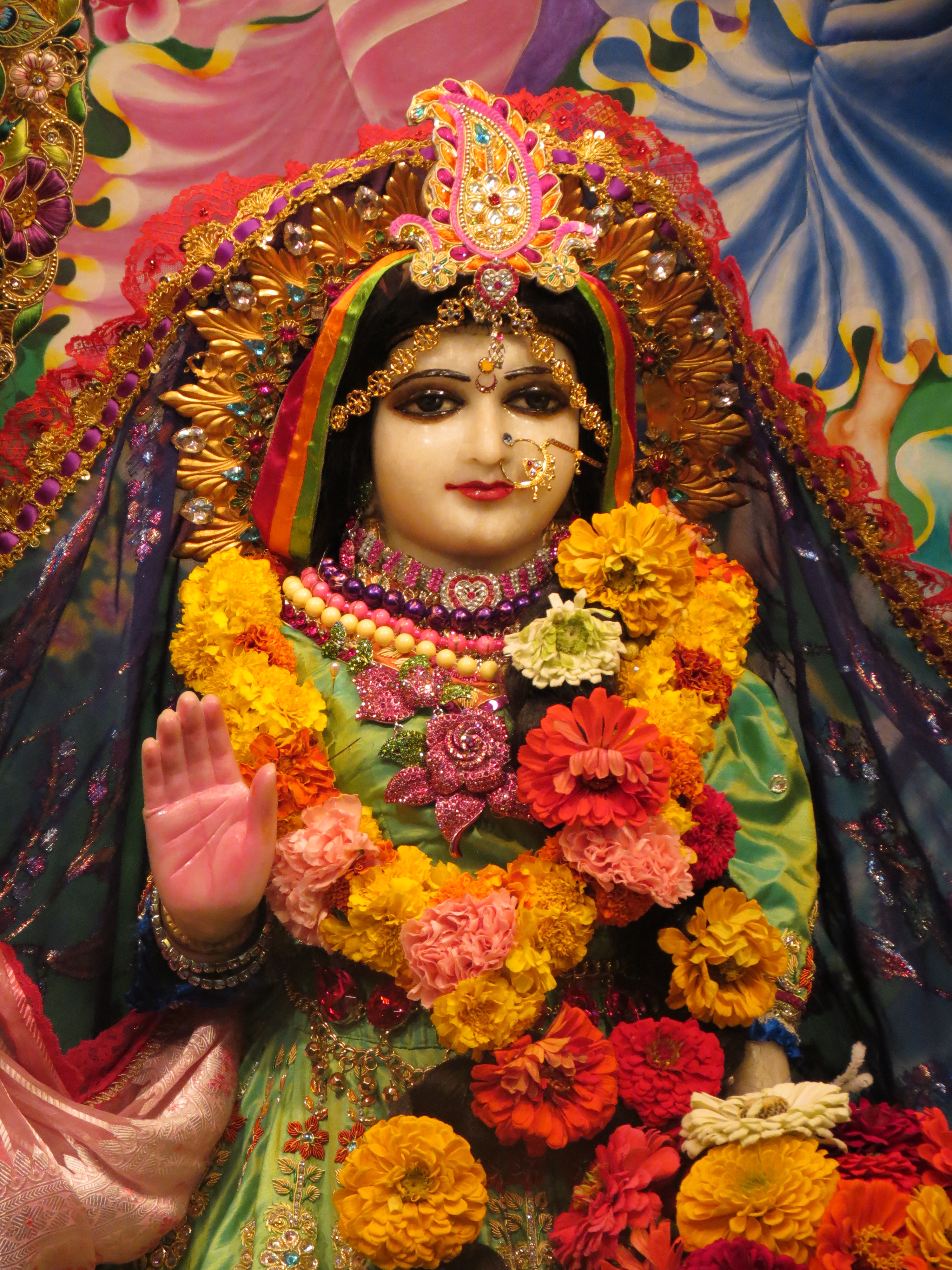
Today marks the appearance of Srimati Radharani, otherwise known as Radhastami. We honor it with a half day fast, followed by a feast after Her appearance at noon.
Srimati Radharani has twenty-five transcendental qualities. Her transcendental qualities are as follows:
1. She is sweetness personified 2. She is a fresh young girl 3. Her eyes are always moving 4. She is always brightly smiling 5. She possesses all auspicious marks on her body 6. She can agitate Krishna by the flavor of Her person 7. She is expert in the art of singing 8. She can speak very nicely and sweetly 9. She is expert in presenting feminine attractions 10. She is modest and gentle 11. She is always very merciful 12. She is transcendentally cunning 13. She knows how to dress nicely 14. She is always shy 15. She is always respectful 16. She is always patient 17. She is very grave 18. She is enjoyed by Krishna 19. She is situated on the highest devotional platform 20. She is the abode of love of the residents of Gokula 21. She can give shelter to all kinds of devotees 22. She is always affectionate to superiors and inferiors 23. She is always obliged by the dealings of Her associates 24. She is the greatest amongst Krishna’s girlfriends 25. She always keeps Krishna under Her control
Although I don’t know much about who created this page, It appears to have a good selection of pre 1978 Books, music, photos, videos and much more. Very nice site and easy to navigate. I would recommend taking a look. Hare Krishna!
His Divine Grace A. C. Bhaktivedanta Swami Prabhupada’s Appearance Day Homage
by Vyasasan das
Dear Srila Prabhupada
On this most blessed and auspicious day, the celebration of your appearance; Sri Vyasa-puja, please accept my most humble obeisance’s at your divine lotus feet, and kindly forgive my offences.
On my 21st birthday I shaved my head, put on tilak and a dhoti for the first time. It was the day I decided to become a devotee with the hope of someday becoming your disciple. On the very first day of my adult life I surrendered to your instructions, following the four regulative principles and trying to chant 16 rounds of japa a day, with the hopes of someday becoming a worthy disciple. And in spite of my shortcomings, within a year, you initiated me and gave me the name Vyasasan das.
The Vyasasana is the sacred seat of Srila Vyasadeva, who is the original Spiritual Master because he compiled and disseminated the Vedic knowledge, and you are the bona-fide representative of Srila Vyasadeva. Therefore according to the Vedic system, on the birthday of the spiritual master the disciples and followers offer homage to you, by writting and speaking about your glories. This is the meaning of Vyasa Puja.
So today we honor Lord Sri Krishna’s appearance day with a full day fast, followed by a small feast after His appearance at midnight. We will try to increase our remembrance of Him by additional chanting and reading ,and singing His glories.
My good friend Padmapani Prabhu over at The Prabhupada Connection sent me the following post in my email this morning, we share the text with you.
“There are many statements about the festive days in connection with Kṛṣṇa’s different activities. One of these festive days is Janmāṣṭamī, the day of Kṛṣṇa’s birth. This Janmāṣṭamī day is the most opulent festival day for the devotees, and it is still observed with great pomp in every Hindu house in India. Sometimes even the devotees of other religious groups take advantage of this auspicious day and enjoy the performance of the ceremony of Janmāṣṭamī. Ecstatic love for Kṛṣṇa is also aroused on the days of Ekādaśī, which are other festive days in connection with Kṛṣṇa.” (Nectar of Devotion, Chapter 26)
“Of course, this Janmāṣṭamī ceremony is observed by all Hindus. Irrespective of becoming Vaiṣṇava or not, this ceremony is observed in India every home. Just like in your Western countries the Christmas is observed in every home, similarly Janmāṣṭamī is observed in every home. Today is a great ceremonial day. So our program is, at twelve o’clock night the Lord will take birth and we shall receive Him.” (Srila Prabhupada Janmastami Lecture, Montreal, August 16, 1968)
Today we honor the appearance day of Lord Balarama with a half day fast, followed by a nice vegetarian feast. I may even open up the bee hive to collect a little honey as an offering to Balarama at moonrise, as Balarama is very fond of the aromatic beverage Varuni, which is made from liquid honey.
…The demigod known as Varuṇa sent his daughter Vāruṇī in the form of liquid honey oozing from the hollows of the trees. Because of this honey the whole forest became aromatic, and the sweet aroma of the liquid honey, Vāruṇī, captivated Balarāmajī. Balarāmajī and all the gopīs became very much attracted by the taste of Vāruṇī, and all of them drank it together. While drinking this natural beverage, Vāruṇī, all the gopīs chanted the glories of Lord Balarāma, and Lord Balarāma felt very happy, as if He had become intoxicated by drinking that Vāruṇī beverage. His eyes rolled in a pleasing attitude. He was decorated with long garlands of forest flowers, and the whole situation appeared to be a great function of happiness because of this transcendental bliss. Lord Balarāma smiled beautifully, and the drops of perspiration decorating His face appeared to be soothing morning dew. (from Krsna Book ch. 65 Lord Balarama Visits Vrndavana)
After almost two decades of war in Afghanistan and just weeks before the scheduled withdrawal of U.S. forces, the Taliban swiftly returned to power in the capital of Kabul on Sunday, toppling the government and driving thousands of people into a desperate race to escape the country. (The New York Times)
So this was today’s top news story. There is going to be great upheaval in Afghanistan after the American withdrawal, but really the question begs asking; what were we doing there, armed, and in another country for the last 20 years?
The Real Peace Formula
The great mistake of modern civilization is to encroach upon others’ property as though it were one’s own and to thereby create an unnecessary disturbance of the laws of nature. These laws are very strong. No living entity can violate them. Only one who is Krsna conscious can easily overcome the stringency of the laws of nature and thus become happy and peaceful in the world.
As a state is protected by the department of law and order, so the state of Universe, of which this earth is only an insignificant fragment, is protected by the laws of nature. This material nature is one of the different potencies of God, who is the ultimate proprietor of everything that be. This earth is, therefore, the property of God, but we, the living entities, especially the so-called civilized human beings, are claiming God’s property as our own, under both an individual and collective false conception. If you want peace, you have to remove this false conception from your mind and from the world. This false claim of proprietorship by the human race on earth is partly or wholly the cause of all disturbances of peace on earth.
Foolish and so-called civilized men are claiming proprietary rights on the property of God because they have now become godless. You cannot be happy and peaceful in a godless society. In the Bhagavad-gita Lord Krsna says that He is the factual enjoyer of all activities of the living entities, that He is the Supreme Lord of all universes, and that He is the well-wishing friend of all beings. When the people of the world know this as the formula for peace, it is then and there that peace will prevail.
Therefore, if you want peace at all, you will have to change your consciousness into Krsna consciousness, both individually and collectively, by the simple process of chanting the holy name of God. This is a standard and recognized process for achieving peace in the world. We therefore recommend that everyone become Krsna conscious by chanting:
“Hare Krsna, Hare Krsna, Krsna Krsna, Hare Hare Hare Rama, Hare Rama, Rama Rama, Hare Hare“
This is practical, simple, and sublime. Four hundred and eighty years ago this formula was introduced in India by Lord Sri Caitanya, and now it is available in your country. Take to this simple process of chanting as above mentioned, realize your factual position by reading the Bhagavad-gita As It Is, and reestablish your lost relationship with Krsna, God. Peace and prosperity will be the immediate worldwide result.
…The essence of spiritual knowledge is found in the pastimes of Śrī Caitanya Mahāprabhu, which are identical with the pastimes of Lord Kṛṣṇa. This is the essence of knowledge. If knowledge does not include the understanding of Śrī Caitanya Mahāprabhu and Kṛṣṇa, it is simply superfluous. By Śrī Caitanya Mahāprabhu’s grace, the nectar of Lord Śrī Kṛṣṇa’s pastimes is flowing in different directions in hundreds and thousands of rivers. One should not think that the pastimes of Śrī Caitanya Mahāprabhu are different from Kṛṣṇa’s pastimes. It is said: śrī-kṛṣṇa-caitanya, rādhā-kṛṣṇa nahe anya. Lord Caitanya Mahāprabhu is a combination of Rādhā-Kṛṣṇa, and without understanding His pastimes, one cannot understand Rādhā and Kṛṣṇa. Śrīla Narottama dāsa Ṭhākura therefore sings: rūpa-raghunātha-pade haibe ākuti kabe hāma bujhaba se yugala pirīti. “When shall I become very eager to study the books left by the six Gosvāmīs? Then I shall be able to understand the conjugal pastimes of Rādhā and Kṛṣṇa.” (Purport Madha-lila 25.271)
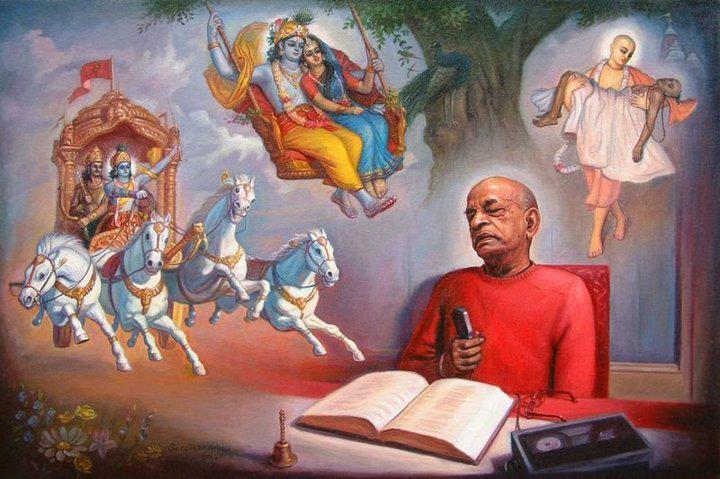
Do you know that every day even I read my own books?
Do you know why I read my books?
I read my books everyday because even I learn something new when I read them.
Do you know why I learn something new when I read my books?
Because these books are not my books – I do not write these books.
Every morning when I sit here to write my books Krsna comes personally and he dictates to me what to write, I simply take dictation from Krsna and I write these books.
Therefore when I read them even I learn something.”
-(Srila Prabhupada Room conversation with Bhagavat Das Vanachari, Bombay, 1974)
In a temple of jewels in Vṛndāvana, underneath a desire tree, Śrī Śrī Rādhā-Govinda, served by Their most confidential associates, sit upon an effulgent throne. I offer my humble obeisances unto Them. (CC/Adi/1/16)
Govinda resides eternally in Vṛndāvana. In the spiritual world of Vṛndāvana the buildings are made of touchstone, the cows are known as surabhi cows, givers of abundant milk, and the trees are known as wish-fulfilling trees, for they yield whatever one desires.
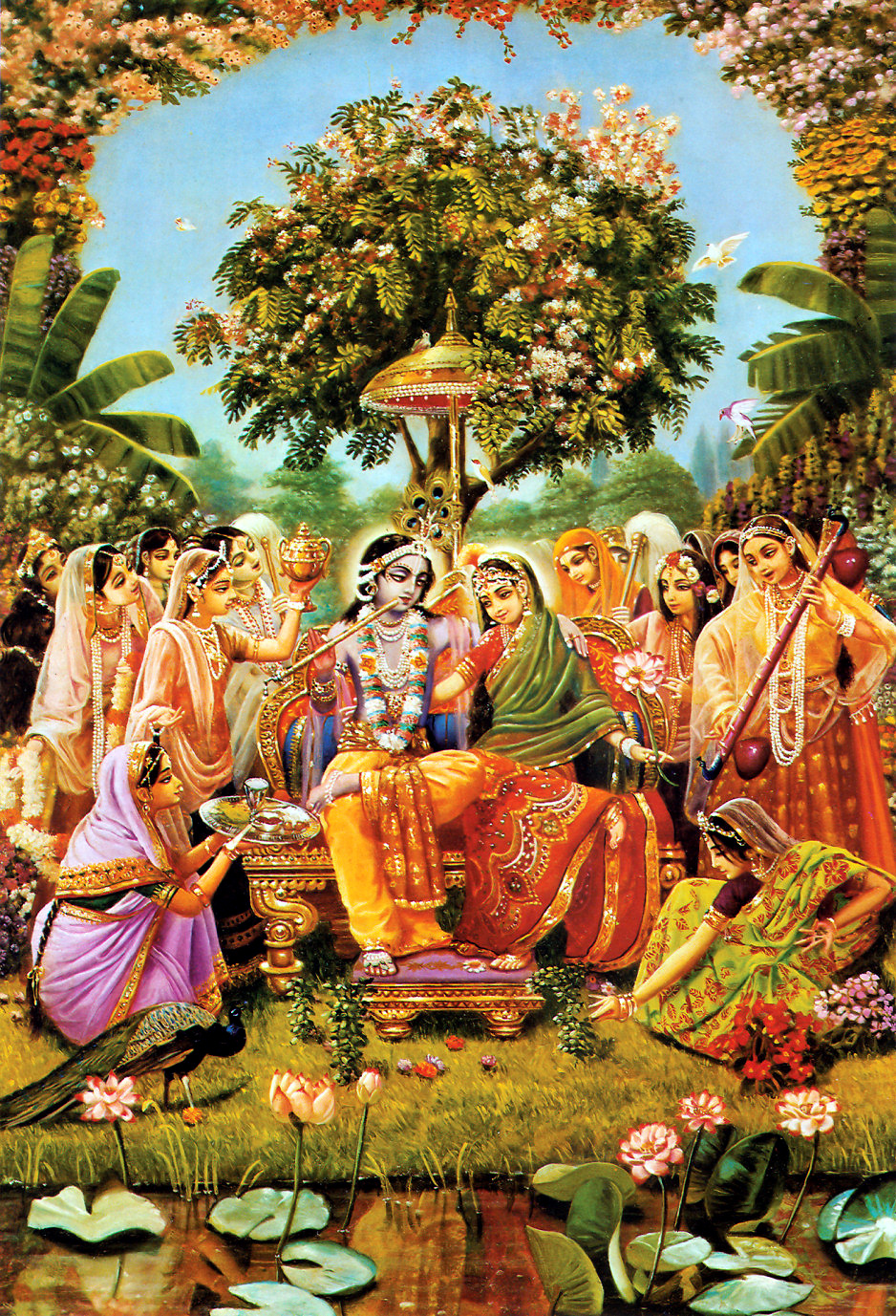
Rādhārāṇī and Kṛṣṇa as seated beneath a wish-fulfilling tree in Vṛndāvana on a throne decorated with valuable jewels. There Kṛṣṇa’s dear friends, the cowherd boys and the gopīs, serve Rādhā and Kṛṣṇa by singing, dancing, offering betel nuts and refreshments and decorating Their Lordships with flowers.
In Vṛndāvana Kṛṣṇa herds the surabhi cows, and He is worshiped by hundreds and thousands of gopīs, cowherd girls, who are all goddesses of fortune.
I worship Govinda, the primeval Lord, the first progenitor who is tending the cows, yielding all desire, in abodes built with spiritual gems, surrounded by millions of purpose trees, always served with great reverence and affection by hundreds of thousands of lakṣmīs or gopīs.
When Kṛṣṇa descends to the material world, this same Vṛndāvana descends just as an entourage accompanies an important personage. Because when Kṛṣṇa comes, His land also comes, Vṛndāvana is not considered to exist in the material world. Therefore devotees take shelter of the Vṛndāvana in India, for it is considered to be a replica of the original Vṛndāvana. Although one may complain that no kalpa-vṛkṣa, wish-fulfilling trees, exist there, when the Gosvāmīs were there, the kalpa-vṛkṣa were present. It is not that one can simply go to such a tree and make demands; one must first become a devotee. The Gosvāmīs would live under a tree for one night only, and the trees would satisfy all their desires. For the common man this may all seem very wonderful, but as one makes progress in devotional service, all this can be realized.
Vṛndāvana is actually experienced as it is by persons who have stopped trying to derive pleasure from material enjoyment. “When will my mind become cleansed of all hankering for material enjoyment so I will be able to see Vṛndāvana?” one great devotee asks. The more Kṛṣṇa conscious we become and the more we advance, the more everything is revealed as spiritual. Thus Kṛṣṇadāsa Kavirāja Gosvāmī considered Vṛndāvana in India to be as good as the Vṛndāvana in the spiritual sky, and in Caitanya-caritāmṛta he describes Rādhārāṇī and Kṛṣṇa as seated beneath a wish-fulfilling tree in Vṛndāvana on a throne decorated with valuable jewels. There Kṛṣṇa’s dear friends, the cowherd boys and the gopīs, serve Rādhā and Kṛṣṇa by singing, dancing, offering betel nuts and refreshments and decorating Their Lordships with flowers. Even today in India people decorate thrones and recreate this scene during the month of July. Generally at that time people go to Vṛndāvana to offer their respects to the Deities there. [TLC/introduction]
Nothing will benefit human health and increase chances for the survival of life on Earth as much as the evolution to a vegetarian diet.
-Albert Einstein
A Vegetarian diet not only is the safe alternative to meat eating, but increase the duration of life, purify one’s existence and give strength, health, happiness and satisfaction. As Srila Prabhupada explaines in the Bhagavad-gita;
Bhagavad-gita As It Is Macmillan 1972 Edition By His Divine Grace A.C. Bhaktivedanta Swami Prabhupada Chapter 17 The Divisions of Faith Text 8-10
Foods in the mode of goodness increase the duration of life, purify one’s existence and give strength, health, happiness and satisfaction. Such nourishing foods are sweet, juicy, fattening and palatable. Foods that are too bitter, too sour, salty, pungent, dry and hot, are liked by people in the modes of passion. Such foods cause pain, distress, and disease. Food cooked more than three hours before being eaten, which is tasteless, stale, putrid, decomposed and unclean, is food liked by people in the mode of ignorance.
PURPORT
Thc purpose of food is to increase the duration of life, purify the mind and aid bodily strength. This is its only purpose. In the past, great authorities selected those foods that best aid health and increase life’s duration, such as milk products, sugar, rice, wheat, fruits and vegetables. These foods are very dear to those in the mode of goodness. Some other foods, such as baked corn and molasses, while not very palatable in themselves, can be made pleasant when mixed with milk or other foods. They are then in the mode of goodness. All these foods are pure by nature. They are quite distinct from untouchable things like meat and liquor. Fatty foods, as mentioned in the eighth verse, have no connection with animal fat obtained by slaughter. Animal fat is available in the form of milk, which is the most wonderful of all foods. Milk, butter, cheese and similar products give animal fat in a form which rules out any need for the killing of innocent creatures. It is only through brute mentality that this killing goes on. The civilized method of obtaining needed fat is by milk. Slaughter is the way of subhumans. Protein is amply available through split peas, dhal, whole wheat, etc.
Prahlāda Mahārāja, the Saintly Son of Hiraṇyakaśipu
Today we honor the appearance day of Lord Nṛsiṁhadeva, with a fast until sunset, followed by a nice vegetarian feast. We share with you the Seventh Canto of the Srimad Bhagavatam-Part One which describes the pastimes of Pralada Maharaja and his Demonic father Hiranyakasipu. I have included in this post, the entire scanned copy of Canto 7, Vol. 1. You can download by following the link below (it will take a few moments to open).
Śrīmad-Bhāgavatam Canto 7, Vol.1 “The Science of God” by His Divine Grace A. C. Bhaktivedanta Swami Prabhupāda
click the following link to veiw or save the entire scanned copy of SB-07-01-1976
Today marks the disappearance day of my dear friend and God brother, Jayananda das. He was such a beautiful devotee, the perfect servant of our Srila Prabhupada, and friend to all. His death was glorious as stated in a letter to Ramesvara das shortly after his death:
Jayananda’s death is glorious. It is very good that he had stated,what is the use of such a useless body, better to give it up. He has left his body very wonderfully, and he has been transferred to Vaikuntha. I have already sent a condolence letter for publication in Back To Godhead. Everyone should follow the example of Jayananda. I am very proud that I had such a nice disciple. If possible Jayananda’s picture should be hung in the ratha of Lord Jagannatha, and in all of our temples a day may be set aside for holding a festival in his honor, just as we do on the disappearance day of the other great Vaisnavas. (letter by Srila Prabhupada 77-05-11)
We have included some personal letters by Srila Prabhupada to Jayananda
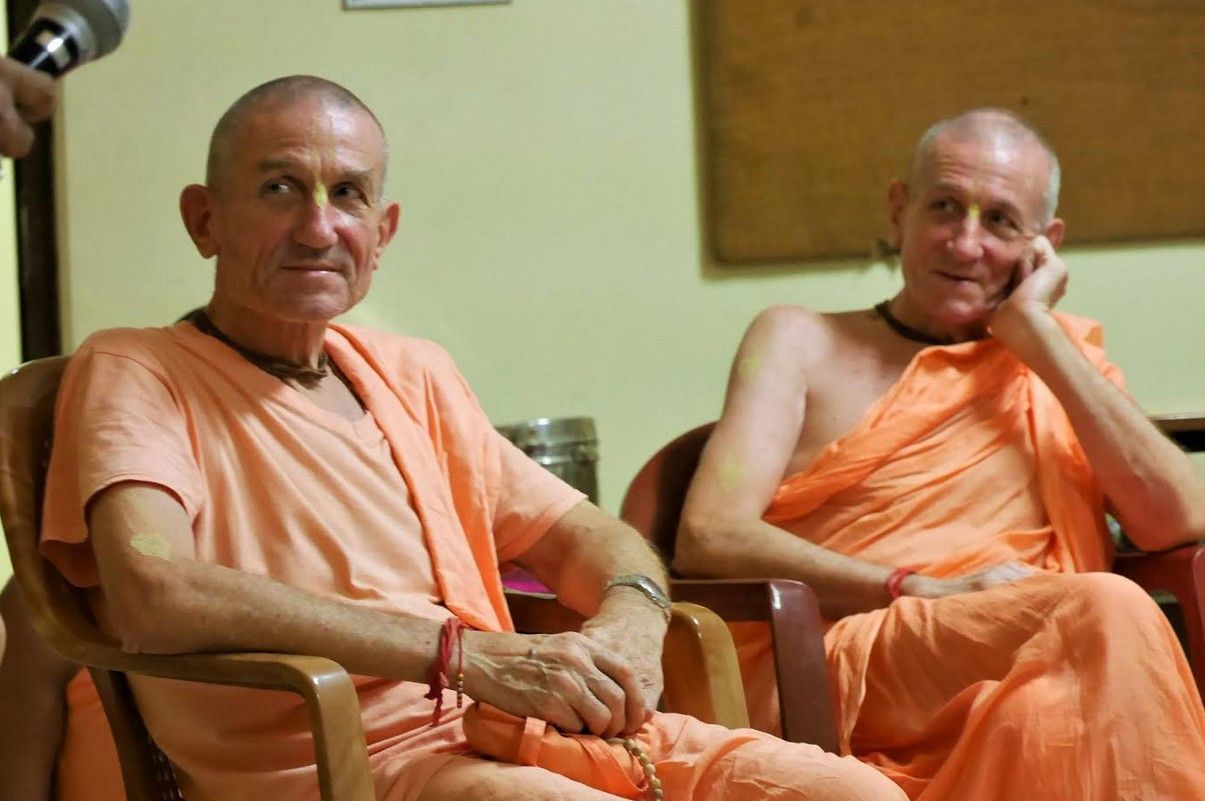
It is with great sadness that we report the passing of His Grace Pankajanghri Prabhu, the beloved Nrsimhadeva pujari, and twin brother of His Grace Jananivasa Prabhu. He died of Covid-19 complications in Mayapur, India.
HG Pankajanghri Prabhu has Departed
By the GBC Executive Committee
Dear Devotees,
Please accept our humble obeisances. All glories to Srila Prabhupada.
HG Pankajanghri Prabhu, ISKCON’s most beloved Nrsimhadeva pujari, has departed from this world in Sri Dham Mayapur.
Having joined ISKON in the footsteps of his twin brother, HG Jananivasa Prabhu, in 1973, the two brothers dedicated their lives to serving the Lordships of ISKCON’s International Headquarters in Lord Caitanya’s divine abode of Sri Mayapur.
Pankajanghri Prabhu served not only the Lord, but devotees worldwide, who would turn to him in their time of need, begging him to offer their hearts’ prayers at Lord Nrsimhadeva’s feet. Every devotee who has visited Mayapur Dham will hold fondly the image of Pankajanghri Prabhu standing on Nrsimhadeva’s altar, offering prayers and puja on behalf of the devotees, and in turn, offering the Lord’s mahaprasadam to the devotees.
Not many of us, however, were aware that in the background, Pankajanghri Prabhu was also managing the pujari department for many years, ensuring that the service to Their Lordships continues efficiently while expanding and deepening exponentially. We are all indebted to Pankajanghri Prabhu for the great inspiration we derive from the beautiful darshans and festivals that can be experienced only in Sri Dham Mayapur.
Pankajanghri Prabhu also graced the devotees with weekly classes on Srimad-Bhagavatam and Caitanya-caritamrita. He was a founding board member and inspiration for Mayapur Academy, an international school for brahminical training, where he taught the proper mood and method of deity worship to hundreds of students as instructed by Srila Prabhupada.
Along with fifty years of steadfast service as a pujari, manager, speaker, and educator, Pankanjanghri Prabhu was also a dear brother, uncle, and friend to both the Mayapur community and ISKCON worldwide. Today is a heartbreaking day especially for the generations of Mayapurvasis who grew up in the affectionate shelter of such a loving and playful uncle.
It is rare indeed to find a personality with the combination of such dedication, humility, joviality, and kindness. As Srila Prabhupada himself said in 1976, “The two brothers Pankajanghri and Jananivasa – there is no comparison.”
We join the worldwide family of Vaisanvas, especially HG Jananivasa Prabhu and the Mayapur community, in grieving the loss of a beloved godbrother and friend while simultaneously feeling gratitude for the mercy of Sri Nrsimhadeva, who kindly brought His dear servant home to Sri Dham Mayapur for a glorious departure befitting a dedicated devotee like Pankajanghri Prabhu.
With heavy hearts we observed the peaceful passing of His Grace Pankajanghri prabhu yesterday. As one of the most critical personalities in the development of the Pujari floor of the Temple of the Vedic Planetarium, his absence is now deeply felt. Over the years (even decades), we have come to rely on his seniority, purity, and quality of devotion to Krishna as an example to us all.
Still, it is in the mood of separation that we remind ourselves of how important yesterday was. In truth, our association with His Grace Pankajanghri prabhu has not ended, but evolved, for now we may have him in our hearts forever as a Vaishnava who departed towards Srila Prabhupada’s service in the company of other Vaishnavas from around the world, surrounded by the chanting of the sacred mahamantra, on the banks of the most auspicious Mother Ganga, at the very heart of Navadwip Dhama, Sri Mayapur. There is no more glorious, auspicious, or ideal departure than that of His Grace Pankajanghri prabhu, and even in his passing he is teaching us to always remember Krishna and never forget Him.
At the TOVP, we shall continue to uphold Pankajanghri prabhu’s teachings and standards in deity worship as we prepare for the unprecedented shift of Sri Sri Radha Madhava, Sri Panchatattva, and Sri Nrsimhadeva into Their new temple. What we have learned from Pankajanghri prabhu will serve as a legacy to all future pujaris, and now more than ever we ask all devotees, donors, friends, well-wishers and colleagues to come together to honor his memory in kirtan and prayer from the safety of your own homes.
All glories to His Grace Pankajanghri prabhu! Srila Prabhupada ki jai! Your Servants, Ambarisa das and Brajavilasa das














 The Hare Krishna Movement