23 Apr 2012
by The Hare Krishna Movement
in A.C. Bhaktivedanta Swami Prabhupada, Bhagavad-gita, Bhakti Yoga, Krishna Consciousness, Yoga
Tags: astanga-yoga, bhakti yoga, Govinda, jnana-yoga, karma yoga, Krishna, Srila Prabhupada, Syamasundara, Vasudeva, yoga, yogi

If one is fortunate enough to come to the point of bhakti-yoga, it is to be understood that he has surpassed all the other yogas. Therefore, to become Kṛṣṇa conscious is the highest stage of yoga, just as, when we speak of Himalayan, we refer to the world’s highest mountains, of which the highest peak, Mount Everest, is considered to be the culmination.
The culmination of all kinds of yoga practices lies in bhakti-yoga. All other yogas are but means to come to the point of bhakti in bhakti-yoga. Yoga actually means bhakti-yoga; all other yogas are progressions toward the destination of bhakti-yoga. From the beginning of karma-yoga to the end of bhakti-yoga is a long way to self-realization. Karma-yoga, without fruitive results, is the beginning of this path. When karma-yoga increases in knowledge and renunciation, the stage is called jñāna-yoga. When jñāna-yoga increases in meditation on the Supersoul by different physical processes, and the mind is on Him, it is called aṣṭāṅga-yoga. And, when one surpasses the aṣṭāṅga-yoga and comes to the point of the Supreme Personality of Godhead Kṛṣṇa, it is called bhakti-yoga, the culmination. Factually, bhakti-yoga is the ultimate goal, but to analyze bhakti-yoga minutely one has to understand these other yogas. The yogī who is progressive is therefore on the true path of eternal good fortune.
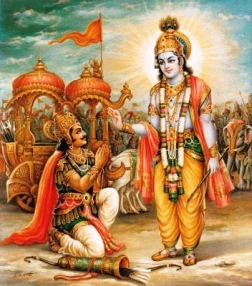
It is by great fortune that one comes to Kṛṣṇa consciousness on the path of bhakti-yoga to become well situated according to the Vedic direction. The ideal yogī concentrates his attention on Kṛṣṇa, who is called Śyāmasundara, who is as beautifully colored as a cloud, whose lotus-like face is as effulgent as the sun, whose dress is brilliant with jewels and whose body is flower garlanded. Illuminating all sides is His gorgeous luster, which is called the brahmajyoti. He incarnates in different forms such as Rāma, Nṛsiṁha, Varāha and Kṛṣṇa, the Supreme Personality of Godhead, and He descends like a human being, as the son of Mother Yaśodā, and He is known as Kṛṣṇa, Govinda and Vāsudeva. He is the perfect child, husband, friend and master, and He is full with all opulences and transcendental qualities. If one remains fully conscious of these features of the Lord, he is called the highest yogī.
More
22 Apr 2012
by The Hare Krishna Movement
in Devotional Service, Krishna Consciousness, Vaisnava-aparadha
Tags: bhakti creeper, His Divine Grace A.C. Bhaktivedanta Swami Prabhupada, Krsna consciousness becomes polluted by material activities, laws of nature, Lord Krsna, mad elephant offense, offending a brahmana, offending a vaisnava, pure consciousness, Srimad Bhagavatam, vaiṣṇava-aparādha, Vaisnavas

Sometimes we see that devotees, even though they are following the rules and regulations, appear not to be making very much spiritual advancement. Often we see that they appear to be going backwards rather than forward in their devotional lives. This is often the case of “the mad elephant offense” or vaisnava-aparadha, which can stop or destroy their devotional career, and should be carefully avoided. We have included a few select verses from Srila Prabhupada’s Srimad Bhagavatam which support this statement.
…To commit an offense against a devotee is very dangerous in devotional service. Lord Caitanya therefore said that an offense to a devotee is just like a mad elephant run loose; when a mad elephant enters a garden, it tramples all the plants. Similarly, an offense unto the feet of a pure devotee murders one’s position in devotional service…
…One’s pure intelligence, or pure Kṛṣṇa consciousness, becomes polluted by material activities. Pure consciousness can be revived by the process of sacrifice, charity, pious activities, etc., but when one pollutes his Kṛṣṇa consciousness by offending a brāhmaṇa or a Vaiṣṇava, it is very difficult to revive. Śrī Caitanya Mahāprabhu has described the vaiṣṇava-aparādha, or offense to a Vaiṣṇava, as “the mad elephant offense.” One should be very careful not to offend a Vaiṣṇava or a brāhmaṇa…
Srimad Bhagavatam 3.15.39
kṛtsna-prasāda-sumukhaṁ spṛhaṇīya-dhāma
snehāvaloka-kalayā hṛdi saṁspṛśantam
śyāme pṛthāv urasi śobhitayā śriyā svaś-
cūḍāmaṇiṁ subhagayantam ivātma-dhiṣṇyam
The Lord is the reservoir of all pleasure. His auspicious presence is meant for everyone’s benediction, and His affectionate smiling and glancing touch the core of the heart. The Lord’s beautiful bodily color is blackish, and His broad chest is the resting place of the goddess of fortune, who glorifies the entire spiritual world, the summit of all heavenly planets. Thus it appeared that the Lord was personally spreading the beauty and good fortune of the spiritual world.
Purport
When the Lord came, He was pleased with everyone; therefore it is stated here, kṛtsna-prasāda-sumukham. The Lord knew that even the offensive doormen were His pure devotees, although by chance they committed an offense at the feet of other devotees. To commit an offense against a devotee is very dangerous in devotional service. Lord Caitanya therefore said that an offense to a devotee is just like a mad elephant run loose; when a mad elephant enters a garden, it tramples all the plants. Similarly, an offense unto the feet of a pure devotee murders one’s position in devotional service. On the part of the Lord there was no offended mood because He does not accept any offense created by His sincere devotee. But a devotee should be very cautious of committing offenses at the feet of another devotee. The Lord, being equal to all, and being especially inclined to His devotee, looked as mercifully at the offenders as at the offended. This attitude of the Lord was due to His unlimited quantity of transcendental qualities. His cheerful attitude towards the devotees was so pleasing and heart-touching that His very smile was attractive for them. That attraction was glorious not only for all the higher planets of this material world, but beyond, for the spiritual world also. Generally a human being has no idea of what the constitutional position is in the higher material planets, which are far better constituted in regard to all paraphernalia, yet the Vaikuṇṭha planet is so pleasing and so celestial that it is compared to the middle jewel or locket in a necklace of jewels.
More
13 Apr 2012
by The Hare Krishna Movement
in Krishna, Krishna Consciousness, The Hare Krishna Movement, The Reservoir of Pleasure
Tags: A.C. Bhaktivedanta Swami Prabhupada, bhagavad-gita, devotional service, His Divine Grace, Krishna consciousness, Krsna The Reservoir of Pleasure, pure consciousness, real life, real pleasure, Sri Krsna

Kṛṣṇa, the Reservoir of Pleasure
by His Divine Grace A. C. Bhaktivedanta Swami Prabhupāda
Kṛṣṇa—this sound is transcendental. Kṛṣṇa means the highest pleasure. All of us, every living being, seeks pleasure. But we do not know how to seek pleasure perfectly. With a materialistic concept of life, we are frustrated at every step in satisfying our pleasure because we have no information regarding the real level on which to have real pleasure. For the last few weeks we have been learning that we are not this body; we are consciousness. Not exactly consciousness, for consciousness is actually the symptom of our real identity: we are pure soul, now merged within this material body. Modern material science lays no stress on this; therefore the scientists are sometimes misled in their understanding of spirit soul. But spirit soul is a fact, which anyone can understand by the presence of consciousness. Any child can understand that consciousness is the symptom of the spirit soul.
Now the whole process we are trying to learn from the Bhagavad-gītā (The Song of God) is how to bring ourselves to this level of consciousness. And if we act from the level of consciousness, then we may not be pushed again into the level of this bodily conception; and, if we can continue on that level, if we can continue to act in pure consciousness, then, at the end of this body we shall be free from material contamination, our spiritual life will be revived, and the ultimate result will be that in our next life, after leaving this body, we shall have our full, eternal spiritual life. Spirit, as we have already discussed, is described as eternal.
More
02 Apr 2012
by The Hare Krishna Movement
in Krishna Consciousness, Teachings of Queen Kunti
Tags: asamaurdhva, Devaki, Hrsikesa, King Kamsa, Krsna, kuntidevi, Lord Brahma, Lord Krsna, Lord Siva, Nanda Maharaja, Queen Kunti, Vasudeva
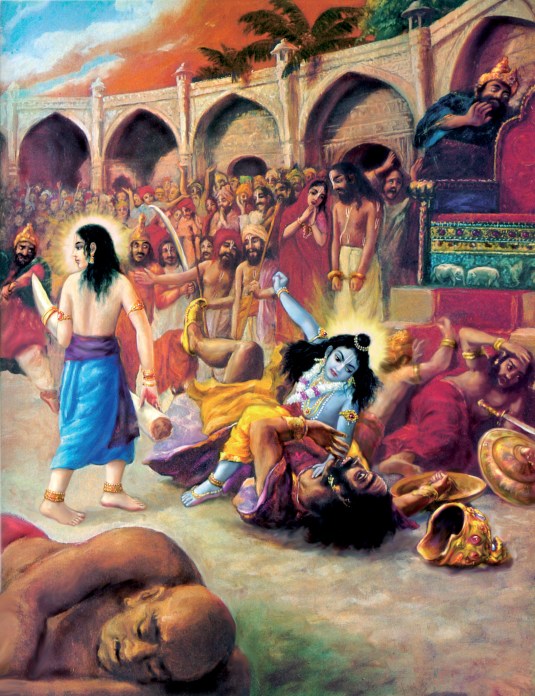
…Of course, the world is full of dangers. But Kuntīdevī says, “Because Devakī is Your devotee, You saved her from the distresses imposed upon her by her envious brother.”
…For sense gratification we have fallen into this material condition and are suffering in different varieties of life. Because this is the material world, even Kṛṣṇa’s mother was put into suffering. Devakī was so advanced that she became the mother of Kṛṣṇa, but still she was put into difficulties by her own brother, Kaṁsa. That is the nature of this material world. The living entities in this world are so jealous that if one’s personal interest is hampered, one will immediately be ready to give trouble to others, even to one’s nearest relatives.
“A person who acts in the service of Kṛṣṇa with his body, mind, intelligence, and words is a liberated person, even within the material world.”
Teachings of Queen Kunti
By His Divine Grace A.C. Bhaktivedanta Swami Prabhupada
Chapter 6
The Master of the Senses
yathā hṛṣīkeśa khalena devakī
kaṁsena ruddhāticiraṁ śucārpitā
vimocitāhaṁ ca sahātmajā vibho
tvayaiva nāthena muhur vipad-gaṇāt
O Hṛṣīkeśa, master of the senses and Lord of lords, You have released Your mother, Devakī, who was long imprisoned and distressed by the envious King Kaṁsa, and me and my children from a series of constant dangers.
—Śrīmad-Bhāgavatam 1.8.23
Devakī, the mother of Kṛṣṇa and sister of King Kaṁsa, was put into prison along with her husband, Vasudeva, because the envious King was afraid of being killed by Devakī’s eighth son (Kṛṣṇa). The King killed all the sons of Devakī who were born before Kṛṣṇa, but Kṛṣṇa escaped the danger of child-slaughter because He was transferred to the house of Nanda Mahārāja, Lord Kṛṣṇa’s foster father. Kuntīdevī, along with her children, was also saved from a series of dangers. But Kuntīdevī was shown far more favor because Lord Kṛṣṇa did not save the other children of Devakī, whereas He saved the children of Kuntīdevī. This was done because Devakī’s husband, Vasudeva, was living, whereas Kuntīdevī was a widow and there was none to help her except Kṛṣṇa. The conclusion is that Kṛṣṇa bestows more favor upon a devotee who is in greater dangers. Sometimes He puts His pure devotees in such dangers because in that condition of helplessness the devotee becomes more attached to the Lord. The more the attachment is there for the Lord, the more success is there for the devotee.
More
25 Mar 2012
by The Hare Krishna Movement
in Bhagavad-gita, Krishna Consciousness, Raja-Vidya, Spiritual Life
Tags: A.C. Bhaktivedanta Swami Prabhupada, Action in Knowledge of Krsna, bound by karma, Brahma-samhita, fruitive reaction, karma, Krishna, material body, nature's arrangment, Raja-Vidya, the king of knowledge

…We must understand the meaning of relationships with Kṛṣṇa. In this material world we have many relationships as father, mother, wife or husband. Whatever relationship we find here is but a perverted reflection of the relationship we have with the Supreme Lord. Whatever we find in this material world is born of the Absolute Truth, but here it is pervertedly reflected in time. Whatever relationship we have with Kṛṣṇa goes on. If we have a relationship in friendship, that friendship is eternal and continues from life to life. In the material world, a friendship exists for a few years and then breaks; therefore it is called perverted, temporal, or unreal. If we make our friendship with Kṛṣṇa, it will never break. If we make our master Kṛṣṇa, we will never be cheated. If we love Kṛṣṇa as our son, He will never die. If we love Kṛṣṇa as our lover, He will be the best of all, and there will be no separation. Because Kṛṣṇa is the Supreme Lord, He is unlimited and has an unlimited number of devotees. Some are trying to love Him as lover or husband, and therefore Kṛṣṇa accepts this role. In whatever way we approach Kṛṣṇa, He will accept us, as He states in Bhagavad-gītā.
ye yathā māṁ prapadyante
tāṁs tathaiva bhajāmy aham
mama vartmānuvartante
manuṣyāḥ pārtha sarvaśaḥ
“All of them—as they surrender unto Me—I reward accordingly. Everyone follows My path in all respects, O son of Pṛthā.” (Bg. 4.11)
Raja-Vidya: The King of Knowledge
By His Divine Grace A.C. Bhaktivedanta Swami Prabhupada
Chapter 8
Action in Knowledge of Kṛṣṇa
na māṁ karmāṇi limpanti
na me karma-phale spṛhā
iti māṁ yo ’bhijānāti
karmabhir na sa badhyate
“There is no work that affects Me; nor do I aspire for the fruits of action. One who understands this truth about Me also does not become entangled in the fruitive reactions of work.”(Bg. 4.14)
The whole world is bound by karma. We all know of the existence of microbes or germs which exist by the million within the measurement of one millimeter. In the Brahma-saṁhitā it is stated that beginning with the microbe, which is called indragopa, up to Indra, the king of the heavenly planets, all are bound by karma, the reaction of work. We all have to suffer or enjoy the reactions of our work, be they good or bad. As long as we have to suffer or enjoy these reactions, we are bound to these material bodies.
By nature’s arrangement the material body is given to the living entity for his suffering or enjoying. Different types of bodies are acquired for different purposes. The body of a tiger is made for killing and eating raw meat. Similarly, the hogs are made in such a way that they can eat stool. And as human beings our teeth are made for eating vegetables and fruits. All of these bodies are made according to the work done in past lives by the living entity. Our next bodies are being prepared according to the work which we are now doing, but in the previously quoted verse Śrī Kṛṣṇa indicates that one who knows the transcendental nature of His activities becomes free from the reactions of activities. Our activities should be such that we will not again become entangled in this material world. This can be made possible if we become Kṛṣṇa conscious by studying Kṛṣṇa, learning of the transcendental nature of His activities, and understanding how He behaves in this material world and in the spiritual world.
More
07 Mar 2012
by The Hare Krishna Movement
in Caitanya Mahaprabhu, Chanting Hare Krishna, Krishna Consciousness, Teachings of Lord Chaitanya
Tags: Caitanya Mahaprabhu, Hare Krsna, Hare Rama, Hari, holy names of Krishna, Krishna consciousness, Lord Caitanya, love of God, self realization, spiritual madness, Srila Prabhupada, Teachings of Lord Caitanya

The holy name of the Lord—Hare Kṛṣṇa, Hare Kṛṣṇa, Kṛṣṇa Kṛṣṇa, Hare Hare/ Hare Rāma, Hare Rāma, Rāma Rāma, Hare Hare—is a transcendental vibration because it comes from the transcendental platform, the supreme abode of Kṛṣṇa. Because there is no difference between Kṛṣṇa and His name, the holy name of Kṛṣṇa is as pure, perfect and liberated as Kṛṣṇa Himself.
“It is the transcendental nature of the holy names of Hare Kṛṣṇa, Hare Kṛṣṇa, Kṛṣṇa Kṛṣṇa, Hare Hare/ Hare Rāma, Hare Rāma, Rāma Rāma, Hare Hare to transport a man into spiritual madness. Anyone who sincerely chants this holy name very soon attains elevation to the platform of love of God and becomes mad after God. This madness arising from love of God is the first perfectional stage for a human being.”
Excerpted from; Teachings of Lord Caitanya
By His Divine Grace A. C. Bhaktivedanta Swami Prabhupāda
Chapter Eighteen, The Conversations with Prakāśānanda
…In this age of logic, argument and disagreement, the chanting of Hare Kṛṣṇa is the only means for self-realization. Because this transcendental vibration alone can deliver the conditioned soul, it is considered to be the essence of the Vedānta-sūtra. According to the material conception, there is duality between the name, form, quality, emotions and activities of a person and the person himself, but as far as the transcendental vibration is concerned, there is no such limitation, for it descends from the spiritual world. In the spiritual world there is no difference between the name of the person and the quality of the person. Of course in the material world there is a difference. Because the Māyāvādī philosophers cannot understand this, they cannot utter the transcendental vibration.
More
19 Feb 2012
by The Hare Krishna Movement
in Krishna Consciousness, Krsna is the Source of All Incarnations, Raja-Vidya
Tags: A.C. Bhaktivedanta Swami Prabhupada, Arjuna, ilusory energy, Krishna, Krishna consciousness, Krsna, Krsna's appearance, maya, Raja-Vidya, spiritual advancement

Kṛṣṇa’s birth, His appearance and disappearance, are likened unto the appearance and disappearance of the sun. In the morning it appears as if the sun is born from the eastern horizon, but actually it is not. The sun is neither rising nor setting; it is as it is in its position. All risings and settings are due to the rotation of the earth. Similarly, in Vedic literatures there are prescribed schedules for the appearance and disappearance of Śrī Kṛṣṇa. Kṛṣṇa’s rising is just like the sun. The sun’s rising and setting are going on at every moment; somewhere in the world people are witnessing sunrise and sunset. It is not that at one point Kṛṣṇa is born and at another point He is gone. He is always there somewhere, but He appears to come and go. Kṛṣṇa appears and disappears in many universes. We only have experience of this one universe, but from Vedic literatures we can understand that this universe is but a part of the infinite manifestations of the Supreme Lord.
Raja-vidya: The King of Knowledge
By His Divine Grace A.C. Bhaktivedanta Swami Prabhupada
Chapter 6
Knowledge of Kṛṣṇa’s Appearances and Activities
There are two forces of nature working in us. By one we decide that in this lifetime we will make spiritual advancement, but at the next moment the other force, māyā, or illusory energy, says, “What is all this trouble that you’re going to? Just enjoy this life and be easy with yourself.” This tendency to fall into forgetfulness is the difference between God and man. Arjuna is a companion and associate of Kṛṣṇa’s, and whenever Kṛṣṇa appears on any planet, Arjuna also takes birth and appears with Him. When Kṛṣṇa spoke Bhagavad-gītā to the sun god, Arjuna was also present with Him. But, being a finite living entity, Arjuna could not remember. Forgetfulness is the nature of the living entity. We cannot even remember what we were doing at this exact time yesterday or a week ago. If we cannot remember this, how is it possible to remember what happened in our previous lives? At this point we may ask how it is that Kṛṣṇa can remember and we cannot, and the answer is that Kṛṣṇa does not change His body.
More
14 Feb 2012
by The Hare Krishna Movement
in Devotional Service, Krishna Consciousness, KRSNA The Supreme Personality of Godhead
Tags: A.C. Bhaktivedanta Swami Prtabhupada, devotional service, entourage, feelings of separation, gopis, Krishna, Krsna The Supreme Personality of Godhead, Krsna's transcendental form Krsna's pastimes, Lord Caitanya, true love

Today being Valentines Day, and with everyone absorbed in a loving mood, we thought we would post something about True Love.
…Everyone and everything is attracted to Kṛṣṇa–that is the perfect description of Kṛṣṇa’s attraction. The example of the gopīs is very instructive to persons who are trying to be absorbed in Kṛṣṇa consciousness. One can very easily associate with Kṛṣṇa simply by remembering His transcendental pastimes. Everyone has a tendency to love someone. That Kṛṣṇa should be the object of love is the central point of Kṛṣṇa consciousness. By constantly chanting the Hare Kṛṣṇa mantra and remembering the transcendental pastimes of Kṛṣṇa, one can be fully in Kṛṣṇa consciousness and thus make his life sublime and fruitful.
KRSNA The Supreme Personality of Godhead
By His Divine Grace A.C. Bhaktivedanta Swami Prabhupada
Chapter 34
The Gopīs’ Feelings of Separation
The gopīs of Vṛndāvana were so attached to Kṛṣṇa that they were not satisfied simply with the rāsa dance at night. They wanted to associate with Him and enjoy His company during the daytime also. When Kṛṣṇa went to the forest with His cowherd boy friends and cows, the gopīs did not physically take part, but their hearts went with Him. And because their hearts went, they were able to enjoy His company through strong feelings of separation. To acquire this strong feeling of separation is the teaching of Lord Caitanya and His direct disciplic succession of Gosvāmīs. When we are not in physical contact with Kṛṣṇa, we can associate with Him like the gopīs, through feelings of separation. Kṛṣṇa’s transcendental form, qualities, pastimes, and entourage are all identical with Him. There are nine different kinds of devotional service. Devotional service to Kṛṣṇa in feelings of separation elevates the devotee to the highest perfectional level, to the level of the gopīs.
More
04 Feb 2012
by The Hare Krishna Movement
in Krishna Consciousness
Tags: A.C. Bhaktivedanta Swami Prabhupada, consciousness, human body, human form of life, Leonardo da Vinci, Srila Prabhupada, we are not this body

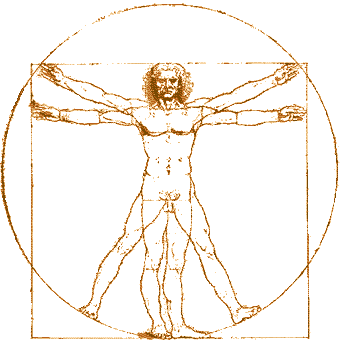
“The very first step in self-realization is realizing one’s identity as separate from the body. “I am not this body but am spirit soul” is an essential realization for anyone who wants to transcend death and enter into the spiritual world beyond. It is not simply a matter of saying “I am not this body,” but of actually realizing it. This is not as simple as it may seem at first. Although we are not these bodies but are pure consciousness, somehow or other we have become encased within the bodily dress. If we actually want the happiness and independence that transcend death, we have to establish ourselves and remain in our constitutional position as pure consciousness.” (from Beyond Birth and Death)
THE HUMAN FORM OF LIFE
Srila Prabhupada would often pose the question: ‘what is the difference between a live body and a dead one?’ He would point out that if we are nothing but chemicals, then these chemicals are also present in the dead body. What is it that distinguishes a living form from a non-living form? The answer, Srila Prabhupada taught, is consciousness, or awareness. All living forms display this symptom of consciousness to one degree or another. That is why we call them living rather than dead. Even the small microbial germ or the common houseplant shows signs of consciousness, whereas our dining table and chairs do not.
Srila Prabhupada would stress that although different forms of life display different degrees and levels of consciousness, it is in the human form that we find the highest development of consciousness. He taught that since humans had the highest level of self-awareness it was a complete waste if he simply engaged in the same activities as the animals.
But what is it about our consciousness that makes it so different from that of the insect, the bird, the beast, or even the monkey? These creatures eat and we also eat; they sleep and we also sleep; they reproduce and we reproduce; they defend themselves and so do we. That we can perform these functions with greater sophistication may be one indicator that we possess higher consciousness, but it does not fully explain our excellence above all other forms of life.
Srila Prabhupada explained that the real difference is found in our ability to question our existence, reflect upon our selves, and inquire into our own nature and the nature of God. We can create languages, ponder the meaning of life, and puzzle in wonderment over the night sky. Such an endowment is not present in any other form of life.
The Vedas therefore advise that in this human form of life we should be inquisitive to know who we are, what the universe is, what God is, and what the relationship is between ourselves, the universe, and God.
We should inquire about the solution to the ultimate problems of life, namely birth, death, old age, and disease. Such questions cannot be asked by the cats and dogs, but they must arise in the heart of a real human being.
YOU ARE NOT THIS BODY
Without exception, all material phenomena have a beginning and an end. A prominent idea of modem culture is that consciousness is another such material phenomenon. Thus it is believed that consciousness (or the self) also ends with the death of the material body. This point of view, however, remains only an assumption. It has not been proven true by any scientific observation or experiment. Srila Prabhupada was highly critical of Western culture’s strong identification of the self with the material body as he explains in the second canto of Srimad-Bhagavatam:
“The whole materialistic world, based on the conception of the material body as the self, is ignorant of the science of God. The materialist is always busy working for the welfare of the material body, not only his own but also those of his children, kinsmen, communitymen, countrymen, etc. The materialists have many branches of philanthropic and altruistic activities from a political, national and international angle of vision, but none of the field work can go beyond the jurisdiction of the misconception of identifying the material body with the spirit soul. Unless, therefore, one is saved from the wrong conception of the body and the soul, there is no knowledge of Godhead, and unless there is knowledge of God, all advancement of material civilization, however dazzling, should be considered a failure.”
More
30 Jan 2012
by The Hare Krishna Movement
in Bhismadeva, Krishna Consciousness, Srimad Bhagavatam
Tags: A.C. Bhaktivedanta Swami Prabhupada, Bhismadeva, Bhismastami, Dhisma's Passing Away, mystics, SB 1.9.29, Srimad Bhagavatam, yogis
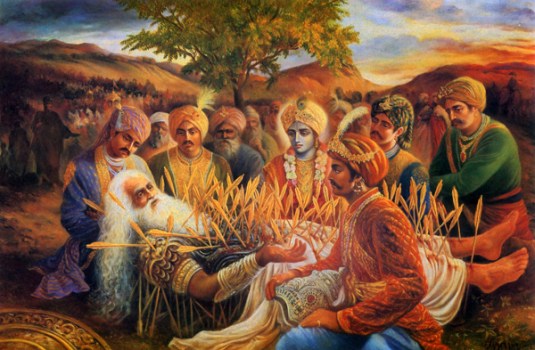
Today we observe the Disappearance of Bhismadeva or “Bhismastami” with these verses from the Srimad Bhagavatam describing this monumental event.
The perfect yogīs or mystics can leave the material body at their own sweet will…
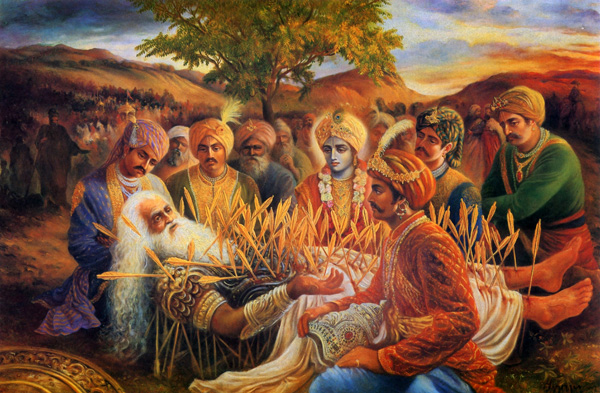
In the momentous hour of leaving his material body, Bhīṣmadeva set the glorious example concerning the important function of the human form of life. The subject matter which attracts the dying man becomes the beginning of his next life. Therefore, if one is absorbed in thoughts of the Supreme Lord Śrī Kṛṣṇa, he is sure to go back to Godhead without any doubt. This is confirmed in the Bhagavad-gītā (8.5-15):
Srimad Bhagavatam
By His Divine Grace A.C. Bhaktivedanta Swami Prabhupada
Canto 1, Chapter 9, Text 29-30
Bhisma’s Passing Away
dharmaṁ pravadatas tasya
sa kālaḥ pratyupasthitaḥ
yo yoginaś chanda-mṛtyor
vāñchitas tūttarāyaṇaḥ
dharmam—occupational duties; pravadataḥ—while describing; tasya—his; saḥ—that; kālaḥ—time; pratyupasthitaḥ—exactly appeared; yaḥ—that is; yoginaḥ—for the mystics; chanda-mṛtyoḥ—of one who dies according to one’s own selection of time; vāñchitaḥ—is desired by; tu—but; uttarāyaṇaḥ—the period when the sun runs on the northern horizon.
While Bhīṣmadeva was describing occupational duties, the sun’s course ran into the northern hemisphere. This period is desired by mystics who die at their will.
The perfect yogīs or mystics can leave the material body at their own sweet will at a suitable time and go to a suitable planet desired by them. In the Bhagavad-gītā (8.24) it is said that self-realized souls who have exactly identified themselves with the interest of the Supreme Lord can generally leave the material body during the time of the fire-god’s effulgence and when the sun is in the northern horizon, and thus achieve the transcendental sky. In the Vedas these times are considered auspicious for quitting the body, and they are taken advantage of by the expert mystics who have perfected the system. Perfection of yoga means attainment of such supermental states as to be able to leave the material body as desired. Yogīs can also reach any planet within no time without a material vehicle. The yogīs can reach the highest planetary system within a very short time, and this is impossible for the materialist. Even attempting to reach the highest planet will take millions of years at a speed of millions of miles per hour. This is a different science, and Bhīṣmadeva knew well how to utilize it. He was just waiting for the suitable moment to quit his material body, and the golden opportunity arrived when he was instructing his noble grandsons, the Pāṇḍavas. He thus prepared himself to quit his body before the exalted Lord Śrī Kṛṣṇa, the pious Pāṇḍavas and the great sages headed by Bhagavān Vyāsa, etc., all great souls.
More
26 Jan 2012
by The Hare Krishna Movement
in Krishna Consciousness, KRSNA The Supreme Personality of Godhead, Spiritual Life, Spiritual World
Tags: A.C. Bhaktivedanta Swami Prabhupada, Balarama, Dvaraka, Krishna, Krsna and Balarama, Krsna The Supreme Personality of Godhead, Kuruksetra, Lord Parasurama, Vrndavana, Yadu dynasty
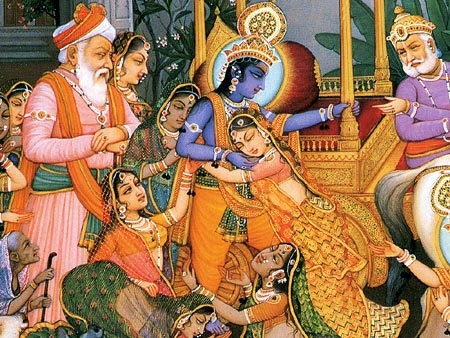
“For one who remembers Me without deviation, I am easy to obtain, O son of Prtha, because of his constnt engagement in devotional service. (Bhagavad-gita 8.14)
…The special qualification of the pure devotee is that he is always thinking of Kṛṣṇa without considering the time or place. There should be no impediments. He should be able to carry out his service anywhere and at any time. Some say that the devotee should remain in holy places like Vṛndāvana or some holy town where the Lord lived, but a pure devotee can live anywhere and create the atmosphere of Vṛndāvana by his devotional service. It was Śrī Advaita who told Lord Caitanya, “Wherever You are, O Lord-there is Vṛndavana.” (From Purport)
So to help us in remembering the Lord, we are posting this very nice chapter from “KRSNA The Supreme Personality of Godhead” by His Divine Grace A.C. Bhaktivedanta Swami, who is teaching us how to always think of Krishna.
…All the members of the Yadu dynasty were naturally very beautiful, and yet on this occasion, when they appeared duly decorated with gold necklaces and flower garlands, dressed in valuable clothing and properly armed with their respective weapons, their natural beauty and personalities were a hundred times enhanced. The members of the Yadu dynasty came to Kurukṣetra in their gorgeously decorated chariots resembling the airplanes of the demigods, pulled by big horses that moved like the waves of the ocean, and some of them rode on sturdy, stalwart elephants that moved like the clouds in the sky. Their wives were carried on beautiful palanquins by beautiful men whose features resembled those of the Vidyādharas. The entire assembly looked as beautiful as an assembly of the demigods of heaven…
KRSNA The Supreme Personality of Godhead (1970 Edition)
By His Divine Grace A.C. Bhaktivedanta Swami Prabhupada
Vol.2 Chapter 27
Lord Kṛṣṇa and Balarāma Meet the Inhabitants of Vṛndāvana
Once upon a time while Lord Kṛṣṇa and Balarāma were living peacefully in Their great city of Dvārakā, there was the rare occasion of a full solar eclipse, such as takes place at the end of every kalpa, or day of Brahmā. At the end of every kalpa the sun is covered by a great cloud, and incessant rain covers the lower planetary systems up to Svargaloka. By astronomical calculation, people were informed about this great eclipse prior to its taking place, and therefore everyone, both men and women, decided to assemble at the holy place in Kurukṣetra known as Samanta-pañcaka.
More
22 Jan 2012
by The Hare Krishna Movement
in Books by Srila Prabhupada, Krishna Consciousness, The Path of Perfection
Tags: A.C. Bhaktivedanta Swami Prabhupada, bhakti yoga, Durga, Krishna Consciousness Society, Krsna, lotus feet, O son of Maharaja Nanda, Radha and Krsna, Srila Prabhupada, The Path of Perfection, yoga

Thanks to Sudarshan das for submitting this picture
…We have formed this International Society for Krishna Consciousness in order to teach people what they have forgotten. In this material world, we have forgotten the service of Rādhā-Kṛṣṇa; therefore we have become servants of māyā, the senses. Therefore, in this Society we are saying, “You are serving your senses. Now just turn your service to Rādhā and Kṛṣṇa, and you will be happy. You have to render service—either to māyā [illusion], the senses, or to Śrī Śrī Rādhā-Kṛṣṇa.”
In this world, everyone is serving the senses, but people are not satisfied. No one can be satisfied, because the senses are always demanding more gratification, and this means that we are constantly having to serve the senses. In any case, our position as servant remains the same. It is a question of whether we want to be happy in our service. It is the verdict of Bhagavad-gītā and the other Vedic scriptures that we will never be happy trying to serve our senses, for they are only sources of misery. Therefore Lord Caitanya Mahāprabhu prays to be situated in Kṛṣṇa’s service. He also prays,
ayi nanda-tanuja kiṅkaraṁ
patitaṁ māṁ viṣame bhavāmbudhau
kṛpayā tava pāda-paṅkaja-
sthita-dhūlī-sadṛśaṁ vicintaya
“O son of Mahārāja Nanda [Kṛṣṇa], I am Your eternal servitor, yet somehow or other I have fallen into the ocean of birth and death. Please pick me up from this ocean of death and place me as one of the atoms at Your lotus feet.” (Śikṣāṣṭaka 5) This is another way of asking Kṛṣṇa to engage us in His service…
The Path of Perfection
By His Divine Grace A.C. Bhaktivedanta Swami Prabhupada
Chapter 8
Failure and Success in Yoga
full chapter More
17 Jan 2012
by The Hare Krishna Movement
in Krishna, Krishna Consciousness, Spiritual World, Srimad Bhagavatam
Tags: A.C. Bhaktivedanta Swami Prabhupada, brahmanas, chariots, conchshells, elephants, Krishna, Krsna enters Dwaraka, Lord Krishna, lotus flowers, Srimad Bhagavatam, The Supreme Personality of Godhead, unbroken seeds, Vedic hymns
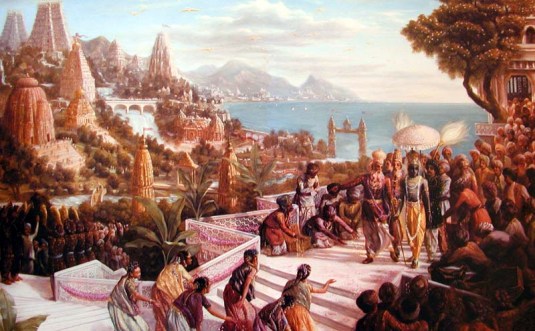
Srimad Bhagavatam
By His Divine Grace A.C. Bhaktivedanta Swami Prabhupada
Canto 1, Chapter 11
Lord Kṛṣṇa’s Entrance into Dvārakā
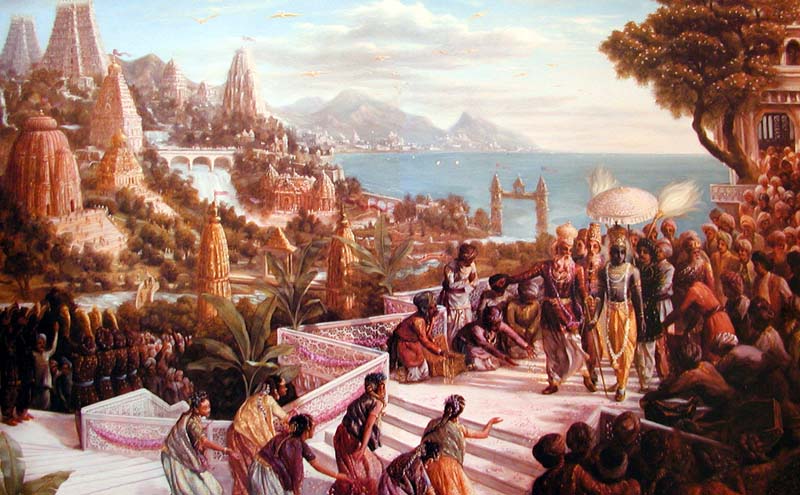
While entering the city of Dvaraka, Lord Krishna acknowledged all the inhabitants’ by casting His transcendental glance over them. The city was filled with the opulences of all seasons. There were hermitages, orchards, flower gardens, parks and reservoirs of water filled with lotus flowers. The highways, subways, lanes, markets and public meeting places were all thoroughly cleansed and then moistened with scented water, And to welcome the Lord, the residents of Dvaraka strew flowers, fruits and unbroken seeds everywhere. The residents hastened toward the Lord on chariots, upon which rode brahmanas bearing flowers, In front of the chariots were elephants, which are emblems of good fortune. Conchshells and bugles were sounded, and Vedic hymns were chanted. Thus, the residents offered their respects, which were saturated with affection, In return, Lord Krishna, the Personality of Godhead, approached them and offered due honor and respect to each and every one of the friends, relatives, citizens and others who came to receive and welcome Him. As the Lord passed along the public road of Dvaraka, His head was protected from sunshine by a white umbrella. White feathered fans moved in semicircles, and showers of flowers fell upon the road. His yellow garments and garlands of flowers made it appear as if a dark cloud were surrounded simultaneously by the sun, the moon, lighting and rainbows.
Lord Kṛṣṇa’s attraction is so powerful that once being attracted by Him one cannot tolerate separation from Him. Why is this so? Because we are all eternally related with Him as the sun rays are eternally related with the sun disc. The sun rays are molecular parts of the solar radiation. Thus the sun rays and the sun cannot be separated. The separation by the cloud is temporary and artificial, and as soon as the cloud is cleared, the sun rays again display their natural effulgence in the presence of the sun. Similarly, the living entities, who are molecular parts of the whole spirit, are separated from the Lord by the artificial covering of māyā, illusory energy. This illusory energy, or the curtain of māyā, has to be removed, and when it is so done, the living entity can see the Lord face to face, and all his miseries are at once removed. Every one of us wants to remove the miseries of life, but we do not know how to do it. The solution is given here, and it rests on us to assimilate it or not. (Srimad Bhagavatam 1.11.10 Purport)
Painting by-Ramadasa Abhirama dasa
07 Jan 2012
by The Hare Krishna Movement
in Interview with Srila Prabhupada, Krishna Consciousness, Science of Self Realization, Srila Prabhupada Conversations
Tags: caste system, Christ consciousness, fake gurus, God consciousness, Hare Krsna mantra, Interviews with Srila Prabhupada, krsna consciousness, Sandy Nixon, spiritual master God, Srila Prabhupada
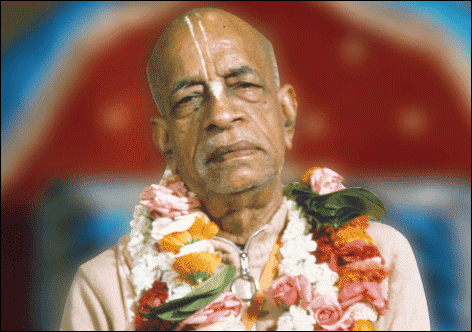
The following interview with freelance reporter Sandy Nixon took place in July 1975, in Śrīla Prabhupāda’s quarters at the Kṛṣṇa center in Philadelphia. This discussion serves as a superb introduction to Kṛṣṇa consciousness and covers such basic topics as the Hare Kṛṣṇa mantra, the relationship between the spiritual master and God, the difference between genuine and fake gurus, the role of women in Kṛṣṇa consciousness, the Indian caste system, and the relationship between Christ consciousness and Kṛṣṇa consciousness.
What is Krsna Consciousness?
Ms. Nixon: My first question is very basic. What is Kṛṣṇa consciousness?
Śrīla Prabhupāda: Kṛṣṇa means God. We are all intimately connected with Him because He is our original father. But we have forgotten this connection. When we become interested in knowing, “What is my connection with God? What is the aim of life?” then we are called Kṛṣṇa conscious.
Ms. Nixon: How does Kṛṣṇa consciousness develop in the practitioner?
Śrīla Prabhupāda: Kṛṣṇa consciousness is already there in the core of everyone’s heart. But because of our materially conditioned life, we have forgotten it. The process of chanting the Hare Kṛṣṇa mahā-mantra—Hare Kṛṣṇa, Hare Kṛṣṇa, Kṛṣṇa Kṛṣṇa, Hare Hare/ Hare Rāma, Hare Rāma, Rāma Rāma, Hare Hare—revives the Kṛṣṇa consciousness we already have. For example, a few months ago these American and European boys andgirls did not know about Kṛṣṇa, but just yesterday we saw how they were chanting Hare Kṛṣṇa and dancing in ecstasy throughout the whole Ratha-yātrā procession [an annual festival sponsored by the Kṛṣṇa consciousness movement in cities around the world]. Do you think that was artificial? No. Artificially, nobody can chant and dance for hours together. They have actually awakened their Kṛṣṇa consciousness by following a bona fide process. This is explained in the Caitanya-caritāmṛta (Madhya 22. 107)
More
06 Jan 2012
by The Hare Krishna Movement
in Krishna Consciousness, Lectures, Srimad Bhagavatam
Tags: constant devotional remembrance. spiritual sky, Damaghosa, His Divine Grace A.C. Bhaktivedanta Swami Prabhupada, krsna consciousness, Lord Krsna, Pradyamuna das, pure consciousness, SB 1.15.47-48, Srila Prabhupada Lecture Srimad Bhagavatam
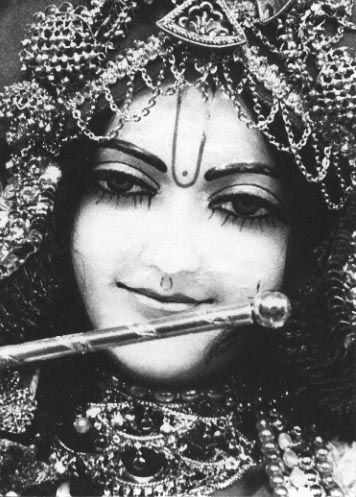
Photo by Damaghosa Prabhu
“If you become devotee of Krsna, then you can live with Krsna, even in this life. Even in this life. Because Krsna is omnipotent, if you are really devotee of Krsna, He will talk with you, He will dance with you, He will eat with you, everything.”
Lecture by His Divine Grace A.C. Bhaktivedanta Swami Prabhupada
December 25, 1973, Los Angeles
Srimad-Bhagavatam 1.15.47-48
Pradyumna: “Thus by pure consciousness due to constant devotional remembrance, they attained the spiritual sky, which is ruled by the Supreme Nārāyaṇa, Lord Kṛṣṇa. This is attained only by those who meditate upon the one Supreme Lord without deviation. This abode of the Lord Śrī Kṛṣṇa, known as Goloka Vṛndāvana, cannot be attained by persons who are absorbed in the material conception of life. But the Pāṇḍavas, being completely washed of all material contamination, attained that abode in their very same bodies.” [SB 1.15.47-48]
Prabhupāda: Tad-dhyāna udriktayā. Dhyāna means meditation. So the Pāṇḍavas, always they were thinking of Kṛṣṇa. While they were eating, they were sitting, they were sleeping, they were talking, they were fighting-Kṛṣṇa. This is Kṛṣṇa consciousness. When Arjuna was fighting, so there was also Kṛṣṇa. When they were dealing in politics with Duryodhana, there was Kṛṣṇa. Kṛṣṇa is his friend, always talking with him, staying with him, sleeping with him, eating with him.
More
05 Jan 2012
by The Hare Krishna Movement
in A.C. Bhaktivedanta Swami Prabhupada, Bhagavad-gita, Krishna Consciousness, Yoga
Tags: bhagavad-gita, bhajete, His Divine Grace A.C. Bhaktivedanta Swami Prabhupada, Krishna, Krishna consciousness, prabhupada, yoga, yogi, yoginam api sarvesam

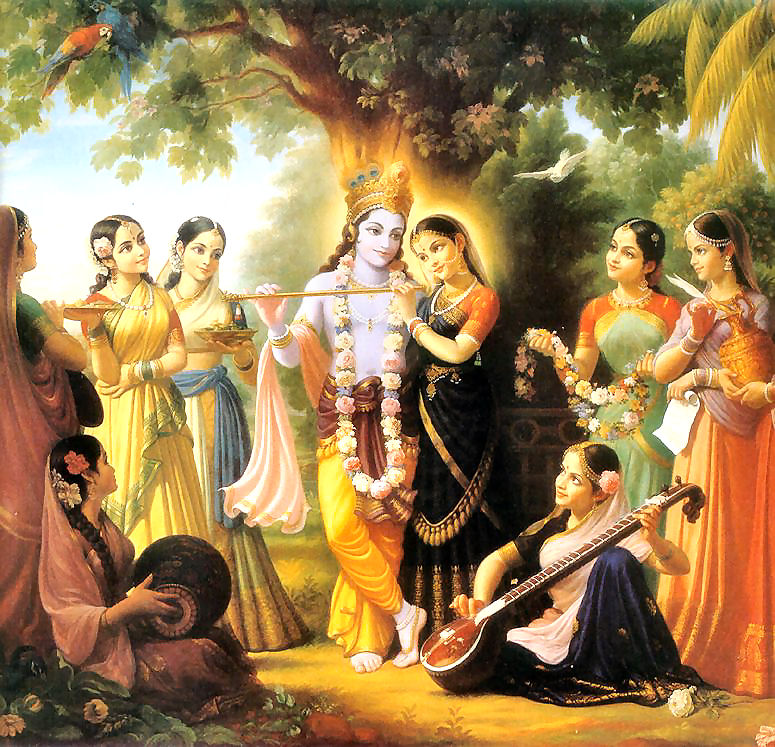
It is by great fortune that one comes to Kṛṣṇa consciousness on the path of bhakti-yoga to become well situated according to the Vedic direction. The ideal yogī concentrates his attention on Kṛṣṇa, who is called Śyāmasundara, who is as beautifully colored as a cloud, whose lotus-like face is as effulgent as the sun, whose dress is brilliant with jewels and whose body is flower garlanded. Illuminating all sides is His gorgeous luster, which is called the brahmajyoti. He incarnates in different forms such as Rāma, Nṛsiṁha, Varāha and Kṛṣṇa, the Supreme Personality of Godhead, and He descends like a human being, as the son of Mother Yaśodā, and He is known as Kṛṣṇa, Govinda and Vāsudeva. He is the perfect child, husband, friend and master, and He is full with all opulences and transcendental qualities. If one remains fully conscious of these features of the Lord, he is called the highest yogī.
Bhagavad-gita As It Is – Macmillan 1972 Edition
By His Divine Grace A.C. Bhaktivedanta Swami Prabhupada
Chapter 6, Text 47
yoginām api sarveṣāṁ
mad-gatenāntar-ātmanā
śraddhāvān bhajate yo māṁ
sa me yuktatamo mataḥ
yoginām—of all yogīs; api—also; sarveṣām—all types of; mat-gatena—abiding in Me; antaḥ-ātmanā—always thinking of Me within; śraddhāvān—in full faith; bhajate—renders transcendental loving service; yaḥ—one who; mām—Me (the Supreme Lord); saḥ—he; me—Mine; yuktatamaḥ—the greatest yogī; mataḥ—is considered.
Translation
And of all yogīs, he who always abides in Me with great faith, worshiping Me in transcendental loving service, is most intimately united with Me in yoga and is the highest of all.
More
28 Dec 2011
by The Hare Krishna Movement
in Krishna Consciousness, KRSNA The Supreme Personality of Godhead, Srimad Bhagavatam
Tags: gopis, His Divine Grace A.C. Bhaktivedanta Swami Prabhupada, Krishna, Krsna The Supreme Personality of Godhead, rasa dance, remembering Krishna, Syamarani, Vrindavan

In the previous article, Srila Prabhupada is describing the nine types of devotional service recommended ….(hearing, chanting, remembering, worshiping, praying, serving, engaging as a servitor of the Lord, establishing friendly relations with the Lord, offering everything to the Lord). These are all easy to practice and should be joyfully performed. So with this in mind we are posting one of Krishna’s unlimited pastimes, to help us in remembering the Lord.
Both the gopīs and Kṛṣṇa entered the water of the Yamunā just to relieve their fatigue from the rāsa dance. The lily flower garlands around the necks of the gopīs were strewn to pieces due to their embracing the body of Kṛṣṇa, and the flowers were reddish from being smeared with the kuṅkuma on their breasts. The bumblebees were humming about in order to get honey from the flowers. Kṛṣṇa and the gopīs entered the water of Yamunā just as an elephant enters a water tank with his many female companions. Both the gopīs and Kṛṣṇa forgot their real identity, playing in the water, enjoying each others’ company and relieving the fatigue of rāsa dancing. The gopīs began to splash water on the body of Kṛṣṇa, all the while smiling, and Kṛṣṇa enjoyed this. As Kṛṣṇa was taking pleasure in the joking words and splashing water, the demigods in the heavenly planets began to shower flowers. The demigods thus praised the superexcellent rāsa dance of Kṛṣṇa, the supreme enjoyer, and His pastimes with the gopīs in the water of Yamunā. (Krsna The Supreme Personality of Godhead Chapter 32)
Image courtsy of Syamarani devi http://www.bhaktiart.net
28 Dec 2011
by The Hare Krishna Movement
in Krishna Consciousness, Raja-Vidya
Tags: Arjuna, His Divine Grace A.C. Bhaktivedanta Swami Prabhupada, Krishna, krsna consciousness, Raja-Vidya, samsara, susukham, the king of knowledge, Yudhisthira Maharaja

When Yudhiṣṭhira Mahārāja was asked, “What is the most wonderful thing in the world?” he replied, “The most wonderful thing is that every day, every moment, people are dying, and yet everyone thinks that death will not come for him.”
Raja – Vidya: The King of Knowledge
By His Divine Grace A.C. Bhaktivedanta Swami Prabhupada
Chapter 2
Knowledge Beyond Saṁsāra
Kṛṣṇa specifically states that this process of Kṛṣṇa consciousness is susukham, very pleasant and easy to practice. Indeed, the devotional process is very pleasant; we melodiously sing with instruments, and someone will listen and also join (śravaṇaṁ kīrtanam). Of course the music should be in relation with the Supreme Lord, in glorification of Him. Hearing Bhagavad-gītā is also part of devotional service, and in addition to hearing it one should be eager to apply it in his life. Kṛṣṇa consciousness is a science and should not be accepted blindly. There are nine processes of devotional service recommended (hearing, chanting, remembering, worshiping, praying, serving, engaging as a servitor of the Lord, establishing friendly relations with the Lord, offering everything to the Lord). These are all easy to practice and should be joyfully performed.
Of course if one thinks that Bhagavad-gītā and the Hare Kṛṣṇa mantra are part of the Hindu system and doesn’t want to accept them because of this, he can nonetheless attend the Christian church and sing there. There is no difference between this process and that process; the point is whatever process one follows, he must become God conscious. God is neither Moslem nor Hindu nor Christian—He is God. Nor are we to be considered Hindu, Moslem or Christian. These are bodily designations. We are all pure spirit, part and parcel of the Supreme. God is pavitram, pure, and we are also pure. Somehow or other, however, we have fallen into this material ocean, and as the waves toss, we suffer. Actually we have nothing to do with the tossing waves of material miseries. We must simply pray, “Kṛṣṇa, please pick me up.” As soon as we forget Kṛṣṇa, the ocean of illusion is there, and it at once captures us. The chanting of Hare Kṛṣṇa is most important in order to escape from this ocean. Hare Kṛṣṇa, Hare Kṛṣṇa, Kṛṣṇa Kṛṣṇa, Hare Hare/ Hare Rāma, Hare Rāma, Rāma Rāma, Hare Hare is a sound (śabda) that is non-different from Kṛṣṇa. The sound Kṛṣṇa and the original Kṛṣṇa are the same. When we chant Hare Kṛṣṇa and dance, Kṛṣṇa is also dancing with us. Of course we may say, “Well, I do not see Him,” but why do we put so much stress on seeing? Why not hearing? Seeing, tasting, smelling, touching, and hearing are all instruments for experience and knowledge. Why do we put such exclusive stress on seeing? A devotee does not wish to see Kṛṣṇa; he is satisfied by simply hearing of Kṛṣṇa. Seeing may eventually be there, but hearing should not be considered any less important. There are things which we hear but do not see—the wind may be whistling past our ears, and we can hear it, but there is no possibility of seeing the wind. Since hearing is no less an important experience or valid one than seeing, we can hear Kṛṣṇa and realize His presence through sound. Śrī Kṛṣṇa Himself says, “I am not there in My abode, or in the heart of the meditating yogī but where my pure devotees are singing.” We can feel the presence of Kṛṣṇa as we actually make progress.
More
27 Dec 2011
by The Hare Krishna Movement
in Krishna Consciousness, KRSNA The Supreme Personality of Godhead, Uncategorized
Tags: charitable, His Divine Grace A.C. Bhaktivedanta Swami Prabhupada, Krsna The Supreme Personality of Godhead, Lord Caitanya, Lord Krsna, medicinal extracts, noble, pious trees, shade, Srimad Bhagavatam, tolerant, trees of Vrndavana

They have dedicated their lives to the welfare of others. They are the perfect example of noble life.
One may take excellent lessons from the pious trees, who offer innumerable benefits, such as fruits, flowers, cooling shade and medicinal extracts. Even when a tree is suddenly cut down and dragged away, the tree does not protest but continues to give service to others in the form of firewood. Thus, one should become the disciple of such magnanimous trees and learn from them the qualities of saintly conduct. (Srimad Bhagavatam)
Taking shelter of the shade of the trees, Kṛṣṇa became very happy. While walking He began to address the inhabitants of Vṛndāvana. “My dear Stokakṛṣṇa, My dear Varūthapa, My dear Bhadrasena, My dear Sudāmā, My dear Subala, My dear Arjuna, My dear Viśāla, My dear Ṛṣabha–just look at these most fortunate trees of Vṛndāvana. They have dedicated their lives to the welfare of others. Individually they are tolerating all kinds of natural disturbances, such as hurricanes, torrents of rain, scorching heat and piercing cold, but they are very careful to relieve our fatigues and give us shelter. My dear friends, I think they are glorified in this birth as trees. They are so careful to give shelter to others that they are like noble, highly elevated charitable men who never deny charity to one who approaches them. No one is denied shelter by these trees. They supply various kinds of facilities to human society, such as leaves, flowers, fruit, shade, roots, bark, flavor extracts and fuel. They are the perfect example of noble life. They are like a noble person who has sacrificed everything possible–his body, mind, activities, intelligence and words–in engaging in the welfare of all living entities.”
More
25 Dec 2011
by The Hare Krishna Movement
in Bhagavad-gita, Devotional Service, Krishna Consciousness, Lord Jesus Christ
Tags: Arjuna, bhagavad-gita, devotee is friendly to every living entity, devotional service, God consciousness, Jesus Christ, Lord Jesus Christ, Srila Prabhupada
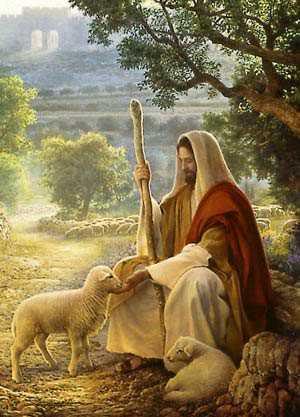
A devotee of Kṛṣṇa is friendly to everyone. Therefore it is said here that he has no enemy. How is this? A devotee situated in Kṛṣṇa consciousness knows that only devotional service to Kṛṣṇa (God) can relieve a person from all the problems of life. He has personal experience of this, and therefore he wants to introduce this system, Kṛṣṇa consciousness, or God Consciousness, into human society. There are many examples in history of devotees of the Lord risking their lives for the spreading of God consciousness. The favorite example is Lord Jesus Christ
He was crucified by the nondevotees, but He sacrificed His life for spreading God consciousness. Of course, it would be superficial to understand that He was killed. Similarly, in India also there are many examples, such as Ṭhākur Haridāsa. Why such risk? Because they wanted to spread Kṛṣṇa consciousness, and it is difficult. A Kṛṣṇa conscious person knows that if a man is suffering, it is due to his forgetfulness of his eternal relationship with Kṛṣṇa (God). Therefore, the highest benefit one can render to human society is relieving one’s neighbor from all material problems. In such a way, a pure devotee is engaged in the service of the Lord. Now, we can imagine how merciful Kṛṣṇa is to those engaged in His service, risking everything for Him. Therefore it is certain that such persons must reach the supreme planet after leaving the body.
Bhagavad-gita As It Is – Macmillan 1972 Edition
By His Divine Grace A.C. Bhaktivedanta Swami Prabhupada
Chapter 11 The Universial Form Text 55
mat-karma-kṛn mat-paramo
mad-bhaktaḥ saṅga-varjitaḥ
nirvairaḥ sarva-bhūteṣu
yaḥ sa mām eti pāṇḍava
mat-karma-kṛt—engaged in doing My work; mat-paramaḥ—concerning Me, the Supreme; mat-bhaktaḥ—engaged in My devotional service; saṅga-varjitaḥ—freed from the contamination of previous activities and mental speculation; nirvairaḥ—without an enemy; sarva-bhūteṣu—to every living entity; yaḥ—one who; saḥ—he; mām—unto Me; eti—comes; pāṇḍava—O son of Pāṇḍu.
Translation
My dear Arjuna, one who is engaged in My pure devotional service, free from the contaminations of previous activities and from mental speculation, who is friendly to every living entity, certainly comes to Me.
More
Previous Older Entries Next Newer Entries










 The Hare Krishna Movement