08 Feb 2014
by The Hare Krishna Movement
in A.C. Bhaktivedanta Swami Prabhupada, Chanting Hare Krishna, Krsna Consciousness, Mantra Meditation, Meditation, The Path of Perfection, Yoga
Tags: A.C. Bhaktivedanta Swami Prtabhupada, Action as Yoga, Bhagavad Gita, chanting and dancing, chanting Hare Krishna, dancing and chanting, Hare Krishna, kirtan, Krsna, mantra meditation, meditation, sankirtan, The Hare Krishna Movement, The Path of Perfection, yoga, yoga system
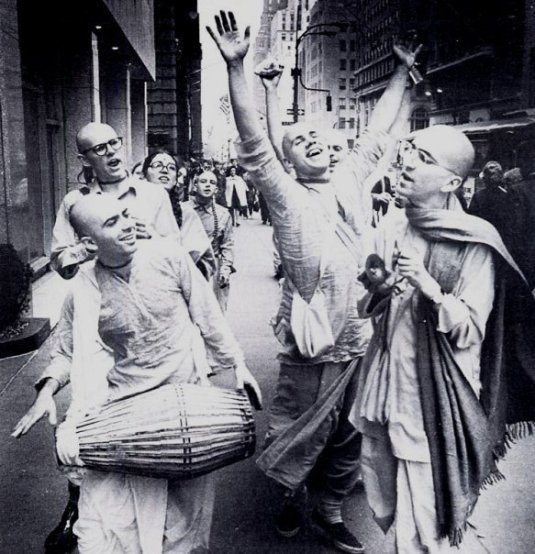
…In the Sixth and Eighth Chapters of Bhagavad-gītā, Lord Śrī Kṛṣṇa, the Supreme Personality of Godhead, explains that the eightfold yoga system is a means to control the mind and senses. This method, however, is very difficult for people to perform, especially in this age of Kali, an age characterized by ignorance and chaos.
Although this eightfold yoga system is particularly recommended in the Sixth Chapter of Bhagavad-gītā, the Lord emphasizes that the process of karma-yoga, action in Kṛṣṇa consciousness, is superior.
…No one really wants to sit down and meditate. Why should we? We’re meant for positive activity, for recreation, for pleasure. In Kṛṣṇa consciousness, our recreation is dancing and chanting, and when we get tired, we take prasāda. Is dancing difficult? Is chanting difficult? We don’t charge anything to dance in the temple. If you go to a ballroom, you have to pay to enter, but we do not charge. It is natural to enjoy music and dancing and palatable foods. These are our recreations, and this is our method of meditation. So this yoga system is not at all laborious. It is simply recreation, susukham. It is stated in the Ninth Chapter of Bhagavad-gītā (9.2) that this yoga is susukham—very happy. “It is everlasting, and it is joyfully performed.” It is natural, automatic, and spontaneous. It is our real life in the spiritual world. (The Path of Perfection)
Full Chapter More
23 Jan 2014
by The Hare Krishna Movement
in Chanting Hare Krishna, Harinama Sankirtan, Krishna Consciousness, Locanananda das, Sankirtan, The Hare Krishna Movement
Tags: Back to Godhead Magazine, BTG, chanting Hare Krishna, enthusiastic devotees, Fifth Ave., Hare Krishna, Hari Nama Sankirtan, Locanananda dasa, Lord Jagannatha's Rathayatra parade, mantra meditation, Near Death while Out Chanting, sankirtan, sankirtana cleanses the heart, Sri Krsna sankirtana, Yajna Purusa dasa

The following is a very nice story which appeared as a Back to Godhead Magazine Article back in 1998. It was written by Locanananda dasa and he recounts the true events that occurred while out chanting on a hot summers day, in the streets of New York City.
More
16 Dec 2013
by The Hare Krishna Movement
in A.C. Bhaktivedanta Swami Prabhupada, Chanting Hare Krishna, Narada Muni, Srila Prabhupada, Srimad Bhagavatam
Tags: A.C. Bhaktivedanta Swami Prtabhupada, bona fide representative, chanting Hare Krishna, chanting the glories of the Lord, devotee, Narada Muni, sincere devotee of the lord, Srila Prabhupada, Srimad Bhagavatam, traveling all over the world

click on image to enlarge
The following is a nice verse from the Srimad Bhagavatam spoken by Narada Muni. As I was looking for an image for this post, I thought I should put up a picture of Him. But then it hit me, this verse could have just as easily been spoken by Srila Prabhupada! In fact it was.
Thus I began chanting the holy name and fame of the Lord by repeated recitation, ignoring all the formalities of the material world. Such chanting and remembering of the transcendental pastimes of the Lord are benedictory. So doing, I traveled all over the earth, fully satisfied, humble and unenvious.
The life of a sincere devotee of the Lord is thus explained in a nutshell by Nārada Muni by his personal example. Such a devotee, after his initiation by the Lord or His bona fide representative, takes very seriously chanting of the glories of the Lord and traveling all over the world so that others may also hear the glories of the Lord. Such devotees have no desire for material gain. They are conducted by one single desire: to go back to Godhead. This awaits them in due course on quitting the material body. Because they have the highest aim of life, going back to Godhead, they are never envious of anyone, nor are they proud of being eligible to go back to Godhead. Their only business is to chant and remember the holy name, fame and pastimes of the Lord and, according to personal capacity, to distribute the message for others’ welfare without motive of material gain.
full text More
30 Nov 2013
by The Hare Krishna Movement
in A.C. Bhaktivedanta Swami Prabhupada, Caaitanya-caritamrta, Chanting Hare Krishna, Sahajiya, Spiritual Life, Spiritual Master, Sri Caitanya-Caritamrta
Tags: A.C. Bhaktivedanta Swami Prabhupada, Adi-lila 7.95-96, association of devotees, chanting Hare Krishna, guru, holy name of the lord, instructions of the spiritual master prabhupada vani, Lord Krsna, Spiritual Life, spiritual master, Sri Caitanya Caritamrta, vani
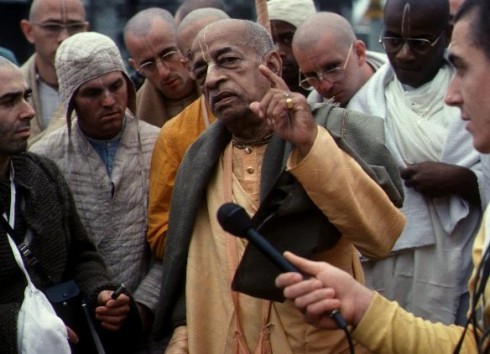
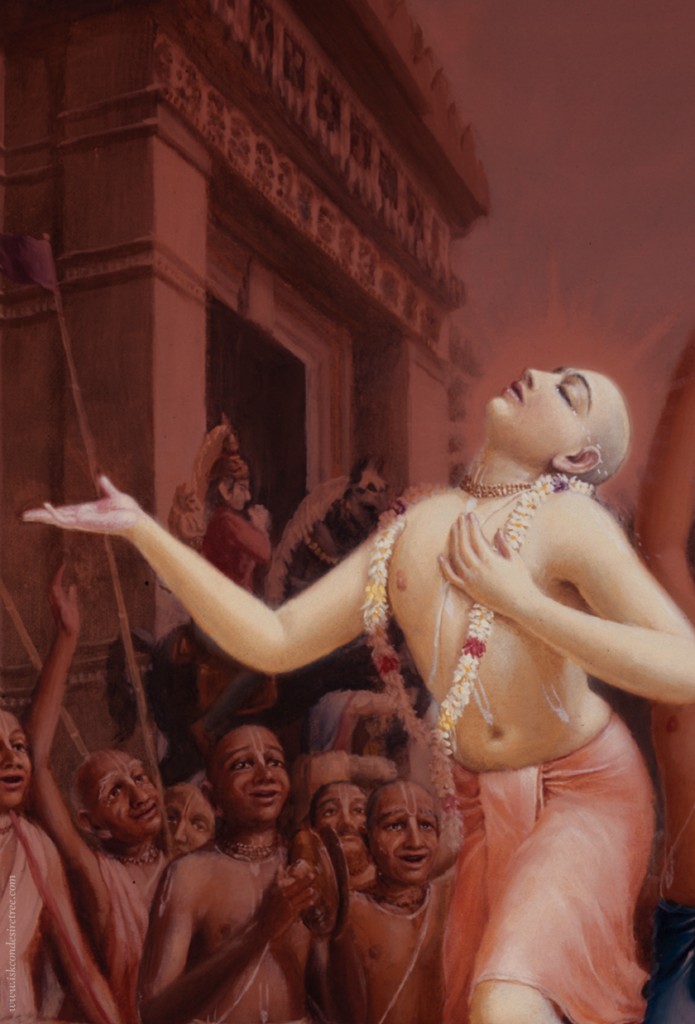
“I firmly believe in these words of My spiritual master, and therefore I always chant the holy name of the Lord, alone and in the association of devotees. That holy name of Lord Kṛṣṇa sometimes causes Me to chant and dance, and therefore I chant and dance. Please do not think that I intentionally do it. I do it automatically. (Sri Caitanya-caritamrta Adi-lila 7.95-96)
A person who cannot keep his faith in the words of his spiritual master but acts independently never receives the authority to chant the holy name of the Lord. (from purport)
This is one of my favorite verses from the Sri Caitanya-caritamrta, and the purport here is one of the most important lessons in spiritual life. Namely, success in spiritual life is faith in the words of the spiritual master and following his instructions. Thereby receiving his blessings. If one receives the blessings of his spiritual master he can chant the holy name of the lord constantly.
Full text and purport More
24 Nov 2013
by The Hare Krishna Movement
in A.C. Bhaktivedanta Swami Prabhupada, Chanting Hare Krishna
Tags: always chant, chanting Hare Krishna, chanting of the holy name of Lord Visnu, Hare Hare, Hare Krishna, Hare Rama, Krishna, Lord Visnu

The following are a few select excerpts on the importance of chanting Hare Krishna. Even if there is still some offence, our chanting should not be abandoned, but rather continued day and night.
Simply our prayer should be, My dear Krishna, please remind me to always chant Your Holy Name, please do not put me into forgetfulness. You are sitting within me as Supersoul, so you can put me into forgetfulness or into remembering You. So please do not put me into forgetfulness. Please always remind me to chant, even You send me into the hell, it doesn’t matter, just so long as I can always chant Hare Krishna. (letter to Devananda, Nov. 23, 1968)
The chanting of the holy name of Lord Viṣṇu is the best process of atonement for a thief of gold or other valuables, for a drunkard, for one who betrays a friend or relative, for one who kills a brāhmaṇa, or for one who indulges in sex with the wife of his guru or another superior. It is also the best method of atonement for one who murders women, the king or his father, for one who slaughters cows, and for all other sinful men. Simply by chanting the holy name of Lord Viṣṇu, such sinful persons may attract the attention of the Supreme Lord, who therefore considers, “Because this man has chanted My holy name, My duty is to give him protection.” (Srimad Bhagavatam 6.2.9-10)
“I do not find the strength to carry on alone the sankirtana of the holy name of Hari. Please bless me by giving me just one drop of faith with which to obtain the great treasure of the holy name of Krsna.
Krsna is yours. You have the power to give Him to me. I am simply your servant running behind you shouting, “Krsna! Krsna!” (Ohe! Vaisnava Thakrua-Srila Bhaktivinoda Thakur)
More
14 Oct 2013
by The Hare Krishna Movement
in Chanting Hare Krishna, Festivals, Hare Krishna Maha Mantra, Sri Caitanya-Caritamrta
Tags: 24 hour kirtan, blissful chanting, chanting Hare Krishna, holy dham, karthik, krishna kirtan, New Vrindavan

click on image to enlarge
“In this Age of Kali, the holy name of the Lord, the Hare Kṛṣṇa mahā-mantra, is the incarnation of Lord Kṛṣṇa. Simply by chanting the holy name, one associates with the Lord directly. Anyone who does this is certainly delivered.” (Sri Caitanya-caritamrta; Adi-lila 7.21)
More
18 Aug 2013
by The Hare Krishna Movement
in Chanting Hare Krishna, Harinama Sankirtan, Sankirtan, The Hare Krishna Movement
Tags: chanting Hare Krishna, Hare Krishna, harinama sankirtan, His Divine Grace A.C. Bhaktivedanta Swami Prabhupada, Krishna consciousness movement, Lord Caitanya, Radha-Damodar Traveling Sankirtan Party, RDTSKP, sankirtan, The Hare Krishna Movement, traveling temple

Harinam Sankirtana
A friend shared these images with me on Facebook and we thought we would share them with you. I loved this idea of a traveling temple, and in the 1970’s I traveled on one of the famous Radha-Damodara bus’s. This idea of bringing the holy name to every Town & Village should be encouraged throughout our society more and more. This would help unite devotees under the banner of Lord Caitanya, and bring peace to the world.
In pursuance of the order of Lord Caitanya, the devotees of the Krishna Consciousness movement should try to introduce the chanting of the Hare Krishna maha-mantra throughout the world. It is only by chanting Hare Krishna that one may get free from the disease of forgetfulness of Krishna, which is the root cause of all suffering. However one is situated, whether one is single, married or renounced, one should have the determination to go out and preach Krishna consciousness. That was the instruction of our spiritual master, His Divine Grace A.C. Bhaktivedanta Swami Prabhupada. (Locanananda das)
“We are saying that this Hare Krishna maha-mantra can save everyone, and we are therefore distributing it publicly, free of charge… The devotees are preaching without charge, declaring in the streets, parks, and everywhere. “Here! Here is the Hare Krishna maha-mantra. Come on, take it!” (POP p. 72)
More
09 Aug 2013
by The Hare Krishna Movement
in A.C. Bhaktivedanta Swami Prabhupada, Chanting Hare Krishna, Maha-mantra, Mantra Meditation, Nectar of Devotion
Tags: A.C. Bhaktivedanta Swami Prabhupada, chanting Hare Krishna, Hare Hare, Hare Krsna, Hare Rama, heavenly happiness, liberation, Maha Mantra, mantra meditation, Nectar of Devotion, singing the flories of the Lord

This morning I was reading from the Nectar of Devotion the chapter entitled “The Mahā-mantra”. We have posted the entire chapter as well as some other related quotes from the Nectar of Devotion on the Maha-mantra.
In the Padma Purāṇa there is a statement: “For any person who is chanting the holy name either softly or loudly, the paths to liberation and even heavenly happiness are at once open.”
When a mantra or hymn is chanted softly and slowly, that is called japa. The same mantra, when chanted loudly, is called kīrtana. For example, the mahā-mantra (Hare Kṛṣṇa, Hare Kṛṣṇa, Kṛṣṇa Kṛṣṇa, Hare Hare/ Hare Rāma, Hare Rāma, Rāma Rāma, Hare Hare) when uttered very softly only for one’s own hearing is called japa. The same mantra, when chanted loudly for being heard by all others, is called kīrtana. The mahā-mantra can be used for japa and kīrtana also. When japa is practiced it is for the personal benefit of the chanter, but when kīrtana is performed it is for the benefit of all others who may hear.
In the Liṅga Purāṇa there is a statement about glorifying and singing about the Lord. It is said there: “A brāhmaṇa who is constantly engaged in singing the glories of the Lord is surely elevated to the same planet as the Supreme Personality of Godhead. Lord Kṛṣṇa appreciates this singing even more than the prayers offered by Lord Śiva.”
In the Viṣṇu-dharma there is a statement glorifying this process of congregational chanting: “My dear King, this word ‘Kṛṣṇa’ is so auspicious that anyone who chants this holy name immediately gets rid of the resultant actions of sinful activities from many, many births.” That is a fact. There is the following statement in Caitanya-caritāmṛta: “A person who chants the holy name of Kṛṣṇa once can counteract the resultant actions of more sinful activities than he is able to perform.” A sinful man can perform many, many sinful activities, but he is unable to perform so many that they cannot be wiped out by one single uttering of “Kṛṣṇa.”
“Anyone who is engaged in chanting My transcendental name must be considered to be always associating with Me. And I may tell you frankly that for such a devotee I become easily purchased.”
In the Padma Purāṇa also it is stated: “The chanting of the Hare Kṛṣṇa mantra is present only on the lips of a person who has for many births worshiped Vāsudeva.” It is further said in the Padma Purāṇa, “There is no difference between the holy name of the Lord and the Lord Himself. As such, the holy name is as perfect as the Lord Himself in fullness, purity and eternity. The holy name is no material sound vibration, nor has it any material contamination.”
Full Chapter More
02 Aug 2013
by The Hare Krishna Movement
in A.C. Bhaktivedanta Swami Prabhupada, Caaitanya-caritamrta, Chanting Hare Krishna, Spiritual Master
Tags: A.C. Bhaktivedanta Swami Prabhupada, chanting Hare Krishna, faith in the lord, guru, holy name, instructions of the spiritual master, spiritual master, Sri Caitanya-caritamrta, Vedic knowledge, yasya deve para bhaktir

This is another nice verse from the Sri Caitanya-caritamrta, on the importance of following strictly the instructions of the spiritual master, and thereby receiving his blessings and mercy. Allowing us to taste the nectar of the Holy Name.
Sri Caitanya-caritamrta 1975
By His Diine Grace A. C. Bhaktivedanta Swami Prabhupada
Adi-lila 7. Texts 95-96
ei tāṅra vākye āmi dṛḍha viśvāsa dhari’
nirantara kṛṣṇa-nāma saṅkīrtana kari
sei kṛṣṇa-nāma kabhu gāoyāya, nācāya
gāhi, nāci nāhi āmi āpana-icchāya
ei—this; tāṅra—his (My spiritual master’s); vākye—in the words of; āmi—I; dṛḍha—firm; viśvāsa—faith; dhari’-depend; nirantara—always; kṛṣṇa-nāma—the holy name of Lord Kṛṣṇa; saṅkīrtana—chanting; kari—continue; sei—that; kṛṣṇa-nāma—the holy name of Lord Kṛṣṇa; kabhu—sometimes; gāoyāya—causes Me to chant; nācāya—causes Me to dance; gāhi—by chanting; nāci—dancing; nāhi—not; āmi—Myself; āpana—own; icchāya—will.
TRANSLATION
“I firmly believe in these words of My spiritual master, and therefore I always chant the holy name of the Lord, alone and in the association of devotees. That holy name of Lord Kṛṣṇa sometimes causes Me to chant and dance, and therefore I chant and dance. Please do not think that I intentionally do it. I do it automatically.
PURPORT
A person who cannot keep his faith in the words of his spiritual master but acts independently never receives the authority to chant the holy name of the Lord. It is said in the Vedas (Śvetāśvatara Upaniṣad 6.23):
yasya deve parā bhaktir
yathā deve tathā gurau
tasyaite kathitā hy arthāḥ
prakāśante mahātmanaḥ
“Only unto those great souls who have implicit faith in both the Lord and the spiritual master are all the imports of Vedic knowledge automatically revealed.”
This Vedic injunction is very important, and Śrī Caitanya Mahāprabhu supported it by His personal behavior. Believing in the words of His spiritual master, He introduced the saṅkīrtana movement, just as the present Kṛṣṇa consciousness movement was started with belief in the words of our spiritual master. He wanted to preach, we believed in his words and tried somehow or other to fulfill them, and now this movement has become successful all over the world. Therefore faith in the words of the spiritual master and in the Supreme Personality of Godhead is the secret of success. Śrī Caitanya Mahāprabhu never disobeyed the orders of His spiritual master and stopped propagating the saṅkīrtana movement.
More
15 Jul 2013
by The Hare Krishna Movement
in A.C. Bhaktivedanta Swami Prabhupada, Chanting Hare Krishna, Lectures
Tags: A.C. Bhaktivedanta Swami, Avatara, chanting Hare Krishna, Hare, Hare Krishna, Krishna, lecture on the maha-mantra, Maha Mantra, mantra, mantra meditation, prabhupada, Prabhupada Lecture, Rama, sound incarnation, Srila Prabhupada, swami, transcendental sound

So this sound, this Hare Krsna, Hare Krsna, Krsna Krsna, Hare Hare. Hare Rama, Hare Rama, Rama Rama, Hare Hare, is the sound representation of the Supreme Lord.
Lecture on Maha-mantra
By His Divine Grace A.C. Bhaktivedanta Swami Prabhupada
Recorded September 8th, 1966, New York
Prabhupada: Now, some of you members have asked me to explain the meaning of this chanting, Hare Krishna, Hare Krsna, Krsna Krsna, Hare Hare. Hare Rama, Hare Rama, Rama Rama, Hare Hare. Now, this sound is transcendental sound, transcendental sound, incarnation, sound incarnation of the Absolute Truth. Just try to understand what is incarnation. Incarnation means… The Sanskrit word is avatara, and that is translated into English as “incarnation.” Of course, the root meaning of incarnation I cannot exactly explain to you, but the root meaning of the… (aside:) The root meaning of avatara is “which comes from the transcendental sky, the spiritual sky to the material sky.” That is called avatara. Avatarana. Avatarana. Just like… Avatarana means “coming from up to down.” That is called avatarana. And avatara is understood that when God or His bona fide representative comes from that sky to this material plane, that is called avatara.
More
09 Jul 2013
by The Hare Krishna Movement
in A.C. Bhaktivedanta Swami Prabhupada, Chanting Hare Krishna, Free Downloads, Free eBooks, On the Way to Krsna
Tags: 2nd Ave., A.C. Bhaktivedanta Swami Prabhupada, chanting Hare Krishna, free ebook, free pdf download, Hare, Hare Krishna, Krishna, meditation, mirror of the mind, On the Way to Krishna, Rama, The Way of Chanting and knowing Krsna, transcendental sound vibration

The following chapter “The Way of Chanting and Knowing Kṛṣṇa” is from one of the small paperback books entitled On The Way to Kṛṣṇa that was printed back in 1973. I always liked these smaller paperback books because I could take them with me wherever I went. For a Free PDF download that you can save or read online follow the link at bottom of post.
On the Way to Kṛṣṇa
By His Divine Grace A. C. Bhaktivedanta Swami Prabhupāda
Chapter Two
More
04 Jun 2013
by The Hare Krishna Movement
in A.C. Bhaktivedanta Swami Prabhupada, Chanting Hare Krishna, Sri Caitanya-Caritamrta
Tags: A.C. Bhaktivedanta Swami Prabhupada, Antya-lila 4.71, chanting Hare Krishna, Hare Krishna, holy name of the lord, Sri Caitanya-caritamrta, Srila Prabhupada, ten offenses
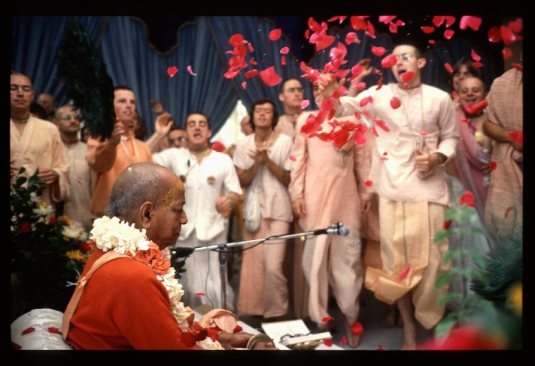
The Following is a very nice verse from the Sri Caitanya-caritamrta about the importance of Chanting the Holy Name of the Lord. Following that is the verse which describes the importance of chanting the names śrī-kṛṣṇa-caitanya prabhu-nityānanda before chanting the Hare Kṛṣṇa mahā-mantra, and the ten kinds of offenses which should be avoided.
…”Of the nine processes of devotional service, the most important is to always chant the holy name of the Lord. If one does so, avoiding the ten kinds of offenses, one very easily obtains the most valuable love of Godhead.” (Antya-lila 4.71)
Similarly, Śrīla Sanātana Gosvāmī has praised the chanting of the holy name as follows in his Bṛhad-bhāgavatāmṛta (Chapter One, verse 9)
“All glories, all glories to the all-blissful holy name of Śrī Kṛṣṇa, which causes the devotee to give up all conventional religious duties, meditation and worship. When somehow or other uttered even once by a living entity, the holy name awards him liberation. The holy name of Kṛṣṇa is the highest nectar. It is my very life and my only treasure.”
More
09 May 2013
by The Hare Krishna Movement
in Arunodaya Kirtan, Bhaktivinoda Thakura, Chanting Hare Krishna
Tags: Gauranga's golden features, Hari, karatalas, Lord Caitanya, Lord Gaurasundara, mrdangas, Mukunda Madhava, puraba bhage, Srila Bhaktivinoda Thakur, tathai tathai, udilo aruna, Yadava

When the rising sun appeared in the East, the jewel of the twice-born, Lord Gaurasundara, awakened, and, taking His devotees with Him, He went all over the countryside towns and villages. The mṛdangas (khol) resounded “tāthaī, tāthaī,” and the jhājas [large metal karatālas that look like small cymbals] in that kīrtana played in time. Lord Gaurāńga’s golden form slightly trembled in ecstatic love of Godhead, and His footbells jingled. All the devotees chanted the names Mukunda, Mādhava, Yadava and Hari, their mouths being filled with the vibrations. They would announce to the still sleeping people, “You spend your nights uselessly sleeping and your days decorating your bodies! You have achieved such a rare human body, but you do not care for this gift. You remain not serving the darling of Yaśodā and slowly fall through your last moments to death. With every rising and setting of the sun, a day passes and is lost. Then, why do you remain idle and not serve the Lord of the heart? This temporary life is full of various miseries. Take shelter of the holy name as your only business. To penetrate the darkness of ignorance and bless everyone’s heart, the holy name has risen like the shining sun. Drink the pure nectar of the holy name. There is nothing but the name to be had in the fourteen worlds. It has filled the soul of Srī Bhaktivinoda Thākura.
Full Song with Bengali translation and word for word transliteration. More
18 Apr 2013
by The Hare Krishna Movement
in A.C. Bhaktivedanta Swami Prabhupada, Chanting Hare Krishna, Letters by Srila Prabhupada, Sankirtan, Susan Beckman, The Hare Krishna Movement
Tags: A.C. Bhaktivedanta Swami Prabhupada, chanting Hare Krishna, humble state of mind, Jayananda das, Letters by Srila Prabhupada, Lord Caitanya, lower than the straw in the street, sankirtan, sankirtan movement, Susan Beckman, The Hare Krishna Movement
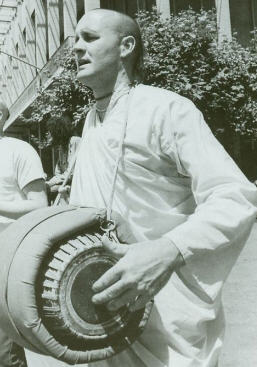
…Lord Sri Chaitanya Mahaprabhu, the incarnation of Godhead in this age has delivered the medicine for all problems of the world by his introducing the Sankirtan movement. The chanting is a process of purification. Just like we use soap to cleanse the body, this is material, but the chanting is spiritual cleansing.
…one should learn the art of chanting the Holy name of Krishna 24 hours a day and that alone is the remedy for all problems of material existence. How is it possible to chant 24 hours a day? Lord Chaitanya gave the hint, “One can chant the holy name of God in a humble state of mind, thinking himself lower than the straw in the street, more tolerant than a tree, devoid of all kinds of sense of false prestige, and always ready to offer all respects to others. In such a humble state of mind one can chant the Holy name of God constantly.” So I cannot give you any better advice for your problem, simply chant Hare Krishna and everything will be all right. (Letter to Susan Bekman from Srila Prabhupada)
Full Letter More
12 Apr 2013
by The Hare Krishna Movement
in A.C. Bhaktivedanta Swami Prabhupada, Chanting Hare Krishna, Mantra Meditation, Srimad Bhagavatam, Vaisnava Vocabulary
Tags: A.C. Bhaktivedanta Swami Prabhupada, chanting Hare Krishna, Hare Krishna, Hare Krishna Mantra, holy name, kirtanad eva krsnasya, Krsna maha-mantra, Lord Caitanya Mahaprabhu, Srila Prabhupada

click on image to enlarge
..Simply by chanting the holy name of Kṛṣṇa: Hare Kṛṣṇa, Hare Kṛṣṇa, Kṛṣṇa Kṛṣṇa, Hare Hare/ Hare Rāma, Hare Rāma, Rāma Rāma, Hare Hare simply by chanting the holy name…,” kīrtanād eva kṛṣṇasya, “he becomes free from all these contaminations, by one thing, simply chanting Hare Kṛṣṇa.”
Kīrtanād eva kṛṣṇasya, mukta-saṅgaḥ paraṁ vrajet
…although Kali-yuga is an ocean of faults, there is still one good quality about this age: Simply by chanting the Hare Kṛṣṇa mahā-mantra, one can become free from material bondage and be promoted to the transcendental kingdom.
This is a very important sloka (verse), as can be confirmed by the number of times Srila Prabhupada has cited it. I was curious about this verse so I went to the incomparable web page Vani Quotes and did a search on the phrase kīrtanād eva kṛṣṇasya, mukta-saṅgaḥ paraṁ vrajet, and was surprised to find just how many times Srila Prabhupada used this verse in his preaching. I think this will be the next verse I try to memorize.
Full verse:
kaler doṣa-nidhe rājann
asti hy eko mahān guṇaḥ
kīrtanād eva kṛṣṇasya
mukta-saṅgaḥ paraṁ vrajet
kaleḥ—of the age of Kali; doṣa-nidheḥ—in the ocean of faults; rājan—O King; asti—there is; hi—certainly; ekaḥ—one; mahān—very great; guṇaḥ—good quality; kīrtanāt—by chanting; eva—certainly; kṛṣṇasya—of the holy name of Kṛṣṇa; mukta-saṅgaḥ—liberated from material bondage; param—to the transcendental spiritual kingdom; vrajet—one can go.
My dear King, although Kali-yuga is an ocean of faults, there is still one good quality about this age: Simply by chanting the Hare Kṛṣṇa mahā-mantra, one can become free from material bondage and be promoted to the transcendental kingdom. (SB 12.3.510
Cited Verses More
12 Mar 2013
by The Hare Krishna Movement
in A.C. Bhaktivedanta Swami Prabhupada, Chanting Hare Krishna, Krishna Consciousness, Mantra Meditation, Sankirtan, Srimad Bhagavatam
Tags: A.C. Bhaktivedanta Swami Prabhupada, age of kali, chant Hare Krishna, full of faults, Hare Krishna Mantra, Kali-yuga, kirtanad eva krsnasya, Krsna, krsna consciousness, Lord Caitanya Mahaprabhu, sankirtana movement, Srila Prabhupada, The Hare Krishna Movement
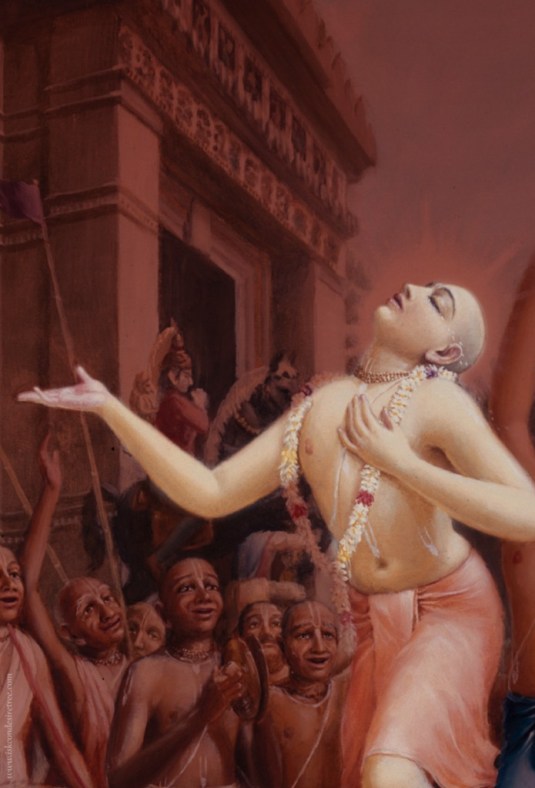
“In the sastra it is said this Kali-yuga is full of faults, so many faults. It is the ocean of faults. But there is a very nice thing, asti hy eko mahan gunah, a very great quality. What is that? Kirtanad eva krsnasya mukta-sangah param vrajet [SB 12.3.51]. If you simply chant Hare Krishna mantra, then you become perfect. Is it very difficult? Chant Hare Krishna and you become perfect. But we are so unfortunate, we are not even prepared to chant. This is our position. So you have to make little determination that ‘I shall chant henceforward Hare Krishna mantra.’ Then everything is all right.” (Srila Prabhupada from Lecture)
and this from Srimad Bhagavatam 8.5.23
When Kṛṣṇa appeared, He gave His orders, and when Kṛṣṇa Himself appeared as a devotee, as Śrī Caitanya Mahāprabhu, He showed us the path by which to cross the ocean of Kali-yuga. That is the path of The Hare Kṛṣṇa Movement. When Śrī Caitanya Mahāprabhu appeared, He ushered in the era for the saṅkīrtana movement. It is also said that for ten thousand years this era will continue. This means that simply by accepting the saṅkīrtana movement and chanting the Hare Kṛṣṇa mahā-mantra, the fallen souls of this Kali-yuga will be delivered. After the Battle of Kurukṣetra, at which Bhagavad-gītā was spoken, Kali-yuga continues for 432,000 years, of which only 5,000 years have passed. Thus there is still a balance of 427,000 years to come. Of these 427,000 years, the 10,000 years of the saṅkīrtana movement inaugurated by Śrī Caitanya Mahāprabhu 500 years ago provide the opportunity for the fallen souls of Kali-yuga to take to the Kṛṣṇa consciousness movement, chant the Hare Kṛṣṇa mahā-mantra and thus be delivered from the clutches of material existence and return home, back to Godhead.
Full Text and Purport More
10 Feb 2013
by The Hare Krishna Movement
in A.C. Bhaktivedanta Swami Prabhupada, Caitanya Mahaprabhu, Chanting Hare Krishna, Krsna Consciousness, Sankirtan, Sri Caitanya-Caritamrta
Tags: A.C. Bhaktivedanta Swami Prabhupada, actions which will be benificial for all living entities, adi-lila 9.27-52, devotional service, Krsna consciousness movement, sankirtan movement, Sri Caitanya Mahaprabhu, Sri Caitanya-caritamrta, tree of devotional service, welfare activities for the benifit of others
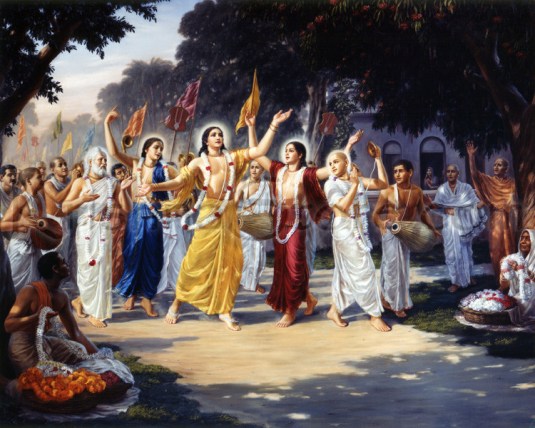
click on image to enlarge
Lord Caitanya’s Sankirtana Movement
“It is the duty of every living being to perform welfare activities for the benefit of others with his life, wealth, intelligence and words.”
“By his work, thoughts and words, an intelligent man must perform actions which will be beneficial for all living entities in this life and in the next.”
The Kṛṣṇa consciousness movement introduced by Lord Caitanya is extremely important because one who takes to it becomes eternal, being freed from birth, death and old age. People do not recognize that the real distresses in life are the four principles of birth, death, old age and disease. They are so foolish that they resign themselves to these four miseries, not knowing the transcendental remedy of the Hare Kṛṣṇa mahā-mantra. Simply by chanting the Hare Kṛṣṇa mahā-mantra, one can become free from all misery, but because they are enchanted by the illusory energy, people do not take this movement seriously. Therefore those who are actually servants of Śrī Caitanya Mahāprabhu must seriously distribute this movement all over the world to render the greatest benefit to human society.
There is a very nice section in the Śrī Caitanya-caritāmṛta wherein the author uses the figurative example of the gardener, to explain the mission of Lord Caitanya Mahāprabhu. With pleasure we are posting the entire section below… More
31 Jan 2013
by The Hare Krishna Movement
in Advaita Acarya, Caitanya Mahaprabhu, Chanting Hare Krishna, Sri Caitanya-Caritamrta, Srimati Tulasi Devi
Tags: A.C. Bhaktivedanta Swami Prabhupada Sri Caitanya's descent, Advaita Acarya, appears by the desire of His devotee, Caitanya Mahaprabhu, protector of religion, srimati tulasi, tulasi buds in water from the ganges, Tulasi devi

…Whenever the Supreme Personality of Godhead descends in His human form, He sends ahead all His devotees, who act as His father, teacher and associates in many roles. Such personalities appear before the descent of the Supreme Personality of Godhead. Before the appearance of Lord Śrī Kṛṣṇa Caitanya Mahāprabhu, there appeared His devotees like Śrī Mādhavendra Purī; His spiritual master, Śrī Īśvara Purī; His mother, Śrīmatī Śacīdevī; His father, Śrī Jagannātha Miśra; and Śrī Advaita Ācārya.
Advaita Ācārya having appeared, He found the world devoid of devotional service to Śrī Kṛṣṇa because people were engrossed in material affairs.
Everyone was engaged in material enjoyment, whether sinfully or virtuously. No one was interested in the transcendental service of the Lord, which can give total relief from the repetition of birth and death.
Seeing the activities of the world, the Ācārya felt compassion and began to ponder how He could act for the people’s benefit.
[Advaita Ācārya thought:] “If Śrī Kṛṣṇa were to appear as an incarnation, He Himself could preach devotion by His personal example.
“In this Age of Kali there is no religion other than the chanting of the holy name of the Lord, but how in this age will the Lord appear as an incarnation?
“I shall worship Kṛṣṇa in a purified state of mind. I shall constantly petition Him in humbleness.
“My name, ‘Advaita,’ will be fitting if I am able to induce Kṛṣṇa to inaugurate the movement of the chanting of the holy name.”
“Śrī Kṛṣṇa, who is very affectionate toward His devotees, sells Himself to a devotee who offers Him merely a tulasī leaf and a palmful of water.”
Advaita Ācārya considered the meaning of the verse in this way: Not finding any way to repay the debt He owes to one who offers Him a tulasī leaf and water, Lord Kṛṣṇa thinks, “There is no wealth in My possession that is equal to a tulasī leaf and water.”
Thus the Lord liquidates the debt by offering Himself to the devotee. Considering this, the Ācārya began worshiping the Lord.
Thinking of the lotus feet of Śrī Kṛṣṇa, He constantly offered tulasī buds in water from the Ganges.
He appealed to Śrī Kṛṣṇa with loud calls and thus made it possible for Kṛṣṇa to appear.
Therefore the principal reason for Śrī Caitanya’s descent is this appeal by Advaita Ācārya. The Lord, the protector of religion, appears by the desire of His devotee.
More
17 Jan 2013
by The Hare Krishna Movement
in Chanting Hare Krishna, Mantra Meditation, Meditation
Tags: Bg 8.8, chanting, chanting Hare Krishna, Hare Krishna, mantra meditation, sixteen words, Srila Prabhupada, Srimad Bhagavatam lecture 7.9.10, Sriman Havagriva brahmacari, vishnujana swami

He who meditates on the Supreme Personality of Godhead, his mind constantly engaged in remembering Me…is sure to reach Me.
…In this verse Lord Kṛṣṇa stresses the importance of remembering Him. One’s memory of Kṛṣṇa is revived by chanting the mahāmantra, Hare Kṛṣṇa. By this practice of chanting and hearing the sound vibration of the Supreme Lord, one’s ear, tongue and mind are engaged. This mystic meditation is very easy to practice, and it helps one attain the Supreme Lord. (from purport to Bhagavad-gita 8.8)
More
15 Jan 2013
by The Hare Krishna Movement
in Chanting Hare Krishna, Ganges, Holy Places of Pilgrimage, Sri Nandanandana das, Stephen Knapp
Tags: chanting Hare Krishna, Hari, Holy Names of the Lord, Krishna, Lord Vishnu, Padma Purana, Sri Nandanandana dasa, Stephen Knapp

This is Part 3 in the series on ‘Chanting the Hare Krishna Maha Mantra’ by Sri Nandanandana Prabhu, describing the power of the Lord’s holy names.
Lord Vishnu’s Names are More Powerful than the Greatest Holy Places
by Sri Nandanandana dasa (Stephen Knapp)
The power of the Lord’s holy names is also related in the following story. It is described in the Padma Purana that many years ago when asked by the sages at the forest of Naimisharanya which one single act will bring the fruit of visiting the many holy places, Suta Gosvami answered in this way: Out of so many rituals and rites that are prescribed, only one is superior. There is no doubt that one who has devotion to Lord Vishnu has undoubtedly conquered everything. Hari, [Vishnu, Krishna], the Lord of all gods, should alone be propitiated. The goblin of sin will perish by means of the great sacred hymns in the form of the names of Vishnu. There is no doubt that those with pure hearts, going around Vishnu even once, get (the fruit of) having bathed at all the holy places. A man would obtain the fruit of (having visited) all holy places by seeing Vishnu’s image. Chanting the excellent name of Vishnu, a man would obtain (the result) of having chanted all the sacred hymns. A man having once smelt the tulasi plant, the grace of Vishnu, does not see the huge and terrible face of Yama [Yamaraja, the lord of death]. A man having (but) once saluted Krishna does not drink the mother’s milk [does not need to be reborn again]. I always repeatedly salute them whose mind is (fixed) on the feet of Vishnu. Even [those of lower tribes, such as] pulkasas, chandalas, or other mleccha tribes, who serve the feet of Vishnu alone are fit to be saluted. Then what about the meritorious and devoted brahmanas and royal sages? Having placed one’s devotion in Vishnu, a person does not experience confinement in the womb (is not reborn). A man who with high sounds chants the name of Vishnu purifies the world as does the Ganga [Ganges River]. There is no doubt that a man is freed from sins like murder of a brahmana by seeing (the image of), touching (the feet of), reciting (the name of), and devoting oneself (to Vishnu).
More
Previous Older Entries Next Newer Entries









 The Hare Krishna Movement