We are still in the month of Damodara (Kartika). In honor and in celebration of the month of Damodara, we will be focusing our attention on the pastimes of Krishna in Vrndavan. Especially Krishna’s childhood pastimes.
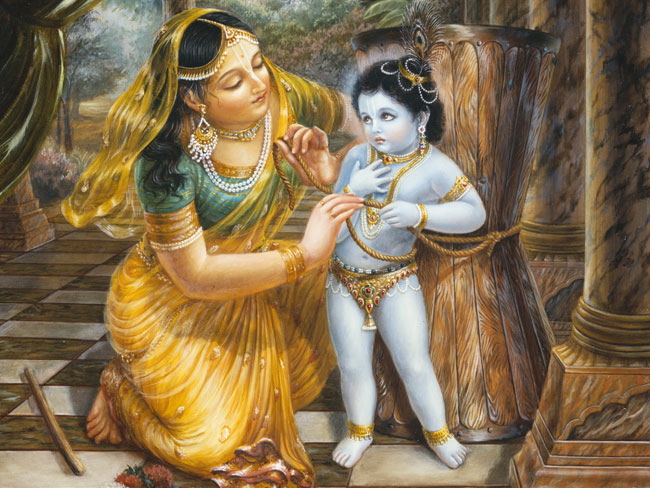
Upon seeing His mothers whipping stick, He cried and rubbed His eyes again and again with His two lotus hands. His eyes were fearful and His breathing quick, and as Mother Yasoda bound His belly with ropes, He shivered in fright and His pearl necklace shook. To this Supreme Lord, Sri Damodara, who is bound with His devotee’s love, I offer my humble obeisances. (Damodarastakam verse 2)
The following is the summary of Chapter 9 of the Tenth Canto of the Srimad Bhagavatam, entitled “Mother Yasoda Binds Lord Krsna.“
And following that, is a nice purport by Visnujana Swami describing the verse in more detail.
Srimad-Bhagavatam
By His Divine Grace A.C. Bhaktivedanta Swami Prabhupada
Tenth Canto, Chapter 9
Mother Yaśodā Binds Lord Kṛṣṇa
Summary
While mother Yaśodā was allowing Kṛṣṇa to drink her breast milk, she was forced to stop because she saw the milk pan boiling over on the oven. The maidservants being engaged in other business, she stopped allowing Kṛṣṇa to drink from her breast and immediately attended to the overflowing milk pan. Kṛṣṇa became very angry because of His mother’s behavior and devised a means of breaking the pots of yogurt. Because He created this disturbance, mother Yaśodā decided to bind Him. These incidents are described in this chapter.
One day, the maidservants being engaged in other work, mother Yaśodā was churning the yogurt into butter herself, and in the meantime Kṛṣṇa came and requested her to allow Him to suck her breast milk. Of course, mother Yaśodā immediately allowed Him to do so, but then she saw that the hot milk on the oven was boiling over, and therefore she immediately stopped allowing Kṛṣṇa to drink the milk of her breast and went to stop the milk on the oven from overflowing. Kṛṣṇa, however, having been interrupted in His business of sucking the breast, was very angry. He took a piece of stone, broke the churning pot and entered a room, where He began to eat the freshly churned butter. When mother Yaśodā, after attending to the overflowing milk, returned and saw the pot broken, she could understand that this was the work of Kṛṣṇa, and therefore she went to search for Him. When she entered the room, she saw Kṛṣṇa standing on the ulūkhala, a large mortar for grinding spices. Having turned the mortar upside down, He was stealing butter hanging from a swing and was distributing the butter to the monkeys. As soon as Kṛṣṇa saw that His mother had come, He immediately began to run away, and mother Yaśodā began to follow Him. After going some distance, mother Yaśodā was able to catch Kṛṣṇa, who because of His offense was crying. Mother Yaśodā, of course, threatened to punish Kṛṣṇa if He acted that way again, and she decided to bind Him with rope. Unfortunately, when the time came to knot the rope, the rope with which she wanted to bind Him was short by a distance equal to the width of two fingers. When she made the rope longer by adding another rope, she again saw that it was short by two fingers. Again and again she tried, and again and again she found the rope too short by two fingers. Thus she became very tired, and Kṛṣṇa, seeing His affectionate mother so tired, allowed Himself to be bound. Now, being compassionate, He did not show her His unlimited potency. After mother Yaśodā bound Kṛṣṇa and became engaged in other household affairs, Kṛṣṇa observed two yamala-arjuna trees, which were actually Nalakūvara and Maṇigrīva, two sons of Kuvera who had been condemned by Nārada Muni to become trees. Kṛṣṇa, by His mercy, now began to proceed toward the trees to fulfill the desire of Nārada Muni.
Verse 2
rudantaḿ muhur netra-yugmaḿ mṛjantam
karāmbhoja-yugmena sātańka-netram
muhuḥ śvāsa-kampa-trirekhāńka-kaṇṭha-
sthita-graivaḿ dāmodaraḿ bhakti-baddham
Upon seeing His mothers whipping stick, He cried and rubbed His eyes again and again with His two lotus hands. His eyes were fearful and His breathing quick, and as Mother Yasoda bound His belly with ropes, He shivered in fright and His pearl necklace shook. To this Supreme Lord, Sri Damodara, who is bound with His devotee’s love, I offer my humble obeisances.
The second verse continues describing the lila-visesa. He is crying (rudantam) because He sees the stick in Mother Yasoda’s hand. Perceiving that she may strike Him, He appears fearful, hoping her natural empathy may save Him from punishment. Due to fear, tears are forming in His eyes, so He rubs his eyes with his lotus-like hands in the normal manner of children to wipe away the tears that are beginning to flow.
Then (satanka-netram) His fearful eyes reveal how much He is dreading punishment. It also indicates His glancing here and there in great fear, trying to avoid being punished. The confidential pastime is revealed in this way. Therefore, due to his continual sobbing He is trembling, (muhuh svasa-kampa) and thus, (sthita-graiva) the pearl necklaces and earrings that adorn Him are also shaking.
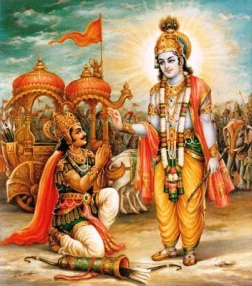
The Supreme Personality of Godhead, who is feared by everyone, has become fearful of Mother Yasoda. In this way, Mother Yasoda now becomes greater than God, more powerful than Krishna. The Mayavadi philosophers want to become one with God, but in Vaishnava philosophy the devotee becomes more than Krishna, and Krishna accepts this. He elevates His devotee beyond His own position, just as Arjuna became the hero at Kurukshetra and Krishna was simply his chariot driver. Actually, Krishna was the hero, but He gave the credit to His devotee, because He takes pleasure in seeing His devotee in a greater position than Himself.
“When Mother Yasoda was trying to bind the offending child, she saw that the rope was short by the measurement of two fingers. Thus she brought another rope to join it. This new rope was also short by two fingers, and when another rope was joined to it, it was still two fingers short. As many ropes as she joined, all of them failed; their shortness could not be overcome.”
The reason for the failure of the rope to bind Him is bhakti-baddham. He can be bound only with devotion. No other power can bind Him. The significance of the two fingers is also very important. The first finger represents the devotee’s sincere endeavor of love and unflinching determination to attain Krishna and thereby please Him. The second finger represents Krishna’s supreme mercy by which He agrees to be bound by His devotee’s pure love.
So He is bound with a rope around the belly (damodaram) and tied to a wooden grinding mortar. This reveals the Lord’s excellent quality of coming under the control of His devotee’s pure love (bhakti-baddham). He responds to bhakti in two ways. From Mother Yasoda’s point of view, He is conquered and bound by her loving parental devotion, vatsalya. From His own point of view, He willingly allows her to bind Him, although no rope can ever bind Him.
“Because of Mother Yasoda’s hard labor, her whole body became covered with perspiration, and the flowers and comb were falling from her hair. When child Krishna saw His mother thus fatigued, He became merciful to her and agreed to be bound. O Maharaja Pariksit, this entire universe, with its great exalted demigods like Lord Shiva, Lord Brahma and Lord Indra, is under the control of the Supreme Personality of Godhead. Yet the Supreme Lord has one transcendental attribute: He comes under the control of His devotees. This was now exhibited by Krishna in this pastime.” (purport by Visnujana Swami)
Purport by: KKSongs