“Simply by chanting the holy name of Lord Kṛṣṇa, one can be freed from all undesirable habits. This is the means of awakening all good fortune and initiating the flow of waves of love for Kṛṣṇa. (Cc Antya 20.11)
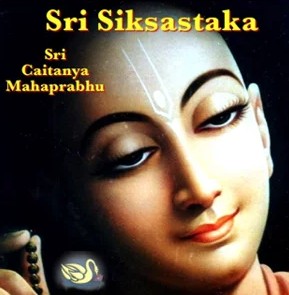
Sri Caitanya Mahaprabhu is the most recent incarnation of Krsna. He appeared 500 years ago in Bengal, in the form of Krsna’s devotee, in the mood of Srimati Radharani. He left only eight slokas (verses) of His instructions in writing. They describe the glories of the holy names of the Lord and the mood one must have to chant and to be a devotee.
The Sri Siksastakam is a collection of eight sanskrit verses written by Sri Caitanya Mahaprabhu (1486–1535), the founder of the Gaudiya Vaishnava tradition. In Sanskrit, śikṣā means “instruction” and aṣṭaka means “consisting of eight parts”.
These verses represent the primary written teachings left by Chaitanya Mahaprabhu and focus heavily on the practice, philosophy, and spiritual effects of the congregational chanting (sankirtana) of the Hare Krishna maha-mantra.
What I found interesting, when reading these verses from the Caitanya-caritamrta, is how the wording is different from the way we all learned it from “The Songs of the Vaisnava Acharya” songbook. The same but different.
“Let there be all victory for the chanting of the holy name of Lord Kṛṣṇa, which can cleanse the mirror of the heart and stop the miseries of the blazing fire of material existence. That chanting is the waxing moon that spreads the white lotus of good fortune for all living entities. It is the life and soul of all education. The chanting of the holy name of Kṛṣṇa expands the blissful ocean of transcendental life. It gives a cooling effect to everyone and enables one to taste full nectar at every step. (Cc Antya 20.12)
Purport
This is the first verse of Śrī Caitanya Mahāprabhu’s Śikṣāṣṭaka. The other seven verses are found in texts 16, 21, 29, 32, 36, 39 and 47.
“My Lord, O Supreme Personality of Godhead, in Your holy name there is all good fortune for the living entity, and therefore You have many names, such as Kṛṣṇa and Govinda, by which You expand Yourself. You have invested all Your potencies in those names, and there are no hard and fast rules for remembering them. My dear Lord, although You bestow such mercy upon the fallen, conditioned souls by liberally teaching Your holy names, I am so unfortunate that I commit offenses while chanting the holy name, and therefore I do not achieve attachment for chanting. (Cc Antya 20.16)
“One who thinks himself lower than the grass, who is more tolerant than a tree, and who does not expect personal honor but is always prepared to give all respect to others can very easily always chant the holy name of the Lord. (Cc Antya 20.21)
“One who thinks himself lower than the grass, who is more tolerant than a tree, and who does not expect personal honor but is always prepared to give all respect to others can very easily always chant the holy name of the Lord. (Cc Antya 20.29)
“Oh, My Lord, O Kṛṣṇa, son of Mahārāja Nanda, I am Your eternal servant, but because of My own fruitive acts, I have fallen in this horrible ocean of nescience. Now please be causelessly merciful to Me. Consider Me a particle of dust at Your lotus feet. (Cc Antya 20.32)
“My dear Lord, when will My eyes be beautified by filling with tears that constantly glide down as I chant Your holy name? When will My voice falter and all the hairs on My body stand erect in transcendental happiness as I chant Your holy name? (Cc Antya 20.36)
“My Lord Govinda, because of separation from You, I consider even a moment a great millennium. Tears flow from My eyes like torrents of rain, and I see the entire world as void. (Cc Antya 20.39)
“Let Kṛṣṇa tightly embrace this maidservant, who has fallen at His lotus feet. Let Him trample Me or break My heart by never being visible to Me. He is a debauchee, after all, and can do whatever He likes, but He is still no one other than the worshipable Lord of My heart. (Cc Antya 20.47)
Commentary by A.C. Bhaktivedānta Swāmī Prabhupāda:
Lecture Excerpt — Bombay, November 7, 1970
Lord Caitanya gave us eight stanzas of His mission, what He wanted to do. They are explained in eight stanzas, and they are known as Sikṣāṣṭaka. Sikṣā means instruction, and āṣṭaka means eight. So in eight stanzas He has finished his instruction, and His next disciples, the six Gosvāmīs, have explained them in volumes of books. So Lord Caitanya says the subject is paraṁ́ vijayate śrī-kṛṣṇa-saṇkīrtanam: all glories to the chanting of Hare Kṛṣṇa mantra or Kṛṣṇa saṇkīrtan movement. All glories. All victory. How it is victory, all victory? That He explains, that ceto-darpaṇa-mārjanam. If you chant this Hare Kṛṣṇa mantra, then the dirty things which have accumulated in your heart due to material contamination will be cleared off.
He gives the example that the heart is just like a mirror. If on the mirror there are heaps of dust accumulated, then one cannot see the real face by the reflection of the mirror. Therefore, it should be cleansed. So in our present conditional life, our heart is overloaded with so much dust accumulated due to our material association from time immemorial. So if we chant this Hare Kṛṣṇa mantra, then the dust will be removed. Even not immediately, it will begin to be removed. And as soon as the mirror of the heart is cleansed of all dust, immediately one can see the face what he is. That face means real identification. By chanting Hare Kṛṣṇa mantra, one will understand that he is not this body. This is our misconception. The dust means this misconception, accepting this body or the mind as self. Actually, we are not this body or the mind. We are spirit soul. So as soon as we can understand that we are not these bodies, immediately bhava-mahā-dāvāgni-nirvāpaṇam. The blazing fire of material conditions, or the blazing fire of material miseries, immediately becomes dissipated. No more misery. Ahaṁ brahmāsmi (I am spirit soul).
As it is stated in the Bhagavad-gītā, brahma-bhūtaḥ prasannātmā. Immediately one understands his real identification as spirit soul, he becomes joyful. We are not joyful. Due to our material contact, we are always full of anxieties. By chanting Hare Kṛṣṇa mantra, we shall immediately come to the stage of joyful life. Bhava-mahā-dāvāgni-nirvāpaṇam. And this is called liberation. When one becomes joyful, free from all anxieties, that stage is actual liberation because every living creature, the spirit soul is by nature joyful. The whole struggle for existence is that he is searching after that joyful stage of life, but he missing the point. Therefore, in every effort for joyful life we are being defeated. This constant defeat can be overcome immediately by chanting this Hare Kṛṣṇa mantra. That is the effect of this transcendental vibration. And after liberation, after being joyful, the material joys decreases. Whatever joy you want to enjoy, that decreases.
Take, for example, for eating. If we want to eat some nice foodstuff, after eating a few morsels of food we do not like to take any more. That means here in the material world, whatever joy we accept, it will decrease. But spiritual joy, Lord Caitanya says ānandāmbudhi-vardhanam, the spiritual joy is just like ocean. But here in the material world, we have got experience that ocean does not increase. Ocean remains within its limit. But the ocean of spiritual joyfulness increases. Anandāmbudhi-vardhanam. Sreyaḥ-kairava-candrikā-vitaraṇam. How it increases? He is giving the example like the moon, rising moon. As the waxing moon. As the moon from the day of new moon, new moon night, the first day it is just like a small curved line. But second day, third day it increases, gradually it increases. Similarly, the spiritual life, the spiritual joyful life increases like the moon rays day after day, day after day, till it reaches the full moon night, yes. So ceto-darpaṇa-mārjanam bhava-mahā-dāvāgni-nirvāpaṇam, śreyaḥ-kairava-candrikā-vitaraṇam vidyā-vadhū-jīvanam. And the life then becomes full of knowledge because spiritual life means eternal life, full of bliss and full of knowledge. So we increase our volumes of joy because proportionately we increase the volume of our knowledge. Sreyaḥ-kairava-candrikā-vitaraṇaṁ́ vidyā-vadhū-jīvanam, ānandāmbudhi-vardhanaṁ́. It is just like a ocean, but still it increases. Anandāmbudhi-vardhanaṁ́, sarvātma-snapanaṁ́. It is so nice that once situated in this state of life, one thinks that “I am fully satisfied.” Sarvātma-snapanaṁ́. Just like if one takes bath dipping into the water, he feels refreshed immediately. Similarly, this spiritual life increasing joys day after day makes one feeling that he is fully satisfied. (The Science of Self Realization : SSR 8: Attaining Perfection : Knowing the Purpose of Life)
Lord Chaitanya Mahāprabhu recommended: ceto-darpaṇa-mārjanam. Mārjanam means “cleanse,” and darpaṇam means “mirror.” The heart is a mirror. It is like a camera. Just as a camera takes all kinds of pictures of days and nights, so also our heart takes pictures and keeps them in an unconscious state [Subconsciousness]. Psychologists know this. The heart takes so many pictures, and therefore it becomes covered. We do not know when it has begun, but it is a fact that because there is material contact, our real identity is covered. Therefore ceto-darpana-marjanam: one has to cleanse his heart. (SP: Science of Selfrealization)
And when the heart is cleansed, then a person becomes eligible for being freed from the clutches of maya, or the materialistic way of life. He understands that he is not this body-that he’s a spirit soul, and that his business is therefore different from merely material concerns. He thinks, “Now I am engaged only in seeking these bodily comforts of life. These are not at all essential, because my body will change. Today, since I am in an American body, I think I have so many duties as an American man. Tomorrow I may be in an American dog body, and immediately my duty would change. So I can understand that these bodily concerns are not my real business. My real business is how to elevate myself-as a spirit soul-to the spiritual world, back to home, back to Godhead.”
When the mind is completely washed of all material contamination, the pure consciousness acts. The sound vibration from the spiritual sky can automatically cleanse all material contaminations, as confirmed by Caitanya Mahāprabhu: ceto-darpaṇa-mārjanam [Cc. Antya 20.12]. We need only take the advice of Lord Chaitanya Mahāprabhu and chant the Hare Kṛṣṇa mantra to cleanse the mind of all material contamination, and this may be considered the summary of this difficult verse. As soon as the whole material contamination is washed away by this process of chanting, all desires and reactions to material activities become immediately vanquished, and real life, peaceful existence, begins. In this age of Kali it is very difficult to adopt the yogic process mentioned in this verse.
Unless one is very expert in such yoga, the best course is to adopt the ways and means of Lord Caitanya Mahāprabhu, śrī-kṛṣṇa-saṇkīrtanam. Thus one can gloriously become freed from all material contamination by the simple process of chanting Hare Kṛṣṇa Hare Kṛṣṇa Kṛṣṇa Kṛṣṇa Hare Hare / Hare Rāma Hare Rāma Rāma Rāma Hare Hare. Just as life in this material world has its beginning in material sound, similarly a spiritual life has its beginning in this spiritual sound vibration. (SB 4.23.17 pp)
In His Śikṣāṣṭaka, Lord Caitanya describes the progressive benefits of chanting Hare Krishna. First, ceto-darpana-marjanam [Cc. Antya 20.12]. The beginning is cleansing the heart, because we are impure on account of dirty things within our heart, accumulated lifetime after lifetime in the animalistic way of life. So everything-advancement of spiritual life, culture, tapasya-is meant to cleanse the heart. And in this process of chanting the maha-mantra, the first installment of benefit is the cleansing of the heart. Ceto-darpaṇa-mārjanam.
Specifically, chanting the Hare Kṛṣṇa mantra purifies one, and this chanting is therefore recommended by Sri Caitanya Mahāprabhu. Ceto-darpaṇa-mārjanam: [Cc. Antya 20.12] by chanting the names of Krishna, the mirror of the heart is cleansed, and the devotee loses interest in everything external. When one is influenced by the external energy of the Lord, his heart is impure. When one’s heart is not pure, he cannot see how things are related to the Supreme Personality of Godhead. Idam hi visvam bhagavan ivetarah (Bhag. 1.5.20). He whose heart is purified can see that the whole cosmic manifestation is but the Supreme Personality of Godhead, but he whose heart is contaminated sees things differently. Therefore by sat-sanga, or association with devotees, one becomes perfectly pure in heart. (SB 4.24.59 pp)
In this way the person who chants Hare Kṛṣṇa purifies his consciousness. Then his materialistic activity is stopped. He knows, “This is simply a waste of time. I must act spiritually.” That is knowledge, which comes from cleansing the heart (ceto-darpaṇa-mārjanam [Cc. Antya 20.12]). The illusion of wrongly working on the basis of the bodily concept of life is overcome simply by the chanting of the Hare Kṛṣṇa maha-mantra. This is the first installment of benefit from chanting. (SP: Civilization and Transcendence)
Original Verses: Caitanya Caritamṛta, Antya Lila Chapter 20
Verses 12, 16, 21, 29, 32, 36, 39, 47, and 65;
Śrī Śikṣāṣṭakam, Kṛṣṇadāsa Kavirāja Gosvāmī