“Simply by chanting the holy name of Lord Kṛṣṇa, one can be freed from all undesirable habits. This is the means of awakening all good fortune and initiating the flow of waves of love for Kṛṣṇa. (Cc Antya 20.11)
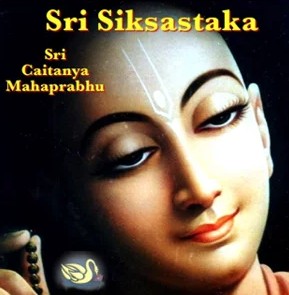
Sri Caitanya Mahaprabhu is the most recent incarnation of Krsna. He appeared 500 years ago in Bengal, in the form of Krsna’s devotee, in the mood of Srimati Radharani. He left only eight slokas (verses) of His instructions in writing. They describe the glories of the holy names of the Lord and the mood one must have to chant and to be a devotee.
The Sri Siksastakam is a collection of eight sanskrit verses written by Sri Caitanya Mahaprabhu (1486–1535), the founder of the Gaudiya Vaishnava tradition. In Sanskrit, śikṣā means “instruction” and aṣṭaka means “consisting of eight parts”.
These verses represent the primary written teachings left by Chaitanya Mahaprabhu and focus heavily on the practice, philosophy, and spiritual effects of the congregational chanting (sankirtana) of the Hare Krishna maha-mantra.
What I found interesting, when reading these verses from the Caitanya-caritamrta, is how the wording is different from the way we all learned it from “The Songs of the Vaisnava Acharya” songbook. The same but different.
“Let there be all victory for the chanting of the holy name of Lord Kṛṣṇa, which can cleanse the mirror of the heart and stop the miseries of the blazing fire of material existence. That chanting is the waxing moon that spreads the white lotus of good fortune for all living entities. It is the life and soul of all education. The chanting of the holy name of Kṛṣṇa expands the blissful ocean of transcendental life. It gives a cooling effect to everyone and enables one to taste full nectar at every step. (Cc Antya 20.12)
Purport
This is the first verse of Śrī Caitanya Mahāprabhu’s Śikṣāṣṭaka. The other seven verses are found in texts 16, 21, 29, 32, 36, 39 and 47.
“My Lord, O Supreme Personality of Godhead, in Your holy name there is all good fortune for the living entity, and therefore You have many names, such as Kṛṣṇa and Govinda, by which You expand Yourself. You have invested all Your potencies in those names, and there are no hard and fast rules for remembering them. My dear Lord, although You bestow such mercy upon the fallen, conditioned souls by liberally teaching Your holy names, I am so unfortunate that I commit offenses while chanting the holy name, and therefore I do not achieve attachment for chanting. (Cc Antya 20.16)
“One who thinks himself lower than the grass, who is more tolerant than a tree, and who does not expect personal honor but is always prepared to give all respect to others can very easily always chant the holy name of the Lord. (Cc Antya 20.21)
“One who thinks himself lower than the grass, who is more tolerant than a tree, and who does not expect personal honor but is always prepared to give all respect to others can very easily always chant the holy name of the Lord. (Cc Antya 20.29)
“Oh, My Lord, O Kṛṣṇa, son of Mahārāja Nanda, I am Your eternal servant, but because of My own fruitive acts, I have fallen in this horrible ocean of nescience. Now please be causelessly merciful to Me. Consider Me a particle of dust at Your lotus feet. (Cc Antya 20.32)
“My dear Lord, when will My eyes be beautified by filling with tears that constantly glide down as I chant Your holy name? When will My voice falter and all the hairs on My body stand erect in transcendental happiness as I chant Your holy name? (Cc Antya 20.36)
“My Lord Govinda, because of separation from You, I consider even a moment a great millennium. Tears flow from My eyes like torrents of rain, and I see the entire world as void. (Cc Antya 20.39)
“Let Kṛṣṇa tightly embrace this maidservant, who has fallen at His lotus feet. Let Him trample Me or break My heart by never being visible to Me. He is a debauchee, after all, and can do whatever He likes, but He is still no one other than the worshipable Lord of My heart. (Cc Antya 20.47)
Commentary by A.C. Bhaktivedānta Swāmī Prabhupāda:
Lecture Excerpt — Bombay, November 7, 1970