I was thinking about the following verse the other day:
“The supreme occupation [dharma] for all humanity is that by which men can attain to loving devotional service unto the transcendent Lord. Such devotional service must be unmotivated and uninterrupted to completely satisfy the self.” ( SB 1.2.6)
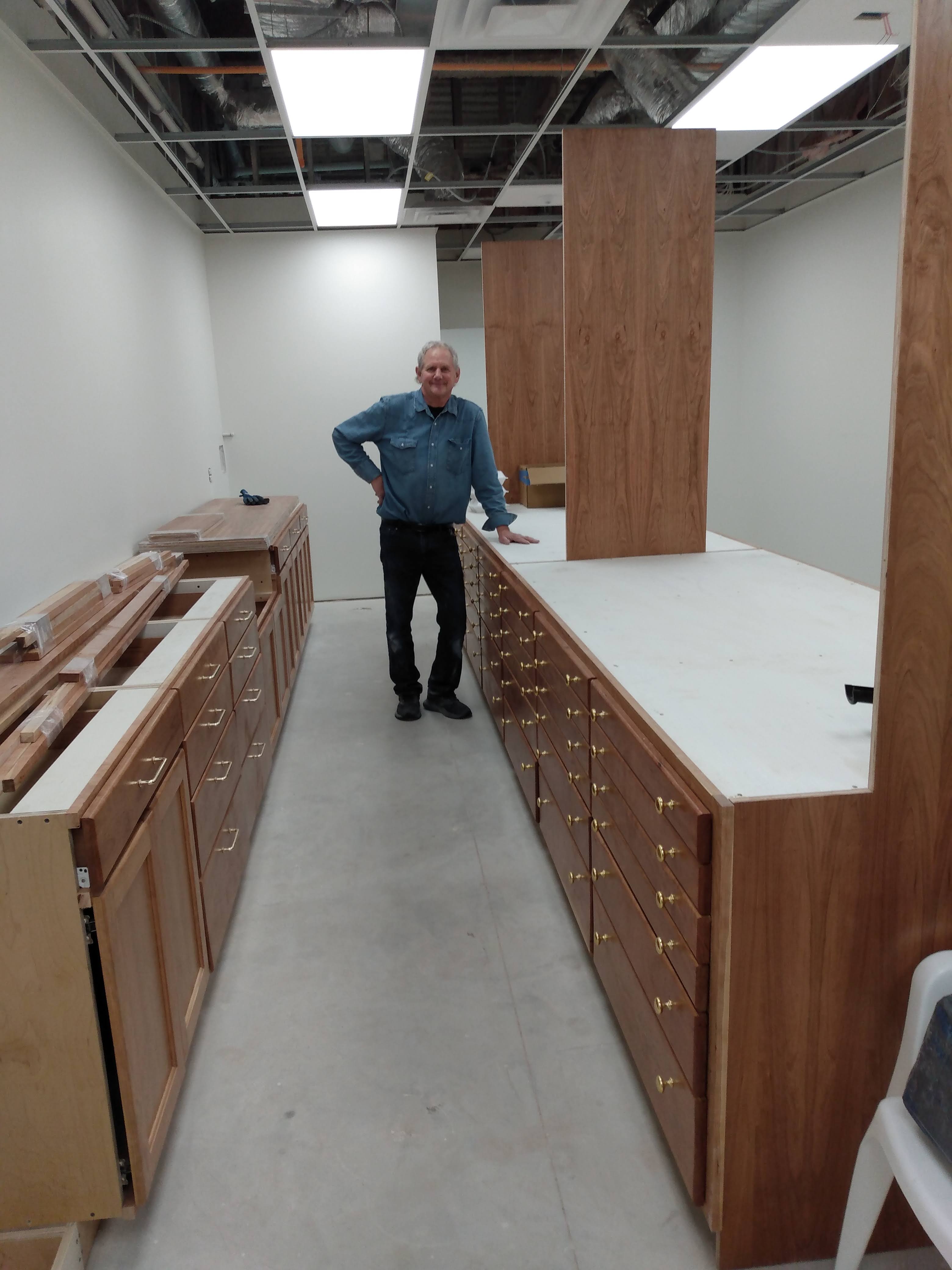
And in some small way, I was feeling very fortunate. Over the years Srila Prabhupada has kept me engaged in devotional service to Krishna, as a wood worker building different pujari rooms for the Lords paraphernalia, construction projects, maintaining various web pages, gardening, offering food and water to the Lord, worshiping the Lord in our temple room, and washing the Lord’s plates and cups.
Sometimes I think I am just an insignificant servant of my spiritual master, but then I remember what Srila Prabhupada once said about devotional service: “If you had any idea of what you were doing, you would be fainting in ecstasy”.
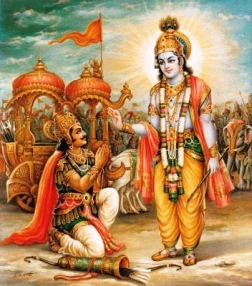
I was reading from the introduction to the Bhagavad-gita As It is…
the whole purpose of Bhagavad-gita is to revive our sanātana occupation, or sanātana-dharma, which is the eternal occupation of the living entity. We are temporarily engaged in different activities, but all of these activities can be purified when we give up all these temporary activities and take up the activities which are prescribed by the Supreme Lord. That is called our pure life.
The Lord is very kind to the living entities because they are His sons. Lord Krsna declares in Bhagavad-gita 14.4, “sarva-yonisu…aham bija-pradah pita pitā.” “I am the father of all.” Of course there are all types of living entities according to their various karmas, but here the Lord claims that He is the father of all of them. Therefore the Lord descends to reclaim all of these fallen, conditioned souls to call them back to the sanātana eternal sky so that the sanātana living entities may regain their eternal sanātana positions in eternal association with the Lord. The Lord comes Himself in different incarnations, or He sends His confidential servants as sons or His associates or ācāryas to reclaim the conditioned souls.
Therefore, sanatana-dharma does not refer to any sectarian process of religion. It is the eternal function of the eternal living entities in relationship with the eternal Supreme Lord. Sanātana-dharma refers, as stated previously, to the eternal occupation of the living entity. Rāmānujācārya has explained the word sanātana as “that which has neither beginning nor end,” so when we speak of sanātana-dharma, we must take it for granted on the authority of Sri Rāmānujācārya that it has neither beginning nor end.
So in some small way, I am feeling very fortunate.
full text and purport SB 1.2.6
Śrīmad-Bhāgavatam
By His Divine Grace A. C. Bhaktivedanta Swami Prabhupāda
Canto One, Chapter Two
Divinity and Divine Service
Text 6
sa vai puṁsāṁ paro dharmo
yato bhaktir adhokṣaje
ahaituky apratihatā
yayātmā suprasīdati
saḥ—that; vai—certainly; puṁsām—for mankind; paraḥ—sublime; dharmaḥ—occupation; yataḥ—by which; bhaktiḥ—devotional service; adhokṣaje—unto the Transcendence; ahaitukī—causeless; apratihatā—unbroken; yayā—by which; ātmā—the self; suprasīdati—completely satisfied.
TRANSLATION
The supreme occupation [dharma] for all humanity is that by which men can attain to loving devotional service unto the transcendent Lord. Such devotional service must be unmotivated and uninterrupted to completely satisfy the self.
PURPORT
In this statement, Śrī Sūta Gosvāmī answers the first question of the sages of Naimiṣāraṇya. The sages asked him to summarize the whole range of revealed scriptures and present the most essential part so that fallen people or the people in general might easily take it up. The Vedas prescribe two different types of occupation for the human being. One is called the pravṛtti-mārga, or the path of sense enjoyment, and the other is called the nivṛtti-mārga, or the path of renunciation. The path of enjoyment is inferior, and the path of sacrifice for the supreme cause is superior. The material existence of the living being is a diseased condition of actual life. Actual life is spiritual existence, or brahma-bhūta existence, where life is eternal, blissful and full of knowledge. Material existence is temporary, illusory and full of miseries. There is no happiness at all. There is just the futile attempt to get rid of the miseries, and temporary cessation of misery is falsely called happiness. Therefore, the path of progressive material enjoyment, which is temporary, miserable and illusory, is inferior. But devotional service to the Supreme Lord, which leads one to eternal, blissful and all-cognizant life, is called the superior quality of occupation. This is sometimes polluted when mixed with the inferior quality. For example, adoption of devotional service for material gain is certainly an obstruction to the progressive path of renunciation. Renunciation or abnegation for ultimate good is certainly a better occupation than enjoyment in the diseased condition of life. Such enjoyment only aggravates the symptoms of disease and increases its duration. Therefore devotional service to the Lord must be pure in quality, i.e., without the least desire for material enjoyment. One should, therefore, accept the superior quality of occupation in the form of the devotional service of the Lord without any tinge of unnecessary desire, fruitive action and philosophical speculation. This alone can lead one to perpetual solace in His service.
We have purposely denoted dharma as occupation because the root meaning of the word dharma is “that which sustains one’s existence.” A living being’s sustenance of existence is to coordinate his activities with his eternal relation with the Supreme Lord Kṛṣṇa. Kṛṣṇa is the central pivot of living beings, and He is the all-attractive living entity or eternal form amongst all other living beings or eternal forms. Each and every living being has his eternal form in the spiritual existence, and Kṛṣṇa is the eternal attraction for all of them. Kṛṣṇa is the complete whole, and everything else is His part and parcel.
The relation is one of the servant and the served. It is transcendental and is completely distinct from our experience in material existence. This relation of servant and the served is the most congenial form of intimacy. One can realize it as devotional service progresses. Everyone should engage himself in that transcendental loving service of the Lord, even in the present conditional state of material existence. That will gradually give one the clue to actual life and please him to complete satisfaction.
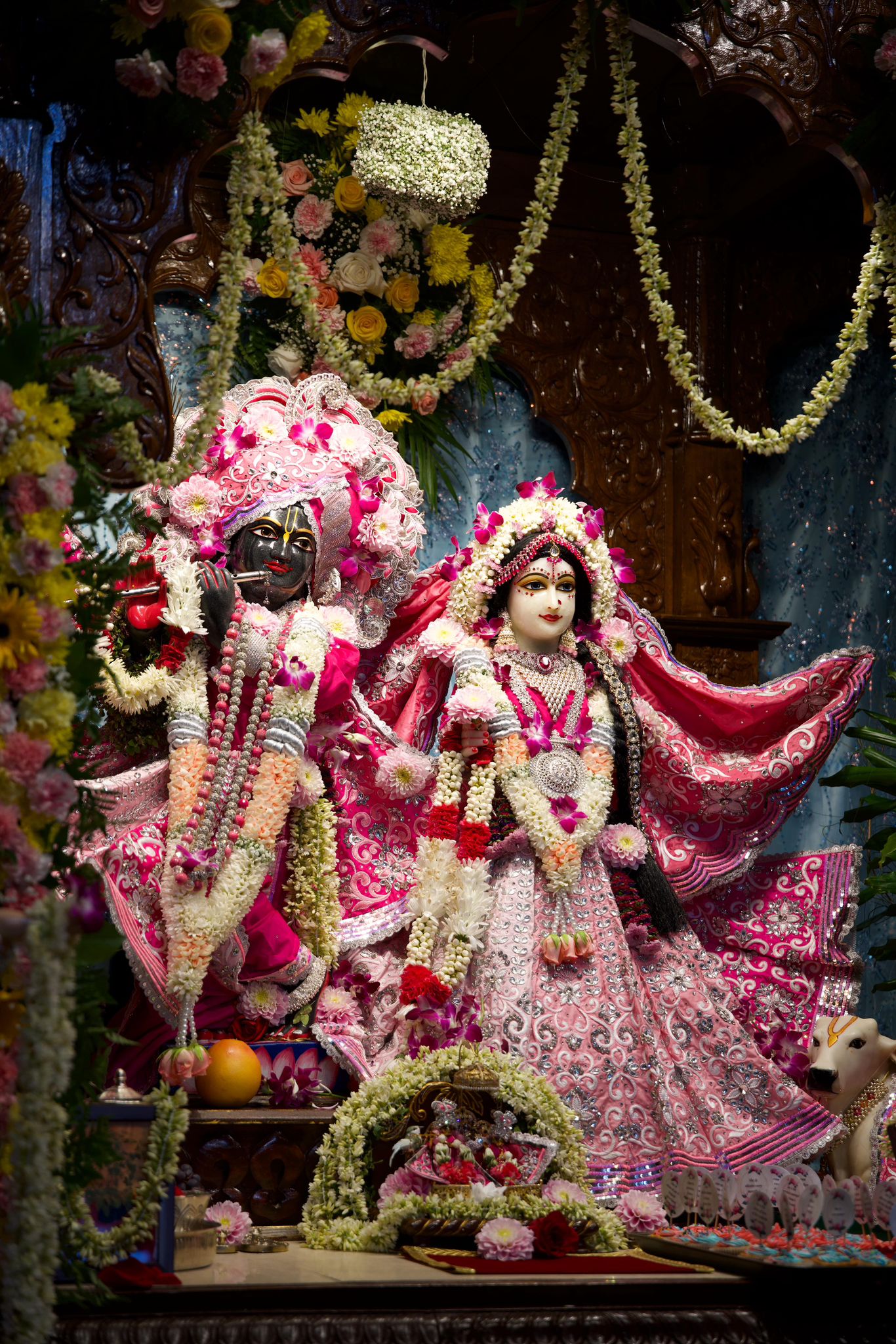
ISKCON Napperville