10 Jul 2013
by The Hare Krishna Movement
in A.C. Bhaktivedanta Swami Prabhupada, Bhagavad-gita, Lectures
Tags: brahman, dvija, golokera prema-dhana, Hayagriva, Jaya Gopala, krsna consciousness, Madhudvisa, prabhupada, sabda-brahma, sound vibration, sound-brahma, Virabhadra

This is a very nice, intimate, lecture on the Bhagavad-gita, given by Srila Prabhupada in the early days. He is obviously in a very good mood, and is challenging his students to use their intelligence.
…Vīrabhadra: And my fourth and last question is, are you in this world?
Prabhupāda: Hm? (laughter)
Vīrabhadra: Are you in this world?
Prabhupāda: I am?
Vīrabhadra: Are you in this world? I mean you, are you…?
Prabhupāda: I’m not in this world, yes.
Vīrabhadra: You’re not in this world.
Prabhupāda: No.
Jaya-gopāla: I thought I heard it said that you are in this world without being a part of it. You are in the world without being a part of it, being a part of it, like the lotus flower which floats on the water.
Prabhupāda: Yes, that is the way. That is the way of understanding. Just like I am in America. It is very easy to understand. I am not adopting any ways of life as the Americans do. So I am not in America. Not only myself, all my disciples who are following me, they are also not Americans. They’re different from American behavior, American ways of life. In that sense I’m not in America. I am in Vṛndāvana because wherever I go in my apartment or in my temple I live with Kṛṣṇa and Kṛṣṇa consciousness. I don’t accept any consciousness of America. And I teach my disciples also to take to that consciousness. So one who takes to that consciousness, he is also not in America, not in this world. It is… I have given this example many times. Just like a king and a bug is sitting on the same throne. The bug is biting and the king is ruling. It is not that because the bug is there on the throne, he is king, or the king is sitting with the bug, he is bug. Why this difference? Difference of consciousness. The king knows his duty. He is working in his duty; therefore he’s king. And the bug knows his business, to bite; therefore he’s bug. But sitting on the same place. But because due to different consciousness, one is bug, one is king. So if you take to Kṛṣṇa consciousness and if you remain in Kṛṣṇa consciousness, you don’t belong to this world. You are no more bug, you are king. Change this consciousness. Even apparently you may seem to remain with the bug, you are no more bug. Is it clear?
Lecture on Bhagavad-gītā 2.46-62
By His Divine Grace A.C. Bhaktivedanta Swami Prabhupada
Recorded December 16, 1968, Los Angeles
Full Lecture More
09 Jul 2013
by The Hare Krishna Movement
in A.C. Bhaktivedanta Swami Prabhupada, Quotes by Srila Prabhupada, Rakshana das
Tags: Gaudiya Vaisnava societies, Rakshana das, saintly association, Sampradaya sun, Srila Prabhupada Quotes, transcendental sound

This very nice compilation of Quotes, compiled by Rakshana Prabhu, appeared today on the Sampradaya Sun. We reprint it here in its entirety.
The Transmission of Transcendental Sound
by Rakshana das
Jul 08, 2013 — AUSTRALIA (SUN)
The quotes contained in this paper are support for the efficacy of the many forms of transcendental sound vibration imparted by the spiritual master and the Lord, especially the vibration of pure Vedic scripture as spoken by Srila Prabhupada. They are not a challenge or alternative to the eternal principle of accepting a ‘bona fide’ spiritual master and surrendering unto him. Nor are they meant to obfuscate the potential for higher understanding and taste experienced in saintly association.
Unfortunately, devotees in some Gaudiya Vaisnava societies believe that transcendental sound cannot be fully potent unless the speaker is physically present within earshot. Of equal concern is the ISKCON strategy of creating ever-new imaginative directives aimed at corralling followers into subservient impotence.
Some of the quotes are well known to quite a few devotees, although repetition of transcendental knowledge is never redundant. These quotes are simply a window toward understanding the glorious variety of spiritual relationships sanctioned by the Lord, and an opportunity to admire the qualities of all genuine devotees, regardless of status of initiation.
More
09 Jul 2013
by The Hare Krishna Movement
in A.C. Bhaktivedanta Swami Prabhupada, Srimad Bhagavatam
Tags: A.C. Bhaktivedanta Swami Prabhupada, codes of religion, dharma, God, jnana, Kali-yuga, knowledge, krsne sva-dhamopagate, Lord Sri Krishna, purana, religion
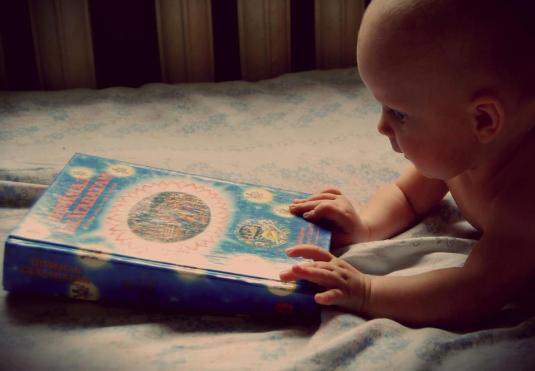
Srimad Bhagavatam
By His Divine Grace A.C. Bhaktivedanta Swami Prabhupada
Canto One, Chapter 3, Text 43
kṛṣṇe sva-dhāmopagate
dharma-jñānādibhiḥ saha
kalau naṣṭa-dṛśām eṣa
purāṇārko ’dhunoditaḥ
kṛṣṇe—in Kṛṣṇa’s; sva-dhāma—own abode; upagate—having returned; dharma—religion; jñāna—knowledge; ādibhiḥ—combined together; saha—along with; kalau—in the Kali-yuga; naṣṭa-dṛśām—of persons who have lost their sight; eṣaḥ—all these; purāṇa-arkaḥ—the Purāṇa which is brilliant like the sun; adhunā—just now; uditaḥ—has arisen.
TRANSLATION
This Bhāgavata Purāṇa is as brilliant as the sun, and it has arisen just after the departure of Lord Kṛṣṇa to His own abode, accompanied by religion, knowledge, etc. Persons who have lost their vision due to the dense darkness of ignorance in the age of Kali shall get light from this Purāṇa.
PURPORT
Lord Śrī Kṛṣṇa has His eternal dhāma, or abode, where He eternally enjoys Himself with His eternal associates and paraphernalia. And His eternal abode is a manifestation of His internal energy, whereas the material world is a manifestation of His external energy. When He descends on the material world, He displays Himself with all paraphernalia in His internal potency, which is called ātma-māyā. In the Bhagavad-gītā the Lord says that He descends by His own potency (ātma-māyā). His form, name, fame, paraphernalia, abode, etc., are not, therefore, creations of matter. He descends to reclaim the fallen souls and to reestablish codes of religion which are directly enacted by Him. Except for God, no one can establish the principles of religion. Either He or a suitable person empowered by Him can dictate the codes of religion. Real religion means to know God, our relation with Him and our duties in relation with Him and to know ultimately our destination after leaving this material body. The conditioned souls, who are entrapped by the material energy, hardly know all these principles of life. Most of them are like animals engaged in eating, sleeping, fearing and mating. They are mostly engaged in sense enjoyment under the pretension of religiosity, knowledge or salvation. They are still more blind in the present age of quarrel, or Kali-yuga. In the Kali-yuga the population is just a royal edition of the animals. They have nothing to do with spiritual knowledge or godly religious life. They are so blind that they cannot see anything beyond the jurisdiction of the subtle mind, intelligence or ego, but they are very much proud of their advancement in knowledge, science and material prosperity. They can risk their lives to become a dog or hog just after leaving the present body, for they have completely lost sight of the ultimate aim of life. The Personality of Godhead Śrī Kṛṣṇa appeared before us just a little prior to the beginning of Kali-yuga, and He returned to His eternal home practically at the commencement of Kali-yuga. While He was present, He exhibited everything by His different activities. He spoke the Bhagavad-gītā specifically and eradicated all pretentious principles of religiosity. And prior to His departure from this material world, He empowered Śrī Vyāsadeva through Nārada to compile the messages of the Śrīmad-Bhāgavatam, and thus both the Bhagavad-gītā and the Śrīmad-Bhāgavatam are like torchbearers for the blind people of this age. In other words, if men in this age of Kali want to see the real light of life, they must take to these two books only, and their aim of life will be fulfilled. Bhagavad-gītā is the preliminary study of the Bhāgavatam. And Śrīmad-Bhāgavatam is the summum bonum of life, Lord Śrī Kṛṣṇa personified. We must therefore accept Śrīmad-Bhāgavatam as the direct representation of Lord Kṛṣṇa. One who can see Śrīmad-Bhāgavatam can see also Lord Śrī Kṛṣṇa in person. They are identical.
09 Jul 2013
by The Hare Krishna Movement
in A.C. Bhaktivedanta Swami Prabhupada, Chanting Hare Krishna, Free Downloads, Free eBooks, On the Way to Krsna
Tags: 2nd Ave., A.C. Bhaktivedanta Swami Prabhupada, chanting Hare Krishna, free ebook, free pdf download, Hare, Hare Krishna, Krishna, meditation, mirror of the mind, On the Way to Krishna, Rama, The Way of Chanting and knowing Krsna, transcendental sound vibration

The following chapter “The Way of Chanting and Knowing Kṛṣṇa” is from one of the small paperback books entitled On The Way to Kṛṣṇa that was printed back in 1973. I always liked these smaller paperback books because I could take them with me wherever I went. For a Free PDF download that you can save or read online follow the link at bottom of post.
On the Way to Kṛṣṇa
By His Divine Grace A. C. Bhaktivedanta Swami Prabhupāda
Chapter Two
More
08 Jul 2013
by The Hare Krishna Movement
in A.C. Bhaktivedanta Swami Prabhupada, Science of Self Realization
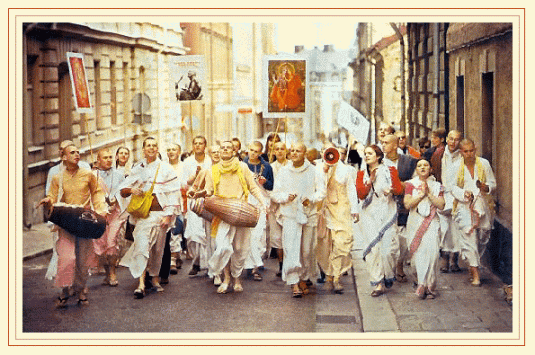
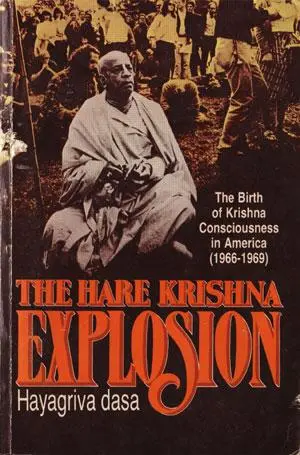
…So by the grace of Lord Caitanya, this movement is already introduced in the Western countries, beginning from New York. Our saṅkīrtana movement was first introduced in New York in 1966. At that time I came and began to chant this Hare Kṛṣṇa mantra in Tompkins Square. I was chanting there for three hours with a small mṛdaṅga (drum), and these American boys assembled and gradually joined, and so it is increasing. First of all it was started in a New York storefront, 26 Second Avenue, then we started our branches in San Francisco, Montreal, Boston, Los Angeles, Buffalo, Columbus. We now [1970] have twenty-four branches, including one in London and one in Hamburg. In London they are all American boys and girls, and they are preaching. (Srila Prabhupada from The Science of Sef Realization)
More
07 Jul 2013
by The Hare Krishna Movement
in Bhaktisiddhanta Sarasvati Thakura, Bhaktivinoda Thakura, Photos
Tags: Ananda-candra datta, Bhaktivinoda Thakur, Bimala Prasad, Brinagar, jagat-mohini, Kedaranatha, Nadia district, Srila Bhaktisiddhanta, Srila Bhaktivinoda Thakura, Srila Prabhupada
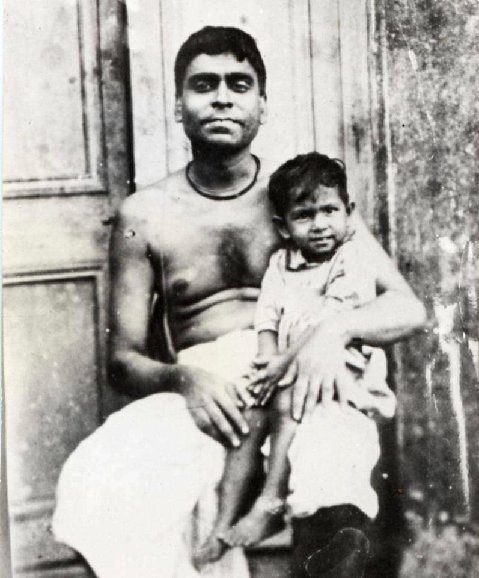
Today as we honor the disappearance of Srila Bhaktivinoda Thakura with a 1/2 day fast and readings on his life and teachings, we share with you this rare photo.
This is a photo of young Srila Bhaktivinoda Thakura, who was then known by his family name of Kedaranatha (which was the name given by his father, and is another name for Lord Siva), and was born on September 2nd, 1838, on a Sunday in the ancient village of Brinagar (Ulagram or Ula) located in the Nadia district of West Bengal. He was the third son of Ananda-candra Datta and Jagat-mohini Devi. He is pictured here, with I believe, young Bimala Prasad, who was latter to become Srila Bhaktisiddhanta Sarasvati, the spiritual master of our Srila Prabhupada.
07 Jul 2013
by The Hare Krishna Movement
in Bhaktivinoda Thakura, Sri Nama-kirtana
Tags: best dancer in vrndavana, braja-baro-nagara, chanting Hare Krishna, gokula-ranjana kana, gopi-prana-dhana, kirtana, madana-manohara, nama, nama-kirtana, names of krishna, son of mother yasoda, Songs of the Vaisnava Acaryas, Sri Nama-kirtana, Srila Bhaktivinoda Thakur, yasomati-nandana

click on image to enlarge
In honor of the disappearance day celebration of Srila Bhaktivinoda Thakura, we are posting one of his famous songs, entitled “Śrī Nāma-kīrtana”.
Krishna is very pleased when we call on Him by His Names, which are associated with His devotees, qualities and pastimes. This song by Bhaktivinoda Thakura is composed of the Nanes of Krsna in different aspects. (from the Songs of the Vaisnava Acaryas)
Śrī Nāma-kīrtana
Chanting of the Holy Names
by Srila Bhaktivinoda Thakura
full song with synonyms and translations More
05 Jul 2013
by The Hare Krishna Movement
in A.C. Bhaktivedanta Swami Prabhupada, Spiritual World, Teachings of Lord Chaitanya
Tags: A.C. Bhaktivedanta Swami Prabhupada, Aniruddha, Damodara, devotees, four-handed, Hrsikesa, Krsna, Madhava, Madhusudana, Narayana, Padmanabha, prabhava form, Pradyumna, Sankarsana, spiritual sky, Sridhara, Teachings of Lord Chaitanya, Trivikrama, universe, vaisnava calendar, Vamana, Vasudeva, vilasa-murti, Visnu

click on image
Sometime back I ran across this picture and saved it to my files thinking I could use it in a post someday. While posting this chapter from the Teachings of Lord Caintanya, entitled “Unlimited Forms of Godhead”, I was looking for an image to use. So I selected the above image and to my surprise when I clicked on it, it moved. I had forgotten how cheesy cool this image was, and why it captured my interest, back when I saved it. So we share it today with our readers, and thank the unknown artist who put this picture to life.
…The different forms of Kṛṣṇa are distributed throughout the universe to give pleasure to the devotees. It is not that devotees are born only in India. There are devotees in all parts of the world, but they have simply forgotten their identity. These forms incarnate not only to give pleasure to the devotee but to reestablish devotional service and perform other activities which vitally concern the Supreme Personality of Godhead.
Teachings of Lord Chaintanya
By His Divine Grace A.C. Bhaktivedanta Swami Prabhupada
Chapter Seven
More
04 Jul 2013
by The Hare Krishna Movement
in A.C. Bhaktivedanta Swami Prabhupada, Back to Godhead, Conversation with Srila Prabhupada
Tags: 4th of July, A.C. Bhaktivedanta Swami Prabhupada, American Independence, Back to Godhead Magazine, BTG, Dependence on God, Independence day, life liberty and the pursuit of happiness, RDTSKP, transcendental literature

I remember as a younger man, back in 1976, when I was a member of the Radha Damodar Traveling Sankirtan Party (RDTSKP), I was in Washington D.C. distributing this very same issue of Back to Godhead Magazine. The thing about Transcendental Literature, is it remains ever fresh. 37 years later this article is still as important and significant as the day it was first published in Back to Godhead Magazine.
Declaring Our Dependence on God
Excerpted from Back to Godhead Magazine Vol. 11, No. 7, 1976
Two hundred years ago, Americans fought the War of Independence to assure life, liberty, and happiness in a fledgling nation. In a conversation with the BACK TO GODHEAD staff, His Divine Grace A.C. Bhaktivedanta Swami Prabhupada explains that Americans can actually achieve these things only by maintaining a God conscious society, with God conscious leaders.
More
03 Jul 2013
by The Hare Krishna Movement
in A.C. Bhaktivedanta Swami Prabhupada
Tags: A.C. Bhaktivedanta Swami Prabhupada, Arjuna, bhakta, devotion, devotional service, Gita, impersonal, impersonal Brahman, impersonalists, karmi, Krishna, Krsna, meditation, personalists, spiritual realization, spiritual sky, unmanifested, yogi

In this 12th chapter of the Bhagavad-gita As It Is entitled Devotional Service, the path of liberation is explained…
For one who worships Me, giving up all his activities unto Me and being devoted to Me without deviation, engaged in devotional service and always meditating upon Me, who has fixed his mind upon Me, O son of Pṛthā, for him I am the swift deliverer from the ocean of birth and death.
Also a nice description of the qualities of a devotee are given…
One who is not envious but who is a kind friend to all living entities, who does not think himself a proprietor, who is free from false ego and equal both in happiness and distress, who is always satisfied and engaged in devotional service with determination and whose mind and intelligence are in agreement with Me—he is very dear to Me.
Full Chapter More
02 Jul 2013
by The Hare Krishna Movement
in A.C. Bhaktivedanta Swami Prabhupada, Maharaja Pariksit, Spiritual Master, Srila Prabhupada's Books, Srimad Bhagavatam, Sukadeva Goswami
Tags: A.C. Bhaktivedanta Swami, at time of death, hear chant and remember, Maharaja Pariksit, perfection of life, segue, self realization, Srimad Bhagavatam, Sukadeva Goswami

This morning I was marveling at how beautifully Srila Prabhupada segues [def: an uninterrupted transition from one song to another. 2. go on without a pause.] from the First Canto of the Srimad Bhagavatam into the Second Canto. This Srimad Bhagavatam, is truly one of the most amazing books in existence today!
You are the spiritual master of great saints and devotees. I am therefore begging you to show the way of perfection for all persons, and especially for one who is about to die. (SB 1.19.37)
Please let me know what a man should hear, chant, remember and worship, and also what he should not do. Please explain all this to me. (SB 1.19.38)
Śrī Sūta Gosvāmī said: The King thus spoke and questioned the sage, using sweet language. Then the great and powerful personality, the son of Vyāsadeva, who knew the principles of religion, began his reply… (SB 1.19.40) [End of First Canto]
[Start of Second Canto]…Śrī Śukadeva Gosvāmī said: My dear King, your question is glorious because it is very beneficial to all kinds of people. The answer to this question is the prime subject matter for hearing, and it is approved by all transcendentalists. (SB 2.1.1)
…That very Śrīmad-Bhāgavatam I shall recite before you because you are the most sincere devotee of Lord Kṛṣṇa. One who gives full attention and respect to hearing Śrīmad-Bhāgavatam achieves unflinching faith in the Supreme Lord, the giver of salvation. (SB 2.1.10)
Unless one is perfectly anxious to inquire about the way of perfection, there is no necessity of approaching a spiritual master. A spiritual master is not a kind of decoration for a householder. Generally a fashionable materialist engages a so-called spiritual master without any profit. The pseudo spiritual master flatters the so-called disciple, and thereby both the master and his ward go to hell without a doubt. Mahārāja Parīkṣit is the right type of disciple because he puts forward questions vital to the interest of all men, particularly for the dying men. The question put forward by Mahārāja Parīkṣit is the basic principle of the complete thesis of Śrīmad-Bhāgavatam. Now let us see how intelligently the great master replies. (from purport to SB 1.19.37)
Full translation and purports More
Next Newer Entries





 The Hare Krishna Movement