29 Jan 2012
by The Hare Krishna Movement
in Kali Yuga, Srimad Bhagavatam
Tags: A.C. Bhaktivedanta Swami Prabhupada, age of quarrel, devotees, Kali, Kali-yuga, Naimisaranya, SB 1.1.10, spiritual master, Srimad Bhagavatam

One day after finishing their morning duties by burning a sacrificial fire and respectfully offering a seat to Srila Suta Goswami. the great sages, headed by Saunaka Rsi, earnestly addressed him: “Respected Suta Goswami, you are completely free from all vice. You are well versed in all the scriptures famous for religious life, and in the Puranas and the histories as well, for you have gone through them under proper guidance and have also explained them. Being the eldest learned Vedantist, O Suta Goswami, you are acquainted with the knowledge of Vyasadeva, who is the incarnation of Godhead, and you also know other sages who are fully versed in all kinds of physical and metaphysical knowledge. And because you are submissive, your spiritual masters have endowed you with all the favors estowed upon a gentle disciple. Therefore you can tell us all that you have scientifically learned from them”
Srimad Bhagavatam
By His Divine Grace A.C. Bhaktivedanta Swami Prabhupada
Canto 1, Chapter 1, Text 10
prāyeṇālpāyuṣaḥ sabhya
kalāv asmin yuge janāḥ
mandāḥ sumanda-matayo
manda-bhāgyā hy upadrutāḥ
prāyeṇa—almost always; alpa—meager; āyuṣaḥ—duration of life; sabhya—member of a learned society; kalau—in this age of Kali (quarrel); asmin—herein; yuge—age; janāḥ—the public; mandāḥ—lazy; sumanda-matayaḥ—misguided; manda-bhāgyāḥ—unlucky; hi—and above all; upadrutāḥ—disturbed.
O learned one, in this iron age of Kali men have but short lives. They are quarrelsome, lazy, misguided, unlucky and, above all, always disturbed.
The devotees of the Lord are always anxious for the spiritual improvement of the general public. When the sages of Naimiṣāraṇya analyzed the state of affairs of the people in this age of Kali, they foresaw that men would live short lives. In Kali-yuga, the duration of life is shortened not so much because of insufficient food but because of irregular habits. By keeping regular habits and eating simple food, any man can maintain his health. Overeating, over-sense gratification, overdependence on another’s mercy, and artificial standards of living sap the very vitality of human energy. Therefore the duration of life is shortened.
The people of this age are also very lazy, not only materially but in the matter of self-realization. The human life is especially meant for self-realization. That is to say, man should come to know what he is, what the world is, and what the supreme truth is. Human life is a means by which the living entity can end all the miseries of the hard struggle for life in material existence and by which he can return to Godhead, his eternal home. But, due to a bad system of education, men have no desire for self-realization. Even if they come to know about it, they unfortunately become victims of misguided teachers.
More
17 Jan 2012
by The Hare Krishna Movement
in Krishna, Krishna Consciousness, Spiritual World, Srimad Bhagavatam
Tags: A.C. Bhaktivedanta Swami Prabhupada, brahmanas, chariots, conchshells, elephants, Krishna, Krsna enters Dwaraka, Lord Krishna, lotus flowers, Srimad Bhagavatam, The Supreme Personality of Godhead, unbroken seeds, Vedic hymns
Srimad Bhagavatam
By His Divine Grace A.C. Bhaktivedanta Swami Prabhupada
Canto 1, Chapter 11
Lord Kṛṣṇa’s Entrance into Dvārakā
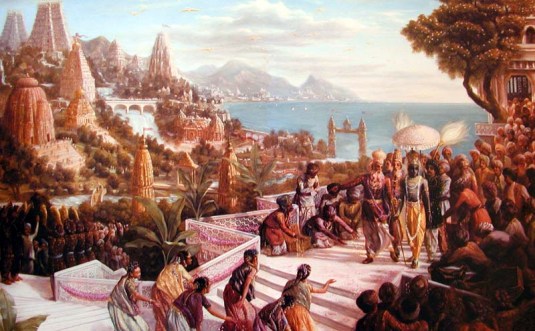
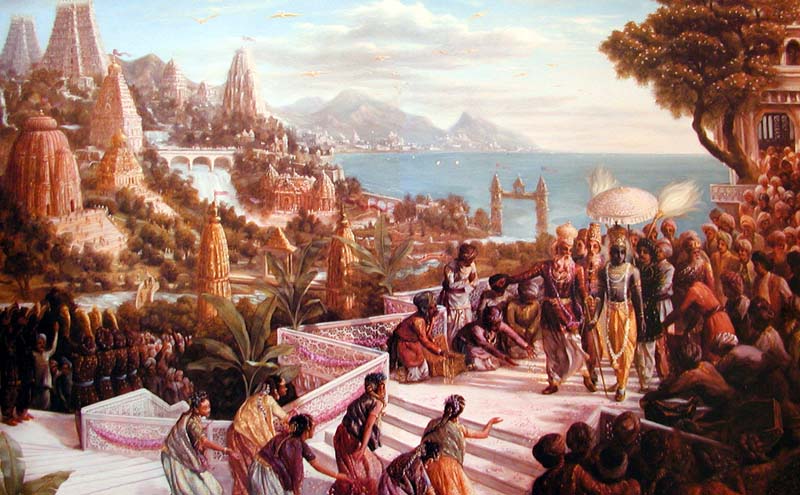
While entering the city of Dvaraka, Lord Krishna acknowledged all the inhabitants’ by casting His transcendental glance over them. The city was filled with the opulences of all seasons. There were hermitages, orchards, flower gardens, parks and reservoirs of water filled with lotus flowers. The highways, subways, lanes, markets and public meeting places were all thoroughly cleansed and then moistened with scented water, And to welcome the Lord, the residents of Dvaraka strew flowers, fruits and unbroken seeds everywhere. The residents hastened toward the Lord on chariots, upon which rode brahmanas bearing flowers, In front of the chariots were elephants, which are emblems of good fortune. Conchshells and bugles were sounded, and Vedic hymns were chanted. Thus, the residents offered their respects, which were saturated with affection, In return, Lord Krishna, the Personality of Godhead, approached them and offered due honor and respect to each and every one of the friends, relatives, citizens and others who came to receive and welcome Him. As the Lord passed along the public road of Dvaraka, His head was protected from sunshine by a white umbrella. White feathered fans moved in semicircles, and showers of flowers fell upon the road. His yellow garments and garlands of flowers made it appear as if a dark cloud were surrounded simultaneously by the sun, the moon, lighting and rainbows.
Lord Kṛṣṇa’s attraction is so powerful that once being attracted by Him one cannot tolerate separation from Him. Why is this so? Because we are all eternally related with Him as the sun rays are eternally related with the sun disc. The sun rays are molecular parts of the solar radiation. Thus the sun rays and the sun cannot be separated. The separation by the cloud is temporary and artificial, and as soon as the cloud is cleared, the sun rays again display their natural effulgence in the presence of the sun. Similarly, the living entities, who are molecular parts of the whole spirit, are separated from the Lord by the artificial covering of māyā, illusory energy. This illusory energy, or the curtain of māyā, has to be removed, and when it is so done, the living entity can see the Lord face to face, and all his miseries are at once removed. Every one of us wants to remove the miseries of life, but we do not know how to do it. The solution is given here, and it rests on us to assimilate it or not. (Srimad Bhagavatam 1.11.10 Purport)
Painting by-Ramadasa Abhirama dasa
13 Jan 2012
by The Hare Krishna Movement
in A.C. Bhaktivedanta Swami Prabhupada, Devotee's, Lectures, Srimad Bhagavatam
Tags: Ajamila, devotees, Lectures by Srila Prabhupada, Narayana, SB 6.1.28-29, sinful persons, Srila Prabhupada, Srimad Bhagavatam, Visnudutas, Yamaduta, Yamaraja

“At the time of his death the sinful Ajamila saw three awkward persons with deformed bodily features, fierce, twisted faces, and hair standing erect on their bodies. With ropes in their hands, they had come to take him away to the abode of Yamaraja. When he saw them he was extremely bewildered, and because of attachment to his child, Narayana, who was playing a short distance away, Ajamila began to cal him loudly by his name. Thus with tears in his eyes he somehow or other chanted the holy name of Narayana. the order carriers of Visnu, the Visnudutas, immediately arrived when when they heard the holy name of their master from the mouth of the dying Ajamila. The order carriers of Yamaraja were snatching the soul from the core of the heart of Ajamila, the husband of the prostitute, but with resounding voices the messengers of Lord Visnu, the Visnudutas, forbade them to do so” (from Srimad Bhagavatam 6.1.27-29)
Srimad Bhagavatam Lectures
By His Divine Grace A.C. Bhaktivedanta Swami Prabhupada
SB 6.1.28-29 May 28, 1975 Honolulu
Pradyumna: Translation: “Ajāmila then saw three awkward persons with deformed bodily features, fierce, twisted faces, and hair standing erect on their bodies. With ropes in their hands they had come to take him away to the abode of Yamarāja. When he saw them he was extremely bewildered, and because of attachment to his child, who was playing a short distance away, Ajāmila began to call him loudly by his name. Thus, with tears in his eyes, he somehow or other chanted the holy name of Nārāyaṇa.” [SB 6.1.28-29]
Prabhupāda: Sa pāśa-hastāṁs trīn dṛṣṭvā puruṣān ati-dāruṇān. So, at the time of death there are so many disturbance. We have got experience, but you have forgot because bhūtvā bhūtvā pralīyate [Bg. 8.19]. But these things are observed by the sinful person. The Yamadūta, they come to take to the sinful, sinful person, not devotees. Just like the whole population of the city, they are not all subjected to the prison laws. Some criminals. Similarly, this Yamadūta goes to such sinful persons. They are not all. But it is the question of Ajāmila… He was so sinful that automatically the Yamadūtas came, and they wanted to take him.
full lecture More
12 Jan 2012
by The Hare Krishna Movement
in Krishna, Teachings of Queen Kunti
Tags: A.C. Bhaktivedanta Swami Prabhupada, Krsna, kunty uvaca, Srimad Bhagavatam, Srimati Kuntidevi, Teachings of Queen Kunti, The Original Person
Teachings of Queen Kunti
By His Divine Grace A.C. Bhaktivedanta Swami Prabhupada
Chapter 1, The Original Person
kunty uvāca
namasye puruṣaṁ tvādyam
īśvaraṁ prakṛteḥ param
alakṣyaṁ sarva-bhūtānām
antar bahir avasthitam
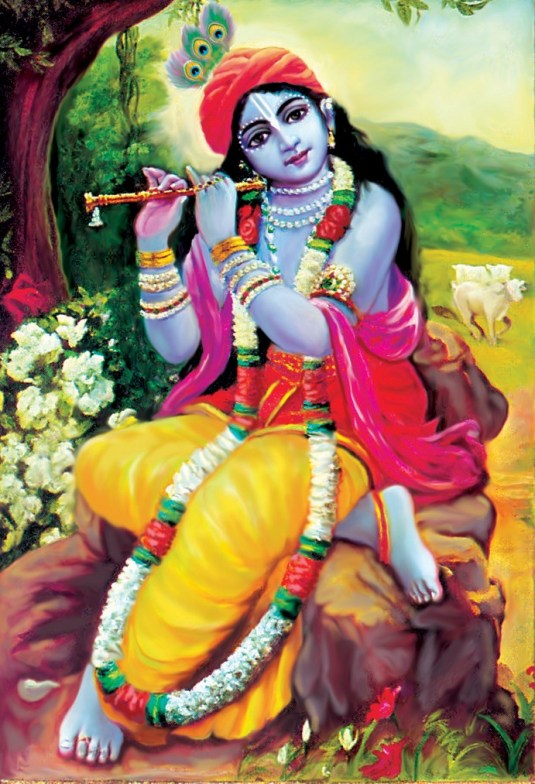
Śrīmatī Kuntī said: O Kṛṣṇa, I offer my obeisances unto You because You are the original personality and are unaffected by the qualities of the material world. You are existing both within and without everything, yet You are invisible to all. —Śrīmad-Bhāgavatam 1.8.18
Śrīmatī Kuntīdevī was quite aware that Kṛṣṇa is the original Personality of Godhead, although He was playing the part of her nephew. Such an enlightened lady could not commit a mistake by offering obeisances unto her nephew. Therefore, she addressed Him as the original puruṣa beyond the material cosmos. Although all living entities are also transcendental, they are neither original nor infallible. The living entities are apt to fall down under the clutches of material nature, but the Lord is never like that. In the Vedas, therefore, He is described as the chief among all living entities (nityo nityānāṁ cetanaś cetanānām). Then again He is addressed as īśvara, or the controller. The living entities or the demigods like Candra and Sūrya are also to some extent īśvara, but none of them is the supreme īśvara, or the ultimate controller. Kṛṣṇa is the parameśvara, or the Supersoul. He is both within and without. Although He was present before Śrīmatī Kuntī as her nephew, He was also within her and everyone else. In the Bhagavad-gītā (15.15) the Lord says, “I am situated in everyone’s heart, and only due to Me one remembers, forgets, and is cognizant, etc. Through all the Vedas I am to be known because I am the compiler of the Vedas, and I am the teacher of the Vedānta.” Queen Kuntī affirms that the Lord, although both within and without all living beings, is still invisible. The Lord is, so to speak, a puzzle for the common man. Queen Kuntī experienced personally that Lord Kṛṣṇa was present before her, yet He entered within the womb of Uttarā to save her embryo from the attack of Aśvatthāmā’s brahmāstra. Kuntī herself was puzzled about whether Śrī Kṛṣṇa is all-pervasive or localized. In fact, He is both, but He reserves the right of not being exposed to persons who are not surrendered souls. This checking curtain is called the māyā energy of the Supreme Lord, and it controls the limited vision of the rebellious soul. It is explained as follows.
03 Jan 2012
by The Hare Krishna Movement
in Srila Prabhupada, The Hare Krishna Movement
Tags: Bhagavad=gita, Founder Acarya of the International Society for Krishna Consciousness, His Divine Grace A.C. Bhaktivedanta Swami Prabhupada, Krishna, Sri Caitanya, Srila Prabhupada, Srimad Bhagavatam, The Hare Krishna Movement

…Krishna says in the Bhagavad-gita, “one who teaches this most confidential knowledge to others is very dear to Me.” Through his translations of Vedic texts such as the Bhagavad-gita, Srimad Bhagavatam, and the Sri Chaitanya-caritamrita, Srila Prabhupada taught others the instructions of Lord Krishna in a way that was understandable to all…
Srila Prabhupada is a Friend to All
Author unknown
His Divine Grace A.C. Bhaktivedanta Swami, more affectionately known as Srila Prabhupada, is the Founder Acarya of the International Society for Krishna Consciousness, ISKCON, or more popularly known as The Hare Krishna Movement. The movement was inaugurated in India by Lord Caitanya almost five hundred years ago. The age that we currently live in is full of quarrel and dissent and the only means of self-realization is through the constant chanting of the holy name of God.
The Hare Krishna mantra, “Hare Krishna, Hare Krishna, Krishna Krishna, Hare Hare, Hare Rama, Hare Rama, Rama Rama, Hare Hare”, is found in the ancient scriptures of India, and is the most powerful of mantras in this age since it directly addresses God and His energy in a loving way. Lord Chaitanya freely distributed this mantra to all of India through congregational chanting. Srila Prabhupada, a spiritual master in the disciplic succession descending from Lord Chaitanya, preached this same movement in the mid 1960s beginning in America and eventually spreading throughout the world.
More
29 Dec 2011
by The Hare Krishna Movement
in Srimad Bhagavatam, Teachings of Queen Kunti
Tags: ancient India, BBT, His Divine Grace A.C. Bhaktivedanta Swami Prabhupada, Indias's grand epic poem, King Pandu, Kunti, Kuruksetra War, Mahabharata, Pandavas, Srimad Bhagavatam, Teachings of Queen Kunti

We begin a new series by offering the Teachings of Queen Kunti in weekly installments. We begin today with the Introduction to this wounderful book.
As they appear in the First Canto of the Bhāgavatam, Queen Kuntī’s celebrated prayers consist of only twenty-six couplets (verses 18 through 43 of the Eighth Chapter), yet they are considered a philosophical, theological, and literary masterpiece. The present book (Teachings of Queen Kuntī) includes those inspired verses and illuminating commentary by His Divine Grace A. C. Bhaktivedanta Swami Prabhupāda, Founder-Ācārya of the International Society for Krishna Consciousness and the most renowned Vedic scholar and spiritual leader of our time. In addition to this commentary (originally written in 1962), Teachings of Queen Kuntī contains further explanations that Śrīla Prabhupāda gave more recently in an absorbing series of lectures. In those memorable talks, delivered in the spring of 1973 at ISKCON’s Western world headquarters in Los Angeles, he analyzed the verses in significantly greater detail and shed even more light upon them.
Teachings of Queen Kuntī By His Divine Grace A.C. Bhaktivedanta Swami Prabhupada
Introduction
The tragic and heroic figure of Queen Kuntī emerges from an explosive era in the history of ancient India. As related in theMahābhārata, India’s grand epic poem of 110,000 couplets, Kuntī was the wife of King Pāṇḍu and the mother of five illustrious sons known as the Pāṇḍavas. As such, she was one of the central figures in a complex political drama that culminated fifty centuries ago in the Kurukṣetra War, a devastating war of ascendancy that changed the course of world events. The Mahābhārata describes the prelude to the holocaust as follows:
More
27 Dec 2011
by The Hare Krishna Movement
in Krishna Consciousness, KRSNA The Supreme Personality of Godhead, Uncategorized
Tags: charitable, His Divine Grace A.C. Bhaktivedanta Swami Prabhupada, Krsna The Supreme Personality of Godhead, Lord Caitanya, Lord Krsna, medicinal extracts, noble, pious trees, shade, Srimad Bhagavatam, tolerant, trees of Vrndavana

They have dedicated their lives to the welfare of others. They are the perfect example of noble life.
One may take excellent lessons from the pious trees, who offer innumerable benefits, such as fruits, flowers, cooling shade and medicinal extracts. Even when a tree is suddenly cut down and dragged away, the tree does not protest but continues to give service to others in the form of firewood. Thus, one should become the disciple of such magnanimous trees and learn from them the qualities of saintly conduct. (Srimad Bhagavatam)
Taking shelter of the shade of the trees, Kṛṣṇa became very happy. While walking He began to address the inhabitants of Vṛndāvana. “My dear Stokakṛṣṇa, My dear Varūthapa, My dear Bhadrasena, My dear Sudāmā, My dear Subala, My dear Arjuna, My dear Viśāla, My dear Ṛṣabha–just look at these most fortunate trees of Vṛndāvana. They have dedicated their lives to the welfare of others. Individually they are tolerating all kinds of natural disturbances, such as hurricanes, torrents of rain, scorching heat and piercing cold, but they are very careful to relieve our fatigues and give us shelter. My dear friends, I think they are glorified in this birth as trees. They are so careful to give shelter to others that they are like noble, highly elevated charitable men who never deny charity to one who approaches them. No one is denied shelter by these trees. They supply various kinds of facilities to human society, such as leaves, flowers, fruit, shade, roots, bark, flavor extracts and fuel. They are the perfect example of noble life. They are like a noble person who has sacrificed everything possible–his body, mind, activities, intelligence and words–in engaging in the welfare of all living entities.”
More
17 Nov 2011
by The Hare Krishna Movement
in Chanting Hare Krishna, Lectures
Tags: Bombay Pandal, chanting Hare Krishna, Hare Krishna Movement, self realization, Srimad Bhagavatam, Supreme Personality of Godhead

The Hare Krishna Movement
“Bombay Pandal Lecture”
By Srila Prabhupada
Bombay, April 6, 1971:
Ladies and gentlemen, we are very much thankful to you for your kindly participating in this great movement, Hare Krishna.
This Hare Krishna Movement is especially meant for this age because for self-realization, although there are many methods recommended in Vedic scriptures, in this age the greatest common factor for self-realization is simply chanting this Hare Krishna mantra.
Actually, our miserable condition of life is due to our forgetfulness. As I said yesterday, day before yesterday, this material existence is a condemned position of the living entities, exactly like a criminal is placed in the prisonhouse. Now, the whole Vedic literature is meant for getting us liberated from this condition of life. So far Bhagavad-gita is concerned, the same aim is there because at the ultimate instruction, Lord Krishna says, sarva-dharman parityajya mam ekam saranam vraja [Bg. 18.66].
More
14 Nov 2011
by The Hare Krishna Movement
in Srimad Bhagavatam
Tags: dharma, Divinty and Divine Service, His Divine Grace A.C. Bhaktivedanta Swami Prabhupada, SB 1.2.6, Srimad Bhagavatam, supreme occupation

…the root meaning of the word dharma is “that which sustains one’s existence.” A living being’s sustenance of existence is to coordinate his activities with his eternal relation with the Supreme Lord Kṛṣṇa
Srimad Bhagavatam
By His Divine Grace A. C. Bhaktivedanta Swami Prabhupada
Canto 1, Chapter 2, Text 6
sa vai puṁsāṁ paro dharmo
yato bhaktir adhokṣaje
ahaituky apratihatā
yayātmā suprasīdati
saḥ—that; vai—certainly; puṁsām—for mankind; paraḥ—sublime; dharmaḥ—occupation; yataḥ—by which; bhaktiḥ—devotional service; adhokṣaje—unto the Transcendence; ahaitukī—causeless; apratihatā—unbroken; yayā—by which; ātmā—the self; suprasīdati—completely satisfied.
The supreme occupation [dharma] for all humanity is that by which men can attain to loving devotional service unto the transcendent Lord. Such devotional service must be unmotivated and uninterrupted to completely satisfy the self.
Purport
In this statement, Śrī Sūta Gosvāmī answers the first question of the sages of Naimiṣāraṇya. The sages asked him to summarize the whole range of revealed scriptures and present the most essential part so that fallen people or the people in general might easily take it up. The Vedas prescribe two different types of occupation for the human being. One is called the pravṛtti-mārga, or the path of sense enjoyment, and the other is called the nivṛtti-mārga, or the path of renunciation. The path of enjoyment is inferior, and the path of sacrifice for the supreme cause is superior. The material existence of the living being is a diseased condition of actual life. Actual life is spiritual existence, or brahma-bhūta [SB 4.30.20] existence, where life is eternal, blissful and full of knowledge. Material existence is temporary, illusory and full of miseries. There is no happiness at all. There is just the futile attempt to get rid of the miseries, and temporary cessation of misery is falsely called happiness. Therefore, the path of progressive material enjoyment, which is temporary, miserable and illusory, is inferior. But devotional service to the Supreme Lord, which leads one to eternal, blissful and all-cognizant life, is called the superior quality of occupation. This is sometimes polluted when mixed with the inferior quality. For example, adoption of devotional service for material gain is certainly an obstruction to the progressive path of renunciation. Renunciation or abnegation for ultimate good is certainly a better occupation than enjoyment in the diseased condition of life. Such enjoyment only aggravates the symptoms of disease and increases its duration. Therefore devotional service to the Lord must be pure in quality, i.e., without the least desire for material enjoyment. One should, therefore, accept the superior quality of occupation in the form of the devotional service of the Lord without any tinge of unnecessary desire, fruitive action and philosophical speculation. This alone can lead one to perpetual solace in His service.
More
08 Nov 2011
by The Hare Krishna Movement
in Srila Prabhupada, Srimad Bhagavatam
Tags: as uttamasloka, great devotees, His Divine Grace A.C. Bhaktivedanta Swami Prabhupada, lotus feet, praised by selected verse, Srimad Bhagavatam
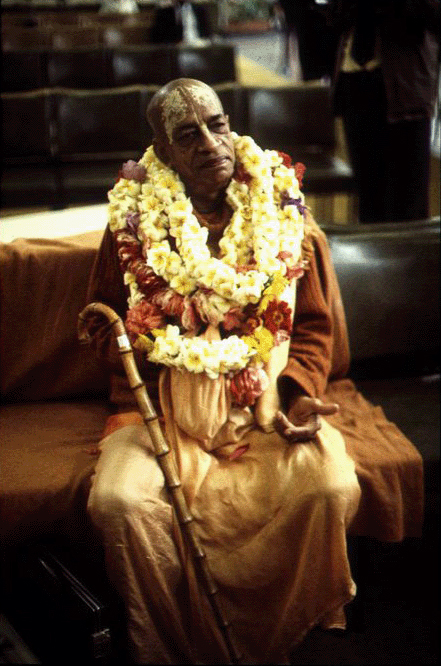
A pure devotee always engages in the service of the Lord, taking shelter of His lotus feet, and therefore he has a direct connection with the saffron mercy-particles that are strewn over the lotus feet of the Lord. Although when a pure devotee speaks the articulation of his voice may resemble the sound of this material sky, the voice is spiritually very powerful because it touches the particles of saffron dust on the lotus feet of the Lord. As soon as a sleeping living entity hears the powerful voice emanating from the mouth of a pure devotee, he immediately remembers his eternal relationship with the Lord, although up until that moment he had forgotten everything.
Srimad Bhagavatam
By His Divine Grace A.C. Bhaktivedanta Swami Prabhupada
Canto 4, Chapter 20, Text 25
sa uttamaśloka mahan-mukha-cyuto
bhavat-padāmbhoja-sudhā kaṇānilaḥ
smṛtiṁ punar vismṛta-tattva-vartmanāṁ
kuyogināṁ no vitaraty alaṁ varaiḥ
saḥ—that; uttama-śloka—O Lord, who are praised by selected verses; mahat—of great devotees; mukha-cyutaḥ—delivered from the mouths; bhavat—Your; pada-ambhoja—from the lotus feet; sudhā—of nectar; kaṇa—particles; anilaḥ—soothing breeze; smṛtim—remembrance; punaḥ—again; vismṛta—forgotten; tattva—to the truth; vartmanām—of persons whose path; ku-yoginām—of persons not in the line of devotional service; naḥ—of us; vitarati—restores; alam—unnecessary; varaiḥ—other benedictions.
My dear Lord, You are glorified by the selected verses uttered by great personalities. Such glorification of Your lotus feet is just like saffron particles. When the transcendental vibration from the mouths of great devotees carries the aroma of the saffron dust of Your lotus feet, the forgetful living entity gradually remembers his eternal relationship with You. Devotees thus gradually come to the right conclusion about the value of life. My dear Lord, I therefore do not need any other benediction but the opportunity to hear from the mouth of Your pure devotee.
It is explained in the previous verse that one has to hear glorification of the Lord from the mouth of a pure devotee. This is further explained here. The transcendental vibration from the mouth of a pure devotee is so powerful that it can revive the living entity’s memory of his eternal relationship with the Supreme Personality of Godhead. In our material existence, under the influence of illusory māyā, we have almost forgotten our eternal relationship with the Lord, exactly like a man sleeping very deeply who forgets his duties. In the Vedas it is said that every one of us is sleeping under the influence of māyā. We must get up from this slumber and engage in the right service, for thus we can properly utilize the facility of this human form of life. As expressed in a song by Ṭhākura Bhaktivinoda, Lord Caitanya says, jīva jāga, jīva jāga. The Lord asks every sleeping living entity to get up and engage in devotional service so that his mission in this human form of life may be fulfilled. This awakening voice comes through the mouth of a pure devotee.
More
29 Oct 2011
by The Hare Krishna Movement
in Festivals, Srila Prabhupada
Tags: disappearance of vaisnavas, Disapperance Day of Srila Prabhupada, Founder Acharya of the International Society of Krishna Consciousness, His Divine Grace A.C. Bhaktivedanta Swami Prabhupada, Lord Krishna's devotee, SB 4.20.25, Srimad Bhagavatam, uttama-sloka
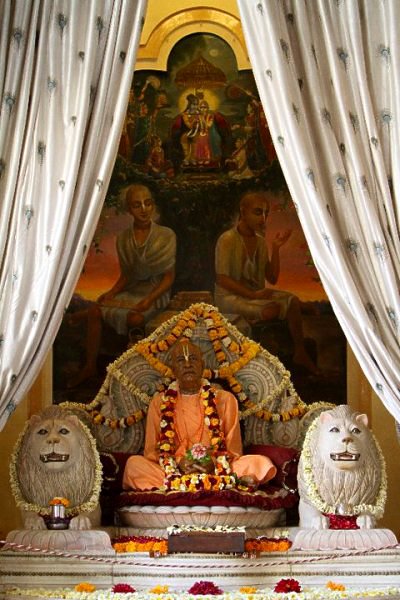
Srila Prabhupada's Vyasasana; Vrindavan India
“He reasons ill that Vaisnavas die when thou art living still in sound. The Vaisnava dies to live, and living spreads the holy name around.”
Today is the Disappearance day of His Divine Grace A.C. Bhaktivedanta Swami Prabhupada. Founder Acharya of the International Society for Krishna Consciousness. Srila Prabhupada had this to say about the disappearance of Vaisnavas
“As Lord Krsna’s appearance and disappearance are all spiritual, transcendental, they are not ordinary things, similarly, Lord Krsna’s devotee, His representative, who is sent to this material world for preaching the glories of Lord Krsna, their appearance and disappearance is also like Krsna’s. Therefore, according to Vaisnava principles, the appearance and disappearance of Vaisnava is considered all-auspicious.”
In honor of Srila Prabhupadas disappearance day we are posting this nice verse from the Srimad Bhagavatam explaining the importance of hearing from a pure devotee.
Opportunity to Hear from the Pure Devotee
Srila Prabhupada’s explanation of the importance of hearing from a pure devotee (Srimad-Bhagavatam 4.20.25):
sa uttamasloka mahan-mukha-cyuto
bhavat-padambhoja-sudha-kananilah
smrtim punar vismrta-tattva-vartmanam
kuyoginam no vitaraty alam varaih
sah—that; uttama-sloka—O Lord, who are praised by selected verses; mahat—of great devotees; mukha-cyutah—delivered from the mouths; bhavat—Your; pada-ambhoja—from the lotus feet; sudha—of nectar; kana—particles; anilah—soothing breeze; smrtim—remembrance; punah—again; vismrta—forgotten; tattva—to the truth; vartmanam—of persons whose path; ku-yoginam—of persons not in the line of devotional service; nah—of us; vitaratialam—unnecessary; varaih—other benedictions.
Translation
My dear Lord, You are glorified by the selected verses uttered by great personalities. Such glorification of Your lotus feet is just like saffron particles. When the transcendental vibration from the mouths of great devotees carries the aroma of the saffron dust of Your lotus feet, the forgetful living entity gradually remembers his eternal relationship with You. Devotees thus gradually come to the right conclusion about the value of life. My dear Lord, I therefore do not need any other benediction but the opportunity to hear from the mouth of Your pure devotee.
More
27 Oct 2011
by The Hare Krishna Movement
in Books by Srila Prabhupada, Devotee's, Remembering Srila Prabhupada, Vyasasan das
Tags: books by Srila Prabhupada, Dreams of Srila Prabhupada, His Divine Grace A.C. Bhaktivedanta Swami Prabhupada, Prahlada Instructs His Demoniac Schoolmates, Srimad Bhagavatam, Vyasasan das

Srila Prabhupada with Seventh Canto of the Srimad Bhagavatam
Where is Vyasasan?
By Vyasasan das Oct. 27, 2011
This morning I had a dream.
Usually I don’t put much importance on dreams, unless it is a spiritual dream; one where my spiritual master His Divine Grace A.C. Bhaktivedanta Swami Prabhupada, is present. Dreams with Srila Prabhupada, I take special notice of, and often write them down before I forget. Such is the case today.
In my dream Srila Prabhupada was about to give Srimad Bhagavatam class. He was about to read from the Seventh Canto, Chapter Six, “Prahlada Instructs His Demoniac Schoolmates”. But before the class began, one devotee announced that after the class instead of us getting the opportunity to ask Srila Prabhupada questions, Srila Prabhupada was going to ask questions of us.
I tried to listen with rapt attention, being fearful Srila Prabhupada would ask me a question afterwards, and expect me to explain.
As soon as the class was concluded and before Srila Prabhupada had a chance to ask his disciples questions, I quickly hid behind one of the columns in the temple, just out of sight of His Divine Grace. I was lamenting that I wished I had spent more time studying Srila Prabhupada’s books. If only I had carefully studied the entire Seventh Canto, memorized the important slokas, and understood the purports to the translations. If only I was a better student and disciple, I wouldn’t have to hide behind this pillar. I was lamenting like this and sweat was forming on my brow when suddenly I heard Srila Prabhupada’s voice.
“Vyasasan.” ” Where is Vyasasan?”
One devotee stood up and announced that I was hiding.
More
18 Oct 2011
by The Hare Krishna Movement
in Bhismadeva, Srimad Bhagavatam
Tags: Bhisma, Bishmadeva, Brahma, His Divine Grace A.C. Bhaktivedanta Swami Prabhupada, Maharaja Yudhisthira, plan of the Lord, Siva, Srimad Bhagavatam, vice cannot conqure virtue
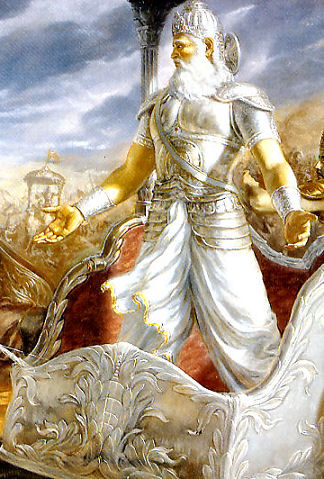
Bhishmadeva
Even a great fighter like Bhīṣma could not win the Battle of Kurukṣetra because the Lord wanted to show that vice cannot conquer virtue, regardless of who tries to execute it.
Srimad-Bhagavatam
By His Divine Grace A.C. Bhaktivedanta Swami Prabhupada
Canto 1″Creation”, Chapter 9, Text 16
The Passing Away of Bhismadeva in the Presence of Lord Krsna
na hy asya karhicid rājan
pumān veda vidhitsitam
yad vijijñāsayā yuktā
muhyanti kavayo ‘pi hi
na—never; hi—certainly; asya—His; karhicit—whatsoever; rājan—O King; pumān—anyone; veda—knows; vidhitsitam—plan; yat—which; vijijñāsayā—with exhaustive inquiries; yuktāḥ—being engaged; muhyanti—bewildered; kavayaḥ—great philosophers; api—even; hi—certainly.
O King, no one can know the plan of the Lord [Śrī Kṛṣṇa]. Even though great philosophers inquire exhaustively, they are bewildered.
The bewilderment of Mahārāja Yudhiṣṭhira over his past sinful acts and the resultant sufferings, etc., is completely negated by the great authority Bhīṣma (one of the twelve authorized persons). Bhīṣma wanted to impress upon Mahārāja Yudhiṣṭhira that since time immemorial no one, including such demigods as Śiva and Brahmā, could ascertain the real plan of the Lord. So what can we understand about it? More
06 Oct 2011
by The Hare Krishna Movement
in Lectures, Spiritual Life, Srimad Bhagavatam
Tags: Krishna, Krishna consciousness, Parikshit Maharaja, Srila Prabhupada, Srimad Bhagavatam, Sukadeva Goswami, Vedic literatures, what is my duty

Chanakya Pandit says that “If you want to make spiritual advancement, then you should always think that “Death is next moment. Death is next moment.”
Excerpt from lecture on Srimad-Bhagavatam
Canto 1, Chapter 4, Text 25, Montreal, June 20, 1968
By His Divine Grace A. C. Bhaktivedanta Swami Prabhupada
Parikshit Maharaja, he was a powerful king. He was equipped with all, everything, but he did not counteract the curse [1]. He could counteract that curse. He was so powerful, but he accepted: “All right. I am cursed. I shall give up my life within seven days.” That means he took it as an opportunity that “I am going to death within seven days. That is certain. And I must prepare myself fully so that my next life I can approach Krishna.” So this is a good opportunity, that “I have got seven days’ time.” We haven’t got seven seconds’ time. We do not know. Nobody has served me notice. We find by practical experience that we are walking on the street—all of a sudden there is some accident, and we die. There is possibility. So the important point is that Maharaja Parikshit was fortunate enough to get seven days’ time before his death. But we do not know how much time is there for our death. So how much serious we shall be. Chanakya Pandit says that “If you want to make spiritual advancement, then you should always think that “Death is next moment. Death is next moment.” Because there is no guarantee when death is coming. If I think that death is next moment, that is not any utopian. The next moment may be my death. And Chanakya Pandit says, “But if you want to be materially happy, you should always think that ‘I shall never die,’ ” although it is false idea. Everyone will die.
More
02 Oct 2011
by The Hare Krishna Movement
in Back to Godhead, Books by Srila Prabhupada, Brahmananda das, Srimad Bhagavatam
Tags: Back to Godhead Magazine, Brahmananda Swami, Srila Prabhupada, Srimad Bhagavatam, The Books of His Divine Grace A. C. Bhaktivedanta Swami Prabhupada

“The words of Srimad-Bhagavatam are Your incarnation, and if people repeatedly hear them in submissive aural reception, then they will be able to understand Your message.”
The Books of His Divine Grace A.C. Bhaktivedanta Swami Prabhupada
Originally published in Back to Godhead No. 52
Bhaktivedanta Book Trust 1973
By Brahmananda Swami ISKCON East Africa
Part 4
In the opening sentences of Srila Prabhupada’s introduction to the Srimad-Bhagavatam, he affirms that the word “God” refers to the supreme controller and that a controller cannot be impersonal. In the first sloka of the Srimad-Bhagavatam, obeisances are offered to the Supreme Personality of Godhead.
om namo bhagavate vasudevaya
om—O my Lord; namah—my respectful obeisances unto You; bhagavate—unto the Personality of Godhead; vasudevaya—unto Lord Krsna, the son of Vasudeva.
O my Lord, the all-pervading Personality of Godhead, I offer my respectful obeisances unto You.
Whereas others have translated the Sanskrit scriptures conveniently to suit their interpretations, Srila Prabhupada always gives word-for-word English equivalents for each Sanskrit verse, and thus the translations cannot be disputed. This is a painstaking process, considering the length of the Srimad-Bhagavatam, but it is in keeping with the heritage of the Gosvamis to present the literature of devotional service authoritatively and scientifically. Furthermore, the English-reading public can easily learn the meanings to the Sanskrit words from this format.
More
28 Sep 2011
by The Hare Krishna Movement
in Book Changes, Letters by Srila Prabhupada, Srila Prabhupada's Books
Tags: bhagavad-gita, book changes, Letters by Srila Prabhupada, Miss Nedungadi, original books, Srimad Bhagavatam
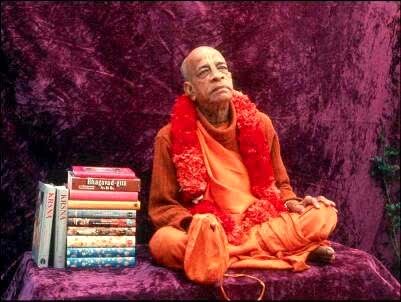
Bombay, Calicut–2, Kerala State,
Friday, 19 March, 1975:
My dear Miss Nedungadi, please accept my greetings. I am in due receipt of your letter dated March 6th, 1975 and have noted the contents.
Thank you so much for your kind appreciations. I am so much grateful that you have enjoyed studying my books. Many young intelligent persons such as yourself are studying these books in the colleges and universities all over the world.
Actually anyone who tries to understand these books will become a great realized devotee of Lord Krishna gradually. The original potency of the sastra remains in these books because I have not added or opinionated anything of my own. I have simply presented the scriptures such as Bhagavad-gita and Srimad-Bhagavatam as they are. Therefore just see the effect they have on the world.
At present, we have about 100 centers worldwide and about 10,000 fully dedicated students in those centers. You are welcome to visit or stay in any of our centers for your spiritual advancement. We have a nice center in Madras: 50, Aspiran Gardens, 2nd St., Kilpauk, Madras–600010. You can get all the books there.
I will be in Bombay at the end of April and beginning of May. So, if you can come then, I shall see you there. In the meantime please correspond with or visit one of our temples.
I hope this meets you in good health.
Your ever well-wisher,
A. C. Bhaktivedanta Svami
ACBS/ps
21 Sep 2011
by The Hare Krishna Movement
in Krsna is the Source of All Incarnations
Tags: A.C. Bhaktivedanta Swami Prabhupada, Asuri Brahmana, Devahuti, fifth incarnation of Visnu, Lord Kapila, metaphysics, Sankhya philosophy, Srimad Bhagavatam

The instructions of Lord Kapila to His mother Devahūti are fully described in the Third Canto (Chapters 25-32) of the Śrīmad-Bhāgavatam, and anyone who follows the instructions can achieve the same liberation obtained by Devahūti. The Lord spoke Bhagavad-gītā, and thereby Arjuna achieved self-realization, and even today anyone who follows the path of Arjuna can also attain the same benefit as Śrī Arjuna. The scriptures are meant for this purpose. Foolish, unintelligent persons make their own interpretations by imagination and thus mislead their followers, causing them to remain in the dungeon of material existence. However, simply by following the instructions imparted by Lord Kṛṣṇa or Lord Kapila, one can obtain the highest benefit, even today.
Srimad-Bhagavatam
By His Divine Grace A.C. Bhaktivedanta Swami Prabhupada
Canto 1, Text 10
“Creation”
Krsna Is the Source of All Incarnations
The fifth incarnation, named Lord Kapila, is foremost among perfected beings. He gave an exposition of the creative elements and metaphysics to Āsuri Brāhmaṇa, for in course of time this knowledge had been lost.
Purport
The sum total of the creative elements is twenty-four in all. Each and every one of them is explicitly explained in the system of Sāṅkhya philosophy. Sāṅkhya philosophy is generally called metaphysics by the European scholars. The etymological meaning of sāṅkhya is “that which explains very lucidly by analysis of the material elements.” This was done for the first time by Lord Kapila, who is said herein to be the fifth in the line of incarnations.
More
21 Sep 2011
by The Hare Krishna Movement
in Back to Godhead, Books by Srila Prabhupada, Brahmananda das
Tags: back to Godhead, bhagavad-gita, Books of His Divine Grace A.C. Bhaktivedanta Swami Prabhupada, Brahmananda Swami, Srimad Bhagavatam
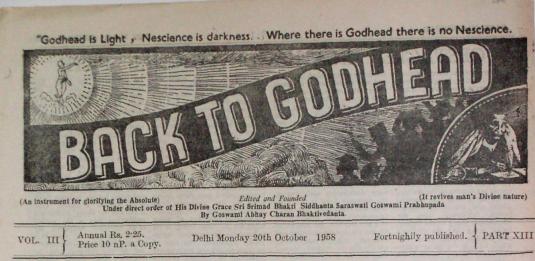
The Books of His Divine Grace A.C. Bhaktivedanta Swami Prabhupada
Originally published in Back to Godhead No. 52
Bhaktivedanta Book Trust 1973
By Brahmananda Swami ISKCON East Africa
Part 3
Back to Godhead contained timely articles, essays, book reviews and selections from full-length works in progress such as the Sri Isopanisad. It should be noted that this paper was entirely the effort of Srila Prabhupada. He wrote all the material, edited it, typed it for the printer and checked the galley proofs. Then he sold the copies. Each fortnight he would take batches of Back to Godhead into Delhi. To save a few cents bus fare he sometimes had to walk for miles, and often he would sit in tea parlors until late at night, himself not even taking a glass of water there, preaching and distributing his paper and collecting one cent per copy.
At this time Srila Prabhupada also wrote outlines of his dream. It was a worldwide association of God conscious devotees who actively preached the eternal religion of love of God in all fields of society at large and who used all the modern means at their disposal. The League of Devotees, the forerunner of the now worldwide ISKCON, the International Society for Krishna Consciousness, was thus formally registered. From international sankirtana parties, to gosalas (cow protection reserves), to authorized teaching of Sanskrit, to a printing press solely for flooding the marketplace with Krsna conscious literature, ISKCON is today the reality of that dream.
More
14 Sep 2011
by The Hare Krishna Movement
in Spiritual World, Srimati Tulasi Devi
Tags: Spiritual world, Srimad Bhagavatam, Srimati Tulasi Devi, Tulasi, tulasi garlands, tulasi leaves

Srimati Tulasi and Sri Sri Radha Vrindavan Chandra
The most important thing about the spiritual world is that there is no envy among the devotees there. This is true even among the flowers, which are all conscious of the greatness of tulasī.
Although flowering plants like the mandāra, kunda, kurabaka, utpala, campaka, arṇa, punnāga, nāgakeśara, bakula, lily and pārijāta are full of transcendental fragrance, they are still conscious of the austerities performed by tulasī, for tulasī is given special preference by the Lord, who garlands Himself with tulasī leaves.
Purport
The importance of tulasī leaves is very clearly mentioned here. Tulasī plants and their leaves are very important in devotional service. Devotees are recommended to water the tulasī tree every day and collect the leaves to worship the Lord. One time an atheistic svāmī remarked, “What is the use of watering the tulasī plant? It is better to water eggplant. By watering the eggplant one can get some fruits, but what is the use of watering the tulasī?” These foolish creatures, unacquainted with devotional service, sometimes play havoc with the education of people in general.
The most important thing about the spiritual world is that there is no envy among the devotees there. This is true even among the flowers, which are all conscious of the greatness of tulasī. In the Vaikuṇṭha world entered by the four Kumāras, even the birds and flowers are conscious of service to the Lord. (Srimad Bhagavatam)
14 Sep 2011
by The Hare Krishna Movement
in A.C. Bhaktivedanta Swami Prabhupada, Krishna Consciousness, Srimad Bhagavatam, Uncategorized, Yoga
Tags: devotee, krsna consciousness, mystic yogi, narayana-para, Srimad Bhagavatam, Surpreme Personality of Godhead, transcendental service of the Lord, yogi

…The real purpose of yogic performances is to control the mind and the senses. In other words, one cannot attain the mercy and benediction of the Supreme Lord until one is able to control the mind and the senses. This is actually possible when one fully engages in Kṛṣṇa consciousness…
Srimad-Bhagavatam
By His Divine Grace A.C. Bhaktivedanta Swami Prabhupada
Canto 3: “The Status Quo”
SB 3.15: Description of the Kingdom of God
There is no defeat in this material world for persons who control the mind and senses by controlling the breathing process and who are therefore experienced, mature mystics. This is because by such perfection in yoga they have attained your mercy.
Purport
The purpose of yogic performances is explained here. It is said that an experienced mystic attains full control of the senses and the mind by controlling the breathing process. Therefore, controlling the breathing process is not the ultimate aim of yoga. The real purpose of yogic performances is to control the mind and the senses. Anyone who has such control is to be understood to be an experienced, mature mystic yogī. It is indicated herein that a yogī who has control over the mind and senses has the actual benediction of the Lord, and he has no fear. In other words, one cannot attain the mercy and benediction of the Supreme Lord until one is able to control the mind and the senses. This is actually possible when one fully engages in Kṛṣṇa consciousness. A person whose senses and mind are always engaged in the transcendental service of the Lord has no possibility of engaging in material activities. The devotees of the Lord are not defeated anywhere in the universe. It is stated, nārāyaṇa-parāḥ sarve: one who is nārāyaṇa-para, or a devotee of the Supreme Personality of Godhead, is not afraid anywhere, whether he is sent to hell or promoted to heaven (Bhāg. 6.17.28).
Pasted from; PrabhupadaBooks.com
Previous Older Entries Next Newer Entries







 The Hare Krishna Movement