Changing Bodies

We Are Not These Bodies, We Are Soul

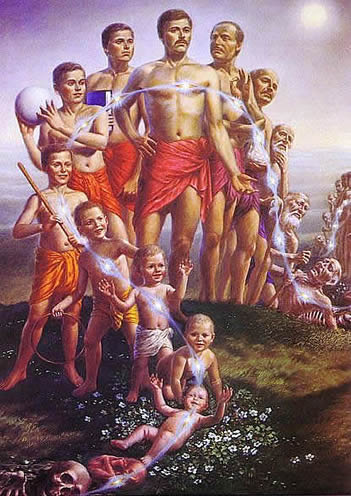
…within this body there is soul, and the body is changing every moment, but the soul is there. Just as a soul comes from the womb of his mother with a small body, and that small body changes—it becomes the body of a boy, it becomes the body of a youth, then it becomes the body of an old man, then it vanquishes… That we have to admit. We may say that the body is growing, but actually, the fact is, body is changing. It is medically admitted that we are changing our body every second. We are changing our blood corpuscles, and therefore a change of the body is taking place, and that is being manifested in a different shape only. Actually, we are changing every moment our body. So the ultimate change, when this body cannot be worked any more, just like a dress, when it is torn, when it is too old, you have to change it. Similarly, when this body becomes useless, no more, it cannot be pulled on any more, you take another body. Tathā dehāntara-prāptir. As we are, in our practical life, we are changing our body every moment, similarly, the last stage of changing this body is called death. Just as I give up this body, I have to enter into the womb of some kind of mother. These things are explained in the Vedic literatures. (Srila Prabhupada from lecture; San Francisco, April 2, 1968)

The soul is eternal, it is changing body, different bodies, and there are 8,400,000 different forms of body. According to his desire, he is entering another body.

…in the hundreds and thousands of universities all over the world there is no department of knowledge where the science of the soul is taught. Actually, we are all spirit soul. From Bhagavad-gītā we understand that we are transmigrating from one body to another, even in our present lives. All of us had at one time the body of a small baby. Where is that body? That body is gone. Presently I am an old man, but I remember that I was once a small baby. I still remember when I was about six months old; I was lying down on the lap of my elder sister, who was knitting, and I was playing. I can remember that, so it is possible for everyone to remember that he had a small body. After the baby’s body I had a boy’s body; then I had a youthful body, and now I am in this body. Where are those bodies? They are gone now. This is a different body. It is explained in Bhagavad-gītā that when I give up this body, I will have to accept another body. It is very simple to understand. I have changed so many bodies, not only from childhood to boyhood to youth, but according to medical science we are changing bodies every second, imperceptibly. This Process indicates that the soul is permanent. Although I have changed many bodies, I remember my baby body and my childhood body—I am the same person, soul. Similarly, when ultimately I change this body, I shall have to accept another. This simple formula is stated in Bhagavad-gītā. Everyone can reflect on it…(Srila Prabhupada from; Krsna Consciousness The Topmost Yoga System)

A person or an animal is not the material body; rather, the material body is the covering of the living being. Bhagavad-gītā compares the body to a dress and elaborately explains how one changes dresses one after another. The same Vedic knowledge is confirmed here. The living being, the soul, is constantly changing bodies one after another. Even in the present life, the body changes from childhood to boyhood, from boyhood to youth, and from youth to old age; similarly, when the body is too old to continue, the living being gives up this body and, by the laws of nature, automatically gets another body according to his fruitive activities, desires and ambitions. The laws of nature control this sequence, and therefore as long as the living entity is under the control of the external, material energy, the process of bodily change takes place automatically, according to one’s fruitive activities.

More

Fix Your Mind Upon the Personality of Godhead

In our previous post Om, Oṁkāra, or the Praṇava, is the Seed of Transcendental Realization Oṁkāra, or the praṇava, which is the seed of transcendental realization, and it is composed of the three transcendental letters a-u-m, was discussed. By its chanting by the mind, in conjunction with the breathing process, was a means of changing the habit of the mind, to bring the mind under control. But in this next verse, Śukadeva Gosvāmī recommends the next step in God Realization, namely to fix one’s mind in the service of the Personality of Godhead.

Gradually, as the mind becomes progressively spiritualized, withdraw it from sense activities, and by intelligence the senses will be controlled. The mind too absorbed in material activities can be engaged in the service of the Personality of Godhead and become fixed in full transcendental consciousness.

More

Our Relationship With God

…As soon as one understands his identity, his relationship with God, then immediately he becomes happy. We are so full of miseries because we have identified ourselves with the material world. Therefore we are unhappy. Anxieties and fearfulness are due to our misidentifying with the material world.

A Lecture Given At Conway Hall, London,
By His Divine Grace A.C. Bhaktivedanta Swami Prabhupada

We Are All Eternal Servitors of Krsna

Today’s subject matter is our relationship with God. That is self-realization. The sankirtana movement is the easiest process for self-realization because it cleanses the heart. Our misunderstanding of our identity is due to the dust covering the mirror of the mind. In a mirror which is covered with dust one cannot see himself. But if it is very clear, then one can see himself. So meditation is a process for cleansing the heart. Meditation means to try to understand one’s relationship with the Supreme.

More

Contents of the Gita Summarized 2A

As this is a very long chapter we are posting it in two parts. Today we are posting text 1-35, and tomorrow we will conclude the chapter entitled “Contents of the Gita Summarized”

Bhagavad-gita As It Is 1972 Macmillan Edition
By His Divine Grace A.C. Bhaktivedanta Swami Prabhupada
Chapter Two, Text and Purports 1-35

Contents of the Gita Summarized

TEXT 1
sañjaya uvāca
taṁ tathā kṛpayāviṣṭam
aśru-pūrṇākulekṣaṇam
viṣīdantam idaṁ vākyam
uvāca madhusūdanaḥ

sañjayaḥ uvāca—Sañjaya said; tam—unto Arjuna; tathā—thus; kṛpayā—by compassion; āviṣṭam—overwhelmed; aśru-pūrṇa—full of tears; ākula—depressed; īkṣaṇam—eyes; viṣīdantam—lamenting; idam—this; vākyam—words; uvāca—said; madhusūdanaḥ—the killer of Madhu.

TRANSLATION

Sañjaya said: Seeing Arjuna full of compassion and very sorrowful, his eyes brimming with tears, Madhusūdana, Kṛṣṇa, spoke the following words.

PURPORT

Material compassion, lamentation and tears are all signs of ignorance of the real self. Compassion for the eternal soul is self-realization. The word “Madhusūdana” is significant in this verse. Lord Kṛṣṇa killed the demon Madhu, and now Arjuna wanted Kṛṣṇa to kill the demon of misunderstanding that had overtaken him in the discharge of his duty. No one knows where compassion should be applied. Compassion for the dress of a drowning man is senseless. A man fallen in the ocean of nescience cannot be saved simply by rescuing his outward dress-the gross material body. One who does not know this and laments for the outward dress is called a śūdra, or one who laments unnecessarily. Arjuna was a kṣatriya, and this conduct was not expected from him. Lord Kṛṣṇa, however, can dissipate the lamentation of the ignorant man, and for this purpose the Bhagavad-gītā was sung by Him. This chapter instructs us in self-realization by an analytical study of the material body and the spirit soul, as explained by the supreme authority, Lord Śrī Kṛṣṇa. This realization is made possible by working with the fruitive being situated in the fixed conception of the real self.

More

Entering the Spiritual Worlds

“Everything in the spiritual world is substantial and original. This material world is only an imitation…. It is just like a cinematographic picture, in which we see only the shadow of the real thing.” In this lecture, delivered in October 1966 in New York City, Śrīla Prabhupāda gives an amazing glimpse into the nature of the spiritual world and some positive instructions on how to arrive there at the end of life’s perilous journey.

The Journey of Self-Discovery
By His Divine Grace A.C. Bhaktivedanta Swami Prabhupada

paras tasmāt tu bhāvo ’nyo
’vyakto ’vyaktāt sanātanaḥ
yaḥ sa sarveṣu bhūteṣu
naśyatsu na vinaśyati

“Yet there is another unmanifest nature, which is eternal and is transcendental to this manifested and unmanifested matter. It is supreme and is never annihilated. When all in this world is annihilated, that part remains as it is.” [Bhagavad-gītā 8.20]

We cannot calculate the length and breadth of even this universe, yet there are millions and millions of universes like this one within the material sky. And above this material sky there is another sky, which is called the spiritual sky. In that sky all the planets are eternal, and life is eternal, also. We cannot know these things by our material calculations, so we must take this information from the Bhagavad-gītā.

More

The Appearance of Lord Caitanya

The Appearance of Lord Caitanya

Lord Sri Caitanya Mahaprabhu is Krishna Himself, and He is teaching how to develop love of God by a very simple method…chanting the names of the Lord. Only five hundred years ago Lord Caitanya Mahāprabhu, prophesied that the Hare Kṛṣṇa mantra would resound throughout every town and village in the world. At a time when Western man was directing his exploratory spirit toward studying the physical universe and circumnavigating the globe, in India Śrī Caitanya was inaugurating and masterminding a revolution directed inward. His movement swept the subcontinent, gained millions of followers, and profoundly influenced the future of religious and philosophical thinking, both in India and the West. In the following talk, presented in November 1969 at London’s Conway Hall, Śrīla Prabhupāda describes the divine appearance of Śrī Caitanya.

Śrī Caitanya Mahāprabhu, the golden avatāra, appeared in India nearly five hundred years ago. It is the custom in India that when a child is born, an astrologer is called for. When Lord Kṛṣṇa, the Supreme Personality of Godhead, appeared five thousand years ago, Gargamuni was called by His father, and he said, “This child formerly incarnated in three complexions, such as red and golden, and now He has appeared in blackish color.” Kṛṣṇa’s color is described in the scriptures as blackish, just like the color of a cloud. Lord Caitanya is understood to be Kṛṣṇa appearing in golden complexion.

There is much evidence in Vedic literature that Caitanya Mahāprabhu is an incarnation of Kṛṣṇa, and this is confirmed by scholars and devotees. In the Śrīmad-Bhāgavatam it is confirmed that the incarnation of Kṛṣṇa, or God, in this present age, Kali-yuga, will always engage in describing Kṛṣṇa. He is Kṛṣṇa, but as a devotee of Kṛṣṇa He describes Himself. And in this age His bodily complexion will not be blackish. This means that it may be white, it may be red, or it may be yellow, because these four colors—white, red, yellow, and black—are the colors assumed by the incarnations for the different ages. Therefore, since the red, white, and blackish colors were already taken by former incarnations, the remaining color, golden, is assumed by Caitanya Mahāprabhu. His complexion is not blackish, but He is Kṛṣṇa.

More

The Transcendental Nature of the Holy Names of Krishna

The holy name of the Lord—Hare Kṛṣṇa, Hare Kṛṣṇa, Kṛṣṇa Kṛṣṇa, Hare Hare/ Hare Rāma, Hare Rāma, Rāma Rāma, Hare Hare—is a transcendental vibration because it comes from the transcendental platform, the supreme abode of Kṛṣṇa. Because there is no difference between Kṛṣṇa and His name, the holy name of Kṛṣṇa is as pure, perfect and liberated as Kṛṣṇa Himself.

“It is the transcendental nature of the holy names of Hare Kṛṣṇa, Hare Kṛṣṇa, Kṛṣṇa Kṛṣṇa, Hare Hare/ Hare Rāma, Hare Rāma, Rāma Rāma, Hare Hare to transport a man into spiritual madness. Anyone who sincerely chants this holy name very soon attains elevation to the platform of love of God and becomes mad after God. This madness arising from love of God is the first perfectional stage for a human being.”

Excerpted from; Teachings of Lord Caitanya
By His Divine Grace A. C. Bhaktivedanta Swami Prabhupāda
Chapter Eighteen, The Conversations with Prakāśānanda

…In this age of logic, argument and disagreement, the chanting of Hare Kṛṣṇa is the only means for self-realization. Because this transcendental vibration alone can deliver the conditioned soul, it is considered to be the essence of the Vedānta-sūtra. According to the material conception, there is duality between the name, form, quality, emotions and activities of a person and the person himself, but as far as the transcendental vibration is concerned, there is no such limitation, for it descends from the spiritual world. In the spiritual world there is no difference between the name of the person and the quality of the person. Of course in the material world there is a difference. Because the Māyāvādī philosophers cannot understand this, they cannot utter the transcendental vibration.

More

Chanting is the Recommended Means for Self-realization

The Hare Krishna Movement


“Bombay Pandal Lecture”
By Srila Prabhupada
Bombay, April 6, 1971:

Ladies and gentlemen, we are very much thankful to you for your kindly participating in this great movement, Hare Krishna.

This Hare Krishna Movement is especially meant for this age because for self-realization, although there are many methods recommended in Vedic scriptures, in this age the greatest common factor for self-realization is simply chanting this Hare Krishna mantra.

Actually, our miserable condition of life is due to our forgetfulness. As I said yesterday, day before yesterday, this material existence is a condemned position of the living entities, exactly like a criminal is placed in the prisonhouse. Now, the whole Vedic literature is meant for getting us liberated from this condition of life. So far Bhagavad-gita is concerned, the same aim is there because at the ultimate instruction, Lord Krishna says, sarva-dharman parityajya mam ekam saranam vraja [Bg. 18.66].

More

Become Self Realized by Reading These Books

Letters by Srila Prabhupada

Anyone who tries to understand these books will become a great realized devotee of Lord Krishna gradually

Bombay, Calicut–2,  Kerala State, 
Friday, 19 March, 1975:

My dear Miss Nedungadi, please accept my greetings. I am in due receipt of your letter dated March 6th, 1975 and have noted the contents.

Thank you so much for your kind appreciations. I am so much grateful that you have enjoyed studying my books. Many young intelligent persons such as yourself are studying these books in the colleges and universities all over the world.

Actually anyone who tries to understand these books will become a great realized devotee of Lord Krishna gradually. The original potency of the sastra remains in these books because I have not added or opinionated anything of my own. I have simply presented the scriptures such as Bhagavad-gita and Srimad-Bhagavatam as they are. Therefore just see the effect they have on the world.

At present, we have about 100 centers worldwide and about 10,000 fully dedicated students in those centers. You are welcome to visit or stay in any of our centers for your spiritual advancement. We have a nice center in Madras: 50, Aspiran Gardens, 2nd St., Kilpauk, Madras–600010. You can get all the books there.

I will be in Bombay at the end of April and beginning of May. So, if you can come then, I shall see you there. In the meantime please correspond with or visit one of our temples.

I hope this meets you in good health.

Your ever well-wisher,
A. C. Bhaktivedanta Svami

ACBS/ps

Pasted from http://www.prabhupadanugas.eu/?p=3171

Narada-bhakti-sutra Text 2

Narada-bhakti-sutra Text 2
Translation & Purport by His Divine Grace A.C. Bhaktivedanta Swami

TRANSLATION

Devotional service manifests as the most elevated, pure love for God.

PURPORT

As stated before, after attaining the highest stage of self-realization, one becomes situated in devotional service to the Lord. The perfection of devotional service is to attain love of God. Love of God involves the Supreme Personality of Godhead, the devotee, and the process of devotional service. Self-realization, the brahma-bhūta stage, is the beginning of spiritual life; it is not the perfectional stage. If a person understands that he is not his body and that he has nothing to do with this material world, he becomes free from material entanglement. But that realization is not the perfectional stage.
The perfectional stage begins with activity in the self-realized position, and that activity is based on the understanding that a living entity is eternally the subordinate servitor of the Supreme Lord. Otherwise, there is no meaning to self-realization. If one is puffed up with the idea that he is the Supreme Brahman, or that he has become one with Nārāyaṇa, or that he has merged into the brahmajyoti effulgence, then he has not grasped the perfection of life. As the Śrīmad-Bhāgavatam (10.2.32) states,

More

Simple Living, High Thinking


Simple Living, High Thinking
by Jahnaya Das

If one is truly serious about achieving the ultimate goal of human life by perfecting his spiritual inquiry, he must adopt a life style that is conducive to the cultivation of self-realizing knowledge. This life style can be beautifully summarized in the phrase ‘simple living and high thinking’. Here simple living is in relation to maintenance of the body, and high thinking is in relation to the aim of one’s intellectual pursuits.

In order to exist in this world it is necessary to maintain one’s bodily existence, but as will be shown in later lessons, maintenance of the body is not progress towards the goal of life. Maintenance just allows one to perform the activity of existing in a particular body, which does not denote any accomplishment of a goal. This maintenance of the body involving mainly our activities of eating, sleeping, mating and defending is not in itself any great feat opr achievement. Even the animals are engaging in these activities of bodily maintenance. The cows also eat, the birds also mate, the hogs also sleep and the dogsalso defend. Simply engaging in theseactivities of maintenance does not actually make one human. For this reason, one who is interested in achieving the real, permanent goal of life does not focus solely on these activities of bodily maintenance, but he rather focuses primarily on the path of perfection. This is why he adopts the process of simple living.

More

The King of Knowledge


Just knowing “I am not this body but am spirit soul” is not sufficient. We have to escape this entanglement of material nature. This is called mukti, liberation. Out of many thousands of persons who are in self-knowledge as to what and who they are, only one or two may be actually liberated.

And out of many thousands who are liberated, only one or two may understand what and who Krishna is. So understanding Krishna is not such an easy job. Thus in this age of Kali, an age characterized by ignorance and chaos, liberation is out of the reach of practically everyone.

One has to go through the whole ordeal of becoming civilized, then religious, and then one has to perform charities and sacrifices and come to the platform of knowledge, then to the stage of liberation, and finally, after liberation, to the understanding of what Krishna is. This process is also indicated in Bhagavad-gita:

brahma-bhutah prasannatma
na socati na kanksati
samah sarvesu bhutesu
mad-bhaktim labhate param

“One who is thus transcendentally situated at once realizes the Supreme Brahman. He never laments or desires to have anything; he is equally disposed to every living entity. In that state he attains pure devotional service unto Me.” (Bg. 18.54)

More

Hope and Change


Hope and Change
Posted by krishnasmercy on July 13, 2010

“A conditioned soul cannot deliver another conditioned soul. Only Krishna or His bona fide representative can deliver him.” (King Prithu, The Nectar of Devotion, Ch 9)

Most of us are familiar with the term “the blind leading the blind.” This refers to a person who has no vision directing others on where to go. The people that are lost are considered blind in the sense that they cannot see the light, the true path in life. When they ask for help, directions to the supreme destination, they are led astray by someone who is also blind. In order to find the proper path, we must seek out someone who has eyes, a vision which allows them to see things as they are. The Vedas tell us that only God possesses this vision and that He is kind enough to grant these spiritual eyes to His faithful adherents, the bona fide spiritual masters.

What are the prescriptions given by the liberated souls? In this age, the primary recommendation is that we should constantly engage in Krishna’s service. This discipline is known as bhakti-yoga, and its primary component is the regular chanting of God’s names, “Hare Krishna Hare Krishna, Krishna Krishna, Hare Hare, Hare Rama Hare Rama, Rama Rama, Hare Hare”. We shouldn’t mistakenly take bhakti-yoga to be a passing fad or a part-time activity. The liberated souls are free from conditioned life because they spend all their time working for Krishna. Obviously this is a very high level of devotion which can’t be achieved overnight, but the desire to reach this end must be there. The reason that chanting is the foremost spiritual practice is that it can be performed anywhere and at any time of the day. Moreover, there is no time limit to this chanting. We can take up the various gymnastics exercises that are part of hatha-yoga, but after half an hour we’ll get tired and move on to something else.

Bhakti-yoga, or devotional service, is meant to take up all of our time. The key is to always be conscious of God, no matter what we are doing. This is the difference between bhoga/tyaga and bhakti. Bhakti also brings about enjoyment and involves things that we like to do, but the difference is in the area of consciousness. With bhoga, we think of ourselves as the lord and master, and the same with tyaga. Many people take great pride in their renunciation capabilities. “I can go without eating anything for days; I only sleep four hours a day; I don’t eat meat”, etc. These things are certainly very nice, but our renunciation must have a purpose, otherwise the false ego kicks in and we start taking ourselves to be the masters of everything.

Bhakti-yoga involves service. We can’t see God in our conditioned state, so we are advised to consult with those who can. Our first business is to serve the eternally liberated soul, the spiritual master. How do we tell who is a bona fide spiritual master? Aside from being liberated, the spiritual master is a pure devotee of Krishna. What does it mean to be a pure devotee? This is actually quite easy to figure out. To gauge whether or not someone is a devotee, simply ask yourself what their aim in life is. What is the driving force behind that person’s activities? If the answer to these questions is love for Krishna, then you know the person is a devotee. A spiritual master may rub us the wrong way from time to time, saying things that offend us, but if their intention is to make Krishna happy, then we must take them to be liberated.

The liberated souls are so kind that they don’t want to hog the glory for themselves. Their business is to make other people liberated as well. In this way, they are the greatest freedom fighters, helping the distraught living entities out of the ditch. A spiritual master that all of us can approach is His Divine Grace A.C. Bhaktivedanta Swami Prabhupada. He lives forever through His countless books and recorded lectures. We should all make good use of these resources and fix ourselves up to the highest position.

Next Newer Entries

108 Imporant Slokas from the 1972 Bhagavad-gita As It Is

Click on image to go to Post

Click on image to go to Post

The Hare Krishna Cookbook

Songs of the Vaisnava Acaryas

Bhagavad-gita As It Is 1972 Edition “Online”

click on image

click on image to visit site

Srimad Bhagavatam Online

click on image

Raja-Vidya the King of Knowledge

click on image

click on image

Blog Stats

  • 4,552,444 hits

Enter your email address to subscribe to this blog and receive notifications of new posts by email.

Join 3,910 other subscribers

Important Slokas from the Brahma-samhita

click on image

click on image

Slokas from the Sri Isopanisad

click on image

click on image

Prayers By Queen Kunti (Slokas)

click on image

Gajendra’s Prayers of Surrender (Slokas)

click on image

A Short Statement of the Philosophy of Krishna Consciousness

click on image

click on image

July 9th Letter

click on image

click on image

The Hare Krishna Explosion

Reference Material/Study Guide

click on image

click on image

  • LINKS