25 Jun 2013
by The Hare Krishna Movement
in Back to Godhead, Bhaktisiddhanta Sarasvati Thakura, Bhaktivinoda Thakura, Brahmananda das, Caitanya Mahaprabhu, Gaudiya Vaisnavism
Tags: A.C. Bhaktivedanta Swami Prabhupada, Back to Godhead Magazine, Bhaktisiddhanta Sarasvati, Brahmananda dasa, Brahmananda Swami, brahmanas, devotional service, lion guru, Lord Caitanya, netyananda-vamsa, Srila Bhaktisiddhanta, Srila Bhaktivinoda Thakur

This is Part 2 of the very informative article by Sriman Brahmananda Prabhu as it appeared in Back to Godhead Magazine in 1974, which gives not only some of the History of Lord Caitanya’s Mission, but on the preaching of Srila Bhaktivinoda Thakur, Srila Bhaktisiddhanta, Gaudiya Vaisnavism, and the Hare Krishna Movement here in the West.
How the Teachings of Lord Caitanya Came to the Western World
Excerpted from Back to Godhead Magazine
Vol.1, No. 68, 1974
Part 2
by His Holiness Brahmananda Svami
[Lord Caitanya Mahaprabhu, who is Krsna Himself in the form of His own pure devotee, appeared 500 years ago in Bengal, India, to teach—by His own example—how one can become fully Krsna conscious. The teachings of Lord Caitanya were recorded and transmitted by many faithful disciples, but they were virtually unknown in the West until 1896, when Srila Bhaktivinoda Thakura, a great spiritual master in the disciplic line from Lord Caitanya, published a short book entitled Sri Caitanya Mahaprabhu—His Life and Precepts and sent copies to the Western world. The following is the second of three articles depicting the pioneering efforts of Srila Bhaktivinoda Thakura, and those who have followed him, in spreading the great benediction of Krsna consciousness to the West.]
More
20 May 2013
by The Hare Krishna Movement
in A.C. Bhaktivedanta Swami Prabhupada, Krishna Consciousness, KRSNA The Supreme Personality of Godhead, Uddhava
Tags: A.C. Bhaktivedanta Swami Prabhupada, bhagavad-gita, cowherd boys, cowherd men, devotional service, expert devotees, gopis, Krsna and Balarama, Krsna The Supreme Personality of Godhead, message of solace, residents of Vrndavana, Srila Prabhupada, Srimati Radharani, Uddhava, Uddhava Visits Vrndavana, Vrndavana, Yasoda, ye yatha mam prapadyante
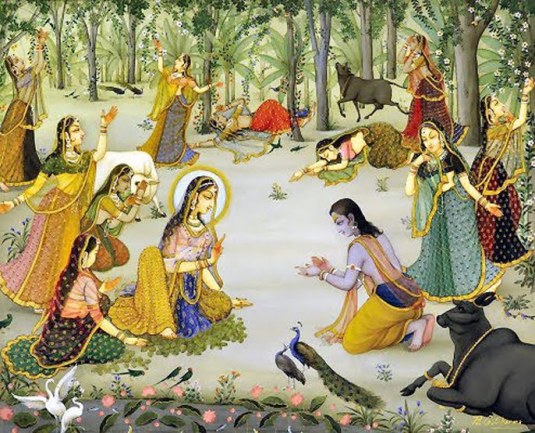
click on image to enlarge
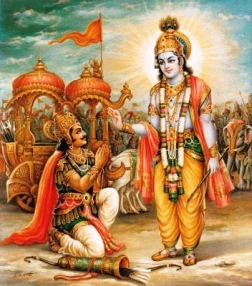
This is perhaps one of my favorite chapters in the Kṛṣṇa Book, and I find myself reading it again and again. There are many lessons one can take away from this chapter. With great pleasure we are posting the entire chapter in the hopes that one of our readers will become enlivened in Kṛṣṇa Consciousness as a result of reading it.
…As stated in the Bhagavad-gītā, ye yathā māṁ prapadyante: Kṛṣṇa is very responsive. He responds in proportion to the devotee’s advancement in devotional service. The gopīs were thinking of Kṛṣṇa in separation twenty-four hours a day. Kṛṣṇa was also always thinking of the gopīs, mother Yaśodā, Nanda Mahārāja and the residents of Vṛndāvana, although He appeared to be away from them. He could understand how they were transcendentally aggrieved, and so He immediately wanted to send Uddhava to give them a message of solace.
Uddhava is described as the most exalted personality in the Vṛṣṇi dynasty, almost equal to Kṛṣṇa. He was a great friend, and on account of being the direct student of Bṛhaspati, the teacher and priest of the heavenly planets, he was very intelligent and sharp in decision. From the intellectual standpoint, he was highly qualified. Kṛṣṇa, being a very loving friend of Uddhava, wanted to send him to Vṛndāvana just to study the highly elevated ecstatic devotional service practiced there. Even if one is highly elevated in material education and is even the disciple of Bṛhaspati, he still has to learn from the gopīs and the residents of Vṛndāvana how to love Kṛṣṇa to the highest degree. Sending Uddhava to Vṛndāvana with a message to the residents of Vṛndāvana to pacify them was Kṛṣṇa’s special favor to Uddhava.
Lord Kṛṣṇa’s name is Hari, which means one who takes away all the distress from the surrendered souls. Lord Caitanya states that there cannot be, at any time, a worship as exalted as that realized by the gopīs. Being very anxious about the gopīs’ grief, Kṛṣṇa talked with Uddhava and politely requested him to go to Vṛndāvana. Shaking Uddhava’s hand with His own hands, He said, ”My dear gentle friend Uddhava, please go immediately to Vṛndāvana and try to pacify My father and mother, Nanda Mahārāja and Yaśodā-devī, and the gopīs. They are very much griefstricken, as if suffering from great ailments. Go and give them a message. I hope their ailments will be partially relieved. The gopīs are always absorbed in thoughts of Me. They have dedicated body, desire, life and soul to Me. I am anxious not only for the gopīs, but for anyone who sacrifices society, friendship, love and personal comforts for Me. It is My duty to protect such exalted devotees. The gopīs are the most dear. They are always thinking of Me in such a way that they remain overwhelmed and almost dead in anxiety due to separation from Me. They are keeping alive simply by thinking that I am returning to them very soon.“
Full Chapter More
21 Apr 2013
by The Hare Krishna Movement
in A.C. Bhaktivedanta Swami Prabhupada, Bhagavad-gita, Krishna Consciousness, Prostitutes
Tags: A.C. Bhaktivedanta Swami Prabhupada, Allen Ginsberg, Bilvamangala Thakura, brahman family, candalas, cintamani, cintmani, devotee of the Lord, devotional service, prostitute, prostitute-hunter, Sri Bilvamangala Thakura, Srila Prabhupada, sucinam srimatam gehe
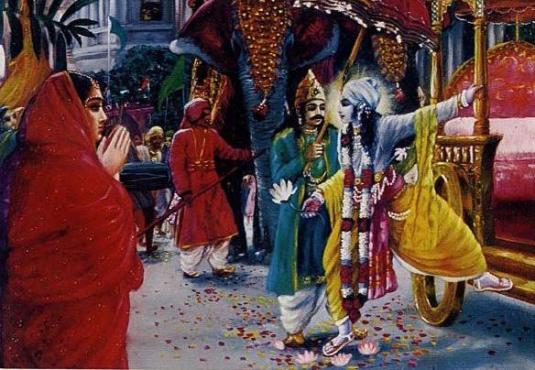
This I found this extremely interesting from my reading this morning, how even the prostitutes some 5,000 years ago in the time of Lord Krsna were accepted as necessary citizens for the proper upkeep of society. They were not condemned by the Lord, but rather He greeted them with the proper etiquette. Krishna says in the Bhagavad-gita… “even the low-born caṇḍālas and those who are born in a family of unbelievers, and even the prostitutes, shall attain perfection of life if they take shelter of unalloyed devotional service to Me, because in the path of devotional service there are no impediments due to degraded birth and occupation. The path is open for everyone who agrees to follow it.”
At the same time, many hundreds of well-known prostitutes began to proceed on various vehicles. They were all very eager to meet the Lord, and their beautiful faces were decorated with dazzling earrings, which enhanced the beauty of their foreheads.(SB 1.11.19)
…We may not hate even the prostitutes if they are devotees of the Lord. Even to date there are many prostitutes in great cities of India who are sincere devotees of the Lord. By tricks of chance one may be obliged to adopt a profession which is not very adorable in society, but that does not hamper one in executing devotional service to the Lord. Devotional service to the Lord is uncheckable in all circumstances.
Śrī Bilvamaṅgala Ṭhākura, a great ācārya of the Viṣṇusvāmī Vaiṣṇava sect, in his householder life was overly attached to a prostitute who happened to be a devotee of the Lord. One night when the Ṭhākura came to Cintāmaṇi’s house in torrents of rain and thunder, Cintāmaṇi was astonished to see how the Ṭhākura could come on such a dreadful night after crossing a foaming river which was full of waves. She said to Ṭhākura Bilvamaṅgala that his attraction for the flesh and bone of an insignificant woman like her would be properly utilized if it could be diverted to the devotional service of the Lord to achieve attraction for the transcendental beauty of the Lord. It was a momentous hour for the Ṭhākura, and he took a turn towards spiritual realization by the words of a prostitute. Later on the Ṭhākura accepted the prostitute as his spiritual master, and in several places of his literary works he has glorified the name of Cintāmaṇi, who showed him the right path. (SB 1.11.19 Purport)
It is clearly declared by the Supreme Lord, that in devotional service, there is no distinction between the lower or higher classes of people. In the material conception of life, there are such divisions, but for a person engaged in transcendental devotional service to the Lord, there are not. Everyone is eligible for the supreme destination. (Bg 9.32 Purport)
In the second part of the post there is a conversation with Allen Ginsberg on the life of Bilvamaṅgala Ṭhākura
More
28 Mar 2013
by The Hare Krishna Movement
in A.C. Bhaktivedanta Swami Prabhupada, Devotional Service, Teachings of Lord Chaitanya
Tags: A.C. Bhaktivedanta Swami Prabhupada, bhakti, Caitanya Mahaprabhu, devotee, devotional service, fruitive activities, meditation, meditational yoga, perfect stage of devotion, philosophical speculation, speculative knowledge, Teachings of Lord Chaitanya, Vedic literature

Teachings of Lord Caitanya
By His Divine Grace A. C. Bhaktivedanta Swami Prabhupāda
Chapter Five
How to Approach God
Actually all Vedic literature directs the human being toward the perfect stage of devotion. The paths of fruitive activities, speculative knowledge and meditation do not lead one to the perfectional stage, but by the process of devotional service the Lord actually becomes approachable. Therefore all Vedic literature recommends that one accept this process. In this regard, Caitanya Mahāprabhu quoted from the Lord’s instructions to Uddhava in Śrīmad-Bhāgavatam:
na sādhayati māṁ yogo
na sāṅkhyaṁ dharma uddhava
na svādhyāyas tapas tyāgo
yathā bhaktir mamorjitā
“My dear Uddhava, neither philosophical speculation, nor meditational yoga, nor penances can give Me such pleasure as devotional service practiced by the living entities.” (Bhāg. 11.14.20)
More
23 Mar 2013
by The Hare Krishna Movement
in Bhakti Yoga, Diksha, Guru & Disciple, Iskcon Bangalore, Reference Material
Tags: astanga-yoga, bhakti, bhoga, bona fide disciple, bona fide spiritual masted, chanting, deity worship, demigod worship, devotional service, dharma, disciple spiritual master guru, free pdf download, ISKCON Bangalore, Krishna, Prasadam, reference material on spiritual life, vapu and vani

Some time back I found this nice download of reference material and study guide for aspiring devotees. I printed it out, which took 80 pieces of paper, punched holes, and put it in a ring folder. It is arranged very professionally, and is broken down into eight basic areas of study.
1) Spiritual Master
2) Disciple
3) Deity Worship
4) Devotional Service
5) Chanting
6) Demigod Worship
7) Prasadam
8) General Information
For a free pdf download to view or save follow link; Harinam_Diksha_Reference_Material_for_Written_Test_new
10 Feb 2013
by The Hare Krishna Movement
in A.C. Bhaktivedanta Swami Prabhupada, Caitanya Mahaprabhu, Chanting Hare Krishna, Krsna Consciousness, Sankirtan, Sri Caitanya-Caritamrta
Tags: A.C. Bhaktivedanta Swami Prabhupada, actions which will be benificial for all living entities, adi-lila 9.27-52, devotional service, Krsna consciousness movement, sankirtan movement, Sri Caitanya Mahaprabhu, Sri Caitanya-caritamrta, tree of devotional service, welfare activities for the benifit of others
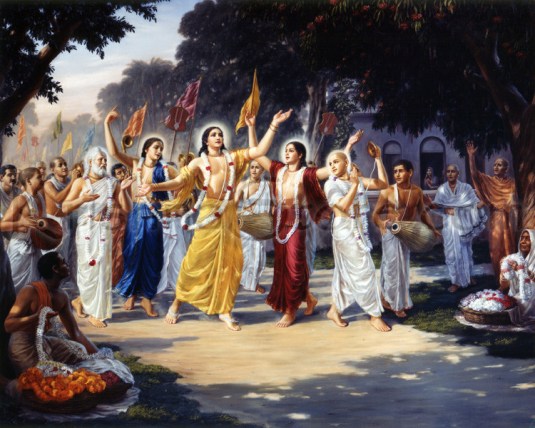
click on image to enlarge
Lord Caitanya’s Sankirtana Movement
“It is the duty of every living being to perform welfare activities for the benefit of others with his life, wealth, intelligence and words.”
“By his work, thoughts and words, an intelligent man must perform actions which will be beneficial for all living entities in this life and in the next.”
The Kṛṣṇa consciousness movement introduced by Lord Caitanya is extremely important because one who takes to it becomes eternal, being freed from birth, death and old age. People do not recognize that the real distresses in life are the four principles of birth, death, old age and disease. They are so foolish that they resign themselves to these four miseries, not knowing the transcendental remedy of the Hare Kṛṣṇa mahā-mantra. Simply by chanting the Hare Kṛṣṇa mahā-mantra, one can become free from all misery, but because they are enchanted by the illusory energy, people do not take this movement seriously. Therefore those who are actually servants of Śrī Caitanya Mahāprabhu must seriously distribute this movement all over the world to render the greatest benefit to human society.
There is a very nice section in the Śrī Caitanya-caritāmṛta wherein the author uses the figurative example of the gardener, to explain the mission of Lord Caitanya Mahāprabhu. With pleasure we are posting the entire section below… More
28 Jan 2013
by The Hare Krishna Movement
in A.C. Bhaktivedanta Swami Prabhupada, Caitanya Mahaprabhu, Devotional Service, Srimad Bhagavatam
Tags: A.C. Bhaktivedanta Swami Prabhupada, causeless mercy, chanting, devotional service, hearing, Lord Sri Caitanya Mahaprabhu, mercy of sri caitanya, millennium, Prayers by Queen Kunti, praying, remembering, Srimad Bhagavad-gita, Srimad Bhagavatam, worshiping

…In the Śrīmad Bhagavad-gītā the Lord asserts that He appears in every millennium just to reestablish the way of religion. The way of religion is made by the Supreme Lord. No one can manufacture a new path of religion, as is the fashion for certain ambitious persons. The factual way of religion is to accept the Lord as the supreme authority and thus render service unto Him in spontaneous love.
The Lord, however, out of His causeless mercy, because He is more merciful to the suffering living beings than they can expect, appears before them and renovates the principles of devotional service comprised of hearing, chanting, remembering, serving, worshiping, praying, cooperating and surrendering unto Him. Adoption of all the above-mentioned items, or any one of them, can help a conditioned soul get out of the tangle of nescience and thus become liberated from all material sufferings created by the living being illusioned by the external energy. This particular type of mercy is bestowed upon the living being by the Lord in the form of Lord Śrī Caitanya Mahāprabhu. (from Purport to SB 1.8.35)
Full Text and puroprt More
28 Oct 2012
by The Hare Krishna Movement
in A.C. Bhaktivedanta Swami Prabhupada, Prahlada Maharaja, Srimad Bhagavatam, Teachings of Pralada Maharaja
Tags: 9 types of devotional service, A.C. Bhaktivedanta Swami Prabhupada, arcanam, atma-nivedanam, dasyam, devotional service, kirtanam, Narada Muni, nine processes of devotional service, pada-sevanam, Prahlada Maharaja, sakyam, sarvanam, smaranam, Srila Prabhupada, Teachings of Prahlada Maharaja, the science of God, vandanam, visnoh
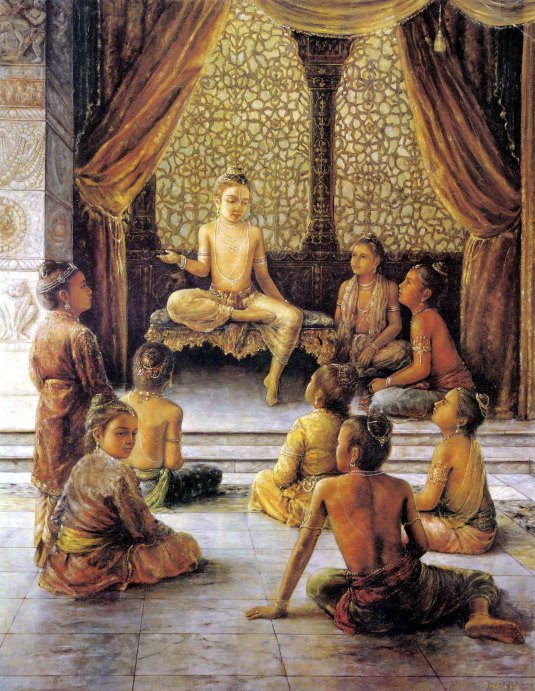
click on image to enlarge
Prahlāda Mahārāja said: Hearing and chanting about the transcendental holy name, form, qualities, paraphernalia and pastimes of Lord Viṣṇu, remembering them, serving the lotus feet of the Lord, offering the Lord respectful worship with sixteen types of paraphernalia, offering prayers to the Lord, becoming His servant, considering the Lord one’s best friend, and surrendering everything unto Him (in other words, serving Him with the body, mind and words)—these nine processes are accepted as pure devotional service. One who has dedicated his life to the service of Kṛṣṇa through these nine methods should be understood to be the most learned person, for he has acquired complete knowledge.
Full text and purport More
18 Oct 2012
by The Hare Krishna Movement
in Diksha, Disciplic succession, Locanananda das, Siksa, Spiritual Master
Tags: devotional service, diksa, disciple, Founder Acarya, grand disciples, guru, Krishna's empowered emissary, Krishna's pure devotee, ritvik acarya, ritvik system of initiation, spiritual master, Srila Prabhupada

This is excerpted comment by Locanananda Prabhu at Prabhupada News on an article posted there by one of Srila Prabhupada’s personal servants, Gauridasa Pandita dasa, about the Ritvik order. Very nice comment.
The Spiritual Master
by Locanananda dasa
Srila Prabhupada is the eternal spiritual master of his followers and of all generations of followers still to come. His Divine Grace likened initiation to the admissions procedure at school. He said it was more or less a formality. He surely never wanted this initiation issue to divide his followers into different camps.
The essence of the process of devotional service is to surrender to the spiritual master. A disciple accepts the discipline taught by Krishna’s pure representative. He does not manufacture his own way. In that sense, followers are disciples, and Srila Prabhupada will deliver them to Krishna.
More
13 Oct 2012
by The Hare Krishna Movement
in A.C. Bhaktivedanta Swami Prabhupada, Bhakti-latā-bīja, Devotional Service, Vaisnava-aparadha
Tags: A.C. Bhaktivedanta Swami Prabhupada, Autum, bhakti-latā-bīja, bija, devotional service, garden in autumn, gardener, hearing and chanting, kirtana, seed, seed of devotional service, sowing the seed in his heart, sravana

“When a person receives the seed of devotional service, he should take care of it by becoming a gardener and sowing the seed in his heart. If he waters the seed gradually by the process of śravaṇa and kīrtana [hearing and chanting], the seed will begin to sprout.
“As one waters the bhakti-latā-bīja, the seed sprouts, and the creeper gradually increases to the point where it penetrates the walls of this universe and goes beyond the Virajā River between the spiritual world and the material world. It attains brahma-loka, the Brahman effulgence, and, penetrating through that stratum, it reaches the spiritual sky and the spiritual planet Goloka Vṛndāvana.”
“Being situated in one’s heart and being watered by śravaṇa-kīrtana, the bhakti creeper grows more and more. In this way it attains the shelter of the desire tree of the lotus feet of Kṛṣṇa, who is eternally situated in the planet known as Goloka Vṛndāvana in the topmost region of the spiritual sky.”
“The creeper greatly expands in the Goloka Vṛndāvana planet, and there it produces the fruit of love for Kṛṣṇa. Although remaining in the material world, the gardener regularly sprinkles the creeper with the water of hearing and chanting.
More
06 Oct 2012
by The Hare Krishna Movement
in A.C. Bhaktivedanta Swami Prabhupada, Krishna Consciousness, Sri Caitanya-Caritamrta
Tags: A.C. Bhaktivedanta Swami Prabhupada, cleanse the heart as the Lord cleansed the Gundica temple, devotee, devotional service, Gundica Temple, Krsna, krsna consciousness, Lord Caitanya, madhya-lila 12.135, Sri Caitanya-carimrta
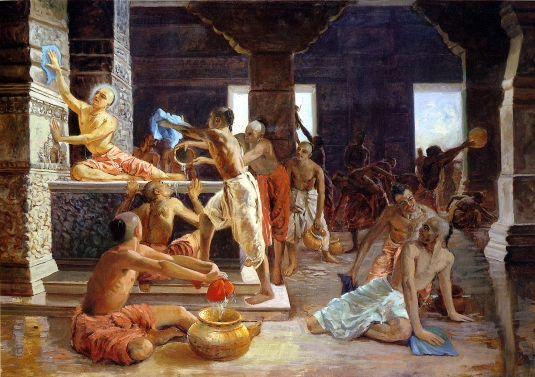
…If a devotee at all wants to cleanse his heart, he must chant and hear the glories of the Lord, Śrī Kṛṣṇa (śṛṇvatāṁ sva-kathāḥ kṛṣṇaḥ). This is a simple process. Kṛṣṇa Himself will help cleanse the heart because He is already seated there. Kṛṣṇa wants to continue living within the heart, and the Lord wants to give directions, but one has to keep his heart as clean as Lord Caitanya Mahāprabhu kept the Guṇḍicā temple. The devotee therefore has to cleanse his heart just as the Lord cleansed the Guṇḍicā temple. In this way one can be pacified and enriched in devotional service.
More
11 Sep 2012
by The Hare Krishna Movement
in A.C. Bhaktivedanta Swami Prabhupada, Devotional Service, Nectar of Instruction, The Nectar of Instruction, Upadesamrta
Tags: A.C. Bhaktivedanta Swami Prabhupada, bhagavad-gita, Bhakti-rasamrta-sindu, devotional service, imaginative ecstasy, Nectar of Instruction, sentimental speculation, Srila Prabhupada, Srila Rupa Goswami

Click on image to enlarge
…Devotional service means transcendental activities.
Devotional service is not a matter of sentimental speculation or imaginative ecstasy. Its substance is practical activity.
The execution of devotional service is not a matter of idle meditation but practical action in the foreground of spiritual life.
“In the course of traversing the universal creation of Brahmā, some fortunate soul may receive the seed of bhakti-latā, the creeper of devotional service. This is all by the grace of guru and Kṛṣṇa.” (Caitanya-caritāmṛta, Madhya 19.151)
If by fortune one takes advantage of this opportunity to engage in devotional service, the path of liberation immediately opens.
One should accept this opportunity to return home, back to Godhead, very enthusiastically.
The Nectar of Instruction
By His Divine Grace A.C. Bhaktivedanta Swami Prabhupada
Text 3
More
12 Jul 2012
by The Hare Krishna Movement
in Bhagavad-gita, Devotional Service
Tags: A.C. Bhaktivedanta Swami Prabhupada, Bg 10.8-11, bhagavad-gita, constantly devoted, devotional service, lamp of knowledge, shining lamp of knowledge, spiritual understanding, worship Me with love, worship of Krishna
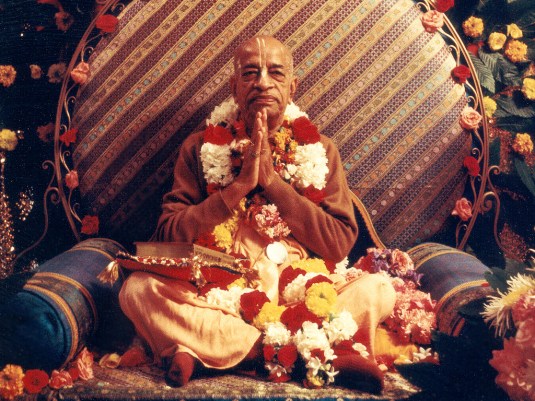
…Pure devotees concentrate their minds in Kṛṣṇa consciousness in full devotional service; therefore they are always situated in the transcendental position. Devotional service and worship of Kṛṣṇa are very clearly indicated in the 10th chapter of Bhagavad-gita verses eight to eleven. That is the way of pure devotional service.
Bhagavad-gita As It Is
By His Divine Grace A.C. Bhaktivedanta Swami Prabhupada
Chapter 10, Text 8-11
The Opulence of the Absolute
I am the source of all spiritual and material worlds. Everything emanates from Me. The wise who know this perfectly engage in My devotional service and worship Me with all their hearts.
The thoughts of My pure devotees dwell in Me, their lives are surrendered to Me, and they derive great satisfaction and bliss enlightening one another and conversing about Me.
To those who are constantly devoted and worship Me with love, I give the understanding by which they can come to Me.
Out of compassion for them, I, dwelling in their hearts, destroy with the shining lamp of knowledge the darkness born of ignorance.
For full text and purports More
09 Jul 2012
by The Hare Krishna Movement
in Chanting Hare Krishna, Hare Krishna Maha Mantra, Krishna Consciousness, Srimad Bhagavatam
Tags: A.C. Bhaktivedanta Swami Prabhupada, chanting Hare Krishna, devotional service, offenseless chanting and hearing, parikshit, Prabhupada books, Sri Sukadeva Goswami, Srimad Bhagavatam, The Hare Krishna Movement, transcendental chanting of the holy name
click on image to visit online store
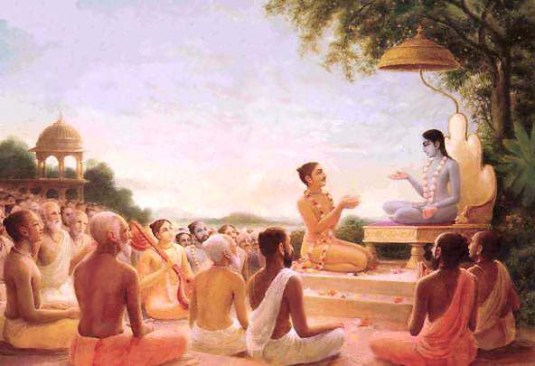
…In this verse, Śrī Śukadeva Gosvāmī recommends the transcendental chanting of the holy name of the Lord. By offenseless chanting and hearing of the holy name of the Lord, one becomes acquainted with the transcendental form of the Lord, and then with the attributes of the Lord, and then with the transcendental nature of His pastimes, etc. Here it is mentioned that one should constantly chant the holy name of the Lord after hearing it from authorities. This means that hearing from the authorities is the first essential.
Anyone who hears Śrīmad-Bhāgavatam attentively from its bona fide reciter is sure to become a sincere devotee of the Lord, who is able to award liberation. There was none so attentive as Mahārāja Parīkṣit in the matter of hearing Śrīmad-Bhāgavatam, and there was none so qualified as Śukadeva Gosvāmī to recite the text of Śrīmad-Bhāgavatam. Therefore, anyone who follows in the footsteps of either the ideal reciter or the ideal hearer, Śukadeva Gosvāmī and Mahārāja Parīkṣit respectively, will undoubtedly attain salvation like them.
O King, constant chanting of the holy name of the Lord after the ways of the great authorities is the doubtless and fearless way of success for all, including those who are free from all material desires, those who are desirous of all material enjoyment, and also those who are self-satisfied by dint of transcendental knowledge.
Srimad Bhagavatam
By His Divine Grace A.C. Bhaktivedanta Swami Prabhupada
Second Canto, Chapter One, Text 10-11
The First Step in God Realization
More
09 May 2012
by The Hare Krishna Movement
in Narada-bhakti-sutra
Tags: A.C. Bhaktivedanta Swami Prabhupada, devotional service, Krsna, Narada, Narada-bhakti-sutra, regulative devotional service, religious rituals, renunciation, service to Krishna, social custom, transcendental loving service, Vedic injunction
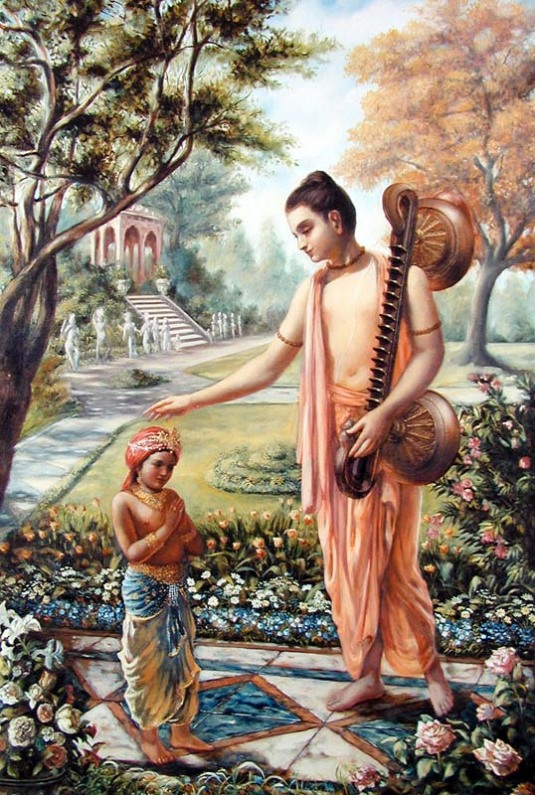
Narada-bhakti-sutra
By His Divine Grace A. C. Bhaktivedanta Swami Prabhupāda
TEXT 8
nirodhas tu loka-veda-vyāpāra-nyāsaḥ
nirodhaḥ—renunciation; tu—moreover; loka—of social custom; veda—and of the revealed scripture; vyāpāra—of the engagements; nyāsa—renunciation.
TRANSLATION
Such renunciation in devotional service means to give up all kinds of social customs and religious rituals governed by Vedic injunction.
PURPORT
In a verse in the Lalita-mādhava (5.2), Śrīla Rūpa Gosvāmī describes renunciation in devotional service:
ṛddhā siddhi-vraja-vijayitā satya-dharmā samādhir
brahmānando gurur api camatkārayaty eva tāvat
yāvat premṇāṁ madhu-ripu-vaśīkāra-siddhauṣadhīnāṁ
gandho ’py antaḥ-karaṇa-saraṇī-pānthatāṁ na prayāti
“Activities such as mystic trance, becoming one with the Supreme, and the religious principles of brahminism, such as speaking the truth and tolerance, have their own respective attractions, but when one becomes captivated by love of Kṛṣṇa, the Supreme Personality of Godhead, all attraction for mystic power, monistic pleasure, and mundane religious principles becomes insignificant.”
In other words, by discharging pure devotional service one attains the highest stage of love of Godhead and is freed from all other obligations, such as those mentioned in the karma-kāṇḍa, jñāna-kāṇḍa, and yoga-kāṇḍa sections of the Vedas. One who engages in pure devotional service has no desire to improve himself—except in the service of the Lord. In such devotional service there cannot be any worship of the impersonal or localized features of the Supreme Lord. The devotee simply performs activities that satisfy the Supreme Personality of Godhead and thus attains pure love for the Lord.
More
24 Apr 2012
by The Hare Krishna Movement
in Back to Godhead, Hayagriva das, Remembering Srila Prabhupada
Tags: Back to Godhead Magazine, Bowery, devotional service, hayagriva das, His Divine Grace, Kirtanananda, Krsna's service, matchless gifts, New York: Summer 1966, Second Avenue, Srila Prabhupada, Umapati

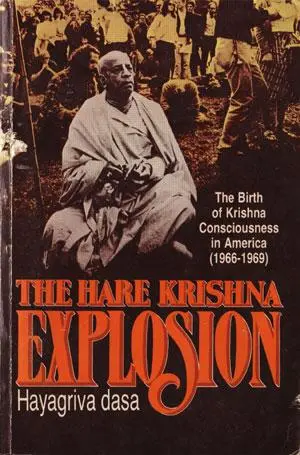
…Srila Prabhupada was lecturing from the Bhagavad-gita…then, incredibly, midway through the lecture, an old white-haired begrizzled Bowery bum entered the storefront and walked right through the middle of the room, past all of us who sat in shocked silence, and on up towards Srila Prabhupada, who sat beneath the back windows. I didn’t know what he was about to do, but I noticed that he was carrying a package of paper handtowels and a couple of rolls of toilet paper. He didn’t say a word, but walked right past Srila Prabhupada and carefully placed the hand-towels by the sink and the toilet paper on the floor under the sink. Then, clearing his throat and saying something incoherent, he turned around and walked out. No one knew what to say and no one knew whether or not Srila Prabhupada had been insulted.
“Just see,” Srila Prabhupada suddenly said. “He has just begun his devotional service. That is the process. Whatever we have—it doesn’t matter what—we must offer it for Krsna’s service.”
Sleepers Awake!
New York: Summer 1966
By Hayagriva das
Excerpted from ‘Back To Godhead’ Magazine
1970-1973 Vol.1, No. 46
When I first met my spiritual master, His Divine Grace A.C. Bhaktivedanta Swami Prabhupada, I felt that there was never a time when I did not know him. I never tire of telling of my first meeting with him on the streets of Lower East Side New York. At the time, I was hurrying from my Mott Street apartment, which had become a refuge for psychedeliacs, to a much quieter apartment on Fifth Street where I hoped to get some peace. I was walking down Houston Street and across Bowery, past the rushing traffic and stumbling derelicts, and after crossing Bowery, just before Second Avenue, I saw His Divine Grace jauntily strolling down the sidewalk, his head high in the air, his hand in a beadbag. He struck me like a famous actor in a very familiar movie. He seemed ageless, though later I found out that he was seventy years old. He was wearing the traditional saffron colored robes of a sannyasi, the renounced order, and quaint white shoes with points. Coming down Houston Street, he looked like the genie that popped out of Aladdin’s lamp. I was fresh from a trip to India, and His Divine Grace reminded me of the many holy men I had recently seen walking the dirt roads of Hardwar and Rishikesh and bathing in the Ganges. I had gone to India to look for a guru but had returned disappointed. It was on this bright July morning, when I was least expecting it, that Sri Krsna, out of His infinite mercy, sent guru to me. The old Vedic adage—by the grace of Krsna you get guru, and by the grace of guru you get Krsna—was justified. Afterwards, Srila Prabhupada (as we were later to call him) often told me, “If you are sincere, you don’t have to search out your guru. Krsna will send him.” So amid the hot clang and clamor of Houston and Bowery, guru had found me out.
More
13 Apr 2012
by The Hare Krishna Movement
in Krishna, Krishna Consciousness, The Hare Krishna Movement, The Reservoir of Pleasure
Tags: A.C. Bhaktivedanta Swami Prabhupada, bhagavad-gita, devotional service, His Divine Grace, Krishna consciousness, Krsna The Reservoir of Pleasure, pure consciousness, real life, real pleasure, Sri Krsna

Kṛṣṇa, the Reservoir of Pleasure
by His Divine Grace A. C. Bhaktivedanta Swami Prabhupāda
Kṛṣṇa—this sound is transcendental. Kṛṣṇa means the highest pleasure. All of us, every living being, seeks pleasure. But we do not know how to seek pleasure perfectly. With a materialistic concept of life, we are frustrated at every step in satisfying our pleasure because we have no information regarding the real level on which to have real pleasure. For the last few weeks we have been learning that we are not this body; we are consciousness. Not exactly consciousness, for consciousness is actually the symptom of our real identity: we are pure soul, now merged within this material body. Modern material science lays no stress on this; therefore the scientists are sometimes misled in their understanding of spirit soul. But spirit soul is a fact, which anyone can understand by the presence of consciousness. Any child can understand that consciousness is the symptom of the spirit soul.
Now the whole process we are trying to learn from the Bhagavad-gītā (The Song of God) is how to bring ourselves to this level of consciousness. And if we act from the level of consciousness, then we may not be pushed again into the level of this bodily conception; and, if we can continue on that level, if we can continue to act in pure consciousness, then, at the end of this body we shall be free from material contamination, our spiritual life will be revived, and the ultimate result will be that in our next life, after leaving this body, we shall have our full, eternal spiritual life. Spirit, as we have already discussed, is described as eternal.
More
10 Apr 2012
by The Hare Krishna Movement
in Bhagavad-gita, Devotional Service, Free Downloads, Raja-Vidya
Tags: Arjuna, Bg. 9.2, bhagavad-gita, books by Srila Prabhupada, chanting Hare Krishna, confidential knowledge, devotional service, Krishna, Raja-Vidya

click on link at bottom for a free download on entire book to read online or save in pdf format
…It is said that the execution of devotional service is so perfect that one can perceive the results directly. This direct result is actually perceived, and we have practical experience that any person who is chanting the holy names of Kṛṣṇa (Hare Kṛṣṇa, Hare Kṛṣṇa, Kṛṣṇa Kṛṣṇa, Hare Hare/ Hare Rāma, Hare Rāma, Rāma Rāma, Hare Hare)in course of time feels some transcendental pleasure and very quickly becomes purified of all material contamination. This is actually seen. Furthermore, if one engages not only in hearing but in trying to broadcast the message of devotional activities as well, or if he engages himself in helping the missionary activities of Kṛṣṇa consciousness, he gradually feels spiritual progress. This advancement in spiritual life does not depend on any kind of previous education or qualification. The method itself is so pure that by simply engaging in it one becomes pure.
Bhagavada-gita As It Is Macmillan Edition 1975
By His Divine Grace A.C. Bhaktivedanta Swami Prabhupada
Chapter 9, Text 2
rāja-vidyā rāja-guhyaṁ
pavitram idam uttamam
pratyakṣāvagamaṁ dharmyaṁ
su-sukhaṁ kartum avyayam
rāja-vidyā—the king of education; rāja-guhyam—the king of confidential knowledge; pavitram—the purest; idam—this; uttamam—transcendental; pratyakṣa—directly experienced; avagamam—understood; dharmyam—the principle of religion; susukham—very happy; kartum—to execute; avyayam—everlasting.
This knowledge is the king of education, the most secret of all secrets. It is the purest knowledge, and because it gives direct perception of the self by realization, it is the perfection of religion. It is everlasting, and it is joyfully performed.
Purport
This chapter of Bhagavad-gītā is called the king of education because it is the essence of all doctrines and philosophies explained before. There are seven principal philosophers in India: Gautama, Kaṇāda, Kapila, Yājñavalkya, Śāṇḍilya, Vaiśvānara, and, finally, Vyāsadeva, the author of the Vedānta-sūtra. So there is no dearth of knowledge in the field of philosophy or transcendental knowledge. Now the Lord says that this Ninth Chapter is the king of all such knowledge, the essence of all knowledge that can be derived from the study of the Vedas and different kinds of philosophy. It is the most confidential because confidential or transcendental knowledge involves understanding the difference between the soul and the body. And the king of all confidential knowledge culminates in devotional service.
More
24 Mar 2012
by The Hare Krishna Movement
in A.C. Bhaktivedanta Swami Prabhupada, Back to Godhead, Remembering Srila Prabhupada, Srila Prabhupada
Tags: back to Godhead, bhagavad-gita, devotional service, Krsna conscious person, krsna consciousness, part and parcel, spritual sky, Srila Prabhupada, suffering of conditioned soul

…Someone asked, “What is the Krsna conscious person’s attitude towards others?” Srila Prabhupada replied, “He sees everyone as part and parcel of Krsna. The Krsna conscious person thinks, ‘They are suffering from not knowing Krsna, so let me bring them to Krsna.’ This is the highest service. Everyone is suffering, so to act in Krsna consciousness is the highest service. After all, they are suffering on account of detachment from Krsna.”
“Krsna consciousness never becomes old, it is fresh eternally. Do you know of any book five thousand years old that reads as fresh as Bhagavad-gita? Live in spiritual understanding and you’ll never become faded.”
The Great Soul Who Walked Among Us
Excerpted from Back To Godhead Magazine Vol. 13 No. 1-2
“Consider this example: when the sun is in the sky, there is no question of darkness. Similarly, when the Hare Krsna mantra is vibrating on your tongue and you are hearing attentively, then your consciousness becomes Krsna consciousness, or clear consciousness, and there is no question of maya, or hazy consciousness. Just as when light and darkness come together the darkness cannot stand before the light, maya cannot remain in the presence of Krsna.
More
21 Feb 2012
by The Hare Krishna Movement
in Lectures, The Hare Krishna Movement
Tags: actual religion, bhagavad-gita, devotional service, His Divine Grace A.C. Bhaktivedanta Swami Prabhupada, krsna consciousness, love for God, Song of God, Srila Prabhupada lecture
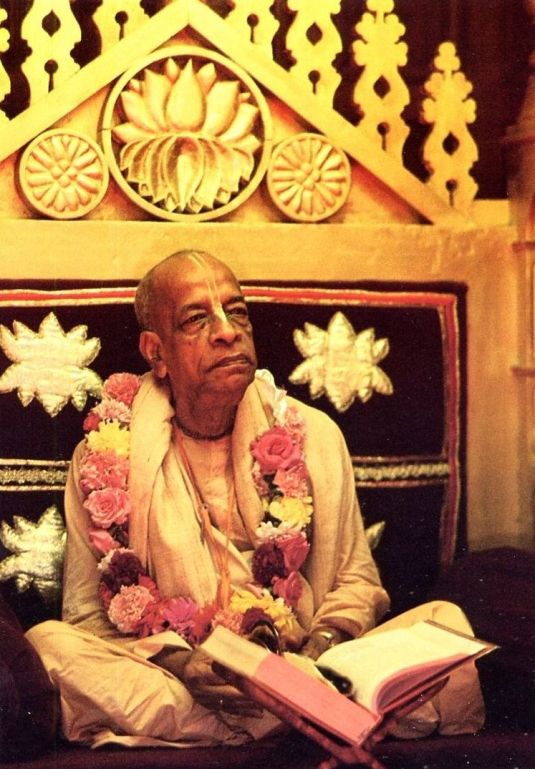
…so far our movement is concerned, you know, more or less, about our movement. But you should know that this is the most scientific, authorized movement in the human society, because the movement is based on the authority of Bhagavad-gita. Bhagavad-gita is spoken by the Supreme Personality of Godhead for the benefit of the whole human society.
“Actual Religion means to understand God and to develop your Love for God”
Lecture by His Divine Grace A.C. Bhaktivedanta Swami Prabhupada
New York, April 5, 1973
Ladies and Gentlemen, I thank you very much for kindly receiving me in this honorable way. According to our Vaisnava philosophy, whatever honor is offered to the spiritual master, that is transferred to the Supreme Personality of Godhead. Yasya prasadad bhagavat-prasado yasyaprasadan na gatih kuto ’pi. Our this philosophy, Vaisnava philosophy, it teaches that if you please your spiritual master, then God is also pleased. Because the spiritual master is the most confidential servant of God, therefore by honoring the spiritual master, the Supreme Personality of Godhead is honored. Just like in English language there is the word, “If you love me, love my dog.” So the spiritual master is the “dog” of God; therefore if the spiritual master is patted, God is very much pleased.
More
Previous Older Entries Next Newer Entries









 The Hare Krishna Movement