30 Nov 2013
by The Hare Krishna Movement
in A.C. Bhaktivedanta Swami Prabhupada, Caaitanya-caritamrta, Chanting Hare Krishna, Sahajiya, Spiritual Life, Spiritual Master, Sri Caitanya-Caritamrta
Tags: A.C. Bhaktivedanta Swami Prabhupada, Adi-lila 7.95-96, association of devotees, chanting Hare Krishna, guru, holy name of the lord, instructions of the spiritual master prabhupada vani, Lord Krsna, Spiritual Life, spiritual master, Sri Caitanya Caritamrta, vani
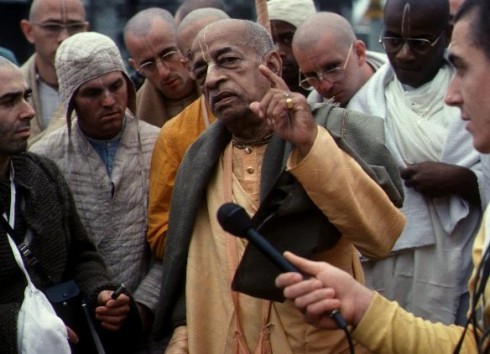
“I firmly believe in these words of My spiritual master, and therefore I always chant the holy name of the Lord, alone and in the association of devotees. That holy name of Lord Kṛṣṇa sometimes causes Me to chant and dance, and therefore I chant and dance. Please do not think that I intentionally do it. I do it automatically. (Sri Caitanya-caritamrta Adi-lila 7.95-96)
A person who cannot keep his faith in the words of his spiritual master but acts independently never receives the authority to chant the holy name of the Lord. (from purport)
This is one of my favorite verses from the Sri Caitanya-caritamrta, and the purport here is one of the most important lessons in spiritual life. Namely, success in spiritual life is faith in the words of the spiritual master and following his instructions. Thereby receiving his blessings. If one receives the blessings of his spiritual master he can chant the holy name of the lord constantly.
Full text and purport More
24 Nov 2013
by The Hare Krishna Movement
in A.C. Bhaktivedanta Swami Prabhupada, Chanting Hare Krishna
Tags: always chant, chanting Hare Krishna, chanting of the holy name of Lord Visnu, Hare Hare, Hare Krishna, Hare Rama, Krishna, Lord Visnu

The following are a few select excerpts on the importance of chanting Hare Krishna. Even if there is still some offence, our chanting should not be abandoned, but rather continued day and night.
Simply our prayer should be, My dear Krishna, please remind me to always chant Your Holy Name, please do not put me into forgetfulness. You are sitting within me as Supersoul, so you can put me into forgetfulness or into remembering You. So please do not put me into forgetfulness. Please always remind me to chant, even You send me into the hell, it doesn’t matter, just so long as I can always chant Hare Krishna. (letter to Devananda, Nov. 23, 1968)
The chanting of the holy name of Lord Viṣṇu is the best process of atonement for a thief of gold or other valuables, for a drunkard, for one who betrays a friend or relative, for one who kills a brāhmaṇa, or for one who indulges in sex with the wife of his guru or another superior. It is also the best method of atonement for one who murders women, the king or his father, for one who slaughters cows, and for all other sinful men. Simply by chanting the holy name of Lord Viṣṇu, such sinful persons may attract the attention of the Supreme Lord, who therefore considers, “Because this man has chanted My holy name, My duty is to give him protection.” (Srimad Bhagavatam 6.2.9-10)
“I do not find the strength to carry on alone the sankirtana of the holy name of Hari. Please bless me by giving me just one drop of faith with which to obtain the great treasure of the holy name of Krsna.
Krsna is yours. You have the power to give Him to me. I am simply your servant running behind you shouting, “Krsna! Krsna!” (Ohe! Vaisnava Thakrua-Srila Bhaktivinoda Thakur)
More
31 Oct 2013
by The Hare Krishna Movement
in A.C. Bhaktivedanta Swami Prabhupada, Panca-Tattva, Sankirtan, Sri Caitanya-Caritamrta
Tags: A.C. Bhaktivedanta Swami Prabhupada, chanting Hare Krishna, Hare Hare, Hare Krishna, Hare Krishna mahamantra, Hare Rama, incarnation, internal potencey, Lord Caitanya, Maha Mantra, mahaprabhu, marginal potency, most magnanimous incarnation, panca tattva mantra, plenary expansion, sankirtan jajna, Sri Krsna Caitanya, ultimate benediction, śrī-kṛṣṇa-caitanya prabhu-nityānanda śrī-advaita gadādhara śrīvāsādi-gaura-bhakta-vṛnda

“Love of Godhead is the ultimate benediction for all human beings.” Śrī Caitanya Mahāprabhu is the bestower of this great benediction.
“In the Age of Kali, people who are endowed with sufficient intelligence will worship the Lord, who is accompanied by His associates, by performance of saṅkīrtana-yajña.” (Bhāg. 11.5.32)
…Śrī Caitanya Mahāprabhu is always accompanied by His plenary expansion Śrī Nityānanda Prabhu, His incarnation Śrī Advaita Prabhu, His internal potency Śrī Gadādhara Prabhu and His marginal potency Śrīvāsa Prabhu. He is in the midst of them as the Supreme Personality of Godhead. One should know that Śrī Caitanya Mahāprabhu is always accompanied by these other tattvas. Therefore our obeisances to Śrī Caitanya Mahāprabhu are complete when we say śrī-kṛṣṇa-caitanya prabhu-nityānanda śrī-advaita gadādhara śrīvāsādi-gaura-bhakta-vṛnda. As preachers of the Kṛṣṇa consciousness movement, we first offer our obeisances to Śrī Caitanya Mahāprabhu by chanting this Pañca-tattva mantra; then we say Hare Kṛṣṇa, Hare Kṛṣṇa, Kṛṣṇa Kṛṣṇa, Hare Hare Hare Rāma, Hare Rāma, Rāma Rāma, Hare Hare. There are ten offenses in the chanting of the Hare Kṛṣṇa mahā-mantra, but these are not considered in the chanting of the Pañca-tattva mantra, namely, śrī-kṛṣṇa-caitanya prabhu-nityānanda śrī-advaita gadādhara śrīvāsādi-gaura-bhakta-vṛnda. Śrī Caitanya Mahāprabhu is known as mahā-vadānyāvatāra, the most magnanimous incarnation, for He does not consider the offenses of the fallen souls. Thus to derive the full benefit of the chanting of the mahā-mantra (Hare Kṛṣṇa, Hare Kṛṣṇa, Kṛṣṇa Kṛṣṇa, Hare Hare Hare Rāma, Hare Rāma, Rāma Rāma, Hare Hare), we must first take shelter of Śrī Caitanya Mahāprabhu, learn the Pañca-tattva mahā-mantra, and then chant the Hare Kṛṣṇa mahā-mantra. That will be very effective. (Purport from Sri Caitanya-caritamrta, Adi-lila 7.4)
More
24 Oct 2013
by The Hare Krishna Movement
in A.C. Bhaktivedanta Swami Prabhupada, Japa, Nectar of Devotion, Practicing Krishna Consciousness at Home
Tags: A.C. Bhaktivedanta Swami Prabhupada, chanting Hare Krishna, holy name, japa, japa bag, japa beads, kirtan, Maha Mantra, mantra meditation
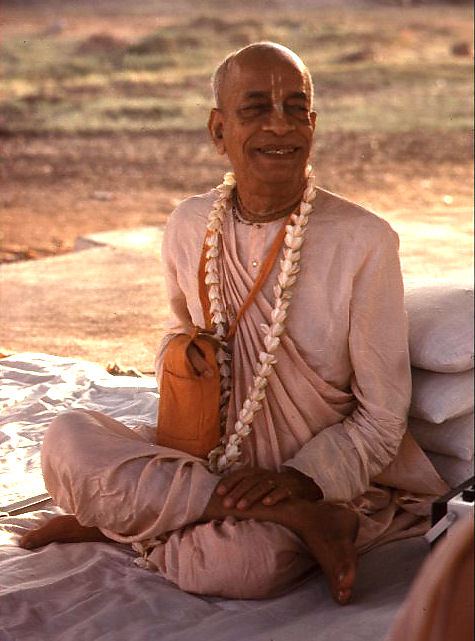
This is such a beautiful picture of Srila Prabhupada with his japa bag, that we thought we would do a short post on ‘japa’.
When a mantra or hymn is chanted softly and slowly, that is called japa. The same mantra, when chanted loudly, is called kīrtana. For example, the mahā-mantra (Hare Kṛṣṇa, Hare Kṛṣṇa, Kṛṣṇa Kṛṣṇa, Hare Hare/ Hare Rāma, Hare Rāma, Rāma Rāma, Hare Hare) when uttered very softly only for one’s own hearing is called japa. The same mantra, when chanted loudly for being heard by all others, is called kīrtana. The mahā-mantra can be used for japa and kīrtana also. When japa is practiced it is for the personal benefit of the chanter, but when kīrtana is performed it is for the benefit of all others who may hear.
In the Padma Purāṇa there is a statement: “For any person who is chanting the holy name either softly or loudly, the paths to liberation and even heavenly happiness are at once open.” (Nectar of Devotion Chapter 9)
Of all the sacrifices, the chanting of Hare Kṛṣṇa, Hare Kṛṣṇa, Kṛṣṇa Kṛṣṇa, Hare Hare/ Hare Rāma, Hare Rāma, Rāma Rāma, Hare Hare is the purest representation of Kṛṣṇa. (from purport; Bhagavad-gita 10.25)
More
14 Oct 2013
by The Hare Krishna Movement
in Chanting Hare Krishna, Festivals, Hare Krishna Maha Mantra, Sri Caitanya-Caritamrta
Tags: 24 hour kirtan, blissful chanting, chanting Hare Krishna, holy dham, karthik, krishna kirtan, New Vrindavan

click on image to enlarge
“In this Age of Kali, the holy name of the Lord, the Hare Kṛṣṇa mahā-mantra, is the incarnation of Lord Kṛṣṇa. Simply by chanting the holy name, one associates with the Lord directly. Anyone who does this is certainly delivered.” (Sri Caitanya-caritamrta; Adi-lila 7.21)
More
15 Sep 2013
by The Hare Krishna Movement
in Festivals
Tags: chanting dancing feasting, chanting Hare Krishna, festival of colors, Krishna consciousness, Krishna prasadam, krishna's holy names, New Vrindavan, Palace of Gold, Srila Prabhupada, worlds happiest festival

click on image to enlarge
Festival of Colors
The Worlds Happiest Festival
Today we spent the day chanting, dancing, and feasting, at the second annual Festival of Colors held on the grounds of Srila Prabhupada’s Palace of Gold in New Vrindavan. What can I say…we had a great time! After hours of dancing and throwing colored dye, we sat down in the shade of a nearby tree, caught our breath, and just took it all in. To my complete amazement and satisfaction, as I watched the children playing, the young people laughing and dancing, and the adults of all ages celebrating the day, everyone was smiling. Srila Prabhupada must also have been smiling to see so many visitors to the Palace, so many people of all walks of life rejoicing in the sounds of Krishna’s Holy Names, taking Krishna Prasadam, and having a favorable impression of Krishna Consciousness. It was huge.
We share with you some images from this happy festival. More
07 Sep 2013
by The Hare Krishna Movement
in A.C. Bhaktivedanta Swami Prabhupada, Caaitanya-caritamrta, Caitanya Mahaprabhu, Krsna is the Source of All Incarnations
Tags: A.C. Bhaktivedanta Swami Prabhupada, Caitanya Caritamrta, Caitanya Mahaprabhu, chanting Hare Krishna, confidential devotees, Hare Krishna, Krsnadasa Kaviraja Gosvami, Lord Caitanya, Radharani, Sri Krsna, Srimati Radharani, transcendental pleasure

“Lord Kṛṣṇa desired to taste the limitless nectarean mellows of the love of one of His multitude of loving damsels [Śrī Rādhā], and so He has assumed the form of Lord Caitanya. He has tasted that love while hiding His own dark complexion with Her effulgent yellow color. May that Lord Caitanya confer upon us His grace.”(This is the third verse of the second Caitanyāṣṭaka of Śrīla Rūpa Gosvāmī’s Stava-mālā.)
Śrī Caitanya-caritāmṛta
By His Divine Grace A. C. Bhaktivedanta Swami Prabhupāda
Summary of Ādi-līlā, Chapter 4
The Confidential Reasons for Lord Caitanya’s Appearance
In this chapter of the epic Caitanya-caritāmṛta, Kṛṣṇadāsa Kavirāja Gosvāmī has stressed that Lord Caitanya appeared for three principal purposes of His own. The first purpose was to relish the position of Śrīmatī Rādhārāṇī, who is the prime reciprocator of transcendental love of Śrī Kṛṣṇa. Lord Kṛṣṇa is the reservoir of transcendental loving transactions with Śrīmatī Rādhārāṇī. The subject of those loving transactions is the Lord Himself, and Rādhārāṇī is the object. Thus the subject, the Lord, wanted to relish the loving mellow in the position of the object, Rādhārāṇī.
The second reason for His appearance was to understand the transcendental mellow of Himself. Lord Kṛṣṇa is all sweetness. Rādhārāṇī’s attraction for Kṛṣṇa is sublime, and to experience that attraction and understand the transcendental sweetness of Himself, He accepted the mentality of Rādhārāṇī.
The third reason that Lord Caitanya appeared was to enjoy the bliss tasted by Rādhārāṇī. The Lord thought that undoubtedly Rādhārāṇī enjoyed His company and He enjoyed the company of Rādhārāṇī, but the exchange of transcendental mellow between the spiritual couple was more pleasing to Śrīmatī Rādhārāṇī than to Śrī Kṛṣṇa. Rādhārāṇī felt more transcendental pleasure in the company of Kṛṣṇa than He could understand without taking Her position, but for Śrī Kṛṣṇa to enjoy in the position of Śrīmatī Rādhārāṇī was impossible because that position was completely foreign to Him. Kṛṣṇa is the transcendental male, and Rādhārāṇī is the transcendental female. Therefore, to know the transcendental pleasure of loving Kṛṣṇa, Lord Kṛṣṇa Himself appeared as Lord Caitanya, accepting the emotions and bodily luster of Śrīmatī Rādhārāṇī.
Lord Caitanya appeared to fulfill these confidential desires and also to preach the special significance of chanting Hare Kṛṣṇa, Hare Kṛṣṇa, Kṛṣṇa Kṛṣṇa, Hare Hare Hare Rāma, Hare Rāma, Rāma Rāma, Hare Hare, and to answer the call of Advaita Prabhu. These were secondary reasons.
More
18 Aug 2013
by The Hare Krishna Movement
in Chanting Hare Krishna, Harinama Sankirtan, Sankirtan, The Hare Krishna Movement
Tags: chanting Hare Krishna, Hare Krishna, harinama sankirtan, His Divine Grace A.C. Bhaktivedanta Swami Prabhupada, Krishna consciousness movement, Lord Caitanya, Radha-Damodar Traveling Sankirtan Party, RDTSKP, sankirtan, The Hare Krishna Movement, traveling temple

Harinam Sankirtana
A friend shared these images with me on Facebook and we thought we would share them with you. I loved this idea of a traveling temple, and in the 1970’s I traveled on one of the famous Radha-Damodara bus’s. This idea of bringing the holy name to every Town & Village should be encouraged throughout our society more and more. This would help unite devotees under the banner of Lord Caitanya, and bring peace to the world.
In pursuance of the order of Lord Caitanya, the devotees of the Krishna Consciousness movement should try to introduce the chanting of the Hare Krishna maha-mantra throughout the world. It is only by chanting Hare Krishna that one may get free from the disease of forgetfulness of Krishna, which is the root cause of all suffering. However one is situated, whether one is single, married or renounced, one should have the determination to go out and preach Krishna consciousness. That was the instruction of our spiritual master, His Divine Grace A.C. Bhaktivedanta Swami Prabhupada. (Locanananda das)
“We are saying that this Hare Krishna maha-mantra can save everyone, and we are therefore distributing it publicly, free of charge… The devotees are preaching without charge, declaring in the streets, parks, and everywhere. “Here! Here is the Hare Krishna maha-mantra. Come on, take it!” (POP p. 72)
More
09 Aug 2013
by The Hare Krishna Movement
in A.C. Bhaktivedanta Swami Prabhupada, Chanting Hare Krishna, Maha-mantra, Mantra Meditation, Nectar of Devotion
Tags: A.C. Bhaktivedanta Swami Prabhupada, chanting Hare Krishna, Hare Hare, Hare Krsna, Hare Rama, heavenly happiness, liberation, Maha Mantra, mantra meditation, Nectar of Devotion, singing the flories of the Lord

This morning I was reading from the Nectar of Devotion the chapter entitled “The Mahā-mantra”. We have posted the entire chapter as well as some other related quotes from the Nectar of Devotion on the Maha-mantra.
In the Padma Purāṇa there is a statement: “For any person who is chanting the holy name either softly or loudly, the paths to liberation and even heavenly happiness are at once open.”
When a mantra or hymn is chanted softly and slowly, that is called japa. The same mantra, when chanted loudly, is called kīrtana. For example, the mahā-mantra (Hare Kṛṣṇa, Hare Kṛṣṇa, Kṛṣṇa Kṛṣṇa, Hare Hare/ Hare Rāma, Hare Rāma, Rāma Rāma, Hare Hare) when uttered very softly only for one’s own hearing is called japa. The same mantra, when chanted loudly for being heard by all others, is called kīrtana. The mahā-mantra can be used for japa and kīrtana also. When japa is practiced it is for the personal benefit of the chanter, but when kīrtana is performed it is for the benefit of all others who may hear.
In the Liṅga Purāṇa there is a statement about glorifying and singing about the Lord. It is said there: “A brāhmaṇa who is constantly engaged in singing the glories of the Lord is surely elevated to the same planet as the Supreme Personality of Godhead. Lord Kṛṣṇa appreciates this singing even more than the prayers offered by Lord Śiva.”
In the Viṣṇu-dharma there is a statement glorifying this process of congregational chanting: “My dear King, this word ‘Kṛṣṇa’ is so auspicious that anyone who chants this holy name immediately gets rid of the resultant actions of sinful activities from many, many births.” That is a fact. There is the following statement in Caitanya-caritāmṛta: “A person who chants the holy name of Kṛṣṇa once can counteract the resultant actions of more sinful activities than he is able to perform.” A sinful man can perform many, many sinful activities, but he is unable to perform so many that they cannot be wiped out by one single uttering of “Kṛṣṇa.”
“Anyone who is engaged in chanting My transcendental name must be considered to be always associating with Me. And I may tell you frankly that for such a devotee I become easily purchased.”
In the Padma Purāṇa also it is stated: “The chanting of the Hare Kṛṣṇa mantra is present only on the lips of a person who has for many births worshiped Vāsudeva.” It is further said in the Padma Purāṇa, “There is no difference between the holy name of the Lord and the Lord Himself. As such, the holy name is as perfect as the Lord Himself in fullness, purity and eternity. The holy name is no material sound vibration, nor has it any material contamination.”
Full Chapter More
02 Aug 2013
by The Hare Krishna Movement
in A.C. Bhaktivedanta Swami Prabhupada, Caaitanya-caritamrta, Chanting Hare Krishna, Spiritual Master
Tags: A.C. Bhaktivedanta Swami Prabhupada, chanting Hare Krishna, faith in the lord, guru, holy name, instructions of the spiritual master, spiritual master, Sri Caitanya-caritamrta, Vedic knowledge, yasya deve para bhaktir

This is another nice verse from the Sri Caitanya-caritamrta, on the importance of following strictly the instructions of the spiritual master, and thereby receiving his blessings and mercy. Allowing us to taste the nectar of the Holy Name.
Sri Caitanya-caritamrta 1975
By His Diine Grace A. C. Bhaktivedanta Swami Prabhupada
Adi-lila 7. Texts 95-96
ei tāṅra vākye āmi dṛḍha viśvāsa dhari’
nirantara kṛṣṇa-nāma saṅkīrtana kari
sei kṛṣṇa-nāma kabhu gāoyāya, nācāya
gāhi, nāci nāhi āmi āpana-icchāya
ei—this; tāṅra—his (My spiritual master’s); vākye—in the words of; āmi—I; dṛḍha—firm; viśvāsa—faith; dhari’-depend; nirantara—always; kṛṣṇa-nāma—the holy name of Lord Kṛṣṇa; saṅkīrtana—chanting; kari—continue; sei—that; kṛṣṇa-nāma—the holy name of Lord Kṛṣṇa; kabhu—sometimes; gāoyāya—causes Me to chant; nācāya—causes Me to dance; gāhi—by chanting; nāci—dancing; nāhi—not; āmi—Myself; āpana—own; icchāya—will.
TRANSLATION
“I firmly believe in these words of My spiritual master, and therefore I always chant the holy name of the Lord, alone and in the association of devotees. That holy name of Lord Kṛṣṇa sometimes causes Me to chant and dance, and therefore I chant and dance. Please do not think that I intentionally do it. I do it automatically.
PURPORT
A person who cannot keep his faith in the words of his spiritual master but acts independently never receives the authority to chant the holy name of the Lord. It is said in the Vedas (Śvetāśvatara Upaniṣad 6.23):
yasya deve parā bhaktir
yathā deve tathā gurau
tasyaite kathitā hy arthāḥ
prakāśante mahātmanaḥ
“Only unto those great souls who have implicit faith in both the Lord and the spiritual master are all the imports of Vedic knowledge automatically revealed.”
This Vedic injunction is very important, and Śrī Caitanya Mahāprabhu supported it by His personal behavior. Believing in the words of His spiritual master, He introduced the saṅkīrtana movement, just as the present Kṛṣṇa consciousness movement was started with belief in the words of our spiritual master. He wanted to preach, we believed in his words and tried somehow or other to fulfill them, and now this movement has become successful all over the world. Therefore faith in the words of the spiritual master and in the Supreme Personality of Godhead is the secret of success. Śrī Caitanya Mahāprabhu never disobeyed the orders of His spiritual master and stopped propagating the saṅkīrtana movement.
More
01 Aug 2013
by The Hare Krishna Movement
in A.C. Bhaktivedanta Swami Prabhupada, Caaitanya-caritamrta, Sankirtan, The Hare Krishna Movement
Tags: A.C. Bhaktivedanta Swami Prabhupada, Adi-lila 2.2, celestial kingdom, chanting Hare Krishna, dancing, Ganges, Hare Krishna, Hare Rama, krsna consciousness, Lord Caitanya, lotus flowers, materialistic persons, pastimes of Lord Krsna, singing, Sri Caitanya-caritamrta
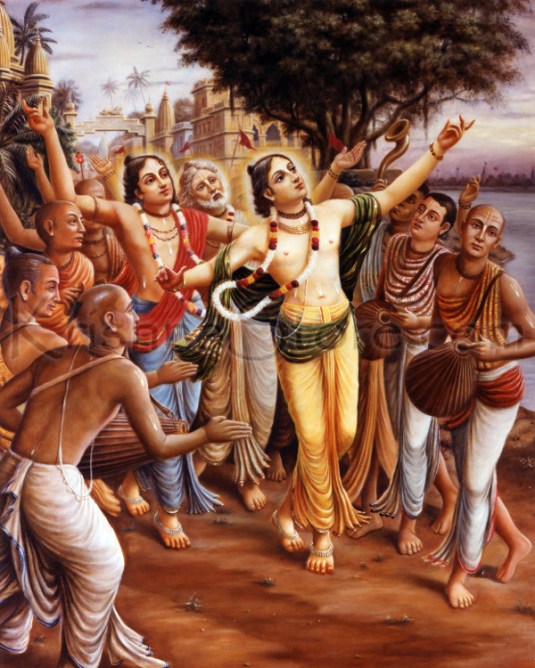
…Lord Caitanya’s movement of Kṛṣṇa consciousness is full of dancing and singing about the pastimes of Lord Kṛṣṇa. It is compared herein to the pure waters of the Ganges, which are full of lotus flowers. The enjoyers of these lotus flowers are the pure devotees, who are like bees and swans. They chant like the flowing of the Ganges, the river of the celestial kingdom. The author desires such sweetly flowing waves to cover his tongue. He humbly compares himself to materialistic persons who always engage in dry talk from which they derive no satisfaction. If they were to use their dry tongues to chant the holy name of the Lord-Hare Kṛṣṇa, Hare Kṛṣṇa, Kṛṣṇa Kṛṣṇa, Hare Hare Hare Rāma, Hare Rāma, Rāma Rāma, Hare Hare-as exemplified by Lord Caitanya, they would taste sweet nectar and enjoy life. (from purport to Adi 2.2)
Full Text and Purport More
15 Jul 2013
by The Hare Krishna Movement
in A.C. Bhaktivedanta Swami Prabhupada, Chanting Hare Krishna, Lectures
Tags: A.C. Bhaktivedanta Swami, Avatara, chanting Hare Krishna, Hare, Hare Krishna, Krishna, lecture on the maha-mantra, Maha Mantra, mantra, mantra meditation, prabhupada, Prabhupada Lecture, Rama, sound incarnation, Srila Prabhupada, swami, transcendental sound

So this sound, this Hare Krsna, Hare Krsna, Krsna Krsna, Hare Hare. Hare Rama, Hare Rama, Rama Rama, Hare Hare, is the sound representation of the Supreme Lord.
Lecture on Maha-mantra
By His Divine Grace A.C. Bhaktivedanta Swami Prabhupada
Recorded September 8th, 1966, New York
Prabhupada: Now, some of you members have asked me to explain the meaning of this chanting, Hare Krishna, Hare Krsna, Krsna Krsna, Hare Hare. Hare Rama, Hare Rama, Rama Rama, Hare Hare. Now, this sound is transcendental sound, transcendental sound, incarnation, sound incarnation of the Absolute Truth. Just try to understand what is incarnation. Incarnation means… The Sanskrit word is avatara, and that is translated into English as “incarnation.” Of course, the root meaning of incarnation I cannot exactly explain to you, but the root meaning of the… (aside:) The root meaning of avatara is “which comes from the transcendental sky, the spiritual sky to the material sky.” That is called avatara. Avatarana. Avatarana. Just like… Avatarana means “coming from up to down.” That is called avatarana. And avatara is understood that when God or His bona fide representative comes from that sky to this material plane, that is called avatara.
More
09 Jul 2013
by The Hare Krishna Movement
in A.C. Bhaktivedanta Swami Prabhupada, Chanting Hare Krishna, Free Downloads, Free eBooks, On the Way to Krsna
Tags: 2nd Ave., A.C. Bhaktivedanta Swami Prabhupada, chanting Hare Krishna, free ebook, free pdf download, Hare, Hare Krishna, Krishna, meditation, mirror of the mind, On the Way to Krishna, Rama, The Way of Chanting and knowing Krsna, transcendental sound vibration

The following chapter “The Way of Chanting and Knowing Kṛṣṇa” is from one of the small paperback books entitled On The Way to Kṛṣṇa that was printed back in 1973. I always liked these smaller paperback books because I could take them with me wherever I went. For a Free PDF download that you can save or read online follow the link at bottom of post.
On the Way to Kṛṣṇa
By His Divine Grace A. C. Bhaktivedanta Swami Prabhupāda
Chapter Two
More
07 Jul 2013
by The Hare Krishna Movement
in Bhaktivinoda Thakura, Sri Nama-kirtana
Tags: best dancer in vrndavana, braja-baro-nagara, chanting Hare Krishna, gokula-ranjana kana, gopi-prana-dhana, kirtana, madana-manohara, nama, nama-kirtana, names of krishna, son of mother yasoda, Songs of the Vaisnava Acaryas, Sri Nama-kirtana, Srila Bhaktivinoda Thakur, yasomati-nandana

click on image to enlarge
In honor of the disappearance day celebration of Srila Bhaktivinoda Thakura, we are posting one of his famous songs, entitled “Śrī Nāma-kīrtana”.
Krishna is very pleased when we call on Him by His Names, which are associated with His devotees, qualities and pastimes. This song by Bhaktivinoda Thakura is composed of the Nanes of Krsna in different aspects. (from the Songs of the Vaisnava Acaryas)
Śrī Nāma-kīrtana
Chanting of the Holy Names
by Srila Bhaktivinoda Thakura
full song with synonyms and translations More
05 Jun 2013
by The Hare Krishna Movement
in A.C. Bhaktivedanta Swami Prabhupada, Back to Godhead, Kali Yuga
Tags: A.C. Bhaktivedanta Swami Prabhupada, bhagavatam, chanting Hare Krishna, future, Hare Krishna, hypocrisy, kalau dasa-nidhe rajan, Kali-yuga, past, prediction, present, Srimad Bhagavatam

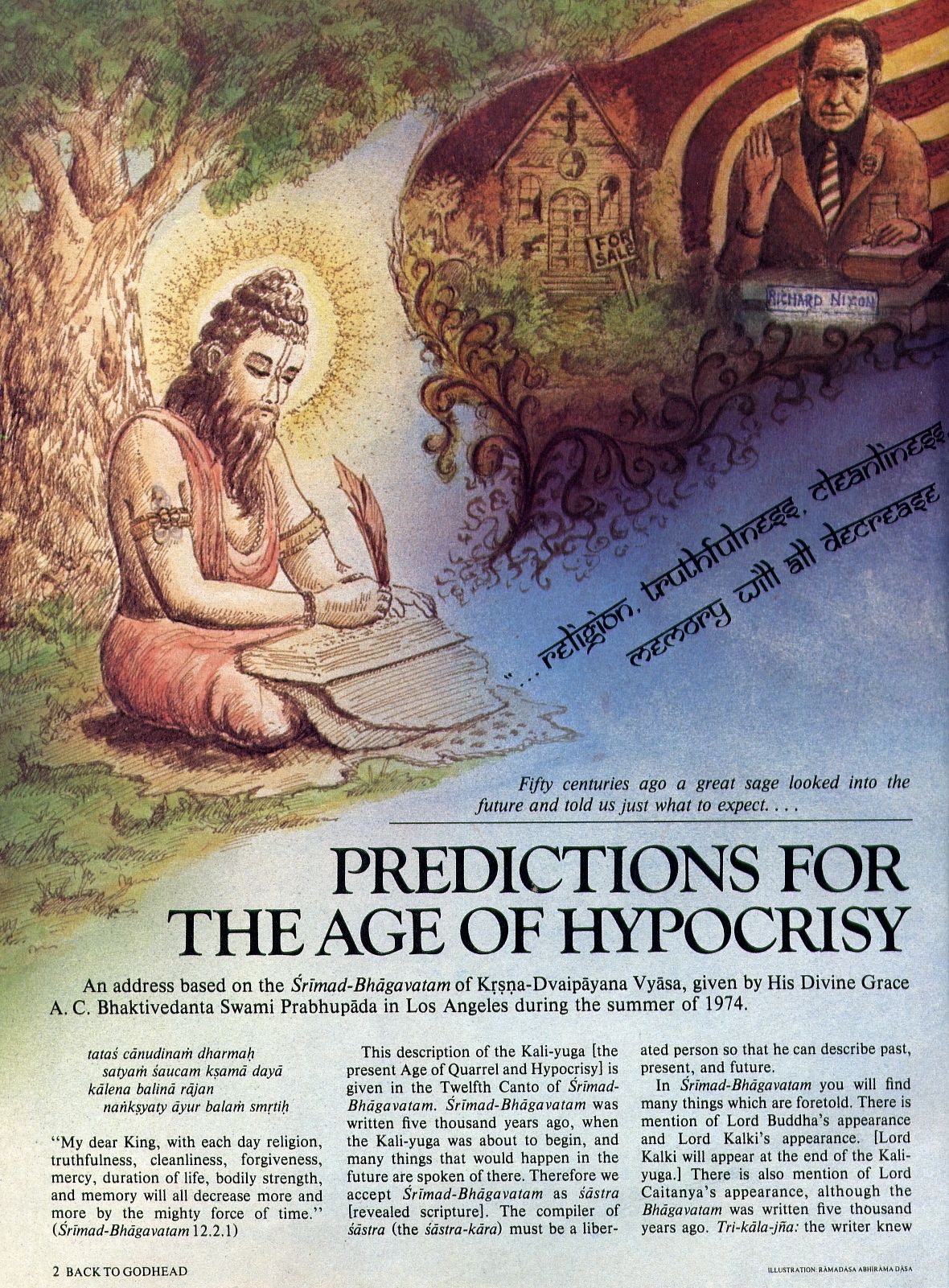
Predictions for the Age of Hypocrisy
Fifty centuries ago a great sage looked into the future and told us just what to expect. . .
An address based on the Srimad-Bhagavatam of Krsna-Dvaipayana Vyasa, given by His Divine Grace A.C. Bhaktivedanta Swami Prabhupada in Los Angeles during the summer of 1974.
Excerpted from Back to Godhead Magazine
tatas canu-dinam dharmah
satyam saucam ksama daya
kalena balina rajan
nanksyaty ayur balam smrtih
“My dear King, with each day religion, truthfulness, cleanliness, forgiveness, mercy, duration of life, bodily strength, and memory will all decrease more and more by the mighty force of time.” (Srimad-Bhagavatam 12.2.1)
This description of the Kali-yuga [the present Age of Quarrel and Hypocrisy] is given in the Twelfth Canto of Srimad-Bhagavatam. Srimad-Bhagavatam was written five thousand years ago, when the Kali-yuga was about to begin, and many things that would happen in the future are spoken of there. Therefore we accept Srimad-Bhagavatam as sastra [revealed scripture]. The compiler of sastra (the sastra-kara) must be a liberated person so that he can describe past, present, and future.
In Srimad-Bhagavatam you will find many things which are foretold. There is mention of Lord Buddha’s appearance and Lord Kalki’s appearance. [Lord Kalki will appear at the end of the Kali-yuga.] There is also mention of Lord Caitanya’s appearance, although the Bhagavatam was written five thousand years ago. Tri-kala-jna: the writer knew past, present, and future.
So here Sukadeva Gosvami is describing the chief symptoms of this age. He says, tatas canudinam: with the progress of this age (Kali-yuga), dharma, religious principles; satyam, truthfulness; saucam, cleanliness; ksama, forgiveness; daya, mercifulness; ayur, duration of life; balam, bodily strength; smrti, memory—these eight things will gradually decrease to nil or almost nil.
More
04 Jun 2013
by The Hare Krishna Movement
in A.C. Bhaktivedanta Swami Prabhupada, Chanting Hare Krishna, Sri Caitanya-Caritamrta
Tags: A.C. Bhaktivedanta Swami Prabhupada, Antya-lila 4.71, chanting Hare Krishna, Hare Krishna, holy name of the lord, Sri Caitanya-caritamrta, Srila Prabhupada, ten offenses
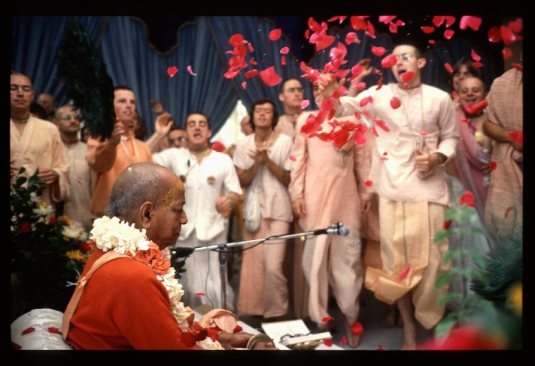
The Following is a very nice verse from the Sri Caitanya-caritamrta about the importance of Chanting the Holy Name of the Lord. Following that is the verse which describes the importance of chanting the names śrī-kṛṣṇa-caitanya prabhu-nityānanda before chanting the Hare Kṛṣṇa mahā-mantra, and the ten kinds of offenses which should be avoided.
…”Of the nine processes of devotional service, the most important is to always chant the holy name of the Lord. If one does so, avoiding the ten kinds of offenses, one very easily obtains the most valuable love of Godhead.” (Antya-lila 4.71)
Similarly, Śrīla Sanātana Gosvāmī has praised the chanting of the holy name as follows in his Bṛhad-bhāgavatāmṛta (Chapter One, verse 9)
“All glories, all glories to the all-blissful holy name of Śrī Kṛṣṇa, which causes the devotee to give up all conventional religious duties, meditation and worship. When somehow or other uttered even once by a living entity, the holy name awards him liberation. The holy name of Kṛṣṇa is the highest nectar. It is my very life and my only treasure.”
More
18 Apr 2013
by The Hare Krishna Movement
in A.C. Bhaktivedanta Swami Prabhupada, Chanting Hare Krishna, Letters by Srila Prabhupada, Sankirtan, Susan Beckman, The Hare Krishna Movement
Tags: A.C. Bhaktivedanta Swami Prabhupada, chanting Hare Krishna, humble state of mind, Jayananda das, Letters by Srila Prabhupada, Lord Caitanya, lower than the straw in the street, sankirtan, sankirtan movement, Susan Beckman, The Hare Krishna Movement
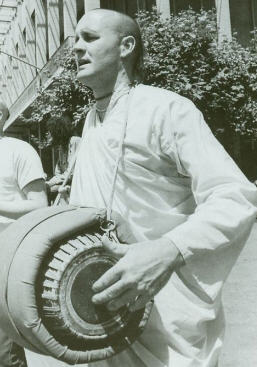
…Lord Sri Chaitanya Mahaprabhu, the incarnation of Godhead in this age has delivered the medicine for all problems of the world by his introducing the Sankirtan movement. The chanting is a process of purification. Just like we use soap to cleanse the body, this is material, but the chanting is spiritual cleansing.
…one should learn the art of chanting the Holy name of Krishna 24 hours a day and that alone is the remedy for all problems of material existence. How is it possible to chant 24 hours a day? Lord Chaitanya gave the hint, “One can chant the holy name of God in a humble state of mind, thinking himself lower than the straw in the street, more tolerant than a tree, devoid of all kinds of sense of false prestige, and always ready to offer all respects to others. In such a humble state of mind one can chant the Holy name of God constantly.” So I cannot give you any better advice for your problem, simply chant Hare Krishna and everything will be all right. (Letter to Susan Bekman from Srila Prabhupada)
Full Letter More
12 Apr 2013
by The Hare Krishna Movement
in A.C. Bhaktivedanta Swami Prabhupada, Chanting Hare Krishna, Mantra Meditation, Srimad Bhagavatam, Vaisnava Vocabulary
Tags: A.C. Bhaktivedanta Swami Prabhupada, chanting Hare Krishna, Hare Krishna, Hare Krishna Mantra, holy name, kirtanad eva krsnasya, Krsna maha-mantra, Lord Caitanya Mahaprabhu, Srila Prabhupada

click on image to enlarge
..Simply by chanting the holy name of Kṛṣṇa: Hare Kṛṣṇa, Hare Kṛṣṇa, Kṛṣṇa Kṛṣṇa, Hare Hare/ Hare Rāma, Hare Rāma, Rāma Rāma, Hare Hare simply by chanting the holy name…,” kīrtanād eva kṛṣṇasya, “he becomes free from all these contaminations, by one thing, simply chanting Hare Kṛṣṇa.”
Kīrtanād eva kṛṣṇasya, mukta-saṅgaḥ paraṁ vrajet
…although Kali-yuga is an ocean of faults, there is still one good quality about this age: Simply by chanting the Hare Kṛṣṇa mahā-mantra, one can become free from material bondage and be promoted to the transcendental kingdom.
This is a very important sloka (verse), as can be confirmed by the number of times Srila Prabhupada has cited it. I was curious about this verse so I went to the incomparable web page Vani Quotes and did a search on the phrase kīrtanād eva kṛṣṇasya, mukta-saṅgaḥ paraṁ vrajet, and was surprised to find just how many times Srila Prabhupada used this verse in his preaching. I think this will be the next verse I try to memorize.
Full verse:
kaler doṣa-nidhe rājann
asti hy eko mahān guṇaḥ
kīrtanād eva kṛṣṇasya
mukta-saṅgaḥ paraṁ vrajet
kaleḥ—of the age of Kali; doṣa-nidheḥ—in the ocean of faults; rājan—O King; asti—there is; hi—certainly; ekaḥ—one; mahān—very great; guṇaḥ—good quality; kīrtanāt—by chanting; eva—certainly; kṛṣṇasya—of the holy name of Kṛṣṇa; mukta-saṅgaḥ—liberated from material bondage; param—to the transcendental spiritual kingdom; vrajet—one can go.
My dear King, although Kali-yuga is an ocean of faults, there is still one good quality about this age: Simply by chanting the Hare Kṛṣṇa mahā-mantra, one can become free from material bondage and be promoted to the transcendental kingdom. (SB 12.3.510
Cited Verses More
08 Mar 2013
by The Hare Krishna Movement
in A.C. Bhaktivedanta Swami Prabhupada, Bhagavad-gita, Om
Tags: A.C. Bhaktivedanta Swami Prabhupada, bhakti yoga, chanting Hare Krishna, mama om visnu-padaya, meditation, Om, om ajnana-timirandhasya, om namo bhagavate vasudevaya, om tat sat, omkara, syllable om, The Syllable Om, yoga

The Syllable Om
Many years ago as a young aspiring yogi, and with my very first attempts at meditation, I began my practice with the sacred syllable Om. Many years later and although I may have advanced somewhat spiritually, and practice bhakti-yoga, devotional service and the chanting of the Maha-mantra Hare Krishna, Hare Krishna, Krishna Krishna, Hare Hare, still all my morning prayers still begin with the syllable Om. Such as “om namo bhagavate vasudevaya” before my reading of the Srimad Bhagavatam. And my morning offering of respectful obeisances to my spiritual master Srila Prabhupada with the prayer “om ajñāna-timirāndhasya jñānāñjana-śalākayā, cakṣur unmīlitaṁ yena tasmai śrī-gurave namaḥ” and “nama oṁ viṣṇu-pādāya kṛṣṇa-preṣṭhāya bhū-tale,śrīmate bhaktivedānta-svāmin iti nāmine”. Today we are looking at a few slokas from the Bhagavad-gita where the syllable Om is used.
More
04 Mar 2013
by The Hare Krishna Movement
in A.C. Bhaktivedanta Swami Prabhupada, Lectures, Nectar of Devotion
Tags: A.C. Bhaktivedanta Swami Prabhupada, Acyutananda das, ceto-darpana-marjanam, chanting Hare Krishna, cleansing the heart, Europeans and Americans, Nectar of Devotion, prabhupada, sankirtan, sri krishna sankirtan, Sri-krsna-sankirtan, Srila Prabhupada

click on image to enlarge
…Kṛṣṇa consciousness is a fact in everyone’s heart. It is already there. Otherwise how these Europeans and Americans, they’re taking to Kṛṣṇa consciousness very seriously? So it is to be understood that Kṛṣṇa consciousness was there already. By the process of hearing… As Caitanya Mahāprabhu has recommended: ceto-darpaṇa-mārjanaṁ paraṁ vijayate śrī-kṛṣṇa-saṅkīrtanam [Cc. Antya 20.12]. Śrī-kṛṣṇa-saṅkīrtanam is so auspicious that the chanting of this mantra awakens the dormant Kṛṣṇa consciousness. Ceto-darpaṇa-mārjanam. The more you hear Hare Kṛṣṇa mantra, the more your heart becomes cleansed. These are the statements given by Caitanya Mahāprabhu. There cannot be any defect. My statement may be defective, but Caitanya Mahāprabhu’s statement cannot be defective, because He is in the transcendental platform. He is transcendence Himself. Kṛṣṇa-caitanya-nāmne. Kṛṣṇāya kṛṣṇa-caitanya-nāmine. He’s Kṛṣṇa Himself, but He has appeared in the form of Kṛṣṇa Caitanya. Therefore, whatever He says, that is fact. Ceto-darpaṇa-mārjanam. The more we hear the vibration, the transcendental vibration, Hare Kṛṣṇa, Hare Kṛṣṇa, Kṛṣṇa Kṛṣṇa, Hare Hare/ Hare Rāma, Hare Rāma, Rāma Rāma, Hare Hare, without any offense… Even with, mixed with offense… There are three stages of chanting this vibration: offensive chanting, and almost offenseless chanting, and offenseless chanting. Offensive chanting may give you material pains and pleasures, and almost offenseless will give you liberation, will place you in the transcendental platform. And when it is offenseless, then immediately you’ll invoke love of God, Kṛṣṇa-prema. So even in offensive stage, if you go on chanting and try to be, try to become safe from offensive condition… Daśa-vidhā-nāma, ten kinds of offenses, if we avoid, that is the process of auspicity. But even we are not in the platform of offenseless chanting, still, we must go on chanting. It will gradually make our heart cleansed and we’ll be offenseless. Ceto-darpaṇa-mārjanaṁ bhava-mahā-dāvāgni-nirvāpaṇam [Cc. Antya 20.12]. So the Kṛṣṇa consciousness, awakening of Kṛṣṇa consciousness, is required. That is called ceto-darpaṇa-mārjanam.
So here, Rūpa Gosvāmī says auspicity means that which spreads for everyone, in all parts of the world. That is auspicity. Not partial. In politics or sociology or humanitarian activities, there is partiality for a certain section of human being, or certain section of living beings. But this chanting of Hare Kṛṣṇa mantra, awakening Kṛṣṇa consc…, dormant Kṛṣṇa consciousness, is meant for all living entities. Even birds, beasts, insects, they can also awaken. This is the recommendation of Haridāsa Ṭhākura, that if we chant loudly, the trees will hear, the birds will hear, the insect will hear, and they will be liberated. That is the statement of Nāmācārya Haridāsa Ṭhākura. Therefore chanting of Hare Kṛṣṇa mantra and awakening of dormant Kṛṣṇa consciousness is the auspicious activities, welfare activities, for every living entity all over the world.
Full Lecture More
Previous Older Entries Next Newer Entries













 The Hare Krishna Movement