I remember some years ago (1979), Bob Dylan released this song entitled “Gotta Serve Somebody”. I’m sure many of you remember it.
[Chorus] But you’re going to have to serve somebody, yes indeed You’re going to have to serve somebody Well, it may be the devil or it may be the Lord But you’re going to have to serve somebody
I chose to serve the Lord, Krishna. Service ts our eternal nature, our dharma. And like Bob says “You’re going to have to serve somebody”
The following are some quotes from the Srimad Bhagavatam, ant the Bhagavad-gita, on our eternal relationship (sanātana-dharma) with the Lord.
At the last stage of one’s life, one should be bold enough not to be afraid of death. But one must cut off all attachment to the material body and everything pertaining to it and all desires thereof. (SB 2.1.15)
The foolishness of gross materialism is that people think of making a permanent settlement in this world, although it is a settled fact that one has to give up everything here that has been created by valuable human energy. Great statesmen, scientists, philosophers, etc., who are foolish, without any information of the spirit soul, think that this life of a few years only is all in all and that there is nothing more after death. This poor fund of knowledge, even in the so-called learned circles of the world, is killing the vitality of human energy, and the awful result is being keenly felt. And yet the foolish materialistic men do not care about what is going to happen in the next life. The preliminary instruction in the Bhagavad-gītā is that one should know that the identity of the individual living entity is not lost even after the end of this present body, which is nothing but an outward dress only. As one changes an old garment, so the individual living being also changes his body, and this change of body is called death. Death is therefore a process of changing the body at the end of the duration of the present life. An intelligent person must be prepared for this and must try to have the best type of body in the next life. The best type of body is a spiritual body, which is obtained by those who go back to the kingdom of God or enter the realm of Brahman. (from purport)
sarva-bhūta-stham—situated in all beings; ātmānam—the Supersoul; sarva—all; bhūtāni—entities; ca—also; ātmani—in the Self; īkṣate—does see; yoga-yukta-ātmā—one who is dovetailed in Kṛṣṇa consciousness; sarvatra—everywhere; sama-darśanaḥ—seeing equally.
TRANSLATION A true yogī observes Me in all beings, and also sees every being in Me. Indeed, the self-realized man sees Me everywhere.
PURPORT
A Kṛṣṇa conscious yogī is the perfect seer because he sees Kṛṣṇa, the Supreme, situated in everyone’s heart as Supersoul (Paramātmā).
Īśvaraḥ sarva-bhūtānāṁ hṛd-deśe ’rjuna tiṣṭhati.
The Supreme Lord is situated in everyone’s heart, O Arjuna, and is directing the wanderings of all living entities.
Today we celebrate the Appearance of Srila Bhaktisiddhanta Saraswati Thakura, the son of Srila Bhaktivinoda Thakura, and Spiritual Master of our Srila Prabhupada. We will honor it with a half day fast, rememberances and readings. I happened upon the following post some years ago on the Sampradaya Sun, and because it was so nicely assembled, we will share it with you here today.
The Appearance of Srila Bhaktisiddhanta by Sun Staff CANADA (SUN)
Srila Bhaktisiddhanta Saraswati Thakura appeared in Purusottam Ksetra, Jagannatha Puri, Orissa, on February 6, 1874. He was born in the family home next to the Narayan-chhata of Sri Jagannatha Temple, which always reverberated with the chanting of the Holy Name. Named Bimala Prasad, He was the fourth son of Srila Bhaktivinoda Thakura and Srimati Bhagavati Devi.
By the age of twelve, Bhaktisiddhanta Sarasvati was well versed in astronomy. Hearing news of this, Srila Jagannatha dasa Babaji summoned him one day and instructed him to make a Vaisnava calendar that included the appearance and disappearance days of all Lord Caitanya Mahaprabhu’s and Visnupriya Thakurani’s associates. Following these instructions, Srila Bhaktisiddhanta Sarasvati made the necessary calculations and began publication of “Sri Nabadvipa Panjica”.
Last night as I was falling asleep, this prayer just popped into my head:
SRI RUPA PRANAMA
sri-caitanya-mano-‘bhistam sthapitum yena bhtu-tale svayam rupah kada mahyam dadati sva-padantikam
sri-caitanya-of Lord Caitanya; manah– mind; abhistam-what is desired; sthapitam-established; yena-by whom; bhu-tale-on the surface of the globe; svayam-himself; rupah-Srila Rupa Gosvami; kada-when; mahyam-unto me; dadati-will give; sva-his own; pada-lotus feet; antikam-proximity to.
When will Srila Rupa Gosvami Prabhupada, who has established within this material world the mission to fulfill the desire of Lord Caitanya, give me shelter under his lotus feet?
And as I drifted off to sleep I was thinking about Srila Rupa Goswami, I don’t know why. But I woke still thinking about him. The following is an article from Back to Godhead Magizine.
Obstacles on the Path of Eternity An Excerpt from Srila Rupa Gosvami’s Upadesamrta from Back to Godhead Magazine Vol. 1, No.88, 1973
[SRILA RUPA GOSVAMI was one of six exalted devotees especially chosen through the Krsna conscious chain of spiritual masters to teach the devotional service of the Supreme Lord in a scientific manner. Although all of these six great devotees were erudite scholars and prolific writers, Srila Rupa Gosvami is the most prominent, for he most greatly appreciated the nectar of Krsna consciousness. His Upadesamrta (Nectarean Instructions), a short work of only eleven verses, teaches the basic principles for arousing one’s dormant love of Krsna, the Supreme Lord. Written in Sanskrit some 400 years ago, it has now been translated into English, with an illuminating explanation of each verse, by His Divine Grace A.C. Bhaktivedanta Swami Prabhupada.]
The following is one of the most quoted verses by Srila Prabhupada, from the Srimad Bhagavatam, and it is also one of the longest purports as well. Very important verse!
śrī-prahrādaḥ uvāca—Prahlāda Mahārāja said; śravaṇam—hearing; kīrtanam—chanting; viṣṇoḥ—of LordViṣṇu (not anyone else); smaraṇam—remembering; pāda-sevanam—serving the feet; arcanam—offering worship (with ṣoḍaśopacāra, the sixteen kinds of paraphernalia); vandanaṁ—offering prayers; dāsyam—becoming the servant; sakhyam—becoming the best friend; ātma-nivedanam—surrendering everything, whatever one has; iti—thus; puṁsā arpitā—offered by the devotee; viṣṇau—unto Lord Viṣṇu (not to anyone else); bhaktiḥ—devotional service; cet—if; nava-lakṣaṇā—possessing nine different processes; kriyeta—one should perform; bhagavati—unto the Supreme Personality of Godhead; addhā—directly or completely; tat—that; manye—I consider; adhītam—learning; uttamam—topmost.
Prahlāda Mahārāja said: Hearing and chanting about the transcendental holy name, form, qualities, paraphernalia and pastimes of Lord Viṣṇu, remembering them, serving the lotus feet of the Lord, offering the Lord respectful worship with sixteen types of paraphernalia, offering prayers to the Lord, becoming His servant, considering the Lord one’s best friend, and surrendering everything unto Him (in other words, serving Him with the body, mind and words)—these nine processes are accepted as pure devotional service. One who has dedicated his life to the service of Kṛṣṇa through these nine methods should be understood to be the most learned person, for he has acquired complete knowledge.
When Prahlāda Mahārāja was asked by his father to say something from whatever he had learned, he considered that what he had learned from his spiritual master was the best of all teachings…(from purport)
O son of Kuntī [Arjuna], I am the taste of water, the light of the sun and the moon, the syllable om in the Vedic mantras; I am the sound in ether and ability in man.(Bg 7.8)
“Water is our life. So when you take water, quench your thirst, you can immediately thank God because that taste is God. So immediately you can remember, “O my dear Lord, You have created so nice thing, water. Oh, I am so thirsty. It is quenching my thirst. Thank You.” Is it very difficult? But the nonsense, they will not do even this. They’ll say, “Oh, God is dead.” Therefore we are suffering. We are so ungrateful that we even do not give thanks. In the ordinary way, if somebody gives me a glass of water when I am thirsty—it is etiquette—I say, “Thank you.” And God has given us so vast mass of water in the ocean, in the sea, in the sky. Without water we cannot live. There is no thanksgiving. There is no thanksgiving.” (Śrīla Prabhupāda, 68/08/20 – Lecture SB 07.09.12-13 – Montreal)
Recently I was staying at a friends house, and in the room where I was spending the night there was one book by Giriraj Swami entitled “Watering the Seed”. I happened to open it and began reading from the Preface:
…from that first meeting with Srila Prabhupada, my whole life’s purpose became to bring people to meet Srila Prabhupada. And I was able to do that for many years. But when he passed away, I wondered ‘what will be my service now?’. My whole service had been to bring people to Srila Prabhupada.
Now I understand that Srila Prabhupada is always present, and that by speaking of him, hearing about him, remembering him, and, most significantly, by studying his books and following his instructions, we can experience his presence. So I can continue doing what I was doing when he was personally present-introducing soul’s to Srila Prabhupada-and that is what I feel most natural doing. Because I know that somehow or other, if someone comes in touch with Srila Prabhupada, his life will become successful. (Watering the Seed, Preface)
Now, I am always encouraged when I hear my Godbrothers speaking in this way, because this is how I have always felt, and continue to feel. That my main purpose, as a disciple, is to bring people to Srila Prabhupada, and there-by bringing them to Krishna.
Sometime ago, I ran across this wonderful web site Prabhupada.io. It has it all, images, text, conversations, lectures, letters, etc. It is truly an Archive of Srila Prabhupada’s Original unedited words. Highly Recommended!
Building a Sacred Digital Archive for the Next 10,000 Years
The path to creating Prabhupada.io began with a simple recognition: Srila Prabhupada’s teachings are not merely books—they are eternal law books that deserve preservation and accessibility for millennia to come.
The Vision: A True Digital Archive
What distinguishes a true digital archive from a mere collection of files? It requires, among other things:
Comprehensive indexing that reveals the interconnected web of spiritual knowledge
Clean, searchable source texts extracted with care from the original works
Intuitive navigation that serves both newcomers and scholars
Open accessibility that removes barriers between seekers and sacred wisdom
Future-proof architecture built to endure for generations
Question: How Many Persons are Benefitted from Book Distribution?…………
Prabhupada: Whoever gets a book is benefitted. If he reads the book he is benefitted still more, or if he gives the book to someone else for reading, both he and the other person is benefitted. Even if one does not read the book but simply holds if and sees it, he is benefitted. If he simply gives small donation towards the work of Krsna consciousness he is benefitted. And anyone who distributes these transcendental literatures, he is also benefitted. ( Letter to: German Disciples — Bombay May 6, 1977)
Thank you to whoever posted this on Facebook. I didn’t catch the name of person posting this, but this is real good!
THE BHAGAVAD GITA IN TEN POINTS On July 13, 1947 Srila Prabhupada wrote a letter to Raja Mohendra Pratap and explained the Bhagavad-gita to him in ten points. The following is Srila Prabhupada’s summary of ten conclusions in the Bhagavad-gita.
1) God is one and everything is in Him and He is in everything.
2) To render transcendental service unto God is to serve everything that be, just like to water the root of the tree is to water the different branches and numerous leaves of the tree or to supply food to the stomach is to vitalize all the senses and the sense organs of the body.
3) The parts are automatically served when the Whole is served but when the parts are served the whole may not be served or not served at all.
4) The parts and the Whole being eternally related, it is the eternal duty of the parts to render service unto the Whole.
5) A recipient of the services of the parts, God’s sat-cit-ananda vigraha, i.e., the all-attractive Cognizant and all-blissful Personality eternal. He can reveal Himself by His own potency without any help of the external potency called maya in order to be cognizable by the limited potency of the parts and as such He is not only the greatest of all but he is the smallest of all. That is His prerogative.
6) He is better realized when He by His causeless mercy agrees to descend in this mortal world but He is never realized by the partial speculations of the empiric philosophers, however systematic and long-termed it may be.
7) Sri Krishna is the Personality of Godhead and is the Summum Bonum Cause of all Causes proved by fact and figures in the statement of Bhagavad-gita, but He reserves the right of not being exposed to the sensual speculations of the empiric philosophers.
One should therefore surrender unto Him if one wants to know Him as He is and that is the real process to approach the Infinite by the infinitesimals.
9) Sri Krishna is easily available by the religion of love, i.e., by love and service as conceived by the damsels of Vraja who had practically no education whatsoever and much less any claim for high class birthright.
10) The highest service that can be rendered to the mankind is, therefore, to preach the philosophy and religion of Bhagavad-gita for all the times, all the places and all the people.
Happy New Year to all are readers. Wishing you all a prosperous new year filled with happiness and love. And may your Krishna Consciousness increase with each passing day.
When I think of New Years, I am reminded of what a short time a year is in the greater scheme of eternity. In the Bhagavad-gita there is a brief description of the duration of time in the material universe.
…The duration of the material universe is limited. It is manifested in cycles of kalpas. A kalpa is a day of Brahmā, and one day of Brahmā consists of a thousand cycles of four yugas or ages: Satya, Tretā, Dvāpara, and Kali. The cycle of Satya is characterized by virtue, wisdom and religion, there being practically no ignorance and vice, and the yuga lasts 1,728,000 years. In the Tretā-yuga vice is introduced, and this yuga lasts 1,296,000 years. In the Dvāpara-yuga there is an even greater decline in virtue and religion, vice increasing, and this yuga lasts 864,000 years. And finally in Kali-yuga (the yuga we have now been experiencing over the past 5,000 years) there is an abundance of strife, ignorance, irreligion and vice, true virtue being practically nonexistent, and this yuga lasts 432,000 years. (from purport Bg 8.17)
Even if I could grasp the extent of time in the material universe, that is just a fraction of the unlimited eternal time that continues after the termination of the yuga.
…Then the process is set rolling again. These four yugas, rotating a thousand times, comprise one day of Brahmā, the creator god, and the same number comprise one night. Brahmā lives one hundred of such “years” and then dies. These “hundred years” by earth calculations total to 311 trillion and 40 million earth years. By these calculations the life of Brahmā seems fantastic and interminable, but from the viewpoint of eternity it is as brief as a lightning flash. In the causal ocean there are innumerable Brahmās rising and disappearing like bubbles in the Atlantic. Brahmā and his creation are all part of the material universe, and therefore they are in constant flux. (from purport Bg 8.17)
The above calculations Srila Prabhupada uses and I quote;
…seems fantastic and interminable, but from the viewpoint of eternity it is as brief as a lightning flash.
Earliest Recording of Srila Prabhupada in the Bhaktivedanta Archives
Its interesting to note that this lecture also became the Introduction to Bhagavad-gita As It Is
Prabhupāda:
om ajnana-timirandhasya jnananjana-salakaya caksur unmilitam yena tasmai sri-gurave namah
sri-caitanya-mano-‘bhistam sthapitum yena bhtu-tale svayam rupah kada mahyam dadati sva-padantikam
vande ‘ham sri-guroh sri-yuta-pada-kamalam sri-gurun vaisnavams’ ca sri-rupam sagrajatam saha-gana-raghunathanvitam tam sa jivam sadvaitam savadhutam parijana-sahitam krsna-caitanya-devam sri-radha-krsna-padan saha-gana-lalita-sri-visakhanvitams’ ca
he krsna karuna-sindho dina-bandho jagat-pate gopesa gopika kanta radha-kanta namo ‘stu te
Hare Krishna, Hare Krishna Krishna Krishna, Hare Hare Hare Rama, Hare Rama Rama Rama, Hare Hare
Bhagavad-gītā is known also Gītopaniṣad, the essence of Vedic knowledge, and one of the most important of the various Upaniṣads in Vedic literature. This Bhagavad-gītā, there are many commentations in English, and what is the necessity of another English commentation of the Bhagavad-gītā can be explained in the following way. One . . .
(break) One American lady, Mrs. Charlotte Leblanc, asked me to recommend an English edition of Bhagavad-gītā which she can read.
Of course, in America there are so many editions of English Bhagavad-gītā, but so far I have seen them, not only in America but also India, none of them can be said strictly as authoritative, because almost every one of them have expressed their own opinion through the commentation of the Bhagavad-gītā without touching the spirit of Bhagavad-gītā As It Is.
The spirit of Bhagavad-gītā is mentioned in the Bhagavad-gītā itself. It is just like this—if we want to take a particular medicine, then we have to follow the particular direction mentioned on the label of the medicine. We cannot take the particular medicine according to our own direction or by the direction of a friend, but we have to take the medicine under the direction given on the label of the bottle and as directed by the physician. Similarly, the Bhagavad-gītā also should be taken or accepted as it is directed by the speaker Himself.
…”I have read one book, Lord Jesus Christ, when he was a young boy he was very much shocked when he saw that animal-killing is going on in the synagogue. Therefore he differentiated from the Jews and he started his own religion, Christian religion. Is it not a fact? Am I right? Why… He was also a Jew. Why he deviated? Why he deviated from the Jews? Because when he saw in his young age that animals are being killed in the synagogue, he differed, “No, no, this is horrible. This should be stopped.” Therefore, his first commandment is “Thou shall not kill.” (Exodus 20:13) Am I wrong or right? Eh? That was his first impression, that people should stop killing. So who is Christian? Everyone is violating this first commandment, what to speak of other commandments. Everyone. So it is very difficult to find a real Christian. But if you violate the commandments of Christ, then what kind of Christian you are? This is our question. Who will answer this?” (Lecture by His Grace Srila Prabhupada, Srimad Bhagavatam 1.16.21 Hawaii January 17 1974)
Here is another word for your vaisnava vocabulary; Acaryopasanam.
In Bhagavad-gita, Thirteenth Chapter, it is clearly stated that one should execute devotional service and advance on the path of spiritual knowledge by accepting the acarya.Ācāryopāsanam: one should worship an acarya, a spiritual master who knows things as they are. The spiritual master must be in the disciplic succession from Krsna. (from purport SB 3.29.17)
We can understand from Srila Prabhupada, that there are huge gaps in the disciplic succession, but we need to follow the prominent Acarya.
“So these gaps do not hamper from understanding the parampara system. We have to pick up the Prominent Acarya, and follow from him.” (letter to Dayananda April12,1968)
Śrī Caitanya Mahaprabhu is none other than the combined form of Sri Radha and Krsna.
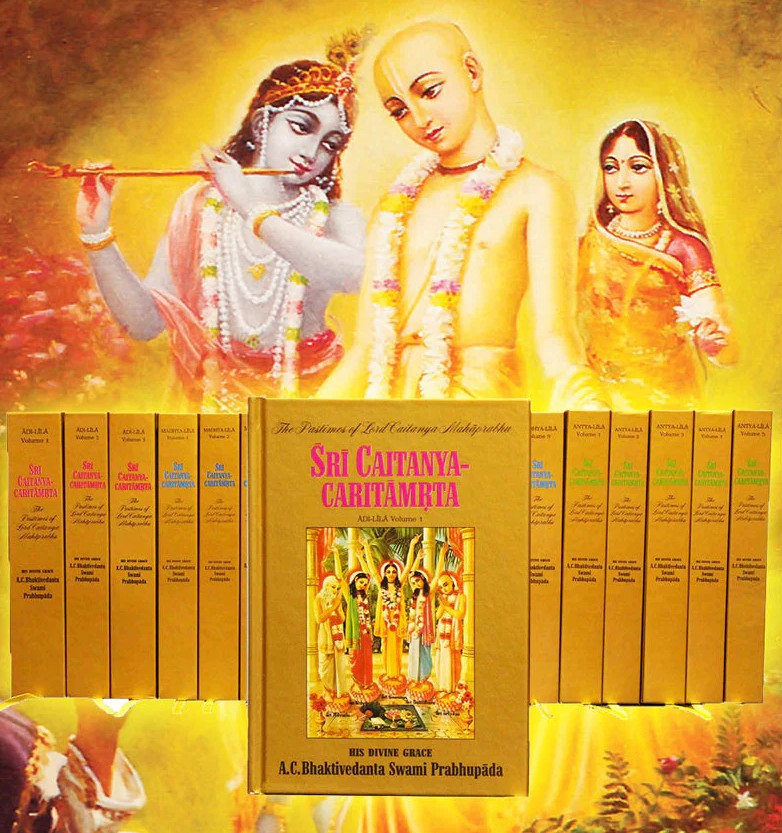
This morning I happened to open the Sri Caitanya-caritamrta Vol.1, and just began reading from the Preface. Every time I read from Srila Prabhupada’s books, something important is revealed, or something important is remembered.This morning I was reminded of the six guidelines for the process of surrender.
A pure devotee is a soul who is forever surrendered to the Lord, just as a child is surrendered to his parents or an animal to its master. In the surrendering process, one should: (1) accept things favorable for discharging devotional service, (2) reject things unfavorable, (3) believe firmly in the Lord’s protection, (4) feel exclusively dependent on the mercy of the Lord, (5) have no interest separate from the interest of the Lord, and (6) always feel oneself meek and humble.
Although Srila Prabhupada wrote many books, he one day asked me, “So why did I write all these books?” I said, “So we can know the philosophy, learn the philosophy.” He said, “No, the purpose of all these books is to convince you to chant the holy name of Krishna.”
Chanting is exactly like the simple method of inhaling and exhaling. Although it seems like a very simple act, it is nevertheless the essence of the whole thing. Without that inhaling and exhaling, none of the other activities can take place. We also understand that no one simply inhales and exhales, but all the other activities are supportive of the inhaling and exhaling.
”One cleanses himself daily by taking a bath in water, but one who takes his bath only once in the sacred Ganges water of the Bhagavad-gita cleanses away all the dirt of material life. Because Bhagavad-gita is spoken by the Supreme Personality of Godhead, one need not read any other Vedic literature. One need only attentively and regularly hear and read Bhagavad-gita.
In the present age, mankind is so absorbed with mundane activities that it is not possible to read all of the Vedic literatures. But this is not necessary. This one book, Bhagavad-gita, will suffice because it is the essence of all Vedic literatures and because it is spoken by the Supreme Personality of Godhead.
It is said that one who drinks the water of the Ganges certainly gets salvation, but what to speak of one who drinks the waters of Bhagavad-gita? Gita is the very nectar of the Mahabharata spoken by Visnu Himself, for Lord Krsna is the original Visnu. It is nectar emanating from the mouth of the Supreme Personality of Godhead, and the Ganges is said to be emanating from the lotus feet of the Lord. Of course there is no difference between the mouth and the feet of the Supreme Lord, but in our position we can appreciate that the Bhagavad-gita is even more important than the Ganges.
The Bhagavad-gita is just like a cow, and Lord Krsna, who is a cowherd boy, is milking this cow. The milk is the essence of the Vedas, and Arjuna is just like a calf. The wise men, the great sages and pure devotees, are to drink the nectarean milk of Bhagavad-gita.
In this present day, man is very eager to have one scripture, one God, one religion, and one occupation. So let there be one common scripture for the whole world–Bhagavad-gita. And let there be one God only for the whole world–Sri Krsna. And one mantra only–Hare Krsna, Hare Krsna, Krsna Krsna, Hare Hare/ Hare Rama, Hare Rama, Rama Rama, Hare Hare. And let there be one work only–the service of the Supreme Personality of Godhead.” (Bhagavad-gītā Introduction)
Please accept my humble obeisances, and kindly forgive my offences.
I offer my most humble and heartfelt obeisance’s on this most auspicious day of your disappearance. As Srila Bhaktivinoda Thakur has reminded us:
He reasons ill who says that Vaiṣṇavas die, When thou art living still in sound! The Vaiṣṇavas die to live, and living try To spread the holy name around.
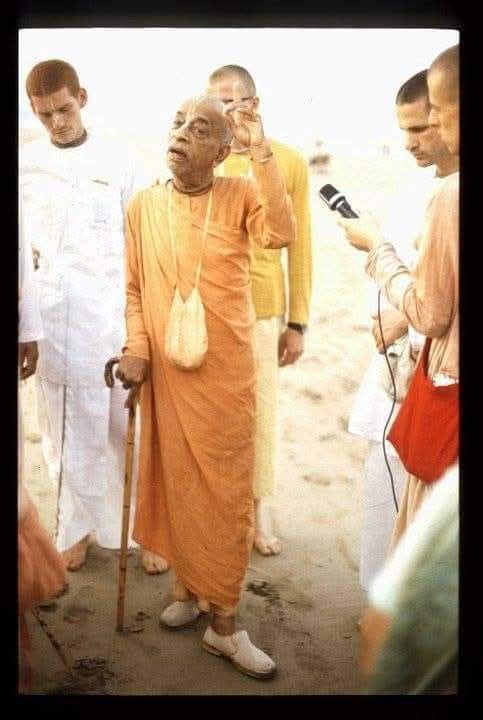
For me there is no difference between your appearance day and your disappearance day, for you are very much alive, in the hearts of you disciples. You live on, in your words and instructions.
Recently we visited Buttler PA, where you first preached the mission of Sri Caitanya Mahaprabhu, and we witnessed your humble introduction to America.
Thank you for coming to this world to save us in spite of the tremendous difficulties and obstacles which you had to face alone, depending solely on the mercy of the Supreme Lord Krishna and your eternal spiritual master, Srila Bhaktisiddhanta Sarasvati Thakura.
Thank you for coming to America, and bringing with you so many matchless gifts. Not only did you bring the message of Krishna and Lord Caitanya, but you brought with you music and art, Vedic medicine, the science of cooking vegetarian food, and the keys to a healthy and productive life, in the service of God. I may never have learned who is God, had you not appeared on our shores.
Although I am an unworthy disciple, full of faults, I approach you with the greatest appreciation, and utmost respect, for you are the greatest spiritual ambassador to spread Krishna Consciousness all over the world.
I don’t have the words to properly glorify you, so instead, in closing, I want to quote from you, in your closing address to your Spiritual master Srila Bhaktisiddhanta, given in homage in 1936:
Personally, I have no hope for any direct service for the coming crores of births of the sojourn of my life, but I am confident that some day or other I shall be delivered from this mire of delusion in which I am at present so deeply sunk. Therefore let me with all my earnestness pray at the lotus feet of my divine master to allow me to suffer the lot for which I am destined due to my past misdoings, but to let me have this power of recollection: that I am nothing but a tiny servant of the Almighty Absolute Godhead, realized through the unflinching mercy of my divine master. Let me therefore bow down at his lotus feet with all the humility at my command. -Abhay Charan Das 1936
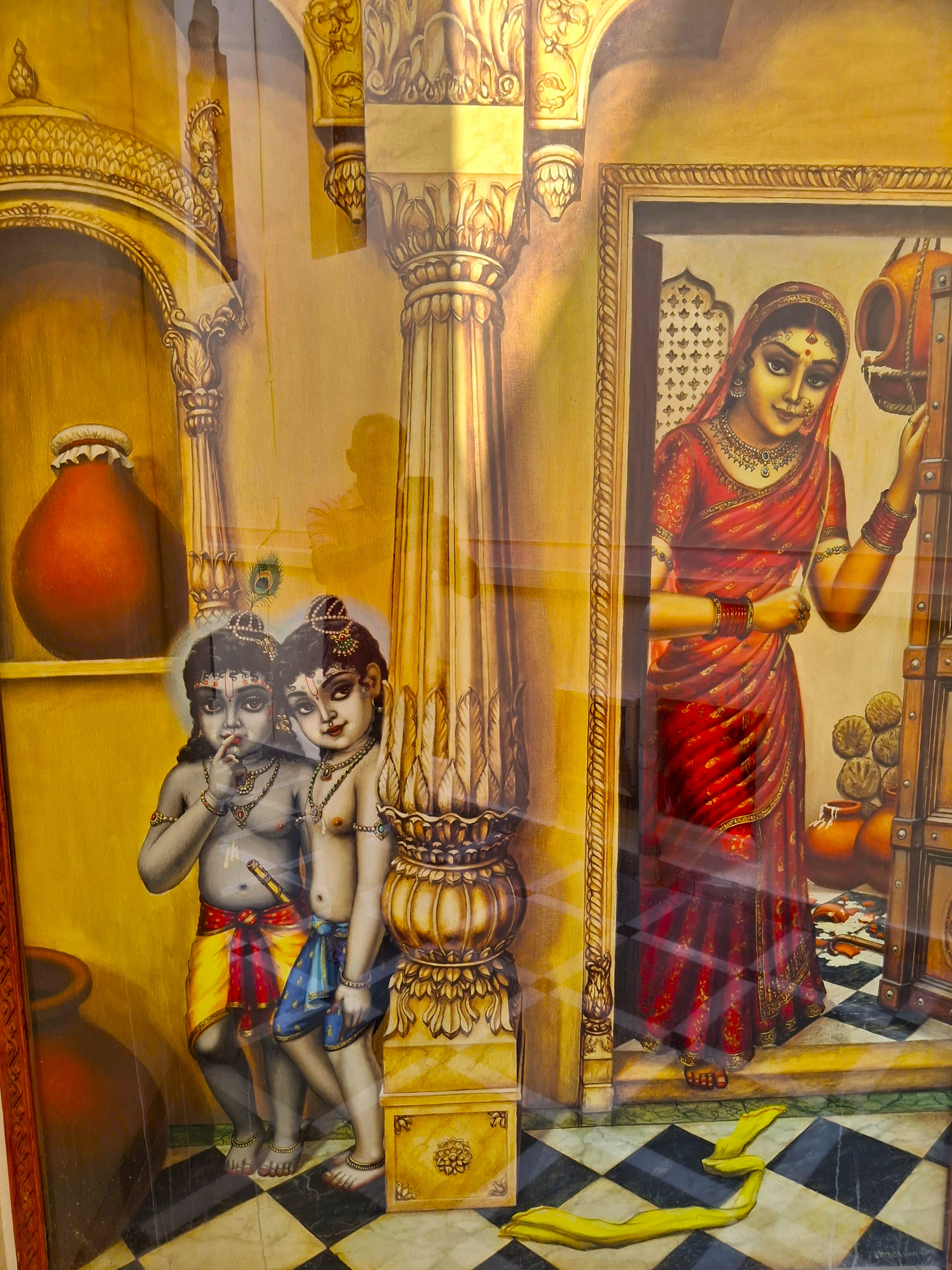
When we were in India for the 50th Anniversary of the Krishna Balarama Mandir, I saw this beautiful painting of Krishna, Balarama and Mother Yasoda. I know it is not the best image…as the glass was reflecting the sunlight…but there was something about this painting that captured my imagination and just pulled me into the pastime.
“O Lord, although You are able to give all kinds of benedictions, I do not pray to You for liberation, nor eternal life in Vaikuntha, nor any other boon. My only prayer is that Your childhood pastimes may constantly appear in my mind. O Lord, I do not even want to know Your feature of Paramatma. I simply wish that Your childhood pastimes may ever be enacted in my heart.” (verse 4 from the Sri Damodarastaka)











 The Hare Krishna Movement