07 Dec 2013
by The Hare Krishna Movement
in A.C. Bhaktivedanta Swami Prabhupada, Lectures, Nectar of Devotion
Tags: A.C. Bhaktivedanta Swami Prabhupada, bhajana-kriya, Caitanya Mahaprabhu, Dasasvamedha-ghara, devotional service, four principles, Initiation, lecture on Nectar of Devotion, Nectar of Devotion, prabhupada, ruci, Rupa Gosvami, sadhu-sanga, sraddha, TLC

The Nectar of Devotion Lecture
Los Angeles, June 23, 1970
Prabhupāda: Hare Kṛṣṇa.
So we have published our Nectar of Devotion.
So every one of you should read this Nectar of Devotion repeatedly.
The whole substance of Vaiṣṇava philosophy and activities, everything is there.
So every one of you read this Nectar of Devotion once, twice, thrice.
Unless you have got full-fledged ideas what is this devotional service… That was written by… Actually, it was spoken by Lord Caitanya to Rūpa Gosvāmī. For ten days continually He instructed Rūpa Gosvāmī at Prayāga, Daśāśvamedha-ghāṭa. You have seen the picture in TLC. Caitanya Mahāprabhu was at Allahabad, Prayāga, and Rūpa Gosvāmī met Him there. He was offering obeisances flat. You have seen that picture. So at that time Caitanya Mahāprabhu personally gave him instruction what is this cult of bhakti. So for ten days. And he took note of it and later on he placed this book in the form of Bhakti-rasāmṛta-sindhu. That is in Sanskrit. It will be difficult for you. Therefore I have presented a summary study, and the summary study has come to 407 pages. If we would have elaborately described each and every verse, then it would have come to at least thousand pages.
More
05 Dec 2013
by The Hare Krishna Movement
in A.C. Bhaktivedanta Swami Prabhupada, Narada Muni, Srimad Bhagavatam
Tags: A.C. Bhaktivedanta Swami Prabhupada, Krsna, Liberated souls, meditate on the lotus feet of the lord, Narada Muni, Personality of Godhead, supersoul, The Supreme Personality of Godhead, Vyasa, Vyasadeva
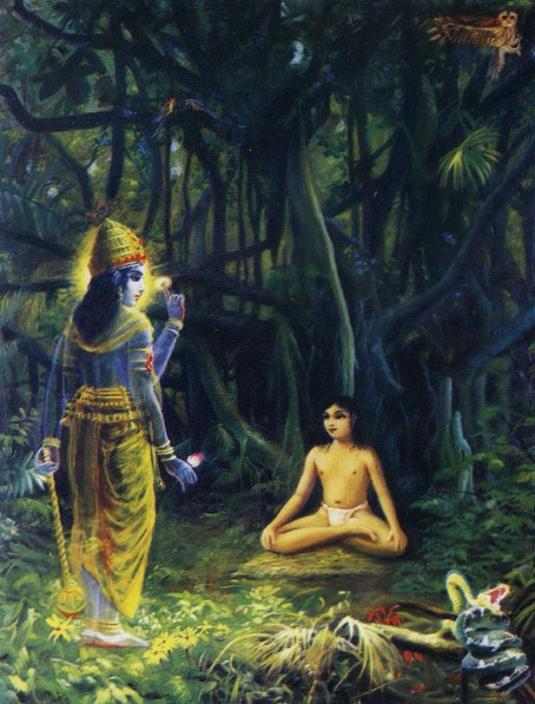
This morning I was reading from the First Canto, sixth chapter of the Srimad Bhagavatam entitled “Conversation Between Nārada and Vyāsadeva”. Here Śrī Nārada Muni is explaining how it is, he attained his present transcendental body, and his encounter with the Personality of Godhead Śrī Kṛṣṇa. This is a beautiful chapter and I find myself reading it again and again.
After that, under the shadow of a banyan tree in an uninhabited forest I began to meditate upon the Supersoul situated within, using my intelligence, as I had learned from liberated souls.
As soon as I began to meditate upon the lotus feet of the Personality of Godhead with my mind transformed in transcendental love, tears rolled down my eyes, and without delay the Personality of Godhead Śrī Kṛṣṇa appeared on the lotus of my heart.
O Vyāsadeva, at that time, being exceedingly overpowered by feelings of happiness, every part of my body became separately enlivened. Being absorbed in an ocean of ecstasy, I could not see both myself and the Lord.
The transcendental form of the Lord, as it is, satisfies the mind’s desire and at once erases all mental incongruities. Upon losing that form, I suddenly got up, being perturbed, as is usual when one loses that which is desirable.
I desired to see again that transcendental form of the Lord, but despite my attempts to concentrate upon the heart with eagerness to view the form again, I could not see Him any more, and thus dissatisfied, I was very much aggrieved.
Seeing my attempts in that lonely place, the Personality of Godhead, who is transcendental to all mundane description, spoke to me with gravity and pleasing words, just to mitigate my grief.
O Nārada [the Lord spoke], I regret that during this lifetime you will not be able to see Me anymore. Those who are incomplete in service and who are not completely free from all material taints can hardly see Me.
O virtuous one, you have only once seen My person, and this is just to increase your desire for Me, because the more you hanker for Me, the more you will be freed from all material desires.
Srimad Bhagavatam
By His Divine Grace A. C. Bhaktivedanta Swami Prabhupada
First Canto, Chapter 6, Text 15-22
full text and purports More
02 Dec 2013
by The Hare Krishna Movement
in A.C. Bhaktivedanta Swami Prabhupada, Arsha Prayoga, BBT, Bhagavad-gita, Book Changes, Rupanuga das
Tags: 1983 second edition, A.C. Bhaktivedanta Swami Prabhupada, BBT, Bhagavad-gita As It Is, book changes, Rupanuga das, Srila Prabhupada
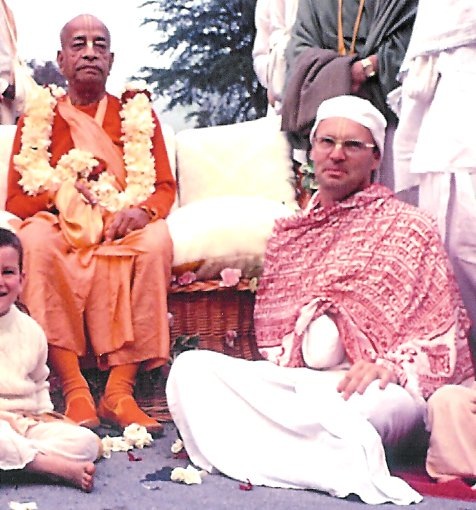
Here is another nice article by Sriman Rupanuga Prabhu. This deals with the book changes issue, particularly, the revised 1983 Bhagavad-gita. This book change issue is very important for the spiritual welfare of all future generations of devotees and interested persons. It is worth a careful read.
Taking Credit Where Credit’s Due
by Rupanuga das (ACBSP)
The revised and enlarged edition of the Bhagavad-gita As It Is (BGAII), as published by the Bhaktivedanta Book Trust (BBT) 1983, disregards the academic community’s protocols or standards governing the revised editions of the books. According to the guidelines now widely accepted and practiced by publishers and academicians, the names of editors and co-authors of such newly revised editions are to be included along with dates. This distinguishes such a 2nd edition from a publication which is only a second printing of an author’s original first edition.
More
01 Dec 2013
by The Hare Krishna Movement
in A.C. Bhaktivedanta Swami Prabhupada, Kali Yuga, Srimad Bhagavatam, Vedas
Tags: A.C. Bhaktivedanta Swami Prabhupada, anomalies, enlightened in spiritual knowledge, future anomalies, Kaili age, Kali, Kali-yuga, millennium, spiritual knowldege, spiritual master, Srila Vyasadeva, Srimad Bhagavatam, Vyasadeva

The great sage Vyāsadeva saw anomalies in the duties of the millennium. This happens on the earth in different ages, due to unseen forces in the course of time.
The great sages like Vyāsadeva are liberated souls, and therefore they can see clearly past and future. Thus he could see the future anomalies in the Kali age, and accordingly he made arrangement for the people in general so that they can execute a progressive life in this age, which is full of darkness. The people in general in this age of Kali are too much interested in matter, which is temporary. Because of ignorance they are unable to evaluate the assets of life and be enlightened in spiritual knowledge.
…The unmanifested forces of time are so powerful that they reduce all matter to oblivion in due course. In Kali-yuga, the last millennium of a round of four millenniums, the power of all material objects deteriorates by the influence of time. In this age the duration of the material body of the people in general is much reduced, and so is the memory. The action of matter has also not so much incentive. The land does not produce food grains in the same proportions as it did in other ages. The cow does not give as much milk as it used to give formerly. The production of vegetables and fruits is less than before. As such, all living beings, both men and animals, do not have sumptuous, nourishing food. Due to want of so many necessities of life, naturally the duration of life is reduced, the memory is short, intelligence is meager, mutual dealings are full of hypocrisy and so on.
Srimad Bhagavatam
By His Divine Grace A. C. Bhaktivedanta Swami Prabhupada
Canto One, Chapter 4, Texts 16, 17-18
full text and purport More
30 Nov 2013
by The Hare Krishna Movement
in A.C. Bhaktivedanta Swami Prabhupada, Caaitanya-caritamrta, Chanting Hare Krishna, Sahajiya, Spiritual Life, Spiritual Master, Sri Caitanya-Caritamrta
Tags: A.C. Bhaktivedanta Swami Prabhupada, Adi-lila 7.95-96, association of devotees, chanting Hare Krishna, guru, holy name of the lord, instructions of the spiritual master prabhupada vani, Lord Krsna, Spiritual Life, spiritual master, Sri Caitanya Caritamrta, vani
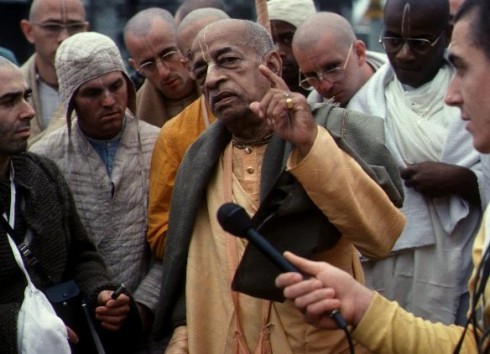
“I firmly believe in these words of My spiritual master, and therefore I always chant the holy name of the Lord, alone and in the association of devotees. That holy name of Lord Kṛṣṇa sometimes causes Me to chant and dance, and therefore I chant and dance. Please do not think that I intentionally do it. I do it automatically. (Sri Caitanya-caritamrta Adi-lila 7.95-96)
A person who cannot keep his faith in the words of his spiritual master but acts independently never receives the authority to chant the holy name of the Lord. (from purport)
This is one of my favorite verses from the Sri Caitanya-caritamrta, and the purport here is one of the most important lessons in spiritual life. Namely, success in spiritual life is faith in the words of the spiritual master and following his instructions. Thereby receiving his blessings. If one receives the blessings of his spiritual master he can chant the holy name of the lord constantly.
Full text and purport More
29 Nov 2013
by The Hare Krishna Movement
in A.C. Bhaktivedanta Swami Prabhupada, Bhagavad-gita, Materializm
Tags: A.C. Bhaktivedanta Swami Prabhupada, bhagavad-gita, birth death diease and old age, material comforts, material desease, material existence, wealth and economic development

The problems of material existence-birth, old age, disease and death-cannot be counteracted by accumulation of wealth and economic development. In many parts of the world there are states which are replete with all facilities of life, which are full of wealth, and economically developed, yet the problems of material existence are still present.
If economic development and material comforts could drive away one’s lamentations for family, social, national or international inebrieties, then Arjuna would not have said that even an unrivalled kingdom on earth or supremacy like that of the demigods in the heavenly planets would not be able to drive away his lamentations. He sought, therefore, refuge in Kṛṣṇa consciousness, and that is the right path for peace and harmony.
More
22 Nov 2013
by The Hare Krishna Movement
in A.C. Bhaktivedanta Swami Prabhupada, Durga
Tags: A.C. Bhaktivedanta Swami Prabhupada, demigods, Durga, durga-devi, external energy of Krishna, goddess durga, Krsna, material enjoyment, saktas, servants of the lord, spiritual salvation, Vaisnavas

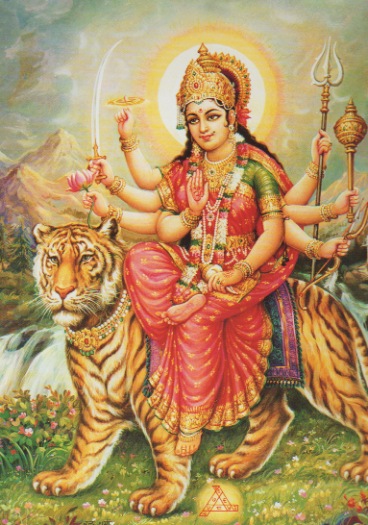
This morning I ran across this nice image of the Goddess Durgā. Durgā-devī, is actually the external energy of Kṛṣṇa, the shadow energy of the Lord. People in general worship goddess Durgā, the wife of Lord Śiva, for material prosperity. As devotees of Krishna, we do not worship the demigods or demigoddess’s. As Srila Prabhupada points out;
There is a misconception that there are many Gods. Actually that is not a fact. God is one, but there are many other powerful living entities who are in charge of different departments of administration. They are called demigods. All the demigods are servants who carry out the orders of the Supreme Lord, the Personality of Godhead.
Only the less intelligent worship the demigods for their various purposes. The most intelligent worship only the Supreme Personality of Godhead, Kṛṣṇa.
Sometimes we, the members of the Kṛṣṇa consciousness movement, are accused of not approving of the worship of demigods….
…Because Kṛṣṇa and His energy appeared simultaneously, people have generally formed two groups—the śāktas and the Vaiṣṇavas—and sometimes there is rivalry between them. Essentially, those who are interested in material enjoyment are śāktas, and those interested in spiritual salvation and attaining the spiritual kingdom are Vaiṣṇavas. Because people are generally interested in material enjoyment, they are interested in worshiping Māyādevī, the energy of the Supreme Personality of Godhead. Vaiṣṇavas, however, are śuddha-śāktas, or pure bhaktas, because the Hare Kṛṣṇa mahā-mantra indicates worship of the Supreme Lord’s energy, Harā. A Vaiṣṇava prays to the energy of the Lord for the opportunity to serve the Lord along with His spiritual energy. Thus Vaiṣṇavas all worship such Deities as Rādhā-Kṛṣṇa, Sītā-Rāma, Lakṣmī-Nārāyaṇa and Rukmiṇī-Dvārakādhīśa, whereas durgā-śāktas worship the material energy under different names. ( from purport SB 10.2.11-12)
…But he also points out that we offer all respect to the demigods as they are all servants of the Lord.
More
18 Nov 2013
by The Hare Krishna Movement
in A.C. Bhaktivedanta Swami Prabhupada, Free Downloads, Free eBooks, Srimad Bhagavatam
Tags: A.C. Bhaktivedanta Swami Prabhupada, Bhaktivedanta purports, final srimad bhagavatam volume, Founder Acarya, International Society for Krishna Consciousness, Krsna Balarama Mandira, prabhupada, SB 10.3, Srimad Bhagavatam, translated by His Divine Grace

This is the final Śrīmad-Bhāgavatam volume translated by His Divine Grace A. C. Bhaktivedanta Swami Prabhupada, Founder-Acarya of the International Society for Krishna Consciousness, before his untimely departure. We share it with you as a free PDF download. You can click on following link to view the complete volume or save it to your computer.
click on following link; Srimad Bhagavatam Tenth Canto Part 3
More
16 Nov 2013
by The Hare Krishna Movement
in A.C. Bhaktivedanta Swami Prabhupada, Childhood Pastimes of Krsna
Tags: A.C. Bhaktivedanta Swami Prabhupada, childhood pastimes, Krsna, month of Damodar, Mother Yasoda, Sampradaya sun, Srila Prabhupada lecture, Universal Form, vatsalya rasa, Yasoda Vishvarupa-darshan
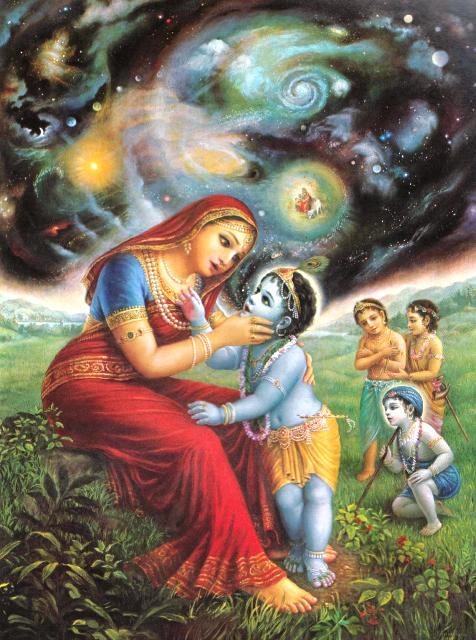
We are reprinting here a nice article which appeared on the Sampradaya Sun a few days ago, entitled “The Glorious Month of Damodara”. These are excerpts from Srila Prabhupada’s Lectures and a question and answer discussion, concerning the childhood pastime of Mother Yasoda seeing the Universal form in Krsna’s mouth.
Yasoda Vishvarupa-darshan
One of the Krsna-lila pastimes glorified during the month of Damodar is that of Yasoda Ma getting vishvarupa-darshan in Krsna’s mouth. In a lecture on Bhagavad-gita 2.25, Srila Prabhupada explained the pastime in terms of vatsalya-rasa:
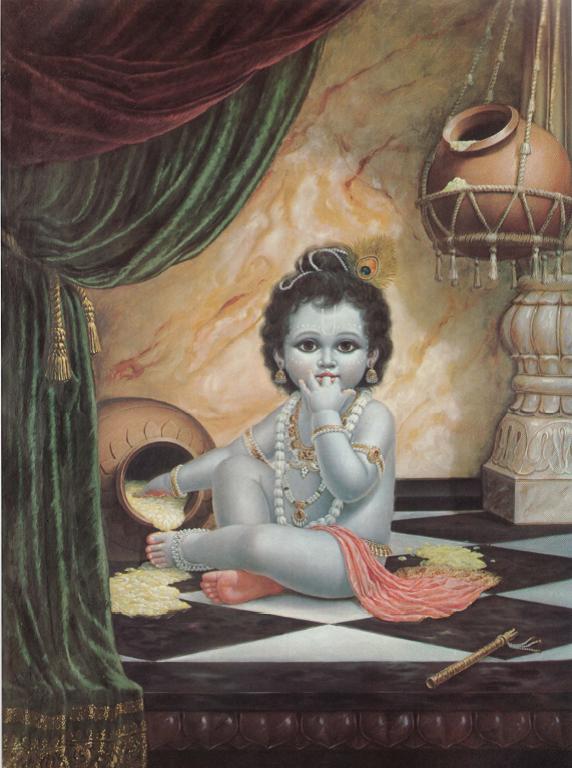
“When Kṛṣṇa was playing as a child, He ate earth and the playmates complained to mother Yaśodā: “Mother, your son Kṛṣṇa is eating earth.” Mother Yaśodā called for explanation: “Kṛṣṇa, why You are eating earth? I have given You sandeśa. ” Kṛṣṇa said, “No, mother, I have not eaten.” “No, Your friends are complaining.” “No, they have become My enemies this morning. We had some quarrel. Therefore they have combined together to make Me chastised by you.” So in this way… Then mother Yaśodā wanted to solve this problem: “All right, show Your mouth, open Your mouth. I want to see.” And when Kṛṣṇa opened the mouth, the mother saw innumerable universes are within the mouth. This is Kṛṣṇa. Aṇor aṇīyān mahato mahīyān. Kṛṣṇa enters within the universe, but at the same time, millions of universes are within His mouth. This is the explanation of “the greater than the greatest and the smaller than the smallest.” Of course, mother Yaśodā, although she saw, she could not believe it because mother Yaśodā never thought of that Kṛṣṇa is the Supreme Personality of Godhead. She always thought that “He is my teeny child.” That’s all. “I have to take care of Him.” This is called paternal feelings. Vātsalya-rasa.” (Lecture on Bhagavad-gita 2.25 — Hyderabad, November 29, 1972)
More
15 Nov 2013
by The Hare Krishna Movement
in A.C. Bhaktivedanta Swami Prabhupada, Childhood Pastimes of Krsna, Makhana-chora
Tags: A.C. Bhaktivedanta Swami Prabhupada, Krishna's childhood pastimes, Krsna is known as Makhana-cora, Makhana-cora, the butter thief, The Supreme Personality of Godhead, Vrndavan pastimes

The month of Damodara is winding down, only a few days left. So we are continuing with our posts on “Krsna Childhood Pastimes”, with a few excerpts on Krsna’s pastimes of sealing butter.
…Lord Śrī Kṛṣṇa is sometimes described as a thief. He is very famous amongst His pure devotees as the Mākhana-cora. He used to steal butter from the houses of neighbors at Vṛndāvana in His early age. Since then He is famous as a thief. But in spite of His being famous as a thief, He is worshiped as a thief, whereas in the mundane world a thief is punished and is never praised. Since He is the Absolute Personality of Godhead, everything is applicable to Him, and still in spite of all contradictions He is the Supreme Personality of Godhead. (from purport SB 1.10.19)
More
13 Nov 2013
by The Hare Krishna Movement
in A.C. Bhaktivedanta Swami Prabhupada, A.C. Bhaktivedanta Swami Prabhupada, Back to Godhead, BTG magizine, God, Jon Nordheimer
Tags: A.C. Bhaktivedanta Swami Prabhupada, God, interview with Srila Prabhupada, Jon Nordheimer, Krsna God, New York Times, prabhupada, spiritual sparks

click on image to enlarge
This is a nice article from Back to Godhead Magazine published in 1975. It is an interview with New York Times reporter Jon Nordheimer, and His Divine Grace A.C. Bhaktivedanta Swami Prabhupada, on the subject of God.
The Choice is Yours
Excerpted from Back to Godhead Magazine 1975, Vol. 10, No. 4
Interview with His Divine Grace A. C. Bhaktivedanta Swami Prabhupada
PRABHUPADA: When we speak of Krsna, we mean God. Everyone has some vague idea of God, but no clear idea. Therefore God descends to show what He is. If we speculate on God, someone will think one thing, and another person will think another. This is the result of speculation. But if God Himself comes and shows Himself as He is and speaks about Himself, that is perfect knowledge. This Krsna consciousness movement is spreading that message: God Himself is speaking about Himself: “I am this; I am like this; My form is like this; My activities are like this; My address is this and that—if you like, you can come back to Me. This is the situation. Everyone can come to Me.” All this information is in Bhagavad-gita As It Is. In Bhagavad-gita God speaks about Himself and presents Himself as He is. We simply have to take that information; then we can understand God. As soon as we understand God, we can go home immediately. It is very simple.
More
12 Nov 2013

…There is no parallel to His childhood pastimes as exhibited at Vrajabhūmi, which are the prototypes of His eternal affairs in the original Kṛṣṇaloka described as the cintāmaṇi-dhāma in the Brahma-saṁhitā [Bs. 5.29]. Lord Śrī Kṛṣṇa descended Himself at Vrajabhūmi with all His transcendental entourage and paraphernalia. Śrī Caitanya Mahāprabhu therefore confirmed that no one is as fortunate as the residents of Vrajabhūmi, and specifically the cowherd girls, who dedicated their everything for the satisfaction of the Lord. His pastimes with Nanda and Yaśodā and His pastimes with the cowherd men and especially with the cowherd boys and the cows have caused Him to be known as Govinda. (from purport to SB 1.8.21)
Full Text and Purport More
Image
by The Hare Krishna Movement
10 Nov 2013
by The Hare Krishna Movement
in A.C. Bhaktivedanta Swami Prabhupada, Cow Protection, Festivals, Gopastami, KRSNA The Supreme Personality of Godhead
Tags: A.C. Bhaktivedanta Swami Prabhupada, Balarama, childhood age known as kaumara, cowherd boy, gopa, gopastami, gosthastami, Krishna, Krsna, Krsna Book, pauganda, The killing of Dhenukasura, vaisnava calender, Vrndavan

Please click on image to enlarge
Today on the Vaisnava Calender marks the day known as Gopastami or Gosthastami. On this day lord Sri Krishna became a qualified cowherd and took the cows out to Govardhana to graze. Previously He was the keeper of the calves. It was on this day that He became a gopa, or cowherd boy.
In this way, Śrī Kṛṣṇa, along with His elder brother Balarāma, passed the childhood age known as kaumāra and stepped into the age of paugaṇḍa, from the sixth year up to the tenth. At that time, all the cowherd men conferred and agreed to give those boys who had passed their fifth year charge of the cows in the pasturing ground. Given charge of the cows, Kṛṣṇa and Balarāma traversed Vṛndāvana, purifying the land with Their footprints.
…When Kṛṣṇa, Balarāma and Their friends entered the village of Vṛndāvana, They played Their flutes, and the boys praised Their uncommon activities in the forest. Their faces were decorated with tilaka and smeared with the dust raised by the cows, and Kṛṣṇa’s head was decorated with a peacock feather. Both He and Balarāma played Their flutes, and the young gopīs were joyous to see Kṛṣṇa returning home. All the gopīs in Vṛndāvana remained very morose on account of Kṛṣṇa’s absence. All day they were thinking of Kṛṣṇa in the forest or of Him herding cows in the pasture. When they saw Kṛṣṇa returning, all their anxieties were immediately relieved, and they began to look at His face the way drones hover over the honey of the lotus flower. When Kṛṣṇa entered the village, the young gopīs smiled and laughed. Kṛṣṇa, while playing the flute, enjoyed the beautiful smiling faces of the gopīs. (from Kṛṣṇa, the Supreme Personality of Godhead, Chapter 15)
To honor this day we are posting some further childhood pastimes of Sri Krishna from the Kṛṣṇa Book entitled “The Killing of Dhenukāsura”
Full Chapter More
01 Nov 2013
by The Hare Krishna Movement
in A.C. Bhaktivedanta Swami Prabhupada, Childhood Pastimes of Krsna, Festivals, Govardhana-puja, KRSNA The Supreme Personality of Godhead
Tags: A.C. Bhaktivedanta Swami Prabhupada, Devastating Rainfall in Vrndavana, Govardhana Hill, Indra, Krsna The Supreme Personality of Godhead, lifting Govardhana Hill, Supreme Controller, Vrndavana
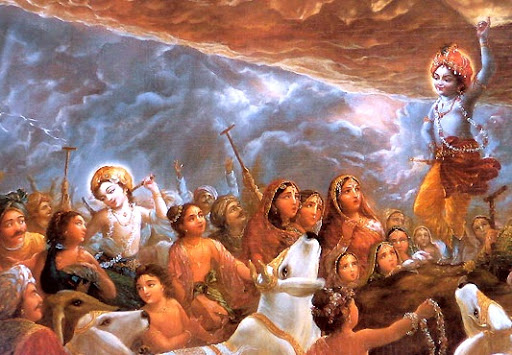
…Lord Kṛṣṇa picked up Govardhana Hill with one hand, exactly as a child picks up a mushroom from the ground. Thus He exhibited His transcendental pastime of lifting Govardhana Hill. Lord Kṛṣṇa then began to address His devotees, “My dear brothers, My dear father, My dear inhabitants of Vṛndāvana, you can now safely enter under the umbrella of Govardhana Hill, which I have just lifted. Do not be afraid of the hill and think that it will fall from My hand. You have been too much afflicted from the heavy rain and strong wind; therefore I have lifted this hill, which will protect you exactly like a huge umbrella. I think this is a proper arrangement to relieve you from your immediate distress. Be happy along with your animals underneath this great umbrella.” Being assured by Lord Kṛṣṇa, all the inhabitants of Vṛndāvana entered beneath the great hill and appeared to be safe along with their property and animals.
…The inhabitants of Vṛndāvana and their animals remained there for one week without being disturbed by hunger, thirst or any other discomforts. They were simply astonished to see how Kṛṣṇa was holding up the mountain with the little finger of His left hand.
… After this incident, the Supreme Personality of Godhead, surrounded by His dear friends and animals, returned to His home. As usual, the gopīs began to chant the glorious pastimes of Lord Kṛṣṇa with great feeling, for they were chanting from the heart. (Kṛṣṇa, the Supreme Personality of Godhead Chapter 25)
Full Chapter More
31 Oct 2013
by The Hare Krishna Movement
in A.C. Bhaktivedanta Swami Prabhupada, Panca-Tattva, Sankirtan, Sri Caitanya-Caritamrta
Tags: A.C. Bhaktivedanta Swami Prabhupada, chanting Hare Krishna, Hare Hare, Hare Krishna, Hare Krishna mahamantra, Hare Rama, incarnation, internal potencey, Lord Caitanya, Maha Mantra, mahaprabhu, marginal potency, most magnanimous incarnation, panca tattva mantra, plenary expansion, sankirtan jajna, Sri Krsna Caitanya, ultimate benediction, śrī-kṛṣṇa-caitanya prabhu-nityānanda śrī-advaita gadādhara śrīvāsādi-gaura-bhakta-vṛnda

“Love of Godhead is the ultimate benediction for all human beings.” Śrī Caitanya Mahāprabhu is the bestower of this great benediction.
“In the Age of Kali, people who are endowed with sufficient intelligence will worship the Lord, who is accompanied by His associates, by performance of saṅkīrtana-yajña.” (Bhāg. 11.5.32)
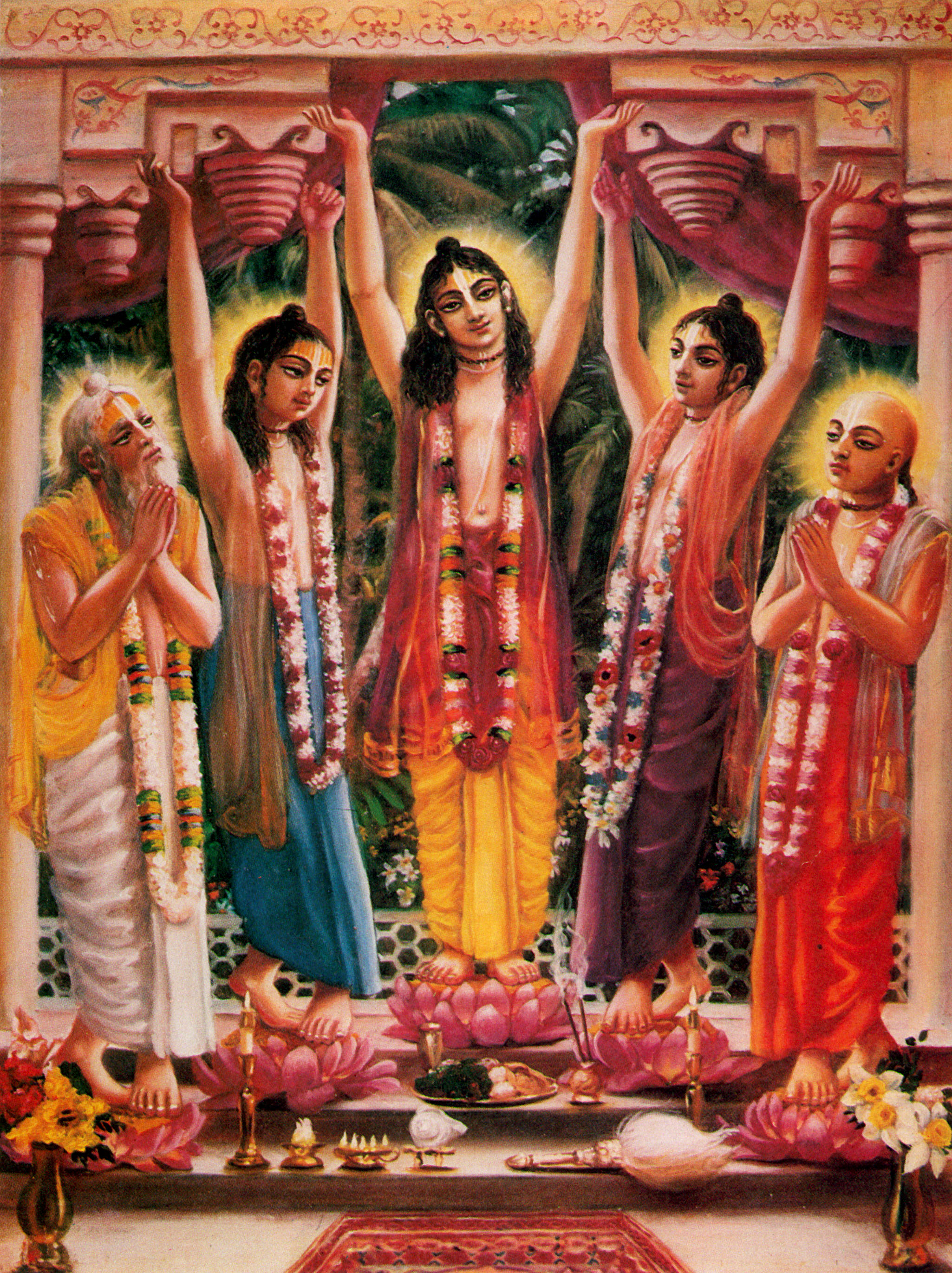
…Śrī Caitanya Mahāprabhu is always accompanied by His plenary expansion Śrī Nityānanda Prabhu, His incarnation Śrī Advaita Prabhu, His internal potency Śrī Gadādhara Prabhu and His marginal potency Śrīvāsa Prabhu. He is in the midst of them as the Supreme Personality of Godhead. One should know that Śrī Caitanya Mahāprabhu is always accompanied by these other tattvas. Therefore our obeisances to Śrī Caitanya Mahāprabhu are complete when we say śrī-kṛṣṇa-caitanya prabhu-nityānanda śrī-advaita gadādhara śrīvāsādi-gaura-bhakta-vṛnda. As preachers of the Kṛṣṇa consciousness movement, we first offer our obeisances to Śrī Caitanya Mahāprabhu by chanting this Pañca-tattva mantra; then we say Hare Kṛṣṇa, Hare Kṛṣṇa, Kṛṣṇa Kṛṣṇa, Hare Hare Hare Rāma, Hare Rāma, Rāma Rāma, Hare Hare. There are ten offenses in the chanting of the Hare Kṛṣṇa mahā-mantra, but these are not considered in the chanting of the Pañca-tattva mantra, namely, śrī-kṛṣṇa-caitanya prabhu-nityānanda śrī-advaita gadādhara śrīvāsādi-gaura-bhakta-vṛnda. Śrī Caitanya Mahāprabhu is known as mahā-vadānyāvatāra, the most magnanimous incarnation, for He does not consider the offenses of the fallen souls. Thus to derive the full benefit of the chanting of the mahā-mantra (Hare Kṛṣṇa, Hare Kṛṣṇa, Kṛṣṇa Kṛṣṇa, Hare Hare Hare Rāma, Hare Rāma, Rāma Rāma, Hare Hare), we must first take shelter of Śrī Caitanya Mahāprabhu, learn the Pañca-tattva mahā-mantra, and then chant the Hare Kṛṣṇa mahā-mantra. That will be very effective. (Purport from Sri Caitanya-caritamrta, Adi-lila 7.4)
More
30 Oct 2013
by The Hare Krishna Movement
in A.C. Bhaktivedanta Swami Prabhupada, Childhood Pastimes of Krsna, Krsna Consciousness, Spiritual World, Srimad Bhagavatam, Vrndavana
Tags: A.C. Bhaktivedanta Swami Prabhupada, asura, Bakasura, BBT, Bhaktivedanta purports, cowheard boys, fruit vendor, go carana, Gokula, Krishna and Balarama, Krsna, Mother Yasoda, Nanda, Nanda Maharaja, pastimes of krsna, SB 10.11, Srimad Bhagavatam, Vatsasura, yamala arjunas, Yasoda

Today is Rama Ekadasi (fast from grains and beans), so on this auspicious day, in the auspicious month of Damodara, we wanted to do a special post. The following is the entire 11th chapter of the Tenth Canto of Srimad Bhagavatam entitled “The Childhood Pastimes of Kṛṣṇa”.
The following two verses are just an example of the nectar one will find in the following chapter…
…The gopīs would say, “If You dance, my dear Kṛṣṇa, then I shall give You half a sweetmeat.” By saying these words or by clapping their hands, all the gopīs encouraged Kṛṣṇa in different ways. At such times, although He was the supremely powerful Personality of Godhead, He would smile and dance according to their desire, as if He were a wooden doll in their hands. Sometimes He would sing very loudly, at their bidding. In this way, Kṛṣṇa came completely under the control of the gopīs.(Text 7)
…To pure devotees throughout the world who could understand His activities, the Supreme Personality of Godhead, Kṛṣṇa, exhibited how much He can be subdued by His devotees, His servants. In this way He increased the pleasure of the Vrajavāsīs by His childhood activities. (Text 9)
Srimad Bhagavatam
By His Divine Grace A. C. Bhaktivedanta Swami Prabhupada
Canto 10, Chapter 11
More
28 Oct 2013
by The Hare Krishna Movement
in A.C. Bhaktivedanta Swami Prabhupada, Bhagavad-gita, Krishna Consciousness, Krsna Consciousness
Tags: 1972 Edition, A.C. Bhaktivedanta Swami Prabhupada, Arjuna, Bhagavad-gita As It Is, bhava, devotee, essintial part of knowledge, friend of krsna, Krishna, krsna consciousness, man manah, official meditator, the most confidential part of knowledge
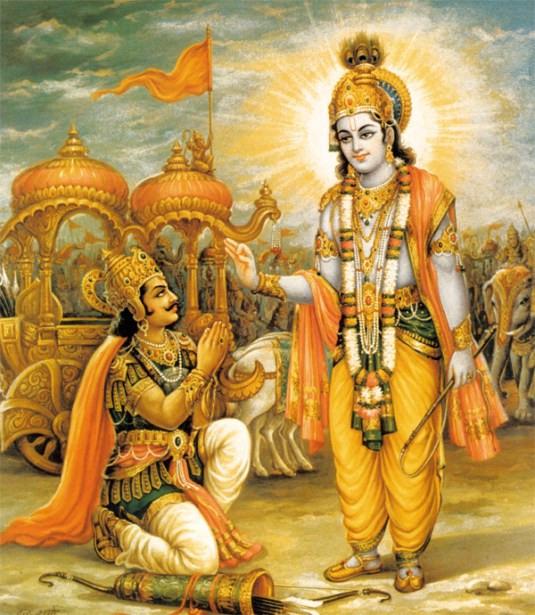
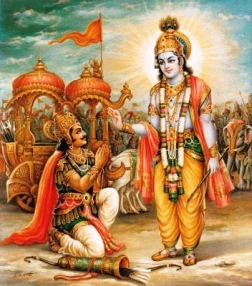
Because you are My very dear friend, I am speaking to you the most confidential part of knowledge. Hear this from Me, for it is for your benefit.
Always think of Me and become My devotee. Worship Me and offer your homage unto Me. Thus you will come to Me without fail. I promise you this because you are My very dear friend.
…”Just always think of Me.”…This is the most important instruction in all Vedic literature. What Kṛṣṇa is saying in this connection is the most essential part of knowledge, and it should be carried out not only by Arjuna but by all living entities.
…The most confidential part of knowledge is that one should become a pure devotee of Kṛṣṇa and always think of Him and act for Him. One should not become an official meditator. Life should be so molded that one will always have the chance to think of Kṛṣṇa. One should always act in such a way that all his daily activities are in connection with Kṛṣṇa. He should arrange his life in such a way that throughout the twenty-four hours he cannot but think of Kṛṣṇa. And the Lord’s promise is that anyone who is in such pure Kṛṣṇa consciousness will certainly return to the abode of Kṛṣṇa, where he will be engaged in the association of Kṛṣṇa face to face. This most confidential part of knowledge is spoken to Arjuna because he is the dear friend of Kṛṣṇa. Everyone who follows the path of Arjuna can become a dear friend to Kṛṣṇa and obtain the same perfection as Arjuna.
More
26 Oct 2013
by The Hare Krishna Movement
in A.C. Bhaktivedanta Swami Prabhupada, Damodara, KRSNA The Supreme Personality of Godhead
Tags: A.C. Bhaktivedanta Swami Prabhupada, Bhaktivedanta purport, Dhara, Drona, gopis, Krishna, krishna pastimes, Krsna, Krsna Book, Lord Balarama, Lord Damodara, Lord Krishna, month of Kartika, Mother Yasoda, Nanda Maharaja, residents of Vrndavana, SB 10.8, transcendental pleasure, Vision of the Universal Form
…continuing with our attempt to post Krsna’s childhood pastimes, throughout the duration of the “Month of Damodara”
…Another day, when Kṛṣṇa and Balarāma were playing with Their friends, all the boys joined Balarāma and told mother Yaśodā that Kṛṣṇa had eaten clay. On hearing this, mother Yaśodā caught hold of Kṛṣṇa’s hand and said, “My dear Kṛṣṇa, why have You eaten earth in a solitary place? Just see, all Your friends including Balarāma are complaining about You.” Being afraid of His mother, Kṛṣṇa replied, “My dear mother, all these boys, including My elder brother Balarāma, are speaking lies against Me. I have never eaten clay. My elder brother Balarāma, while playing with Me today, became angry, and therefore He has joined with the other boys to complain against Me. They have all combined together to complain so you will be angry and chastise Me. If you think they are truthful, then you can look within My mouth to see whether I have taken clay or not.” His mother replied, “All right, if You have actually not taken any clay, then just open Your mouth. I shall see.”
More
24 Oct 2013
by The Hare Krishna Movement
in A.C. Bhaktivedanta Swami Prabhupada, Japa, Nectar of Devotion, Practicing Krishna Consciousness at Home
Tags: A.C. Bhaktivedanta Swami Prabhupada, chanting Hare Krishna, holy name, japa, japa bag, japa beads, kirtan, Maha Mantra, mantra meditation
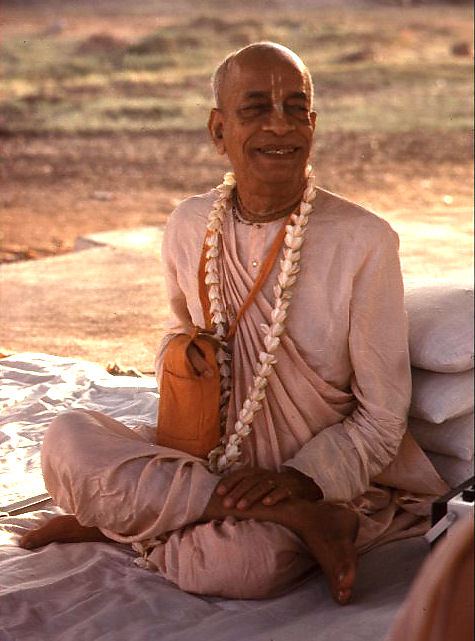
This is such a beautiful picture of Srila Prabhupada with his japa bag, that we thought we would do a short post on ‘japa’.
When a mantra or hymn is chanted softly and slowly, that is called japa. The same mantra, when chanted loudly, is called kīrtana. For example, the mahā-mantra (Hare Kṛṣṇa, Hare Kṛṣṇa, Kṛṣṇa Kṛṣṇa, Hare Hare/ Hare Rāma, Hare Rāma, Rāma Rāma, Hare Hare) when uttered very softly only for one’s own hearing is called japa. The same mantra, when chanted loudly for being heard by all others, is called kīrtana. The mahā-mantra can be used for japa and kīrtana also. When japa is practiced it is for the personal benefit of the chanter, but when kīrtana is performed it is for the benefit of all others who may hear.
In the Padma Purāṇa there is a statement: “For any person who is chanting the holy name either softly or loudly, the paths to liberation and even heavenly happiness are at once open.” (Nectar of Devotion Chapter 9)
Of all the sacrifices, the chanting of Hare Kṛṣṇa, Hare Kṛṣṇa, Kṛṣṇa Kṛṣṇa, Hare Hare/ Hare Rāma, Hare Rāma, Rāma Rāma, Hare Hare is the purest representation of Kṛṣṇa. (from purport; Bhagavad-gita 10.25)
More
Previous Older Entries Next Newer Entries











 The Hare Krishna Movement