18 Oct 2011
by The Hare Krishna Movement
in Bhismadeva, Srimad Bhagavatam
Tags: Bhisma, Bishmadeva, Brahma, His Divine Grace A.C. Bhaktivedanta Swami Prabhupada, Maharaja Yudhisthira, plan of the Lord, Siva, Srimad Bhagavatam, vice cannot conqure virtue
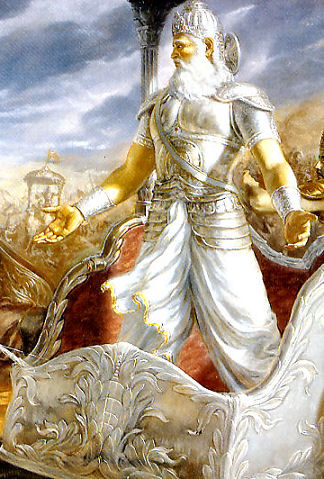
Bhishmadeva
Even a great fighter like Bhīṣma could not win the Battle of Kurukṣetra because the Lord wanted to show that vice cannot conquer virtue, regardless of who tries to execute it.
Srimad-Bhagavatam
By His Divine Grace A.C. Bhaktivedanta Swami Prabhupada
Canto 1″Creation”, Chapter 9, Text 16
The Passing Away of Bhismadeva in the Presence of Lord Krsna
na hy asya karhicid rājan
pumān veda vidhitsitam
yad vijijñāsayā yuktā
muhyanti kavayo ‘pi hi
na—never; hi—certainly; asya—His; karhicit—whatsoever; rājan—O King; pumān—anyone; veda—knows; vidhitsitam—plan; yat—which; vijijñāsayā—with exhaustive inquiries; yuktāḥ—being engaged; muhyanti—bewildered; kavayaḥ—great philosophers; api—even; hi—certainly.
O King, no one can know the plan of the Lord [Śrī Kṛṣṇa]. Even though great philosophers inquire exhaustively, they are bewildered.
The bewilderment of Mahārāja Yudhiṣṭhira over his past sinful acts and the resultant sufferings, etc., is completely negated by the great authority Bhīṣma (one of the twelve authorized persons). Bhīṣma wanted to impress upon Mahārāja Yudhiṣṭhira that since time immemorial no one, including such demigods as Śiva and Brahmā, could ascertain the real plan of the Lord. So what can we understand about it? More
06 Oct 2011
by The Hare Krishna Movement
in Lectures, Spiritual Life, Srimad Bhagavatam
Tags: Krishna, Krishna consciousness, Parikshit Maharaja, Srila Prabhupada, Srimad Bhagavatam, Sukadeva Goswami, Vedic literatures, what is my duty

Chanakya Pandit says that “If you want to make spiritual advancement, then you should always think that “Death is next moment. Death is next moment.”
Excerpt from lecture on Srimad-Bhagavatam
Canto 1, Chapter 4, Text 25, Montreal, June 20, 1968
By His Divine Grace A. C. Bhaktivedanta Swami Prabhupada
Parikshit Maharaja, he was a powerful king. He was equipped with all, everything, but he did not counteract the curse [1]. He could counteract that curse. He was so powerful, but he accepted: “All right. I am cursed. I shall give up my life within seven days.” That means he took it as an opportunity that “I am going to death within seven days. That is certain. And I must prepare myself fully so that my next life I can approach Krishna.” So this is a good opportunity, that “I have got seven days’ time.” We haven’t got seven seconds’ time. We do not know. Nobody has served me notice. We find by practical experience that we are walking on the street—all of a sudden there is some accident, and we die. There is possibility. So the important point is that Maharaja Parikshit was fortunate enough to get seven days’ time before his death. But we do not know how much time is there for our death. So how much serious we shall be. Chanakya Pandit says that “If you want to make spiritual advancement, then you should always think that “Death is next moment. Death is next moment.” Because there is no guarantee when death is coming. If I think that death is next moment, that is not any utopian. The next moment may be my death. And Chanakya Pandit says, “But if you want to be materially happy, you should always think that ‘I shall never die,’ ” although it is false idea. Everyone will die.
More
02 Oct 2011
by The Hare Krishna Movement
in Back to Godhead, Books by Srila Prabhupada, Brahmananda das, Srimad Bhagavatam
Tags: Back to Godhead Magazine, Brahmananda Swami, Srila Prabhupada, Srimad Bhagavatam, The Books of His Divine Grace A. C. Bhaktivedanta Swami Prabhupada

“The words of Srimad-Bhagavatam are Your incarnation, and if people repeatedly hear them in submissive aural reception, then they will be able to understand Your message.”
The Books of His Divine Grace A.C. Bhaktivedanta Swami Prabhupada
Originally published in Back to Godhead No. 52
Bhaktivedanta Book Trust 1973
By Brahmananda Swami ISKCON East Africa
Part 4
In the opening sentences of Srila Prabhupada’s introduction to the Srimad-Bhagavatam, he affirms that the word “God” refers to the supreme controller and that a controller cannot be impersonal. In the first sloka of the Srimad-Bhagavatam, obeisances are offered to the Supreme Personality of Godhead.
om namo bhagavate vasudevaya
om—O my Lord; namah—my respectful obeisances unto You; bhagavate—unto the Personality of Godhead; vasudevaya—unto Lord Krsna, the son of Vasudeva.
O my Lord, the all-pervading Personality of Godhead, I offer my respectful obeisances unto You.
Whereas others have translated the Sanskrit scriptures conveniently to suit their interpretations, Srila Prabhupada always gives word-for-word English equivalents for each Sanskrit verse, and thus the translations cannot be disputed. This is a painstaking process, considering the length of the Srimad-Bhagavatam, but it is in keeping with the heritage of the Gosvamis to present the literature of devotional service authoritatively and scientifically. Furthermore, the English-reading public can easily learn the meanings to the Sanskrit words from this format.
More
14 Sep 2011
by The Hare Krishna Movement
in A.C. Bhaktivedanta Swami Prabhupada, Krishna Consciousness, Srimad Bhagavatam, Uncategorized, Yoga
Tags: devotee, krsna consciousness, mystic yogi, narayana-para, Srimad Bhagavatam, Surpreme Personality of Godhead, transcendental service of the Lord, yogi

…The real purpose of yogic performances is to control the mind and the senses. In other words, one cannot attain the mercy and benediction of the Supreme Lord until one is able to control the mind and the senses. This is actually possible when one fully engages in Kṛṣṇa consciousness…
Srimad-Bhagavatam
By His Divine Grace A.C. Bhaktivedanta Swami Prabhupada
Canto 3: “The Status Quo”
SB 3.15: Description of the Kingdom of God
There is no defeat in this material world for persons who control the mind and senses by controlling the breathing process and who are therefore experienced, mature mystics. This is because by such perfection in yoga they have attained your mercy.
Purport
The purpose of yogic performances is explained here. It is said that an experienced mystic attains full control of the senses and the mind by controlling the breathing process. Therefore, controlling the breathing process is not the ultimate aim of yoga. The real purpose of yogic performances is to control the mind and the senses. Anyone who has such control is to be understood to be an experienced, mature mystic yogī. It is indicated herein that a yogī who has control over the mind and senses has the actual benediction of the Lord, and he has no fear. In other words, one cannot attain the mercy and benediction of the Supreme Lord until one is able to control the mind and the senses. This is actually possible when one fully engages in Kṛṣṇa consciousness. A person whose senses and mind are always engaged in the transcendental service of the Lord has no possibility of engaging in material activities. The devotees of the Lord are not defeated anywhere in the universe. It is stated, nārāyaṇa-parāḥ sarve: one who is nārāyaṇa-para, or a devotee of the Supreme Personality of Godhead, is not afraid anywhere, whether he is sent to hell or promoted to heaven (Bhāg. 6.17.28).
Pasted from; PrabhupadaBooks.com
25 Aug 2011
by The Hare Krishna Movement
in Krishna, Spiritual World, Srimad Bhagavatam
Tags: bhakti-vedantas, His Divine Grace A.C. Bhaktivedanta Swami Prabhupada, Kali, Krsna, Sri Narada, Srimad Bhagavatam, transcendental pastimes, Vyasadeva

Srimad Bhagavatam
By His Divine Grace A.C. Bhaktivedanta Swami Prabhupada
Canto 1, Chapter 5, Text 26
The Lord descends on this material world out of His causeless mercy and displays His various transcendental pastimes as a human being so that human beings attracted towards Him become able to go back to Godhead.
O Vyāsadeva, in that association and by the mercy of those great Vedāntists, I could hear them describe the attractive activities of Lord Kṛṣṇa And thus listening attentively, my taste for hearing of the Personality of Godhead increased at every step.
Lord Śrī Kṛṣṇa, the Absolute Personality of Godhead, is attractive not only in His personal features, but also in His transcendental activities. It is so because the Absolute is absolute by His name, fame, form, pastimes, entourage, paraphernalia, etc. The Lord descends on this material world out of His causeless mercy and displays His various transcendental pastimes as a human being so that human beings attracted towards Him become able to go back to Godhead. Men are naturally apt to hear histories and narrations of various personalities performing mundane activities, without knowing that by such association one simply wastes valuable time and also becomes addicted to the three qualities of mundane nature. Instead of wasting time, one can get spiritual success by turning his attention to the transcendental pastimes of the Lord. By hearing the narration of the pastimes of the Lord, one contacts directly the Personality of Godhead, and, as explained before, by hearing about the Personality of Godhead, from within, all accumulated sins of the mundane creature are cleared. Thus being cleared of all sins, the hearer gradually becomes liberated from mundane association and becomes attracted to the features of the Lord. Nārada Muni has just explained this by his personal experience. The whole idea is that simply by hearing about the Lord’s pastimes one can become one of the associates of the Lord. Nārada Muni has eternal life, unlimited knowledge and unfathomed bliss, and he can travel all over the material and spiritual worlds without restriction. One can attain to the highest perfection of life simply by attentive hearing of the transcendental pastimes of the Lord from the right sources, as Śrī Nārada heard them from the pure devotees (bhakti-vedāntas) in his previous life. This process of hearing in the association of the devotees is especially recommended in this age of quarrel (Kali).
05 Aug 2011
by The Hare Krishna Movement
in Srila Prabhupada, Srimad Bhagavatam
Tags: Book Bhagavata, Devotee Bhagavata, devotional service, Divinity and Divine Service, Srila Prabhupada, Srimad Bhagavatam, transcendental knowledge
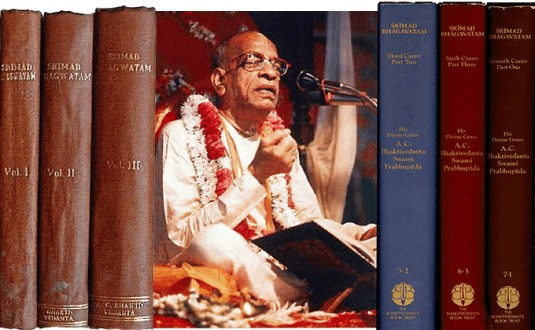
The message of the Book Bhagavata is received from the devotee Bhagavata, Srila Prabhupada, and under His guidance the devotee is able to progress in devotional service. By such sincere association the disciple is able to receive transcendental knowledge very easily.
Srimad Bhagavatam
By His Divine Grace A. C. Bhaktivedanta Swami Prabhupada
Chapter 3 Divinity and Divine Service
naṣṭa-prāyeṣv abhadreṣu
nityaṁ bhāgavata-sevayā
bhagavaty uttama-śloke
bhaktir bhavati naiṣṭhikī
By regular attendance in classes on the Bhāgavatam and by rendering of service to the pure devotee, all that is troublesome to the heart is almost completely destroyed, and loving service unto the Personality of Godhead, who is praised with transcendental songs, is established as an irrevocable fact.
Here is the remedy for eliminating all inauspicious things within the heart which are considered to be obstacles in the path of self-realization. The remedy is the association of the Bhāgavatas. There are two types of Bhāgavatas, namely the book Bhāgavata and the devotee Bhāgavata. Both the Bhāgavatas are competent remedies, and both of them or either of them can be good enough to eliminate the obstacles. A devotee Bhāgavata is as good as the book Bhāgavata because the devotee Bhāgavata leads his life in terms of the book Bhāgavata and the book Bhāgavata is full of information about the Personality of Godhead and His pure devotees, who are also Bhāgavatas. Bhāgavata book and person are identical.
The devotee Bhāgavata is a direct representative of Bhagavān, the Personality of Godhead. So by pleasing the devotee Bhāgavata one can receive the benefit of the book Bhāgavata. Human reason fails to understand how by serving the devotee Bhāgavata or the book Bhāgavata one gets gradual promotion on the path of devotion. But actually these are facts explained by Śrīla Nāradadeva, who happened to be a maidservant’s son in his previous life. The maidservant was engaged in the menial service of the sages, and thus he also came into contact with them. And simply by associating with them and accepting the remnants of foodstuff left by the sages, the son of the maidservant got the chance to become the great devotee and personality Śrīla Nāradadeva. These are the miraculous effects of the association of Bhāgavatas. And to understand these effects practically, it should be noted that by such sincere association of the Bhāgavatas one is sure to receive transcendental knowledge very easily, with the result that he becomes fixed in the devotional service of the Lord. The more progress is made in devotional service under the guidance of the Bhāgavatas, the more one becomes fixed in the transcendental loving service of the Lord. The messages of the book Bhāgavata, therefore, have to be received from the devotee Bhāgavata, and the combination of these two Bhāgavatas will help the neophyte devotee to make progress on and on.
12 Jun 2011
by The Hare Krishna Movement
in Guru & Disciple, Spiritual Life, Srimad Bhagavatam
Tags: back to Godhead, bona fide spiritual master, Lord Krsna, Maharaja Pariksit, Personality of Godhead, Sri Suta Gowvami, Srimad Bhagavatam, Sukadeva Goswami, Vyasadeva

Srimad-Bhagavatam
By His Divine Grace A. C. Bhaktivedanta Swami Prabhupada
Canto 1:”Creation”
SB 1.19: The Appearance of Sukadeva Gosvami
The great sage Śukadeva Gosvāmī was certainly inspired by Lord Kṛṣṇa to appear voluntarily before Mahārāja Parīkṣit, the great devotee of the Lord, just to give him the teachings of Śrīmad-Bhāgavatam. One can achieve the nucleus of the devotional service of the Lord by the mercy of the spiritual master and the Personality of Godhead. The spiritual master is the manifested representative of the Lord to help one achieve ultimate success. One who is not authorized by the Lord cannot become a spiritual master. Śrīla Śukadeva Gosvāmī is an authorized spiritual master, and thus he was inspired by the Lord to appear before Mahārāja Parīkṣit and instruct him in the teachings of Śrīmad-Bhāgavatam.
Simply by such questioning and hearing, one can achieve the highest perfectional stage of life.
Text 37
You are the spiritual master of great saints and devotees. I am therefore begging you to show the way of perfection for all persons, and especially for one who is about to die.
Purport
Unless one is perfectly anxious to inquire about the way of perfection, there is no necessity of approaching a spiritual master. A spiritual master is not a kind of decoration for a householder. Generally a fashionable materialist engages a so-called spiritual master without any profit. The pseudo- spiritual master flatters the so-called disciple, and thereby both the master and his ward go to hell without a doubt. Mahārāja Parīkṣit is the right type of disciple because he puts forward questions vital to the interest of all men, particularly for the dying men. The question put forward by Mahārāja Parīkṣit is the basic principle of the complete thesis of Śrīmad-Bhāgavatam. Now let us see how intelligently the great master replies.
Text 38
Please let me know what a man should hear, chant, remember and worship, and also what he should not do. Please explain all this to me.
Text 40
Śrī Sūta Gosvāmī said: The King thus spoke and questioned the sage, using sweet language. Then the great and powerful personality, the son of Vyāsadeva, who knew the principles of religion, began his reply.
More
12 May 2011
by The Hare Krishna Movement
in Devotional Service, Srimad Bhagavatam
Tags: devotional service, fearfulness, illusion, loving Krsna, Srila Prabhupada, Srimad Bhagavatam, submissive hearing, Supreme Personality of Godhead, transcending worldly miseries, Vedic literature
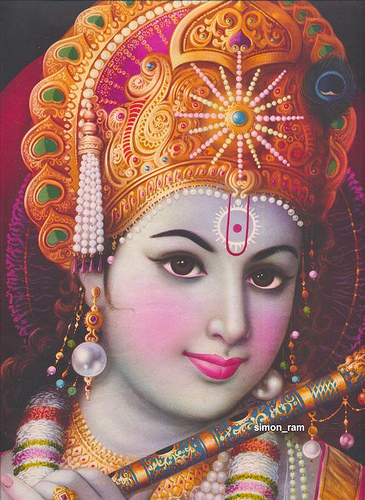
Srimad Bhagavatam
By His Divine Grace A.C. Bhaktivedanta Swami Prabhupada
Canto 1, Chapter 7, Text 7
The conclusion is that simply by hearing the Vedic literature Śrīmad-Bhāgavatam, one can have direct connection with the Supreme Personality of Godhead Śrī Kṛṣṇa, and thereby one can attain the highest perfection of life by transcending worldly miseries, illusion and fearfulness. These are practical tests for one who has actually given a submissive hearing to the readings of the Śrīmad-Bhāgavatam.
TEXT 7
yasyāṁ vai śrūyamāṇāyāṁ
kṛṣṇe parama-pūruṣe
bhaktir utpadyate puṁsaḥ
śoka-moha-bhayāpahā
SYNONYMS
yasyām—this Vedic literature; vai—certainly; śrūyamāṇāyām—simply by giving aural reception; kṛṣṇe—unto Lord Kṛṣṇa; parama—supreme; pūruṣe—unto the Personality of Godhead; bhaktiḥ—feelings of devotional service; utpadyate—sprout up; puṁsaḥ—of the living being; śoka—lamentation; moha—illusion; bhaya—fearfulness; apahā—that which extinguishes.
TRANSLATION
Simply by giving aural reception to this Vedic literature, the feeling for loving devotional service to Lord Kṛṣṇa, the Supreme Personality of Godhead, sprouts up at once to extinguish the fire of lamentation, illusion and fearfulness.
PURPORT
There are various senses, of which the ear is the most effective. This sense works even when a man is deep asleep. One can protect himself from the hands of an enemy while awake, but while asleep one is protected by the ear only. The importance of hearing is mentioned here in connection with attaining the highest perfection of life, namely, getting free from three material pangs. Everyone is full of lamentation at every moment, he is after the mirage of illusory things, and he is always afraid of his supposed enemy. These are the primary symptoms of material disease. And it is definitely suggested herein that simply by hearing the message of Śrīmad-Bhāgavatam one gets attachment for the Supreme Personality of Godhead Śrī Kṛṣṇa, and as soon as this is effected the symptoms of the material diseases disappear. Śrīla Vyāsadeva saw the all-perfect Personality of Godhead, and in this statement the all-perfect Personality of Godhead Śrī Kṛṣṇa is clearly confirmed.
More
10 May 2011
by The Hare Krishna Movement
in Books by Srila Prabhupada, Srimad Bhagavatam
Tags: His Divine Grace A.C. Bhaktivedanta Swami Prabhupada, original pre-1978, Set, Srila Prabhupada wholesale, Srimad Bhagavatam
 Srimad Bhagavatam Compact 30 Vol 1977 Edition
Cantos 1-9, plus the Original Krsna Book in 3 Volumes comprising the 10th Canto
Srimad Bhagavatam , an “Epic Philosophical and Literary Classic”, holds a prominent position in India’s voluminous written wisdom. The timeless wisdom of India is expressed in the Vedas, ancient Sanskrit texts that touch upon all fields of human knowledge. Originally preserved through oral tradition, the Vedas were first put into writing by Srila Vyasadeva, the “literary incarnation of God.” After compiling the Vedas, Srila Vyasadeva was inspired by his spiritual master to present their profound essence in the form of Srimad-Bhagavatam. Known as “the ripened fruit of the tree of Vedic Literature, Srimad-Bhagavatam is the most complete and authoritative exposition of Vedic Knowledge.
This 12,000 page, 30 vol. set, comes in High Quality Hard Bound 5×7 size. with over 600 beautiful full color plates.
For a limited time selling at the reduced Wholesale rate of $149.95
No home library is complete without a set.
Get one today!
Go to http://www.theharekrishnamovement.com To buy a set online!
13 Apr 2011
by The Hare Krishna Movement
in Srimad Bhagavatam
Tags: 4.28.48, Founder Acarya, International Socity for Krishna Consciousness, Religion means abiding by the orders of God, rogues, so-called Kings, Srimad Bhagavatam
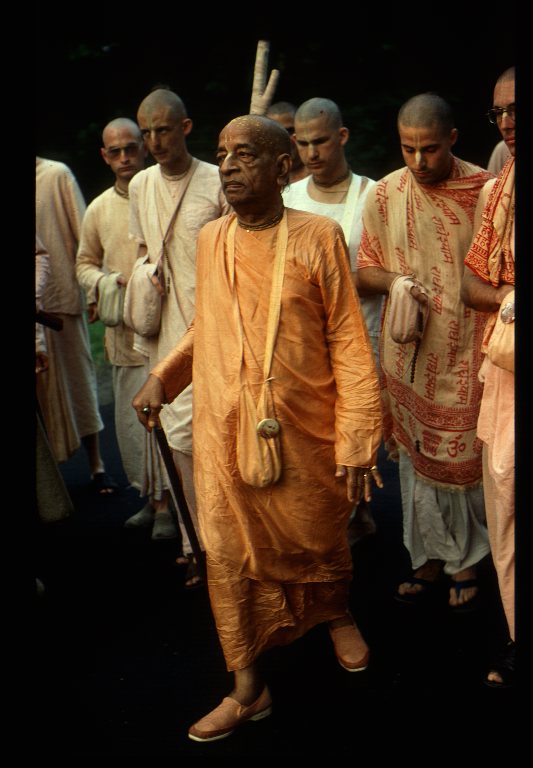
Srimad Bhagavatam
By His Divine Grace A.C. Bhaktivedanta Swami Prabhupada
Forth Canto, Chapter 28, Text 48
uttiṣṭhottiṣṭha rājarṣe
imām udadhi-mekhalām
dasyubhyaḥ kṣatra-bandhubhyo
bibhyatīṁ pātum arhasi
SYNONYMS
uttiṣṭha—please get up; uttiṣṭha—please get up; rāja-ṛṣe—O saintly king; imām—this earth; udadhi—by the ocean; mekhalām—surrounded; dasyubhyaḥ—from the rogues; kṣatra-bandhubhyaḥ—from the unclean kings; bibhyatīm—very much afraid; pātum—to protect; arhasi—you ought.
TRANSLATION
O best of kings, please get up! Get up! Just see this world surrounded by water and infested with rogues and so-called kings. This world is very much afraid, and it is your duty to protect her.
PURPORT
Whenever an ācārya comes, following the superior orders of the Supreme Personality of Godhead or His representative, he establishes the principles of religion, as enunciated in Bhagavad-gītā. Religion means abiding by the orders of the Supreme Personality of Godhead. Religious principles begin from the time one surrenders to the Supreme Personality of Godhead. It is the ācārya’s duty to spread a bona fide religious system and induce everyone to bow down before the Supreme Lord. One executes the religious principles by rendering devotional service, specifically the nine items like hearing, chanting and remembering. Unfortunately, when the ācārya disappears, rogues and nondevotees take advantage and immediately begin to introduce unauthorized principles in the name of so-called svāmīs, yogīs, philanthropists, welfare workers and so on. Actually, human life is meant for executing the orders of the Supreme Lord, and this is stated in Bhagavad-gītā (9.34):
man-manā bhava mad-bhakto
mad-yājī māṁ namaskuru
mām evaiṣyasi yuktvaivam
ātmānaṁ mat-parāyaṇaḥ
“Engage your mind always in thinking of Me and become My devotee. Offer obeisances and worship Me. Being completely absorbed in Me, surely you will come to Me.”
The main business of human society is to think of the Supreme Personality of Godhead at all times, to become His devotees, to worship the Supreme Lord and to bow down before Him. The ācārya, the authorized representative of the Supreme Lord, establishes these principles, but when he disappears, things once again become disordered. The perfect disciples of the ācārya try to relieve the situation by sincerely following the instructions of the spiritual master. At the present moment practically the entire world is afraid of rogues and nondevotees; therefore this Kṛṣṇa consciousness movement is started to save the world from irreligious principles. Everyone should cooperate with this movement in order to bring about actual peace and happiness in the world.
12 Feb 2011
by The Hare Krishna Movement
in Spiritual World, Srimad Bhagavatam
Tags: Battle of Kuruksetra, Bhismadeva, King Yudhisthira, Pandavas

O King, no one can know the plan of the Lord [Śrī Krsna]. Even though great philosophers inquire exhaustively, they are bewildered. SB 1.9.13
Bhīṣmadeva was certainly satisfied by seeing the triumph of virtue, and he was glad to see King Yudhiṣṭhira on the throne, although he himself fought against him. Even a great fighter like Bhīṣma could not win the Battle of Kurukṣetra because the Lord wanted to show that vice cannot conquer virtue, regardless of who tries to execute it. Bhīṣmadeva was a great devotee of the Lord, but he chose to fight against the Pāṇḍavas by the will of the Lord because the Lord wanted to show that a fighter like Bhīṣma cannot win on the wrong side.
12 Feb 2011
by The Hare Krishna Movement
in Spiritual Life, Srimad Bhagavatam
Tags: BBT, Bhisma, Bhismastami, HDG A.C. Bhaktivedanta Swami, Lord Krishna, purports, Srimad Bhagavatam

Feb 10, 2011 — CANADA (SUN) — Bhismastami, observed on February 11th, from Srimad Bhagavatam Chapter Nine with select Purports by HDG A.C. Bhaktivedanta Swami Srila Prabhupada.
The Passing Away of Bhismadeva in the Presence of Lord Krsna
TEXT 1
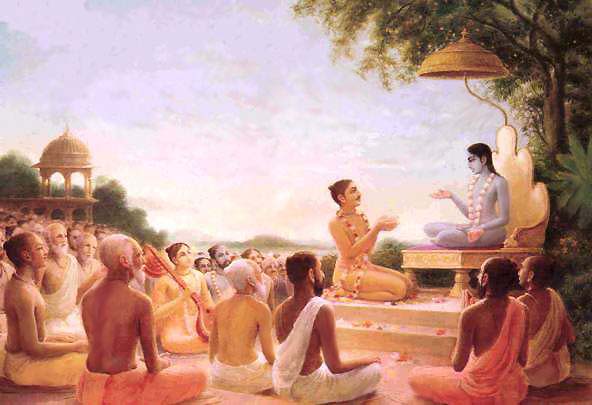
Suta Gosvami said: Being afraid for having killed so many subjects on the Battlefield of Kuruksetra, Maharaja Yudhisthira went to the scene of the massacre. There, Bhismadeva was lying on a bed of arrows, about to pass away.
PURPORT
In this Ninth Chapter, as it is willed by Lord Sri Krsna, Bhismadeva will impart instructions to King Yudhisthira on the subject of occupational duties. Bhismadeva will also offer his last prayer to the Lord on the verge of passing away from this mortal world and thus become liberated from the bondage of further material engagements. Bhismadeva was endowed with the power of leaving his material body at will, and his lying down on the bed of arrows was his own choice. This passing away of the great warrior attracted the attention of all the contemporary elites, and all of them assembled there to show their feelings of love, respect and affection for the great soul.
More
28 Jan 2011
by The Hare Krishna Movement
in Indra, Srimad Bhagavatam
Tags: A.C. Bhaktivedanta Swami, hog, Lord Indra, Lord Kapila, maya, Srimad Bhagavatam

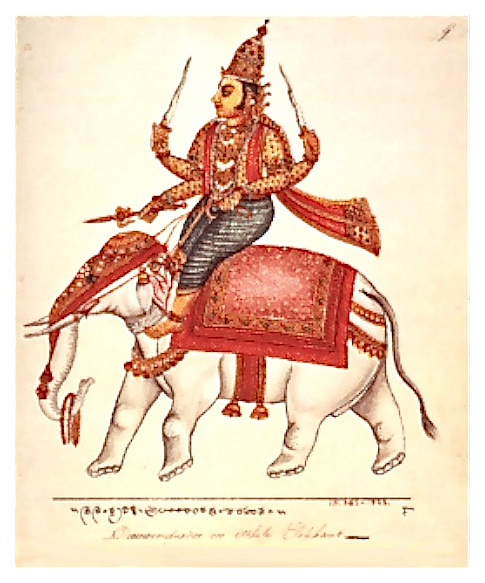
King Indra cursed to become a Hog
Taken from the Srimad Bhagavatam Canto 3, Chapter 30, Text 5-6
By His Divine Grace A.C. Bhaktivedanta Swami Prabhupada
“The conditioned living entity is satisfied in his own particular species of life; while deluded by the covering influence of the illusory energy, he feels little inclined to cast off his body, even when in hell, for he takes delight in hellish enjoyment.”
It is said that once Indra, the King of heaven, was cursed by his spiritual master, Bṛhaspati, on account of his misbehavior, and he became a hog on this planet. After many days, when Brahmā wanted to recall him to his heavenly kingdom, Indra, in the form of a hog, forgot everything of his royal position in the heavenly kingdom, and he refused to go back. This is the spell of māyā. Even Indra forgets his heavenly standard of life and is satisfied with the standard of a hog’s life. By the influence of māyā the conditioned soul becomes so affectionate towards his particular type of body that if he is offered, “Give up this body, and immediately you will have a king’s body,” he will not agree. This attachment strongly affects all conditioned living entities. Lord Kṛṣṇa is personally canvassing, “Give up everything in this material world. Come to Me, and I shall give you all protection,” but we are not agreeable. We think, “We are quite all right. Why should we surrender unto Kṛṣṇa and go back to His kingdom?” This is called illusion, or māyā. Everyone is satisfied with his standard of living, however abominable it may be.
Such satisfaction with one’s standard of living is due to deep-rooted attraction for body, wife, home, children, animals, wealth and friends. In such association, the conditioned soul thinks himself quite perfect.
This so-called perfection of human life is a concoction. Therefore, it is said that the materialist, however materially qualified he may be, is worthless because he is hovering on the mental plane, which will drag him again to the material existence of temporary life. One who acts on the mental plane cannot get promotion to the spiritual. Such a person is always sure to glide down again to material life. In the association of so-called society, friendship and love, the conditioned soul appears completely satisfied.
19 Jan 2011
by The Hare Krishna Movement
in Krishna Consciousness, Srimad Bhagavatam
Tags: devotee, fruitive workers, karmi, Lord Krsna, lotus feet, Srimad Bhagavatam, Vyasa

In the Bhagavad-gītā it is also said that such fallen devotees are given a chance to take birth in a family of highly qualified brāhmaṇas or in a rich mercantile family. A devotee in such a position is not as fortunate as one who is chastised by the Lord and put into a position seemingly of helplessness. The devotee who becomes helpless by the will of the Lord is more fortunate than those who are born in good families. The fallen devotees born in a good family may forget the lotus feet of the Lord because they are less fortunate, but the devotee who is put into a forlorn condition is more fortunate because he swiftly returns to the lotus feet of the Lord, thinking himself helpless all around.
Srimad-Bhagavatam [Canto 1, Ch.5, Text 20] 1977 Edition
By His Divine Grace A.C. Bhaktivedanta Swami Prabhupada
My dear Vyāsa, even though a devotee of Lord Kṛṣṇa sometimes falls down somehow or other, he certainly does not undergo material existence like others [fruitive workers, etc.] because a person who has once relished the taste of the lotus feet of the Lord can do nothing but remember that ecstasy again and again.
Purport
A devotee of the Lord automatically becomes uninterested in the enchantment of material existence because he is rasa-graha, or one who has tasted the sweetness of the lotus feet of Lord Kṛṣṇa. There are certainly many instances where devotees of the Lord have fallen down due to uncongenial association, just like fruitive workers, who are always prone to degradation. But even though he falls down, a devotee is never to be considered the same as a fallen karmī. A karmī suffers the result of his own fruitive reactions, whereas a devotee is reformed by chastisement directed by the Lord Himself. The sufferings of an orphan and the sufferings of a beloved child of a king are not one and the same. An orphan is really poor because he has no one to take care of him, but a beloved son of a rich man, although he appears to be on the same level as the orphan, is always under the vigilance of his capable father. A devotee of the Lord, due to wrong association, sometimes imitates the fruitive workers. The fruitive workers want to lord it over the material world. Similarly, a neophyte devotee foolishly thinks of accumulating some material power in exchange for devotional service. Such foolish devotees are sometimes put into difficulty by the Lord Himself. As a special favor, He may remove all material paraphernalia. By such action, the bewildered devotee is forsaken by all friends and relatives, and so he comes to his senses again by the mercy of the Lord and is set right to execute his devotional service.
More
Next Newer Entries








 The Hare Krishna Movement