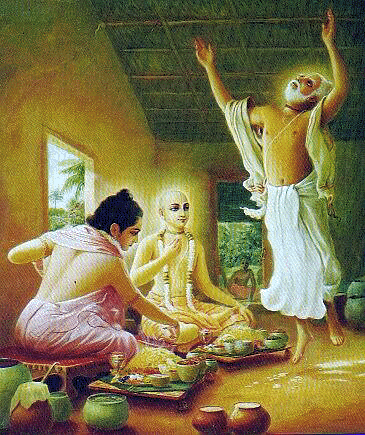
Advaita Acarya Invites Lord Caitanya Home

Today being Thanksgiving, we decided to post a story of one of the “Most Famous Feasts” in recent Vaisnava history, cooked by the wife of Advaita Acarya, Sita. Followed by the song composed by Srila Bhaktivinoda Thakura, “Prasada-sevya part 2” honoring this event.

Sri Caitanya-caritamrta – 1975 Edition
By His Divine Grace A.C. Bhaktivedanta Swami Prabhupada
Lord Sri Caitanya Mahaprabhu’s Stay at the House of Advaita Acarya
Madhya 3, Text 38-136

Advaita Ācārya said, “You have been fasting continuously for three days in Your ecstasy of love for Kṛṣṇa. I therefore invite You to My home, where You may kindly take Your alms. Come with Me to My residence.”

Advaita Prabhu continued, “At My home I have just cooked one palmful of rice. The vegetables are always very simple. There is no luxurious cooking-simply a little liquid vegetable and spinach.”

Saying this, Śrī Advaita Ācārya took the Lord into the boat and brought the Lord to His residence. There Advaita Ācārya washed the feet of the Lord and was consequently very happy within.

All the eatables were first cooked by the wife of Advaita Ācārya. Then Śrīla Advaita Ācārya personally offered everything to Lord Viṣṇu.

More

Samsara Davanala Lidha Loka (Sri Gurvastakam)

Srila Prabhupada sings Sri Gurvastakam Prayers

http://www.youtube.com/watch?v=WMiyGh2elHU&feature=player_embedded

Sri-Sri-Gurv-astaka
(Eight prayers Glorifying the Spiritual Master)
By Srila Visvanatha Cakravarti Thakura

Srila Visvanatha Cakravarti Thakura, who appeared in the latter half of the 17th century, is a great spiritual master in the Krsna Consciousness chain of gurus and disciples. He says that one should loudly chant the following eight prayers, with great care and attention, during the brahma-muhurta, the auspicious time an hour and a half before sunrise when devotional practices are especially potent. Anyone who thus chants these eight beautiful prayers glorigying the spiritual master will certainly get a chance to render direct service to Krsna, the Lord of Vrndavan, after the demise of his body. (from 1974 edition of “Songs of the Vaisnava Acaryas)

For complete sanskrit text, translation and purport by His Divine Grace A. C. Bhaktivedanta Swami Prabhupada…

More

The Eight Names of Vrinda-devi


Asta-Nama-Stava from the Padma Purana The Eight Names of Vrinda-devi

On the full moon-day of Kartik Lord Sri Krishna Himself worships Srimati Tulasi-devi with this Mantra.

Vrindavani, vrinda, visvapujita, pushpasara, nandini, Krishna-jivani, visva-pavani, tulasi

VRINDAVANI – One who first manifested in Vrindavan.

VRINDA – The goddess of all plant and trees ( even if one Tulasi plant is present in a forest it can be called Vrindavana.)

VISHVAPUJITA – One whom the whole universe worships.

PUSHPASARA – The topmost of all flowers, without whom Krishna does not like to look upon other flowers.

NANDINI – Seeing whom gives unlimited bliss to the devotees.

KRISHNA-JIVANI – The life of Sri Krishna.

VISHVA-PAVANI – One who purifies the three worlds.

TULASI – One who has no comparison.

Anyone while worshiping Tulasi-devi chants these eight names will get the same results as one who performs the Ashvamedha sacrifice. And one who on the full-moon day of Kartika (Tulasi-devi’s appearance day) worships Her with this Mantra will break free from the bonds of this miserable world of birth and death, and very quickly attains Goloka Vrndavan. On the full moon-day of Kartik Lord Sri Krishna Himself worships Srimati Tulasi-devi with this Mantra.

One who remembers this Mantra will very quickly attain devotion to Lord Krishna’s Transcendental Lotus Feet.

Pasted from; http://www.vrindavan-dham.com/vrinda/songs-prayers.php

Sri Damodarastakam as explained by Visnujana Swami / Verse Eight

O Lord, the entire universe was created by Lord Brahma, who was born from Your abdomen, which was bound with a rope by Mother Yasoda. To this rope I offer my humble obeisances.

namas te ‘stu dāmne sphurad-dīpti-dhāmne
tvadīyodarāyātha viśvasya dhāmne
namo rādhikāyai tvadīya-priyāyai
namo ‘nanta-līlāya devāya tubhyam

namaḥ–obeisances; te–to You; astu–may there be; dāmne–unto the rope around Your waist; sphurat–splendrous; dīpti-dhāmne–unto the effulgent abode; tvadīya-udarāya–unto Your belly; atha–thus; viśvasya–of the entire universe; dhāmne–unto the shelter; namaḥ–obeisances; rādhikāyai–unto Rādhikā; tvadīya priyāyai–unto Your Beloved; namaḥ– obeisances; ananta-līlāya–unto Your limitless sportive pastimes; devāya– unto Your transcendental nature; tubhyam–unto You.

8) O Lord, the entire universe was created by Lord Brahma, who was born from Your abdomen, which was bound with a rope by Mother Yasoda. To this rope I offer my humble obeisances. I offer my obeisances to Your most beloved Srimati Radharani, and to Your unlimited pastimes.

At the conclusion of the prayer, obeisances are offered (namas te) to the Lord’s unique binding, His bodily limbs, His associates, and to the Lord Himself, in order to arouse the mood of bhakti. Even the rope that binds His belly (damne) receives worship. That rope is the abode of, or source of, effulgence (sphurad dipti-dhamne), and the poet here suggests that the rope is also the source of the all-pervading brahman effulgence.

Then, obeisances are offered to the Lord’s belly, which is bound by this wondrous rope (tvadiyodarayatha). What is that belly like? It is the abode or support of all the infinite universes in the creation (visvasya), including all the moving and non-moving living entities dwelling therein. A gigantic lotus flower that sustains the fourteen worlds sprouts from that belly and is the abode of Lord Brahma.

More

Sri Damodarastakam as explained by Visnujana Swami / Verse Seven

You then freed the sons of Kuvera, Manigriva, and Nalakuvera, who were cursed to stand as trees, and You gave them the chance to become Your devotees.

kuverātmajau baddha-mūrtyaiva yadvat
tvayā mocitau bhakti-bhājau kṛtau ca
tathā prema-bhaktiḿ svakāḿ me prayaccha
na mokṣe graho me ‘sti dāmodareha

kuvera-ātmajau–the two sons of Kuvera (named Nalakūvara and Maṇigrīva); baddha-mūrtyā-eva–by He whose divine form was bound with ropes to the grinding mortar; yat-vat–since they were like that (cursed by Nārada to take birth as twin arjuna trees); tvayā–by You; mocitau–they who were liberated; bhakti-bhājau–the recipients of devotional service; kṛtau–You made them; ca–also; tathā–then; premabhaktim–loving devotion; svakām–Your own; me–unto me; prayaccha– please give; na mokṣe–not for liberation; grahaḥ–enthusiasm; me–my; asti–is; dāmodara–O Lord Dāmodara!; iha–this.

7) O Lord Damodara, in Your form as a baby, Mother Yasoda bound You to a grinding stone with a rope for tying cows, You then freed the sons of Kuvera, Manigriva, and Nalakuvera, who were cursed to stand as trees, and You gave them the chance to become Your devotees. Please bless me in this same way, I have no desire for liberation into Your effulgence.

Purport
This verse reveals deep truths about prema-visesa, pure ecstatic love for Krishna. Beginning with kuveratmajau, the two sons of Kuvera are introduced. They were able to obtain the direct vision of the Lord. But isn’t prema-bhakti the only means for seeing the Lord face to face? And having once seen the Lord, doesn’t the agony of separation set in upon losing that vision? This is the feature of prema-bhakti that brings the Lord under the sway of the pure devotee’s love.

How did the two reprobates get such mercy? The answer is that by the quality of Sri Krishna’s love, bhakta-vatsala, the impossible becomes possible. To honor the word of His pure devotee Narada Muni, who gave the benediction that they would see the Lord face to face, the Lord actually delivers these two brothers. Did they ever do anything to deserve this? No. It is simply causeless mercy!

More

Sri Damodarastakam as explained by Visnujana Swami / Verse Six

O unlimited Visnu! O master! O Lord!

namo deva dāmodarānanta viṣṇo
prasīda prabho duḥkha-jālābdhi-magnam
kṛpā-dṛṣṭi-vṛṣṭyāti-dīnaḿ batānu
gṛhāṇeṣa mām ajñam edhy akṣi-dṛśyaḥ

namaḥ–I bow down; deva–O divine Lord!; dāmodara–O Lord whose belly is bound with a rope!; ananta–O limitless Lord!; viṣṇo–O allpervading Lord!; prasīda–be pleased; prabho–O my Master!; duḥkhajāla–a network of material miseries; abdhi-magnam–immersed in the ocean; kṛpā-dṛṣṭi-vṛṣṭyā–by the rain of merciful glances; āti-dīnam–very fallen; bata–alas!; anugṛhāṇa–please accept; īśa–O supremely independent Lord!; mām–me; ajñam–ignorant; edhi–please come; akṣidṛśyaḥ–perceptible to my eyes.

6) O unlimited Visnu! O master! O Lord! Be pleased upon me! I am drowning in and ocean of sorrow and am almost like a dead man, Please shower the rain of mercy on me; uplift me and protect me with Your nectarean vision.

Purport
Feelings of love arise from the purity and potency of longing, and then is only satisfied to behold the beauty of Sri Krishna directly (saksat darsana). The supreme method (param-sadhana) to attain this goal is chanting the Holy Name (sri-nama-sankirtana). Satyavrata Muni begins this verse chanting the Holy Names. In his ecstasy, feelings of awe and reverence are abandoned by the elimination of the word tubhyam (unto You). This creates the mood of being in the personal presence of the Lord.

More

Sri Damodarastakam as explained by Visnujana Swami / Verse Five

O Lord, the cheeks of Your blackish lotus face, which is encircled by locks of curling hair, have become reddened like bimba fruit due to Mother Yasoda’s kisses


idaḿ te mukhāmbhojam atyanta-nīlair
vṛtaḿ kuntalaiḥ snigdha-raktaiś ca gopyā
muhuś cumbitaḿ bimba-raktādharaḿ me
manasy āvirāstām alaḿ lakṣa-lābhaiḥ

idam–this; te–Your; mukha-ambhojam–lotus-like face; avyakta-nīlaiḥ–by very dark blue; vṛtam–surrounded; kuntalaiḥ–by curling locks of hair; snigdha–soft and glossy; raktaiḥ–by reddish-tinted; ca–also; gopyā–by the gopī (Srī Yaśodā); muhuḥ–again and again; cumbitam–kissed; bimbarakta-adharam–with lips red as the bimba fruit; me–my; manasi–in the heart; āvirāstām–may it be manifest; alam–useless (there is no need for me); lakṣa-lābhaiḥ–by millions of attainments of other boons.

5) O Lord, the cheeks of Your blackish lotus face, which is encircled by locks of curling hair, have become reddened like bimba fruit due to Mother Yasoda’s kisses. What more can I describe than this? Millions of opulences are of no use to me, but may this vision constantly remain in my mind.

Purport

The poet demonstrates in this verse that longing for the association of the Lord in the heart is the best means to achieve Him. The longing to see the beautiful lotus face of the Lord, which is supremely enchanting, is stated first (idam te mukhambhojam). The indescribably sweet face of Sri Krishna resembles a lotus flower in full bloom. Simply by seeing His face, which is the treasure house of supreme bliss, all anxiety and distress disappear.

More

Purport to Jaya Radha Madhava

Radha Madhava


Purport to Jaya Radha Madhava

(New York, July 20, 1971)
By His Divine Grace A.C. Bhaktivedanta Swami Prabhupada

[Sings Jaya Radha-Madhava.] (song lyrics follow this post)

Srila Prabhupada:
So this is the original nature of Krsna. He is Radha-Madhava. He is the lover of Srimati Radharani. And kunja-vihari, always enjoying the company of the gopis within the bushes of Vrdavana forest. Radha-madhava kunja-vihari. So He’s not only lover of Radharani, but braja-jana-vallabha. The whole residents of Vrndavana, they love Krsna. They do not know anything else. They do not know whether Krsna is God, or not; neither they are very much harassed, that “I shall love Krsna if He is God.” “He may be God or He may be whatever He is. It doesn’t matter, but we love God, Krsna.” That’s all. That is called unnalloyed love. “If Krsna is God, then I shall love Him” — this is conditional love. This is not pure love. Krsna may be God or whatever He may be, but by His wonderful acts, the Vrajavasi, they are thinking, “Oh Krsna, He is very wonderful child, maybe some demigod. Maybe some demigod.” Because people are generally under impression that the demigods are all-powerful.

More

Sri Damodarastakam as explained by Visnujana Swami / Verse Four

My only prayer is that Your childhood pastimes may constantly appear in my mind

varaḿ deva mokṣaḿ na mokṣāvadhiḿ vā
na canyaḿ vṛṇe ‘haḿ vareṣād apīha
idaḿ te vapur nātha gopāla-bālaḿ
sadā me manasy āvirāstāḿ kim anyaiḥ

varam–boons; deva–O Lord!; mokṣam–liberation; na–not; mokṣāavadhim–the highest pinnacle of liberation (the realm of Srī Vaikuṇṭhaloka); vā–or; na–not; ca-anyam–or anything else; vṛṇe aham–I pray for; vara-īśāt–from You Who can bestow any boon; api–also; iha–here in Vṛndāvana; idam–this; te–Your; vapuḥ–divine bodily form; nātha–O Lord!; gopāla-bālam–a young cowherd boy; sadā–always; me manasi–in my heart; āvirāstām–may it be manifest; kim anyaiḥ–what is the use of other things (mokṣā, and so forth.)

4) O Lord, although You are able to give all kinds of benedictions, I do not pray to You for liberation, nor eternal life in Vaikuntha, nor any other boon. My only prayer is that Your childhood pastimes may constantly appear in my mind. O Lord, I do not even want to know Your feature of Paramatma. I simply wish that Your childhood pastimes may ever be enacted in my heart.

Purport
Both verses four and five describe the poet’s innermost desires, beginning with, varam, boons. No benedictions of any kind are requested even here in Vrindavan (lila) from He who can bestow any boon (varesad). Satyavrata Muni does not seek liberation (moksa na), nor does he desire the highest conception of liberation (moksa-avadhim), which is eternal life in Vaikuntha. Neither is he interested in any other benediction (na ca anyam), referring to the nine processes of devotional service, beginning with sravanam kirtanam, and the benefits they bestow. If others desire these, or even if Krishna wants to bestow these upon him, he has no attraction for them.

The three benedictions referred to – moksa (liberation), moksavadhim (eternal life in Vaikuntha), and anyam (any other boon) – reflect an ascending order of superiority. Eternal life in Vaikuntha is clearly superior to impersonal liberation. The position of other boons, such as the nine processes of devotional service, are described in Srimad Bhagavatam.

“O Lord, we pray that You let us be born in any hellish condition of life, just as long as our hearts and minds are always engaged in the service of Your lotus feet, our words are made beautiful [by speaking of Your activities] just as Tulasi leaves are beautified when offered unto Your lotus feet, and as long as our ears are always filled with the chanting of Your transcendental qualities.” Srimad Bhagavatam 3.15.49.

By these words spoken by the four Kumaras, we can understand that the nine processes of devotion can be perfected even in hell. So in any condition of life, one can experience the perfection that is available in the eternal abode, Vaikuntha, through bhakti-yoga.

More

Disappearance Day of Narottama das Thakur

Srila Narottama das Thakura


Today we honor the disappearance day of Narottama Das Thakur, who is well know as the composer of many Vaisnava Songs. So we post one of his well known songs along with a purport by His Divine Grace A.C. Bhaktivedanta Swami Prabhupada

Sri Krsna Caitanya Prabhu Doya Koro More

śrī-kṛṣṇa-caitanya prabhu doyā koro more
tomā binā ke doyālu jagat-saḿsāre

My dear Lord Caitanya, please be merciful to me, because who can be more merciful than Your Lordship within these three worlds?

patita-pāvana-hetu tava avatāra
mo sama patita prabhu nā pāibe āra

Your incarnation is just to reclaim the conditioned, fallen souls, but I assure You that You will not find a greater fallen soul than me. Therefore, my claim is first.

hā hā prabhu nityānanda, premānanda sukhī
kṛpābalokana koro āmi boro duḥkhī

My dear Lord Nityananda, You are always joyful in spiritual bliss. Since You always appear very happy, I have come to You because I am most unhappy. If You kindly put Your glance over me, then I may also become happy.

doyā koro sītā-pati adwaita gosāi
tava kṛpā-bale pāi caitanya-nitāi

O Svarupa Damodara, personal secretary of Lord Caitanya, O six Gosvamis O Sri Rupa Gosvami, Sri Sanatana Gosvami, Sri Raghunatha Bhatta Gosvami, Sri Gopala Bhatta Gosvami, Sri Jiva Gosvami, and Sri Raghunatha dasa Gosvami! O Lokanatha Gosvami, my beloved spiritual master! Narottama dasa also prays for your mercy.

doyā koro śrī-ācārya prabhu śrīnivāsa
rāmacandra-sańga māge narottama-dāsa

O Srinivasa Acarya, successor to the six Gosvamis! Please be merciful to me. Narottama dasa always desires the company of Ramacandra Cakravarti.

Purport
By His Divine Grace A.C. Bhaktivedanta Swami Prabhupada

This is a song composed by Narottama Dasa Thakura. He prays to Lord Caitanya “My dear Lord, please be merciful to me, because who can be more merciful than Your Lordship within these three worlds?” Actually, this is a fact. Not only Narottama Dasa Thakura but Rupa Gosvami also prayed to Lord Caitanya in this way. At the time of the first meeting of Lord Caitanya and Rupa Gosvami at Prayaga (Allahabad), Srila Rupa Gosvami said, “My dear Lord, You are the most munificent of all incarnations, because You are distributing love of Krsna, Krsna consciousness.” When Krsna was personally present He simply asked us to surrender, but He did not distribute Himself so easily. He made conditions–“First of all you surrender.” But this incarnation, Lord Caitanya, although Krsna Himself, makes no such condition. He simply distributes: “Take love of Krsna.” Therefore Lord Caitanya is approved as the most munificent incarnation. Narottama Dasa Thakura says, “Please be merciful to me. You are so magnanimous, because You have seen the fallen souls of this age, and You are very much compassionate to them, but You should know also that I am the most fallen. No one is more greatly fallen than me.” Patita-pavana-hetu tava avatara. “Your incarnation is just to reclaim the conditioned, fallen souls, but I assure You that You will not find a greater fallen soul than me. Therefore, my claim is first.”

More
Sri Damodarastakam

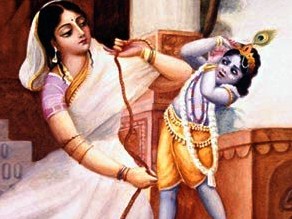
He ran in retreat in fear of Mother Yasoda bus was ultimately caught, to that Supreme Lord, Sri Damodara, I offer my humble obeisances.


Sri Damodarastakam
By Sri Satyavrata Muni
From the original 1974 “Songs of the Vaisnava Acaryas” songbook

This eight sloka prayer is sung morning and evening during the month of Damodara.

namāmīśvaraḿ sac-cid-ānanda-rūpaḿ
lasat-kuṇḍalaḿ gokule bhrājamanam
yaśodā-bhiyolūkhalād dhāvamānaḿ
parāmṛṣṭam atyantato drutya gopyā

1) To the supreme controller who possesses an eternal form of blissful knowledge, whose glistening earrings swing to and fro, who manifested Himself in Gokula, who stole the butter that the gopis kept hanging from the rafters of their storerooms and who then quickly jumped up and ran in retreat in fear of Mother Yasoda, but was ultimately caught-to that Supreme Lord, Sri Damodara, I offer my humble obeisances.

rudantaḿ muhur netra-yugmaḿ mṛjantam
karāmbhoja-yugmena sātańka-netram
muhuḥ śvāsa-kampa-trirekhāńka-kaṇṭha-
sthita-graivaḿ dāmodaraḿ bhakti-baddham

2) Upon seeing His mothers whipping stick, He cried and rubbed His eyes again and again with His two lotus hands. His eyes were fearful and His breathing quick, and as Mother Yasoda bound His belly with ropes, He shivered in fright and His pearl necklace shook, To this Supreme Lord, Sri Damodara, who is bound with His devotee’s love, I offer my humble obeisances.

More

Next Newer Entries

108 Imporant Slokas from the 1972 Bhagavad-gita As It Is

Click on image to go to Post

Click on image to go to Post

The Hare Krishna Cookbook

Songs of the Vaisnava Acaryas

Bhagavad-gita As It Is 1972 Edition “Online”

click on image

click on image to visit site

Srimad Bhagavatam Online

click on image

Raja-Vidya the King of Knowledge

click on image

click on image

Blog Stats

  • 4,573,912 hits

Enter your email address to subscribe to this blog and receive notifications of new posts by email.

Join 3,906 other subscribers

Important Slokas from the Brahma-samhita

click on image

click on image

Slokas from the Sri Isopanisad

click on image

click on image

Prayers By Queen Kunti (Slokas)

click on image

Gajendra’s Prayers of Surrender (Slokas)

click on image

A Short Statement of the Philosophy of Krishna Consciousness

click on image

click on image

July 9th Letter

click on image

click on image

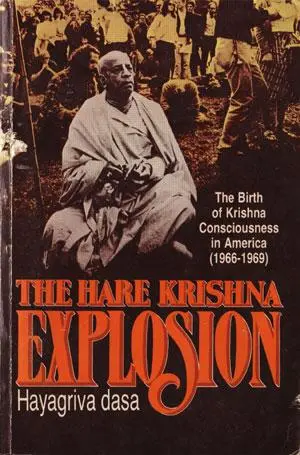
The Hare Krishna Explosion

Reference Material/Study Guide

click on image

click on image

  • LINKS