The Philosophy of the Hare Krishna Movement

theharekrishnamovement

click on above image to buy Srila Prabhupada’s original books

A Short Statement of the Philosophy of the Hare Krishna Movement

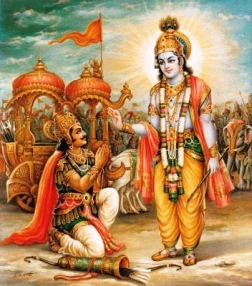
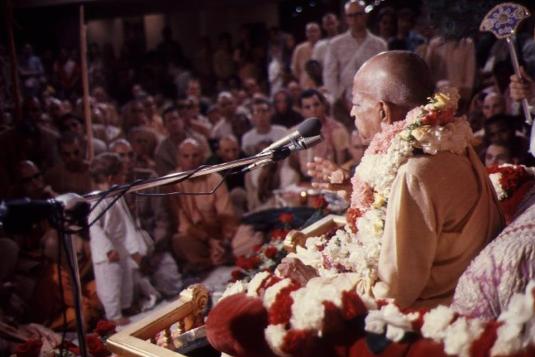
The Hare Krishna Movement is a worldwide community of devotees practicing bhakti-yoga, the eternal science of loving service to God. The movement was founded in the western world in 1966 by His Divine Grace A.C. Bhaktivedanta Swami Prabhupada, a pure devotee of God representing an unbroken chain of spiritual masters originating with Lord Krsna Himself.

Although the Movement has changed in many ways since the physical departure of Srila Prabhupada, still the principles, and practice has remained the same. And Srila Prabhupada is still the Spiritual Master for the Hare Krishna Movement.

“As long as the Spiritual master is physically present , the disciple should serve the physical body of the Spiritual master, and when the spiritual master is no longer physically existing, the disciple should serve the instructions of the spiritual master.” (Srimad Bhagavatam Purport 4.28.47)

The following eight principles are the basis of the Krsna consciousness movement. More

Practicing Kṛṣṇa Consciousness

…While churning the butter, mother Yaśodā was singing about the childhood activities of Kṛṣṇa. It was formerly a custom that if one wanted to remember something constantly, he would transform it into poetry or have this done by a professional poet. It appears that mother Yaśodā did not want to forget Kṛṣṇa’s activities at any time. Therefore she poeticized all of Kṛṣṇa’s childhood activities, such as the killing of Pūtanā, Aghāsura, Śakaṭāsura and Tṛṇāvarta, and while churning the butter, she sang about these activities in poetical form. This should be the practice of persons eager to remain Kṛṣṇa conscious twenty-four hours a day. This incident shows how Kṛṣṇa conscious mother Yaśodā was. To stay in Kṛṣṇa consciousness, we should follow such persons. (SB 10.9.1-2)

full text and purport More

Devastating Rainfall in Vṛndāvana

click on image to enlarge

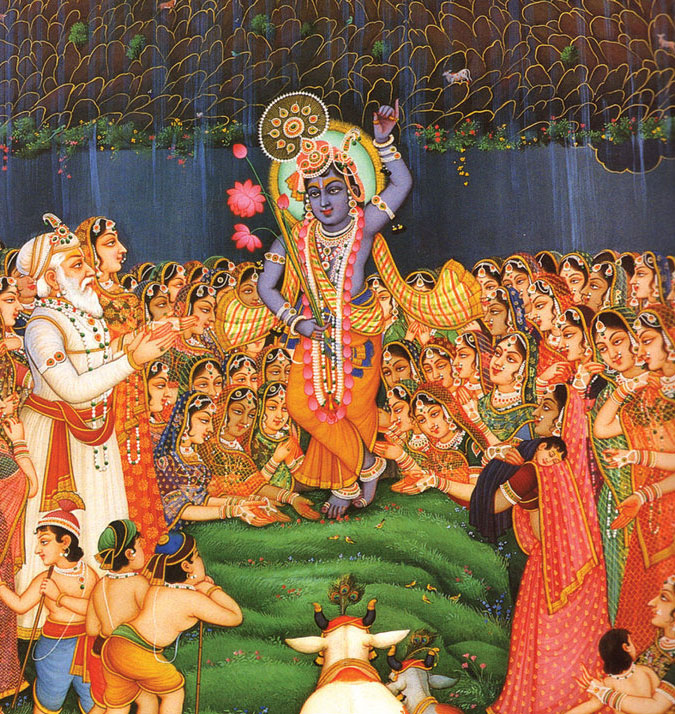
On this very auspicious day, Govardhana-puja, we are reminded of Krsna’s lifting of Govardhana Hill, as told by His Divine Grace A.C. Bhaktivedanta Swami Prabhupada in chapter 25 of the Krsna Book.

…Kṛṣṇa has declared in the Bhagavad-gītā that the worshipers of the demigods are not very intelligent. He has also declared that one has to give up all kinds of worship and simply concentrate on Kṛṣṇa consciousness. Kṛṣṇa’s invoking the anger of Indra and later on chastising him is a clear indication to His devotee that those who are engaged in Kṛṣṇa consciousness have no need to worship any demigod, even if it is found that the demigod has become angry. Kṛṣṇa gives His devotees all protection, and they should completely depend on His mercy.

Kṛṣṇa, the Supreme Personality of Godhead
By His Divine Grace A. C. Bhaktivedanta Swami Prabhupāda
Chapter 25

Devastating Rainfall in Vṛndāvana

When Indra understood that the sacrifice offered by the cowherd men in Vṛndāvana was stopped by Kṛṣṇa, he became angry, and he vented his anger upon the inhabitants of Vṛndāvana, who were headed by Nanda Mahārāja, although Indra knew perfectly well that Kṛṣṇa was personally protecting them. As the director of different kinds of clouds, Indra called for the Sāṁvartaka. This cloud is invited when there is a need to devastate the whole cosmic manifestation. The Sāṁvartaka was ordered by Indra to go over Vṛndāvana and inundate the whole area with an extensive flood. Demonically, Indra thought himself to be the all-powerful supreme personality. When demons become very powerful, they defy the supreme controller, Personality of Godhead. Indra, though not a demon, was puffed up by his material position, and he wanted to challenge the supreme controller. He thought himself, at least for the time being, as powerful as Kṛṣṇa. Indra said, “Just see the impudence of the inhabitants of Vṛndāvana! They are simply inhabitants of the forest, but being infatuated with their friend Kṛṣṇa, who is nothing but an ordinary human being, they have dared to defy the demigods.”

More

The Real Goal of life

click on image to enlarge

Continuing with our series of a True account entitled Perfect Questions, Perfect Answers… A search for meaning carries Bob Cohen, a young American Peace Corps worker halfway around the world, to an ancient village in the midst of West Bengal. There, in a small bamboo hut, he finds a teacher who is able to tell him everything he ever wanted to know.

Perfect Questions, Perfect Answers
By His Divine Grace A. C. Bhaktivedanta Swami Prabhupāda

Chapter Three

The Real Goal of life
February 28, 1972 (continued)

Śrīla Prabhupāda: This movement is especially meant to enable a human being to reach the real goal of life.

Bob: The real goal… ?

Śrīla Prabhupāda: The real goal of life.

Bob: Is the real goal of life to know God?

Śrīla Prabhupāda: Yes. To go back home, back to Godhead. That is the real goal of life. The water that comes from the sea forms clouds, the clouds fall down as rain, and the actual goal is to flow down the river and again enter the sea. So, we have come from God, and now we are embarrassed by material life. Therefore, our aim should be to get out of this embarrassing situation and go back home, back to Godhead. This is the real goal of life.

More

Becoming Eager to See Krsna

…The gopis are another example of great eagerness to see Krsna. The gopis came to Krsna, being captivated by His beautiful features.

The first thing Krsna is looking for is how eager you are to see Him. Krsna will respond. If you are actually eager to see Krsna …your efforts will be successful. But you must desire Krsna only. In this connection, Rupa Gosvami has written a verse:

smeram bhangi-traya-paricitam saci-vistirna-drstim
vamsi-nyastadhara-kisalayam ujjvalam candrakena
govindakhyam hari-tanum itah kesi-tirthopakanthe
ma preksisthas tava yadi sakhe bandhu-sange ‘sti rangah

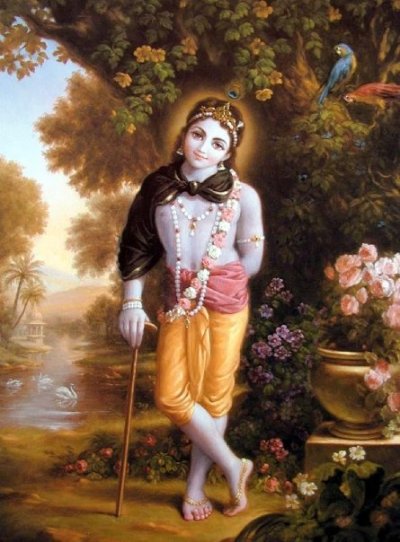
The idea is that one gopi is advising another gopi, “My dear friend, there is one boy His name is Govinda. He is standing on the bank of the Yamuna near the Kesi-ghata, and He is playing on His flute. He is so beautiful, especially during this full-moon night. If you have any intention to enjoy in this material world with your children, husband, or other family members, then please do not go there.” Bhangi-traya: Krsna always stands in a three-curved way with His flute. That is Krsna’s tri-bhanga form, bending in three places. So the one gopi says to the other, “If you think that you’ll enjoy your life more in this material world, then do not go to see Krsna. Do not go there.” The idea is that if you once see Krsna, then you’ll forget all this nonsensical materialistic enjoyment. That is seeing Krsna.

More

A Pure Devotee Can Deliver You Krishna

Click on image to enlarge

Pure devotee means he has no other desire, no material desire. Anyābhilāṣitā-śūnyam, zero.

…And if it is mixed up, anyābhi…, with material desire or spiritual emancipation or fruitive activities, then it is not pure devotee.

So if you can approach such pure devotee… As it is stated in the Brahma-saṁhitā, adurlabham ātma-bhaktau. This is ātma-bhaktau, a pure devotee. He can deliver you Kṛṣṇa. “Take Kṛṣṇa. Here is Kṛṣṇa.” Kṛṣṇa-prema… That is…

The symbolic representation is Śrī Caitanya Mahāprabhu. He’s described by Rūpa Gosvāmī:

namo mahā-vadānyāya kṛṣṇa-prema-pradāya te kṛṣṇāya kṛṣṇa-caitanya-nāmne gaura-tviṣe namaḥ [Madhya 19.53]

When Rūpa Gosvāmī… He was minister in the government of Nawab Hussain Shah. At that time, very exalted personality. He could understand Caitanya Mahāprabhu’s mission. Therefore when he first met Him at Allahabad, Prayāga, he offered his respect with these words: namo mahā-vadānyāya, the most munificent incarnation. Why? Kṛṣṇa-prema-pradāya te. “You are distributing kṛṣṇa-prema. It is very difficult to understand Kṛṣṇa, but You are so kind that You are immediately delivering love of Kṛṣṇa.”

You can know one person. But to develop love for him, that is another transaction. So people cannot understand even Kṛṣṇa, and what is the saying of Kṛṣṇa’s love? But Caitanya Mahāprabhu is so kind that He’s immediately giving kṛṣṇa-prema, love of Kṛṣṇa. Therefore He is described as the most munificent incarnation. Kṛṣṇa Himself could not deliver Himself. He wanted. “First of all you surrender.” Sarva-dharmān parityajya mām ekaṁ śaraṇaṁ vraja [Bg. 18.66] But Caitanya Mahāprabhu is so kind. Simply through this chanting and dancing, He is distributing love of Kṛṣṇa.

You can see practically. These boys from European and American countries, means all over the world, why they are chanting and dancing in this way? Do you think they have become mad? And one says, “Yes, they have become mad.” Why? For love of Kṛṣṇa. Now they have began they have become lover of Kṛṣṇa. So kṛṣṇa-prema is like that. That is through the mercy of Śrī Caitanya Mahāprabhu.

Therefore Śrī Caitanya Mahāprabhu is the symbolic representation of devotee. Bhaktāvatāraṁ bhaktākhyaṁ namāmi bhakta-śaktikam. Namāmi bhakta-śaktikam. He can give the strength to the devotee so that he can develop his dormant love of Kṛṣṇa. Therefore in the Brahma-saṁhitā it is stated that adurlabham ātma-bhaktau. If one is pure devotee, for him, Kṛṣṇa is available very easy. He says in the Bhagavad-gītā. Bhaktyā mām abhijānāti yāvān yaś cāsmi tattvataḥ [Bg. 18.55] “One can understand Me in truth…” Yāvān yaś cāsmi tattvataḥ. “Which is very, very difficult.”

manuṣyāṇāṁ sahasreṣu kaścid yatati siddhaye yatatām api siddhānāṁ kaścin māṁ vetti tattvataḥ [Bg. 7.3]

To understand Kṛṣṇa as He is, it is difficult. But if you take to this process of devotional service…

śravaṇaṁ kīrtanaṁ viṣṇoḥ smaraṇaṁ pāda-sevanam arcanaṁ vandanaṁ dāsyaṁ sakhyam ātma-nivedanam [SB 7.5.23]

Either of these process. All the process or either of these. You become successful to develop your dormant Kṛṣṇa consciousness, and then your life becomes successful. Thank you very much. (end)

Full lecture More

Transcendental Pastimes of the Supreme Lord

Who is there, desiring deliverance from the vices of the age of quarrel, who is not willing to hear the virtuous glories of the Lord?

His transcendental acts are magnificent and gracious, and great learned sages like Nārada sing of them. Please, therefore, speak to us, who are eager to hear about the adventures He performs in His various incarnations.

O wise Sūta, please narrate to us the transcendental pastimes of the Supreme Godhead’s multi-incarnations. Such auspicious adventures and pastimes of the Lord, the supreme controller, are performed by His internal powers.

We never tire of hearing the transcendental pastimes of the Personality of Godhead, who is glorified by hymns and prayers. Those who have developed a taste for transcendental relationships with Him relish hearing of His pastimes at every moment.

..There is a great difference between mundane stories, fiction, or history and the transcendental pastimes of the Lord. The histories of the whole universe contain references to the pastimes of the incarnations of the Lord. The Rāmāyaṇa, the Mahābhārata, and the Purāṇas are histories of bygone ages recorded in connection with the pastimes of the incarnations of the Lord and therefore remain fresh even after repeated readings. For example, anyone may read Bhagavad-gītā or the Śrīmad-Bhāgavatam repeatedly throughout his whole life and yet find in them new light of information. Mundane news is static whereas transcendental news is dynamic, inasmuch as the spirit is dynamic and matter is static. Those who have developed a taste for understanding the transcendental subject matter are never tired of hearing such narrations. (From Purport to SB 1.1.19)

Srimad Bhagavatam
By His Divine Grace A.C. Bhaktivedanta Swami Prabhupada
Canto 1, Chapter 1, Text 16-19

Full Text and Purport More

Next Newer Entries

108 Imporant Slokas from the 1972 Bhagavad-gita As It Is

Click on image to go to Post

Click on image to go to Post

The Hare Krishna Cookbook

Songs of the Vaisnava Acaryas

Bhagavad-gita As It Is 1972 Edition “Online”

click on image

click on image to visit site

Srimad Bhagavatam Online

click on image

Raja-Vidya the King of Knowledge

click on image

click on image

Blog Stats

  • 4,648,751 hits

Enter your email address to subscribe to this blog and receive notifications of new posts by email.

Join 3,893 other subscribers

Important Slokas from the Brahma-samhita

click on image

click on image

Slokas from the Sri Isopanisad

click on image

click on image

Prayers By Queen Kunti (Slokas)

click on image

Gajendra’s Prayers of Surrender (Slokas)

click on image

A Short Statement of the Philosophy of Krishna Consciousness

click on image

click on image

July 9th Letter

click on image

click on image

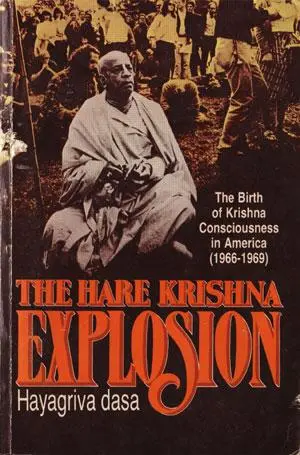
The Hare Krishna Explosion

Reference Material/Study Guide

click on image

click on image

  • LINKS