28 Oct 2011
by The Hare Krishna Movement
in Back to Godhead, Devotee's, Giriraja Swami, Remembering Srila Prabhupada
Tags: Back to Godhead Magazine, Giriraja Swami, photo by Gurudas, Sarasvati, Srila Prabhupada

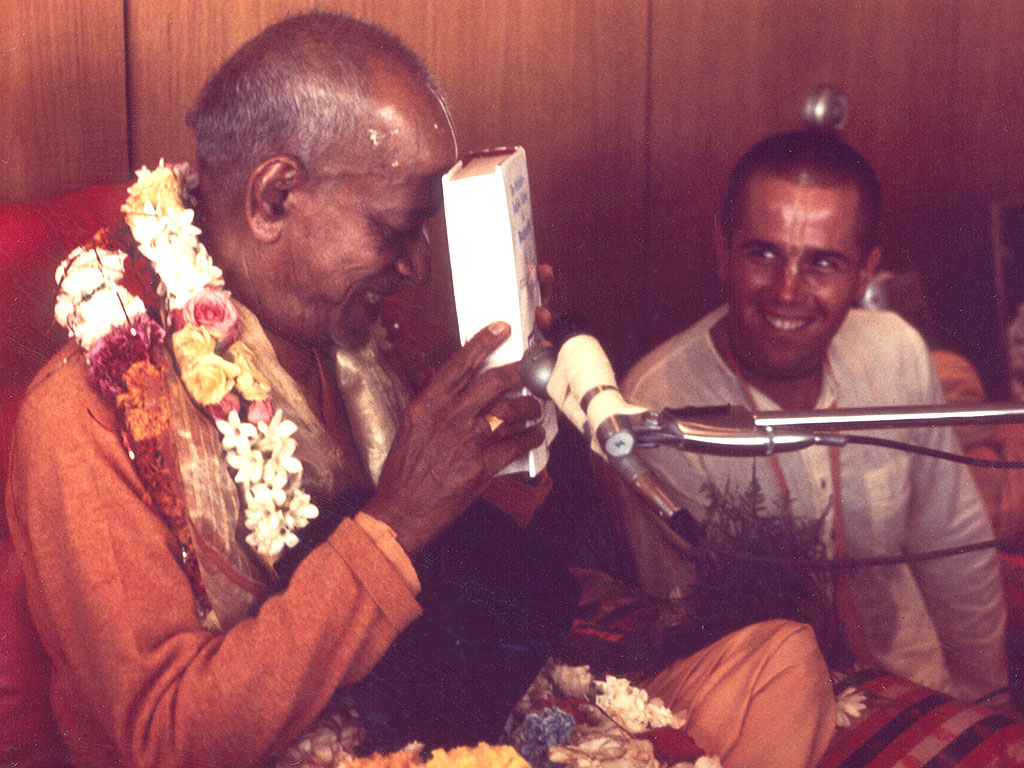
Srila Prabhupada with little Sarasvati
…Srila Prabhupada’s grave voice broke the silence. “Sarasvati, where is Krsna?”
Sarasvati began again to look anxiously all over the room, but still she could not find Him.
Then a devotee said, “Sarasvati, where is Krsna? Who has Krsna?” Sarasvati’s mind awakened with a realization. She opened her eyes wide, raised her eyebrows, and exclaimed,
“Prabhupada has Krsna!” She immediately turned to Srila Prabhupada and rushed to his lotus feet. “Prabhupada has Krsna!”…
Remembering Srila Prabhupada
A Personal Recollection
By Giriraja Swami
In December of 1971, I arranged a speaking program for Srila Prabhupada in Madras, India. Thousands of people came to hear him, and the leading newspaper carried a summary of his lecture every day. Then the Chief Justice of Madras invited him to speak before a large gathering of High Court judges, advocates, and other leading citizens. Srila Prabhupada appealed to the audience to follow the examples of Sri Sanatana Gosvami and Rupa Gosvami, who in the sixteenth century had given up their exalted posts as prime minister and finance minister in the Bengal government to help Sri Caitanya Mahaprabhu spread the Krsna consciousness movement.
More
24 Oct 2011
by The Hare Krishna Movement
in Back to Godhead, Devotee's, Hayagriva das, Srila Prabhupada
Tags: disciples of Srila Prabhupada, Hayagriva dasa, holy river Yamuna, India, Karttika, Karttika pilgrims, Lord Caitanya Mahaprabhu, photo by Gurudas, Radha-Damodara Temple, Srila Prabhupada, Vrndavan
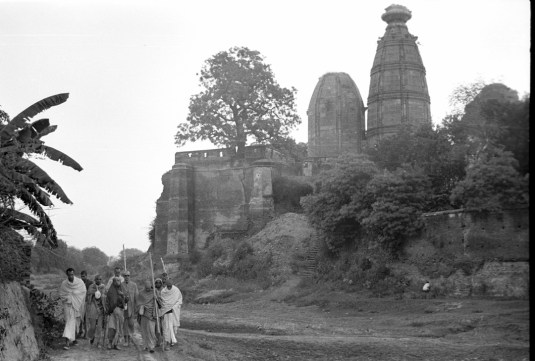
“We should try to make Krsna happy like the gopis of Vrndavana. In Vrndavana everyone is trying to please Krsna—the birds, trees, cows, the river and all His associates. It is not that Vrndavana is only here. We can have Vrndavana everywhere. Krsna is not limited. We should not think that Krsna is far away in Goloka Vrndavana and cannot accept food from us. If you offer food with love, Krsna eats. Krsna does not leave Goloka Vrndavana, but His expansion goes and accepts food. This Vrndavana, which so happens to appear in India, is as worshipable as Krsna. As Krsna is worshipable, His dhama [residence] is also worshipable. So we cannot offend His dhama. If we live in Vrndavana, we are living with Krsna, for Vrndavana is nondifferent from Krsna. There is no difference between the original Vrndavana and this Vrndavana. Vrndavana is so powerful.”
With Srila Prabhupada in Vrndavana
By Hayagriva Dasa
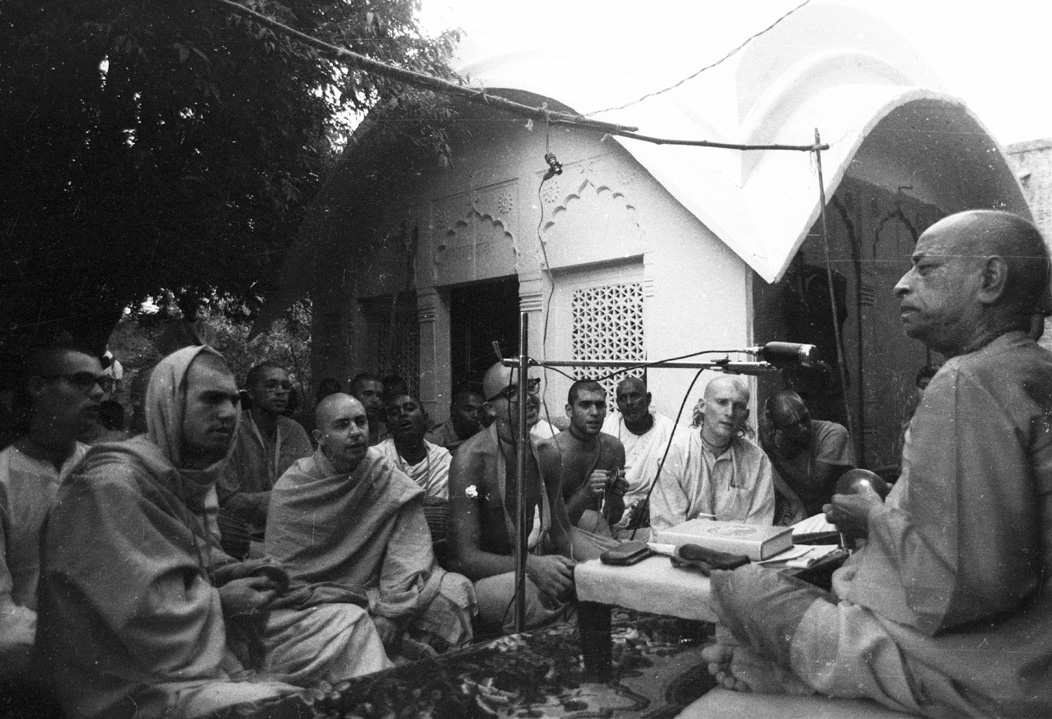
Vrndavana, India, the land of Krsna five thousand years after the disappearance of the Supreme Person, is invaded by eighty American and European disciples of Srila Prabhupada. The white and saffron robed pilgrims arrive in Vrndavana for Karttika, a celebration of Krsna’s rasa dance with the cowherd girls (gopis) of Vrndavana. Yearly, Vrndavana is crowded with Karttika pilgrims from October 15th to November 15th, the best time of year for Vrndavana, a month of clear, pleasant days and cool nights.
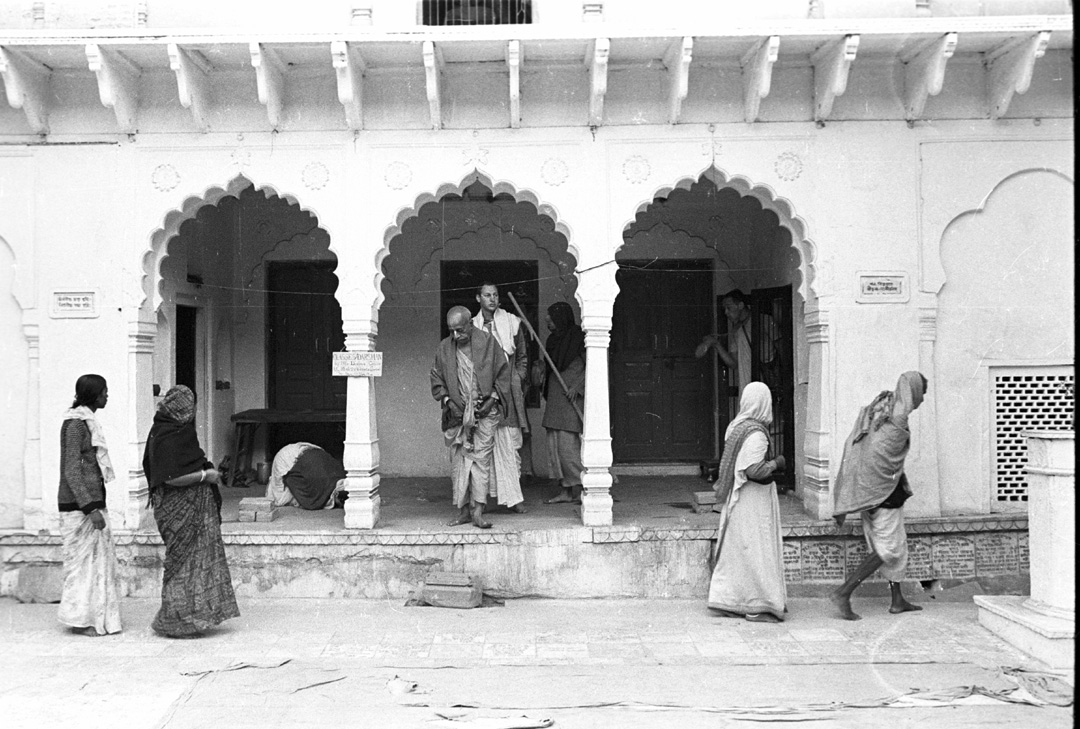
Vrndavana is approached by train from Delhi to Mathura, about ninety miles to the Southeast of Delhi. From Mathura, one takes a bus some eight miles to the village of Vrndavana bordered on three sides by the holy River Yamuna. As a cowherd boy, Krsna sported in the Yamuna, and Vaisnavas consider its waters more purifying than the Ganges itself. In Krsna’s time, Vrndavana was a forest, as its name indicates. Today it is a congested holy-town forgotten by the tourist maps, a town of crumbling temples, memories, chanting devotees, filth and poverty-stricken masses. Tourists whiz by it on the Delhi-Agra Express, unaware of passing Krsna’s old abode. Vrndavana was rediscovered by Lord Caitanya Mahaprabhu and His disciples Rupa and Sanatana Gosvami in the early 16th Century. Many magnificent temples were built in honor of Lord Krsna, but despite the sanctity of the place, it has not been kept up.
More
24 Oct 2011
by The Hare Krishna Movement
in Back to Godhead, Books by Srila Prabhupada, Brahmananda das
Tags: back to Godhead, bhagavad-gita, Caitanya Caritamrta, His Divine Grace A.C. Bhaktivedanta Swami Prabhupada, ISKCON Press, Macmillan's Gita, Nectar of Devotion, Sri Isopanisad, Teachings of Lord Caitanya

The Books of His Divine Grace A.C. Bhaktivedanta Swami Prabhupada
Srila Prabhupada teaches the most difficult and sublime science—the science of how to serve God—in such a way that anyone can understand it. The concepts are presented over and over again, for repetition is a time-tested learning technique in transcendental study. Thus in whichever of Srila Prabhupada’s books one reads first, one will find the entire science of Krsna consciousness presented, yet each succeeding book reveals something more, and with each rereading one will find new light. Srila Prabhupada’s books are the most wonderful vehicle because they swiftly transport the reader to a timeless and ever- green world where everyone is joyfully awakened to the Absolute Truth of Krsna, the Supreme Personality of Godhead.
The Books of His Divine Grace A.C. Bhaktivedanta Swami Prabhupada
Originally published in Back to Godhead No. 52
Bhaktivedanta Book Trust 1973
By Brahmananda Swami ISKCON East Africa
Part 6
The next book, Teachings of Lord Caitanya, was then dictated. It is a summary study of the historic Caitanya-caritamrta. Instead of the exhaustive format of verse to verse translation and purport, Srila Prabhupada presented this book in a shortened but more essential manner. “My books are for my students,” he told us, and so he wanted to write as many as possible. If Bhagavad-gita could be considered the undergraduate study of spiritual life and Srimad-Bhagavatam the master’s study, then Caitanya-caritamrta is the doctorate course. It recounts Lord Caitanya’s teachings to the only five disciples He personally taught. In Teachings of Lord Caitanya, the incomplete philosophy of impersonalism is fully analyzed and forcefully defeated by Lord Caitanya in His discussions with the two biggest impersonalists of His time, Prakasananda Sarasvati and Sarvabhauma Bhattacarya. Also, the quintessence of all detailed knowledge of Krsna and how He acts both in the spiritual and material worlds is disclosed to Ramananda Raya.
More
13 Oct 2011
by The Hare Krishna Movement
in Back to Godhead, Bhagavad-gita, Books by Srila Prabhupada, Brahmananda das
Tags: Bhagavad-gita As It Is, Brahmananda Swami, His Divine Grace A.C. Bhaktivedanta Swami Prabhupada, Macmillan Company, original manuscript

Srila Prabhupada receiving Macmillan Bhagavad-gita As It Is
The Books of His Divine Grace A.C. Bhaktivedanta Swami Prabhupada
Originally published in Back to Godhead No. 52
Bhaktivedanta Book Trust 1973
By Brahmananda Swami ISKCON East Africa
Part 5
Bhagavad-gita As It Is stands as a challenge to all the mental speculators who depart from the Gita’s central teaching of devotional service to the Personality of Godhead, Lord Sri Krsna. Even Mahatma Gandhi stands accused, since his ingenious metaphorical interpretation is simply designed to support his mundane political movement of nonviolence. In India Srila Prabhupada personally requested Gandhi to preach the Gita for what it teaches, Krsna consciousness, just as Srila Bhaktisiddhanta Sarasvati Gosvami Maharaja had personally requested the most famous Indian poet of his time, Rabindranath Tagore.
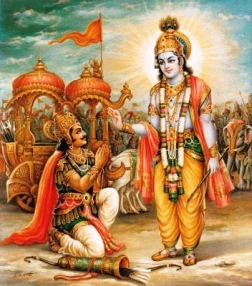
In the Gita’s Ninth Chapter Lord Krsna categorically advises Arjuna to surrender to Him and to love and worship Him only. He specifically uses the Sanskrit word mam, meaning “unto Me.” Yet one commentator, a renowned Indian philosopher and political leader, begins his commentary on this crucial verse, “It is not to Krsna that we have to surrender…” It is very clear that Krsna and Arjuna are standing on the Battlefield of Kuruksetra and that Krsna is telling Arjuna to surrender unto Him. But this scholar wants to turn the reader away from Krsna by insidiously implying that Krsna actually means to surrender to the eternal unmanifested essence within Himself. But Krsna didn’t say this. Significantly, Srila Prabhupada entitles his comments “purports,” not interpretations. In his purports he gives the actual significance of the verses. Srila Prabhupada informs all deluded scholars that because Krsna is absolute, there is no qualitative difference between His within and His without as there is with conditioned living entities like ourselves.
More
09 Oct 2011
by The Hare Krishna Movement
in A.C. Bhaktivedanta Swami Prabhupada, Back to Godhead, Lectures, Technology
Tags: chanting Hare Krishna, Krsna consciousness movement, Lecture by His Divine Grace A.C. Bhaktivedanta Swami Prabhupada, Massachusetts Institute of Technology, MIT, spiritual master, technology
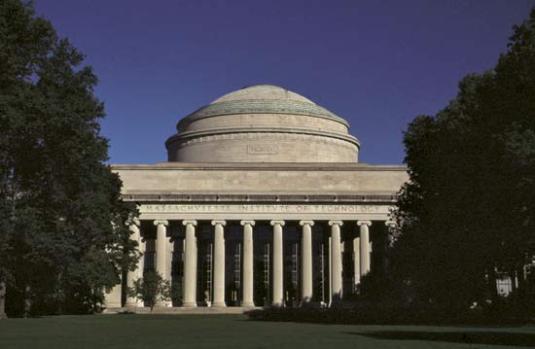
Massachusetts Institute of Technology
The Krsna consciousness movement teaches a science missing from the classrooms of even the world’s best universities.
This movement is for solving the problems of life, and it can be easily done. Anyone can accept it. It doesn’t matter whether one is Indian or American or Hindu or Muslim or Christian. It doesn’t matter. Simply chant this vibration: Hare Krsna, Hare Krsna, Krsna Krsna, Hare Hare/ Hare Rama, Hare Rama, Rama Rama, Hare Hare.
Lecture
By His Divine Grace
A. C. Bhaktivedanta Swami Prabhupada
Founder-Acarya of the International Society for Krishna Consciousness
Massachusetts Institute of Technology, Boston—May 5, 1968
om ajnana-timirandhasya
jnananjana-salakaya
caksur unmilitam yena
tasmai sri-gurave namah
“I offer my respectful obeisances unto my spiritual master, who with the torchlight of knowledge has opened my eyes, which were blinded by the darkness of ignorance.”
This Prayer Is Offering respectful obeisances to the spiritual master. Why? Because the spiritual master is the person who opens our eyes, complicated in ignorance, with the torch of transcendental knowledge. Timirandhasya. Every one of us is born ignorant, and we require specific education and training for seeing things as they are.
Today I am very glad to meet you. You are all students of technology. This Krsna consciousness movement is another technology. In the modern state of civilization there are different depart-ments of knowledge. There is a department for teaching medical science, there is a department for teaching engineering—so many other departments of knowledge. Unfortunately, there is no department for distributing knowledge of the science of the soul. But that is the most important thing, because the soul is the mainstay, the background of all our movements.
In the Bhagavad-gita [3.42] there is a nice verse:
indriyani parany ahur
indriyebhyah param manah
manasas tu para buddhir
yo buddheh paratas tu sah
The idea is that in the present consciousness I am thinking that I am the body, although actually I am not the body. This is ignorance. “Body” means the senses. When I am talking, I am using my tongue for vibration. So these bodily activities are sensual activities.
If you go deep into the matter, you’ll find that the senses can act only when the mind is sound. A crazy man, or a madman, cannot use his senses properly. Therefore the technology of the mind is a higher science. First of all there is the technology of the senses, and then a higher technology of the mind, which is known as psychology and studies thinking, feeling, willing. Psychologists are trying to understand how these are working.
More
02 Oct 2011
by The Hare Krishna Movement
in Back to Godhead, Quotes by Srila Prabhupada, Srila Prabhupada
Tags: Back to Godhead Magazine, BTG 1978, disciples, final instructions, Srila Prabhupada Speaks out

Remembering Srila Prabhupada
Back to Godhead Magazine
Volume 13, Number 102, 1978
During his last months, Srila Prabhupada was not very active physically, and he spoke relatively little. Yet when he did speak, his words were full of spiritual strength. These excerpts from Srila Prabhupada’s last statements reveal the mind of the pure devotee and universal teacher. And they show that Srila Prabhupada is indeed a transcendental personality, whose devotion to Lord Krsna and to the mission of spreading love of Krsna is undying.
“There is nothing new to be said. Whatever I had to say, I have already said in my books. Now you must all try to understand it and continue with your endeavors. Whether I am present or not present doesn’t matter. Just as Krsna is living eternally, the living being also lives eternally. But especially… kirtir yasya sa jivati: ‘One who has done service to the Lord lives forever.’ You have been taught to serve Krsna, and with Krsna we’ll live eternally. Our life is eternal. Na hanyate hanyamane sarire: the disappearance of this temporary body doesn’t matter. The body is meant for disappearance. So, live forever by serving Krsna. Thank you very much.”
More
02 Oct 2011
by The Hare Krishna Movement
in Back to Godhead, Books by Srila Prabhupada, Brahmananda das, Srimad Bhagavatam
Tags: Back to Godhead Magazine, Brahmananda Swami, Srila Prabhupada, Srimad Bhagavatam, The Books of His Divine Grace A. C. Bhaktivedanta Swami Prabhupada

“The words of Srimad-Bhagavatam are Your incarnation, and if people repeatedly hear them in submissive aural reception, then they will be able to understand Your message.”
The Books of His Divine Grace A.C. Bhaktivedanta Swami Prabhupada
Originally published in Back to Godhead No. 52
Bhaktivedanta Book Trust 1973
By Brahmananda Swami ISKCON East Africa
Part 4
In the opening sentences of Srila Prabhupada’s introduction to the Srimad-Bhagavatam, he affirms that the word “God” refers to the supreme controller and that a controller cannot be impersonal. In the first sloka of the Srimad-Bhagavatam, obeisances are offered to the Supreme Personality of Godhead.
om namo bhagavate vasudevaya
om—O my Lord; namah—my respectful obeisances unto You; bhagavate—unto the Personality of Godhead; vasudevaya—unto Lord Krsna, the son of Vasudeva.
O my Lord, the all-pervading Personality of Godhead, I offer my respectful obeisances unto You.
Whereas others have translated the Sanskrit scriptures conveniently to suit their interpretations, Srila Prabhupada always gives word-for-word English equivalents for each Sanskrit verse, and thus the translations cannot be disputed. This is a painstaking process, considering the length of the Srimad-Bhagavatam, but it is in keeping with the heritage of the Gosvamis to present the literature of devotional service authoritatively and scientifically. Furthermore, the English-reading public can easily learn the meanings to the Sanskrit words from this format.
More
22 Sep 2011
by The Hare Krishna Movement
in A.C. Bhaktivedanta Swami Prabhupada, Back to Godhead, Devotional Service, Krishna Consciousness
Tags: Back to Godhead Magazine, devotional service, His Divine Grace A.C. Bhaktivedanta Swami Prabhupada, Krishna, krsna consciousness, materialism, spiritual endeavors, Supreme Personality of Godhead
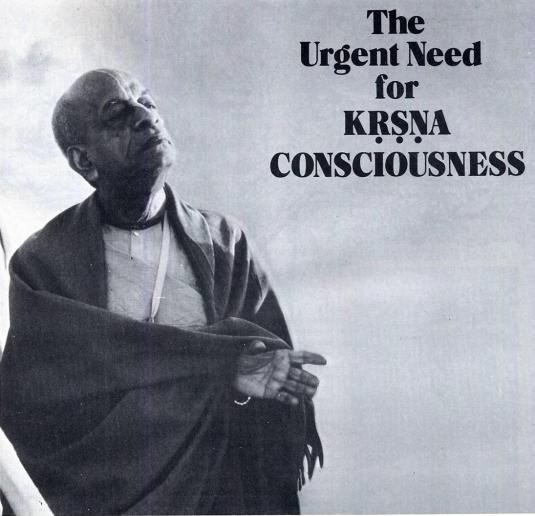
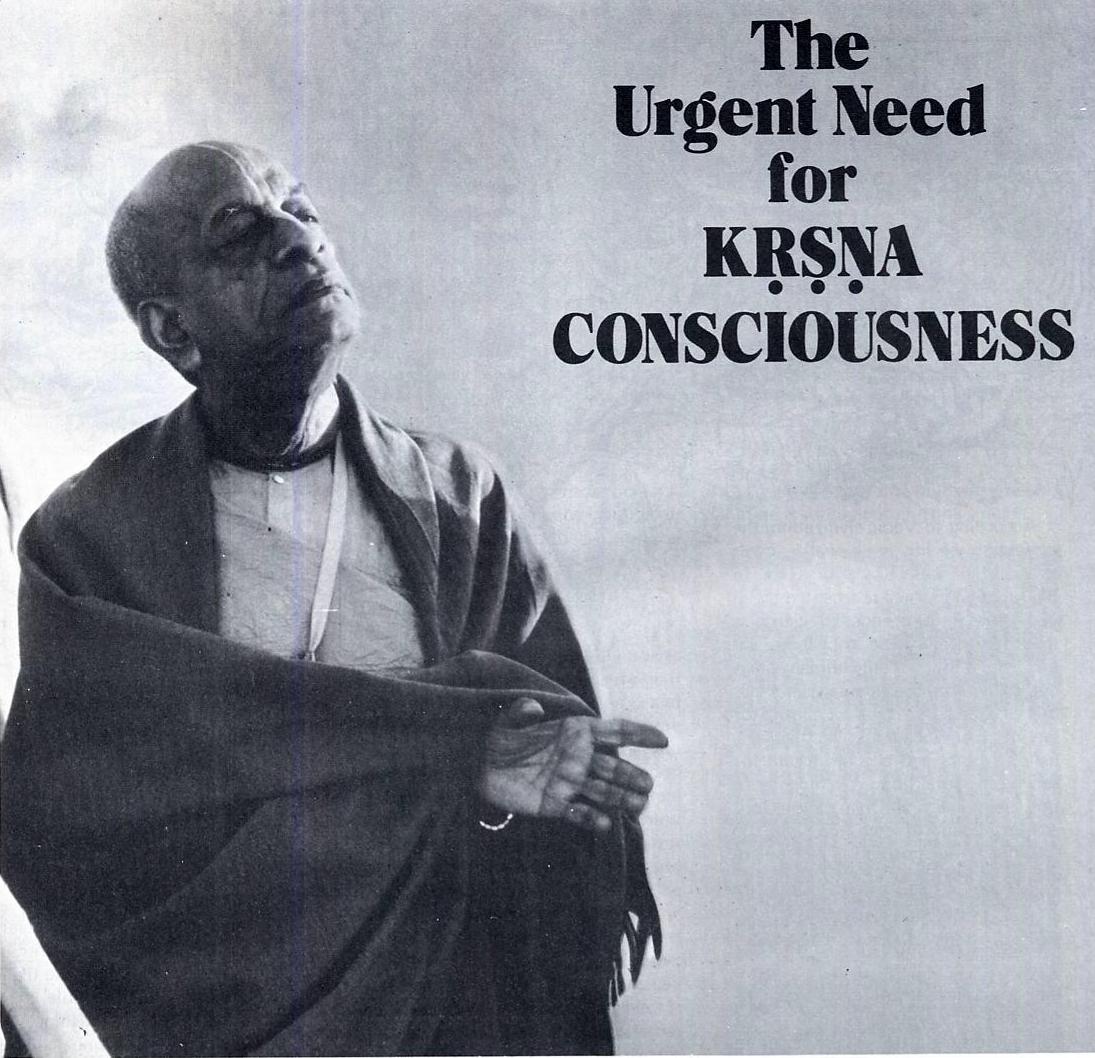
The Urgent Need for Krishna Consciousness
By His Divine Grace A.C. Bhaktivedanta Swami Prabhupada
This very important Krsna consciousness movement is meant to save human society from spiritual death. At present human society is being misled by leaders who are blind, for they do not know the aim and objective of human life, which is self-realization and the reestablishment of our lost relationship with the Supreme Personality of Godhead. That is the missing point. This Krsna consciousness movement is trying to enlighten human society in this important matter.
According to Vedic civilization, the perfection of life is to realize one’s relationship with Krsna or God. In Bhagavad-gita, which is accepted by all authorities in transcendental science as the basis of all Vedic knowledge, we understand that not only human beings but all living entities are parts and parcels of God. The parts are meant for serving the whole, just as the legs, hands, fingers and ears are meant for serving the total body. We living entities, being parts and parcels of God, are duty bound to serve Him.
Actually our position is that we are always rendering service to someone, either to our family, country or society. If we have no one to serve, sometimes we keep a pet cat or dog and render service to it. All these factors prove that we are constitutionally meant to render service, yet in spite of serving to our best capacity, we are no more satisfied. Nor is the person to whom we are rendering that service satisfied. On the material platform, everyone is frustrated. The reason for this is that the service which is being rendered is not properly directed. For example, if we want to render service to a tree, we must water the root. If we pour water on the leaves, branches and twigs, there is little benefit. If the Supreme Personality of Godhead is served, all other parts and parcels will be automatically satisfied. Consequently all welfare activities as well as service to society, family and nation are realized by serving the Supreme Personality of Godhead.
More
21 Sep 2011
by The Hare Krishna Movement
in Back to Godhead, Books by Srila Prabhupada, Brahmananda das
Tags: back to Godhead, bhagavad-gita, Books of His Divine Grace A.C. Bhaktivedanta Swami Prabhupada, Brahmananda Swami, Srimad Bhagavatam
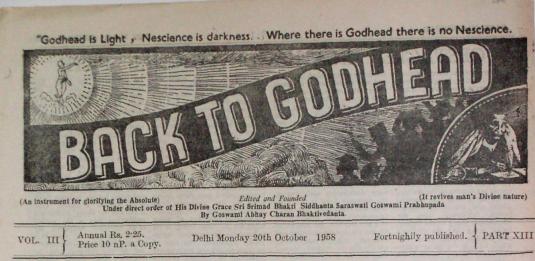
The Books of His Divine Grace A.C. Bhaktivedanta Swami Prabhupada
Originally published in Back to Godhead No. 52
Bhaktivedanta Book Trust 1973
By Brahmananda Swami ISKCON East Africa
Part 3
Back to Godhead contained timely articles, essays, book reviews and selections from full-length works in progress such as the Sri Isopanisad. It should be noted that this paper was entirely the effort of Srila Prabhupada. He wrote all the material, edited it, typed it for the printer and checked the galley proofs. Then he sold the copies. Each fortnight he would take batches of Back to Godhead into Delhi. To save a few cents bus fare he sometimes had to walk for miles, and often he would sit in tea parlors until late at night, himself not even taking a glass of water there, preaching and distributing his paper and collecting one cent per copy.
At this time Srila Prabhupada also wrote outlines of his dream. It was a worldwide association of God conscious devotees who actively preached the eternal religion of love of God in all fields of society at large and who used all the modern means at their disposal. The League of Devotees, the forerunner of the now worldwide ISKCON, the International Society for Krishna Consciousness, was thus formally registered. From international sankirtana parties, to gosalas (cow protection reserves), to authorized teaching of Sanskrit, to a printing press solely for flooding the marketplace with Krsna conscious literature, ISKCON is today the reality of that dream.
More
20 Sep 2011
by The Hare Krishna Movement
in A.C. Bhaktivedanta Swami Prabhupada, Back to Godhead, Lectures
Tags: back to Godhead, Balarama, Gauda, Krishna, Lecture by A.C. Bhaktivedanta Swami Prabhupada, Lord Nityananda, Sri Caitanya-caritamrta, Sri Krsna Caitanya, sun and moon
 The Rising Sun and Moon
Lecture by His Divine Grace A.C. Bhaktivedanta Swami Prabhupada
Mayapur, India—March 26, 1975
Back to Godhead 2004, Vol.38, No. 4
vande sri-krsna-caitanya-
nityanandau sahoditau
gaudodaye puspavantau
citrau sandau tamo-nudau
“I offer my respectful obeisances unto Sri Krsna Caitanya and Lord Nityananda, who are like the sun and moon. They have arisen simultaneously on the horizon of Gauda [West Bengal] to dissipate the darkness of ignorance and thus wonderfully bestow benediction upon all.”—Sri Caitanya-caritamrta, Adi 1.2
SriKrsna Caitanya has many expansions, and the first is Lord Nityananda, who is Krsna’s brother, Balarama. We have to understand these things from the mahajanas, the great sages who are learned in the science of Krsna consciousness. Narottama Dasa Thakura, a mahajana, says, vrajendra-nandana yei, saci-suta hoilo sei, balarama hoilo nitai: “Sri Caitanya Mahaprabhu is Lord Krsna, the son of Nanda Maharaja, and Sri Nityananda Prabhu is Balarama.”
Sometimes foolish people say that Nityananda is an expansion of Radharani. That is not a fact. Nityananda is Balarama. We have to know from the mahajanas; we cannot manufacture our own ideas. That is blasphemy.
More
14 Sep 2011
by The Hare Krishna Movement
in A.C. Bhaktivedanta Swami Prabhupada, Back to Godhead, Sankirtan, The Hare Krishna Movement
Tags: A.C. Bhaktivedanta Swami Prabhupada, Back to Godhead Magazine, Great Apostle of love of God, Lord Caitanya Mahaprabhu, Lord Sri Krishna Caitanya, Origin of the Hare Krishna Movement, sankirtan movement
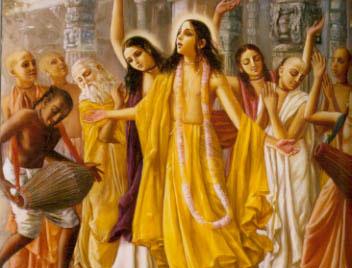
Lord Sri Krishna Caitanya's Sankirtan Movement
Origin of the Hare Krishna Movement
By His Divine Grace A.C. Bhaktivedanta Swami Prabhupada
Back to Godhead Magazine Volume 01, Number 20, 1968
Lord Sri Krishna Chaitanya Mahaprabhu, the Great Apostle of love of God and the Father of the Sankirtan Movement, advented Himself in the City of Nabadwipa in Bengal, India. This was in February, 1486, by Christian reckoning.
By the will of the Lord there was a lunar eclipse on that evening. It is the custom of the Hindu public to bathe in the Ganges of any other sacred river during the hours of eclispe, and to chant the Vedic mantras for purification. When Lord Chaitanya was born during the eclipse, then, the whole India was roaring with the holy sound of Hare Krishna, Hare Krishna, Krishna Krishna, Hare Hare/ Hare Rama, Hare Rama, Rama Rama, Hare Hare.
These sixteen Names of the Lord are mentioned in many Puranas and Upanishads, and they are described as “Tarak Brahman,” the Names for this age. It is stated in the “Shashtras,” the accepted Scriptures, that offenseless chanting of the Holy Names of the Lord can deliver a fallen soul from material bondage. There inumerable Names for the Lord both in India and elsewhere, and all of them are equally good because all of them indicate the Supreme Personality of Godhead. But because these sixteen Names are especially recommended for this Age, called Kali Yuga, it is better for people to take the path of the great Acharyas, the saintly teachers who attained success by practice of this system.
More
23 Aug 2011
by The Hare Krishna Movement
in Back to Godhead, Books by Srila Prabhupada, Brahmananda das, Radha Damodar Mandir
Tags: back to Godhead, books of His Divine Grace, Brahmananda Swami, Radha-Damodara, six goswami's, Srila Prabhupada, Vrndavan
 The Books of His Divine Grace A.C. Bhaktivedanta Swami Prabhupada
Originally published in Back to Godhead No. 52
Bhaktivedanta Book Trust 1973
By Brahmananda Swami ISKCON East Africa
Part 2
The treasure of Radha-Damodara is the samadhi and bhajana(place for executing devotional service) of Srila Rupa Goswami. Of the six Goswami’s, he is the most importnt. Rupa Goswami constructed the largest temple in Vrndavana, Radha-Govindaji, and he wrote the most important book on the science of devotional service, Bhakti-rasamrta-sindhu, which was completed in the year 1552. He and his elder brother Sanatana Goswami were among the chief government administrators of their time and were highly learned in Arabic, Persian and Sanskrit. Lord Caitanya personally instructed Rupa Goswami for ten consecutive days, and Bhakti-rasamrta-sindhu codifies these teachings, with supporting evidence from scores of supplementary Vedic texts.
One great acarya (teacher) in the parampara (disciplic succession) has offered obeisances to the six Goswami’s in the following manner; “They are very expert in scrutinizingly studying all the revealed scriptures with the aim of establishing eternal religious principles for the benefit of all human beings. Thus they are honored all over the three worlds, and they are worth taking shelter of because they are absorbed in the mood of the gopis and are engaged in the transcendental loving service of Radha and Krsna.” In one of Srila Prabhupada’s rooms in the Radha Damodara temple there is a window thatoverlooks the shaded courtyard where the tow tomblike structures that honor Rupa Goswami stand. Just before this window is a bare wood asana (seat) where Srila Prabhupada sat to receive inspiration from the greatest of the Goswami’s From the other where he wrote his books, Srila Prabhupada could look out and see Jiva Goswami’s own worshipable Deities, Radha-Damodara.
More
17 Aug 2011
by The Hare Krishna Movement
in Back to Godhead, Books by Srila Prabhupada, Brahmananda das, Radha Damodar Mandir
Tags: back to Godhead, Brahmananda Swami, Jiva Goswami, Krsna consciousness movement, Radha-Damodara Temple, six goswimis, Srila Prabhupada's books, Vrndavan

Originally published in Back to Godhead No. 52 Bhaktivedanta Book Trust 1973
By Brahmananda Swami ISKCON East Africa
This will be an eleven part series, as it is a rather legenthy article, but very good source for historical information on Srila Prabhupada, Radha-Damodara Temple, and the books of His Divine Grace A.C. Bhaktivedanta Swami Prabhupada.
The Books of His Divine Grace A.C. Bhaktivedanta Swami Prabhupada
“My books are more important than myself.” This was Srila Prabhupada’s instruction to one of his disciples who was being sent from his personal service to open a temple in a distant place. When one considers how much time, energy and intelligence Srila Prabhupada has utilized to single-handedly begin and spread the Krsna Consciousness Movement to an international scale, it is even more astonishing that he has written a score of unique books. Despite his responsibilities in guiding thousands of disciples who operate almost a hundred different centers, that he has produced these books-at substantial sacrifice-proves that the most important factor to the Krsna Consciousness Movement is the books of His Divine Grace A.C. Bhaktivedanta Swami Prabhupada.
While still in India, His Divine Grace inhabited two ordinary rooms in India’s most historic literary temple. This Radha-Damodara temple was built almost 500 hundred years ago by Srila Jiva Goswami in the holy site of Vrndavan, where Lord Krsna, the Supreme Personality of Godhead, appeared to display His transcendental pastimes 5,000 years ago. The Radha-Damodara temple, which has since fallen into disrepair, houses the samadhi (burial place) of Jiva Goswami, one of the six prime disciples of Caitanya Mahaprabhu. Lord Caitanya gave His disciples in Vrndavan three important instructions: first, to discover the exact locations where Krsna displayed His pastimes, as revealed in the sastras (scriptures); then, to build temples where the Lord could be suitably worshiped; and finally, to write books fully explaining the real science of devotional service to God. Lord Caitanya Himself wrote only eight slokas (stanzas), but the six goswamis of Vrndavan have left a vast body of literature for the inestimable benefit of all humanity.
When only ten years old, Jiva Goswami wanted to join Lord Caitanya’s sankirtan movement, but first he prepared himself by becoming fully versed in Sanskrit in Benares. He was then able to write volumes of books, which have prompted one Indian authority to declare Jiva Goswami the greatest philosopher that has ever lived. It is lamentable that due to the lack of qualified translators, the English-knowing world may never be able to take advantage of these books.
The Radha-Damodara temple is also the site of the Samadhi of Krsnadasa Kaviraja, the most important biographer of Lord Caitanya. Krsnadas Kaviraja appeared after Lord Caitanya but was contemporary to the six Goswamis. Directly inspired by Lord Nityananda, one of Lord Caitanya’s principal associates, he wrote his Caitanya-caritamrta at the age of ninety. This book recounts the teaching of Lord Caitanya more vividly than the biographical details which have been preserved by other authors.
…to be continued
07 Jul 2011
by The Hare Krishna Movement
in Back to Godhead, Ganesha, Satyaraja das
Tags: elephant head, Ganapati, Ganesa, Ganesh, Govinda, Hare Krishna, Hindu pantheon, Krsna, lotus feet, Pillaiyar, Saryaraja das, Vinayaka
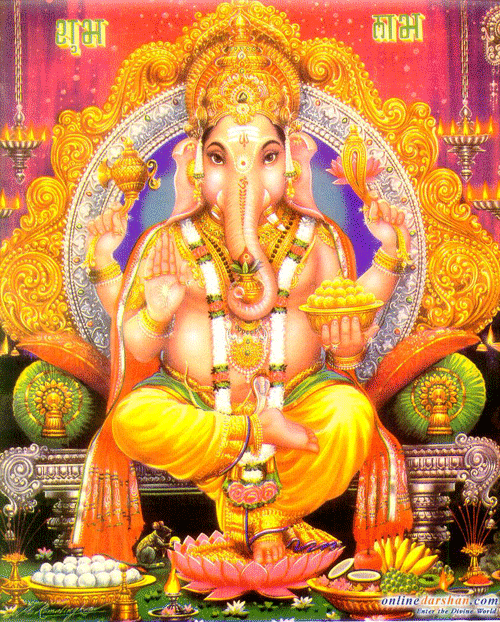
Ganesha (Sanskrit: गणेश; IAST: Gaṇeśa) also spelled Ganesa or Ganesh, also known as Ganapati (Sanskrit: गणपति;IAST: gaṇapati), Vinayaka (Sanskrit: विनायक; IAST: Vināyaka), and Pillaiyar (Tamil: பிள்ளையார்), is one of the deities best-known and most widely worshipped in the Hindu pantheon. His image is found throughout India and Nepal. Hindu sects worship him regardless of affiliations. Devotion to Ganesha is widely diffused and extends to Jains, Buddhists, and beyond India.
Ganesha is Vighneshvara or Vighnaraja, the Lord of Obstacles, both of a material and spiritual order. He is popularly worshipped as a remover of obstacles, though traditionally he also places obstacles in the path of those who need to be checked. [pasted from; Wikipedia.org]
Ganesa: Remover of Obstacles
By Satyaraja Dasa
from; Back to Godhead Magazine
The joyous elephant-faced deity known as Ganesa is revered by one billion Hindus worldwide, and though his worship has little place in the modern-day Hare Krsna movement, his personality and pastimes are part of ISKCON’s heritage.
Ganesa is often seen as the creator and remover of obstacles, as the guardian at entrances, and as a spiritually potent figure who can avert all evil influences. In popular Hindu lore he is thus the god to be worshiped first, before all religious ceremonies, public and private. Things tend to start off with Ganesa, and this is reflected even in common idiomatic phrases. For example, in Maharashtra when a dedication or inauguration is to be performed, a Marathi speaker may refer to the occasion as Sri ganesa karane (“doing the Sri Ganesa”). Another such expression is ganapatice kele (“to conceive a child”). Similar phrases are found in other Indian languages.
More
18 Jun 2011
by The Hare Krishna Movement
in Back to Godhead, Chanting Hare Krishna
Tags: devotees, Hare Krishna, impersonalists, Krsna, Kurappiah Chockalingam, Om, omkara, pranava, spiritual vibration, Srimati Radharani

Om or Hare Krishna?
By Kurappiah Chockalingam
Though the sacred sound om is often associated with impersonalists, only the devotees understand its full import.
The Gosvamis of Vrndavana have analyzed om (a-u-m) as follows: The letter a refers to Krsna, the master of all planets and all living entities. The letter u indicates Srimati Radharani, the pleasure potency of Krsna, and m indicates the living entities. Thus omkara represents Krsna; His name, fame, pastimes, potencies, and devotees; and everything else pertaining to Him.
THROUGHOUT THE VEDAS there is much mention of the syllabel om. This spiritual vibration, which is sometimes called omkara or pranava, comprises three Sanskrit sounds – a, u, and ma (the a in ma is silent). When these three sounds are combined, the result is the single-syllabled vibration om.
An unusual attribute of om is that it has no direct translation from Sanskrit into English. And though every Vedantist will accept om to be a representation of God, exactly how om is viewed differs according to various schools to thought. These schools can be classified into two main categories, the Mayavadi, or impersonalist, and the Vaisnava, or devotee.
The impersonalist, as the name suggests, is happy to treat om as an impersonal, formless, representation of the Absolute Truth. Therefore, the Mayavadi will very openly chant om, being careful to avoid names such as Krsna and Rama, which according to them, are limited. A Mayavadi might explain his theory of pranava om like this: “Since this whole universe has been created by Him (God), whatever there is in the universe is Him alone.
As such, He has no name. But if He has to have a name, then all names are His, for He alone is appearing in all forms. The first sound in most languages is a; the last sound to leave as our mouth closes is m; u is the center of the two. Together, they represent all the basic sounds from which words are produced. And threfore, these three sounds, making up the syllable om, represent the entire universe of names and forms.”
More
22 Mar 2011
by The Hare Krishna Movement
in Back to Godhead, Bhaktisiddhanta Sarasvati Thakura
Tags: Back to Godhead Nagazine, Bhakti Siddhanta Saraswati Goswami, Gaudiya Vaisnavas, Lord Caitanya, Rupa-Raghunath
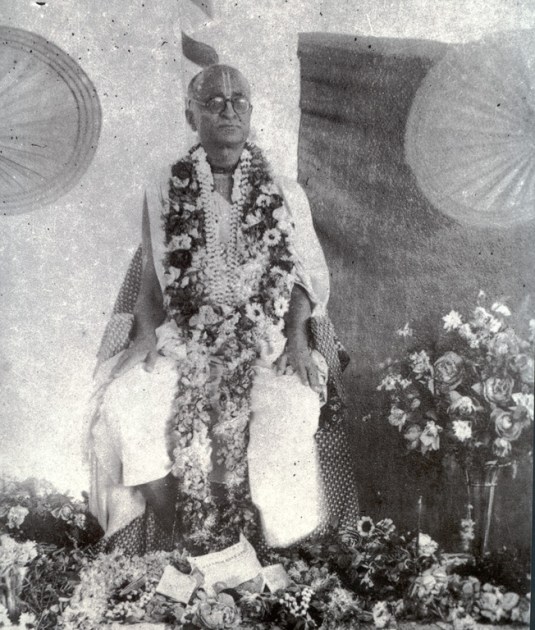
Message of His Divine Grace
from Back to GodHead Magizine 1944
His Divine Grace Sree Sreemad Bhakti Siddhanta Saraswati Goswami Moharaj the celebrated Acharya (Spiritual Head) of the Gaudiya Vaisnavas spoke the following few lines as His Message just a few days (23rd December, 1936) before His passing away from this mortal world.
“I have most probably given many people troubles in the mind. Some of them might have thought about me that I am their enemy because I was obliged to speak the plain truth for service and devotion towards the Absolute Godhead. I have given them all those troubles only for the reason that they may turn their face towards the Personality of Godhead without any desire for gain and with unalloyed devotion. I hope some day or other they may understand me rightly.”
More
Next Newer Entries











 The Hare Krishna Movement