12 Sep 2013
by The Hare Krishna Movement
in A.C. Bhaktivedanta Swami Prabhupada, Caaitanya-caritamrta, Caitanya Mahaprabhu, Sri Caitanya-Caritamrta, Srimati Radharani
Tags: A.C. Bhaktivedanta Swami Prabhupada, appearance of srimati radharani, bliss tasted by radharani, conjugal sentiment, Lord Sri Caitanya Mahaprabhu, Lord Sri Krsna, love of God, Radha, Radharani, Radhastami, Srimati Radharani, sweetness personified, transcendental love

In one of our previous posts “The Confidential Reasons for Lord Caitanya’s Appearance” The chapter summary described that:
Lord Caitanya appeared for three principal purposes of His own. The first purpose was to relish the position of Śrīmatī Rādhārāṇī, who is the prime reciprocator of transcendental love of Śrī Kṛṣṇa. Lord Kṛṣṇa is the reservoir of transcendental loving transactions with Śrīmatī Rādhārāṇī.
The third reason that Lord Caitanya appeared was to enjoy the bliss tasted by Rādhārāṇī…Kṛṣṇa is the transcendental male, and Rādhārāṇī is the transcendental female. Therefore, to know the transcendental pleasure of loving Kṛṣṇa, Lord Kṛṣṇa Himself appeared as Lord Caitanya, accepting the emotions and bodily luster of Śrīmatī Rādhārāṇī.
Today in honor of the appearance of Srimati Radharani, we are posting more from this nectarean chapter More
10 Sep 2013
by The Hare Krishna Movement
in A.C. Bhaktivedanta Swami Prabhupada, Kapila, Teachings of Lord Kapila
Tags: A.C. Bhaktivedanta Swami Prabhupada, full consciousness, Kapila, Lord Kapila, methodology, philosophical system known as sankhya, Sankhya philosophy, Son of Devahuti, spiritual knowledge, Teachings of Lord Kapila

Teachings of Lord Kapila, the Son of Devahūti
By His Divine Grace A. C. Bhaktivedanta Swami Prabhupāda
Foreword
Kapila Muni, a renowned sage of antiquity, is the author of the philosophical system known as Sāṅkhya, which forms an important part of India’s ancient philosophical heritage. Sāṅkhya is both a system of metaphysics, dealing with the elemental principles of the physical universe, and a system of spiritual knowledge, with its own methodology, culminating in full consciousness of the Supreme Absolute. Kapila, however, is not an ordinary philosopher or sage. According to Vedic tradition, the tradition of India’s ancient scriptural literature, He Himself is an avatāra (incarnation) of the Supreme Absolute Truth.
More
10 Sep 2013
by The Hare Krishna Movement
in A.C. Bhaktivedanta Swami Prabhupada, Bhagavad-gita, Threefold Miseries
Tags: A.C, bhakti yoga, Bhaktivedanta Swami Prabhupada, happiness and distress, Krishna consciousness, krsna consciousness is happy, living entities, perfect yogi, pure devotee, relationship with God, Srila Prabhupada, supreme enjoyer, threefold miseries, true equality

[*Note; Les Misérables (“The Miserable Ones”); translated variously from the French as The Miserable Ones, The Wretched, The Poor Ones, The Wretched Poor, or The Victims]
Often while reading Srila Prabhupada’s books, he talks about getting free from the miseries of life, or the threefold miseries. For instance in this purport it is described:
…One who is Kṛṣṇa conscious is a perfect yogī; he is aware of everyone’s happiness and distress by dint of his own personal experience. The cause of the distress of a living entity is forgetfulness of his relationship with God. And the cause of happiness is knowing Kṛṣṇa to be the supreme enjoyer of all the activities of the human being. Kṛṣṇa is the proprietor of all lands and planets. The perfect yogī is the sincerest friend of all living entities. He knows that the living being who is conditioned by the modes of material nature is subjected to the threefold material miseries due to forgetfulness of his relationship with Kṛṣṇa. Because one in Kṛṣṇa consciousness is happy, he tries to distribute the knowledge of Kṛṣṇa everywhere. Since the perfect yogī tries to broadcast the importance of becoming Kṛṣṇa conscious, he is the best philanthropist in the world, and he is the dearest servitor of the Lord.
I thought we could do a short post on just what are the threefold miseries, and how can one become free from them.
The threefold miseries are:
(1) Those miseries which arise from the mind and body
(2) Those miseries inflicted by other living beings
(3) Those miseries arising from natural catastrophes over which one has no control.
More
09 Sep 2013
by The Hare Krishna Movement
in Bhaktivinoda Thakura, Songs of the Vaisnava Acaryas, Sri Nama-kirtana
Tags: Acyutananda Swami, amala harinam, Bhaktivinoda Thakura, braja-baro-nagara, chanting of the holy names, Krsna, Songs of the Vaisnava Acaryas, Sri Nama Sankirtan, the bhaktivedanta book trust, yasomati-nandana

Krishna is very pleased when we call on Him by His Names, which are associated with His devotees, qualities and pastimes. This song by Bhaktivinoda Thakura is composed of the Nanes of Krsna in different aspects. (from the Songs of the Vaisnava Acaryas)
Śrī Nāma-kīrtana
Chanting of the Holy Names
by Srila Bhaktivinoda Thakura
1) yaśomatī-nandana, 2) braja-baro-nāgara,
3) gokula-rañjana kāna
4) gopī-parāṇa-dhana, 5) madana-manohara,
6) kāliya-damana-vidhāna
7) amala harinām amiya-vilāsā
8) vipina-purandara, 9) navīna nāgara-bora,
10) vaṁśī-badana, 11)suvāsā
12) braja-jana-pālana, 13) asura-kula-nāśana
14) nanda-godhana-rākhowālā
15) govinda mādhava, 16) navanīta-taskara,
17) sundara nanda-gopālā
18) yāmuna-taṭa-cara, 19) gopī-vasana-hara,
20) rāsa-rasika, 21) kṛpāmoya
22) śrī-rādhā-vallabha, 23) vṛndābana-naṭabara,
24) bhakativinod-āśraya
English translation More
08 Sep 2013
by The Hare Krishna Movement
in A.C. Bhaktivedanta Swami Prabhupada, Free Downloads, Free eBooks, KRSNA The Supreme Personality of Godhead
Tags: 1970 Edition, A.C. Bhaktivedanta Swami Prabhupada, download free pdf, free, ISKCON Press, Krsna, one thousandth post, pdf download, scanned copy of Krsna, Srila Prabhupada, The Hare Krishna Movement, The Supreme Personality of Godhead, theharekrishnamovement, Vol. 1


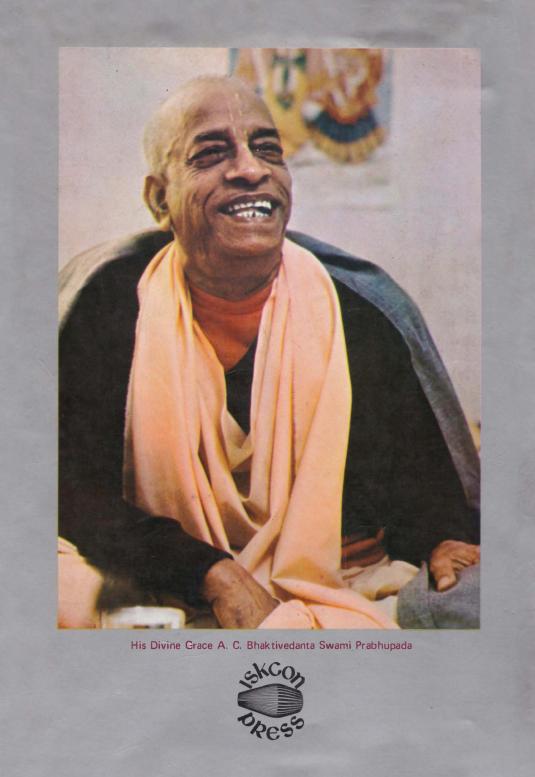
This marks our one thousandth post! So we are putting up our favorite book; “Kṛṣṇa, the Supreme Personality of Godhead” Vol. 1, as a Free PDF Download. You can click on following link to view the entire scanned book, and or save it.
KRSNA_Book_Vol.1_1970_ISKCON_Press_edition_SCAN
More
08 Sep 2013
by The Hare Krishna Movement
in A.C. Bhaktivedanta Swami Prabhupada, Death and Dying, KRSNA The Supreme Personality of Godhead
Tags: 1970 Edition, A.C. Bhaktivedanta Swami Prabhupada, bhoja dynasty, bugles, chariot, conchshells, death, death and dying, demigod, demon, Devaki, devotee, devotional service, drums, Kamsa, kettledrums, Krishna, Krsna The Supreme Personality of Godhead, musical instruments, Vasudeva

…Once upon a time, Vasudeva, the son of Śūrasena, just after marrying Devakī, was going home on his chariot with his newly wedded wife.
While the bride and bridegroom were passing along on the chariot, there were different kinds of musical instruments playing to indicate the auspicious moment. There were conchshells, bugles, drums and kettledrums; combined together, they were vibrating a nice concert. The procession was passing very pleasingly, and Kaṁsa was driving the chariot, when suddenly there was a miraculous sound vibrated from the sky which especially announced to Kaṁsa: “Kaṁsa: you are such a fool. You are driving the chariot of your sister and your brother-in-law, but you do not know that the eighth child of this sister will kill you.”
Kaṁsa was the son of Ugrasena, of the Bhoja dynasty. It is said that Kaṁsa was the most demoniac of all the Bhoja dynasty kings. Immediately after hearing the prophecy from the sky, he caught hold of Devakī’s hair and was just about to kill her with his sword. Vasudeva was astonished at Kaṁsa’s behavior, and in order to pacify the cruel, shameless brother-in-law, he began to speak as follows, with great reason and evidence. He said, “My dear brother-in-law Kaṁsa, you are the most famous king of the Bhoja dynasty, and people know that you are the greatest warrior and a valiant king. How is it that you are so infuriated that you are prepared to kill a woman who is your own sister at this auspicious time of her marriage? Why should you be so much afraid of death? Death is already born along with your birth. From the very day you took your birth, you began to die.(Kṛṣṇa, the Supreme Personality of Godhead, Chapter 1)
On Janmastami day I decided to start reading the Kṛṣṇa Book over again. I don’t know how many times I have read it but unlike mundane literature, it becomes more and more transcendentally relishable with every reading. In this first chapter entitled “The Advent of Lord Kṛṣṇa”, Vasudeva, in his attempt to pacify Kaṁsa, spoke this very famous lesson about death…
More
07 Sep 2013
by The Hare Krishna Movement
in A.C. Bhaktivedanta Swami Prabhupada, Caaitanya-caritamrta, Caitanya Mahaprabhu, Krsna is the Source of All Incarnations
Tags: A.C. Bhaktivedanta Swami Prabhupada, Caitanya Caritamrta, Caitanya Mahaprabhu, chanting Hare Krishna, confidential devotees, Hare Krishna, Krsnadasa Kaviraja Gosvami, Lord Caitanya, Radharani, Sri Krsna, Srimati Radharani, transcendental pleasure

“Lord Kṛṣṇa desired to taste the limitless nectarean mellows of the love of one of His multitude of loving damsels [Śrī Rādhā], and so He has assumed the form of Lord Caitanya. He has tasted that love while hiding His own dark complexion with Her effulgent yellow color. May that Lord Caitanya confer upon us His grace.”(This is the third verse of the second Caitanyāṣṭaka of Śrīla Rūpa Gosvāmī’s Stava-mālā.)
Śrī Caitanya-caritāmṛta
By His Divine Grace A. C. Bhaktivedanta Swami Prabhupāda
Summary of Ādi-līlā, Chapter 4
The Confidential Reasons for Lord Caitanya’s Appearance
In this chapter of the epic Caitanya-caritāmṛta, Kṛṣṇadāsa Kavirāja Gosvāmī has stressed that Lord Caitanya appeared for three principal purposes of His own. The first purpose was to relish the position of Śrīmatī Rādhārāṇī, who is the prime reciprocator of transcendental love of Śrī Kṛṣṇa. Lord Kṛṣṇa is the reservoir of transcendental loving transactions with Śrīmatī Rādhārāṇī. The subject of those loving transactions is the Lord Himself, and Rādhārāṇī is the object. Thus the subject, the Lord, wanted to relish the loving mellow in the position of the object, Rādhārāṇī.
The second reason for His appearance was to understand the transcendental mellow of Himself. Lord Kṛṣṇa is all sweetness. Rādhārāṇī’s attraction for Kṛṣṇa is sublime, and to experience that attraction and understand the transcendental sweetness of Himself, He accepted the mentality of Rādhārāṇī.
The third reason that Lord Caitanya appeared was to enjoy the bliss tasted by Rādhārāṇī. The Lord thought that undoubtedly Rādhārāṇī enjoyed His company and He enjoyed the company of Rādhārāṇī, but the exchange of transcendental mellow between the spiritual couple was more pleasing to Śrīmatī Rādhārāṇī than to Śrī Kṛṣṇa. Rādhārāṇī felt more transcendental pleasure in the company of Kṛṣṇa than He could understand without taking Her position, but for Śrī Kṛṣṇa to enjoy in the position of Śrīmatī Rādhārāṇī was impossible because that position was completely foreign to Him. Kṛṣṇa is the transcendental male, and Rādhārāṇī is the transcendental female. Therefore, to know the transcendental pleasure of loving Kṛṣṇa, Lord Kṛṣṇa Himself appeared as Lord Caitanya, accepting the emotions and bodily luster of Śrīmatī Rādhārāṇī.
Lord Caitanya appeared to fulfill these confidential desires and also to preach the special significance of chanting Hare Kṛṣṇa, Hare Kṛṣṇa, Kṛṣṇa Kṛṣṇa, Hare Hare Hare Rāma, Hare Rāma, Rāma Rāma, Hare Hare, and to answer the call of Advaita Prabhu. These were secondary reasons.
More
06 Sep 2013
by The Hare Krishna Movement
in A.C. Bhaktivedanta Swami Prabhupada, Teachings of Lord Chaitanya
Tags: A.C. Bhaktivedanta Swami Prabhupada, gopis, Lord Caitanya, nectar produced on the mooon, pastimes of the Supreme personality of godhead, Sri Krsna, Teachings of Lord Caitanya, The Beauty of Krsna, unwanted desires
click on image to enlarge
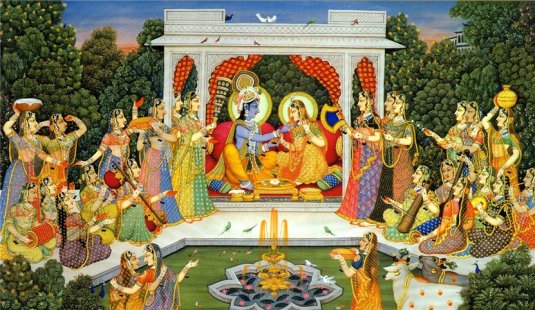
“The gopīs used to relish the beauty of Kṛṣṇa as a ceremony of perpetual enjoyment. They enjoyed the beautiful face of Kṛṣṇa, His beautiful ears with earrings, His broad forehead and His smile, and when enjoying this sight of Kṛṣṇa’s beauty, they used to criticize the creator Brahmā for causing their vision of Kṛṣṇa to be momentarily impeded by the blinking of their eyelids.” (Teachings of Lord Caitanya Chapter 10)
The beauty of Lord Kṛṣṇa increases at the sight of the beauty of the gopīs. And the more the gopīs see Lord Kṛṣṇa’s beauty, the more their beauty increases. (Cc. Adi 4.192)
“May the pastimes of Śrī Kṛṣṇa reduce the miseries existing in the material world and nullify all unwanted desires. The pastimes of the Supreme Personality of Godhead are like śikhariṇī, a blend of yogurt and sugar candy. They overpower the pride of even the nectar produced on the moon, for they distribute the sweet fragrance of the concentrated loving affairs of Śrīmatī Rādhārāṇī and the gopīs.” (Cc. Antya 1.128)
More
04 Sep 2013
by The Hare Krishna Movement
in A.C. Bhaktivedanta Swami Prabhupada, Back to Godhead, Krsna Consciousness, Visakha devi dasi
Tags: A.C. Bhaktivedanta Swami Prabhupada, Back to Godhead Magazine, Book Distribution, BTG, His Divine Grace, hot off the press, preaching Krishna consciousness, Srila Prabhupada, transcontinental jet, traveling emissary, Visakha devi dasi
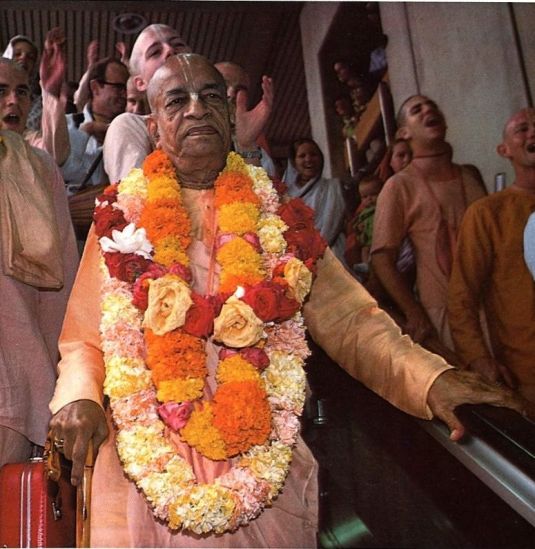
As a young devotee/book distributor, we were always anxious to see the new Back to Godhead Magazines “Hot off the Press”, and distribute them to the public. This was one article written by Visakha devi dasi that I fondly remember. Whenever I got tired out on book distribution, I would think of Srila Prabhupada’s rigorous schedule, and it would inspire me to continue on. Srila Prabhupada was tireless in his preaching and generous in giving others his divine association.
Summer Sessions With Srila Prabhupada
Excerpted from Back to Godhead Magazine 1975, Vol. 10, No 10
Article by Visakha devi dasi
In five cities and on a transcontinental jet, His Divine Grace spends a typical month at his favorite pastime—teaching Krsna Consciousness.
He’s probably logged as much flight time in the past ten years as any other traveling emissary. His Divine Grace A.C. Bhaktivedanta Swami Prabhupada has gone around the world twelve times visiting his ISKCON centers, lecturing and insuring a high standard of spiritual life among his disciples. The author traveled with him this past summer as he shuttled from West to East coast and back again, holding informal meetings and having dialogues with those who came to ask questions no one else could answer.
More
03 Sep 2013
by The Hare Krishna Movement
in A.C. Bhaktivedanta Swami Prabhupada, KRSNA The Supreme Personality of Godhead, Krsna-katha, Maharaja Pariksit, Srimad Bhagavatam, Sukadeva Goswami
Tags: A.C. Bhaktivedanta Swami Prabhupada, Arjuna, Battlefield of Kuruksetra, Ganges, Krsna, Krsna-katha, Kuruksetra, Maharaja Pariksit, Sukadeva Goswami, The Supreme Personality of Godhead, topics about krishna
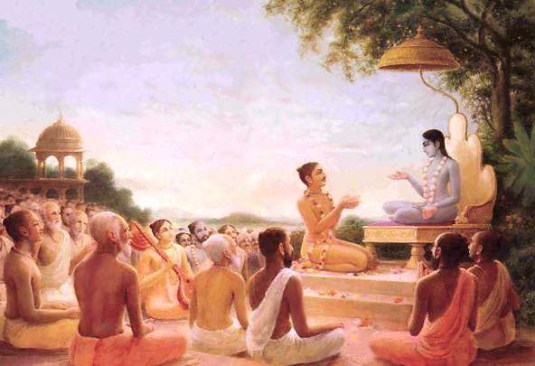
The position of Mahārāja Parīkṣit and Śukadeva Gosvāmī is unique. Mahārāja Parīkṣit is the right person to hear about the transcendental pastimes of Kṛṣṇa, and Śukadeva Gosvāmī is the right person to describe them. If such a fortunate combination is made possible, then Kṛṣṇa-kathā immediately becomes revealed, and people may benefit to the highest possible degree from such a conversation.
More
01 Sep 2013
by The Hare Krishna Movement
in A.C. Bhaktivedanta Swami Prabhupada
Tags: brahman, devotional service, goodness, goodness passion and ignorance, ignorance, material nature, modes of material nature, nature, passion, three modes, transcendental realization, ultimate happiness

Bhagavad-gītā As It Is 1972 Edition
By His Divine Grace A. C. Bhaktivedanta Swami Prabhupāda
Chapter Fourteen
More
Next Newer Entries










 The Hare Krishna Movement