14 Aug 2013
by The Hare Krishna Movement
in A.C. Bhaktivedanta Swami Prabhupada, Dhira Govinda das, Diksha, Guru & Disciple, Siksa, Srila Prabhupada, The Prominent Link
Tags: A.C. Bhaktivedanta Swami Prabhupada, Dhira Govinda das, disciplic succession, guru disciple relationship, guru tattva, guru-disciple, Iskcon, knowledge, murti, Parampara, self realization, spiritual knowledge, spiritual master, Srila Prabhupada, The Hare Krishna Movement, transcendental knowledge
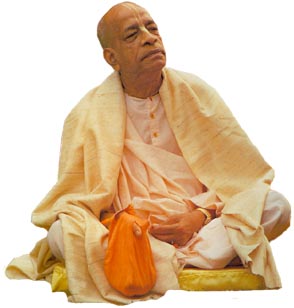
Srila Prabhupada: The Prominent Link
by Dhira Govinda dasa
Recently I had the good fortune to meet one of my God brothers, Dhira Govinda Prabhu. It was on the appearance day of Srila Bhaktisiddhanta Sarasvati Thakur. I had heard of him and had posted the following article some time back and had read some of his book “Srila Prabhupada; The Prominent Link”, but had not meet him yet. But I found him to be a very nice devotee of good character. Just to give his voice a broader rang we decided to post his book Srila Prabhupada The Prominent Link as well as the Prominent Link Supplementary Articles Click on either of the above links to read or save the pdf files.
Many members of Srila Prabhupada’s movement who did not receive formal initiation from him experience Srila Prabhupada as the primary giver of direct transcendental knowledge. This empirical reality forms the basis of recognizing Srila Prabhupada as the prominent link to the parampara. Such a conception is supported by sastric descriptions of the essence of the initiation process, and by the delineation of the parampara described by Srila Prabhupada and Srila Bhaktisiddhanta Sarasvati Thakura.
Introduction
This paper presents a framework for understanding Srila Prabhupada’s position that is derived from a comprehension of Srila Prabhupada’s direct and personal relationship with the members of his movement. The central idea is that Srila Prabhupada is the prominent link to the parampara by virtue of being the prime deliverer of transcendental knowledge. We present these ideas in a mood of open-minded discussion and ask that the reader approach the material with a fresh perspective and a willingness to reexamine the issues.
More
13 Aug 2013
by The Hare Krishna Movement
in A.C. Bhaktivedanta Swami Prabhupada, Bhagavad-gita, Prasadam, Slokas
Tags: A.C. Bhaktivedanta Swami Prabhupada, Krishna, Krsna prasadam, leaf flower fruit or water, love and ecstasy, offering to God, patram puspam phalam toyam, with love and devotion
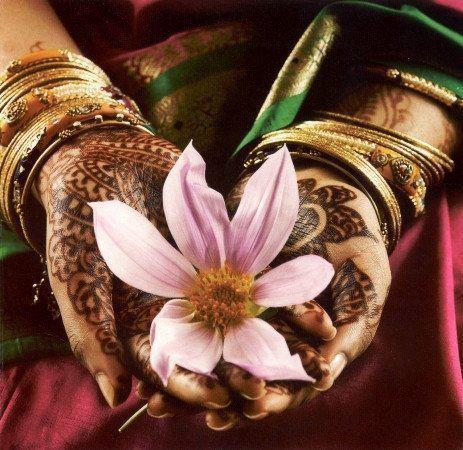
One of the first slokas I ever memorized from the Bhagavad-gita was 9.26 patraṁ puṣpaṁ phalaṁ toyaṁ… “If one offers Me with love and devotion a leaf, a flower, fruit or water, I will accept it.” (Full text and purport follows). This was practically the beginning of my spiritual life. ‘Just try to love God by offering Him something, with devotion. A leaf, a flower, fruit or water.’
One does not need great wealth, education or opulence to satisfy the Supreme Personality of Godhead. If one is fully absorbed in love and ecstasy, he need offer only a flower and a little water. As stated in Bhagavad-gītā, patraṁ puṣpaṁ phalaṁ toyaṁ yo me bhaktyā prayacchati: “If one offers Me with love and devotion a leaf, a flower. fruit or water, I will accept it.” (Bg. 9.26)
The Supreme Lord can be pleased only by devotional service: therefore it is said here that the Lord is surely satisfied by devotion and nothing else. Quoting from the Gautamīya-tantra, the Hari-bhakti-vilāsa states:
tulasī-dala-mātreṇa
jalasya culukena vā
vikrīṇīte svam ātmānaṁ
bhaktebhyo bhakta-vatsalaḥ
“Śrī Kṛṣṇa, who is very affectionate toward His devotees, sells Himself to a devotee who offers merely a tulasī leaf and a palmful of water.” The Supreme Lord is causelessly merciful upon His devotee, so much so that even the poorest of men can offer Him a little water and a flower in devotion and thus please Him. This is due to His affectionate dealings with His devotees. (SB 5.3.6 purport)
Everyone is searching after peace of mind. This is obtainable only when one is completely freed from the desire for material sense gratification and is engaged in the devotional service of the Lord. As stated in Bhagavad-gītā: patraṁ puṣpaṁ phalaṁ toyaṁ yo me bhaktyā prayacchati (9.26). Worship of the Lord is not at all expensive. One can offer the Lord a leaf, a flower, a little fruit and some water. The Supreme Lord accepts these offerings when they are offered with love and devotion. In this way, one can become freed from material desires. As long as one maintains material desires, he cannot be happy. As soon as one engages in the devotional service of the Lord, his mind is purified of all material desires. Then one becomes fully satisfied. (SB 5.7.11, purport)
More
12 Aug 2013
by The Hare Krishna Movement
in Acyutanananda das, Devotee Books
Tags: Achyutananda das, blazing, Blazing Sadhus, Charles M Barnett, CMB Books, never trust a holy man who can't dance, sadhus, Srila Prabhupada, swami
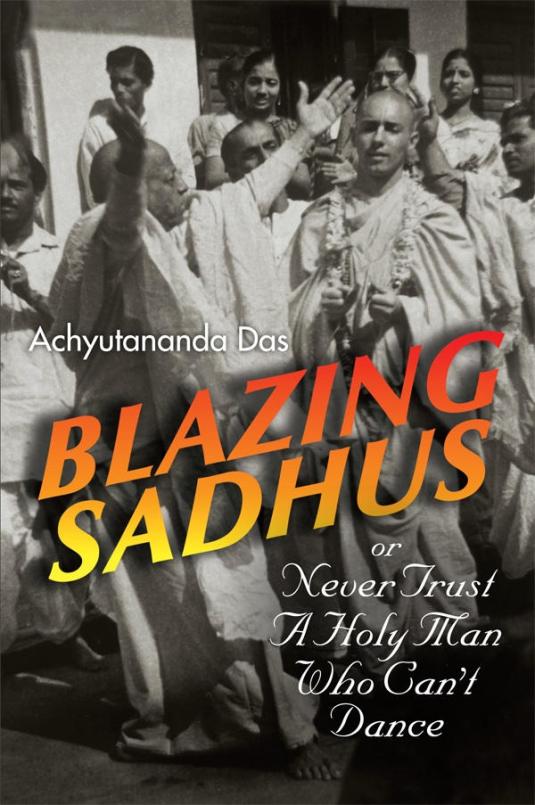
click on image to purchase
Blazing Sadhus
or
Never Trust A Holy Man Who Can’t Dance
by Achyutananda Das
We are now offering this extraordinary book for sale on our web page www.theharekrishnamovement.com. We liked it so much we are offering Free Shipping. Highly Recomended!
Excerpt from back cover;
“Do you know what just happened in there? Do you know what he just did? He gave me the answers to the most cosmic, theological, universal, eternal questions ever asked! And like it was just matter-of-fact! Then he thanks me for asking! I gotta tell people about this.” (-from Chapter Two)
More
11 Aug 2013
by The Hare Krishna Movement
in A.C. Bhaktivedanta Swami Prabhupada, Aksauhini, Lectures, Vaisnava Vocabulary
Tags: 109, 21, 600 cavalry is called an akṣauhiṇī, 650 infantry and 65, 870 chariots, 870 elephants, A.C. Bhaktivedanta Swami Prabhupada, aksauhini, bhakta, bhaktas, isvarah paramah, Krishna, mukti, solid phalanx of 21, Srila Prabhupada, Srimad Bhagavatam lecture
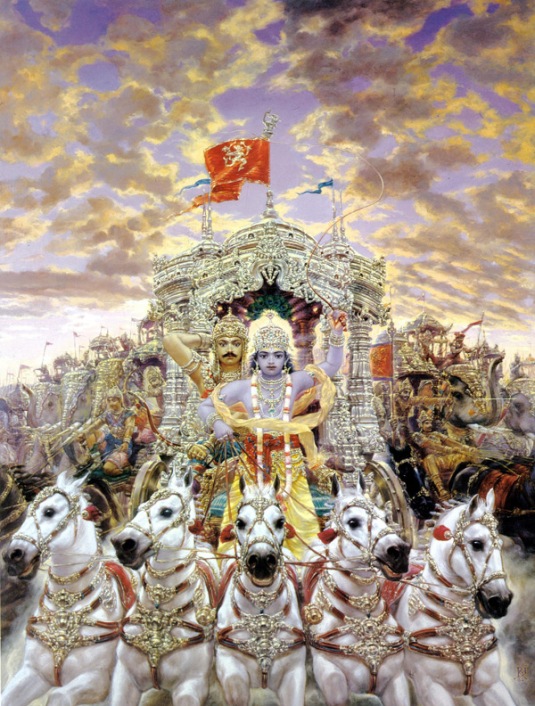
Here is a word for your vaisnava vocabulary: Aksauhini (akṣauhiṇī).
The word akṣauhiṇī refers to a military phalanx consisting of 21,870 chariots and elephants, 109,350 infantry soldiers and 65,610 horses. An exact description is given in the Mahābhārata, Ādi parva, Second Chapter, as follows:
“One chariot, one elephant, five infantry soldiers and three horses are called a patti by those who are learned in the science. The wise also know that a senāmukha is three times what a patti is. Three senāmukhas are known as one gulma, three gulmas are called a gaṇa, and three gaṇas are called a vāhinī. Three vāhinīs have been referred to by the learned as a pṛtanā, three pṛtanās equal one camū, and three camūs equal one anīkinī. The wise refer to ten anīkinīs as one akṣauhiṇī. The chariots of an akṣauhiṇī have been calculated at 21,870 by those who know the science of such calculations, O best of the twice-born, and the number of elephants is the same. The number of infantry soldiers is 109,350, and the number of horses is 65,610. This is called an akṣauhiṇī.” (SB 9.15.30)
A solid phalanx of 21,870 chariots, 21,870 elephants, 109,650 infantry and 65,600 cavalry is called an akṣauhiṇī. (SB 1.8.48 purport)
What makes this word so noteworthy, is the fact that many akṣauhiṇīs were killed on the Battlefield of Kurukṣetra. Such was the enormity of the battle.
Following is a lecture by His Divine Grace describing the lamentation of King Yudhisthira. Mahārāja Yudhiṣṭhira, as the most pious king of the world, takes for himself the responsibility for killing such a huge number of living beings because the battle was fought to reinstate him on the throne.
More
10 Aug 2013
by The Hare Krishna Movement
in A.C. Bhaktivedanta Swami Prabhupada, Free Downloads, Free eBooks, KRSNA The Supreme Personality of Godhead
Tags: A.C. Bhaktivedanta Swami Prabhupada, cowheard boys, free boooks, free eBooks, free pdf download, gopis, Krishna, pdf, Spiritual Life, Spiritual world, Vrndavan
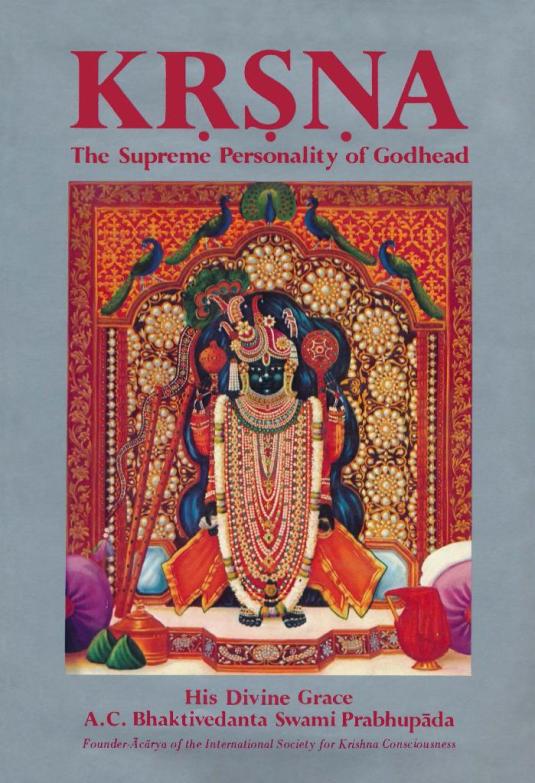
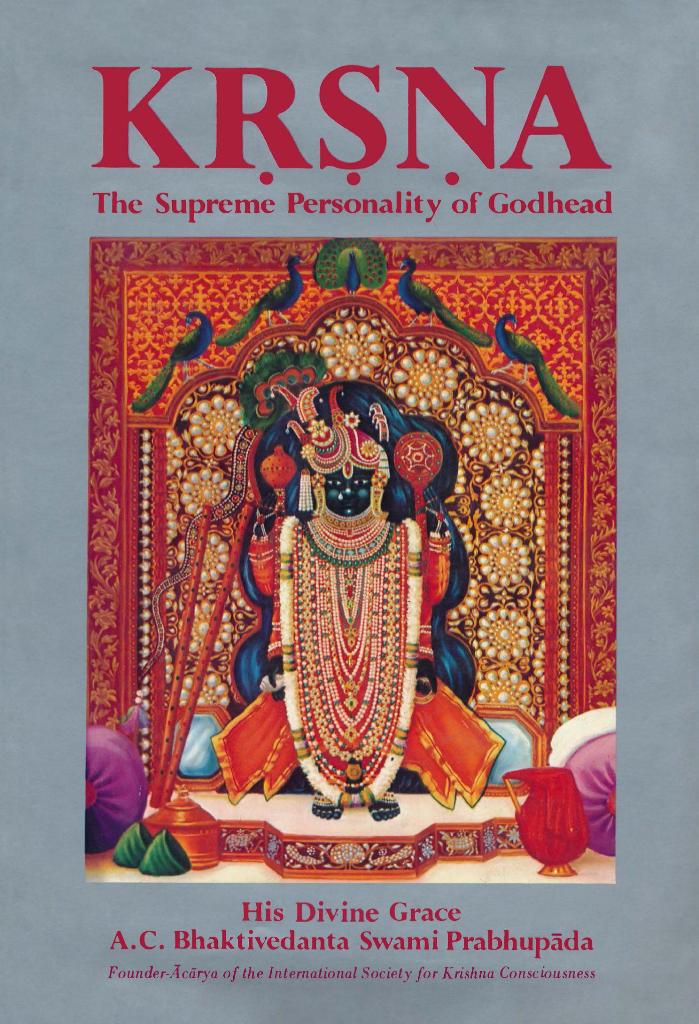
Recently I have been reading one chapter from the Krsna Book everyday, something I haven’t done since my children were young. But now in my old age, reading alone and out loud, in front of our deities, I am finding an even deeper appreciation of this beautiful book. To be honest, I am in awe of this Krsna Book, it is not of this world. Rather it is a window to the Spiritual World. With great joy we are posting a scanned version of Vol. 2 of the Krsna Book, in the pdf format, for a free download.
KRSNA_Book_Vol.2_1970_ISKCON
Click on above link and give it a few moments to load…then you can view it or save it to your files. Hare Krishna!
excerpt from book:
…After being received by the cowherd men and boys, the gopīs, and King Nanda and Yaśodā, Lord Balarāma sat down, feeling satisfied, and they all surrounded Him. First Lord Balarāma inquired from them about their welfare, and then, not having seen Him for such a long time, they began to ask Him different questions. The inhabitants of Vṛndāvana had sacrificed everything for Kṛṣṇa, simply being captivated by the lotus eyes of the Lord. Because of their great desire to love Kṛṣṇa, they never desired anything like elevation to the heavenly planets or merging into the effulgence of Brahman to become one with the Absolute Truth. They were not even interested in enjoying a life of opulence, but were satisfied in living a simple life in the village as cowherd men. They were always absorbed in thoughts of Kṛṣṇa and did not desire any personal benefits, and they were all so much in love with Him that in His absence their voices faltered when they began to inquire from Balarāmajī. (Chapter 11, Lord Balarāma Visits Vṛndāvana)
10 Aug 2013
by The Hare Krishna Movement
in A.C. Bhaktivedanta Swami Prabhupada
Tags: A.C. Bhaktivedanta Swami Prabhupada, and Consciousness, Arjuna, Bg 13, knowledge, Krishna, ksetra, ksetrajna, nature, O son of Kunti, parkrtim purusam caiva, prabhupada gita, prakrti, Purusa, the Enjoyer

Bhagavad-gītā As It Is 1972 Edition
By His Divine Grace A. C. Bhaktivedanta Swami Prabhupāda
Chapter Thirteen
Nature, the Enjoyer, and Consciousness
More
09 Aug 2013
by The Hare Krishna Movement
in A.C. Bhaktivedanta Swami Prabhupada, Chanting Hare Krishna, Maha-mantra, Mantra Meditation, Nectar of Devotion
Tags: A.C. Bhaktivedanta Swami Prabhupada, chanting Hare Krishna, Hare Hare, Hare Krsna, Hare Rama, heavenly happiness, liberation, Maha Mantra, mantra meditation, Nectar of Devotion, singing the flories of the Lord

This morning I was reading from the Nectar of Devotion the chapter entitled “The Mahā-mantra”. We have posted the entire chapter as well as some other related quotes from the Nectar of Devotion on the Maha-mantra.
In the Padma Purāṇa there is a statement: “For any person who is chanting the holy name either softly or loudly, the paths to liberation and even heavenly happiness are at once open.”
When a mantra or hymn is chanted softly and slowly, that is called japa. The same mantra, when chanted loudly, is called kīrtana. For example, the mahā-mantra (Hare Kṛṣṇa, Hare Kṛṣṇa, Kṛṣṇa Kṛṣṇa, Hare Hare/ Hare Rāma, Hare Rāma, Rāma Rāma, Hare Hare) when uttered very softly only for one’s own hearing is called japa. The same mantra, when chanted loudly for being heard by all others, is called kīrtana. The mahā-mantra can be used for japa and kīrtana also. When japa is practiced it is for the personal benefit of the chanter, but when kīrtana is performed it is for the benefit of all others who may hear.
In the Liṅga Purāṇa there is a statement about glorifying and singing about the Lord. It is said there: “A brāhmaṇa who is constantly engaged in singing the glories of the Lord is surely elevated to the same planet as the Supreme Personality of Godhead. Lord Kṛṣṇa appreciates this singing even more than the prayers offered by Lord Śiva.”
In the Viṣṇu-dharma there is a statement glorifying this process of congregational chanting: “My dear King, this word ‘Kṛṣṇa’ is so auspicious that anyone who chants this holy name immediately gets rid of the resultant actions of sinful activities from many, many births.” That is a fact. There is the following statement in Caitanya-caritāmṛta: “A person who chants the holy name of Kṛṣṇa once can counteract the resultant actions of more sinful activities than he is able to perform.” A sinful man can perform many, many sinful activities, but he is unable to perform so many that they cannot be wiped out by one single uttering of “Kṛṣṇa.”
“Anyone who is engaged in chanting My transcendental name must be considered to be always associating with Me. And I may tell you frankly that for such a devotee I become easily purchased.”
In the Padma Purāṇa also it is stated: “The chanting of the Hare Kṛṣṇa mantra is present only on the lips of a person who has for many births worshiped Vāsudeva.” It is further said in the Padma Purāṇa, “There is no difference between the holy name of the Lord and the Lord Himself. As such, the holy name is as perfect as the Lord Himself in fullness, purity and eternity. The holy name is no material sound vibration, nor has it any material contamination.”
Full Chapter More
08 Aug 2013
by The Hare Krishna Movement
in Krishna, Krishna Consciousness, Krsna-katha
Tags: Govinda, He is playing on His flute, Kesi-ghat, Krishna, Krsna

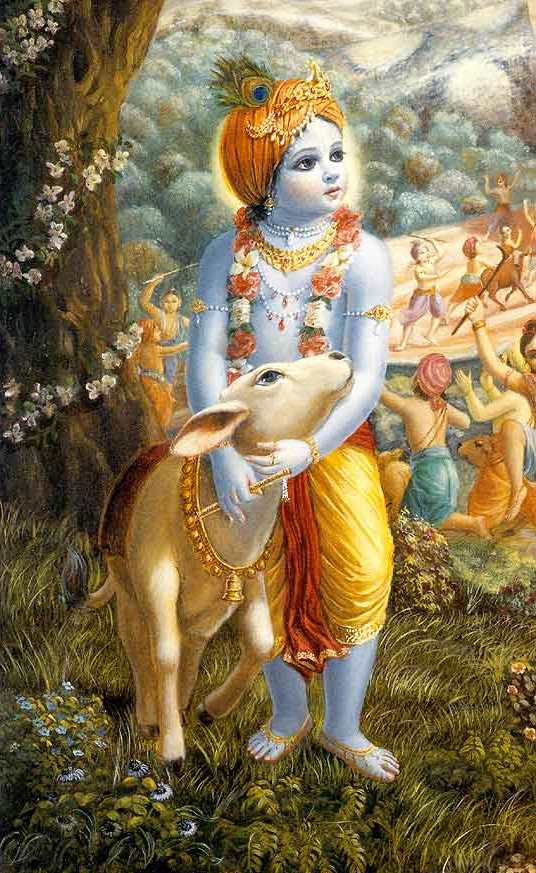
“My dear friend, there is one boy—His name is Govinda. He is standing on the bank of the Yamuna near the Kesi-ghat, and He is playing on His flute. He is so beautiful, especially during this full-moon night. If you have any intentions to enjoy in this material world with your children, husband, or other family members, then please do not go there.”
More
05 Aug 2013
by The Hare Krishna Movement
in A.C. Bhaktivedanta Swami Prabhupada, Bhagavad-gita, Spiritual Life
Tags: A.C. Bhaktivedanta Swami Prabhupada, as it is, Bg 4.9, bhagavad-gita, cintamani-prakara-sadmasu, dancing and playing with Krsna, Krsna, material world, our real position, Prabhupada Lecture, prabhupada vani, that is Vrindavan, Vrindavan picture
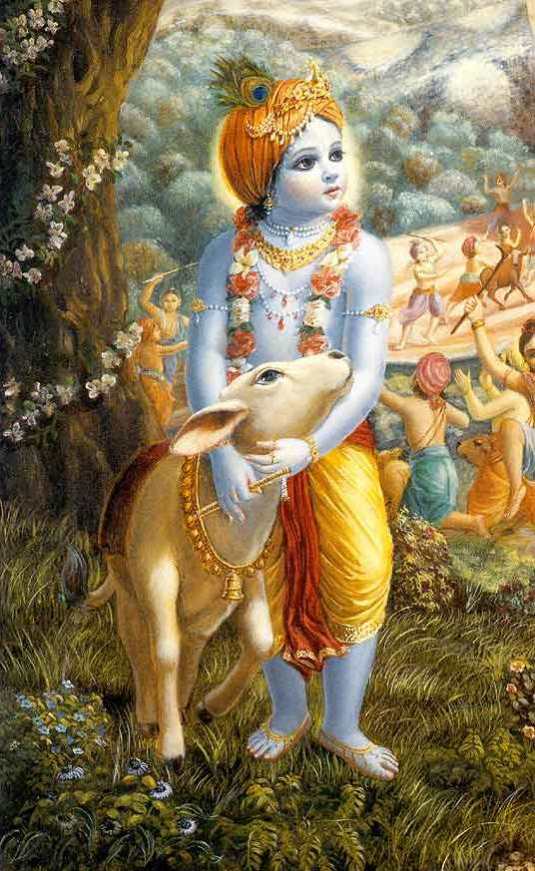
Recently I celebrated another Birthday, and on one card there was this nice inscription; “we are meant for dancing and playing and walking and living with Krsna. That is our real position. That is Vrndavana.” So beautiful was this statement from one of Srila Prabhupada’s lectures, that I looked it up in Prabhupada Vani to read the entire lecture (you can click on underlined link).
…we are meant for dancing and playing and walking and living with Krsna. That is our real position. That is the Vrndavana. Everyone… Everyone is connected with Krsna. … the trees, the flowers, water, the cows, the calves, the cowherd boys, the elderly cowherd men, Nanda Maharaja, Yasodamayi, the gopis. Krsna comes with full Vrndavana picture, and He demonstrates His Vrndavana life, cintamani-prakara-sadmasu, just to attract us, that “You are trying to enjoy in this material world, but here you cannot enjoy because you are eternal. You cannot get eternal life here. So you come to Me. You come to Me.” Tyaktva deham punar janma naiti mam eti kaunteya [Bg. 4.9]. (Lecture given by His Divine Grace A. C. Bhaktivedanta Swami Prabhupada, 21 Feb 76, Mayapura)
Full text and purport to Bg. 4.9 More
02 Aug 2013
by The Hare Krishna Movement
in A.C. Bhaktivedanta Swami Prabhupada, Caaitanya-caritamrta, Chanting Hare Krishna, Spiritual Master
Tags: A.C. Bhaktivedanta Swami Prabhupada, chanting Hare Krishna, faith in the lord, guru, holy name, instructions of the spiritual master, spiritual master, Sri Caitanya-caritamrta, Vedic knowledge, yasya deve para bhaktir

This is another nice verse from the Sri Caitanya-caritamrta, on the importance of following strictly the instructions of the spiritual master, and thereby receiving his blessings and mercy. Allowing us to taste the nectar of the Holy Name.
Sri Caitanya-caritamrta 1975
By His Diine Grace A. C. Bhaktivedanta Swami Prabhupada
Adi-lila 7. Texts 95-96
ei tāṅra vākye āmi dṛḍha viśvāsa dhari’
nirantara kṛṣṇa-nāma saṅkīrtana kari
sei kṛṣṇa-nāma kabhu gāoyāya, nācāya
gāhi, nāci nāhi āmi āpana-icchāya
ei—this; tāṅra—his (My spiritual master’s); vākye—in the words of; āmi—I; dṛḍha—firm; viśvāsa—faith; dhari’-depend; nirantara—always; kṛṣṇa-nāma—the holy name of Lord Kṛṣṇa; saṅkīrtana—chanting; kari—continue; sei—that; kṛṣṇa-nāma—the holy name of Lord Kṛṣṇa; kabhu—sometimes; gāoyāya—causes Me to chant; nācāya—causes Me to dance; gāhi—by chanting; nāci—dancing; nāhi—not; āmi—Myself; āpana—own; icchāya—will.
TRANSLATION
“I firmly believe in these words of My spiritual master, and therefore I always chant the holy name of the Lord, alone and in the association of devotees. That holy name of Lord Kṛṣṇa sometimes causes Me to chant and dance, and therefore I chant and dance. Please do not think that I intentionally do it. I do it automatically.
PURPORT
A person who cannot keep his faith in the words of his spiritual master but acts independently never receives the authority to chant the holy name of the Lord. It is said in the Vedas (Śvetāśvatara Upaniṣad 6.23):
yasya deve parā bhaktir
yathā deve tathā gurau
tasyaite kathitā hy arthāḥ
prakāśante mahātmanaḥ
“Only unto those great souls who have implicit faith in both the Lord and the spiritual master are all the imports of Vedic knowledge automatically revealed.”
This Vedic injunction is very important, and Śrī Caitanya Mahāprabhu supported it by His personal behavior. Believing in the words of His spiritual master, He introduced the saṅkīrtana movement, just as the present Kṛṣṇa consciousness movement was started with belief in the words of our spiritual master. He wanted to preach, we believed in his words and tried somehow or other to fulfill them, and now this movement has become successful all over the world. Therefore faith in the words of the spiritual master and in the Supreme Personality of Godhead is the secret of success. Śrī Caitanya Mahāprabhu never disobeyed the orders of His spiritual master and stopped propagating the saṅkīrtana movement.
More
01 Aug 2013
by The Hare Krishna Movement
in A.C. Bhaktivedanta Swami Prabhupada, Caaitanya-caritamrta, Sankirtan, The Hare Krishna Movement
Tags: A.C. Bhaktivedanta Swami Prabhupada, Adi-lila 2.2, celestial kingdom, chanting Hare Krishna, dancing, Ganges, Hare Krishna, Hare Rama, krsna consciousness, Lord Caitanya, lotus flowers, materialistic persons, pastimes of Lord Krsna, singing, Sri Caitanya-caritamrta
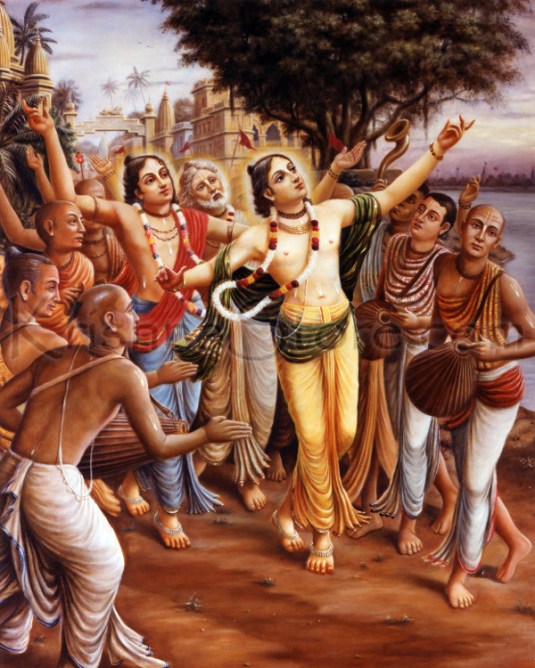
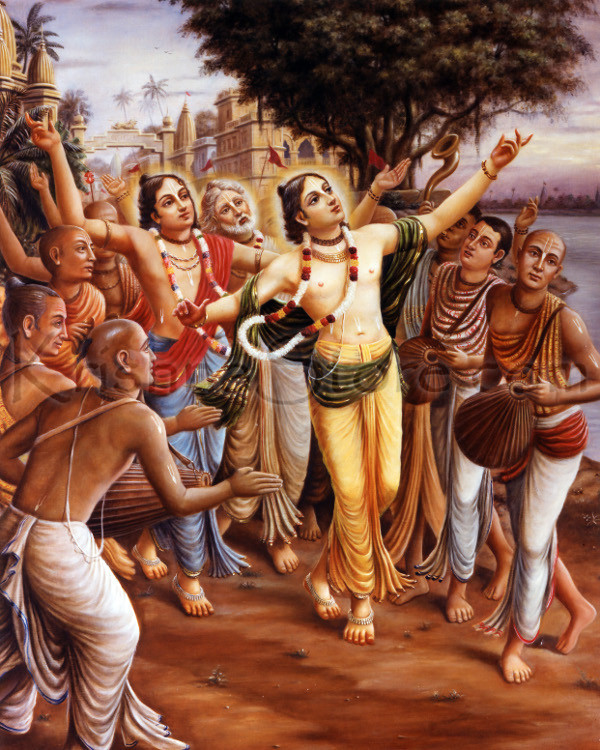
…Lord Caitanya’s movement of Kṛṣṇa consciousness is full of dancing and singing about the pastimes of Lord Kṛṣṇa. It is compared herein to the pure waters of the Ganges, which are full of lotus flowers. The enjoyers of these lotus flowers are the pure devotees, who are like bees and swans. They chant like the flowing of the Ganges, the river of the celestial kingdom. The author desires such sweetly flowing waves to cover his tongue. He humbly compares himself to materialistic persons who always engage in dry talk from which they derive no satisfaction. If they were to use their dry tongues to chant the holy name of the Lord-Hare Kṛṣṇa, Hare Kṛṣṇa, Kṛṣṇa Kṛṣṇa, Hare Hare Hare Rāma, Hare Rāma, Rāma Rāma, Hare Hare-as exemplified by Lord Caitanya, they would taste sweet nectar and enjoy life. (from purport to Adi 2.2)
Full Text and Purport More
Next Newer Entries







 The Hare Krishna Movement