03 Jan 2013
by The Hare Krishna Movement
in A.C. Bhaktivedanta Swami Prabhupada, Gajendra, Gajendra's Prayers of Surrender, Gajendra's Prayers of Surrender, Srimad Bhagavatam
Tags: A.C. Bhaktivedanta Swami Prabhupada, elephant and the crocodile, Gajendra, indradyumna, king of the elephants, SB 8.3.1-29, Srimad Bhagavatam, Supreme Lord, The Supreme Personality of Godhead
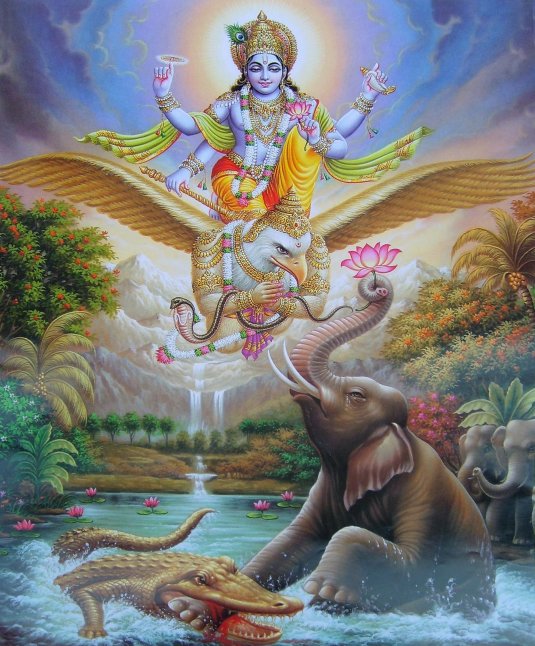
click on image to enlarge
The following are the prayers by Gajendra, the King of the elephants, offered to the Supreme Personality of Godhead, during his difficult struggle with the crocodile. It appears that the King of the elephants was formerly a human being known as Indradyumna and that he learned a prayer to the Supreme Lord. Fortunately he remembered that prayer and began to chant it. First he offered his respectful obeisances to the Supreme Personality of Godhead, and because of his awkward position in having been attacked by the crocodile, he expressed his inability to recite prayers nicely. Nonetheless, he tried to chant the mantra and expressed himself in the prayers that follow.
…It is imperative that all devotees in Kṛṣṇa consciousness practice chanting some mantra. Certainly one should chant the Hare Kṛṣṇa mantra, which is the mahā-mantra, or great mantra, and also one should practice chanting cintāmaṇi-prakara-sadmasu or the Nṛsiṁha strotra (ito nṛsiṁhaḥ parato nṛsiṁho yato yato yāmi tato nṛsiṁhaḥ). Every devotee should practice in order to chant some mantra perfectly so that even though he may be imperfect in spiritual consciousness in this life, in his next life he will not forget Kṛṣṇa consciousness, even if he becomes an animal. Of course, a devotee should try to perfect his Kṛṣṇa consciousness in this life, for simply by understanding Kṛṣṇa and His instructions, after giving up this body one can return home, back to Godhead. Even if there is some falldown, practice of Kṛṣṇa consciousness never goes in vain. For example, Ajāmila, in his boyhood, practiced chanting the name of Nārāyaṇa under the direction of his father, but later, in his youth, he fell down and became a drunkard, woman-hunter, rogue and thief. Nonetheless, because of chanting the name of Nārāyaṇa for the purpose of calling his son, whom he had named Nārāyaṇa, he became advanced, even though he was involved in sinful activities. Therefore, we should not forget the chanting of the Hare Kṛṣṇa mantra under any circumstances. It will help us in the greatest danger, as we find in the life of Gajendra. (From Purport to text 1)
Śrīmad-Bhāgavatam
By His Divine Grace A. C. Bhaktivedanta Swami Prabhupāda
Canto 8, Chapter Three, Text 1-29
Gajendra’s Prayers of Surrender More
03 Oct 2012
by The Hare Krishna Movement
in A.C. Bhaktivedanta Swami Prabhupada, Mohine-Murti, Srimad Bhagavatam
Tags: A.C. Bhaktivedanta Swami Prabhupada, ankle bells, blackis lotus, bumblebees, demigods, demons, incarnation as a woman, lusty desires, mallika flowers, Mohini-murti, Srila Prabhupada, The Supreme Personality of Godhead, Visnu

The following is from the Srimad Bhagavatam, Eight Canto, Chapter Nine, entitled “The Lord Incarnates as Mohinī-Mūrti”. The full chapter follows this beautiful verse from preceding chapter.
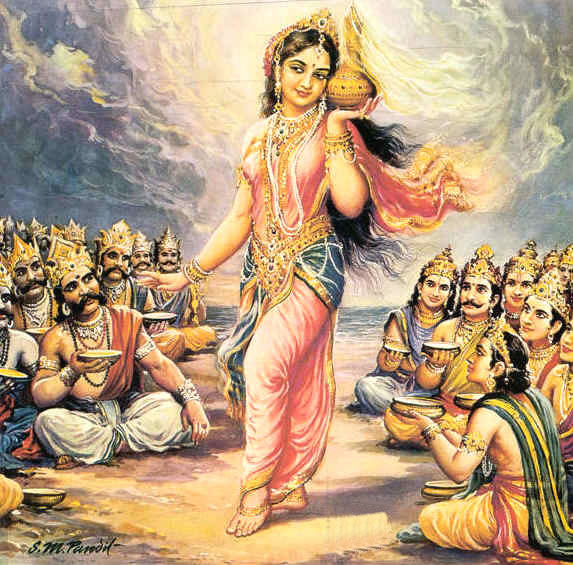
The Supreme Personality of Godhead, Viṣṇu, who can counteract any unfavorable situation, then assumed the form of an extremely beautiful woman. This incarnation as a woman, Mohinī-mūrti, was most pleasing to the mind. Her complexion resembled in color a newly grown blackish lotus, and every part of Her body was beautifully situated. Her ears were equally decorated with earrings, Her cheeks were very beautiful, Her nose was raised and Her face full of youthful luster. Her large breasts made Her waist seem very thin. Attracted by the aroma of Her face and body, bumblebees hummed around Her, and thus Her eyes were restless. Her hair, which was extremely beautiful, was garlanded with mallikā flowers. Her attractively constructed neck was decorated with a necklace and other ornaments, Her arms were decorated with bangles, Her body was covered with a clean sari, and Her breasts seemed like islands in an ocean of beauty. Her legs were decorated with ankle bells. Because of the movements of Her eyebrows as She smiled with shyness and glanced over the demons, all the demons were saturated with lusty desires, and every one of them desired to possess Her. (SB 8.8.41-48)
Because of the Supreme Lord’s assuming the form of a beautiful woman to arouse the lusty desires of the demons, a description of Her complete beauty is given here.
More
25 Aug 2012
by The Hare Krishna Movement
in KRSNA The Supreme Personality of Godhead
Tags: A.C. Bhaktivedanta Swami Prabhupada, books by Srila Prabhupada, hearing and chanting, Krishna, Krsna, Lord Brahma, Lord Krsna, Purusottama, Purusottama month, The Supreme Personality of Godhead
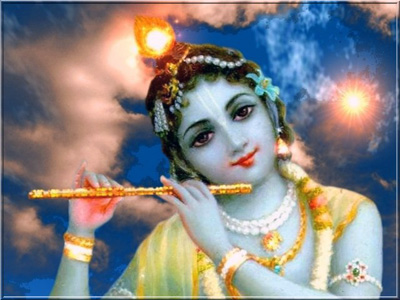
During the Purusottama Month, it is important to Hear and Chant more. With this in mind we are posting the 14th Chapter of Krsna, The Supreme Personality of Godhead, with Lord Brahma praising the Glories of Krishna (Purusottama) The Supreme Personality.
“My dear Lord, there are many instances in the history of human society where a person, after failing to achieve the transcendental platform, engaged himself in devotional service with his body, mind and words and thus attained the highest perfectional state of entering into Your abode. The processes of understanding You by speculation or mystic meditation are all useless without devotional service. One should therefore engage himself in Your devotional service even in his worldly activities, and one should always keep himself near You by the process of hearing and chanting Your transcendental glories. Simply by being attached to hearing and chanting Your glories, one can attain the highest perfectional stage and enter into Your kingdom. If a person, therefore, always keeps in touch with You by hearing and chanting Your glories and offers the results of his work for Your satisfaction only, he very easily and happily attains entrance into Your supreme abode. You are realizable by persons who have cleansed their hearts of all contamination. This cleansing of the heart is made possible by chanting and hearing the glories of Your Lordship.”
“In the Upaniṣads it is stated that the Supreme Brahman is as effulgent as the sun and is the origin of everything, and anyone who can understand that original person becomes liberated from the material conditional life. Anyone who can simply be attached to You by devotional service can know Your actual position, Your birth, appearance, disappearance and activities. As confirmed in the Bhagavad-gītā, simply by understanding Your constitutional position, appearance and disappearance, one can be immediately elevated to the spiritual kingdom after quitting this present body. Therefore to cross over the ocean of material nescience, an intelligent person takes shelter of Your lotus feet and is easily transferred to the spiritual world.”
More
17 Aug 2012
by The Hare Krishna Movement
in Uncategorized
Tags: A.C. Bhaktivedanta Swami Prabhupada, Arjuna, as it is, bhagavad-gita, Bhagavan, Iksvaku, imam vivasvate yogam, Krishna, Macmillan Edition, Manu, Original 1972 Macmillan, science of yoga, the blessed Lord said, The Supreme Personality of Godhead, transcendental knowledge, Vivasvan, yoga

Bhagavad-gītā As It Is
By His Divine Grace A. C. Bhaktivedanta Swami Prabhupāda
Chapter 4
Transcendental Knowledge
More
04 Jul 2012
by The Hare Krishna Movement
in Uncategorized
Tags: A.C. Bhaktivedanta Swami Prabhupada, Arjuna, as it is, bhagavad-gita, buddhi-yoga, chant the holy name of the Lord, constitution of the soul, Hare Krishna, karma, karma yoga, Krishna, krsna consciousness, material grief, philosophy of the soul, spiritual advancement, Sri Krsna, The Supreme Personality of Godhead
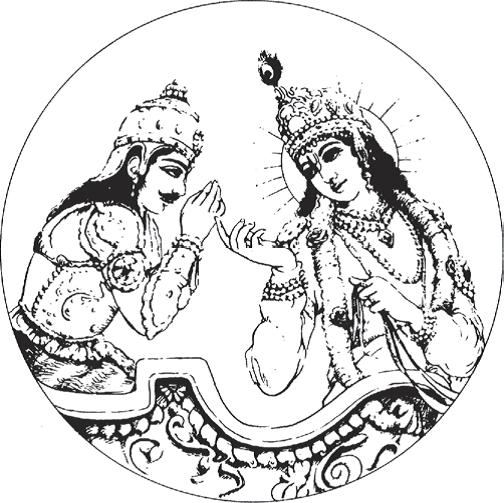
Bhagavad-gita As It Is – Macmillan 1972 Edition
By His Divine Grace A.C. Bhaktivedanta Swami Prabhupada
Chapter 3
TEXT 1
arjuna uvāca
jyāyasī cet karmaṇas te
matā buddhir janārdana
tat kiṁ karmaṇi ghore māṁ
niyojayasi keśava
arjunaḥ—Arjuna; uvāca—said; jyāyasī—speaking very highly; cet—although; karmaṇaḥ—than fruitive action; te—your; matā—opinion; buddhiḥ—intelligence; janārdana—O Kṛṣṇa; tat—therefore; kim—why; karmaṇi—in action; ghore—ghastly; mām—me; niyojayasi—engaging me; keśava—O Kṛṣṇa.
TRANSLATION
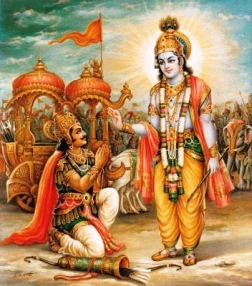
Arjuna said: O Janārdana, O Keśava, why do You urge me to engage in this ghastly warfare, if You think that intelligence is better than fruitive work?
PURPORT
The Supreme Personality of Godhead Śrī Kṛṣṇa has very elaborately described the constitution of the soul in the previous chapter, with a view to deliver His intimate friend Arjuna from the ocean of material grief. And the path of realization has been recommended: buddhi-yoga, or Kṛṣṇa consciousness. Sometimes Kṛṣṇa consciousness is misunderstood to be inertia, and one with such a misunderstanding often withdraws to a secluded place to become fully Kṛṣṇa conscious by chanting the holy name of Lord Kṛṣṇa. But without being trained in the philosophy of Kṛṣṇa consciousness, it is not advisable to chant the holy name of Kṛṣṇa in a secluded place where one may acquire only cheap adoration from the innocent public. Arjuna also thought of Kṛṣṇa consciousness or buddhi-yoga, or intelligence in spiritual advancement of knowledge, as something like retirement from active life and the practice of penance and austerity at a secluded place. In other words, he wanted to skillfully avoid the fighting by using Kṛṣṇa consciousness as an excuse. But as a sincere student, he placed the matter before his master and questioned Kṛṣṇa as to his best course of action. In answer, Lord Kṛṣṇa elaborately explained karma-yoga, or work in Kṛṣṇa consciousness, in this Third Chapter.
More
07 Jun 2012
by The Hare Krishna Movement
in A.C. Bhaktivedanta Swami Prabhupada, Devotee's, Krishna Consciousness, Lectures
Tags: A.C. Bhaktivedanta Swami Prabhupada, benefactor of the truthful devotee, bhagavad-gita, chanting Hare Krishna, Hear About Krishna, heard and chanted, Krishna, lecture by Prabhupada, material enjoyment, Paramata, Sri Krishna, supersoul, The Supreme Personality of Godhead

…I have not bribed these American and European boys to become Krishna conscious. I have no money. When I went to America, I had only seven dollars. One hour’s expenditure in New York. There is no question of bribing them. But they heard about Krishna. I was reading Bhagavad-gita on the street, in the park, and chanting. They heard, and they came to me. They became attracted. Why?
Just Give Them Chance to Hear About Krishna
Srimad-Bhagavatam Lecture 1.2.17 Vrndavana, October 28, 1972
By His Divine Grace A.C. Bhaktivedanta Swami Prabhupada
srnvatam sva-kathah krsnah
punya-sravana-kirtanah
hrdy antah-stho hy abhadrani
vidhunoti suhrt satam
Translation: “Sri Krishna, the Personality of Godhead, who is the Paramatma, Supersoul, in everyone’s heart and the benefactor of the truthful devotee, cleanses desire for material enjoyment from the heart of the devotee who relishes His messages, which are in themselves virtuous when properly heard and chanted.”
There is a English proverb that “God helps him who tries to help himself”. That is a English proverb. So to become Krsna conscious is not very difficult thing. People have no taste. They do not understand the importance of this Krsna consciousness movement. But this is the only way by which one can become perfect and happy.
It is confirmed in the Bhagavad-gita that just to become happy and peaceful one has to learn three things.
bhoktaram yajna-tapasam
sarva-loka-mahesvaram
suhrdam sarva-bhutanam
jnatva mam santim rcchati
If you want… Because the problem is that we want to be happy and peaceful. Everyone says, “I want peace. There is no peace in my mind.” That is a general understanding. Nobody can say that “I am completely happy and peaceful.” No, that is not possible. The material world is made in such a way that you cannot feel happy. That is not possible. First of all, we have come to this material world to enjoy sense gratification, but that is not our proper business. Our proper business is to satisfy the senses of Krsna, not our senses. So because we have deviated from our original position, therefore it is always a perplexity of our life. But due to illusion we cannot understand it.
More
05 May 2012
by The Hare Krishna Movement
in Srimad Bhagavatam
Tags: A.C. Bhaktivedanta Swami, Absolute Truth, Bhaktivedanta purports, Krishna, Srila Prabhupada, Srimad Bhagavatam, The Supreme Personality of Godhead

…Forgetting Kṛṣṇa, we have created so many objects of questions and answers, but none of them are able to give us complete satisfaction. All things—but Kṛṣṇa—give temporary satisfaction only, so if we are to have complete satisfaction we must take to the questions and answers about Kṛṣṇa. We cannot live for a moment without being questioned or without giving answers. Because the Śrīmad-Bhāgavatam deals with questions and answers that are related to Kṛṣṇa, we can derive the highest satisfaction only by reading and hearing this transcendental literature.
Srimad Bhagavatam
By His Divine Grace A.C. Bhaktivedanta
Canto 1, Chapter 2, Text 5
munayaḥ sādhu pṛṣṭo ’haṁ
bhavadbhir loka-maṅgalam
yat kṛtaḥ kṛṣṇa-sampraśno
yenātmā suprasīdati
munayaḥ—O sages; sādhu—this is relevant; pṛṣṭaḥ—questioned; aham—myself; bhavadbhiḥ—by all of you; loka—the world; maṅgalam—welfare; yat—because; kṛtaḥ—made; kṛṣṇa—the Personality of Godhead; sampraśnaḥ—relevant question; yena—by which; ātmā—self; suprasīdati—completely pleased.
TRANSLATION
O sages, I have been justly questioned by you. Your questions are worthy because they relate to Lord Kṛṣṇa and so are of relevance to the world’s welfare. Only questions of this sort are capable of completely satisfying the self.
PURPORT
Since it has been stated hereinbefore that in the Bhāgavatam the Absolute Truth is to be known, the questions of the sages of Naimiṣāraṇya are proper and just, because they pertain to Kṛṣṇa, who is the Supreme Personality of Godhead, the Absolute Truth. In Bhagavad-gītā (15.15) the Personality of Godhead says that in all the Vedas there is nothing but the urge for searching after Him, Lord Kṛṣṇa. Thus the questions that pertain to Kṛṣṇa are the sum and substance of all the Vedic inquiries.
The whole world is full of questions and answers. The birds, beasts and men are all busy in the matter of perpetual questions and answers. In the morning the birds in the nest become busy with questions and answers, and in the evening also the same birds come back and again become busy with questions and answers. The human being, unless he is fast asleep at night, is busy with questions and answers. The businessmen in the market are busy with questions and answers, and so also the lawyers in the court and the students in the schools and colleges. The legislators in the parliament are also busy with questions and answers, and the politicians and the press representatives are all busy with questions and answers. Although they go on making such questions and answers for their whole lives, they are not at all satisfied. Satisfaction of the soul can only be obtained by questions and answers on the subject of Kṛṣṇa.
More
17 Jan 2012
by The Hare Krishna Movement
in Krishna, Krishna Consciousness, Spiritual World, Srimad Bhagavatam
Tags: A.C. Bhaktivedanta Swami Prabhupada, brahmanas, chariots, conchshells, elephants, Krishna, Krsna enters Dwaraka, Lord Krishna, lotus flowers, Srimad Bhagavatam, The Supreme Personality of Godhead, unbroken seeds, Vedic hymns
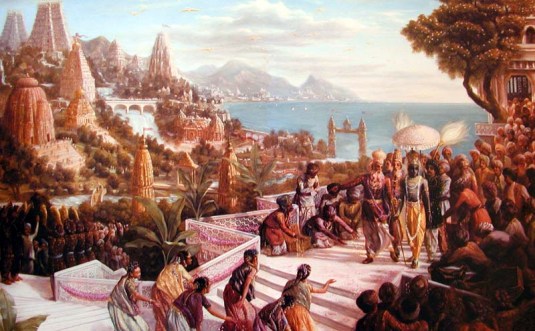
Srimad Bhagavatam
By His Divine Grace A.C. Bhaktivedanta Swami Prabhupada
Canto 1, Chapter 11
Lord Kṛṣṇa’s Entrance into Dvārakā
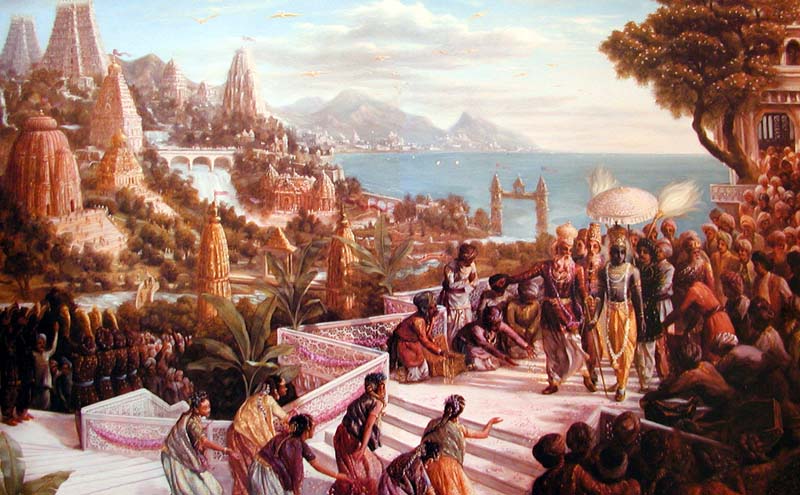
While entering the city of Dvaraka, Lord Krishna acknowledged all the inhabitants’ by casting His transcendental glance over them. The city was filled with the opulences of all seasons. There were hermitages, orchards, flower gardens, parks and reservoirs of water filled with lotus flowers. The highways, subways, lanes, markets and public meeting places were all thoroughly cleansed and then moistened with scented water, And to welcome the Lord, the residents of Dvaraka strew flowers, fruits and unbroken seeds everywhere. The residents hastened toward the Lord on chariots, upon which rode brahmanas bearing flowers, In front of the chariots were elephants, which are emblems of good fortune. Conchshells and bugles were sounded, and Vedic hymns were chanted. Thus, the residents offered their respects, which were saturated with affection, In return, Lord Krishna, the Personality of Godhead, approached them and offered due honor and respect to each and every one of the friends, relatives, citizens and others who came to receive and welcome Him. As the Lord passed along the public road of Dvaraka, His head was protected from sunshine by a white umbrella. White feathered fans moved in semicircles, and showers of flowers fell upon the road. His yellow garments and garlands of flowers made it appear as if a dark cloud were surrounded simultaneously by the sun, the moon, lighting and rainbows.
Lord Kṛṣṇa’s attraction is so powerful that once being attracted by Him one cannot tolerate separation from Him. Why is this so? Because we are all eternally related with Him as the sun rays are eternally related with the sun disc. The sun rays are molecular parts of the solar radiation. Thus the sun rays and the sun cannot be separated. The separation by the cloud is temporary and artificial, and as soon as the cloud is cleared, the sun rays again display their natural effulgence in the presence of the sun. Similarly, the living entities, who are molecular parts of the whole spirit, are separated from the Lord by the artificial covering of māyā, illusory energy. This illusory energy, or the curtain of māyā, has to be removed, and when it is so done, the living entity can see the Lord face to face, and all his miseries are at once removed. Every one of us wants to remove the miseries of life, but we do not know how to do it. The solution is given here, and it rests on us to assimilate it or not. (Srimad Bhagavatam 1.11.10 Purport)
Painting by-Ramadasa Abhirama dasa
18 Oct 2011
by The Hare Krishna Movement
in Krishna, Lectures, Songs of the Vaisnava Acaryas
Tags: braja-jana-vallabha, God, His Divine Grace A.C. Bhaktivedanta Swami Prabhupada, Jaya Radha Madhava, Krsna, kunja-vihari, lover of Srimati Radharani, Radha-Madhava, The Supreme Personality of Godhead, Vrndavana forest

Radha Madhava
(New York, July 20, 1971)
By His Divine Grace A.C. Bhaktivedanta Swami Prabhupada
[Sings Jaya Radha-Madhava.] (song lyrics follow this post)
Srila Prabhupada:
So this is the original nature of Krsna. He is Radha-Madhava. He is the lover of Srimati Radharani. And kunja-vihari, always enjoying the company of the gopis within the bushes of Vrdavana forest. Radha-madhava kunja-vihari. So He’s not only lover of Radharani, but braja-jana-vallabha. The whole residents of Vrndavana, they love Krsna. They do not know anything else. They do not know whether Krsna is God, or not; neither they are very much harassed, that “I shall love Krsna if He is God.” “He may be God or He may be whatever He is. It doesn’t matter, but we love God, Krsna.” That’s all. That is called unnalloyed love. “If Krsna is God, then I shall love Him” — this is conditional love. This is not pure love. Krsna may be God or whatever He may be, but by His wonderful acts, the Vrajavasi, they are thinking, “Oh Krsna, He is very wonderful child, maybe some demigod. Maybe some demigod.” Because people are generally under impression that the demigods are all-powerful.
More
12 Oct 2011
by The Hare Krishna Movement
in Spiritual Life, Sri Damodarastakam, Visnujana Swami
Tags: Damodara, Mother Yasoda, rudantam muhur netra-yugman mrjantam, Sri Damodarastakam, Sri Krishna, The Supreme Personality of Godhead, Visnujana Swami

Mother Yasoda bound His belly with ropes, He shivered in fright and His pearl necklace shook.
rudantaḿ muhur netra-yugmaḿ mṛjantam
karāmbhoja-yugmena sātańka-netram
muhuḥ śvāsa-kampa-trirekhāńka-kaṇṭha-
sthita-graivaḿ dāmodaraḿ bhakti-baddham
rudantam–crying; muhuḥ–again and again; netra-yugmam–His two eyes; mṛjantam–rubbing; kara-ambhoja-yugmena–with His two lotus-like hands; sa-ātańka-netram–with very fearful eyes; muhuḥ–again and again; śvāsa–quick breathing and sighing; kampa–trembling; tri-rekhaańka-kaṇṭha–neck marked with three lines (just like a conchshell); sthita–situated; graiva–pearl necklaces and other neck-ornaments; dāma-udaram–unto He with a rope around His belly; bhakti-baddham– who is bound by devotion.
2) Upon seeing His mothers whipping stick, He cried and rubbed His eyes again and again with His two lotus hands. His eyes were fearful and His breathing quick, and as Mother Yasoda bound His belly with ropes, He shivered in fright and His pearl necklace shook. To this Supreme Lord, Sri Damodara, who is bound with His devotee’s love, I offer my humble obeisances.
Purport
The second verse continues describing the lila-visesa. He is crying (rudantam) because He sees the stick in Mother Yasoda’s hand. Perceiving that she may strike Him, He appears fearful, hoping her natural empathy may save Him from punishment. Due to fear, tears are forming in His eyes, so He rubs his eyes with his lotus-like hands in the normal manner of children to wipe away the tears that are beginning to flow.
Then (satanka-netram) His fearful eyes reveal how much He is dreading punishment. It also indicates His glancing here and there in great fear, trying to avoid being punished. The confidential pastime is revealed in this way. Therefore, due to his continual sobbing He is trembling, (muhuh svasa-kampa) and thus, (sthita-graiva) the pearl necklaces and earrings that adorn Him are also shaking.
More
30 Jun 2011
by The Hare Krishna Movement
in Krishna, Krishna Consciousness
Tags: Balarama, gopis, His Divine Grace A.C. Bhaktivedanta Swami Prabhupada, Krishna, Krsna, Krsna Book, Lord Caitanya, Siksastaka, The Supreme Personality of Godhead

Krishna Nectar
From; KRSNA, The Supreme Personality of Godhead – 1970 Edition
By; His Divine Grace A. C. Bhaktivedanta Swami Prabhupada
Chapter23
Delivering the Wives of the Brahmanas Who Performed Sacrifices
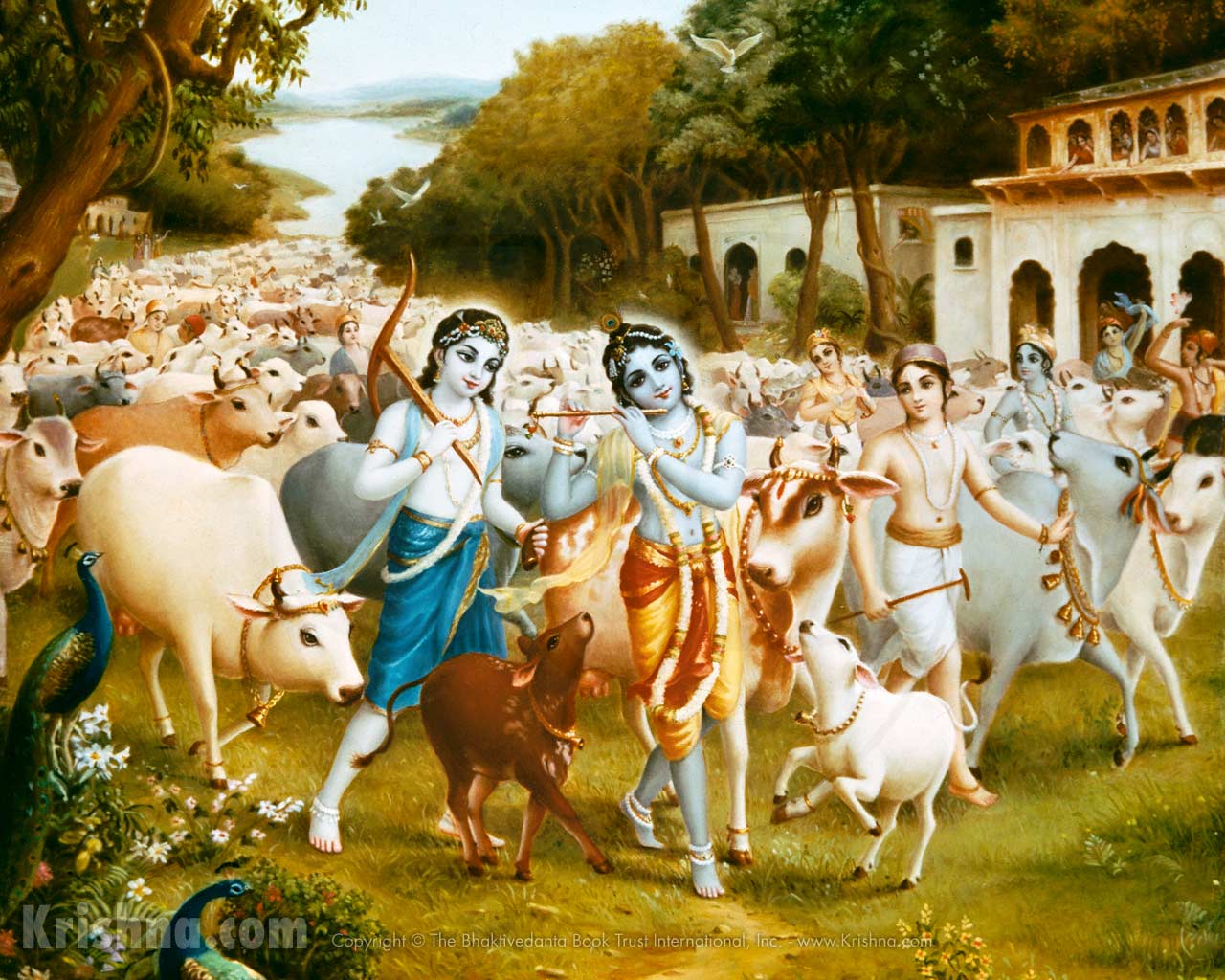
The brāhmaṇas’ wives saw Kṛṣṇa putting on a garment glittering like gold. He wore a nice garland of forest flowers and a peacock feather on His head. He was also painted with the minerals found in Vṛndāvana, and He looked exactly like a dancing actor on a theatrical stage. They saw Him keeping one hand on the shoulder of His friend, and in His other hand, He was holding a lotus flower. His ears were decorated with lilies, He wore marks of tilaka, and He was smiling charmingly. With their very eyes, the wives of the brāhmaṇas saw the Supreme Personality of Godhead, of whom they had heard so much, who was so dear to them, and in whom their minds were always absorbed. Now they saw Him eye to eye and face to face, and Kṛṣṇa entered within their hearts through their eyes.
…”For a long time the wives had been anxious to see Kṛṣṇa. However, when they were preparing to leave home to go see Him, their husbands, fathers, sons and relatives asked them not to go. But the wives did not comply. When a devotee is called by the attraction of Kṛṣṇa, he does not care for bodily ties. The women entered the forest of Vṛndāvana on the bank of the Yamunā, which was verdant with vegetation and newly grown vines and flowers. Within that forest, they saw Kṛṣṇa and Balarāma engaged in tending the cows, along with Their very affectionate boy friends.
More
Next Newer Entries








 The Hare Krishna Movement