06 Oct 2012
by The Hare Krishna Movement
in A.C. Bhaktivedanta Swami Prabhupada, Book Distribution, Books by Srila Prabhupada, Devotee Business's, Free Downloads, Free eBooks, Madhudvisa das, Prabhupada Libary, Srila Prabhupada's Books
Tags: A.C. Bhaktivedanta Swami Prabhupada, Beyond Birth and Death, Bhagavad-gita As It Is, Easy Journey to Other Planets, Elevation to Krishna Consciousness, King of Knowledge, Krishna Store, Krsna The Reservoir of Pleasure, Krsna The Supreme Personality of Godhead, Madhuvisa das, Matchless Gift, Nectar of Devotion, Nectar of Instruction, On Chanting Hare Krishna, On the Way to Krishna, perfection of yoga, Science of Self Realization, Sri Isopanisad, Srila Prabhupada, Srimad-Bhagavatam 1.1, Teachings of Lord Caitanya

click on image to enlarge
Prabhupada Library
Reading Srila Prabhupada’s books is personal association with a pure devotee of Krishna. Prabhupada is living in his books and Krishna is also living in them.
“You may please me the most by reading my books and following the instructions therein…” (Srila Prabhupada)
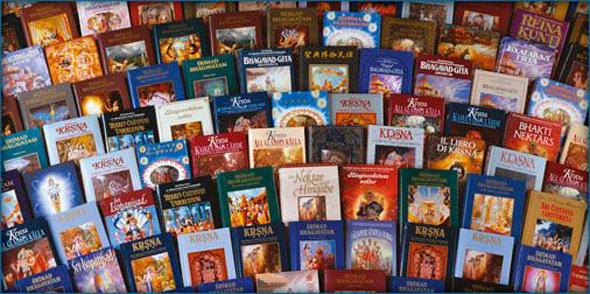
A library of 16 essential books on Krishna consciousness by His Divine Grace A.C. Bhaktivedanta Swami Prabhupada, Founder-Acarya of the Hare Krishna Movement. Includes: Bhagavad-gita As It Is, Krsna–The Supreme Personality of Godhead, Srimad-Bhagavatam 1.1, Science of Self-Realization,Teachings of Lord Caitanya, Nectar of Devotion, Nectar of Instruction, Sri Isopanisad, Perfection of Yoga, Beyond Birth and Death, Matchless Gift, Elevation to Krishna Consciousness, King of Knowledge, Easy Journey to Other Planets, On the Way to Krishna, Krsna the Reservoir of Pleasure, On Chanting Hare Krishna.
More
05 Aug 2012
by The Hare Krishna Movement
in Krishna, Opulence of the Absolute, Sri Caitanya-Caritamrta, Srimati Radharani
Tags: A.C. Bhaktivedanta Swami Prabhupada, Aprakrta-madana, cupid, Krishna, Krsna, Mad. 8.139, Madana, Madana-mohana, Manmatha-madana, Nectar of Devotion, sac-cid-ananda-vigraha, Sri Caitanya-caritamrta
click on image to enlarge
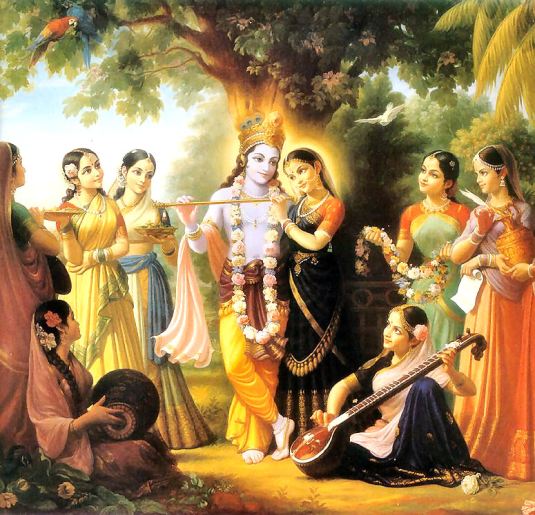
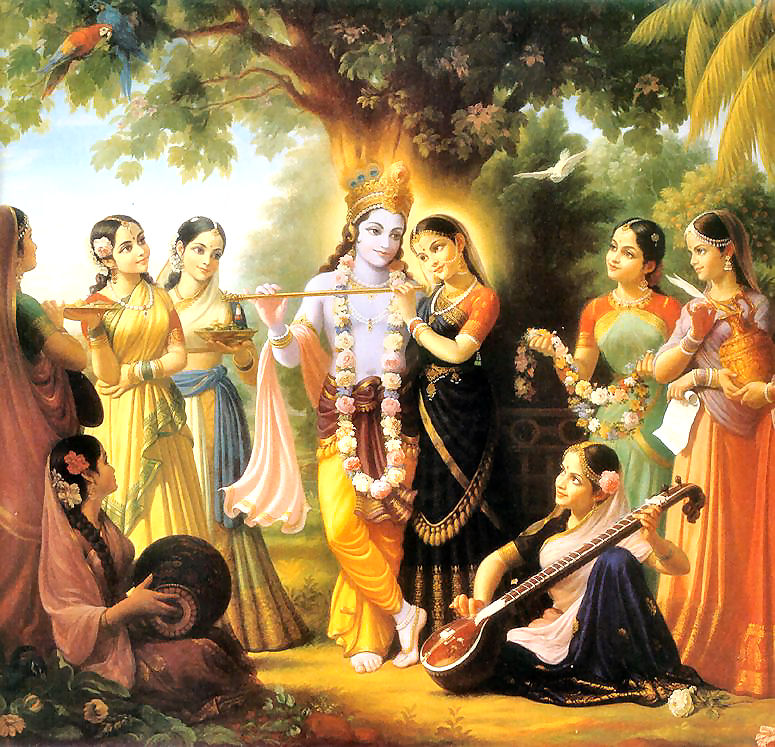
“The very name Kṛṣṇa means that He attracts even Cupid. He is therefore attractive to everyone-male and female, moving and inert living entities. Indeed, Kṛṣṇa is known as the all-attractive one.
“Śrīla Rūpa Gosvāmī has stated that devotional service attracts even Kṛṣṇa. Kṛṣṇa attracts everyone, but devotional service attracts Kṛṣṇa. The symbol of devotional service in the highest degree is Rādhārāṇī. Kṛṣṇa is called Madana-mohana, which means that He is so attractive that He can defeat the attraction of thousands of Cupids. But Rādhārāṇī is still more attractive, for She can even attract Kṛṣṇa. Therefore devotees call Her Madana-mohana-mohinī, the attractor of the attractor of Cupid. To perform devotional service means to follow in the footsteps of Rādhārāṇī…” (Nectar of Devotion Lecture, Nov. 11, 1972, Vrindavan)
…The name Madana refers to Cupid, but Kṛṣṇa is the spiritual Madana. His body is not material like the body of Cupid in this material universe. Kṛṣṇa’s body is all-spiritual-sac-cid-ānanda-vigraha. Therefore He is called Aprākṛta-madana. He is also known as Manmatha-madana, which means that He is attractive even to Cupid.
More
21 Jul 2012
by The Hare Krishna Movement
in Disciplic succession, Guru & Disciple, Nectar of Devotion
Tags: A.C. Bhaktivedanta Swami Prabhupada, Acaryas, accepting the shelter of a bona fide spiritual master, bhakti yoga, Bhakti-rasamrta-sindhu, guru disciple, Initiation, Krishna consciousness, Nectar of Devotion, NOD 7, spiritual master, Srila Rupa Goswami, suffering humanity

click on image to enlarge
The Nectar of Devotion is a summary study of Bhakti-rasāmṛta-sindhu, which was written in Sanskrit by Śrīla Rūpa Gosvāmī Prabhupāda. He was the chief of the six Gosvāmīs, who were the direct disciples of Lord Caitanya Mahāprabhu, and has since been translated into English by His Divine Grace A.C. Bhaktivedanta Swami Prabhupada, Founder-Acarya of the International Society for Krishna Consciousness.
The author of Bhakti-rasāmṛta-sindhu, Śrīla Rūpa Gosvāmī, very humbly submits that he is just trying to spread Kṛṣṇa consciousness all over the world, although he humbly thinks himself unfit for this work. That should be the attitude of all preachers of the Kṛṣṇa consciousness movement, following in the footsteps of Śrīla Rūpa Gosvāmī. We should never think of ourselves as great preachers, but should always consider that we are simply instrumental to the previous ācāryas, and simply by following in their footsteps we may be able to do something for the benefit of suffering humanity. (From introduction to Nectar of Devotion)
Nectar of Devotion
By His Divine Grace A. C. Bhaktivedanta Swami Prabhupāda
Chapter 7 “Evidence Regarding Devotional Principles”
Accepting the Shelter of a Bona Fide Spiritual Master
In the Eleventh Canto of Śrīmad-Bhāgavatam, Third Chapter, verse 21, Prabuddha tells Mahārāja Nimi, “My dear King, please know for certain that in the material world there is no happiness. It is simply a mistake to think that there is happiness here, because this place is full of nothing but miserable conditions. Any person who is seriously desirous of achieving real happiness must seek out a bona fide spiritual master and take shelter of him by initiation. The qualification of a spiritual master is that he must have realized the conclusion of the scriptures by deliberation and arguments and thus be able to convince others of these conclusions. Such great personalities who have taken shelter of the Supreme Godhead, leaving aside all material considerations, are to be understood as bona fide spiritual masters. Everyone should try to find such a bona fide spiritual master in order to fulfill his mission of life, which is to transfer himself to the plane of spiritual bliss.”
The purport is that one should not accept as a spiritual master someone who is fool number one, who has no direction according to the scriptural injunctions, whose character is doubtful, who does not follow the principles of devotional service, or who has not conquered the influence of the six sense-gratifying agents. The six agents of sense gratification are the tongue, the genitals, the belly, anger, the mind and words. Anyone who has practiced controlling these six is permitted to make disciples all over the world. To accept such a spiritual master is the crucial point for advancement in spiritual life. One who is fortunate enough to come under the shelter of a bona fide spiritual master is sure to traverse the path of spiritual salvation without any doubt.
More
12 May 2012
by The Hare Krishna Movement
in Nectar of Devotion
Tags: A.C. Bhaktivedanta Swami Prabhupada, causeless mercy, conditioned soul, core of his heart, devotee, Hanuman, kingdom of God, liberated, material existence means suffering, Nectar of Devotion, offering You respectful obeisances, Rama, Srila Prabhupada, suffering the resultant actions of his past misdeeds, Techniques of Hearing and Remembering
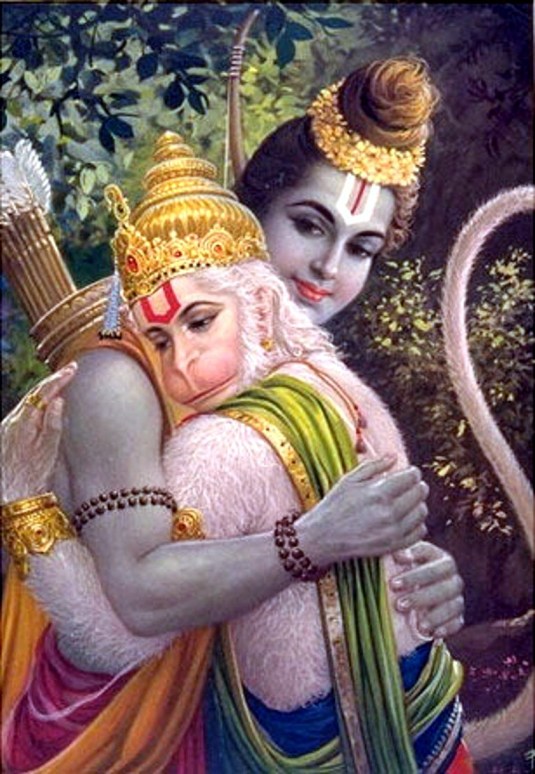
“In the Tenth Canto, Fourteenth Chapter, verse 8, it is said, “My dear Lord, any person who is constantly awaiting Your causeless mercy to be bestowed upon him, and who goes on suffering the resultant actions of his past misdeeds, offering You respectful obeisances from the core of his heart, is surely eligible to become liberated, for it has become his rightful claim.”
This statement of Srimad-Bhagavatam should be the guide of all devotees. A devotee should not expect immediate relief from the reactions of his past misdeeds. No conditioned soul is free from such reactionary experiences, because material existence means continued suffering or enjoying of past activities. If one has finished his material activities then there is no more birth. This is possible only when one begins Krsna conscious activities, because such activities do not produce reaction. Therefore, as soon as one becomes perfect in Krsna conscious activities, he is not going to take birth again in this material world. A devotee who is not perfectly freed from the resultant actions should therefore continue to act in Krsna consciousness seriously, even though there may be so many impediments. When such impediments arise he should simply think of Krsna and expect His mercy. That is the only solace. If the devotee passes his days in that spirit, it is certain that he is going to be promoted to the abode of the Lord. By such activities, he earns his claim to enter into the kingdom of God.”
Full Chapter More
11 May 2012
by The Hare Krishna Movement
in Meditation
Tags: A.C. Bhaktivedanta Swami Prabhupada, executing devotion service, krsna consciousness, meditation, meditation on devotional service, meditation on the form of Visnu, meditation on the transcendental quality of the Lord, Nectar of Devotion, Puranas, Supreme Personality of Godhead

Meditation means to engage the mind in thinking of the form of the Lord, of the qualities of the Lord, of the activities of the Lord and of the service of the Lord. Meditation does not mean anything impersonal or void. According to Vedic literature, meditation is always on the form of Viṣṇu.
The Nectar of Devotion 1970 Edition
By His Divine Grace A.C. Bhaktivedanta Swami Prabhupada
Chapter 10 “Techniques of Hearing and Memorizing”
In the Nṛsiṁha Purāṇa there is a statement about meditation on the form of the Lord. It is said there: “Meditation focusing on the lotus feet of the Supreme Personality of Godhead has been accepted as transcendental and beyond the experience of material pain and pleasure. By such meditation even one who is grossly miscreant can be delivered from the sinful reactions of his life.”
In the Viṣṇu-dharma there is a statement about meditation on the transcendental quality of the Lord. It is said, “Persons who are constantly engaged in Kṛṣṇa consciousness, and who remember the transcendental qualities of the Lord, become free from all reactions to sinful activities, and after being so cleansed they become fit to enter into the kingdom of God.” In other words, no one can enter into the kingdom of God without being freed from all sinful reactions. Sinful reactions can be avoided simply by remembering the form, qualities, pastimes, etc., of the Lord.
In the Padma Purāṇa there is a statement about remembering the activities of the Lord: “A person who is always engaged in meditation on the sweet pastimes and wonderful activities of the Lord surely becomes freed from all material contamination.”
Meditation on Executing Devotional Service More
19 Jan 2012
by The Hare Krishna Movement
in Books by Srila Prabhupada, Devotional Service, Nectar of Devotion
Tags: A.C. Bhaktivedanta Swami Prabhupada, bhakti, bhakti yoga, Bhakti-rasamrta-sindhu, Hari-bhakti-vilasa, Nectar of Devotion, Sanatana Goswami, spiritual master, Srila Rupa Goswami, Vaisnavas

The Nectar of Devotion is a summary study of Srila Rupa Goswami’s Bhakti-rasāmṛta-sindhu, or “the nectar that is derived from the ocean of devotion (bhakti).” It fully contains the complete science of bhakti-yoga, or linking with the Supreme by transcendental loving devotion. Bhakti-yoga is the highest path of attaining God consciousness, and it is simultaneously simple and sublime. It is recommended for everyone in this age.
The Nectar of Devotion 1970 Edition
By Hia Divine Grace A.C. Bhaktivedanta Swami Prabhupada
Chapter 6
How to Discharge Devotional Service
Śrīla Rūpa Gosvāmī states that his elder brother (Sanātana Gosvāmī) has compiled Hari-bhakti-vilāsa for the guidance of the Vaiṣṇavas and therein has mentioned many rules and regulations to be followed by the Vaiṣṇavas. Some of them are very important and prominent, and he will now mention these very important items for our benefit. The purport of this statement is that Śrīla Rūpa Gosvāmī proposes to mention only basic principles, not details. For example, a basic principle is that one has to accept a spiritual master. Exactly how one follows the instructions of his spiritual master is considered a detail. For example, if one is following the instruction of his spiritual master and that instruction is different from the instructions of another spiritual master, this is called detailed information. But the basic principle of acceptance of a spiritual master is good everywhere, although the details may be different. Śrīla Rūpa Gosvāmī does not wish to enter into details here, but wants to place before us only the principles.
He mentions the basic principles as follows: 1) accepting the shelter of the lotus feet of a bona fide spiritual master, 2) becoming initiated by the spiritual master and learning how to discharge devotional service from him, 3) obeying the orders of the spiritual master with faith and devotion, 4) following in the footsteps of great ācāryas (teachers) under the direction of the spiritual master, 5) inquiring from the spiritual master how to advance in Kṛṣṇa consciousness, 6) being prepared to give up anything material for the satisfaction of the Supreme Personality of Godhead, Śrī Kṛṣṇa (This means that when we are engaged in the devotional service of Kṛṣṇa, we must be prepared to give up something which we may not like to give up, and also we have to accept something which we may not like to accept.), 7) residing in a sacred place of pilgrimage like Dvārakā or Vṛndāvana, 8) dealing with the material world only as far as necessary, 9) observing the fasting day on Ekādaśī, and 10) worshiping sacred trees like the banyan tree.
More
16 Nov 2011
by The Hare Krishna Movement
in Nectar of Devotion
Tags: A.C. Bhaktivedanta Swami Prabhupada, bhagavad-gita, Nectar of Devotion, occupational duties, Purity of Devotional Service, Supreme Personality of Godhead, surrender

In the Bhagavad-gītā also the Lord says: “Give up all your occupations and just become surrendered unto Me. I give you assurance that I shall give you protection from all sinful reactions.” One may think that because he is surrendering unto the Supreme Personality of Godhead, he will not be able to perform all of his other obligations. But the Lord says repeatedly, “Don’t hesitate. Don’t consider that because you are giving up all other engagements there will be some flaw in your life. Don’t think like that. I will give you all protection.” That is the assurance of Lord Kṛṣṇa in the Bhagavad-gītā.
The Nectar of Devotion – 1970 Edition
By His Divine Grace A.C. Bhaktivedanta Swami Prabhupada
Chapter 5
Purity of Devotional Service
All of the previous instructions imparted by Śrīla Rūpa Gosvāmī in his broad statements can be summarized thus: as long as one is materially inclined or desirous of merging into the spiritual effulgence, one cannot enter into the realm of pure devotional service. Next, Rūpa Gosvāmī states that devotional service is transcendental to all material considerations and that it is not limited to any particular country, class, society or circumstance. As stated in Śrīmad-Bhāgavatam, devotional service is transcendental and has no cause. Devotional service is executed without any hope for gain, and it cannot be checked by any material circumstances. It is open for all, without any distinction, and it is the constitutional occupation of the living entities.
More
30 Oct 2011
by The Hare Krishna Movement
in Back to Godhead, Books by Srila Prabhupada, Brahmananda das
Tags: back to Godhead, bhagavatam, Brahmananda Swami, Krsna The Supreme Personality of Godhead, Nectar of Devotion, Srila Prabhupada

Srila Prabhupada, as a pure devotee free from all defects, can transmit the Absolute Truth as it has been carefully set down in the Vedic literature, like a mailman who delivers a letter without opening it to add or subtract something. Because Srila Prabhupada is qualified to receive the king of all education, he is empowered to pass it on purely. His books are considered Vedic literature because they are in pursuance of Vyasadeva’s original intentions. Thus Srila Prabhupada’s translations and purports are nondifferent from the original instructions delivered 5,000 years ago by Lord Krsna.
The Books of His Divine Grace A.C. Bhaktivedanta Swami Prabhupada
Originally published in Back to Godhead No. 52
Bhaktivedanta Book Trust 1973
By Brahmananda Swami ISKCON East Africa
Part 7 (conclusion)
One day when several of Srila Prabhupada’s leading disciples were assembled before him, he announced that he had been requested to write a summary study of the Tenth Canto of the Srimad-Bhagavatam. If Srila Prabhupada proceeded translating canto by canto, some students feared, he might not be able to complete the confidential Tenth Canto in his life time. Because this portion had been so misrepresented by materialistic religionists, he wanted to leave behind an edition which presented this important portion in its proper transcendental perspective. He took our approval and then began dictating Krsna, the Supreme Personality of Godhead. This work is the most entertaining of all of Srila Prabhupada’s books. He conceeded that he was writing it in such a way that the reader would not detect the philosophy. In the Bhagavatam, Sukadeva Gosvami, its principal reciter, has declared that there are three classes of men who will be attracted to Krsna’s pastimes. Those very advanced in transcendental realization, the liberated souls, will relish the pastimes. Those who are on the path to achievement of liberation will automatically be purified, and even the gross materialist will enjoy them because of the resemblance between Krsna’s affairs with the gopis and the love affairs between ordinary men and women.
More
24 Oct 2011
by The Hare Krishna Movement
in Back to Godhead, Books by Srila Prabhupada, Brahmananda das
Tags: back to Godhead, bhagavad-gita, Caitanya Caritamrta, His Divine Grace A.C. Bhaktivedanta Swami Prabhupada, ISKCON Press, Macmillan's Gita, Nectar of Devotion, Sri Isopanisad, Teachings of Lord Caitanya

The Books of His Divine Grace A.C. Bhaktivedanta Swami Prabhupada
Srila Prabhupada teaches the most difficult and sublime science—the science of how to serve God—in such a way that anyone can understand it. The concepts are presented over and over again, for repetition is a time-tested learning technique in transcendental study. Thus in whichever of Srila Prabhupada’s books one reads first, one will find the entire science of Krsna consciousness presented, yet each succeeding book reveals something more, and with each rereading one will find new light. Srila Prabhupada’s books are the most wonderful vehicle because they swiftly transport the reader to a timeless and ever- green world where everyone is joyfully awakened to the Absolute Truth of Krsna, the Supreme Personality of Godhead.
The Books of His Divine Grace A.C. Bhaktivedanta Swami Prabhupada
Originally published in Back to Godhead No. 52
Bhaktivedanta Book Trust 1973
By Brahmananda Swami ISKCON East Africa
Part 6
The next book, Teachings of Lord Caitanya, was then dictated. It is a summary study of the historic Caitanya-caritamrta. Instead of the exhaustive format of verse to verse translation and purport, Srila Prabhupada presented this book in a shortened but more essential manner. “My books are for my students,” he told us, and so he wanted to write as many as possible. If Bhagavad-gita could be considered the undergraduate study of spiritual life and Srimad-Bhagavatam the master’s study, then Caitanya-caritamrta is the doctorate course. It recounts Lord Caitanya’s teachings to the only five disciples He personally taught. In Teachings of Lord Caitanya, the incomplete philosophy of impersonalism is fully analyzed and forcefully defeated by Lord Caitanya in His discussions with the two biggest impersonalists of His time, Prakasananda Sarasvati and Sarvabhauma Bhattacarya. Also, the quintessence of all detailed knowledge of Krsna and how He acts both in the spiritual and material worlds is disclosed to Ramananda Raya.
More
22 Oct 2011
by The Hare Krishna Movement
in Nectar of Devotion, Sri Damodarastakam
Tags: Damodara, His Divine Grace A.C. Bhaktivedanta Swami Prabhupada, Kuvera, Manigriva, month of Karttika. spns of Kuvera, Mother Yasoda, Narda Muni, Nectar of Devotion
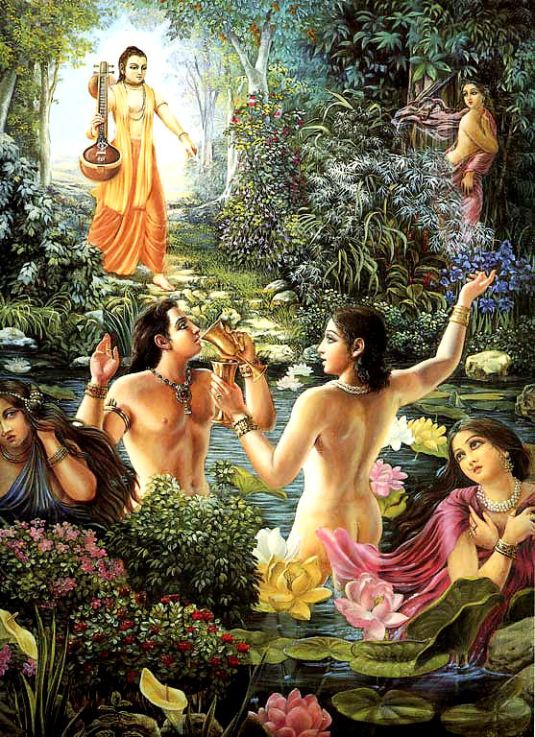
Nārada then said, "Yes, you shall become trees, arjuna trees, and you will stand at the courtyard of Nanda Mahārāj. But Kṛṣṇa Himself will appear in time as the foster son of Nanda, and He will deliver you."
The Nectar of Devotion – 1970 Edition
By His Divine Grace A.C. Bhaktivedanta Swami Prabhupada
Chapter 4
Devotional Service Surpasses All Liberation
How much a devotee is seriously attached to the devotional service of the Supreme Personality of Godhead can be understood from the statement of Mahārāj Pṛthu (Ādirāja) which is described in Śrīmad-Bhāgavatam, Fourth Canto, 20th Chapter, 21st verse. He prays to the Supreme Personality of Godhead thusly: “My dear Lord, if after taking liberation I have no chance of hearing the glories of Your Lordship, glories chanted by pure devotees from the core of their hearts in praise of Your lotus feet, and if I have no chance for this honey of transcendental bliss, then I shall never ask for liberation or this so-called spiritual emancipation. I shall simply always pray unto Your Lordship that You may give me millions of tongues and millions of ears so that I can constantly chant and hear of Your transcendental glories.”
The impersonalists desire to merge into the existence of the Supreme, but without keeping their individuality they have no chance of hearing and chanting the glories of the Supreme Lord. Because they have no idea of the transcendental form of the Supreme Lord there is no chance of their chanting and hearing of His transcendental activities. In other words, unless one is already beyond liberation, one cannot relish the transcendental glories of the Lord, nor can one understand the transcendental form of the Lord.
More
19 Oct 2011
by The Hare Krishna Movement
in Devotee's, Diksha, Guru & Disciple, Siksa
Tags: back to Godhead, devotee, Gurudas photo, Initiation, Nectar of Devotion, Rupa Goswami's samadhi, Srila Prabhupada's books

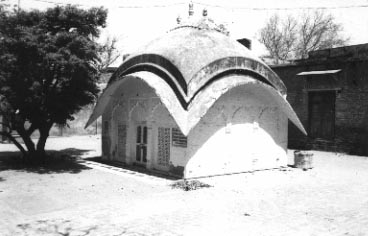
1972 Nectar of Devotion lecture at Rupa Goswami Samadi
The real Initiation
Reported by Vaikunthanatha Dasa
In 1972, when Prabhupada gave a series of lectures on The Nectar of Devotion for one month in Vrindavan, a thought was plaguing me. When I first joined, I’d been taught that the parampara system is like a chain, and if you’re not initiated, if you’re not linked up to this chain, then you can’t go back to Godhead. I thought, “We’re distributing so many books, but if the people who read them are not initiated, then they can’t go back to Godhead.” So, one day I followed Prabhupada from Rupa Goswami’s samadhi, where he lectured, and just before Prabhupada stepped onto his courtyard, I said, “We’re distributing so many books but if people aren’t initiated, then they can’t go back to Godhead.” Prabhupada turned, looked at me right in the eyes and said, “Just by reading my books they are initiated.” I thought, “That is an incredible example of compassion.
Pasted from; http://www.iskcontimes.com/the-real-initiation
29 Sep 2011
by The Hare Krishna Movement
in Devotional Service, Nectar of Devotion
Tags: 1970 Edition, devotional service, fruitive activities, His Divine Grace A.C. Bhaktivedanta Swami Prabhupada, material sense enjoyment, Nectar of Devotion, renunciation, Sri Krsna

His Divine Grace A.C. Bhaktivedanta Swami Prabhupada
The Nectar of Devotion – 1970 Edition
By His Divine Grace A.C. Bhaktivedanta Swami
Chapter 3
Eligibility of the Candidate for Accepting Devotional Service
On account of his association with mahātmās, or great souls one hundred percent in the devotional service of the Lord, one may attain a little bit of attraction for Śrī Kṛṣṇa. But at the same time one may remain very much attached to fruitive activities and material sense enjoyment and not be prepared to undergo the different types of renunciation. Such a person, if he has unflinching attraction to Kṛṣṇa, becomes an eligible candidate for discharging devotional service.
This attraction for Kṛṣṇa consciousness in association with pure devotees is the sign of great fortune. It is confirmed by Lord Caitanya that only the fortunate persons, by the mercy of both a bona fide spiritual master and Kṛṣṇa, will get the seed of devotional service. In this connection, Lord Kṛṣṇa says in Śrīmad-Bhāgavatam, Eleventh Canto, 20th Chapter, verse 8: “My dear Uddhava, only by exceptional fortune does someone become attracted to Me (Kṛṣṇa). And even if one is not completely detached from fruitive activities, or is not completely attached to devotional service, such service is quickly effective.”
More
04 Sep 2011
by The Hare Krishna Movement
in Devotional Service, Science of Self Realization, Srimati Radharani
Tags: Devotees in Vrndavana, His Divine Grace A.C. Bhaktivedanta Swami Prabhupada, Krishna, Madana-mohana-mohani, Nectar of Devotion, Radharani, Srimati Radharani

From; The Nectar of Devotion – 1970 Edition
By His Divine Grace A.C. Bhaktivedanta Swami Prabhupada
Attracting Krsna
Śrīla Rūpa Gosvāmī has stated that devotional service attracts even Kṛṣṇa. Kṛṣṇa attracts everyone, but devotional service attracts Kṛṣṇa. The symbol of devotional service in the highest degree is Rādhārāṇī. Kṛṣṇa is called Madana-mohana, which means that He is so attractive that He can defeat the attraction of thousands of Cupids. But Rādhārāṇī is still more attractive, for She can even attract Kṛṣṇa. Therefore devotees call Her Madana-mohana-mohanī-the attractor of the attractor of Cupid.
To perform devotional service means to follow in the footsteps of Rādhārāṇī, and devotees in Vṛndāvana put themselves under the care of Rādhārāṇī in order to achieve perfection in their devotional service. In other words, devotional service is not an activity of the material world; it is directly under the control of Rādhārāṇī. In Bhagavad-gītā it is confirmed that the mahātmās, or great souls, are under the protection of daivī prakṛti, the internal energy-Rādhārāṇī. So, being directly under the control of the internal potency of Kṛṣṇa, devotional service attracts even Kṛṣṇa Himself.
This fact is corroborated by Kṛṣṇa in the Eleventh Canto of Śrīmad-Bhāgavatam, 12th Chapter, 1st verse, where He says, “My dear Uddhava, you may know it from Me that the attraction I feel for devotional service rendered by My devotees is not to be attained even by the performance of mystic yoga, philosophical speculation, ritualistic sacrifices, the study of Vedānta, the practice of severe austerities or the giving of everything in charity. These are, of course, very nice activities, but they are not as attractive to Me as the transcendental loving service rendered by My devotees.”(from Nectar of Devotion: Chapter One, Characteristics of Pure Devotional Service, Attracting Krsna)
14 Jul 2011
by The Hare Krishna Movement
in Devotional Service, Krishna Consciousness, Nectar of Devotion
Tags: Bhakti-rasamrta-sindhu, causless mercy, devotional service, devotional service is ecstasy, His Divine Grace A.C. Bhaktivedanta Swami Prabhupada, Nectar of Devotion, pure love of Godhead, Srila Rupa Goswami

Nectar of Devotion
by His Divine Grace A. C. Bhaktivedanta Swami Prabhupāda
Chapter Two
We should always try to mold the activities of our lives in such a way that we will constantly remember Viṣṇu, or Kṛṣṇa. That is Kṛṣṇa consciousness. Whether one concentrates his mind on the four-handed form of Viṣṇu or on the form of two-handed Kṛṣṇa, it is the same. The Padma Purāṇa recommends: somehow or other always think of Viṣṇu, without forgetting Him under any circumstances. Actually this is the most basic of all regulative principles. For, when there is an order from a superior about doing something, there is simultaneously a prohibition. When the order is that one should always remember Kṛṣṇa, the prohibition is that one should never forget Him. Within this simple order and prohibition, all regulative principles are found complete.
The First Stages of Devotion
The three categories of devotional service which Śrīla Rūpa Gosvāmī describes in Bhakti-rasāmṛta-sindhu are listed as devotional service in practice, devotional service in ecstasy and devotional service in pure love of Godhead. There are many subheadings in each of these categories. Generally it is understood that in the category of devotional service in practice there are two different qualities, devotional service in ecstasy has four qualities, and devotional service in pure love of Godhead has six qualities. These qualities will be explained by Śrīla Rūpa Gosvāmī later on.
In this connection, Śrīla Rūpa Gosvāmī suggests that the person eligible for Kṛṣṇa consciousness, or devotional service, can be classified by his particular taste. He says that devotional service is a continual process from one’s previous life. No one can take to devotional service unless he has had some previous connection with it. For example, suppose in this life I practice devotional service to some extent. Even though it is not one-hundred-percent perfectly performed, whatever I have done will not be lost. In my next life, from the very point where I stop in this life, I shall begin again. In this way there is always a continuity. But even if there is no continuity, if only by chance a person takes interest in a pure devotee’s instruction, he can be accepted and can advance in devotional service. Anyway, for persons who have a natural taste for understanding books like Bhagavad-gītā and Śrīmad-Bhāgavatam, devotional service is easier than for those who are simply accustomed to mental speculation and argumentative processes.
More
24 Jun 2011
by The Hare Krishna Movement
in Devotional Service, Nectar of Devotion
Tags: A.C. Bhaktivedanta Swami, Bhakti-rasamrta-sindhu, characteristics of pure devotional service, Krsna, Nectar of Devotion, Srila Rupa Goswami, Srimad Bhagavatam
Nectar of Devotion
By: His Divine Grace A. C. Bhaktivedanta Swami Prabhupada
Chapter One
Characteristics of Pure Devotional Service
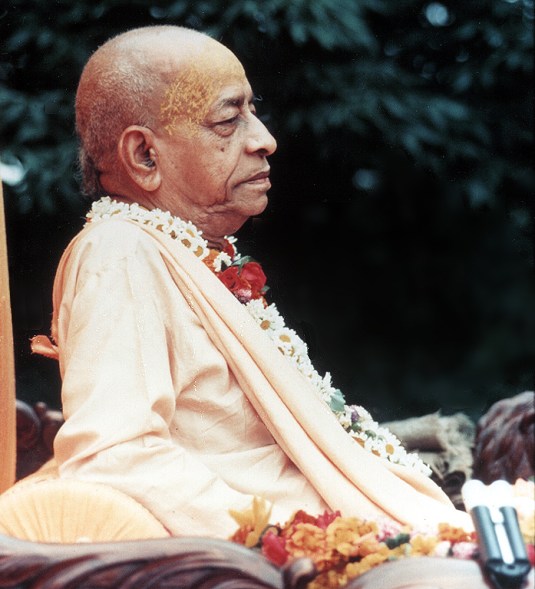
In Śrīmad-Bhāgavatam, Third Canto, Twenty-ninth Chapter, verses 12 and 13, Śrīla Kapiladeva, while instructing His mother, has given the following characteristics of pure devotional service: “My dear mother, those who are My pure devotees, and who have no desire for material benefit or philosophical speculation, have their minds so much engaged in My service that they are never interested in asking Me for anything—except to be engaged in that service. They do not even beg to live in My abode with Me.”
There are five kinds of liberation, namely to become one with the Lord, to live with the Supreme Lord on the same planet, to have the same features as the Lord, to enjoy the same opulences as the Lord and to live as a companion of the Lord. A devotee, what to speak of rejecting material sense gratification, does not even want any of the five kinds of liberation. He is satisfied simply by discharging loving service to the Lord. That is the characteristic of pure devotion.
In the above statement by Kapiladeva from Śrīmad-Bhāgavatam, the actual position of a pure devotee is described, and the primary characteristics of devotional service are also defined. Further characteristics of devotional service are described by Rūpa Gosvāmī with evidences from different scriptures. He states that there are six characteristics of pure devotional service, which are as follows:
(1) Pure devotional service brings immediate relief from all kinds of material distress.
(2) Pure devotional service is the beginning of all auspiciousness.
(3) Pure devotional service automatically puts one in transcendental pleasure.
(4) Pure devotional service is rarely achieved.
(5) Those in pure devotional service deride even the conception of liberation.
(6) Pure devotional service is the only means to attract Kṛṣṇa.
Kṛṣṇa is all-attractive, but pure devotional service attracts even Him. This means that pure devotional service is even transcendentally stronger than Kṛṣṇa Himself, because it is Kṛṣṇa’s internal potency.
More
27 Feb 2011
by The Hare Krishna Movement
in Srila Prabhupada's Books
Tags: bhagavad-gita, Krishna Conscious, Los Angeles, Nectar of Devotion, Srila Prabhupada, Srutakirti das, Supreme Lord

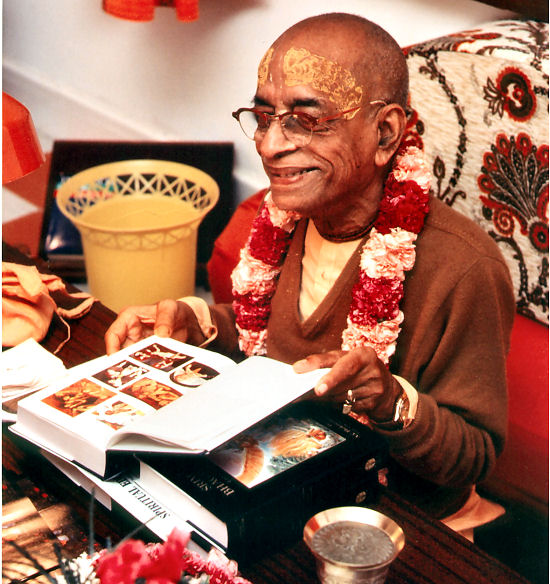
Prabhupada Reading His Own Books
by Srutakirti Prabhu
Entering Srila Prabhupada’s quarters was always an enlightening experience. Sometimes Srila Prabhupada sat and read his books. Whenever he read it seemed as if someone else had written his books because he didn’t read with the mind of an author who might be looking for editing mistakes or grammatical errors. He read them with the relish of a pure devotee reading the pastimes of the Supreme Lord to whom He was completely attached.
One day in Los Angeles I went into his room to perform my duties and he was sitting and readingBhagavad Gita As It Is. After I offered obeisances he looked at me and said, “If you just read this one book and understand, you will become Krishna Conscious in this very life.”
A few months later when I went into his room, he was reading Nectar of Devotion. He looked at me and said, “This book is so nice. Just by reading this one book you can become Krishna Conscious.”
Srila Prabhupada teaches us by example. He does everything he asks us to do. He requests us to read his books and he does, too.
Next Newer Entries














 The Hare Krishna Movement