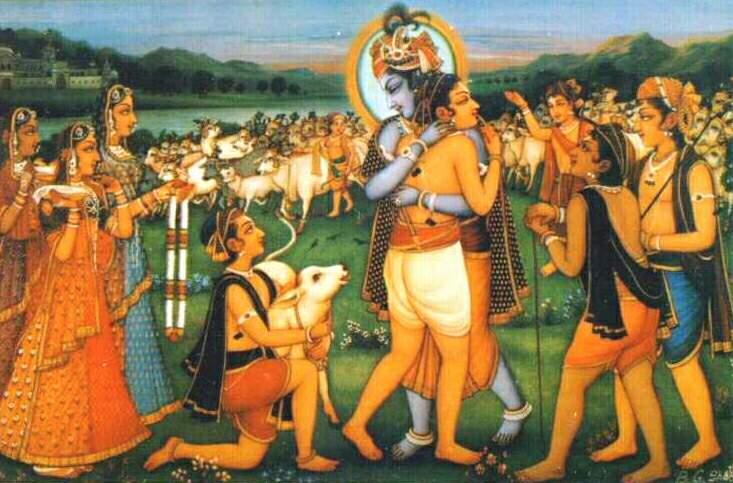
Krishna Balarama

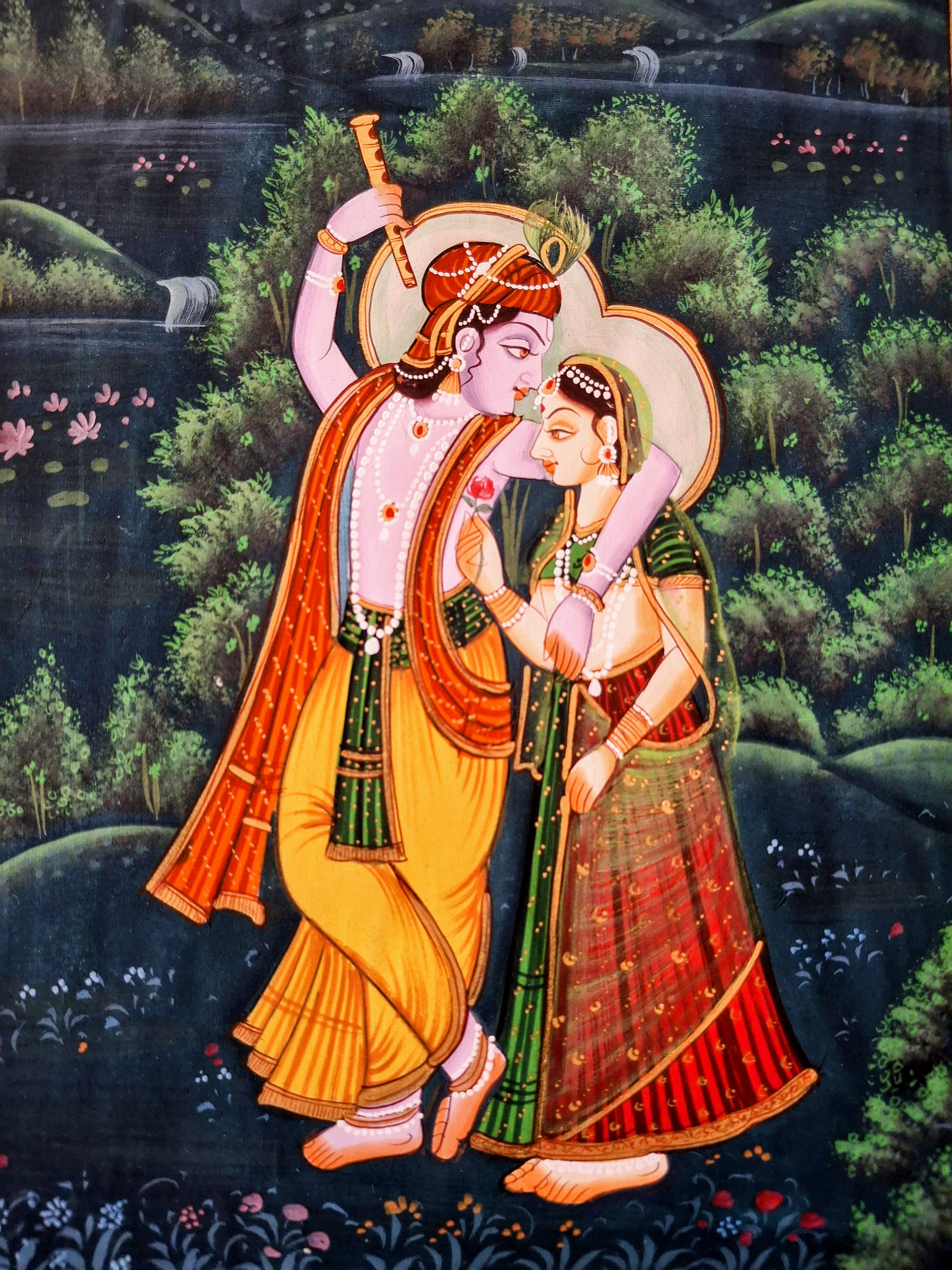
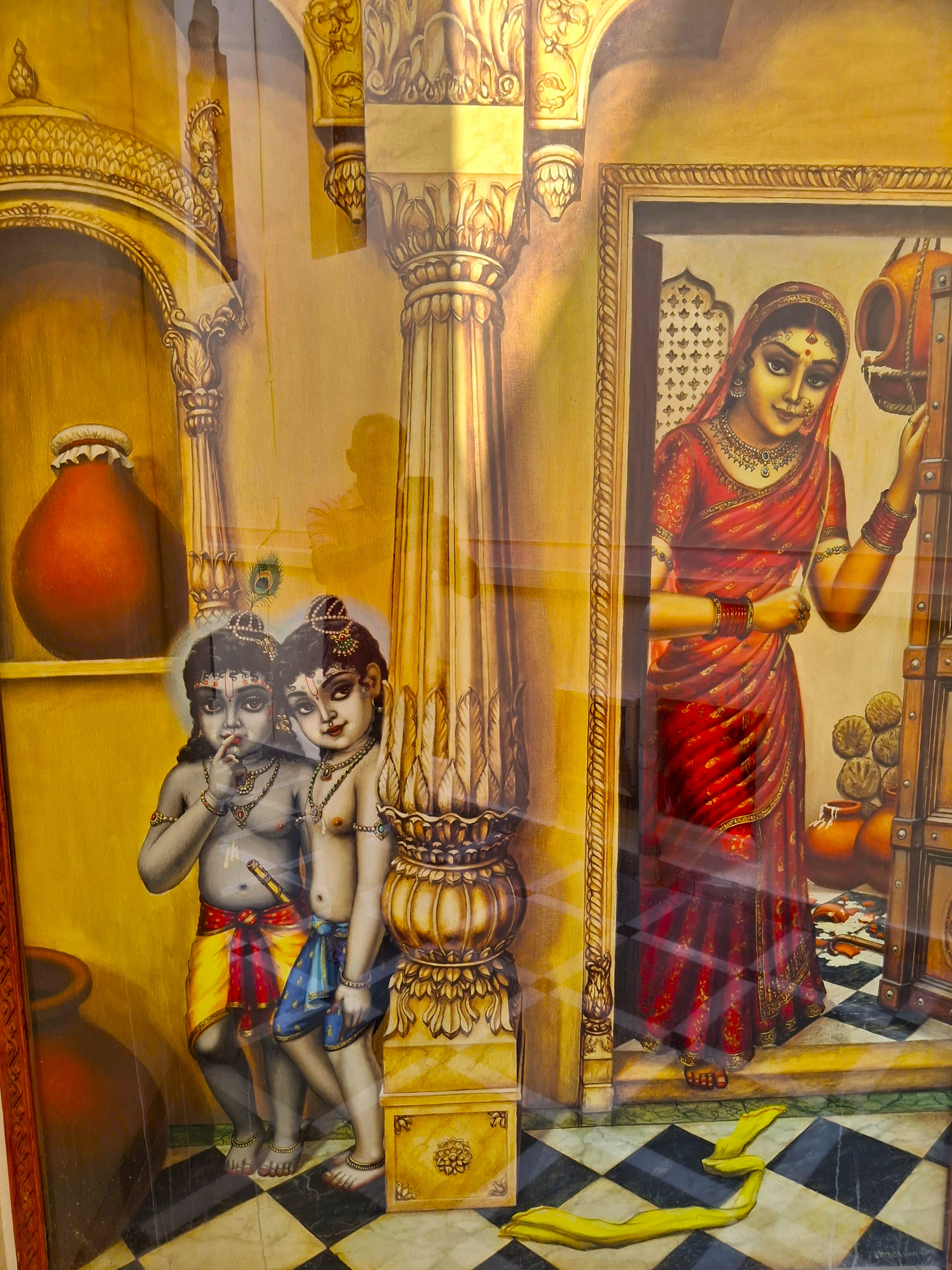
When we were in India for the 50th Anniversary of the Krishna Balarama Mandir, I saw this beautiful painting of Krishna, Balarama and Mother Yasoda. I know it is not the best image…as the glass was reflecting the sunlight…but there was something about this painting that captured my imagination and just pulled me into the pastime.

“O Lord, although You are able to give all kinds of benedictions, I do not pray to You for liberation, nor eternal life in Vaikuntha, nor any other boon. My only prayer is that Your childhood pastimes may constantly appear in my mind. O Lord, I do not even want to know Your feature of Paramatma. I simply wish that Your childhood pastimes may ever be enacted in my heart.” (verse 4 from the Sri Damodarastaka)

More

Devotional Service in Conjugal Love (Madhurya-rasa)

So we are finishing our series on the five types of relationships (rasa’s) with the Lord. Today we are exploring Devotional Service in Conjugal Love (Madhurya-rasa) as explained in chapter 44 of “The Nectar of Devotion”.

Because of the sensitive nature of this topic, we have posted the entire chapter from the the original 1970 edition of “The Nectar of Devotion”, by His Divine Grace A C Bhaktivedanta Swami Prabhupada.

A pure devotee’s attraction to Krsna in conjugal love is called devotional service in conjugal love. Although such conjugal feelings are not at all material, there is some similarity between this spiritual love and material activities. Therefore, persons who are interested only in material activities are unable to understand this spiritual conjugal love, and these devotional reciprocations appear very mysterious to them. Rupa Gosvāmī therefore describes conjugal love very briefly.

The impetuses of conjugal love are Krsna and His very dear consorts, such as Rādhārāṇī and Her immediate associates. Lord Krsnahas no rival: no one is equal to Him, and no one is greater than Him. His beauty is also without any rival, and because He excels all others in the pastimes of conjugal love, He is the original object of all conjugal love.

More

Parenthood (Vatsalya-rasa)

So we are continuing our series on the five types of relationships (rasa’s) with the Lord. Today we are exploring the Paternal Devotional stage of Love of God (Vatsalya-rasa) as explained in chapter 43 of “The Nectar of Devotion”.

When ecstatic love develops into the relationship of parenthood and becomes steadily established, the relationship is called vatsalya-rasa. The exhibition of this vatsalya-rasa standard of devotional service can be found in the dealings of Krishna with His devotees who represent themselves as superior personalities like father, mother, teacher, etc.

Learned scholars have described the impetuses of parental love for Krishna, existing in the elderly personalities who are in relation with Him, as follows: “The Supreme Personality of Godhead, whose bodily complexion is just like a bluish, new-grown lotus flower, whose body is very delicate and whose lotus eyes are surrounded by scattered hair as black as bees, was walking on the streets of Vrindavan when Mother Yasoda, the beloved wife of Nanda Mahārāj, saw Him. Immediately the milk began to flow from her breasts, soaking her body.” Some specific provocations for parental love of Krishna are listed as His blackish bodily hue, which is very attractive and pleasing to see, His all-auspicious bodily features, His mildness, His sweet words, His simplicity, His shyness, His humility, His constant readiness to offer respect to the elderly, and His charity. All of these qualities are considered ecstatic provocations for parental love.

More

Hare Krishna & Happy Holidays

click on image to enlarge

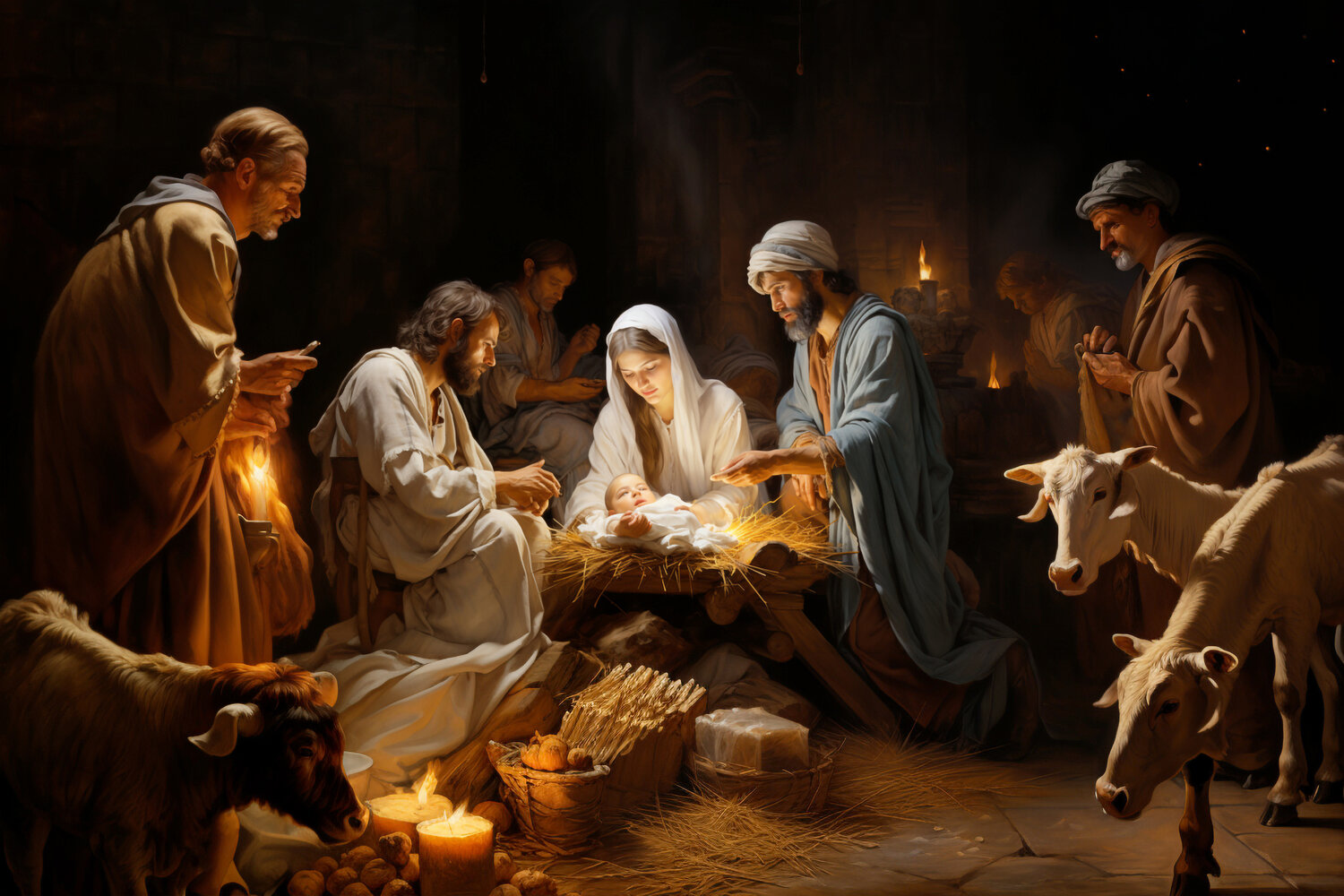
In many parts of the world people are celebrating Christmas. Some see it as a spiritual celebration, putting on their Sunday best and attending Christmas mass at their local church. While others view it as a fantasy holiday, with the focus on Santa Claus and the elves, and reindeer. But either way, for me it is a time focused on family, peace, love and charity.

Gift giving, sharing and receiving gifts, is for the most part, a loving exchange, and it brings joy to those giving, and to those recieving.

Also food is involved. There is always a Christmas dinner, and people spend hours in the kitchen preparing favorite dishes to share with their loved ones. And often a prayer or grace is said in thanks.

And sometimes there is singing. I remember as a child my father used to love to sing by the piano, with my mother or sister playing. As devotees we all love kirtan, or sit down for a melodious bhajan.

But any way that people decide to celebrate Christmas and the Holiday Season, it is a good thing in my mind. Its a celebration of life and love family and friends, and all the gifts God has given us.

There is one nice quote I am reminded of from the Nectar of Devotion

Offering gifts in charity, accepting charitable gifts, revealing one’s mind in confidence, inquiring confidentially, accepting prasadam (spiritual food) and offering prasada are the six symptoms of love shared by one devotee and another. (Nectar of devotion text 4)

Crying for Krishna

Crying for Kṛṣṇa
“The three words, namely Hara, Krishna and Rama, are transcendental seeds of the maha-mantra, and the chanting is a spiritual call for the Lord and His internal energy, Hara, for giving protection to the conditioned soul. The chanting is exactly like a genuine cry by the child for the mother. Mother Hara helps in achieving the grace of the supreme father, Hari, or Krishna, and the Lord reveals Himself to such a sincere devotee.
 
No other means, therefore, of spiritual realization is as effective in this age, as chanting the maha-mantra:
 
Hare Krishna, Hare Krishna, Krishna Krishna, Hare Hare/
Hare Rama, Hare Rama, Rama Rama, Hare Hare”
(Happening Album, 1966)
“Real religion is love, how to love God. That is real religion.  Dharma, what is that? Yato bhaktir… Sa vai puṁsāṁ paro dharmo (SB 1.2.6). There are different kinds of dharma, or religious system. But real religious system means how we have learned to love God. That’s all. Nothing more. No ritualistic ceremony, no formula, nothing. If your heart is always crying for God, that is perfect religion. That is perfect religion. Therefore Caitanya Mahāprabhu says, śūnyāyitaṁ jagat sarvam: ‘Oh, without Kṛṣṇa, I am feeling the whole world is vacant.’ Vacant, yes. So we have to come to that stage. Of course, it is not possible for all of us, but Caitanya Mahāprabhu showed us how to become highest religious person. That is to feel always, ‘Oh, without Kṛṣṇa, everything is vacant. Śūnyāyitaṁ jagat sarvaṁ govinda viraheṇa me. That is dharma, that is dharma.”  (Srila Prabhupada Lecture, Los Angeles, June 5, 1976)

More

Learning to Love

click on image to slightly enlarge

…Since we as living entities are eternal, temporary activities are not our main concern. Our engagements should be eternal because we are eternal, and that eternal engagement is the rendering of service to Kṛṣṇa in love.

Love begins with this give and take. We give something to our lover, he gives something to us, and in this way love develops. When we create any loving transaction with any boy or girl, man or woman, we give and take. Thus Kṛṣṇa is teaching us how to give and take. Kṛṣṇa is begging us:

“Try to love Me. Learn how to love Me. Offer something to Me.”

“Sir,” we may say, “I have nothing to give You.”

“Oh, you cannot collect a piece of fruit, a flower, a leaf or a little water?”

“Oh yes, why not? Anyone can collect this.”

This then is the method of Kṛṣṇa consciousness which allows one to make friends with Kṛṣṇa. We can enter into any number of relationships with Kṛṣṇa. We can become a direct servant of Kṛṣṇa, or in the highest stages we can become Kṛṣṇa’s father, mother or lover. Kṛṣṇa is prepared to establish a loving relationship with all living entities. In actuality this relationship is already there because He is the supreme father and we are His parts and parcels. Because the son is part of the body of the father, the relationship between them cannot be broken; it may be forgotten for some time, but as soon as one recognizes his father or son, immediately affection develops. Similarly, we are eternally related to Kṛṣṇa, but at the present moment this relationship is simply forgotten or suppressed. Consequently we think that we have no relationship with Kṛṣṇa, but this is not a fact. Because we are integral with Him, because we are part and parcel of Him, our relationship with Him is eternal. That relationship simply has to be revived, and that revival is this process of Kṛṣṇa consciousness.

Krsna Consciousness, The Matchless Gift
By His Divine Grace A.C. Bhaktivedanta Swami Prabhupada
Chapter 3

Learning to Love

More
How To Offer Your Food To The Lord

How to Offer Your Food To The Lord

Everything comes from God (Krishna), the air we breath, the water we drink, and the food we eat. But this process of Krishna Consciousness or bhakti-yoga, is the method for re-awakeing our dormant love for God. When you love someone, then there is service. Isn’t this so? A mother loves her baby, and cares for the babies needs; she baths the baby, dresses the baby, feeds the baby etc. So this process of Krishna Consciousness is giving back to the Supreme Lord, in the mood of loving devotional service. Although the Supreme Lord is providing everything, still a devotee thinks, “I want to give something back. I want to offer something to the Lord” Not that we just take from the Lord, ‘O Lord thank you for our daily bread’. No, a devotee wants to bake some bread for the Lord, cook some rice and offer it to the Lord, offer some fruits, and flowers, and water for the Lords pleasure. This is the begining of Love, through service.

A young boy meets a young girl, and he gives her a flower, carries her books, gives her gifts and offers her service. Similary, we want to love God, so we begin with gifts and service, to develope our love and devotion. So this process of offering very nicely prepeared foods to the Lord is Bhakti Yoga. Yoga means ‘union’, and Bhakti means through loving devotional service. It is a very blissful process. I want to Love God, so let me offer some service, some flowers, some nicely cooked food,etc. And we can link up with God (yoga) by thinking of Him, offering prayers, chanting His holy names, and offering the food we eat.

More

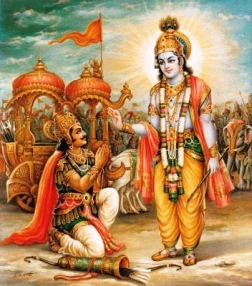
108 Imporant Slokas from the 1972 Bhagavad-gita As It Is

Click on image to go to Post

Click on image to go to Post

The Hare Krishna Cookbook

Songs of the Vaisnava Acaryas

Bhagavad-gita As It Is 1972 Edition “Online”

click on image

click on image to visit site

Srimad Bhagavatam Online

click on image

Raja-Vidya the King of Knowledge

click on image

click on image

Blog Stats

  • 4,551,289 hits

Enter your email address to subscribe to this blog and receive notifications of new posts by email.

Join 3,909 other subscribers

Important Slokas from the Brahma-samhita

click on image

click on image

Slokas from the Sri Isopanisad

click on image

click on image

Prayers By Queen Kunti (Slokas)

click on image

Gajendra’s Prayers of Surrender (Slokas)

click on image

A Short Statement of the Philosophy of Krishna Consciousness

click on image

click on image

July 9th Letter

click on image

click on image

The Hare Krishna Explosion

Reference Material/Study Guide

click on image

click on image

  • LINKS