“Everyone Of You – Become Guru”

…If we simply keep Sri Caitanya Mahaprabhu within our heart, then it will be very easy to understand what is Krsna, because if you understand Krsna, then your life is successful. Our Krsna consciousness movement means just try to understand Krsna; then your life is successful. Krsna says, “Anyone who understands Me, why I come here, what is My activities,” [Bg. 4.9], “he becomes liberated. After giving up this body, he does not accept any material body. In his own spiritual body he goes back to home, back to Godhead.” This is our Krsna consciousness..

…The mission of Sri Caitanya Mahaprabhu is that you become, every one of you, you become a guru. How to become guru? You simply present what Krsna says as it is. Then every one of you will become a guru. Don’t adulterate — “I think,” “In my opinion.” These nonsense things should be given up. We should always be aware that we are insignificant creature. Our opinion and thinking has no value. This should be the first principle. Why should you give opinion on the words of Krsna? Are you more authoritative person than Krsna? This is foolishness, to try to become more than Krsna. There are so many rascals. They present that “Now we have advanced. We know more than Krsna.” So be saved from these rascals. Then you will understand Krsna, and through Caitanya Mahaprabhu you will understand what is the position of Krsna, what is your relationship with Krsna, what is the ultimate goal of life…

“Everyone Of You – Become Guru”
Lecture on Caitanya Caritamrta Adi 1.4
Given By His Divine Grace A.C. Bhaktivedanta Swami Prabhupada 
Mayapur, March 28, 1975 

Nitai: “May that Lord, who is known as the son of Srimati Sacidevi, be transcendentally situated in the innermost chambers of your heart. Resplendent with the radiance of molten gold, He has appeared in the age of Kali by His causeless mercy to bestow what no incarnation ever offered before: the most sublime and radiant spiritual knowledge of the mellow taste of His service.”

Prabhupada:

anarpita-carim cirat karunayavatirnah kalau
samarpayitum unnata ujjvala-rasam sva-bhakti-sriyam
harih purata-sundara-dyuti-kadamba-sandipitah
sada hrdaya-kandare sphuratu vah saci-nandana

 [Cc. Adi 1.4]

This is the blessings of Srila Rupa Gosvami upon everyone.

sri-caitanya-mano-‘bhistam
sthapitam yena bhu-tale
svayam rupah kada mahyam
dadati sva-padantikam

[When will Srila Rupa Gosvami Prabhupada, who has established within this material world the mission to fulfill the desire of Lord Caitanya, give me shelter under his lotus feet?]

We should pray to Rupa Gosvami for his blessings so that we can understand what is the actual position of Sri Caitanya Mahaprabhu. Sri Caitanya Mahaprabhu is the most merciful incarnation to bestow upon us Krsna-prema. Srila Rupa Gosvami understood it, Srila Sarvabhauma Bhattacarya understood it, and we should take their viewpoint of view, what they have studied about Sri Caitanya Mahaprabhu. So Srila Rupa Gosvami says… In the beginning Sri Caitanya Mahaprabhu was appreciated by Srila Rupa Gosvami as maha-vadanyavatara. There are many incarnations of Krsna, kesava dhrta-mina-sarira jaya jagadisa hare, kesava dhrta-nrsimha-rupa jaya jagadisa…, many incarnations. But this incarnation, Sri Caitanya Mahaprabhu, is anarpita-carim cirat. The mercy of this incarnation is unlimited. It was never given before. That is Sri Caitanya Mahaprabhu’s mercy. He distributed the most confidential part of love of Godhead. Although we are living in this fallen age, Kali-yuga, but He is giving the topmost platform of loving Krsna. Anarpita-carim cirat. Therefore He is supposed to be the most munificent incarnation. Namo maha-vadanyaya krsna-prema-pradaya te [Cc. Madhya 19.53]. He is giving directly Krsna-prema.

More

The Transcendental Nature of the Holy Names of Krishna

The holy name of the Lord—Hare Kṛṣṇa, Hare Kṛṣṇa, Kṛṣṇa Kṛṣṇa, Hare Hare/ Hare Rāma, Hare Rāma, Rāma Rāma, Hare Hare—is a transcendental vibration because it comes from the transcendental platform, the supreme abode of Kṛṣṇa. Because there is no difference between Kṛṣṇa and His name, the holy name of Kṛṣṇa is as pure, perfect and liberated as Kṛṣṇa Himself.

“It is the transcendental nature of the holy names of Hare Kṛṣṇa, Hare Kṛṣṇa, Kṛṣṇa Kṛṣṇa, Hare Hare/ Hare Rāma, Hare Rāma, Rāma Rāma, Hare Hare to transport a man into spiritual madness. Anyone who sincerely chants this holy name very soon attains elevation to the platform of love of God and becomes mad after God. This madness arising from love of God is the first perfectional stage for a human being.”

Excerpted from; Teachings of Lord Caitanya
By His Divine Grace A. C. Bhaktivedanta Swami Prabhupāda
Chapter Eighteen, The Conversations with Prakāśānanda

…In this age of logic, argument and disagreement, the chanting of Hare Kṛṣṇa is the only means for self-realization. Because this transcendental vibration alone can deliver the conditioned soul, it is considered to be the essence of the Vedānta-sūtra. According to the material conception, there is duality between the name, form, quality, emotions and activities of a person and the person himself, but as far as the transcendental vibration is concerned, there is no such limitation, for it descends from the spiritual world. In the spiritual world there is no difference between the name of the person and the quality of the person. Of course in the material world there is a difference. Because the Māyāvādī philosophers cannot understand this, they cannot utter the transcendental vibration.

More

Srimati Radharani is the pleasure potency of Krishna, Hare

Lectures on Bhagavad-gita As It Is, (Bhagavad-gita 4.10)
Calcutta, September 23, 1974
By His Divine Grace A. C. Bhaktivedanta Swami Prabhupada

By taking shelter of Krishna, one has to become absorbed in thinking of Krishna. That is not very difficult. Man-mana bhava mad-bhakto mad-yaji mam namaskuru [ Bhagavad-gita 18.65]. It is not at all difficult. You simply chant Hare Krishna mantra. You’ll be man-maya. This is so nice thing. Therefore Chaitanya Mahaprabhu has recommended,

harer nama harer nama harer namaiva kevalam
kalau nasty eva nasty eva nasty eva gatir anyatha [ Chaitanya-charitamrita Adi-lila 17.21]

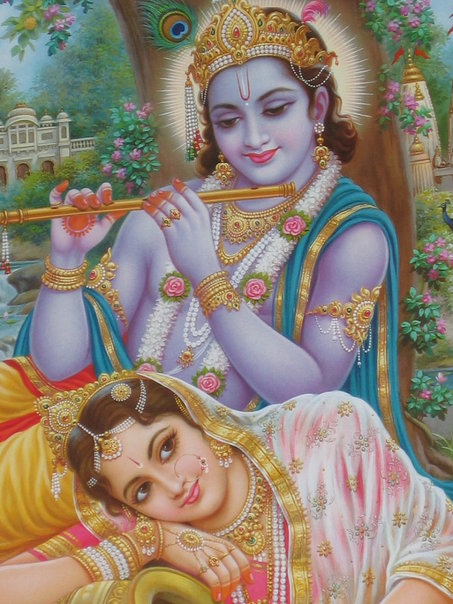
So our request is… Everyone who is present here… Today is Radhastami. So pray to Radharani. And She is hare, hara. This hare, this word, is Radharani. Hara, Radharani. Radha or Hara: the same thing. So Hare Krishna. So we are praying to Radharani, “My Mother, Radharani, and Krishna.” Hare Krishna. “O Krishna, O the Lord.” Hare Krishna, Hare Krishna, the same thing, repetition. “O Radharani, O Krishna.” “O Radha-Krishna.” “Radhe-Krishna” or “Hare Krishna,” the same thing. Hare Krishna, Hare Krishna, Krishna Krishna, Hare Hare. Again addressing, “O Krishna, O Krishna, O Radharani.” Hare Rama. The same thing, again. Hare Rama. Rama is also Krishna. Rama is Rama, Rama is Balarama. They are all Krishna. Hare Rama, Hare Rama, Rama Rama, Hare Hare.

So this repetition of addressing Radha and Krishna or Hare Krishna is to pray, “My dear Lord, … and the energy, the spiritual energy of the Lord, kindly engage me in Your service.” That’s all. “I am now embarrassed with this material service. Please engage me in Your service.”

This is good sense. We are servants here. We are engaged in so many services. But it is not giving us comfort. Na trapa nopashanti. The service which we are rendering to others, they are not satisfied, I am not satisfied. This is material service. But if you give service to Krishna… Svalpam apy asya dharmasya trayate mahato bhayat. A little service can save you from the greatest danger. This is the formula.

More

Disappearance Day of Srila Madhavendra Puri


Disappearance Day of Srila Madhavendra Puri

Madhavendra Puri appeared almost mad in his love of God. He loudly chanted and sang the names and glories of the Lord without thinking of the time or place. Sometimes in his ecstasy he didn’t know whether it was day or night. Sometimes he laughed and sometimes he wept. Sometimes he danced wildly and sometimes he fell to the ground unconscious. He took absolutely no interest in anything not connected with Krishna, and for fear of talking about anything other than the Lord, he always lived without a companion. He would eat only if someone offered him food—otherwise he would simply fast.

In many remarkable ways Krishna returned Madhavendra Puri’s intense love. Once Madhavendra was fasting and meditating beneath a tree in the forest of Vrindavana, where thousands of years before Krishna had played as a child. Suddenly a beautiful cowherd boy (gopala) came with a pot of milk and placed it before Madhavendra. “Please drink the milk I have brought you,” the boy said. Seeing the beauty of the boy, Madhavendra Puri became satisfied in his mind, and hearing these sweet words, he forgot all hunger and thirst. Then within an instant, the boy left the place and did not return. Madhavendra Puri’s heart was filled with wonder. Later, he realized who the boy actually was and cried out in; great ecstatic love: “I saw Lord Krishna directly—but I could not recognize I Him!”

Western religion usually teaches us that God is someone to fear and revere. In India, though, great spiritual masters have long taught that we can go beyond this limited conception and worship God as our master, friend, or child. And about five hundred years ago Madhavendra Puri taught that we can even worship God as our dear beloved.

More

Appearance Day of Srinivas Acarya

Appearance Day of Srinivas Acarya
(compiled by Gauridas Pandit dasa)

Appearance

In a small village of Chakhandi lived a pious Brahman names Gangadhar Bhattacharya and his wife Lakshmi-priya. Both were great devotees of Caitanya Mahaprabhu and Gangadhar was fortunate to witness the sannyasa ceremony of Mahaprabhu in Katwa. He returned filled with such love for Mahaprabhu that the villagers renamed him Caitanya Das. Later the childless couple traveled to Puri to serve Mahaprabhu, and here they received a benediction from Him to soon expect the birth of a great personality. Thus blessed, in the first decade of 1500, Shrinivas was born.

Youth

Shrinivas grew up to be the brightest, most beautiful and beloved boy of Chakhandi. He studied under the famed Dhananjaya Vidyavachaspati, who would later admit that there was nothing he could teach Shrinivas, “since the boy already knows more than I can ever hope to learn”. Due to his fame, Shrinivas came in contact with Narahari Sarakar, an intimate associate and devotee of Mahaprabhu. He accepted Narahari as an instructing guru and later approached him for initiation. Narahari however declined saying that it was Mahaprabhu’s will that he be initiated by Gopal Bhatta Goswami in Vrindavana. He also instructed Shrinivas to meet Mahaprabhu in Puri. On reaching Puri, he took shelter of Gadadhara Pandit, since Lord Chaitanya had already left the planet, to study the Bhagavatam under him. However the only copy of Bhagavatam in Puri had been rendered ineligible by the tears of ecstasy that Mahaprabhu and Gadadhara had shed while reading it. So Shrinivas returned to Bengal to procure the only other copy from Narahari. However by the time he returned, Gadadhara Pandit, unable to bear the separation with His Lord any more had also left the planet.

More

Golden Avatar

Sri Caitanya-caritamrta – 1975 Edition
By His Divine Grace A.C.Bhaktivedanta Swami Prabhupada
Adi 3.52

TRANSLATION

“In the Age of Kali, intelligent persons perform congregational chanting to worship the incarnation of Godhead who constantly sings the name of Kṛṣṇa. Although His complexion is not blackish, He is Kṛṣṇa Himself. He is accompanied by His associates, servants, weapons and confidential companions.”

PURPORT

This text is from Śrīmad-Bhāgavatam (11.5.32). Śrīla Jīva Gosvāmī has explained this verse in his commentary on the Bhāgavatam, known as the Krama-sandarbha, wherein he says that Lord Kṛṣṇa also appears with a golden complexion. That golden Lord Kṛṣṇa is Lord Caitanya, who is worshiped by intelligent men in this age. That is confirmed in Śrīmad-Bhāgavatam by Garga Muni, who said that although the child Kṛṣṇa was blackish, He also appears in three other colors-red, white and yellow. He exhibited His white and red complexions in the Satya and Tretā ages respectively. He did not exhibit the remaining color, yellow-gold, until He appeared as Lord Caitanya, who is known as Gaura Hari.

Śrīla Jīva Gosvāmī explains that kṛṣṇa-varṇam means Śrī Kṛṣṇa Caitanya. Kṛṣṇa-varṇa and Kṛṣṇa Caitanya are equivalent. The name Kṛṣṇa appears with both Lord Kṛṣṇa and Lord Caitanya Kṛṣṇa. Lord Śrī Caitanya Mahāprabhu is the Supreme Personality of Godhead, but He always engages in describing Kṛṣṇa and thus enjoys transcendental bliss by chanting and remembering His name and form. Lord Kṛṣṇa Himself appears as Lord Caitanya to preach the highest gospel.

Lord Caitanya always chants the holy name of Kṛṣṇa and describes it also, and because He is Kṛṣṇa Himself, whoever meets Him will automatically chant the holy name of Kṛṣṇa and later describe it to others. He injects one with transcendental Kṛṣṇa consciousness, which merges the chanter in transcendental bliss. In all respects, therefore, He appears before everyone as Kṛṣṇa, either by personality or by sound. Simply by seeing Lord Caitanya one at once remembers Lord Kṛṣṇa. One may therefore accept Him as viṣṇu-tattva. In other words, Lord Caitanya is Lord Kṛṣṇa Himself.

Sāṅgopāṅgāstra-pārṣadam further indicates that Lord Caitanya is Lord Kṛṣṇa. His body is always decorated with ornaments of sandalwood and with sandalwood paste. By His superexcellent beauty He subdues all the people of the age. In other descents the Lord sometimes used weapons to defeat the demoniac, but in this age the Lord subdues them with His all-attractive figure as Caitanya Mahāprabhu. Śrīla Jīva Gosvāmī explains that His beauty is His astra, or weapon, to subdue the demons. Because He is all-attractive, it is to be understood that all the demigods lived with Him as His companions. His acts were uncommon and His associates wonderful. When He propagated the saṅkīrtana movement, He attracted many great scholars and ācāryas, especially in Bengal and Orissa. Lord Caitanya is always accompanied by His best associates like Lord Nityānanda, Advaita, Gadādhara and Śrīvāsa.

Śrīla Jīva Gosvāmī cites a verse from the Vedic literature which says that there is no necessity of performing sacrificial demonstrations or ceremonial functions. He comments that instead of engaging in such external, pompous exhibitions, all people, regardless of caste, color or creed, can assemble together and chant Hare Kṛṣṇa to worship Lord Caitanya. Kṛṣṇa-varṇaṁ tviṣākṛṣṇam indicates that prominence should be given to the name of Kṛṣṇa. Lord Caitanya taught Kṛṣṇa consciousness and chanted the name of Kṛṣṇa.

Therefore, to worship Lord Caitanya, everyone should together chant the mahā-mantra-Hare Kṛṣṇa, Hare Kṛṣṇa, Kṛṣṇa Kṛṣṇa, Hare Hare Hare Rāma, Hare Rāma, Rāma Rāma, Hare Hare. To propagate worship in churches, temples or mosques is not possible, because people have lost interest in that. But anywhere and everywhere, people can chant Hare Kṛṣṇa. Thus worshiping Lord Caitanya, they can perform the highest activity and fulfill the highest religious purpose of satisfying the Supreme Lord.

Śrīla Sārvabhauma Bhaṭṭācārya, a famous disciple of Lord Caitanya, said, “The principle of transcendental devotional service having been lost, Śrī Kṛṣṇa Caitanya has appeared to deliver again the process of devotion. He is so kind that He is distributing love of Kṛṣṇa. Everyone should be attracted more and more to His lotus feet, as humming bees are attracted to a lotus flower.”

Mad After Krishna (Chapter 9)

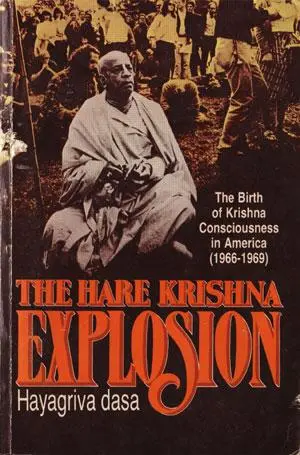
The Hare Krishna Explosion
By Hayagriva Prabhu

Part II: San Francisco, 1967
Chapter 9

Mad After Krishna

Golden Gate Park is redolent with March flowers. The morning fog disperses early, and the days are cloudless and blue. Thousands continue to flock to San Francisco from the midwest and east, and our Sunday kirtans attract big crowds.

Sunday is always a day for strolling in the park, and as soon as we start ringing cymbals and chanting, people follow. Christian, Moslem, Jewish, Buddhist and ISKCON banners, flying from long poles, proclaim our ecumenism. We stake these in the field below Hippy Hill and set up the kettledrum. Haridas, Mukunda, Shyamasundar, Subal, and Upendra sit in a circle on the grass. We beat the rhythm slowly on the kettledrum, the cymbals clash, and the kelp horn announces the beginning of kirtan.

After we chant about an hour, Swamiji walks over from his apartment and enters the center of the circle, clapping his hands and dancing, appearing wonderfully bright in his saffron robes. He leads the chanting, playing his own personal set of cymbals, a large pair with slightly flared rims that resonate loudly. Although he is a half century older than everyone around him, his presence is dynamically youthful. As the kirtan soars, Swamiji is a child amongst children, dancing with hands upraised to the blue sky, placing one foot before the other, dipping slightly, encouraging everyone to dance.

Then something remarkable happens.

More

Sri Madhavendra Puri


Sri Madhavendra Puri
Disappearance day – 17th March, 2011

Madhavendra Puri Discovers Gopala

Madhavendra Puri also known as Madhavendra Puri Goswami appeared in the 14th century.

After making an extensive pilgrimage of India as a sannyasi he passed his life in Vrindavana and Orissa. The main source of knowledge about him is Chaitanya Charitamrita. He belongs to the Madhva line being a disciple of Lakshmipati Tirtha and he was the founder of the Vaishnava centre at Mathura, Vrindavana. He is considered a fountainhead of devotional worship of Krishna and he has started the worship of the Gopala deity, better known as Shrinathji. He is attributed to the discovery of the famous deity of Gopala near Govardhana that was later worshiped by Vallabhacharya, follower of Vishnuswami in Rudra sampradaya, who in turn was influenced by devotional mood of Vrindavana.  He is also famed for receiving direct instructions and gifts from the deity of Gopinatha, who commanded him to travel for the supply of scarce sandal wood paste from Orissa to the Malaya Mountains.

Initiating the sankirtana movement
Madhavendra Puri is accepted as the initiator of the movement of Chaitanya Mahaprabhu, who accepted Madhavendra’s intimate disciple, Ishvara Puri as his diksa guru. He was preaching the principles of Gaudiya Vaishnavism prior to Lord Chaitanya.

More

Radharani’s Dream

Once Srimati Radharani woke up with a start.

She was next to Sri Krishna on the flower bedecked pastimes bed – and looked
with deep questioning eyes into His eyes:

“O My beloved,” She asked, “I dreamt of someone extraordinarily – I am
ashamed to admit, He stole My heart. Could it be You, of whom I dreamt – but
in a different form? It must be!”

Krishna was smiling: “Tell Me more.”

More

Next Newer Entries

108 Imporant Slokas from the 1972 Bhagavad-gita As It Is

Click on image to go to Post

Click on image to go to Post

The Hare Krishna Cookbook

Songs of the Vaisnava Acaryas

Bhagavad-gita As It Is 1972 Edition “Online”

click on image

click on image to visit site

Srimad Bhagavatam Online

click on image

Raja-Vidya the King of Knowledge

click on image

click on image

Blog Stats

  • 4,572,775 hits

Enter your email address to subscribe to this blog and receive notifications of new posts by email.

Join 3,906 other subscribers

Important Slokas from the Brahma-samhita

click on image

click on image

Slokas from the Sri Isopanisad

click on image

click on image

Prayers By Queen Kunti (Slokas)

click on image

Gajendra’s Prayers of Surrender (Slokas)

click on image

A Short Statement of the Philosophy of Krishna Consciousness

click on image

click on image

July 9th Letter

click on image

click on image

The Hare Krishna Explosion

Reference Material/Study Guide

click on image

click on image

  • LINKS