25 Jan 2025
by The Hare Krishna Movement
in A. C. Bhaktivedanta Swami Prabhupada, Caitanya Mahaprabhu, Pure Devotee, Ramananda Raya, Uncategorized
Tags: ac-bhaktivedanta, Caitanya, Caitanya Caritamrta, Krishna, Krsna, Radha, Ramananda Raya, Sri Caitanya Mahaprabhu, Srimati Radharani
click on image to enlarge
This picture hangs in our temple room, not only is this one of my most favorite pictures from the Śrī Caitanya-caritāmṛta, but this is one of the most nectarian chapters as well. I always marvel at how fortunate this Ramananda Raya is.
After embracing Rāmānanda Rāya, the Lord pacified him, informing him, “But for you, no one has ever seen this form.”
In the Bhagavad-gītā (7.25) Lord Kṛṣṇa states:
nāhaṁ prakāśaḥ sarvasya
yoga-māyā-samāvṛtaḥ
mūḍho ’yaṁ nābhijānāti
loko mām ajam avyayam
“I am never manifest to the foolish and unintelligent. For them I am covered by My internal potency [yogamāyā], and so they do not know Me, who am unborn and infallible.”
The Lord always reserves the right of not being exposed to everyone. The devotees, however, are always engaged in the service of the Lord, serving with the tongue by chanting the Hare Kṛṣṇa mantra and tasting mahā-prasāda. Gradually the sincere devotee pleases the Supreme Personality of Godhead, and the Supreme Lord reveals Himself. One cannot see the Supreme Lord by making personal efforts. Rather, when the Lord is pleased by the service of a devotee, He reveals Himself.
This is a continuation from our previous post Drops of Nectar, and includes texts 279-289 from chapter eight of the Madhya-lila entitled “Talks Between Śrī Caitanya Mahāprabhu and Rāmānanda Rāya”.
Lord Śrī Kṛṣṇa is the reservoir of all pleasure, and Śrīmatī Rādhārāṇī is the personification of ecstatic love of Godhead. These two forms has combined as one in Śrī Caitanya Mahāprabhu. This being the case, Lord Śrī Caitanya Mahāprabhu revealed His real form to Rāmānanda Rāya.
Śrī Caitanya-caritāmṛta 1975 Edition
By His Divine Grace A. C. Bhaktivedanta Swami Prabhupāda
Madhya-līlā, Chapter 8, Text 279-289
More
09 Dec 2024
by The Hare Krishna Movement
in A. C. Bhaktivedanta Swami Prabhupada, Caaitanya-caritamrta, humble, Uncategorized
Tags: A.C. Bhaktivedanta, Caitanya Caritamrta, Hare Krishna, humble, humility, India, Krishna, more-tolerant-than-a-tree, spirituality
“To chant the holy name always, one should be humbler than the grass in the street and devoid of all desire for personal honor, but one should offer others all respectful obeisances.
“A devotee engaged in chanting the holy name of the Lord should practice forbearance like that of a tree. Even if rebuked or chastised, he should not say anything to others to retaliate.
“For even if one cuts a tree, it never protests, and even if it is drying up and dying it does not ask anyone for water.
PURPORT
This practice of forbearance (tṛṇād api sunicena) is very difficult, but when one actually engages in chanting the Hare Krishna mantra, the quality of forbearance automatically develops. A person advanced in spiritual consciousness through the chanting of the Hare Krishna mantra need not practice to develop it separately, for a devotee develops all good qualities simply by chanting the Hare Krishna mantra regularly.
“Thus a Vaisnava should not ask anything from anyone else. If someone gives him something without being asked, he should accept it, but if nothing comes, a Vaisnava should be satisfied to eat whatever vegetables and fruits are easily available.
“One should strictly follow the principle of always chanting the holy name, and one should be satisfied with whatever he gets easily. Such devotional behavior solidly maintains one’s devotional service.
“One who thinks himself lower than the grass, who is more tolerant than a tree, and who does not expect personal honor yet is always prepared to give all respect to others can very easily always chant the holy name of the Lord.”
PURPORT
The grass is specifically mentioned in this verse because everyone tramples upon it yet the grass never protests. This example indicates that a spiritual master or leader should not be proud of his position; being always humbler than an ordinary common man, he should go on preaching the cult of Caitanya Mahaprabhu by chanting the Hare Krishna mantra.
(Sri Caitanya-caritamrta, Adi-lila 17.26-31)
03 Jun 2023
by The Hare Krishna Movement
in A. C. Bhaktivedanta Swami Prabhupada, Caaitanya-caritamrta, Caitanya Mahaprabhu
Tags: A.C. Bhaktivedanta Swami Prabhupada, benifical like trees, Caitanya Caritamrta, Krsna, tolerance, tolerant like a tree
6000 years old baobab tree in Senegal
I have been a woodworker almost my entire adult life, always admiring the beauty of wood, and enjoying the trees in nature. I have visited the Redwood forests in California, and the Douglas Fir forests in Oregon, but I have never seen a tree of this size or age. Truly awesome!
I am reminded of a verse from the Caitanya-caritamrta, Adi-lila 9.46, by His Divine Grace A.C. Bhaktivedanta Swami Prabhupada.
” ‘Just see how these trees are maintaining every living entity! Their birth is successful. Their behavior is just like that of great personalities, for anyone who asks anything from a tree never goes away disappointed.’ “
PURPORT
According to Vedic civilization, kṣatriyas are considered to be great personalities because if anyone goes to a ksatriya king to ask for charity, the king will never refuse. The trees are compared to those noble kṣatriyas because everyone derives all kinds of benefits from them-some people take fruit, others take flowers, others take leaves, others take twigs, and others even cut the tree, and yet the tree gives to everyone without hesitation.
Unnecessarily cutting trees without consideration is another example of human debauchery. The paper industry cuts many hundreds and thousands of trees for its mills, and with the paper so much rubbish literature is published for the whimsical satisfaction of human society. Unfortunately, although these industrialists are now happy in this life by dint of their industrial development, they do not know that they will incur the responsibility for killing these living entities who are in the forms of trees.
This verse, quoted from Śrīmad-Bhagavatam, was spoken by Lord Krishna to His friends when He was taking rest underneath a tree after His pastime of stealing the clothes of the gopīs (vastra-harana-lila). By quoting this verse, Caitanya Mahaprabhu teaches us that we should be tolerant like trees and also beneficial like trees, which give everything to the needy persons who come underneath them. A needy person may derive many advantages from trees and also from many animals, but in modern civilization people have become so ungrateful that they exploit the trees and animals and kill them. These are some of the sinful activities of modern civilization.
24 Jan 2014
by The Hare Krishna Movement
in A.C. Bhaktivedanta Swami Prabhupada, Cow Protection, Milk, Vegetarian Cooking, Vegetarian Recipies, Vegetarianism
Tags: A.C. Bhaktivedanta Swami Prabhupada, bhagavad-gita, Caitanya Caritamrta, cow protection, food problem is solved with sufficient cows and grains, ghee, grains, grains vegetables ghee milk yogurt, importance of the cow, Madhya 4.93, milk, prabhupada, Vedic Scriptures, vegetarianism, yogurt

The inhabitants of the village brought to the Deity of Gopāla as much food grains, ghee, yogurt and milk as they had in their village. (Cc. Madhya 4, 93)
…We should understand that in order to prepare nutritious food, we require only grains, ghee, yogurt and milk.
..Anna, ghṛta, dadhi and dugdha are food grains, ghee, yogurt and milk. Actually these are the basis of all food. Vegetables and fruits are subsidiary. Hundreds and thousands of preparations can be made out of grains, vegetables, ghee, milk and yogurt.
…People are often frustrated with national food policies, but from the Vedic scriptures we find that if there are sufficient cows and grains, the entire food problem is solved.
…Cows are the most important animal because they produce the miracle food, milk, from which we can prepare ghee and yogurt. (from purport)
Full Text and Purport More
07 Sep 2013
by The Hare Krishna Movement
in A.C. Bhaktivedanta Swami Prabhupada, Caaitanya-caritamrta, Caitanya Mahaprabhu, Krsna is the Source of All Incarnations
Tags: A.C. Bhaktivedanta Swami Prabhupada, Caitanya Caritamrta, Caitanya Mahaprabhu, chanting Hare Krishna, confidential devotees, Hare Krishna, Krsnadasa Kaviraja Gosvami, Lord Caitanya, Radharani, Sri Krsna, Srimati Radharani, transcendental pleasure

“Lord Kṛṣṇa desired to taste the limitless nectarean mellows of the love of one of His multitude of loving damsels [Śrī Rādhā], and so He has assumed the form of Lord Caitanya. He has tasted that love while hiding His own dark complexion with Her effulgent yellow color. May that Lord Caitanya confer upon us His grace.”(This is the third verse of the second Caitanyāṣṭaka of Śrīla Rūpa Gosvāmī’s Stava-mālā.)
Śrī Caitanya-caritāmṛta
By His Divine Grace A. C. Bhaktivedanta Swami Prabhupāda
Summary of Ādi-līlā, Chapter 4
The Confidential Reasons for Lord Caitanya’s Appearance
In this chapter of the epic Caitanya-caritāmṛta, Kṛṣṇadāsa Kavirāja Gosvāmī has stressed that Lord Caitanya appeared for three principal purposes of His own. The first purpose was to relish the position of Śrīmatī Rādhārāṇī, who is the prime reciprocator of transcendental love of Śrī Kṛṣṇa. Lord Kṛṣṇa is the reservoir of transcendental loving transactions with Śrīmatī Rādhārāṇī. The subject of those loving transactions is the Lord Himself, and Rādhārāṇī is the object. Thus the subject, the Lord, wanted to relish the loving mellow in the position of the object, Rādhārāṇī.
The second reason for His appearance was to understand the transcendental mellow of Himself. Lord Kṛṣṇa is all sweetness. Rādhārāṇī’s attraction for Kṛṣṇa is sublime, and to experience that attraction and understand the transcendental sweetness of Himself, He accepted the mentality of Rādhārāṇī.
The third reason that Lord Caitanya appeared was to enjoy the bliss tasted by Rādhārāṇī. The Lord thought that undoubtedly Rādhārāṇī enjoyed His company and He enjoyed the company of Rādhārāṇī, but the exchange of transcendental mellow between the spiritual couple was more pleasing to Śrīmatī Rādhārāṇī than to Śrī Kṛṣṇa. Rādhārāṇī felt more transcendental pleasure in the company of Kṛṣṇa than He could understand without taking Her position, but for Śrī Kṛṣṇa to enjoy in the position of Śrīmatī Rādhārāṇī was impossible because that position was completely foreign to Him. Kṛṣṇa is the transcendental male, and Rādhārāṇī is the transcendental female. Therefore, to know the transcendental pleasure of loving Kṛṣṇa, Lord Kṛṣṇa Himself appeared as Lord Caitanya, accepting the emotions and bodily luster of Śrīmatī Rādhārāṇī.
Lord Caitanya appeared to fulfill these confidential desires and also to preach the special significance of chanting Hare Kṛṣṇa, Hare Kṛṣṇa, Kṛṣṇa Kṛṣṇa, Hare Hare Hare Rāma, Hare Rāma, Rāma Rāma, Hare Hare, and to answer the call of Advaita Prabhu. These were secondary reasons.
More
27 Apr 2013
by The Hare Krishna Movement
in A.C. Bhaktivedanta Swami Prabhupada, Bhaktisiddhanta Sarasvati Thakura, Books by Srila Prabhupada, Caaitanya-caritamrta, Sri Caitanya-Caritamrta
Tags: A.C. Bhaktivedanta Swami Prabhupada, Bhaktisiddanta Sarasvati, Caitanya Caritamrta, Jayadvaita das, Nitai das, Pradyumna das, Sri Caitanya Mahaprabhu, Sri Caitanya-caritamrta

For some reason I love reading the Concluding Words of the Śrī Caitanya-caritāmṛta, and find myself reading it again and again. The printing of this English translation is historically, a miraculous achievement, and yet reading Srila Prbhupada’s words and hearing the depth of his humility, is awe inspiring. He gives thanks to his American disciples, and to His Spiritual Master His Divine Grace Bhaktisiddhānta Sarasvatī Ṭhākura with the following words:
…I think that His Divine Grace Bhaktisiddhānta Sarasvatī Ṭhākura is always seeing my activities and guiding me within my heart by his words. As it is said in Śrīmad Bhāgavatam, tene brahma hṛdā ya ādi-kavaye. Spiritual inspiration comes from within the heart, wherein the Supreme Personality of Godhead, in His Paramātmā feature, is always sitting with all His devotees and associates. It is to be admitted that whatever translation work I have done is through the inspiration of my spiritual master because personally I am most insignificant and incompetent to do this materially impossible work. I do not think myself a very learned scholar, but I have full faith in the service of my spiritual master, His Divine Grace Śrīla Bhaktisiddhānta Sarasvatī Ṭhakura. If there is any credit to my activities of translating, it is all due to His Divine Grace. Certainly if His Divine Grace were personally present at this time, it would have been a great occasion for jubiliation, but even though he is not physically present, I am confident that he is very pleased by this work of translation. He was very fond of seeing many books published to spread the Kṛṣṇa consciousness movement. Therefore our society, the International Society for Kṛṣṇa Consciousness, has formed to execute the order of Śrī Caitanya Mahāprabhu and His Divine Grace Śrīla Bhaktisiddhānta Sarasvatī Ṭhakura.
Although Srila Prabhupada gives all credit to his spiritual master, we give all credit to him. All Glories to Srila Prabhupada!
Full text More
29 Nov 2012
by The Hare Krishna Movement
in A.C. Bhaktivedanta Swami Prabhupada, Book Changes, Devotee Business's, Sri Caitanya-Caritamrta, Vyasasan das
Tags: 1975 edition, BBT, BBTI, Bhaktivedanta VedaBase, book changes, c.c. madhya 19.157, Caitanya Caritamrta, Locanananda das, One can keep direct company with the Spiritual Master, Srila Prabhupada, veda base, Vyasasan das

One Can Keep Direct Company With the Spiritual Master
by Vyasasan das
There is an ongoing debate over the changes to Srila Prabhupada’s books. The current BBTI want you to believe they are only changing the spelling and grammatical errors, and are simply improving the books. But there is much evidence to prove otherwise. For instance in the famous verse from the Caitanya-caritamrta Madhya-Lila 19.157: “The gardener must defend the creeper by fencing it all around so that the powerful elephant of offenses may not enter.” while reading the purport to this verse from the original 1975 Edition, I couldn’t help but appreciate just how clear Srila Prabhupada’s instructions were:
“If one thinks that there are many pseudo devotees or nondevotees in the Kṛṣṇa Consciousness Society, one can keep direct company with the spiritual master, and if there is any doubt, one should consult the spiritual master.” (from purport to Original 1975 Edition)
While discussing this statement with a friend, he informed me that the BBTI had changed the purport in their re-vised edition. I couldn’t understand why they would change such a clear statement…so I looked it up in the Bhaktivedanta VedaBase…and to my great surprise they did change it!!! So much for the spelling and grammatical errors argument, no they were changing the meaning of Srila Prabhupada’s books.
Lets take a look at this example, of how the books of His Divine Grace A.C. Bhaktivedanda Swami, are being changed by our so-called leaders and intellectuals. (Note the Bold Letters below is done by me to indicate the changes.)
Sri Caitanya-caritamrta (1975 Edition)
If one thinks that there are many pseudo devotees or nondevotees in the Kṛṣṇa Consciousness Society, one can keep direct company with the spiritual master, and if there is any doubt, one should consult the spiritual master. However, unless one follows the spiritual master’s instructions and the regulative principles governing chanting and hearing the holy name of the Lord, one cannot become a pure devotee. By one’s mental concoctions, one falls down. By associating with nondevotees, one breaks the regulative principles and is thereby lost.
Sri Caitanya-caritamrta (Bhaktivedanta VedaBase)
Even if one thinks that there are many pseudo devotees or nondevotees in the Kṛṣṇa Consciousness Society, still one should stick to the Society; if one thinks the Society’s members are not pure devotees, one can keep direct company with the spiritual master, and if there is any doubt, one should consult the spiritual master. However, unless one follows the spiritual master’s instructions concerning the regulative principles and chanting and hearing the holy name of the Lord, one cannot become a pure devotee. By one’s mental concoctions, one falls down. By associating with nondevotees, one breaks the regulative principles and is thereby lost.
More
18 Jul 2012
by The Hare Krishna Movement
in Caitanya Mahaprabhu, Lectures, Sri Caitanya-Caritamrta
Tags: A.C. Bhaktivedanta Swami Prabhupada, Caitanya Caritamrta, Krsna, krsnera svarupa ananta, Lord Caitanya, Mad. 20.146-151, photo by Gurudas, prabhupada, Prabhupada lectures, transcendental forms of Krsna, Vedas, Vedic knowledge points to Krishna

“Vedic Knowledge Points To Krsna”
Lecture on Caitanya-caritamrta Madhya 20.146-151
New York, December 3, 1966
By His Divine Grace A.C. Bhaktivedanta Swami Prabhupada
Prabhupada:
mukhya-gauna-vrtti, kimva anvaya-vyatireke
vedera pratijna kevala kahaye krsnake
So Lord Caitanya says, “You study Vedas in any way, directly, indirectly. In whatever way you like you study Vedas, but the ultimate objective is Krsna.”
Now, Caitanya, Lord Caitanya, is describing about the various forms of Krsna. This is very important subject. How Krsna is all-pervading, He is describing.
krsnera svarupa-ananta, vaibhava-apara
cic-chakti, maya-sakti, jiva-sakti ara
Krsnera svarupa ananta. The transcendental forms of Krsna, innumerable, vaibhava, and His opulence, that is also innumerable. Nobody can estimate. How many forms are there of Krsna or how much opulent He is, nobody can estimate; nobody can measure. This is inconceivable. The first proposition. Cic-chakti maya-sakti jiva-sakti ara. And His potencies are also unlimited, out of which, three potencies are generally accepted: cit-sakti, spiritual potency; material potency; and marginal potency. These three potencies I have described many times. Cit-sakti, the spiritual potency, is a manifestation of the spiritual world, and material potency is a manifestation of this material world, and the marginal potency, we are, we living entities. We are marginal potency. Why it is marginal? Because although we belong to the spiritual potency, but we have got tendency to come into contact of this material potency. Therefore it is called marginal, “this way or that way.” That a slight independence which is there in every living entity, he can use that, and he may select either to live in the spiritual potency or in the material potency. Therefore the living entities are called marginal potency. So parasya saktir vividhaiva sruyate [Cc. Madhya 13.65, purport]. Although the energies of the Supreme Lord are innumerable — nobody can count or measure — but they are divided into three.
More
26 Mar 2012
by The Hare Krishna Movement
in Chanting Hare Krishna, Devotee's, Diksha, Guru & Disciple, Hare Krishna Maha Mantra, Rupanuga das
Tags: A.C. Bhaktivedanta Swami Prabhupada, bhakti, Caitanya Caritamrta, disciples of Srila Prabhupada, Mad-lila 15. 105-111, Rupanuga das, spiritual master, Srila Prabhupada, vaisnava, vani

The Param-guru
By Sriman Rupanuga Prabhu (ACBSP)
Jan 20, 2012 (SUN)
Those sincere souls who have been submitting for decades to disciples of Srila Prabhupada as spiritual masters, only to be disappointed, need not leave the proven path of Bhakti as revealed by Srila Prabhupada (who is not at all at fault). Because of such disappointments, one may have doubts about success in Krsna consciousness. But the path is not to be abandoned. Instead, under the complete shelter of Srila Prabhupada one will be saved for sure from material existence.
There is no need to get initiated again and again. One can take complete shelter of Srila Prabhupada and the Holy Name, Nama Prabhu. Nama Rupe is independent, as confirmed in Caitanya-caritamrta Madhya lila, Chapter 15, verses 105 through 111 with purports, a must read carefully. These verses and purports below, clearly indicate that a sincere soul, initiated or not, can take shelter of Srila Prabhupada-vani and Lord Krsna, the Holy Name, directly.
The disappointed disciples of our Godbrothers remain on duty to give Srila Prabhupada’s mercy to the suffering masses of conditioned souls on this planet, which is known as Martyaloka or the planet of death. Krsna consciousness is a matter of life and death for everyone. Srila Prabhupada wanted millions, he said “a hundred million” devotees.
Respectful obeisances must go out to all the recently disappointed 1,500+ disciples, with the prayer to please take care to remain disciples under the direct protection of their Param-guru, Srila Prabhupada, who said that the grandfather is more kind to the sons than the father. So be it.
Pasted from; http://www.harekrsna.com/sun/editorials/01-12/editorials8173.htm
Caitanya-caritamrta Madhya lila, Chapter 15, text 105-111 with purports
More
03 Mar 2012
by The Hare Krishna Movement
in Books by Srila Prabhupada, Guru & Disciple, Sri Caitanya-Caritamrta, Srila Prabhupada Lilamrta
Tags: A.C. Bhaktivedanta Swami Prabhupada, Bramananda Swami, Caitanya Caritamrta, disciple, Godbrothers, guru, Guru Maharaja, Krishna, print books, Radhavallabha, Ramesvara, Satsvarupa Dasa Goswami, Srila Prabhupada, Srila Prabhupada Lilamrta, Tamala Krishna Goswami

…”I have no personal qualification, but I simply try to satisfy my guru, that’s all. My Guru Maharaja asked me that, ‘If you get some money, you print books.’ So there was a private meeting, talking. Some of my important Godbrothers also were there–it was in Radha-kunda. So Guru Maharaja was speaking to me that, ‘Since we have got this Baghbazar marble temple, there has been so much dissension. And everyone thinking who will occupy this room or that room. I wish therefore to sell this temple and the marble and print some books.’ Yes, so I took up this from his mouth, that he is very fond of books. And he told me personally, ‘If you get some money, print books.’ Therefore I am stressing on this point–Where is book? Where is book? So kindly help me. That is my request. Print as many books as possible in as many languages as possible, and distribute throughout the whole world. Then the Krishna consciousness movement will automatically increase.”
The next morning, while walking on Venice Beach, Srila Prabhupada delivered an extraordinary ultimatum. Surrounded by devotees, he walked along, poking the sand softly with his cane. “These seventeen volumes unpublished,” he began, “are a great problem for our movement.”
“Yes, Prabhupada,” Ramesvara responded, attentive and concerned. The other devotees also nodded, commiserating. Something must be done.
“Yes,” Prabhupada continued, “they must be published immediately.”
“Yes, Prabhupada,” Ramesvara replied obediently.
“So I think they can be printed in two months,” Srila Prabhupada said conclusively.
Ramesvara wasn’t sure he had heard correctly. The Press had only just opened. The artists didn’t even have the lights in their room. Two months was illogical, impossible. Now was the moment to tell Srila Prabhupada the plan for increased production. Ramesvara stepped closer.
“Srila Prabhupada,” he began, “we’ve been meeting about this, and now that the Press is finally here and established, I think we can increase production four times. We think that now we can go from producing one book every four months to producing one of your books every month.” Now both Ramesvara and Radhavallabha were walking together beside Srila Prabhupada, with Tamala Krishna Goswami and Brahmananda Swami walking on his other side.
“One book every month,” Srila Prabhupada said, as if thinking out loud and considering it. “That means over one year. It is not fast enough.” The other devotees looked over at Ramesvara and Radhavallabha, who glanced at each other.
“You have to do all the books in two months’ time,” Srila Prabhupada said again. They had clearly heard it this time, and the two managers were stunned in disbelief.
“Srila Prabhupada,” Ramesvara said, “I think that’s impossible. Maybe we can go faster . . .”
Srila Prabhupada suddenly stopped walking. Planting his cane firmly in the sand, he turned to Ramesvara and said, without anger but very gravely, “Impossible is a word found in the fool’s dictionary.”
Suddenly Ramesvara realized his spiritual life was on the line. To say “impossible” now would mean he had no faith in Krishna’s representative, no faith in the power of God. He must throw away his material estimations and rational common sense.
More
24 Nov 2011
by The Hare Krishna Movement
in Songs of the Vaisnava Acaryas, Sri Caitanya-Caritamrta, Vegetarian Cooking
Tags: Advaita Acarya, Caitanya Caritamrta, ecstasy of Sri Caitanya Mahaprabhu, grhastha-asrama, Krishna, Lord Chaianya Mahaprabhu, Lord Nityananda, Prasadam, sak, Srila Prabhupada, vegetarian Thanksgiving
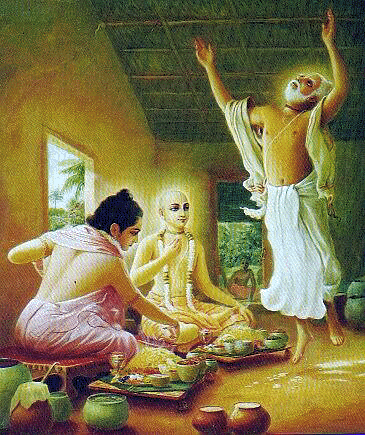
Today being Thanksgiving, we decided to post a story of one of the “Most Famous Feasts” in recent Vaisnava history, cooked by the wife of Advaita Acarya, Sita. Followed by the song composed by Srila Bhaktivinoda Thakura, “Prasada-sevya part 2” honoring this event.
Sri Caitanya-caritamrta – 1975 Edition
By His Divine Grace A.C. Bhaktivedanta Swami Prabhupada
Lord Sri Caitanya Mahaprabhu’s Stay at the House of Advaita Acarya
Madhya 3, Text 38-136
Advaita Ācārya said, “You have been fasting continuously for three days in Your ecstasy of love for Kṛṣṇa. I therefore invite You to My home, where You may kindly take Your alms. Come with Me to My residence.”
Advaita Prabhu continued, “At My home I have just cooked one palmful of rice. The vegetables are always very simple. There is no luxurious cooking-simply a little liquid vegetable and spinach.”
Saying this, Śrī Advaita Ācārya took the Lord into the boat and brought the Lord to His residence. There Advaita Ācārya washed the feet of the Lord and was consequently very happy within.
All the eatables were first cooked by the wife of Advaita Ācārya. Then Śrīla Advaita Ācārya personally offered everything to Lord Viṣṇu.
More
24 Oct 2011
by The Hare Krishna Movement
in Back to Godhead, Books by Srila Prabhupada, Brahmananda das
Tags: back to Godhead, bhagavad-gita, Caitanya Caritamrta, His Divine Grace A.C. Bhaktivedanta Swami Prabhupada, ISKCON Press, Macmillan's Gita, Nectar of Devotion, Sri Isopanisad, Teachings of Lord Caitanya
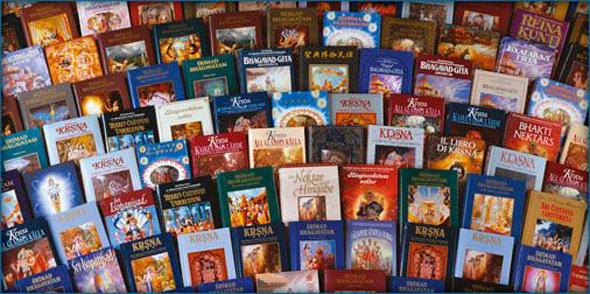
The Books of His Divine Grace A.C. Bhaktivedanta Swami Prabhupada
Srila Prabhupada teaches the most difficult and sublime science—the science of how to serve God—in such a way that anyone can understand it. The concepts are presented over and over again, for repetition is a time-tested learning technique in transcendental study. Thus in whichever of Srila Prabhupada’s books one reads first, one will find the entire science of Krsna consciousness presented, yet each succeeding book reveals something more, and with each rereading one will find new light. Srila Prabhupada’s books are the most wonderful vehicle because they swiftly transport the reader to a timeless and ever- green world where everyone is joyfully awakened to the Absolute Truth of Krsna, the Supreme Personality of Godhead.
The Books of His Divine Grace A.C. Bhaktivedanta Swami Prabhupada
Originally published in Back to Godhead No. 52
Bhaktivedanta Book Trust 1973
By Brahmananda Swami ISKCON East Africa
Part 6
The next book, Teachings of Lord Caitanya, was then dictated. It is a summary study of the historic Caitanya-caritamrta. Instead of the exhaustive format of verse to verse translation and purport, Srila Prabhupada presented this book in a shortened but more essential manner. “My books are for my students,” he told us, and so he wanted to write as many as possible. If Bhagavad-gita could be considered the undergraduate study of spiritual life and Srimad-Bhagavatam the master’s study, then Caitanya-caritamrta is the doctorate course. It recounts Lord Caitanya’s teachings to the only five disciples He personally taught. In Teachings of Lord Caitanya, the incomplete philosophy of impersonalism is fully analyzed and forcefully defeated by Lord Caitanya in His discussions with the two biggest impersonalists of His time, Prakasananda Sarasvati and Sarvabhauma Bhattacarya. Also, the quintessence of all detailed knowledge of Krsna and how He acts both in the spiritual and material worlds is disclosed to Ramananda Raya.
More
19 Aug 2011
by The Hare Krishna Movement
in Chanting Hare Krishna, Sri Caitanya-Caritamrta
Tags: Caitanya Caritamrta, Hare Krishna, Hare Rama, holy name, liberation, Maha Mantra, Srila Prabhupada

The holy name of Lord Krishna is an attractive feature for many saintly, liberal people. It is the annihilator of all sinful reactions and is so powerful that save for the dumb who cannot chant it, it is readily available to everyone, including the lowest type of man, the candala. The holy name of Krishna is the controller of the opulence of liberation, and it is identical with Krishna.
Simply by touching the holy name with one’s tongue, immediate effects are produced. Chanting the holy name does not depend on initiation, pious activities or the purascarya regulative principles generally observed before initiation. The holy name does not wait for all these activities. It is self-sufficient. (Caitanya-caritmrta Mad.15.110)
Hare Krishna, Hare Krishna, Krishna Krishna, Hare Hare,
Hare Rama, Hare Rama, Rama Rama, Hare Hare…
14 May 2011
by The Hare Krishna Movement
in Lectures, Sri Caitanya-Caritamrta
Tags: Caitanya Caritamrta, Goswami, immortal, International Society for Krishna Consciousness, Krsnadas Kaviraja, living force, living force in immortality, material condition, Srila Prabhupada
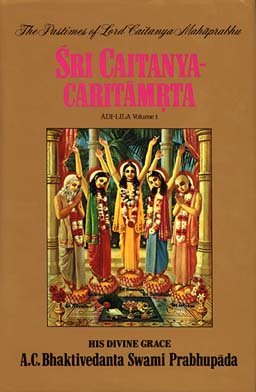
Sri Caitanya-caritāmṛta
By HIs Divine Grace A.C. Bhaktivedanta Swami Prabhupada
(Originally delivered as five morning lectures on the Caitanya-caritāmṛta-the authoritative biography of Lord Caitanya Mahāprabhu by Kṛṣṇadāsa Kavirāja Gosvāmī-before the International Society for Krishna Consciousness, New York City, April 10-14, 1967.)
Introduction
The word caitanya means “living force.” As living entities, we can move, but a table cannot because it does not possess living force. Movement and activity may be considered signs or symptoms of the living force. Indeed, it may be said that there can be no activity without the living force. Although the living force is present in the material condition, it is not amṛta, immortal. The words caitanya-caritāmṛta, then, may be translated as “the character of the living force in immortality.”
But how is this living force displayed immortally? It is not displayed by man or any other creature in this material universe, for none of us are immortal in these bodies. We possess the living force, we perform activities, and we are immortal by our nature and constitution, but the material condition into which we have been put does not allow our immortality to be displayed. It is stated in the Kaṭha Upaniṣad that eternality and the living force belong both to ourselves and God. Although this is true in that both God and ourselves are immortal, there is a difference. As living entities, we perform many activities, but we have a tendency to fall down into material nature. God has no such tendency. Being all-powerful, He never comes under the control of material nature. Indeed, material nature is but one display of His inconceivable energies.
From the ground we may see only clouds in the sky, but if we fly above the clouds we can see the sun shining. From the sky, skyscrapers and cities seem very tiny; similarly, from God’s position this entire material creation is insignificant. The tendency of the conditioned living entity is to come down from the heights, where everything can be seen in perspective. God, however, does not have this tendency. The Supreme Lord is not subject to fall down into illusion (māyā), any more than the sun is subject to fall beneath the clouds. Because the Supreme Lord is not subject to illusion, He is unconditioned; because we, as finite living entities, are prone to fall into illusion, we are called conditioned. Impersonalist philosophers (Māyāvādīs) maintain that both the living entity and God Himself are under the control of māyā when they come into this material world. This may be true of the living entity, but it is not true of God, for in all instances the material energy is working under His direction. Those who think the Supreme Lord is subject to material conditioning are called fools by Kṛṣṇa Himself in the Bhagavad-gītā (9.11):
More
19 Mar 2011
by The Hare Krishna Movement
in Caitanya Mahaprabhu, Sri Caitanya-Caritamrta
Tags: Adi-lila 7.1, Caitanya Caritamrta, life force, magnanimity of Sri Caitanya, Sri Caitanya Mahaprabhu, Sridhama Mayapur, Srila Prabhupada discourse, teaching of Lord Caitanya, ultimate goal of life
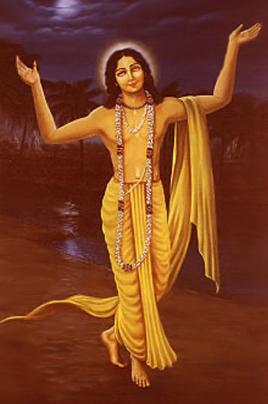
Caitanya Caritamrta Adi 7.1
Mayapur, March 1, 1974
Srila Prabhupada’s discourse follows below:
Pradyumna: Translation: “Let me first offer my respectful obeisances unto Lord Caitanya Mahaprabhu, who is the ultimate goal of life for one bereft of all possessions in this material world and is the only meaning for one advancing in spiritual life. Thus let me write about His magnanimous contribution of devotional service in love of God.”
Prabhupada:
agaty-eka-gatim natva
hinarthadhika-sadhakam
sri-caitanyam likhyate asya
prema-bhakti-vadanyata
[Cc. Adi 7.1]
So Sri Caitanya Mahaprabhu… This is the place of Sri Caitanya Mahaprabhu, appearance site of Sri Caitanya Mahaprabhu, Sridhama Mayapur. So in this place this is the appropriate literature, Sri-caitanya-caritamrta. We may try to discuss during these holy days. Last year some gentleman suggested, after seeing my all literatures, that “You kindly write a translation of Sri-Caitanya-caritamrta.”
More
11 Mar 2011
by The Hare Krishna Movement
in Book Distribution, Devotee's, Vaisesika das
Tags: BBT, Bhagavad Gita, Book Distribution, Caitanya Caritamrta, devotees, Goethe, Hari Nama Sankirtan, Helen Keller, Vaisesika Dasa
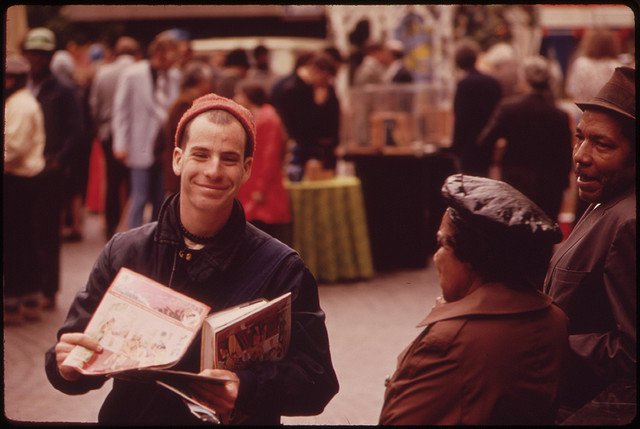
Be Bold
By: Vaisesika Dasa
Dear Devotees,
Please accept my humble pranams at your feet. All glories to the founder/Acarya of ISKCON and his unparalleled books.
Srila Prabhupada made our lives exciting. He pushed us and he was definitely not accustomed to thinking small. In thinking of what my life was like while Srila Prabhupada walked the planet, I often recall a famous quotation from Helen Keller: “Life is either a daring adventure, or nothing.”
Life with Srila Prabhupada was and still is a daring adventure.
More







 The Hare Krishna Movement