Jaya Radha Madhava

Jaya Rādhā-Mādhava
by Srila Bhaktivinoda Thakura

jaya rādhā-mādhava kuñja-bihārī
gopī-jana-vallabha giri-vara-dhārī

jaya–all glories to: rādhā-mādhava–Rādhā and the Lord of sweetness; kuñja-bihārī–He who enjoys loving pastimes in the groves of Vṛndāvana; gopī-jana-vallabha–the lover of the cowherd maidens of Vraja; giri-vara-dhārī–the holder of the great hill named Govardhana;

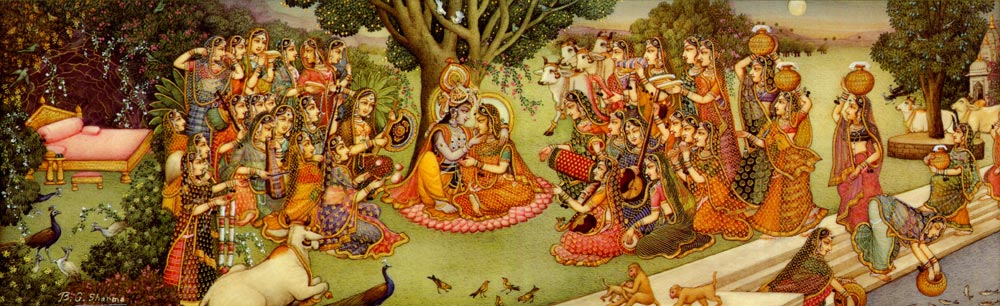
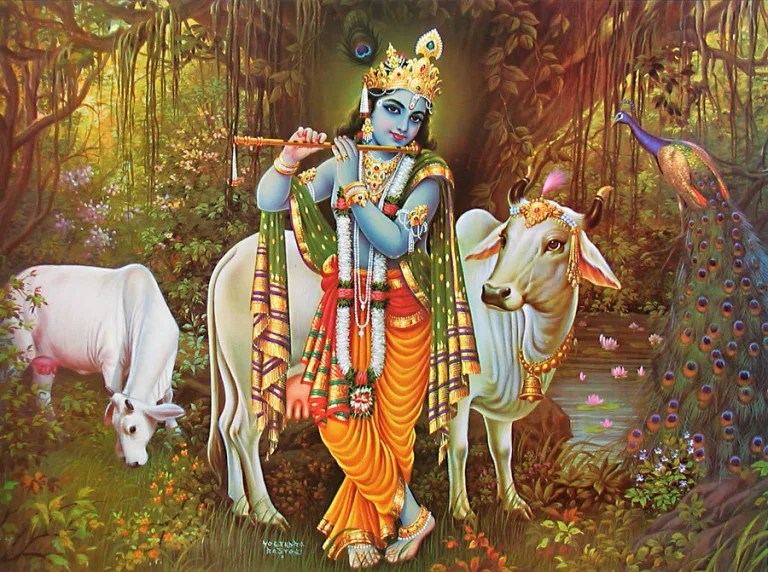
Krsna is the lover of Radha. He displays many amorous pastimes in the groves of Vrndavana, He is the lover of the cowherd maidens of Vraja, and the holder of the great hill named Govardhana.

yaśodā-nandana braja-jana-rañjana
yāmuna-tīra-vana-cārī

yaśodā-nandana–the beloved son of mother Yaśodā; vraja-jana-rañjana–the delighter of the inhabitants of Vraja; yāmuna-tīra-vana-cārī–who wanders in the forests along the banks of the river Yamunā

He is the beloved son of mother Yasoda, the delighter of the inhabitants of Vraja, and He wanders in the forests along the banks of the River Yamuna!

Srila Prabhupada said that this song is “a picture of Vrndavana. Everything is there–Srimati Radharani, Vrndavana, Govardhana, Yasoda, and all the cowherd boys.

So this is the original nature of Kṛṣṇa, original nature of Kṛṣṇa. He is Rādhā-Mādhava. He is the lover of Śrīmatī Rādhārāṇī. And kuñja-vihārī, always enjoying the company of the gopīs within the bushes of Vrndavana forest. Rādhā-mādhava kuñja-vihārī. So He’s not only lover of Rādhārāṇī, but braja-jana-vallabha. The whole residents of Vṛndāvana, they love Kṛṣṇa. (from Srila Prabhupada Lecture NY July 20, 1971)

Purport below

More

Sri Nama Kirtan

This is such a beautiful song, it is a meditation in itself.

Krishna is very pleased when we call on Him by His Names, which are associated with His devotees, qualities and pastimes. This song by Bhaktivinoda Thakura is composed of the Nanes of Krsna in different aspects. (from the Songs of the Vaisnava Acaryas)

Śrī Nāma-kīrtana
Chanting of the Holy Names
by Srila Bhaktivinoda Thakura

full song with synonyms and translations

yaśomatī-nandana, braja-baro-nāgara,
gokula-rañjana kāna
gopī-parāṇa-dhana, madana-manohara,
kāliya-damana-vidhāna

yaśomatī-nandana–Lord Kṛṣṇa is the beloved son of mother Yaśodā; vraja-vara-nāgara–most beloved of the inhabitants of Vraja; gokularañjana–the attractor of the people of Gokula; kāna–(an intimate nickname); gopī-parāṇa-dhana–the wealth of the lives of the gopīs; madana-manohara–who can attract even the mind of Cupid; kāliyadamana-vidhāna–the chastiser of the Kāliya serpent.

Lord Kṛṣṇa is the beloved son of mother Yaśodā; the transcendental lover in the land of Vraja; the delight of Gokula; Kāna [a nickname of Kṛṣṇa]; the wealth of the lives of the gopīs. He steals the mind of even Cupid and punishes the Kāliya serpent.

amala harinām amiya-vilāsā
vipina-purandara, navīna nāgara-bora,
baṁśī-badana suvāsā

amala harinām–these pure holy names; amiya vilāsā–are full of sweet, nectarean pastimes; vipina-purandara–He is the monarch of the garden groves; navīna nāgara-bora–He is the best of youthful lovers; vaḿśīvadana–He is seen with His flute placed to His lips; suvāsā–He is an excellent dresser.

These pure, holy names of Lord Hari are full of sweet, nectarean pastimes. Kṛṣṇa is the Lord of the twelve forests of Vraja, He is ever-youthful and is the best of lovers. He is always playing on a flute, and He is an excellent dresser.

braja-jana-pālana, asura-kula-nāśana
nanda-godhana-rākhowālā
govinda mādhava, navanīta-taskara,
sundara nanda-gopālā

braja-jana-pālana–the protector of the inhabitants of Vraja; asura-kula-nāśana–the destroyer of demonic dynasties; nanda-godhana-rākhaoyālā– the keeper of Nanda Mahārāja’s valuable cows; govinda–the giver of pleasure to the cows; mādhava–the husband of the goddess of fortune; navanīta-taskara–the butter thief; sundara nanda-gopālā–the beautiful cowherd son of Nanda Mahārāja.

Kṛṣṇa is the protector of the inhabitants of Vraja; the destroyer of various demoniac dynasties; the keeper and tender of Nanda Mahārāja’s cows; the giver of pleasure to the cows, land, and spiritual senses; the husband of the goddess of fortune; the butter thief; and the beautiful cowherd boy of Nanda Mahārāja.

yāmuna-taṭa-cara, gopī-basana-hara,
rāsa-rasika, kṛpāmoya
śrī-rādhā-vallabha, bṛndābana-naṭabara,
bhakativinod-āśraya

yāmuna-taṭa-cara–He wanders along the banks of the river Yamunā; gopī-vasana-hara–He steals the garments of the gopīs; rāsa-rasika–He delights in the mellows of the rāsa dance; kṛpāmoya–He is very merciful; śrī-rādhā-vallabha–the most beloved of Srīmatī Rādhāraṇī vṛndāvananaṭabara–the great dancer of Vṛndāvana; bhakativinod-āśraya–the shelter of Bhaktivinoda

Kṛṣṇa wanders along the banks of the River Yamunā. He stole the garments of the young damsels of Vraja who were bathing there. He delights in the mellows of the rāsa dance; He is very merciful; the lover and beloved of Śrīmatī Rādhārāṇī; the great dancer of Vṛndāvana; and the shelter and only refuge of Ṭhākura Bhaktivinoda.

Full Song Broken Down

More
Disappearance Day of Srila Bhaktivinoda Thakura

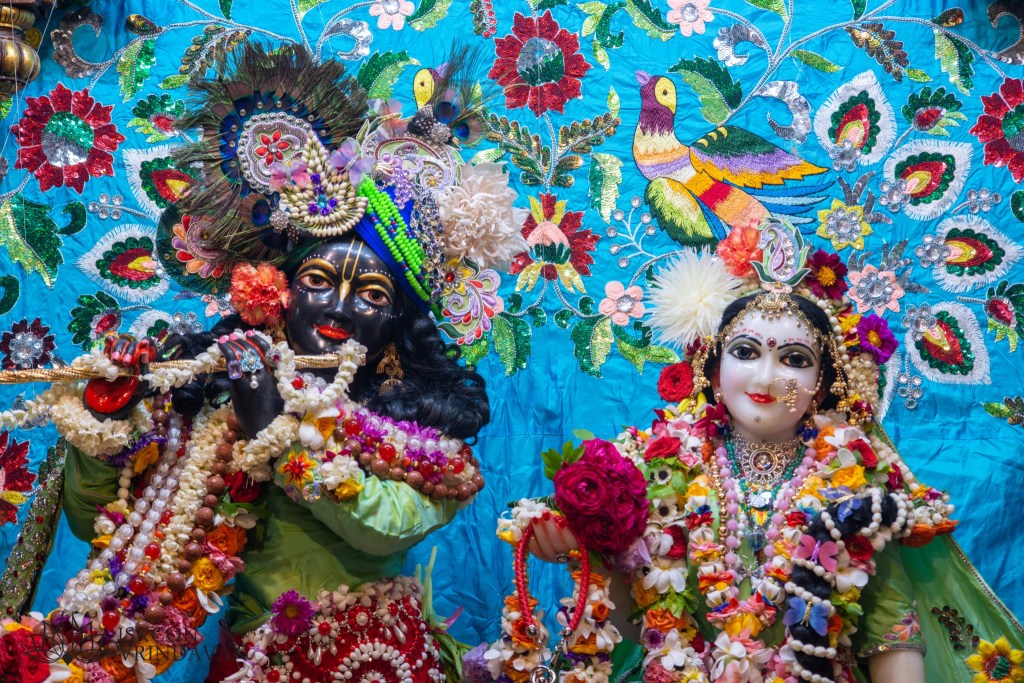
Today marks the disappearance day of Srila Bhaktivinoda Thakura. We honor it with a half day fast followed by a nice vegetarian feast. We share with you one of my favorite songs composed by Srila Bhaktivinoda.

When, oh when, will that day be mine?
When my offenses ceasing,
taste for the name increasing,
when in my heart will your mercy shine?
When, oh when will that day be mine?

Lower than a blade of grass, more tolerant than a tree.
When will my mind attain this quality?
Respectful to all, not expecting their honour, then shall I taste the name’s nectar sublime.
When oh when will that day be mine?

More

Appearance of Srila Bhaktivionda Thakur

Srila Bhaktivinoda Thakur

click on image to enlarge

Today we celebrate the Appearance of Srila Bhaktivinoda Thakur with a half day fast, and songs written by Thakur Bhaktivinoda. We are posting some of the rather lengthy but beautiful Saranagati. Saranagati is one of Bhaktivinoda Thakura’s popular writings. “Saranagati” means “process of surrender.” Today we are posting the Introduction and the first section of songs; the “Dainya”, or the prayers of humility. The overall mood of the Saranagati is in the mode of humility, primarily in the mode complete surrender.

…Bhaktivinoda places a straw between his teeth, prostrates himself before the two Goswamis,Sri Rupa and Sri Sanatana, and clasps their lotus feet with his hands. “I am certainly the lowest of men.” he tells them weeping, “but please make me the best of men by teaching me the ways of saranagati”

More

Appearance of Srila Bhaktivinoda Thakura

Srila Bhaktivinoda Thakura

Today marks the appearance day of Srila Bhaktivinoda Thakura. To honor this day, we are posting a very nice song written by Srila Bhaktivinoda entitled “Suddha-bhakta”, and are observing a 1/2 day fast.

The dust of the lotus feet of pure devotees, enthusiastic devotional service, and service to the pure devotees of the highest order are the roots of the creeper of devotion. The holy days like Ekadasi and Janmastami are the mother of devotion for those devotees who respect them. Let the holy places of Krsna’s pastimes be my places of worship, and bless me. May I always visit all the holy places associated with the lila of Lord Caitanya and His devotees. When I hear the sound of the mrdanga in my heart I always desire to join in kirtana; and when I hear the bonafide songs describing Lord Caitanya’s pastimes, my heart dances in ecstasy. Whenever I see the transcendental sri-vigrahas of Radha-Krsna I am in bliss, for by taking Their Lordships’ prasada we can conquer over the material elements. One day while performing devotional practices, I saw my house transformed into Goloka Vrndavana. When I take the caranamrta of the Deity, I see the holy Ganges waters that come from the feet of Lord Visnu, and my bliss knows no bounds. By seeing the tulasi tree my heart feels joy and Lord Madhava (Krsna) is also satisfied. When I eat the prasada favored by Lord Caitanya it is a new life’s experience. (Lord Caitanya was very fond of a green vegetable preparation called sak, and there is another song in this book that tells of the amazing effects of this type of prasada). Bhaktivinoda concludes by saying: “Whosoever attains the stage of enthusiasm for these devotional practices will be supremely blissful wherever he may be.”

Full song lyrics More

Brief Biography of Srila Bhaktivinoda Thakura


Today is the appearance day of Srila Bhaktivinoda Thakura

Brief Biography of Srila Bhaktivinoda Thakura

Srila Bhaktivinoda Thakura, then known as Kedarnatha Datta was born in 1838, in Birangara (Bengal). The youngest of seven sons, his father Raja Krisananda Datta was a great devotee of Lord Nityananda. The family lived in fairly wealthy circumstances, until Kedarnatha’s father passed away in 1849, when they were reduced to poverty. In 1850, Kedarnatha’s mother arranged a marriage with the five-year-old daughter of Madhusudana Mitra Mahasaya; a resident of Rana Ghata.

More

Hare Krishna Maha-mantra


Hare Krsna Maha-mantra
Purport by Srila Bhaktivinoda Thakura
 
 
हरे कृष्ण हरे कृष्ण कृष्ण कृष्ण हरे हरे |
हरे राम हरे राम राम राम हरे हरे ||
 
hare kṛṣṇa hare kṛṣṇa kṛṣṇa kṛṣṇa hare hare
hare rāma hare rāma rāma rāma hare hare
 
The Hare Kṛṣṇa mantra is known as the mahāmantra, or the greatest of sound vibrations. The mahamantra is a thirty-two syllable mantra chanted requesting Harā (another name of His supreme pleasure energy, personified by Srimati Radharani), and the Supreme Lord (given by two of His names, Krsna, the All-Attractive One, and Rama, the Reservoir of Pleasure) an opportunity to serve Them.
 
There are four cosmic ages, namely, Satya Yuga, Treta Yuga, Dvapara Yuga, and Kali Yuga. Satya Yuga is known as the “Golden Age”, for values of truth and virtues were at the peak. In Treta Yuga (the age where Lord Sri Ramacandra appeared), vice was introduced. Then, Dvapara Yuga (the age when Sri Krsna appeared on Earth) took place, where vice and virtue was leveled off. Following Dvapara Yuga is the darkest age, known as Kali Yuga. It began approximately five thousand years ago, after Sri Krsna left the world. Throughout each age, the prescribed method of salvation changed. In Satya Yuga, strict penances and austerities was the path of salvation. Then, Treta Yuga introduced the concept of conducting sacrifices as mentioned in scriptures. Dvapara Yuga’s method of salvation comprised of developing personal relations with the Lord.
 
In Kali Yuga, however, lifespan, intelligence, and qualities are significantly lowered. Therefore, performing severe penance and austerities is impractical. Conducting sacrifices per scriptures is immensely difficult, for those scriptures are not easily accessible, and conductors of such sacrifices are not present on Earth. Receiving personal association and forming relations with the Lord was only fortunate for a few. Therefore, such methods are not practical and applicable for this age. Therefore, the Brhad Naradiya Purana has claimed:
 
harer nāma harer nāma harer nāmaiva kevalam
kalau nāsty eva nāsty eva nāsty eva gatir anyathā
 
“Only the Holy Name, Only the Holy Name, Only the Holy Name, is the only way. There is no other way, no other way, no other way in this Age of Kali”
 
Therefore, it is clearly indicated that in Kali Yuga, the only method of salvation is by chanting the holy name of God. However, the most powerful mantra for salvation was hidden in confidentiality until this age. It wasn’t until the late fifteenth century when the mahamantra was openly revealed by Lord Caitanya Mahaprabhu. Typically, the Lord does not incarnate on Earth during Kali Yuga, until the very end. However, this Kali Yuga was especially fortunate to have Lord Caitanya Mahaprabhu’s incarnation of gold appear on earth. Through His mission to spread the movement of devotional service in degraded age, He brought the Hare Krsna mahamantra openly for all to benefit.

Pasted from http://kksongs.org/mantra/hk_expl.html

108 Imporant Slokas from the 1972 Bhagavad-gita As It Is

Click on image to go to Post

Click on image to go to Post

The Hare Krishna Cookbook

Songs of the Vaisnava Acaryas

Bhagavad-gita As It Is 1972 Edition “Online”

click on image

click on image to visit site

Srimad Bhagavatam Online

click on image

Raja-Vidya the King of Knowledge

click on image

click on image

Blog Stats

  • 4,571,213 hits

Enter your email address to subscribe to this blog and receive notifications of new posts by email.

Join 3,906 other subscribers

Important Slokas from the Brahma-samhita

click on image

click on image

Slokas from the Sri Isopanisad

click on image

click on image

Prayers By Queen Kunti (Slokas)

click on image

Gajendra’s Prayers of Surrender (Slokas)

click on image

A Short Statement of the Philosophy of Krishna Consciousness

click on image

click on image

July 9th Letter

click on image

click on image

The Hare Krishna Explosion

Reference Material/Study Guide

click on image

click on image

  • LINKS