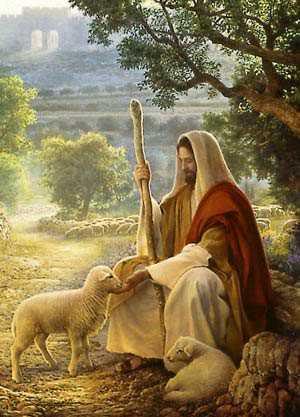
Concentrate your mind upon Krishna

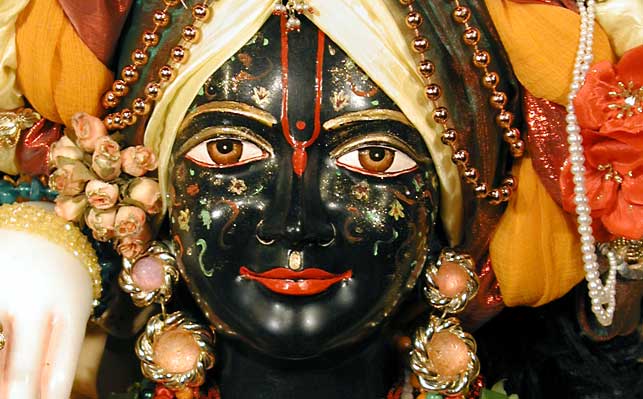
“…one should concentrate his mind upon Kṛṣṇa-the very form with two hands carrying a flute, the bluish boy with a beautiful face and peacock feathers in His hair. There are descriptions of Kṛṣṇa found in the Brahma-saṁhitā and other literatures. One should fix his mind on this original form of Godhead, Kṛṣṇa. He should not even divert his attention to other forms of the Lord. The Lord has multi-forms, as Viṣṇu, Nārāyaṇa, Rāma, Varāha, etc., but a devotee should concentrate his mind on the form that was present before Arjuna. Concentration of the mind on the form of Kṛṣṇa constitutes the most confidential part of knowledge, and this is disclosed to Arjuna because Arjuna is the most dear friend of Kṛṣṇa’s.”

Bhagavad-gita As It Is – Macmillan 1972 Edition
By His Divine Grace A.C. Bhaktivedanta Swami Prabhupada
Chapter 18, Text 65

man-manā bhava mad-bhakto
mad-yājī māṁ namaskuru
mām evaiṣyasi satyaṁ te
pratijāne priyo ‘si me

man-manāḥ—thinking of Me; bhava—just become; mat-bhaktaḥ—My devotee; mat-yājī—My worshiper; mām—unto Me; namaskuru—offer your obeisances; mām—unto Me; eva—certainly; eṣyasi—come; satyam—truly; te—to you; pratijāne—I promise; prijaḥ—dear; asi—you are; me—My.

Always think of Me and become My devotee. Worship Me and offer your homage unto Me. Thus you will come to Me without fail. I promise you this because you are My very dear friend.

More

Advent of Bhagavad-gita


The Advent of Bhagavad-gita

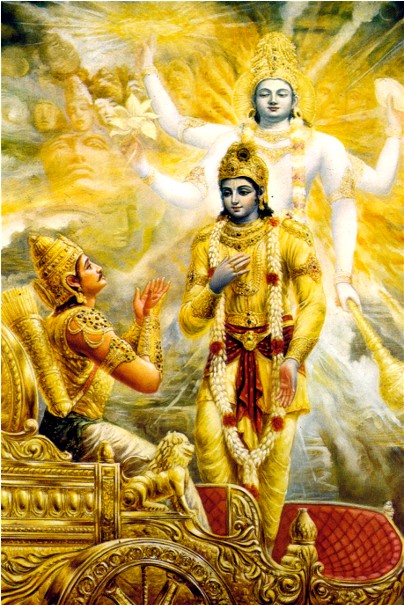
Today is the anniversary commemorating the day when Sri Krishna spoke Bhagavad-gita to Arjuna, at the place known as Kurukṣetra.

Traditionally devotees go to Kurukṣetra (dharma-kṣetra, a place where religious rituals are performed) ) and recite Bhagavad Gita from early morning until the next morning, perform arati to Bhagavad Gita and to Krishna and Arjuna upon the chariot, offer lamps, and discuss the significance of the Bhagavad-gita.

Devotees who cannot get to Kurukṣetra, can honor the blessed event by reading or reciting the Bhagavad-gita, and discussing the subject matter of Bhagavad Gita in the association of devotees.

Distribution of Bhagavad-gita’s on this day is also a very auspicious activity to perform.

Bhagavad-gita As It Is – Macmillan 1972 Edition
By His Divine Grace A.C. Bhaktivedanta Swami Prabhupada

dhṛtarāṣṭra uvāca
dharma-kṣetre kuru-kṣetre
samavetā yuyutsavaḥ
māmakāḥ pāṇḍavāś caiva
kim akurvata sañjaya

dhṛtarāṣṭraḥ—King Dhṛtarāṣṭra; uvāca—said; dharma-kṣetre—in the place of pilgrimage; kuru-kṣetre—in the place named Kurukṣetra; samavetāḥ—assembled; yuyatsavaḥ—desiring to fight; māmakāḥ—my party (sons); pāṇḍavāḥ—the sons of Pāṇḍu; ca—and; eva-certainly; kim—what; akurvata—did they do; sañjaya—O Sañjaya.

Translation

Dhṛtarāṣṭra said: O Sañjaya, after assembling in the place of pilgrimage at Kurukṣetra, what did my sons and the sons of Pāṇḍu do, being desirous to fight?

Purport

Bhagavad-gītā is the widely read theistic science summarized in the Gītā-māhātmya (Glorification of the Gītā). There it says that one should read Bhagavad-gītā very scrutinizingly with the help of a person who is a devotee of Śrī Kṛṣṇa and try to understand it without personally motivated interpretations. The example of clear understanding is there in the Bhagavad-gītā itself, in the way the teaching is understood by Arjuna, who heard the Gītā directly from the Lord. If someone is fortunate enough to understand Bhagavad-gītā in that line of disciplic succession, without motivated interpretation, then he surpasses all studies of Vedic wisdom, and all scriptures of the world. One will find in the Bhagavad-gītā all that is contained in other scriptures, but the reader will also find things which are not to be found elsewhere. That is the specific standard of the Gītā. It is the perfect theistic science because it is directly spoken by the Supreme Personality of Godhead, Lord Śrī Kṛṣṇa.

More

Interpretations of Bhagavad-gita

In honor of the Advent of Srimad Bhagavad-gita we are reprinting an Essay on the Bhagavad-gita written by Srila Prabhupada and published on the advent of Bhagavad-gita in 1948

Interpretations of Bhagavad-gita

Originally published c. 1948, on the auspicious observance of the advent of Srimad Bhagavad-gita.]
By His Divine Grace A.C. Bhaktivedanta Swami

It has become a luxurious fashion of the day, along with the progress of material civilization, that everyone can make his interpretation of the great Indian philosophy called the Bhagavad-gītā. This concise form of Vedic knowledge, known as the Gītopaniṣad, is acknowledged by all sections of transcendental scholars, in India especially, as the cream of all Upaniṣads and that of Vedānta-sūtras also. Scholars and ācāryas like Śrīpāda Śaṅkarācārya and some of his followers also could not leave out this very important book of knowledge, although such scholars of the Māyāvāda school did not acknowledge the bona fides of the Purāṇas. But the interpretation of Śrī Śaṅkarācārya differs from the interpretations of the Vaiṣṇava ācāryas headed by Śrī Ramanujācārya and Madhvācārya. There are innumerable interpretations of the Bhagavad-gītā in the market, and it is certainly a puzzling business to select which of the various interpretations shall be accepted as bona fide and which of them shall be rejected as mala fide.

In order to make a distinction between these two classes of bona fide and mala fide interpretations, we have to make an impartial study of the book, and such unbiased study only will make us able to discern the bona fide from the mala fide.

In this connection, we may first of all try to find out the origin of the Bhagavad-gītā. It is wrong to understand that The Bhagavad-gītā was first spoken in the battlefield of Kurukṣetra as it is a part of the great history of India, namely, the Mahābhārata. We can understand from the talks of Śrī Kṛṣṇa and Arjuna, as it is stated in the Bhagavad-gītā, that long, long before the battle of Kurukṣetra, this philosophy was once spoken by Śrī Kṛṣṇa to Vivasvān (the Sun), and from Vivasvān the knowledge was transferred to Manu, and from Manu it was transferred to King Ikṣvāku. And, in that way of disciplic succession, the knowledge has come down to generations after generations, but in course of time, such disciplic succession broke, and therefore, Śrī Kṛṣṇa again repeated the same yoga or transcendental knowledge to Arjuna. In the beginning of the 4th Chapter of Bhagavad-gītā, this fact is stated as follows:

More

Krishna is the Supreme Brahman


Kṛṣṇa is the Supreme Personality of Godhead, and one should always meditate upon Him and enjoy one’s transcendental relationship with Him. He is the supreme existence…He is the supreme origin; He has no cause, for He is the cause of all causes, and everything is emanating from Him. This perfect knowledge can be had by the grace of the Supreme Lord.

Bhagavad-gita As It Is – Macmillan 1972 Edition
By His Divine Grace A.C. Bhaktivedanta Swami Prabhupada
Chapter 10 The Opulence of the Absolute
Text 12-14

arjuna uvāca
paraṁ brahma paraṁ dhāma
pavitraṁ paramaṁ bhavān
puruṣaṁ śāśvataṁ divyam
ādi-devam ajaṁ vibhum

āhus tvām ṛṣayaḥ sarve
devarṣir nāradas tathā
asito devalo vyāsaḥ
svayaṁ caiva bravīṣi me

Arjuna said: You are the Supreme Brahman, the ultimate, the supreme abode and purifier, the Absolute Truth and the eternal divine person. You are the primal God, transcendental and original, and You are the unborn and all-pervading beauty. All the great sages such as Nārada, Asita, Devala, and Vyāsa proclaim this of You, and now You Yourself are declaring it to me.

PURPORT

In these two verses the Supreme Lord gives a chance to the modern philosopher, for here it is clear that the Supreme is different from the individual soul. Arjuna, after hearing the essential four verses of Bhagavad-gītā in this chapter, became completely free from all doubts and accepted Kṛṣṇa as the Supreme Personality of Godhead. He at once boldly declares, “You are Parambrahma, the Supreme Personality of Godhead.” And previously Kṛṣṇa states that He is the originator of everything and everyone. Every demigod and every human being is dependant on Him. Men and demigods, out of ignorance, think that they are absolute and independant of the Supreme Lord Kṛṣṇa. That ignorance is removed perfectly by the discharge of devotional service. This is already explained in the previous verse by the Lord. Now by His grace, Arjuna is accepting Him as the Supreme Truth, in concordance with the Vedic injunction. It is not because Kṛṣṇa is an intimate friend of Arjuna that he is flattering Him by calling Him the Supreme Personality of Godhead, the Absolute Truth. Whatever Arjuna says in these two verses is confirmed by Vedic truth. Vedic injunctions affirm that only one who takes to devotional service to the Supreme Lord can understand Him, whereas others cannot. Each and every word of this verse spoken by Arjuna is confirmed by Vedic injunction.

More

Bhagavad-gita As It Is

“Classic Edition”
Bhagavad-gita As It Is
By His Divine Grace A. C. Bhaktivedanta Swami Prabhupada

The Original “Classic” 1972 Bhagavad-gita “As It Is” In High Quality Hard Bound Cover.

This is the compact , Complete Edition of Srila Prabhupada’s 1972 Macmillan edition. This edition is the most widely read Gita in the world. Written by His Divine Grace A.C. Bhaktivedanta Swami Prabhupada, who is the world’s foremost Vedic scholar and teacher. He represents an unbroken chain of fully self-realized spiritual masters beginning with Lord Krsna Himself. Thus, unlike other editions of the Gita, his edition conveys Lord Krsna’s profound message as it is-without the slightest taint of adulteration or personally motivated change. Replete with sixteen full-color plates, this new edition is certain to stimulate and enlighten any reader with its ancient yet thoroughly timely teachings.

Bhagavad-gita is universally renowned as the jewel of India’s spiritual wisdom. Spoken by Lord Sri Krsna, the Supreme Personality of Godhead, to His intimate devotee Arjuna, the Gita’s seven hundred concise verses provide a definitive guide to the science of self-realization. Indeed, no work even compares in its revelations of man’s essential nature, his environment and, ultimately, his relationship with God.

Special Features
• Original Sanskrit Text
• English transliterations for each Sanskrit word
• Elaborate commentary
• Complete glossary
• Complete verse index
• High readability
• Profuse full-color illustrations

Original 1972 Complete edition. With translations and elaborate purports by His Divine Grace A.C. Bhaktivedanta Swami Prabhupada.
Hard-cover, 981 pages, 48 color plates. 5″ x 7.5″

Note; Also available in High Quality Soft Bound or Hard Bound, Wholesale by the case!!!

Shop on-line at http://www.theharekrishnamovement.com

Observing the Armies on the Battlefield of Kurukṣetra

Bhagavad-gita As It Is
By His Divine Grace A.C. Bhaktivedanta Swami Prabhupada

Observing the Armies on the Battlefield of Kurukṣetra

Duryodhana clearly felt that the victory of the Kurus depended on the presence of Bhīṣmadeva. He was confident of the full support of Bhīṣmadeva and Droṇācārya in the battle because he well knew that they did not even speak a word when Arjuna’s wife Draupadī, in her helpless condition, had appealed to them for justice while she was being forced to strip naked in the presence of all the great generals in the assembly.

…it is already concluded that all of them would die in the Battle of Kurukṣetra for joining the party of the sinful Duryodhana. Duryodhana was, of course, confident of his victory on account of the above-mentioned combined strength of his friends.

TEXT 1

TRANSLATION

Dhṛtarāṣṭra said: O Sañjaya, after assembling in the place of pilgrimage at Kurukṣetra, what did my sons and the sons of Pāṇḍu do, being desirous to fight?

PURPORT

Bhagavad-gītā is the widely read theistic science summarized in the Gītā-māhātmya (Glorification of the Gītā). There it says that one should read Bhagavad-gītā very scrutinizingly with the help of a person who is a devotee of Śrī Kṛṣṇa and try to understand it without personally motivated interpretations. The example of clear understanding is there in the Bhagavad-gītā itself, in the way the teaching is understood by Arjuna, who heard the Gītā directly from the Lord. If someone is fortunate enough to understand Bhagavad-gītā in that line of disciplic succession, without motivated interpretation, then he surpasses all studies of Vedic wisdom, and all scriptures of the world. One will find in the Bhagavad-gītā all that is contained in other scriptures, but the reader will also find things which are not to be found elsewhere. That is the specific standard of the Gītā. It is the perfect theistic science because it is directly spoken by the Supreme Personality of Godhead, Lord Śrī Kṛṣṇa.

The topics discussed by Dhṛtarāṣṭra and Sañjaya, as described in the Mahābhārata, form the basic principle for this great philosophy. It is understood that this philosophy evolved on the Battlefield of Kurukṣetra, which is a sacred place of pilgrimage from the immemorial time of the Vedic age. It was spoken by the Lord when He was present personally on this planet for the guidance of mankind.

The word dharma-kṣetra (a place where religious rituals are performed) is significant because, on the Battlefield of Kurukṣetra, the Supreme Personality of Godhead was present on the side of Arjuna. Dhṛtarāṣṭra, the father of the Kurus, was highly doubtful about the possibility of his sons’ ultimate victory. In his doubt, he inquired from his secretary Sañjaya, “What did my sons and the sons of Pāṇḍu do?” He was confident that both his sons and the sons of his younger brother Pāṇḍu were assembled in that Field of Kurukṣetra for a determined engagement of the war. Still, his inquiry is significant. He did not want a compromise between the cousins and brothers, and he wanted to be sure of the fate of his sons on the battlefield. Because the battle was arranged to be fought at Kurukṣetra, which is mentioned elsewhere in the Vedas as a place of worship—even for the denizens of heaven—Dhṛtarāṣṭra became very fearful about the influence of the holy place on the outcome of the battle. He knew very well that this would influence Arjuna and the sons of Pāṇḍu favorably, because by nature they were all virtuous. Sañjaya was a student of Vyāsa, and therefore, by the mercy of Vyāsa, Sañjaya was able to envision the Battlefield of Kurukṣetra even while he was in the room of Dhṛtarāṣṭra. And so, Dhṛtarāṣṭra asked him about the situation on the battlefield.

Both the Pāṇḍavas and the sons of Dhṛtarāṣṭra belong to the same family, but Dhṛtarāṣṭra’s mind is disclosed herein. He deliberately claimed only his sons as Kurus, and he separated the sons of Pāṇḍu from the family heritage. One can thus understand the specific position of Dhṛtarāṣṭra in his relationship with his nephews, the sons of Pāṇḍu. As in the paddy field the unnecessary plants are taken out, so it is expected from the very beginning of these topics that in the religious field of Kurukṣetra where the father of religion, Śrī Kṛṣṇa, was present, the unwanted plants like Dhṛtarāṣṭra’s son Duryodhana and others would be wiped out and the thoroughly religious persons, headed by Yudhiṣṭhira, would be established by the Lord. This is the significance of the words dharma-kṣetre and kuru-kṣetre, apart from their historical and Vedic importance.

TEXT 14

TRANSLATION

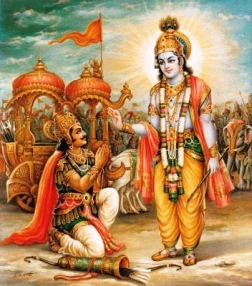
On the other side, both Lord Kṛṣṇa and Arjuna, stationed on a great chariot drawn by white horses, sounded their transcendental conchshells.

PURPORT

In contrast with the conchshell blown by Bhīṣmadeva, the conchshells in the hands of Kṛṣṇa and Arjuna are described as transcendental. The sounding of the transcendental conchshells indicated that there was no hope of victory for the other side because Kṛṣṇa was on the side of the Pāṇḍavas. Jayas tu pāṇḍu-putrāṇāṁ yeṣāṁ pakṣe janārdanaḥ. Victory is always with persons like the sons of Pāṇḍu because Lord Kṛṣṇa is associated with them. And whenever and wherever the Lord is present, the goddess of fortune is also there because the goddess of fortune never lives alone without her husband. Therefore, victory and fortune were awaiting Arjuna, as indicated by the transcendental sound produced by the conchshell of Viṣṇu, or Lord Kṛṣṇa. Besides that, the chariot on which both the friends were seated was donated by Agni (the fire-god) to Arjuna, and this indicated that this chariot was capable of conquering all sides, wherever it was drawn over the three worlds.
“By sound vibration one becomes liberated.”

Excerpt from The Science of Self-Realization
by A.C. Bhaktivedanta Swami Prabhupada
Letter to J.F. Staal Professor of Philosophy and of South Asian Languages
January 30, 1970

“By sound vibration one becomes liberated.” By devotional service, by understanding well the Supreme Personality of Godhead, one can go to His abode and never come back again to this material condition. How is it possible? The answer is, simply by chanting His name constantly.

This is accepted by the exemplary disciple, Arjuna, who has perfectly learned the conclusion of spiritual science from the yogeśvara, the master of mystic knowledge, Kṛṣṇa. Recognizing Kṛṣṇa to be the Supreme Brahman, Arjuna addresses Him, sthāne hṛṣīkeśa…: “The world becomes joyful hearing Your name, and thus do all become attached to You.” (Bg. 11.36) The process of chanting is herein authorized as the direct means of contacting the Supreme Absolute Truth, the Personality of Godhead. Simply by chanting the holy name Kṛṣṇa, the soul is attracted by the Supreme Person, Kṛṣṇa, to go home, back to Godhead.

In the Nārada-pañcarātra it is stated that all the Vedic rituals, mantras, and understanding are compressed into the eight words Hare Kṛṣṇa, Hare Kṛṣṇa, Kṛṣṇa Kṛṣṇa, Hare Hare. Similarly, in the Kali-santaraṇa Upaniṣad it is stated that these sixteen words, Hare Kṛṣṇa, Hare Kṛṣṇa, Kṛṣṇa Kṛṣṇa, Hare Hare/ Hare Rāma, Hare Rāma, Rāma Rāma, Hare Hare, are especially meant for counteracting the degrading and contaminating influence of this materialistic age of Kali.

Bhakti; Summit of Yoga


Bhakti Notes:
by Vaisesika Dasa

FAQ: Why does it seem that Srila Prabhupada’s translations, word for word renditions and purports all seem to point only to Bhakti?

Answer: Srila Prabhupada’s purpose in presenting the Bhagavad gita As It Is, was to bring out Krsna’s ultimate conclusion of the Gita. This is the meaning of “As It Is.”

Some have speculated that in the Gita Krsna presents many paths and that any one of them is as good as another. However, Krsna clearly presents Bhakti as yoga’s summit even when He explains other processes like Karma Yoga and Dhyana Yoga to Arjuna.

In fact, all such processes are meant to bring one to surrender to the Lord in loving devotional service. The more one advances in devotional service, the more one is considered by Krsna to be advanced in yoga.

At the end of the sixth chapter in which Krsna has explained the arduous process of astanga yoga and meditation, He says:

Yoginam api sarvesam mad-gatenantar-atmana
sraddhavan bhajate yo mam sa me yutatamo matah

“And of all yogis, the one with great faith who always abides in Me, thinks of Me within himself, and renders transcendental loving service to Me- he is the most intimately united with Me in yoga and is the highest of all. That is my opinion.” Bg. 6.47

More

Krishna is the only Liberation

SRIMAD BHAGAVATAM (1.7.22) “Arjuna said: O my Lord Sri Krishna, You are the almighty Personality of Godhead. There is no limit to Your different energies. Therefore only You are competent to instill fearlessness in the hearts of Your devotees. Everyone in the flames of material miseries can find the path of liberation in You only.”

More

Next Newer Entries

108 Imporant Slokas from the 1972 Bhagavad-gita As It Is

Click on image to go to Post

Click on image to go to Post

The Hare Krishna Cookbook

Songs of the Vaisnava Acaryas

Bhagavad-gita As It Is 1972 Edition “Online”

click on image

click on image to visit site

Srimad Bhagavatam Online

click on image

Raja-Vidya the King of Knowledge

click on image

click on image

Blog Stats

  • 4,565,143 hits

Enter your email address to subscribe to this blog and receive notifications of new posts by email.

Join 3,909 other subscribers

Important Slokas from the Brahma-samhita

click on image

click on image

Slokas from the Sri Isopanisad

click on image

click on image

Prayers By Queen Kunti (Slokas)

click on image

Gajendra’s Prayers of Surrender (Slokas)

click on image

A Short Statement of the Philosophy of Krishna Consciousness

click on image

click on image

July 9th Letter

click on image

click on image

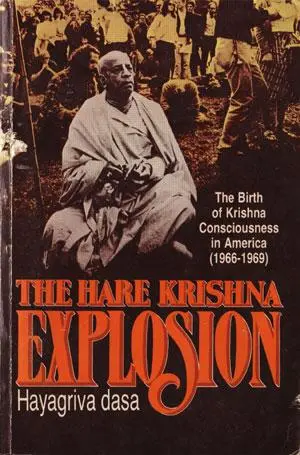
The Hare Krishna Explosion

Reference Material/Study Guide

click on image

click on image

  • LINKS