17 Oct 2011
by The Hare Krishna Movement
in Book Changes, Books by Srila Prabhupada, Free Downloads, Free eBooks, Prahlada-Nrsimha das, Teachings of Lord Chaitanya
Tags: 1968 Edition, A.C. Bhaktivedanta Swami Prabhupada, Ahaituki Bhakti dd, Original 1968 Edition of Teachings of Lord Chaitanya, Pralada-Nrsimha, Teachings of Lord Chaitanya

1968 Edition of "Teachings of Lord Chaitanya"
The following is a letter sent to me earlier today by Pralada-Nrsimha Prabhu, informing me and our readers that the Originial 1968 Edition of “Teachings of Lord Chaitanya” are now available for the first time ever online, as they have been digitized. They are available for free, thanks to a lot of hard work by Ahaituki Bhakti dd who simply asks for your well wishes and blessings in return. This original authorized edition of The Teachings Of Lord Caitanya is being presented free for everyones benefit.
Originial 1968 Edition of “Teachings of Lord Chaitanya”
Letter by Pralada-Nrsimha Prabhu
Please accept my humble obeisances, all glories to Srila Prabhupada!
I am happy to offer (attached below) a digitized (FREE) file of the original 1968 TLC!
As far as I know this is the first time it has been available in any digitized format to any one, ever!
More
21 Sep 2011
by The Hare Krishna Movement
in Krsna is the Source of All Incarnations
Tags: A.C. Bhaktivedanta Swami Prabhupada, Asuri Brahmana, Devahuti, fifth incarnation of Visnu, Lord Kapila, metaphysics, Sankhya philosophy, Srimad Bhagavatam

The instructions of Lord Kapila to His mother Devahūti are fully described in the Third Canto (Chapters 25-32) of the Śrīmad-Bhāgavatam, and anyone who follows the instructions can achieve the same liberation obtained by Devahūti. The Lord spoke Bhagavad-gītā, and thereby Arjuna achieved self-realization, and even today anyone who follows the path of Arjuna can also attain the same benefit as Śrī Arjuna. The scriptures are meant for this purpose. Foolish, unintelligent persons make their own interpretations by imagination and thus mislead their followers, causing them to remain in the dungeon of material existence. However, simply by following the instructions imparted by Lord Kṛṣṇa or Lord Kapila, one can obtain the highest benefit, even today.
Srimad-Bhagavatam
By His Divine Grace A.C. Bhaktivedanta Swami Prabhupada
Canto 1, Text 10
“Creation”
Krsna Is the Source of All Incarnations
The fifth incarnation, named Lord Kapila, is foremost among perfected beings. He gave an exposition of the creative elements and metaphysics to Āsuri Brāhmaṇa, for in course of time this knowledge had been lost.
Purport
The sum total of the creative elements is twenty-four in all. Each and every one of them is explicitly explained in the system of Sāṅkhya philosophy. Sāṅkhya philosophy is generally called metaphysics by the European scholars. The etymological meaning of sāṅkhya is “that which explains very lucidly by analysis of the material elements.” This was done for the first time by Lord Kapila, who is said herein to be the fifth in the line of incarnations.
More
14 Sep 2011
by The Hare Krishna Movement
in A.C. Bhaktivedanta Swami Prabhupada, Back to Godhead, Sankirtan, The Hare Krishna Movement
Tags: A.C. Bhaktivedanta Swami Prabhupada, Back to Godhead Magazine, Great Apostle of love of God, Lord Caitanya Mahaprabhu, Lord Sri Krishna Caitanya, Origin of the Hare Krishna Movement, sankirtan movement
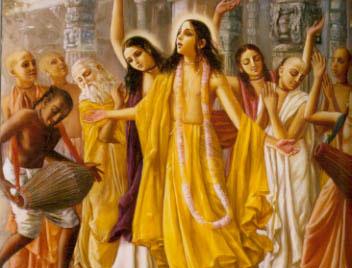
Lord Sri Krishna Caitanya's Sankirtan Movement
Origin of the Hare Krishna Movement
By His Divine Grace A.C. Bhaktivedanta Swami Prabhupada
Back to Godhead Magazine Volume 01, Number 20, 1968
Lord Sri Krishna Chaitanya Mahaprabhu, the Great Apostle of love of God and the Father of the Sankirtan Movement, advented Himself in the City of Nabadwipa in Bengal, India. This was in February, 1486, by Christian reckoning.
By the will of the Lord there was a lunar eclipse on that evening. It is the custom of the Hindu public to bathe in the Ganges of any other sacred river during the hours of eclispe, and to chant the Vedic mantras for purification. When Lord Chaitanya was born during the eclipse, then, the whole India was roaring with the holy sound of Hare Krishna, Hare Krishna, Krishna Krishna, Hare Hare/ Hare Rama, Hare Rama, Rama Rama, Hare Hare.
These sixteen Names of the Lord are mentioned in many Puranas and Upanishads, and they are described as “Tarak Brahman,” the Names for this age. It is stated in the “Shashtras,” the accepted Scriptures, that offenseless chanting of the Holy Names of the Lord can deliver a fallen soul from material bondage. There inumerable Names for the Lord both in India and elsewhere, and all of them are equally good because all of them indicate the Supreme Personality of Godhead. But because these sixteen Names are especially recommended for this Age, called Kali Yuga, it is better for people to take the path of the great Acharyas, the saintly teachers who attained success by practice of this system.
More
09 Sep 2011
by The Hare Krishna Movement
in Bhaktivinoda Thakura
Tags: A.C. Bhaktivedanta Swami Prabhupada, Bhaktisiddhanta Saraswati, bhaktivinoda, Lord Nityananda, Ray of Visnu, Sri Caitanya Mahaprabhu, Srila Bhaktivinoda Thakur

Today is the appearance day of Srila Bhaktivinoda Thakura
Brief Biography of Srila Bhaktivinoda Thakura
Srila Bhaktivinoda Thakura, then known as Kedarnatha Datta was born in 1838, in Birangara (Bengal). The youngest of seven sons, his father Raja Krisananda Datta was a great devotee of Lord Nityananda. The family lived in fairly wealthy circumstances, until Kedarnatha’s father passed away in 1849, when they were reduced to poverty. In 1850, Kedarnatha’s mother arranged a marriage with the five-year-old daughter of Madhusudana Mitra Mahasaya; a resident of Rana Ghata.
More
05 Sep 2011
by The Hare Krishna Movement
in Devotee's, Mukunda das Goswami, Srila Prabhupada
Tags: A.C. Bhaktivedanta Swami Prabhupada, Hare Krishna, Indian Swami, Mukunda das, servant of God, Srila Prabhupada, The Science of Self Realization
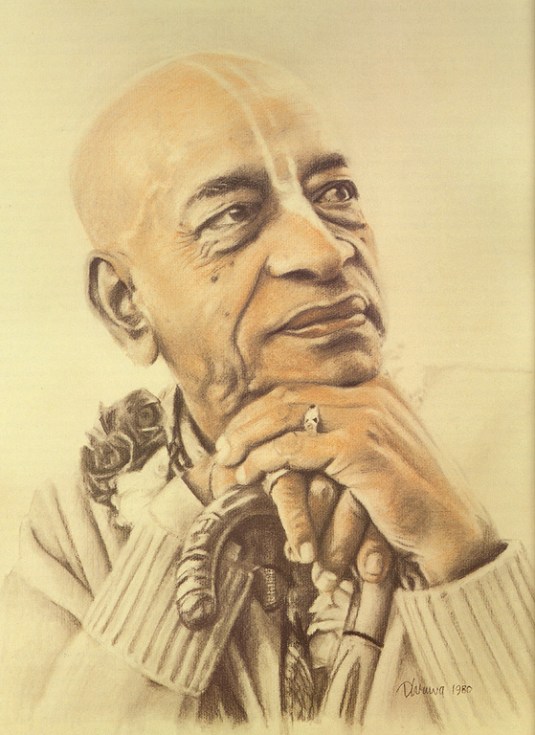
The Science of Self Realization
Foreword By Mukunda Das
From the very start, I knew that His Divine Grace A. C. Bhaktivedanta Swami Prabhupāda was the most extraordinary person I had ever met. The first meeting occurred in the summer of 1966, in New York City. A friend had invited me to hear a lecture by “an old Indian svāmī” on lower Manhattan’s Bowery. Overwhelmed with curiosity about a svāmī lecturing on skid row, I went there and felt my way up a pitch-black staircase. A bell-like, rhythmic sound got louder and clearer as I climbed higher. Finally I reached the fourth floor and opened the door, and there he was.
About fifty feet away from where I stood, at the other end of a long, dark room, he sat on a small dais, his face and saffron robes radiant under a small light. He was elderly, perhaps sixty or so, I thought, and he sat cross-legged in an erect, stately posture. His head was shaven, and his powerful face and reddish horn-rimmed glasses gave him the look of a monk who had spent most of his life absorbed in study. His eyes were closed, and he softly chanted a simple Sanskrit prayer while playing a hand drum. The small audience joined in at intervals, in call-and-response fashion. A few played hand cymbals, which accounted for the bell-like sounds I’d heard. Fascinated, I sat down quietly at the back, tried to participate in the chanting, and waited.
More
07 Jul 2011
by The Hare Krishna Movement
in Bhagavad-gita, Temples
Tags: A.C. Bhaktivedanta Swami Prabhupada, as it is, Bg 10.41, bhagavad-gita, Krsna's opulence, opulence, spark of My splendor, Sree Padmanabha Swamy temple, Temple, Thiruvananthapuram, treasure
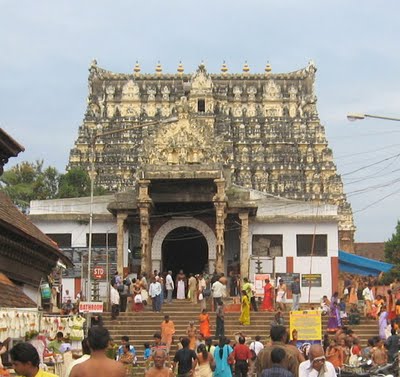
The Opulence of the Absolute
Know that all beautiful, glorious, and mighty creations spring from but a spark of My splendor.
PURPORT
Any glorious or beautiful existence should be understood to be but a fragmental manifestation of Kṛṣṇa’s opulence, whether it be in the spiritual or material world. Anything extraordinarily opulent should be considered to represent Kṛṣṇa’s opulence.(Bhagavad-gita As It Is 10.41)
Temple of boom in Thiruvananthapuram: Rs 1 lakh crore and counting
Ananthakrishnan G, TNN Jul 4, 2011, 01.27am IST
THIRUVANANTHAPURAM: Call it the mother of all treasure hunts. The stock-taking by a panel of experts at the Sree Padmanabha Swamy temple has catapulted the shrine located in Thiruvananthapuram to the country’s richest, with reports claiming that the value of recoveries may have touched close to Rs 1 lakh crore, more than Kerala public debt of Rs 70,969 crore.
With one more “secret” vault yet to be opened, the figure in all likelihood will go up further. But sources said the figures could only be speculation as it wasn’t possible to determine the antique value of the precious gems and jewellery. “These are antique pieces and it’s not possible to determine their prices,” said historian and former director of Indian Council of Historical Research M G S Narayanan. In other words, the worth of the treasure could be intimidatingly higher.
More
07 Jul 2011
by The Hare Krishna Movement
in Diksha, Iskcon Bangalore, Siksa
Tags: A.C. Bhaktivedanta Swami Prabhupada, Bangalore Society, Founder Acharya, ISKCON Bangalore, ISKCON Mumbi, Madhu Pandit, patrons, ritviks

Letter from President, ISKCON Bangalore Society
Dear Patrons,
This communication is aimed at bringing into focus the core issue behind the current dispute between ISKCON Bangalore and ISKCON Mumbai. As a patron of ISKCON Bangalore Society, we believe you should be informed about the factual position of both disputing parties and be reassured about the safe guard of your interest in your relationship with ISKCON Bangalore.
From the time His Divine Grace A.C.Bhaktivedanta Swami Prabhupada, reverentially addressed as Srila Prabhupada, founded ISKCON in New York in 1966, ISKCON grew into a large, transnational organization spanning many countries, having 108 centers and more than 10,000 members, in a matter of 10 years. This was due to the immense spiritual stature and vision of our Founder Acharya, Srila Prabhupada.
While the growth of the organization was impressive, in 1977, just prior to Srila Prabhupada’s leaving this world, it was still a young organization and most of the members and devotees, mainly westerners, had not developed the required spiritual stature, knowledge, realization, immense purity
and gravity that is required to occupy the post of his spiritual successor, as an “Acharya”.
Keeping this in mind, Srila Prabhupada appointed 11 disciples to act as Representatives of Acharya (and not as Acharyas) or ritviks. He issued an institutional directive that these ritviks would also officiate during the initiation ceremony of devotees who would join the movement. It was amply
clear that these individuals would be his representatives only, and would not replace him as the Spiritual Master or Acharya of ISKCON. In other words, Srila Prabhupada was to remain, for all time, the Founder and only Acharya or Diksha guru of ISKCON.
More
07 Jun 2011
by The Hare Krishna Movement
in Sri Caitanya-Caritamrta
Tags: A.C. Bhaktivedanta Swami Prabhupada, envious, jealous people in the dress of Vaisnavas, Krsna consciousness movement, Rupa Goswami, Sanatana Goswami, Sri Caitanya-caritamrta, Vaisnavas

Sri Caitanya-caritamrta – 1975 Edition
By His Divine Grace A. C. Bhaktivedanta Swami Prabhupada
Madhya 1: The Later Pastimes of Lord Sri Caitanya Mahaprabhu
The spiritual master initiates the disciple to deliver him, and if the disciple executes the order of the spiritual master and does not offend other Vaiṣṇavas, his path is clear.
“There are many jealous people in the dress of Vaisnavas in this Krsna consciousness movement, and they should be completely neglected. There is no need to serve a jealous person who is in the dress of a Vaisnava.”
One should neglect an envious person. A preacher’s duty is to love the Supreme Personality of Godhead, make friendships with Vaiṣṇavas, show mercy to the innocent and reject or neglect those who are envious or jealous.
TEXT 218
dui jane prabhura kṛpā dekhi’ bhakta-gaṇe
‘hari’ ‘hari’ bale sabe ānandita-mane
SYNONYMS
dui jane—unto the two persons; prabhura—of the Lord; kṛpā—the mercy; dekhi’-seeing; bhakta-gaṇe—all the devotees; hari hari—the holy name of the Lord; bale—chant; sabe—all; ānandita—cheerful; mane—in the mind.
TRANSLATION
When all of the devotees saw the mercy of the Lord upon the two brothers, they were very much gladdened, and they began to chant the holy name of the Lord, “Hari! Hari!”
PURPORT
Śrīla Narottama dāsa Ṭhākura says, chāḍiyā vaiṣṇava sevā nistāra pāyeche kebā: unless one serves a Vaiṣṇava, he cannot be delivered. The spiritual master initiates the disciple to deliver him, and if the disciple executes the order of the spiritual master and does not offend other Vaiṣṇavas, his path is clear. Consequently Śrī Caitanya Mahāprabhu requested all the Vaiṣṇavas present to show mercy toward the two brothers, Rūpa and Sanātana, who had just been initiated by the Lord. When a Vaiṣṇava sees that another Vaiṣṇava is a recipient of the Lord’s mercy, he becomes very happy. Vaiṣṇavas are not envious. If a Vaiṣṇava, by the mercy of the Lord, is empowered by Him to distribute the Lord’s holy name all over the world, other Vaiṣṇavas become very joyful-that is, if they are truly Vaiṣṇavas. One who is envious of the success of a Vaiṣṇava is certainly not a Vaiṣṇava himself, but an ordinary mundane man. Envy and jealousy are manifested by mundane people, not by Vaiṣṇavas. Why should a Vaiṣṇava be envious of another Vaiṣṇava who is successful in spreading the holy name of the Lord? An actual Vaiṣṇava is very pleased to accept another Vaiṣṇava who is bestowing the Lord’s mercy. A mundane person in the dress of a Vaiṣṇava should not be respected but rejected. This is enjoined in the śāstra (upekṣā). The word upekṣā means neglect. One should neglect an envious person. A preacher’s duty is to love the Supreme Personality of Godhead, make friendships with Vaiṣṇavas, show mercy to the innocent and reject or neglect those who are envious or jealous. There are many jealous people in the dress of Vaiṣṇavas in this Kṛṣṇa consciousness movement, and they should be completely neglected. There is no need to serve a jealous person who is in the dress of a Vaiṣṇava. When Narottama dāsa Ṭhākura says chāḍiyā vaiṣṇava sevā nistāra payeche kebā, he is indicating an actual Vaiṣṇava, not an envious or jealous person in the dress of a Vaiṣṇava.
20 May 2011
by The Hare Krishna Movement
in A.C. Bhaktivedanta Swami Prabhupada, Bhagavad-gita, Divine and Demoniac Natures
Tags: A.C. Bhaktivedanta Swami Prabhupada, as it is, Bg chapter 16, bhagavad-gita, Demoniac, Divine, nature, qualities
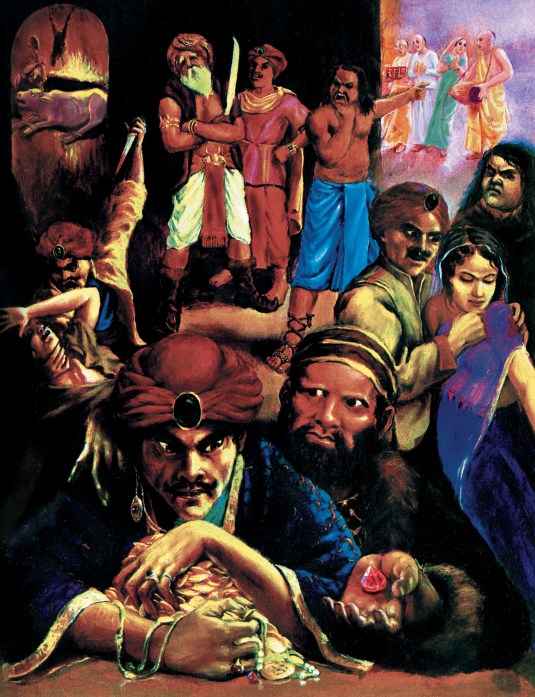
The Divine and Demoniac Natures
We are in the middle of a pandemic that is killing thousands of people worldwide.
Here in America we have a president that instead of acting in a sympathetic, compassionate way towards the sufferings of others, is instead criticizing and blaming others. This is not a good quality for a leader who should be taking responsibility for the safety and welfare of his citizens. All his self glorification, and his attack on others, in this time of turmoil, I find very disturbing and reminiscent of the description given in the 16th chapter of the Bhagavad-gita entitled “The Divine and Demon Natures”
Arrogance, pride, anger, conceit, harshness and ignorance—these qualities belong to those of demonic nature… (Bg. 4.16)
Those who are demoniac do not know what is to be done and what is not to be done. Neither cleanliness nor proper behavior nor truth is found in them. (Bg. 7.16)
The demoniac person thinks: “So much wealth do I have today, and I will gain more according to my schemes. So much is mine now, and it will increase in the future, more and more. He is my enemy, and I have killed him; and my other enemy will also be killed. I am the lord of everything, I am the enjoyer, I am perfect, powerful and happy. I am the richest man, surrounded by aristocratic relatives. There is none so powerful and happy as I am. I shall perform sacrifices, I shall give some charity, and thus I shall rejoice.” In this way, such persons are deluded by ignorance. (Bg. 13-15.16)
Full Chapter Texts and Purports More
24 Apr 2011
by The Hare Krishna Movement
in Devotee's, Diksha, Guru & Disciple, Locanananda das, Siksa
Tags: A.C. Bhaktivedanta Swami Prabhupada, Final Order, GBC, Godbrothers, gurus, Initiation, Iskcon, Locanananda das, officiating acharyas, ritvik, Srila Prabhupadas instructions
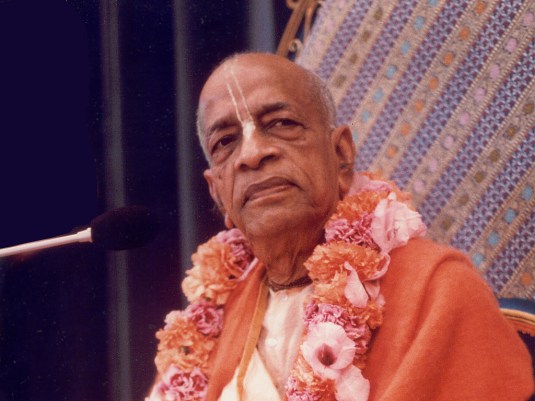
The Real Final Order
10/25/1998 – 2410
Editorial (VNN) – by Sriman Locanananda Prabhu
Submitted on the disappearance day of His Divine Grace A.C. Bhaktivedanta Swami Prabhupada
During what Srila Prabhupada thought might be his final days, he summoned his GBC representatives from all over the world to come to his bedside in May of 1977. He was about to pronounce his final instruction concerning how the movement should be expanded after he was no longer physically present to oversee things. When he was specifically asked how initiations would be performed in the future, he replied that he would recommend some of his GBC men to act as officiating acharyas in his absence. This was a momentous pronouncement. He was going to create the post of officiating acharya by naming some of his disciples to initiate on his behalf. They would actually be gurus, but would act as representatives of the acharya in initiating members into Srila Prabhupada’s movement after His Divine Grace had left this world. Although everyone present said that this instruction was understood, in the twenty-one years since this revelation, not a single ISKCON guru has called himself an “officiating acharya”. This has produced a contrary result.
To resolve the conflict and ongoing debate between the proponents of “ritvik” initiation and ISKCON’s official interpretation of Srila Prabhupada’s instructions, we must find a common denominator upon which both parties can agree. That one camp is ready to excommunicate or overthrow the other is causing a massive headache in the minds of peaceful devotees everywhere. With the greatest urgency, the fracture in our movement must be healed before it becomes a permanent schism. To avoid causing further embarrassment to our spiritual master, and to protect innocent devotees and well-wishers of the Krishna consciousness movement from the devastating effect of our fratricidal follies, all followers of Srila Prabhupada should stop their sabre rattling and calmly consider how to resolve their differences.
More
19 Apr 2011
by The Hare Krishna Movement
in Diksha, Guru & Disciple, Hansadutta das, Shiva, Srila Prabhupada His Movement & You
Tags: A.C. Bhaktivedanta Swami Prabhupada, disciples of Srila Prabhupada, eleven representatives of acharya, hansadutta das, His Divine Grace, initiated disciples book, Letter to Hansadutta, Letter to Kirtananda, ritvik representatives of the acharya, VNN

Role Of The Rittvik Representatives Of The Acharya
By Sriman Hansadutta Prabhu — January 7, 1999 VNN2806
“You are a suitable person and you can give initiation to those that are ready for it. I have selected you among eleven men as ‘Rittvik representative of the Acharya, to give initiations, both first and second initiation, on my behalf.’ A newsletter is being sent to all temple presidents and GBC in this regard, listing the eleven representatives selected by His Divine Grace. Those who are initiated are the disciples of Srila Prabhupada, and anyone whom you deem fit and initiate in this way, you should send their names to be included in Srila Prabhupada’s ‘Initiated disciples’ book.”
EDITORIAL, Jan 7 (VNN) — The discussions that took place on 28th May 1977 between Srila Prabhupada and some GBC regarding initiations in the future were not known to me till years after his disappearance. Srila Prabhupada would say many things on many subjects, but unless a particular policy was written in letter form, or some other legal document such discussions on different matters were not accepted as final. Prabhupada often said you can say anything, but do not put it in writing; writing makes it legal.
More
28 Mar 2011
by The Hare Krishna Movement
in Krishna, Teachings of Pralada Maharaja
Tags: A.C. Bhaktivedanta Swami Prabhupada, all-pervading, all-pervasiveness of the Supreme Lord, God is Everywhere, illusion, material nature, maya, Prahlada Maharaja

Transcendental Teachings of Prahlada Maharaja
By His Divine Grace A.C. Bhaktivedanta Swami Prabhupada
Chapter 5
Realizing that God Is Everywhere
Mahārāja Prahlāda informed his classmates about the all-pervasiveness of the Supreme Lord. But although the Supreme Lord is all-pervasive by means of His expansions and His energies, that does not mean He has lost His personality. That is significant. Although He is all-pervading, still He is a person. According to our material perception, if something is all-pervading, then it has no personality, no localized aspect. But God is not like that. For example, the sunshine is all-pervading, but the sun also has a localized aspect, the sun planet, and you can see it. Not only is there a sun planet, but within the sun planet is a sun-god, whose name is Vivasvān. We get this information from Vedic literature. There is no way to understand what is taking place on other planets except to hear from authorized sources. In the modern civilization we accept scientists as authorities in these matters. We hear a scientist say, “We have seen the moon; it is such and such,” and we believe it. We have not gone with the scientist to see the moon, but we believe him.
More
05 Mar 2011
by The Hare Krishna Movement
in Krishna
Tags: A.C. Bhaktivedanta Swami Prabhupada, forest of Vrndavana, karnikara flowers, Krishna, Krsna The Supreme Personality of Godhead, samadhi, topmost yogi, Vaijayanti garland
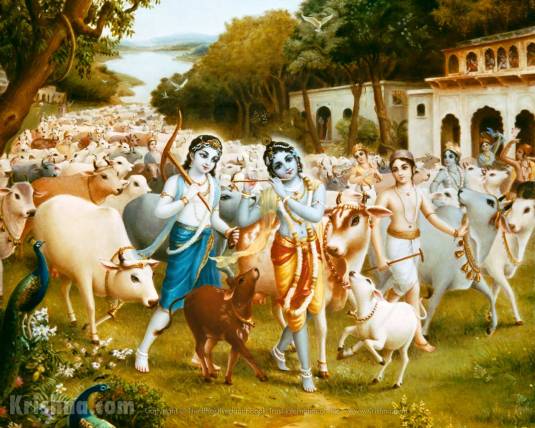
KRSNA The Supreme Personality of Godhead
by His Divine Grace A.C. Bhaktivedanta Swami Prabhupada
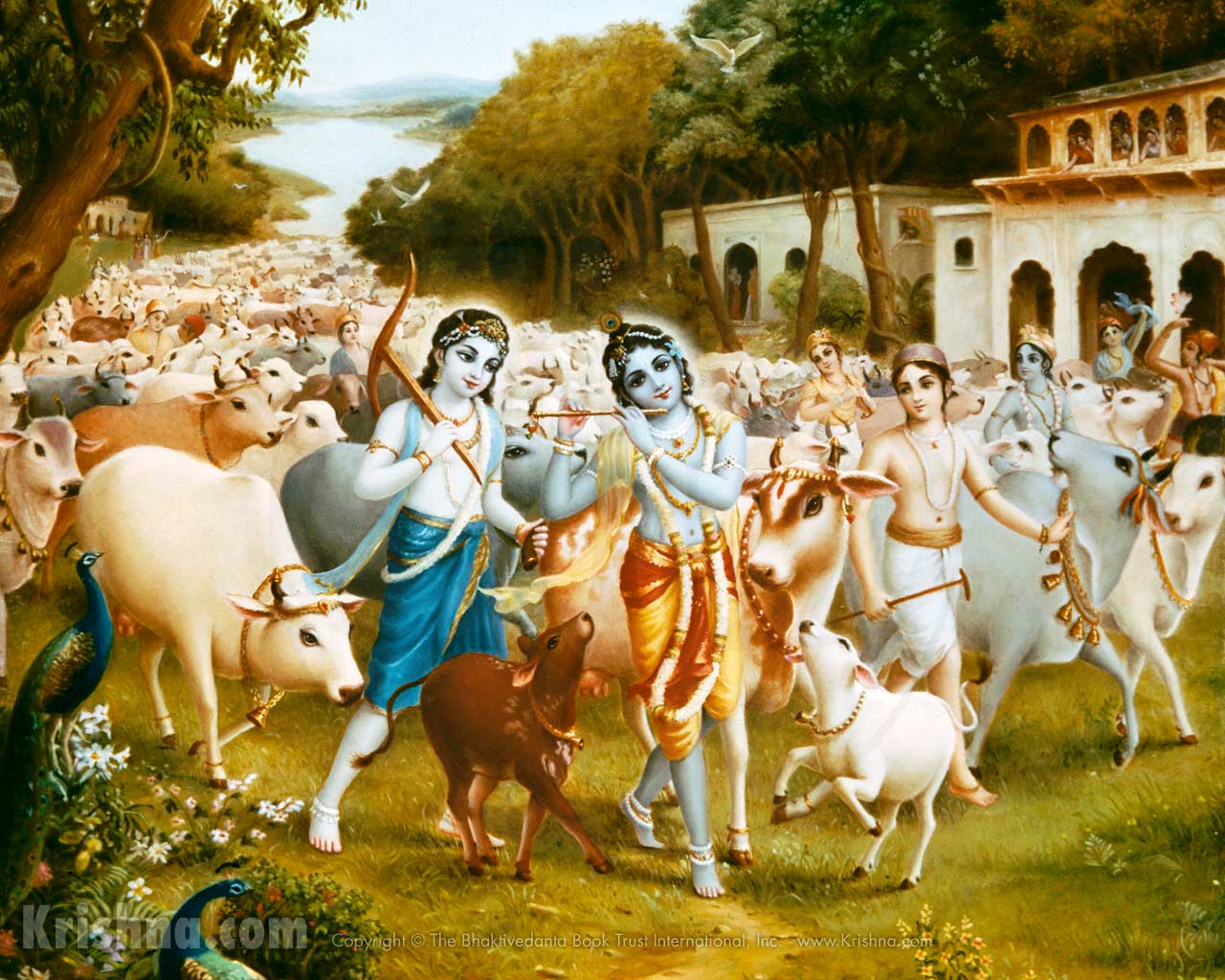
“Wearing a peacocl-feather ornament upon His head, blue karnikara flowers on His ears, a yellow garment as brilliant as gold, and the Vaijayanti garland. Lord Krishna exhibited His transcendental form as the greatest of dancers as He entered the forest of Vrndavana, beautifying it with the marks of footprints. He filled the holes of His flute with the nectar of His lips, and the cowherd boys sang his glories”
“The highest perfection of the eyes is to see Krishna & Balarama entering the forest and playing Their flutes and tending the cows with their friends”
Persons who are constantly engaged in the transcendental meditation of seeing Krishna, internally and externally, by thinking of Him playing the flute and entering the Vrindavan forest, have really attained the perfection of samadhi. It is also confirmed in the Bhagavad-gita that anyone who is always absorbed in the thought of Krishna is the topmost yogi.
17 Jan 2011
by The Hare Krishna Movement
in Hayagriva das, The Hare Krishna Explosion
Tags: A.C. Bhaktivedanta Swami Prabhupada, Calcutta, guru, Hare Krishna, hayagriva das, New York 1966., spiritual master, Srila Prabhupada, the hare krishna explosion, Visitor from Calcutta

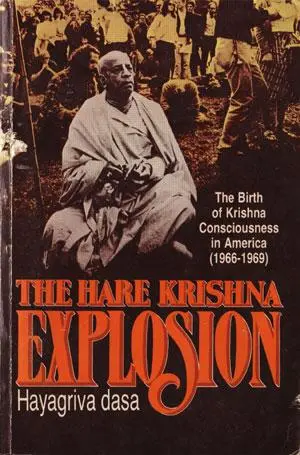
The Hare Krishna Explosion
by Hayagriva dasa
Part I: New York, 1966
Chapter 1
Visitor From Calcutta
I first see him just after crossing the Bowery at Houston Street. As he passes before the iron-mesh fence of a playground, I distinctly glimpse the aura of saintliness. I watch him through the rushing traffic and stumbling derelicts.
He strolls almost jauntily down the sidewalk. He is an old man whom age has never touched. Aloof from the people and bustle about him, he walks proudly, independently, his hand in a cloth beadbag. He wears the saffron robes of a sannyasi, and on his feet are quaint, pointed white shoes.
Only seven months ago, I had seen many saffron-robed monks and holymen walking the dirt roads of Hardwar and Rishikesh, and stopping beside the Ganges to bathe. For me, that had been a futile journey to the mystic East in search of the all-knowing guru.
But now—what’s this?
I look again at the pointed white shoes. Did this man follow me all the way from North India? Or did he just suddenly descend from the clouds onto Manhattan sidewalks? I decide I must speak to him.
More
Next Newer Entries











 The Hare Krishna Movement